Early career | Entered Chang Yuchun's command and served as Army Pacification Officer; repeatedly distinguished himself in battle.
1393 CE
General
Lan Yu
蓝玉
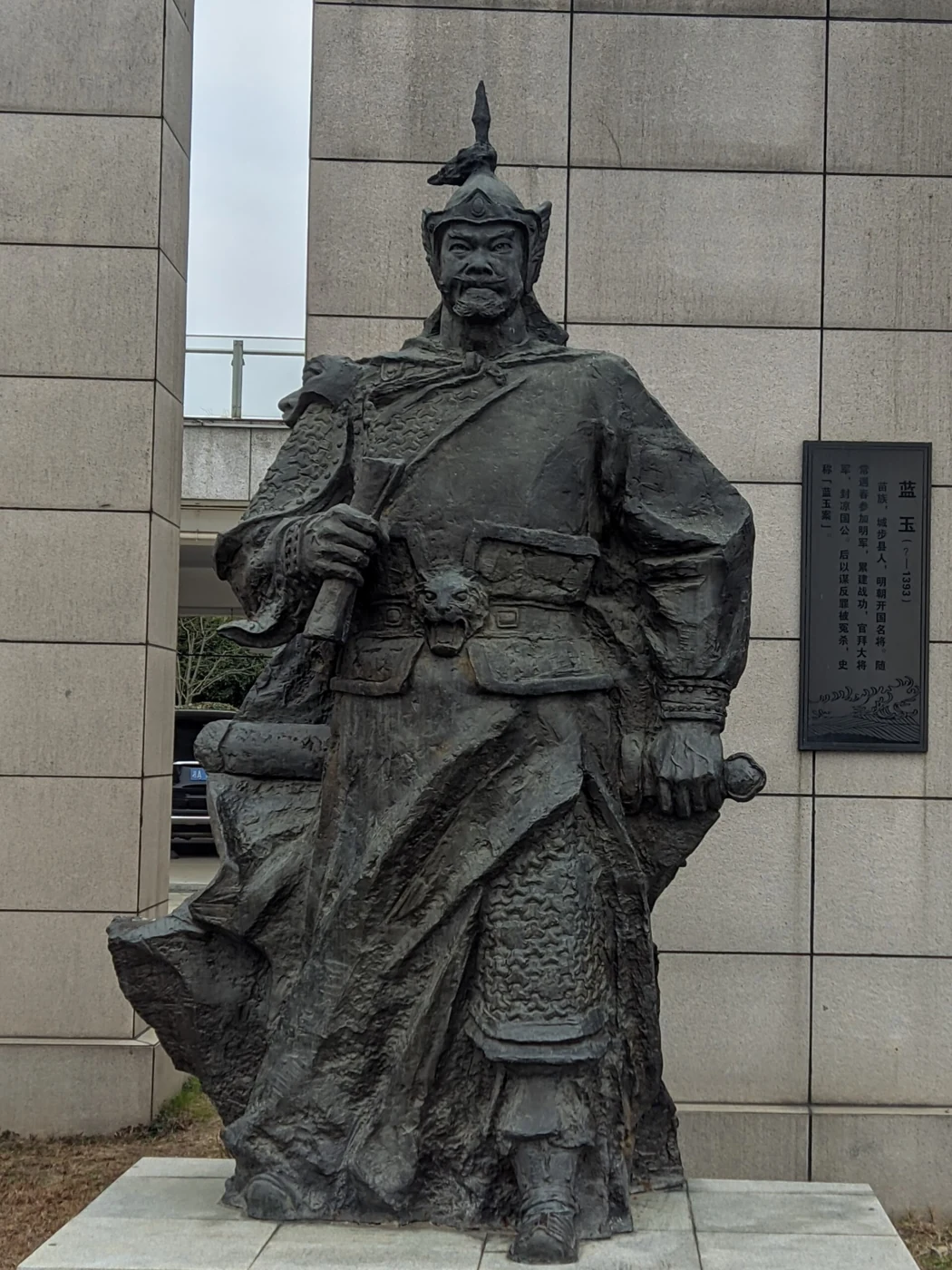
Lan Yu (unknown–1393), also known as Shengyuan, was a native of Dingyuan County, Fengyang Prefecture, in present-day Anhui, and a founding general of the Ming dynasty. He rose to General-in-Chief and Duke of Liang. He was the younger brother of the wife of Chang Yuchun, Prince of Kaiping, followed Chang Yuchun in his early career, and later became one of the most important commanders under Zhu Yuanzhang. Lan Yu's greatest…
1393 CEMing Dynasty
PROFILE
Lan Yu (unknown–1393), also known as Shengyuan, was a native of Dingyuan County, Fengyang Prefecture, in present-day Anhui, and a founding general of the Ming dynasty. He rose to General-in-Chief and Duke of Liang. He was the younger brother of the wife of Chang Yuchun, Prince of Kaiping, followed Chang Yuchun in his early career, and later became one of the most important commanders under Zhu Yuanzhang. Lan Yu's greatest military achievement was his decisive victory over the remaining Northern Yuan forces at Buir Lake, present-day Lake Buir, which largely destroyed the Northern Yuan state apparatus. Zhu Yuanzhang compared him with Wei Qing of the Han and Li Jing of the Tang. Lan Yu, however, became arrogant because of his achievements and repeatedly violated regulations. In 1393, the twenty-sixth year of Hongwu, he was accused of treason by an officer of the Embroidered Uniform Guard, executed on Zhu Yuanzhang's orders, and implicated in a purge that killed about fifteen thousand people, producing the famous Case of Lan Yu.
- Other name
- Duke of Liang
- Period
- Ming
- Date of Birth
- Not recorded in historical sources
- Date of Death
- 1393
- Dynasty / polity
- Ming
- Identity
- General
- Ethnicity / people
- Miao
- Native place
- Dingyuan County, Fengyang Prefecture (in present-day Anhui)
- Place of birth
- Not recorded in historical sources
- Place of death
- Not recorded in historical sources
- Highest office
- See Biography and Major Activities
- Principal achievement
- Leading commander who crushed the Northern Yuan forces at Buir Lake; later became arrogant because of his achievements and was implicated in the Case of Lan Yu
LIFE TIMELINE
About thirty | Followed Fu Youde, General Who Conquers the West, on campaign in Sichuan and captured Jinli, present-day Chengdu.
About thirty-one | Followed General-in-Chief Xu Da on the northern steppe campaign; as a vanguard commander defeated Köke-Temür at Yema River and Tula River.
About thirty-three | Captured Xinghe, present-day Zhangbei in Hebei, and took fifty-nine prisoners including the Yuan noble Tielimichi.
About thirty-seven | Campaigned with Mu Ying against a rebellion in the western Tibetan regions.
About thirty-eight | Enfeoffed Marquis of Yongchang for military merit, granted a stipend of 2,500 shi and hereditary credentials.
About forty | Served as Left Deputy General Who Conquers the South and joined Fu Youde and Mu Ying in a 300,000-man campaign against Yunnan; captured the Yuan official Dalima at Qujing and helped pacify Yunnan.
About forty-two | Returned to court with Fu Youde; stipend increased by 500 shi, and his daughter was made consort of Zhu Chun, Prince of Shu.
About forty-six | Served as Left Deputy General for the Subjugation of the Enemy under General-in-Chief Feng Sheng in the northern campaign against Naghachu and captured Naghachu; after Feng Sheng was punished, Lan Yu replaced him in overall command.
About forty-seven | Led 150,000 troops north and crushed the main Northern Yuan force at Buir Lake, capturing members of the Northern Yuan ruling house, officials, and more than 77,000 men and women; enfeoffed Duke of Liang.
About forty-eight | Ordered to supervise construction of city defenses in Sichuan.
About forty-nine | Suppressed rebellions under the Shinan and Zhongjian Pacification Commissions and pacified groups in Duyun and Sanmao; stipend increased by 500 shi.
About fifty | Commanded troops from seven guards, including Lanzhou and Zhuanglang, in pursuit of fugitives; captured territory at Handong in the western regions and lured the rebel Yuelu Temür and his son into captivity.
About fifty-one | After returning from a western campaign, appointed Grand Tutor to the Heir Apparent; complained because he was unwilling to rank below the Dukes of Song and Ying.
About fifty-two | Accused of treason by Jiang Huan, an officer of the Embroidered Uniform Guard; imprisoned, executed for treason, and his family exterminated. About fifteen thousand people were killed in the resulting purge, known as the Case of Lan Yu.
BIOGRAPHY
Biography
Family Background and Early Years
Lan Yu was a native of Dingyuan County in Fengyang Prefecture. His elder sister Lady Lan married Chang Yuchun, one of Zhu Yuanzhang's leading generals, making Lan Yu Chang Yuchun's brother-in-law. The surviving sources cited in the Chinese entity preserve little information about Lan Yu's earliest years. They record that he entered Chang Yuchun's command at an early stage and served as Army Pacification Officer. Lan Yu was brave in battle, possessed both courage and tactical ability, and repeatedly charged at the front. Chang Yuchun therefore valued him highly and repeatedly praised his abilities before Zhu Yuanzhang, which laid the foundation for Lan's later advancement. Through military merit, Lan Yu rose from Army Pacification Officer to commander of a thousand, then Commanding Officer, and eventually Assistant Commissioner of the Grand Chief Military Commission.
Campaigns Across the Realm
In 1371, the fourth year of Hongwu, Lan Yu followed Fu Youde, General Who Conquers the West, on campaign in Sichuan and captured Jinli, present-day Chengdu. In 1372, the fifth year of Hongwu, during Zhu Yuanzhang's second northern expedition into the steppe, Lan served in the central army under General-in-Chief Xu Da as a vanguard commander. He led troops through Yanmen Pass, defeated Köke-Temür's mounted scouts at Yema River, present-day Kerulen River, and again defeated Köke-Temür's forces at Tula River, present-day Tuul River, forcing Köke-Temür to flee. In 1374, the seventh year of Hongwu, Lan captured Xinghe, present-day Zhangbei in Hebei, and took fifty-nine prisoners, including the Yuan noble Tielimichi. In 1378, the eleventh year of Hongwu, he joined Mu Ying in suppressing a rebellion in the western Tibetan regions.
In 1379, the twelfth year of Hongwu, Lan Yu was enfeoffed Marquis of Yongchang for repeated military achievements, with a stipend of 2,500 shi and hereditary credentials for the title. In 1381, the fourteenth year of Hongwu, he served as Left Deputy General Who Conquers the South under Fu Youde, with Mu Ying as another senior commander, in the 300,000-man campaign against Yunnan. Lan Yu and Mu Ying led the eastern route. According to the Chinese entity, they took Kunming without major fighting, and the Yuan official Guan Fubao surrendered outside the city. Lan then helped capture Dali and seized the Yuan official Dalima at Qujing; the Prince of Liang died while fleeing, and Yunnan was pacified. In the postwar assessment, Lan Yu received the highest merit rating, his stipend was increased by 500 shi, and his daughter was made consort of Zhu Chun, Prince of Shu.
Great Victory at Buir Lake
In 1387, the twentieth year of Hongwu, Lan Yu was appointed Left Deputy General for the Subjugation of the Enemy and followed General-in-Chief Feng Sheng on a northern expedition against the Yuan commander Naghachu. Lan led light cavalry through snow, killed the Yuan official Guolai, and captured his son Bulanxi. When the army reached Jinshan, in the area of present-day Shuangliao, Jilin, Naghachu feigned surrender. Lan Yu detected the deception and captured him, after which Naghachu's troops all surrendered. During the campaign Feng Sheng was punished, and Zhu Yuanzhang ordered Lan Yu to take overall command of military affairs, appointed him General-in-Chief, and stationed him at Jizhou, present-day Jizhou in Tianjin.
In 1388, the twenty-first year of Hongwu, Lan Yu led 150,000 troops north. The army departed from Daning and advanced to Qingzhou, where it learned that the Northern Yuan ruler Tögüs Temür was at Buir Lake, present-day Lake Buir. Lan Yu took a shortcut and marched through the night to Baiyanjing, forty li from the lake. When no enemy appeared, he considered withdrawing. Wang Bi, Marquis of Dingyuan, warned that after taking more than a hundred thousand troops deep into the steppe, returning without any result would leave them unable to answer to the emperor. Lan accepted Wang Bi's advice. He ordered the troops to shelter in pits and make no smoke, then advanced by night to the southern side of Buir Lake. The enemy camp remained more than eighty li to the northeast. Lan ordered Wang Bi to lead the vanguard cavalry quickly toward it. The Northern Yuan forces believed that the Ming army lacked sufficient water and pasture to penetrate so deeply and therefore had made few preparations. Strong winds raised clouds of dust so thick that visibility was poor even in daylight, concealing the Ming approach. Wang Bi suddenly reached the enemy camp. The Northern Yuan troops were shocked, hastily formed for battle, and were decisively defeated. The official Manzi and others were killed, and their followers surrendered. Only the ruler and Crown Prince Tian Baonu escaped with several dozen riders. Lan sent elite cavalry in pursuit but failed to catch them. The Ming army captured the ruler's second son Di Baonu, more than a hundred consorts and princesses, and later Duo'erzhi, Prince of Wu, Dalima, Prince of Dai, and more than three thousand officials of senior rank, together with more than 77,000 men and women. It also seized imperial seals, tallies and edicts, gold and silver seals, and more than 150,000 horses, camels, cattle, and sheep, and burned large quantities of armor, weapons, and stores. When the victory report reached the capital, Zhu Yuanzhang was delighted, issued an edict of praise and consolation, and compared Lan Yu with Wei Qing and Li Jing. Lan also captured the camp of Qarajang and took another sixty thousand people and livestock. On returning to court, he was promoted to Duke of Liang.
Arrogance After Military Success
After the deaths of Xu Da, Prince of Zhongshan, and Chang Yuchun, Prince of Kaiping, Lan Yu repeatedly commanded large armies and accumulated major victories. Zhu Yuanzhang treated him with special favor. Lan, however, became increasingly overbearing. He maintained many estate servants and adopted sons and used his power to act arbitrarily. He once seized civilian farmland in Dongchang. When a censor investigated, Lan became furious and drove the censor away. On returning from a northern expedition, Lan reached Xifeng Pass at night. When the gate officials failed to open the pass quickly enough, he allowed his soldiers to break through the gate, which angered Zhu Yuanzhang. He was also accused of having sexual relations with a consort of the Yuan ruler, after which she killed herself from shame; Zhu Yuanzhang sternly reprimanded him. The Chinese entity says that Zhu had originally intended to make Lan “Duke of Liang” using the character Liang, but because of these offenses changed the written title to “Duke of Liang” using the character Liang and ordered the offenses engraved on Lan's hereditary credentials. Lan nevertheless showed no repentance. At imperial banquets he used arrogant language, and within the army he personally controlled promotions and dismissals. Zhu Yuanzhang repeatedly rebuked him. After returning from a western campaign, Lan was appointed Grand Tutor to the Heir Apparent, but he resented ranking below Feng Sheng, Duke of Song, and Fu Youde, Duke of Ying, saying that surely he was capable of becoming Grand Preceptor. Thereafter Zhu Yuanzhang rejected many of his proposals, and Lan became increasingly discontented.
The Case of Lan Yu and His Death
In 1393, the twenty-sixth year of Hongwu, Jiang Huan, an officer of the Embroidered Uniform Guard, accused Lan Yu of treason. The accusation claimed that Lan had conspired with Cao Zhen, Marquis of Jingchuan; Zhang Yi, Marquis of Heshou; Zhu Shou, Marquis of Zhulu; Wang Bi, Marquis of Dingyuan; He Rong, Earl of Dongguan; Minister of Personnel Zhan Hui; Vice Minister of Revenue Fu Youwen; and others, planning to launch a rebellion when Zhu Yuanzhang performed the imperial plowing ceremony. Zhu Yuanzhang, intent on consolidating and strengthening central authority, had Lan Yu arrested and imprisoned for treason. His property was confiscated, his three kinship groups were exterminated, and the investigation spread through extensive chains of implication. From dukes, marquises, and earls down to civil and military officials, about fifteen thousand people were killed. To warn the court, Zhu Yuanzhang issued a personal proclamation throughout the empire and had the case records compiled as Nichen Lu. The purge became known as the Case of Lan Yu.
Major Activities
Military Contributions
Lan Yu was one of the leading military commanders of the early Ming. The Chinese entity summarizes his military ability in four main areas:
- Pacification of Yunnan: In 1381, the fourteenth year of Hongwu, Lan Yu served as Left Deputy General Who Conquers the South and joined Fu Youde and Mu Ying in a 300,000-man campaign against Yunnan. He captured the Yuan official Dalima at Qujing and helped pacify Dali, Heqing, Lijiang, and other areas, making an important contribution to bringing Yunnan under Ming control.
- Great victory at Buir Lake: In 1388, the twenty-first year of Hongwu, Lan led 150,000 troops north and crushed the main Northern Yuan army at Buir Lake, present-day Lake Buir. The Ming captured members of the Northern Yuan ruling house, officials, and more than 77,000 men and women, as well as over 150,000 horses, camels, cattle, and sheep. The Chinese entity states that the battle largely destroyed the Northern Yuan state apparatus and was a decisive Ming victory in the wars against Northern Yuan. Zhu Yuanzhang compared Lan to Wei Qing of the Han and Li Jing of the Tang.
- Capture of Naghachu: In 1387, the twentieth year of Hongwu, Lan followed Feng Sheng on the northern campaign against Naghachu, saw through Naghachu's feigned surrender, and captured him. Naghachu's entire army then surrendered, removing a major threat in the Liaodong region.
- Suppression of rebellions in the southwest: In 1390, the twenty-third year of Hongwu, Lan suppressed rebellions associated with the Shinan and Zhongjian Pacification Commissions and pacified groups at Duyun and Sanmao. In 1391, the twenty-fourth year of Hongwu, he lured the rebel Yuelu Temür and his son into captivity and sent them to the capital for execution.
Political Activities
Lan Yu's political activity was relatively limited and centered mainly on his military status. Through military merit he was enfeoffed Marquis of Yongchang and later Duke of Liang, and rose to General-in-Chief and Grand Tutor to the Heir Apparent. But he became arrogant because of his achievements, seized civilian land, allowed troops to break through a frontier gate, and was accused of forcing himself on a Yuan consort, repeatedly violating regulations and provoking Zhu Yuanzhang's strong displeasure. While Crown Prince Zhu Biao was alive, Lan reportedly warned him in secret that Zhu Di, Prince of Yan, harbored disloyal ambitions and advised Zhu Biao to guard against him. Zhu Biao did not act on the warning. The Chinese entity says that Zhu Di later learned of the episode, making it a possible background factor in the Case of Lan Yu.
Travels and Areas of Activity
Lan Yu's campaigns took him across many early-Ming theaters of war, from Sichuan to the northern steppe, from Yunnan to Liaodong, and from the northwest to the southwest. His principal areas of activity included present-day Sichuan, Inner Mongolia, Yunnan, Guizhou, Jilin, Gansu, and Qinghai.
Relations with Contemporaries
Lan Yu was related by marriage to Chang Yuchun and served under him early in his career. He repeatedly cooperated with Fu Youde, Mu Ying, Feng Sheng, Wang Bi, and other commanders. He was close to Crown Prince Zhu Biao and, according to the Chinese entity, warned Zhu Biao about Zhu Di's ambitions. This created a potential political conflict between Lan and Zhu Di, who later learned of the warning.
His titles and later career were as follows: in 1379 he was enfeoffed as Marquis of Yongchang with a revenue of 2,500 piculs and a hereditary patent; in 1383, on returning with the army, he received an additional 500 piculs and his daughter was made consort of Zhu Chun, Prince of Shu; in 1387 he served as deputy general of the campaign against the north under the general Feng Sheng, took Nahachu alive and, after Feng Sheng was disgraced, took over as general; in 1388, after the victory at Buyur Lake, he was enfeoffed as Duke of Liang; in 1390 he suppressed the southern rebellions of the Shinan and Zhongjian pacification offices and the caves of Duyun and Sannao, receiving 500 piculs more; in 1391 he led the guards of Lanzhou and Zhuanglang against fugitive raiders, taking territory among the western Tibetans and luring in the rebel general Yelü Timur and his son; in 1392, returning from the western campaign, he was made grand tutor to the crown prince and complained at being placed below the dukes of Song and Ying. His rise from military merit to ducal rank, and his arrogance in later years, form one strand in the relation between the founding ministers and imperial power in the later Hongwu period.
Personal Relations
- Chang Yuchun: brother-in-law; Prince of Kaiping; Lan Yu served under him early in his career.
- Lady Lan: elder sister and wife of Chang Yuchun.
- Lady Chang: niece and crown princess of Zhu Biao.
- Zhu Xiongying and Zhu Yuntong: grand-nephews through Lan's sister's family.
- Lady Lan: daughter and consort of Zhu Chun, Prince of Shu.
- Zhu Chun: son-in-law; eleventh son of the Hongwu Emperor and Prince of Shu.
- Chang Yuchun: early superior who promoted and recommended him.
- Fu Youde: colleague who campaigned with him in southern and western expeditions.
- Mu Ying: colleague in the Yunnan campaign.
- Feng Sheng: colleague during the northern campaign against Naghachu.
- Wang Bi: subordinate whose advice was crucial before the Battle of Buir Lake.
- Zhu Yuanzhang: ruler who both relied heavily on and became suspicious of Lan Yu, and ultimately ordered his execution.
- Zhu Biao: crown prince and relative by marriage, with whom Lan had a close relationship.
- Zhu Di, Prince of Yan: Lan warned Zhu Biao that Zhu Di might rebel.
- Jiang Huan: Embroidered Uniform Guard officer who accused Lan Yu of treason.
- Cao Zhen, Zhang Yi, Zhu Shou, Wang Bi, He Rong, Zhan Hui, and Fu Youwen: identified as Lan Yu's alleged accomplices and executed in the purge.
Historical Assessment
Ming Period / Contemporary
- The History of Ming describes Lan Yu as courageous and strategically gifted, possessing the talent of a great general, but also says that his ambition and arrogance overflowed and that his pride created the conditions for his downfall, presenting his fate in part as self-inflicted.
- After the victory at Buir Lake, Zhu Yuanzhang issued an edict praising Lan Yu and compared him with Wei Qing and Li Jing, showing the high regard in which he held Lan's military ability.
- Cai Dongfan wrote that Lan Yu and Feng Sheng made repeated contributions on campaign for the Ming. He praised Lan for accepting Wang Bi's advice at Buir Lake and noted that the remaining Yuan forces declined thereafter and the frontier remained relatively quiet for decades, but also criticized Lan for failing either to retire at the height of success or to preserve himself through humility, concluding that both Ming treatment and Lan's own conduct contributed to his death.
Early to Mid-Qing Period
- Gu Yingtai, in Mingshi Jishi Benmo, discussed the Case of Lan Yu as part of Zhu Yuanzhang's broad killing of meritorious officials and saw an element of eliminating useful servants after their work was done, while also noting that Lan and other commanders were arrogant and lawless and thereby contributed to their own disasters.
- Zha Jizuo, in Zuiwei Lu, recorded the Case of Lan Yu, recognized Lan's military ability, and criticized his arrogance and domineering conduct.
Late Qing and Republican Period
- Cai Dongfan's Romance of the History of Ming gives a detailed account of the Case of Lan Yu and attributes Lan's death both to Zhu Yuanzhang's suspicion and to Lan's own arrogance.
- Meng Sen, in 《Lectures on the History of Ming》, analyzes the Case of Lan Yu as a political purge designed by Zhu Yuanzhang to consolidate imperial power and eliminate meritorious commanders, with Lan Yu as one of its victims.
Modern Period
- Wu Han, in 《Biography of Zhu Yuanzhang》, analyzes the Case of Lan Yu as a measure by which Zhu Yuanzhang strengthened centralized authority and removed threats posed by the meritorious-official group, interpreting the case as a power struggle between imperial authority and founding commanders.
- Ray Huang, in 1587, A Year of No Significance, treats the Case of Lan Yu as an example in discussing the early Ming political system's movement toward concentrated imperial authority.
- The Chinese entity states that modern scholars generally regard Lan Yu as an outstanding early-Ming commander whose victory at Buir Lake was of decisive importance to stability along the Ming northern frontier, while also viewing his arrogant personality and Zhu Yuanzhang's suspicious governing style as jointly contributing to his tragic end.
FIGURES ASSOCIATED WITH THIS DYNASTY
Bibliography
- History of Ming, JuanYiBai San ShiEr·Lie ZhuanDiErShi
- Chronological Mirror of Ming History
- Meng Sen, Lectures on Ming History
- Cai Dongfan, Romance of the History of Ming