Birth in Dingyuan
Born into a respected family in Huaixi, demonstrating remarkable talent in Legalist studies and administrative history.
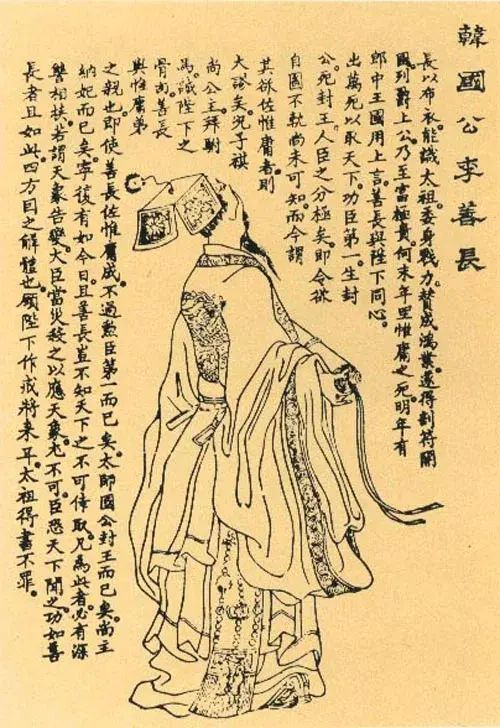
1314 CE–1390 CE
李善长
Li Shanchang (1314–1390 AD), courtesy name Baishi, was a native of Dingyuan, Haozhou (present-day Dingyuan County, Anhui Province). He was the paramount civil founder, administrative architect, and first Left Chancellor of the Central Secretariat of the Ming Dynasty. Ennobled as the Duke of Han and honored with the rank of Grand Preceptor, he was posthumously granted the name "Xiangmin" in the late Ming period. Gifted with…
Li Shanchang (1314–1390 AD), courtesy name Baishi, was a native of Dingyuan, Haozhou (present-day Dingyuan County, Anhui Province). He was the paramount civil founder, administrative architect, and first Left Chancellor of the Central Secretariat of the Ming Dynasty. Ennobled as the Duke of Han and honored with the rank of Grand Preceptor, he was posthumously granted the name "Xiangmin" in the late Ming period. Gifted with profound administrative acumen and well versed in classical Legalist jurisprudence and statecraft, Li joined Zhu Yuanzhang's camp in 1354 AD. He advised Zhu to emulate the magnanimous conduct and discerning personnel selection of Emperor Gaozu of Han to unite the realm. Throughout two decades of warfare across the Yangtze basin, Li remained at headquarters directing logistics, taxation, troop mobilization, and administrative justice, ensuring that front-line armies never lacked supplies and earning praise from Zhu Yuanzhang as "the Xiao He of our age." Following the founding of the Ming Dynasty in 1368 AD, Li served as Left Chancellor, overseeing the compilation of the Great Ming Code, the Imperial Regulations of the Ming, and early administrative statutes. Created Duke of Han with the highest stipend among civil ministers, Li later fell victim to imperial despotism and factional rivalry. In 1390 AD, implicated in the revived treason case of his protege Hu Weiyong, seventy-seven-year-old Li and over seventy members of his extended clan were executed. Li remains one of the most consequential yet tragically doomed statesmen in Ming imperial history.
Born into a respected family in Huaixi, demonstrating remarkable talent in Legalist studies and administrative history.
Greeted Zhu Yuanzhang's troops at Dingyuan, advising him to emulate Liu Bang to conquer the empire, appointed Chief Secretary.
Entrusted with the entire administrative and logistical government of Jiqing (Nanjing) while Zhu campaigned afar.
Supplied grain and weapons during the Battle of Lake Poyang without interruption, lauded by Zhu as a living Xiao He.
Elevated to Left Grand Chancellor of State upon Zhu Yuanzhang assuming the title of King of Wu.
Appointed Left Chancellor of the Central Secretariat upon Ming's founding; formulated the foundational statutes and court rituals.
Ennobled as Duke of Han and Grand Preceptor with the paramount stipend among civil ministers; bestowed two death-exempting iron certificates.
Permitted to retire due to ill health; his eldest son Li Qi married Zhu Yuanzhang's eldest daughter Princess Lin'an.
His protege Hu Weiyong was executed for treason, triggering widespread purges; Li was spared initial wrath due to seniority.
Accused of concealing prior knowledge of Hu's treason; executed alongside more than seventy family members at age seventy-seven.
Li Shanchang was born into a prosperous landholding household in Dingyuan County, Haozhou. From his youth, he demonstrated deep intellect and shrewd pragmatism, devoting himself to the study of Legalist statecraft, dynastic administrative precedents, and financial accounting. In 1354 AD, when Zhu Yuanzhang marched his nascent rebel force through Dingyuan, Li dressed in ceremonial scholarly attire and presented himself before the military encampment.
Zhu Yuanzhang received Li with great courtesy and questioned him privately: "With bandits rising across the four corners of the realm, when will peace be restored?" Li calmly answered: "At the end of the Qin Dynasty, Liu Bang rose from common status. He was magnanimous, knew how to employ talent, and refrained from indiscriminate slaughter, thus winning the empire in five short years. Today the Yuan administration is in ruins and the realm is crumbling. If you, my lord, emulate the broad vision and restraint of Emperor Gaozu, the empire can be pacified in short order!" Delighted by Li's strategic vision, Zhu Yuanzhang immediately retained him as Chief Secretary, inducting him into his innermost circle of strategic counselors.
Throughout the long struggle against regional warlords and the Mongol court, Li Shanchang rarely marched onto the frontline battlefield. Nevertheless, his contribution to the founding of the Ming Dynasty was indispensable. Following the conquest of Jiqing (modern Nanjing) in 1356 AD, Zhu Yuanzhang routinely delegated total civil, logistical, and judicial authority over the rear territories to Li whenever the armies took the field.
Li possessed extraordinary bureaucratic ability. He resettled displaced refugees, drained and cleared untamed lands, encouraged agriculture and weaving, and rebuilt irrigation canals, generating enormous tax surpluses across Jiangnan. Simultaneously, he oversaw the manufacture of firearms and crossbows, mobilized horse remounts, and organized civil clerks to manage regional prefectures. During the climactic four-month clash at Lake Poyang in 1363 AD and the ten-month encirclement of Zhang Shicheng at Pingjiang in 1366 AD, hundreds of thousands of Ming soldiers were engaged afar, yet grain barges and weapons convoys directed by Li arrived without a single day's disruption. Zhu Yuanzhang frequently praised his subordinates: "In antiquity Gaozu achieved supremacy because Xiao He secured his rear. In possessing Shanchang, heaven has granted me my own Xiao He!"
In 1367 AD, when Zhu Yuanzhang took the title King of Wu, Li Shanchang was appointed Left Grand Chancellor of State, directing all civil governance. In January 1368 AD, when the Ming Dynasty was officially inaugurated in Nanjing, Li stood at the apex of civil bureaucracy as Left Chancellor of the Central Secretariat. Confronting the organizational wreckage left by the collapsed Yuan administration, Li assumed personal leadership over founding the Ming legal and administrative architecture.
Li led teams of scholars and jurists to draft the Great Ming Code, providing the statutory foundation for dynastic law. He organized the compilation of the Imperial Regulations of the Ming, establishing codified rites for ancestral sacrifices, palace audiences, weddings, and funerals. He re-established imperial state monopolies over salt and iron, minted the uniform Da Ming Tong Bao copper coinage, and restructured household registries and post stations across the realm. In 1370 AD, Emperor Taizu conferred titles upon the founding merit subjects, ranking Li first among civil ministers. Li was promoted to Grand Preceptor and created Duke of Han, receiving an enormous annual stipend of four thousand bushels of grain and two death-exempting iron certificates. In 1371 AD, pleading physical infirmity, Li was permitted to retire, and his son Li Qi was wedded to Zhu Yuanzhang's eldest daughter Princess Lin'an.
Despite his towering accomplishments, Li Shanchang was obstinate and intolerant of criticism. In the imperial court, he stood as the undisputed chieftain of the Huaixi faction, maintaining a fierce rivalry with the eastern Zhejiang scholar faction led by Liu Ji (Liu Boweng). On one occasion, when Liu Ji strictly enforced the law by executing Li's corrupt client Li Bin, Li harbored deep resentment and repeatedly disparaged Liu before the throne. As Emperor Taizu sought to centralize absolute autocratic power, the overweening influence of the chancellery and the Huaixi nobility provoked deep royal suspicion.
In 1373 AD, Li vigorously recommended his fellow Dingyuan native Hu Weiyong to the chancellery. Hu rose to Left Chancellor, growing increasingly autocratic and factional until 1380 AD, when Zhu Yuanzhang struck down Hu in a sensational treason trial, abolishing the Central Secretariat and the premiership entirely. Li Shanchang had already retired, but because his brother Li Cunyi was related to Hu by marriage, the family was implicated. Taizu pardoned Li on account of past merit, yet the shadow of suspicion never lifted.
In 1390 AD, ten years after Hu's execution, the purge was violently revived. Informers alleged that years earlier Li Shanchang had been approached by Hu's agents and had failed to report the conspiracy to the throne, while an aggrieved servant accused Li of borrowing imperial guards from Duke Tang He to construct a private mansion. The seventy-seven-year-old statesman was powerless to defend himself. Disregarding the iron certificates, Emperor Taizu ordered Li Shanchang, his wives, children, and kin—more than seventy persons in total—summarily executed and their estates confiscated. Only Li Qi was spared execution because of his marriage to the princess, being exiled to Jiangpu. In 1644 AD, the Chongzhen Emperor formally rehabilitated Li's historical name, conferring the posthumous title "Xiangmin". Li Shanchang's brilliant institutional legacy and brutal end remain an enduring symbol of early Ming political violence.
Joining Zhu Yuanzhang at Dingyuan in 1354 AD, Li Shanchang advised him to model his conduct on Liu Bang of Han.
Throughout the wars against Chen Youliang and Zhang Shicheng, he administered Nanjing and ensured uninterrupted grain and troop supplies.
As Left Chancellor, he oversaw the drafting of the Great Ming Code, ritual statutes, and fiscal systems.
In 1370 AD, Emperor Taizu ranked him first among founding civil officials, creating him Duke of Han.
As leader of the Huaixi bureaucratic group, he clashed with Liu Ji and recommended his fellow townsman Hu Weiyong.
In 1390 AD, at age seventy-seven, he was implicated in the Hu Weiyong treason case and executed along with his household.
FIGURES ASSOCIATED WITH THIS DYNASTY