Birth in Haoliang
Born into an impoverished farming family in Haozhou, later losing his entire family to famines and war.
1390 CE
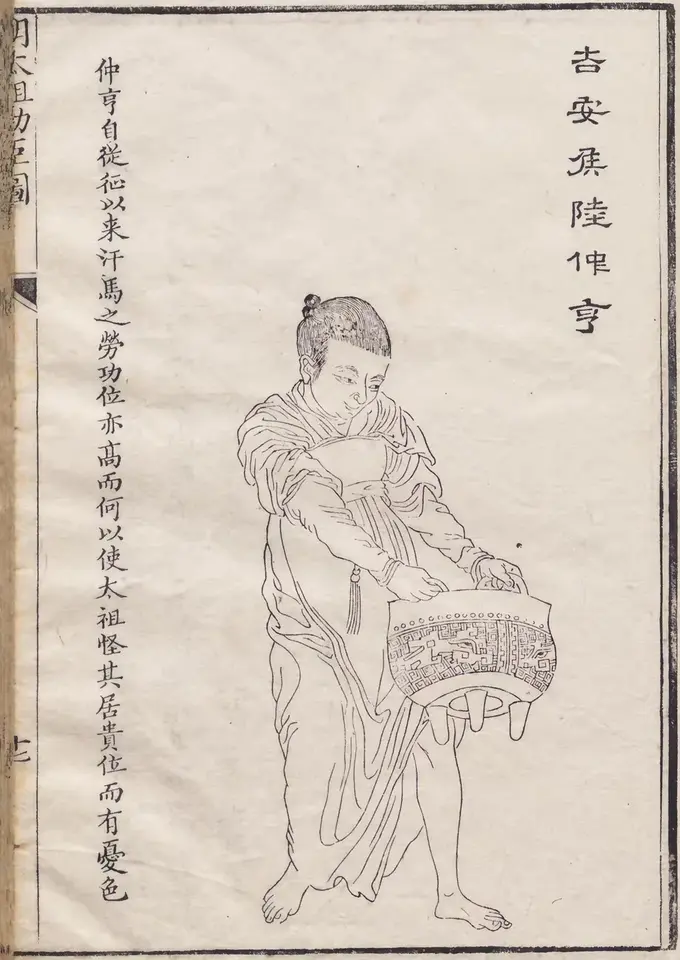
陆仲亨
Lu Zhongheng (1336–1390) was a native of Zhongli, Haozhou (present-day Fengyang, Anhui Province). He was an eminent founding general of the Ming dynasty, one of the Twenty-Four Generals of Huaixi, and held the title Marquis of Ji'an. Having lost his parents and brothers in the widespread famines and warfare of the late Yuan dynasty, Lu was discovered at age seventeen hiding in wild weeds clutching a cup of wheat by Zhu…
Lu Zhongheng (1336–1390) was a native of Zhongli, Haozhou (present-day Fengyang, Anhui Province). He was an eminent founding general of the Ming dynasty, one of the Twenty-Four Generals of Huaixi, and held the title Marquis of Ji'an. Having lost his parents and brothers in the widespread famines and warfare of the late Yuan dynasty, Lu was discovered at age seventeen hiding in wild weeds clutching a cup of wheat by Zhu Yuanzhang, who took him in and nurtured him within the army camp. Joining the military, Lu followed Zhu in capturing Chuzhou, seizing Heyang, and crossing the Yangtze River to storm Taiping and Jiqing (Nanjing), repeatedly displaying battlefield heroism and rising to Marshal of the Left Wing Army and Commander of the Biaoqi Guard. During the campaigns to unify China and establish the Ming dynasty, Lu Zhongheng fought valiantly across southern theaters. He accompanied Grand General Chang Yuchun to capture Ganzhou, overseeing newly surrendered prefectures across northern and southern Lingnan while clearing mountain fortresses in Meizhou and Huichang. In 1368, alongside Liao Yongzhong, he led an army that conquered Guangdong. He was later appointed to succeed Deng Yu in garrisoning the critical stronghold of Xiangyang, serving as Manager of Governmental Affairs of Jiangxi Branch Secretariat and Acting Director of the Chief Military Commission. In 1370, during the grand ennoblement of founding merit ministers, Emperor Taizu conferred upon him the title Marquis of Ji'an with an annual stipend of 1,500 shi and hereditary iron certificates. In the early decades of the Ming dynasty, Lu guarded Yanmen Pass against Northern Yuan raiders, governed Chengdu to quell tribal rebellions in Yunnan, and assisted Fu Youde in subjugating the rebellious Wusa tribes, rendering significant contributions to frontier stability in the northwest and southwest. However, in his later years, his fierce temperament and infractions repeatedly drew imperial reprimands. In 1390, a family domestic reported that Lu had secretly conspired with the executed grand councilor Hu Weiyong. Following an imperial investigation, Emperor Taizu ordered Lu executed, posthumously stripped him of his marquisate, and confiscated his entire estate.
Born into an impoverished farming family in Haozhou, later losing his entire family to famines and war.
Found hiding in the weeds at seventeen by Zhu Yuanzhang, inducted into the rebel camp, and joined the siege of Chuyang.
Crossed the Yangtze River to capture Taiping and pacify Jiqing; promoted to Marshal of the Left Wing Army.
Fought in naval combat against Chen Youliang at Poyang Lake and took Wuchang, promoted to Commander of the Biaoqi Guard.
Accompanied Chang Yuchun to conquer Ganzhou, accepted the surrender of Xiong Tianrui, and pacified Lingnan mountain fortresses.
Marched into Guangdong with Liao Yongzhong, accepted the surrender of Lu and He Zhen, and succeeded Deng Yu in garrisoning Xiangyang.
Created Marquis of Ji'an with 1,500 shi annual stipend and hereditary iron certificate; subsequently demoted for abuse of postal carriages.
Dispatched to garrison Yanmen Pass in Daixian, captured enemy raiders, and was restored to his marquisate by imperial decree.
Transferred to govern Chengdu, suppressed the Anuchong rebellion in Yunnan, and coordinated with Fu Youde to pacify Wusa.
Denounced by a domestic for conspiring with Hu Weiyong; interrogated and executed by imperial order with his estate confiscated.
Lu Zhongheng was born in 1336 in Zhongli, Haozhou (present-day Fengyang County, Anhui Province). Originating from an impoverished peasant family, he grew up amidst relentless natural disasters and civil breakdown along the Huai River. When the Red Turban Rebellions erupted across Jianghuai, regional skirmishes between government armies and rebel factions ravaged the countryside. In 1353, when Lu was seventeen years old, his home village was ransacked and burned. His parents and brothers all perished from starvation and military violence.
Helpless, starving, and clothed in rags, Lu wandered the wasteland clutching a single cup of wheat he had salvaged from the rubble, hiding terrified inside tall brush to evade marauders. At that moment, Zhu Yuanzhang rode through the wilderness accompanied by several dozen horsemen. Noticing movement in the weeds, Zhu parted the grass and found the emaciated yet sturdy youth. Moved by compassion, Zhu called out, "Come, follow me!" Lu nodded decisively and followed. Recognizing his isolation, Zhu brought him back to his military headquarters, raising and training him like his own kin.
From that day forward, Lu Zhongheng served in Zhu Yuanzhang's ranks. Despite his young age, he was courageous, resolute, and fearless in combat. He marched with the army to capture Chuzhou, overran the fortifications at Daliushu, and stormed Heyang (present-day He County, Anhui). Fighting multiple engagements against elite Yuan units, he broke enemy lines and routed local bandits stationed at Qingshan, quickly earning distinction among the generals of Huaixi.
In 1355, Zhu Yuanzhang executed his strategic advance across the Yangtze River to establish a base in Jiangnan. Lu Zhongheng joined the vanguard crossing the turbulent waters, breaking through the precipitous Caishi Shoals and seizing Taiping Prefecture. During the assault on Jiqing Circuit (present-day Nanjing, Jiangsu), the primary political center of Jiangnan, Lu was among the first warriors to scale the city ramparts. Following the capture of Jiqing, Grand General Xu Da led campaigns across southern Jiangsu and southern Anhui; Lu accompanied Xu in subduing Liyang, Changzhou, Xuanzhou, and Jiangyin. In recognition of his valor, Zhu Yuanzhang promoted him to Marshal of the Left Wing Army.
After 1360, Zhu Yuanzhang engaged in a protracted life-or-death struggle against Chen Youliang, who commanded the middle Yangtze. Lu Zhongheng led war vessels during the campaign. In the climactic naval Battle of Poyang Lake, facing Chen Youliang's massive multistoried galleons that spanned the horizon, Lu commanded assault divisions that utilized favorable winds to deploy incendiary weapons. Cutting through enemy formations in close combat, he sustained several wounds but refused to withdraw.
Following Chen Youliang's defeat and death, Lu joined the pursuit and siege of Wuchang, extinguishing Chen's remnant forces. Throughout the pacification of the central Yangtze, Lu's battlefield contributions were recognized with promotion to Commander of the Biaoqi Guard, placing him in command of the capital's elite guard formations.
In August 1364, Grand General Chang Yuchun led an expedition against the crucial Jiangxi stronghold of Ganzhou. Ganzhou occupied rugged mountainous terrain, and Yuan commander Xiong Tianrui resisted stubbornly for months. Lu Zhongheng served as Chang Yuchun's principal deputy, coordinating siege lines and repelling counter-sorties, eventually compelling Xiong Tianrui to yield the city.
Following the capture of Ganzhou, the court recognized the strategic complexity of the Nanling mountain passes where ethnic tribal settlements and Yuan loyalists coexisted. The court appointed Lu Commander of the Ganzhou Guard, conferring authority over the newly annexed prefectures of northern and southern Lingnan. Taking command, Lu deployed elite troops across the mountain redoubts, seizing Meizhou in Guangdong, Huichang in Jiangxi, and Xiangxiang in Hunan, eradicating bandit hideouts and opening direct overland routes into the south.
In the spring of 1368, upon the founding of the Ming dynasty in Nanjing, Emperor Taizu ordered generals Liao Yongzhong and Lu Zhongheng to conquer Lingnan via coordinated naval and overland offensives. Lu led the infantry and cavalry of the Ganzhou Guard southward, rolling over Yingde, Qingyuan, Xujiang, Lianzhou, and Zhaoqing. Upon reaching Deqing, Yuan commander Zhang Pengcheng abandoned his post and fled. Lu marched his army directly to Guangzhou, joining Liao Yongzhong's fleet beneath the city walls. Confronted by superior forces, Yuan assistant administrator Lu and regional magnate He Zhen opened the gates and surrendered, securing all of Guangdong without devastating warfare.
Following the triumph in Guangdong, Lu was reassigned as Commander of the Meidong Guard and promoted to Manager of Governmental Affairs of the Jiangxi Branch Secretariat. Soon after, due to strategic pressures along the Han River corridor, Emperor Taizu appointed Lu to relieve Deng Yu in garrisoning the pivotal fortress of Xiangyang, granting him the title Assistant Commissioner of the Chief Military Commission. In August 1369, Lu returned to Nanjing to serve as Acting Director of the Chief Military Commission, supervising imperial military administration.
In November 1370, Emperor Taizu held a grand ennoblement ceremony for founding merit ministers. Acknowledging Lu Zhongheng's steadfast loyalty and twenty years of battlefield service, the emperor ennobled him as Marquis of Ji'an, granting him the honorific Meritorious Military Minister Founding and Aiding Fortunes with Utmost Sincerity and Exertion, Grand Master of Splendid Happiness, Pillar of State, and an annual stipend of 1,500 shi, accompanied by a hereditary iron certificate.
However, having spent his youth exclusively in military camps, Lu possessed an unpolished, haughty disposition. Shortly after being created a marquis, he and Tang Shengzong, Marquis of Pingjiang, illegally commandeered official imperial postal carriages for hunting and leisure outings. Denounced by censors, Emperor Taizu was outraged by their disregard for state regulations and stripped both men of their marquisates, demoting them to garrison commanders.
In 1371, Northern Yuan cavalry raided the northern defense lines of Shanxi. Emperor Taizu ordered Lu and Tang to redeem their past faults by defending Yanmen Pass in Daixian. Upon arrival, Lu overhauled border watchtowers and deployed ambushes in the mountain gorges, killing and capturing over a thousand enemy horsemen. Delighted by the victory, Emperor Taizu issued an imperial decree restoring both generals to their former noble ranks.
In 1379, Lu accompanied Grand General Tang He alongside Zhou Dexing, Marquis of Jiangxia, and Huang Bin, Marquis of Zhongjia, to train soldiers in Linqing, Shandong. Soon after, the three generals were arrested and brought to Nanjing for questioning regarding lax command oversight, though Emperor Taizu soon pardoned and released them.
In 1381, Emperor Taizu ordered Lu to Chengdu to command western Sichuan defenses. During this time, chieftain Anuchong of Jujin Prefecture in Yunnan launched an insurrection, overrunning Shimen Pass and killing Ming battalion commander Pu Quan. Lu quickly deployed commanders Li Rong and Zheng Xiang to mount a counteroffensive, marching through night and day to recapture Shimen Pass. Surrounding the rebels within deep ravines, Lu's forces executed and captured over four hundred rebels, extinguishing the uprising. When the Wusa tribes rebelled soon after, Lu joined forces with Grand General Fu Youde, pushing into rugged terrain to pacify the region and stabilizing the southwestern border of the empire.
Although Lu Zhongheng commanded vast frontier armies for decades, he harbored increasing anxiety as Emperor Taizu's suspicion toward senior military officials deepened in his later reign. In 1380, when Grand Councilor Hu Weiyong was executed for treason, judicial officials implicated Lu during depositions and urged that he be prosecuted. Emperor Taizu recalled their early bond and sighed at court: "When We first rose in arms at Chuyang, Zhongheng was only seventeen, having lost his parents and brothers in the war, hiding in weeds clutching a cup of wheat. We saw him, called him to Our side, and raised him to manhood, ultimately elevating him to a marquisate through his battle merits. He is Our foundational arm and heart; We cannot bear to punish him!" The emperor granted him full immunity.
However, Lu failed to cultivate humility, instead meeting secretly with other anxious veteran commanders. In 1390, Emperor Taizu initiated a sweeping purge targeting remnant members of Hu Weiyong's clique, reinvestigating former military associates. At this juncture, Feng Tiemu, a servant in Lu's household, harbored personal resentment and formally accused Lu Zhongheng, Tang Shengzong, Fei Ju, and Zhao Yong of having secretly conspired with Hu Weiyong.
Emperor Taizu ordered Lu arrested and remanded to the Embroidered Uniform Guard and the three judicial offices for interrogation. Once the accusations were substantiated, the emperor remarked: "We have often wondered why, despite holding noble rank, he never showed serene joy but always displayed gloomy sorrow at court. Truly, he concealed treason in his heart!" Emperor Taizu decreed Lu's execution in the capital at the age of fifty-five. His marquisate was revoked, and his household wealth was confiscated, concluding the tragic career of this founding general.
From the age of seventeen, Lu Zhongheng dedicated himself to Zhu Yuanzhang's cause, witnessing every foundational campaign of the early Ming empire. From the initial struggles in Chuzhou and Heyang to the crossing of the Yangtze River and the capture of Taiping and Jiqing, he fought consistently at the forefront of the army.
While accompanying Xu Da through southern Jiangsu and southern Anhui, Lu campaigned tirelessly, taking cities and routing opposing armies. Promoted to Marshal of the Left Wing Army, he secured the capital base at Jinling and laid the groundwork for the empire's southern expansion.
Following the destruction of Chen Youliang, Lu displayed formidable independent command abilities. Serving as Commander of the Ganzhou Guard under Chang Yuchun, he pacified mountain strongholds across the Jiangxi, Fujian, and Guangdong borders, securing communication corridors into the far south.
In 1368, Lu coordinated with Liao Yongzhong in an amphibious assault on Guangdong. Lu's overland units swept through Yingde, Qingyuan, and Zhaoqing, joining naval forces outside Guangzhou. His overwhelming military pressure forced Yuan general Lu and warlord He Zhen to surrender unconditionally, bringing the southern coastal provinces peacefully under imperial administration.
Lu made enduring contributions to early Ming frontier security. Facing Northern Yuan incursions along northern Shanxi, he held Yanmen Pass, establishing effective ambushes and repelling raiding horsemen to secure the northern gateway to the Central Plains.
During his tenure in Chengdu, he swiftly suppressed Anuchong's revolt in Yunnan, retaking Shimen Pass, and coordinated with Fu Youde to pacify the rugged Wusa territories. His military campaigns reinforced imperial control over the borderlands of Sichuan, Yunnan, and Guizhou.
FIGURES ASSOCIATED WITH THIS DYNASTY