Birth | Born at Qianxi in Jinhua. Because he shared a birthday with his grandfather, he was initially named Shou.
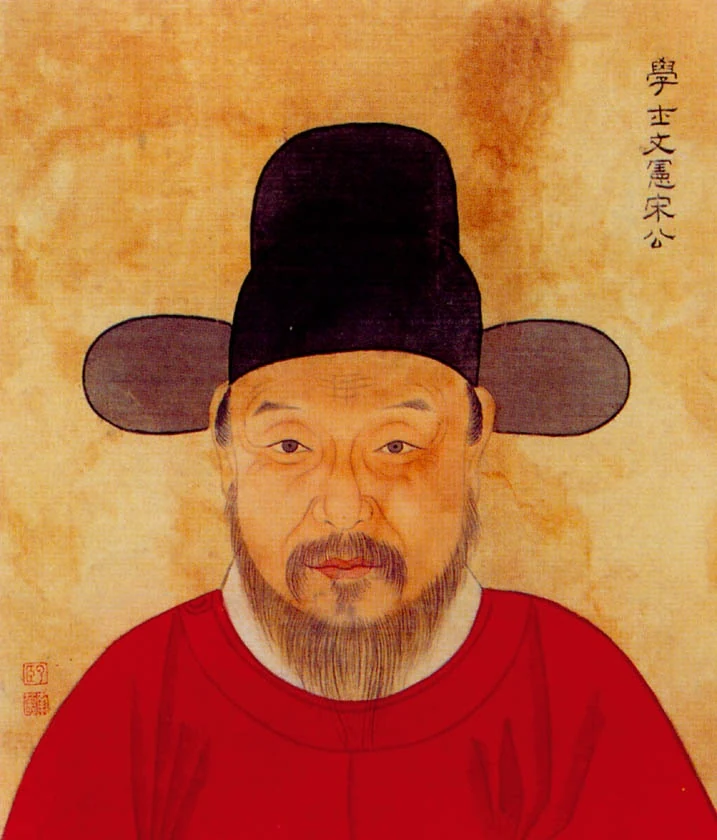
1310 CE–1381 CE
Writerhistorianand statesman of the late Yuan and early Ming
Song Lian
宋濂
Song Lian was the leading civil official and one of the foremost literary figures of the early Ming. He served as chief editor of the History of Yuan, and Zhu Yuanzhang praised him as “the foremost civil minister of the founding era.”
1310 CE–1381 CEMing Dynasty
PROFILE
Song Lian was the leading civil official and one of the foremost literary figures of the early Ming. He served as chief editor of the History of Yuan, and Zhu Yuanzhang praised him as “the foremost civil minister of the founding era.”
- Other Names
- Master Qianxi; one of the Three Great Masters of Poetry and Prose of the Early Ming
- Courtesy Name
- Jinglian
- Art Name
- Qianxi
- Period
- Ming
- Dynasty/Regime
- Ming Dynasty
- Identity
- Writer, historian, and statesman of the late Yuan and early Ming
- Ethnicity/Ethnic Affiliation
- Not reliably confirmed by historical sources
- Native Place
- Pujiang County, Jinhua, Zhejiang
- Date of Birth
- November 4, 1310
- Place of Birth
- Qianxi, Jinhua
- Date of Death
- June 24, 1381
- Place of Death
- Unknown
- Highest Office
- See Biography and Major Deeds
- Major Achievements
- Leading civil official of the early Ming; major literary official of the founding period; chief editor of the History of Yuan; praised by Zhu Yuanzhang as “the foremost civil minister of the founding era.”
LIFE TIMELINE
Age twenty-five | Succeeded Wu Lai as instructor at Dongming Academy of the Zheng family community in Pujiang.
Age thirty-nine | Declined a summons to become an editor in the Hanlin Academy, citing the need to support his parents.
Age forty | Entered Xianhua Mountain as a Daoist, in practice to devote himself to writing.
Age forty-six | Retired to Xiaolongmen Mountain to write.
Age forty-nine | Served as a teacher of the Five Classics at the Wuzhou prefectural school.
Age fifty | On Li Shanchang's recommendation, was summoned to Yingtian together with Liu Ji, Zhang Yi, and Ye Chen; appointed Educational Intendant for the Jiangnan region and instructed Crown Prince Zhu Biao in the classics.
Age fifty-eight | Ordered to serve with Wang Yi as chief compiler of the History of Yuan.
Age fifty-nine | The History of Yuan was completed; appointed Academician of the Hanlin Academy, Grand Master of Palace Accord, Drafter of Imperial Proclamations, and concurrently a compiler of national history.
Age sixty | The continuation of the History of Yuan was completed; demoted to editor for missing a court audience.
Age sixty-one | Promoted to Deputy Director of the Directorate of Education; later demoted to magistrate of Anyuan for failing to submit a memorial on time concerning rites for Confucius.
Age sixty-two | Recalled as a supervising secretary in the Ministry of Rites; promoted in the twelfth month to Senior Mentor to the Crown Prince.
Age sixty-three | Promoted to Hanlin Academician-in-Attendance and Drafter of Imperial Proclamations, concurrently compiling national history and serving as Senior Mentor; ordered to compile the Daming Rili.
Age sixty-four | Ordered to determine mourning dress regulations; completed the Huangming Baoxun.
Age sixty-six | Appointed Chief Academician of the Hanlin Academy while retaining his concurrent offices.
Age sixty-seven | Retired and returned home; Zhu Yuanzhang personally held a farewell banquet for him.
Age seventy | His eldest grandson Song Shen became implicated in the Case of Hu Weiyong, and his second son Song Sui was executed. Song Lian was spared through the efforts of Empress Ma and Crown Prince Zhu Biao and exiled to Maozhou.
Age seventy-two | Died of illness in Kuizhou (present-day Fengjie, Chongqing) and was buried below Lianhua Mountain.
Posthumous | Emperor Xiaozong of Ming ordered the restoration of his offices and regular spring and autumn sacrificial rites at his grave.
Posthumous | Emperor Wuzong of Ming conferred on him the posthumous title Wenxian.
BIOGRAPHY
Biography
Family Background and Early Years
Song Lian was born on the thirteenth day of the tenth month of 1310, the third year of Zhida under Emperor Wuzong of Yuan. His ancestor Song Bai moved to Qianxi in Jinhua in the early Jiading era of the Southern Song; by Song Lian's generation the family had relocated to Pujiang. Born after only seven months of pregnancy, Song Lian was sickly from childhood and, according to the source text, would “fall unconscious for several days whenever he suffered dizziness from wind.” He was carefully raised by his grandmother, Lady Jin, and his mother, Lady Chen. Gifted with exceptional intelligence and memory, he became known as a “child prodigy.” Jia Sikui of Yiwu admired his talent and betrothed his daughter to him.
Song Lian studied successively under the late-Yuan scholars Wenren Mengji, Wu Lai, Liu Guan, and Huang Jin and mastered the Five Classics. He remained devoted to study throughout his life, saying that “from youth to old age I never passed a day without books, and there was no branch of learning I did not investigate.” In 1335, the third year of Yuantong, Wu Lai resigned because of illness from his teaching post at Dongming Academy and recommended Song Lian as his successor. Song Lian then taught for many years at Dongming Academy of the Zheng family community in Pujiang, steadily gaining a wider reputation.
Seclusion and Entry into Public Service at the End of the Yuan
In 1349, the ninth year of Zhizheng, Emperor Shun of Yuan summoned Song Lian to serve as a Hanlin editor on the recommendation of Wei Su and others. Song declined, citing the need to care for his parents. The following year he entered Xianhua Mountain as a Daoist, though his real purpose was to write. In 1356 he moved to Xiaolongmen Mountain and devoted himself to scholarship. In 1358, when Zhu Yuanzhang's army captured Muzhou, Song Lian sent his family to Gouwo Mountain in Zhuji to avoid the fighting but remained behind himself. The following year Zhu Yuanzhang ordered Prefect Wang Xianzong to establish a prefectural school and summoned Song Lian to teach the Five Classics at the Wuzhou prefectural school.
In 1360, the twentieth year of Zhizheng, Song Lian was recommended by Li Shanchang and summoned by Zhu Yuanzhang to Yingtian together with Liu Ji, Zhang Yi, and Ye Chen. In the seventh month he became Educational Intendant for the Jiangnan region; in the tenth month he was ordered to teach the Five Classics to Crown Prince Zhu Biao and later participated in compiling the imperial diary. In 1363, Zhu Yuanzhang founded the Hall for Honoring the Worthy, and Song Lian was among those associated with it. From this point, Song Lian transformed from a late-Yuan recluse into a founding civil official of the Ming.
Service in the Early Ming
In the twelfth month of 1368, the first year of Hongwu, Zhu Yuanzhang ordered the compilation of the History of Yuan and appointed Song Lian and Wang Yi as chief compilers. Work began in the second month of 1369 and the book was completed in the eighth month. Song Lian was then appointed Academician of the Hanlin Academy, Grand Master of Palace Accord, Drafter of Imperial Proclamations, and concurrently a compiler of national history. In 1370 the continuation of the History of Yuan was completed and he received gifts of gold and silk. In the seventh month of the same year, he was demoted to editor for missing a court audience. In the second month of 1371 he was promoted to Deputy Director of the Directorate of Education, but in the eighth month was demoted to magistrate of Anyuan after failing to submit a memorial on time concerning the rites for Confucius. In the second month of 1372 he was recalled as a supervising secretary in the Ministry of Rites and in the twelfth month was promoted to Senior Mentor to the Crown Prince.
In the seventh month of 1373, Song Lian was promoted to Hanlin Academician-in-Attendance and Drafter of Imperial Proclamations, concurrently compiling national history and serving as Senior Mentor. In the eighth month, he and Zhan Tong were ordered to compile the Daming Rili. The work was completed in the fifth month of the following year, and five volumes were then selected and compiled as the Huangming Baoxun. In the ninth month, Zhu Yuanzhang wished to entrust him with political affairs, but Song politely declined. In the sixth month of 1376 he was appointed Chief Academician of the Hanlin Academy, the high point of his official career. In 1377, citing old age, he retired and returned home. Zhu Yuanzhang personally saw him off and arranged for him to appear at court once each year.
Disaster in Old Age and Death in Exile
In 1380, the thirteenth year of Hongwu, Song Lian's eldest grandson Song Shen was implicated in the Case of Hu Weiyong and his second son Song Sui was executed under the law. Zhu Yuanzhang initially intended to execute Song Lian as well, but Empress Ma and Crown Prince Zhu Biao strongly interceded for him, and the sentence was commuted to exile in Maozhou, Sichuan. On the twentieth day of the fifth month of 1381, the fourteenth year of Hongwu, Song Lian died of illness in Kuizhou, present-day Fengjie in Chongqing, at the age of seventy-two. The source text says that at his death he sat upright with his hands folded. Local official Ye Yicong buried him below Lianhua Mountain. Zhu Chun, Prince of Shu, admired Song Lian and later had him reburied east of Huayang.
More than a century later, in 1496, the ninth year of Hongzhi, Sichuan governor Ma Jun submitted a memorial seeking redress for Song Lian. Emperor Xiaozong of Ming ordered his offices restored and prescribed sacrifices at his tomb in spring and autumn. During the Zhengde era, Emperor Wuzong of Ming conferred on him the posthumous title Wenxian.
Major Activities
Literary Contributions
Song Lian was a leader of the early Ming literary world and, together with Liu Ji and Gao Qi, was known as one of the “Three Great Masters of Poetry and Prose of the Early Ming.” He argued that prose should illuminate the Way and have practical application, take the classics and ancient writers as models, value clarity of expression, remain open to adaptation, and arise from genuine response to events. His prose could be plain and concise or graceful and elegant. Biographical pieces such as Qinshi Lu, Biography of Wang Mian, and Biography of Li Yi use telling detail to reveal character, while landscape pieces such as Preface to the Poetry Gathering at Peach-Blossom Ravine and Record of the Encircling-Green Pavilion are concise and refined and have been compared to Ouyang Xiu. Liu Ji praised him as “the finest writer of the present age.” His literary reputation spread abroad; according to the source text, envoys from Korea, Japan, and Annam during the Hongwu era offered double prices to buy collections of his writings. His works were collected in the Collected Writings of Academician Song.
Political Activity
Song Lian played an important role in early Ming politics. He was ordered to direct the compilation of the History of Yuan as chief compiler, and the work was completed within two years. He rose to the post of Chief Academician of the Hanlin Academy and Drafter of Imperial Proclamations, and many of the court's ritual and musical institutions were formulated with his participation. When Zhu Yuanzhang asked about learning for rulers, Song Lian recommended the Expanded Meaning of the Great Learning. Zhu ordered passages from it posted on the walls of the palace side halls and assembled officials to hear Song Lian explain them. When Zhu Yuanzhang's nephew Zhu Wenzheng committed an offense, Song advised that he should be banished to the frontier rather than executed. When Zhu asked about omens and portents, Song cited the Spring and Autumn Annals as recording anomalies rather than auspicious signs and urged him to value human affairs over celestial phenomena. In 1373, the sixth year of Hongwu, Zhu Yuanzhang summoned several dozen Confucian scholars from around the realm to study in Wenhua Hall and appointed Song Lian as their teacher.
Historical Scholarship
Song Lian served as chief editor of the History of Yuan. Work began in 1369 and the first compilation was completed in the eighth month; a continuation was finished in 1370 after another six months of work. The History of Yuan became one of the Twenty-Four Histories. Although criticized for the haste of its compilation, it preserved a large body of primary material from the Yuan period. Song Lian was also ordered to compile the Daming Rili with Zhan Tong and to select material from it as the Huangming Baoxun, works that helped establish the foundations of historical writing in the early Ming.
Neo-Confucian Thought
Song Lian took Cheng-Zhu learning as his principal foundation while also drawing on Zhou Dunyi and others, advocating that one should “honor the sages' classics and treat the Hundred Schools as subordinate.” He held that principle was the mind of Heaven and Earth and that through primordial qi it brought forth and moved the myriad things. The Six Classics, in his view, recorded principles already contained within “our minds”: “the mind becomes the classics, and the classics become the mind.” He argued that the pursuit of the Way required recognizing the “mind of Heaven and Earth,” removing artificial human distortions, and preserving the mind. His thought combined features of Zhu Xi's and Lu Jiuyuan's schools and was also influenced by Buddhism, forming one stage in the intellectual transition from the Yuan-era convergence of Zhu and Lu learning to the rise of the Wang Yangming school in the mid-Ming. Song Lian had been immersed in Buddhism from youth, reportedly reading through the Buddhist canon three times. He called himself the “Layman of No Marks” and argued that the true seal of the Buddhist teaching and the Confucian classics could be used together.
Travels and Movements
Song Lian's travels extended across Zhejiang, Jiangsu, Anhui, Sichuan, and other regions. In his early years he lived at Qianxi in Jinhua, later moving to Qingluo Mountain in Pujiang and teaching at Dongming Academy for more than twenty years. At the end of the Yuan he successively withdrew to Xianhua Mountain and Xiaolongmen Mountain. In the early Ming he served in Nanjing and in 1375 accompanied Crown Prince Zhu Biao and other princes to military exercises at the Central Capital, Fengyang. After retiring he returned home, but in 1380 was exiled to Maozhou and died of illness while passing through Kuizhou.
Contacts with Contemporaries
Song Lian, Liu Ji, Zhang Yi, and Ye Chen were collectively known as the “Four Masters of Eastern Zhejiang” and were summoned together by Zhu Yuanzhang. Song was a close friend of Liu Ji, who praised his writing as “the finest of the present age.” He was the teacher of Fang Xiaoru, who observed the rites of a disciple toward him throughout his life and, after Song's death, visited his grave whenever he passed Kuizhou. Song had a relationship of recommendation with Li Shanchang and worked with Wang Yi as a fellow compiler of the History of Yuan. In old age his grandson Song Shen's involvement in the Case of Hu Weiyong linked him politically with the people implicated in that case.
Personal Relations
Family
- Grandfather: Song Bai (moved to Qianxi in Jinhua during the Southern Song)
- Grandmother: Lady Jin
- Father: Song Wenzhao
- Mother: Lady Chen
- Wife: Lady Jia (daughter of Jia Sikui of Yiwu)
- Second son: Song Sui (executed in the thirteenth year of Hongwu in connection with the Case of Hu Weiyong)
- Eldest grandson: Song Shen (executed in the thirteenth year of Hongwu in connection with the Case of Hu Weiyong)
Teachers and Associates
- Wenren Mengji (teacher)
- Wu Lai (teacher; recommended Song to take over Dongming Academy)
- Liu Guan (teacher)
- Huang Jin (teacher)
- Liu Ji (close friend; together regarded as leading masters of their age)
- Zhang Yi (one of the Four Masters of Eastern Zhejiang)
- Ye Chen (one of the Four Masters of Eastern Zhejiang)
- Fang Xiaoru (disciple)
- Wang Yi (colleague and co-compiler of the History of Yuan)
- Zhan Tong (colleague and co-compiler of the Daming Rili)
Ruler–Subject Relations
- Zhu Yuanzhang (ruler; praised Song as “the foremost civil minister of the founding era”)
- Zhu Biao (crown prince; Song taught him the classics)
- Empress Ma (interceded for Song when he faced execution)
- Zhu Chun (Prince of Shu; arranged Song's reburial after his death)
Conflict
- Hu Weiyong (Song Shen's implication in the Case of Hu Weiyong led to Song Lian's exile)
Historical Assessment
Ming and Contemporary Assessments
- Zhu Yuanzhang called Song Lian “the foremost civil minister of the founding era” and treated him with exceptional respect.
- Liu Ji praised Song Lian as “the finest writer of the present age.”
- Chen Lü described his writing as “deep and restrained in diction and resonance, concise and rigorous in form.”
- Ouyang Xuan said that his prose possessed “a deep and powerful force, like Han Xin commanding troops.”
- Fang Xiaoru wrote in a sacrificial essay: “Your capacity may have embraced all under Heaven, yet all under Heaven could not accommodate your single body; your discernment may have illuminated an age, yet the whole age could not understand the kind of man you were.”
Early to Mid-Qing
- Song Lian's biography in the History of Ming praised his writing as “pure, profound, and expansive, standing alongside the ancient authors,” and described him as “brilliant and strong in memory from childhood” and as someone who “from youth to old age never passed a day without books and was versed in every branch of learning.”
- Early-Qing scholars such as Huang Zongxi placed him within the Jinhua line of Zhu Xi learning in the early Ming and treated him as an important Neo-Confucian thinker of the period.
- Ji Yun and the compilers of the Siku Quanshu described his prose as “graceful, generous, and deeply composed” and regarded him as an ancestor of the cabinet-style prose tradition.
Late Qing and Republican Period
- Republican-era scholars often assessed Song Lian from the perspective of literary history and regarded him as a representative prose writer of the early Ming.
- Hou Wailu and others, in their History of Song-Ming Neo-Confucianism, characterized his thought as “one link in the intellectual transformation from the Yuan-period convergence of Zhu and Lu learning to the emergence of the Wang school in the mid-Ming.”
Modern and Contemporary Assessments
- Modern literary histories generally place Song Lian at the head of the Three Great Masters of Poetry and Prose of the Early Ming and recognize both his achievements in prose and his influence on cabinet-style writing.
- Wang Chunnan and Zhao Yinglin, in Critical Biography of Song Lian and Fang Xiaoru, systematically discuss his life and thought, describing his Neo-Confucian orientation as “taking Cheng-Zhu learning as orthodox while also drawing on Zhou Dunyi and others” and “honoring the sages' classics while subordinating the Hundred Schools.”
- Chen Changyun, in New Studies on Song Lian's Literature, argues that his Neo-Confucian thought included teachings on principle and human nature, statecraft, and practical achievement and stood closer to the pre-Qin teachings of Confucius and Mencius, reflecting a return toward traditional Confucianism during the Yuan–Ming transition.
FIGURES ASSOCIATED WITH THIS DYNASTY
Bibliography
- History of Ming, vol. 128, Biography 16
- Wang Chunnan and Zhao Yinglin, Critical Biography of Song Lian and Fang Xiaoru, Nanjing University Press, 1998
- Hou Wailu, Qiu Hansheng, and Zhang Qizhi, eds., History of Song-Ming Neo-Confucianism