Princely Birth
Born into the royal clan of Han in Xinzheng; read classical treatises on law, statecraft, and military warfare from early youth.
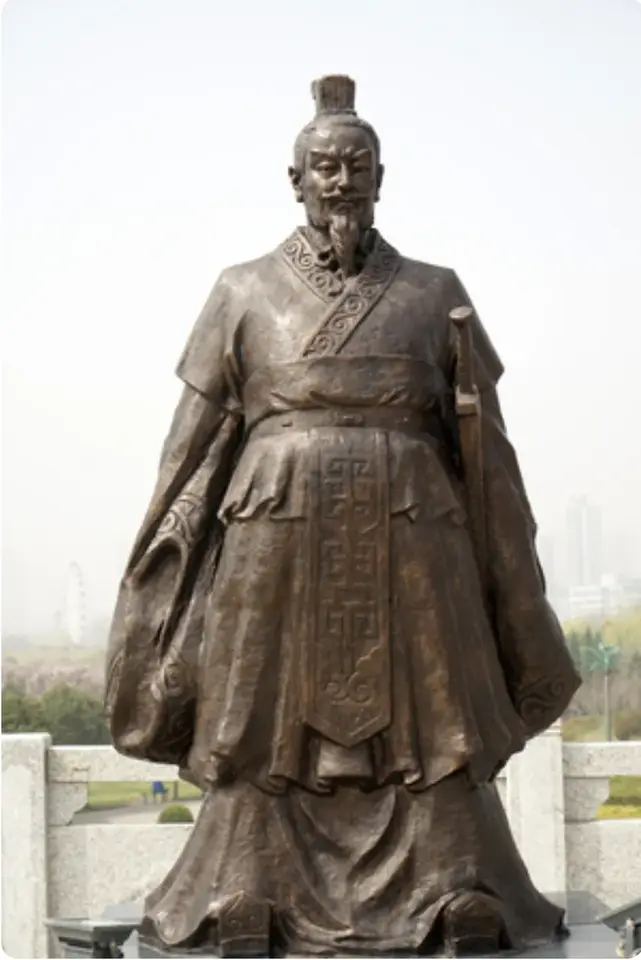
280 BCE–233 BCE
韩非
Han Fei (c. 280 BC – 233 BC), respectfully known to posterity as Han Feizi, was a native of Xinzheng, capital of the State of Han. He was the greatest synthesizer of the Legalist philosophical tradition during the Warring States period, as well as a preeminent political philosopher and literary essayist of ancient China. Born into the royal lineage of the State of Han, he possessed extraordinary intellectual depth. Although…
Han Fei (c. 280 BC – 233 BC), respectfully known to posterity as Han Feizi, was a native of Xinzheng, capital of the State of Han. He was the greatest synthesizer of the Legalist philosophical tradition during the Warring States period, as well as a preeminent political philosopher and literary essayist of ancient China. Born into the royal lineage of the State of Han, he possessed extraordinary intellectual depth. Although burdened by a speech impediment that prevented articulate verbal rhetoric, he wrote with fiery eloquence and penetrating analytical rigor. In his early years, he studied imperial statecraft under the Confucian master Xunzi alongside Li Si, synthesizing Confucian and Legalist theories while rooting his metaphysics in the Daoist Huang-Lao philosophy. Witnessing the territorial contraction and bureaucratic decay of his native Han, Han Fei repeatedly submitted memorials to the King of Han proposing legalist reforms to enrich the nation and strengthen its military, but his proposals were systematically rejected by entrenched aristocrats. In response, he retired into seclusion to author enduring masterpieces including Solitary Indignation, The Five Vermin, Eminent Schools of Thought, and The Difficulties of Persuasion, integrating Shang Yang's concept of law, Shen Buhai's method of administrative technique, and Shen Dao's doctrine of political authority into a comprehensive system of centralized autocracy. King Zheng of Qin was so profoundly moved upon reading his works that he launched an invasion against Han to compel his diplomatic dispatch to Xianyang. In Qin, Han Fei's attempts to preserve his homeland aroused fierce jealousy from Li Si and Yao Jia, who framed him and had him imprisoned, where he was coerced into drinking poison. His collected writings of fifty-five chapters, totaling over one hundred thousand words, served as the primary ideological blueprint for the imperial bureaucratic systems of the Qin and Han dynasties.
Born into the royal clan of Han in Xinzheng; read classical treatises on law, statecraft, and military warfare from early youth.
Following Qin's capture of Shangdang, Han faced territorial dismemberment; Han Fei submitted reform memorials that were dismissed.
Traveled to Lanling in Chu to study imperial statecraft under master Xunzi, forging a close peer relationship with Li Si.
Returned to Han; finding his stutter and candid advice unappreciated, retired to pen Solitary Indignation and The Five Vermin.
Authored Eminent Schools of Thought, advocating the doctrine that rulers should not imitate antiquity but adapt to contemporary circumstances.
His writings reached Qin; King Zheng read his treatises and exclaimed that he would die without regret if he could converse with the author.
Under heavy military pressure from Qin, King An of Han urgently dispatched Han Fei as imperial envoy to negotiate peace in Xianyang.
Received by King Zheng in palace audiences; presented his treatise on Preserving Han to discourage immediate conquest of his homeland.
Li Si and Yao Jia slandered him as an untrustworthy foreign prince, prompting King Zheng to remand him to the Yunyang Prison.
Coerced by Li Si's agents into consuming poison; died in cell at age forty-eight; King Zheng's pardon arrived too late.
Han Fei was born into the royal lineage of the State of Han, the smallest and militarily most fragile among the Seven Warring States. His ancestors belonged to the noble Ji clan of the former State of Jin, sharing direct blood ties with the ruling monarchs of Han, which entitled him to the aristocratic status of Prince Fei. Positioned in the central plains and encircled by formidable rivals including Qin, Chu, and Wei, the State of Han suffered continuous territorial erosion. Growing up in the royal palaces of Xinzheng, Han Fei had access to expansive ancestral archives. Historical records state that from early boyhood he immersed himself in the legal treatises of Shang Yang and Guan Zhong, the strategic manuals of Sun Wu and Wu Qi, and various schools of administrative statecraft, building a comprehensive knowledge base for realistic political philosophy.
Despite his royal blood, Han Fei suffered from a stammer that made rapid speech difficult, rendering him unsuited for the dramatic rhetorical debates popular in Warring States courts. However, his internal thoughts were remarkably clear, rigorous, and observant. Around 262 BC, Qin general Bai Qi launched a massive offensive against Han, seizing over fifty fortresses and triggering the catastrophic Battle of Changping. Witnessing his homeland on the brink of collapse, the young Han Fei repeatedly submitted extensive memorials to King Huanhui of Han, arguing that failure to establish codified legal systems and institutional meritocracy would lead to ruin. He denounced the court for lavishly supporting idle rhetoricians while neglecting soldiers and agricultural laborers. However, his counsel was ignored by the timid monarch and conservative aristocrats.
Realizing that his ideas were unwelcome in the Han court, around 255 BC Han Fei traveled south to Lanling in Chu to study under the renowned Confucian master Xunzi. In Lanling, he studied alongside Li Si, an ambitious scholar from Shangcai. Xunzi's philosophy centered on the premise that human nature is fundamentally selfish and that social order depends upon external discipline, expressed in his doctrine of honoring ritual and elevating law. Han Fei adopted Xunzi's realistic view of human motivation, but stripped it of Confucian moral idealism. Instead of relying on moral cultivation to restore harmony, Han Fei concluded that political order must be anchored entirely in codified laws, administrative control, and the absolute authority of the sovereign.
Simultaneously, Han Fei grounded his philosophical system in Daoist metaphysics. He engaged in close analysis of Laozi's Daodejing, composing Explaining the Laozi and Illustrating the Laozi, which represent the earliest surviving systematic commentaries on the text. Han Fei argued that the Dao is the supreme objective law of the cosmos, while principle represents the inherent nature of particular things. An enlightened ruler must observe affairs with stillness and evaluate ministers strictly by matching their titles against actual performance. His intellectual breadth was so profound that Li Si candidly conceded his own intellectual inferiority.
Around 247 BC, Han Fei returned to Han. The state was in deeper decay under King An, with factional ministers trading state territory for temporary safety. Realizing that upright counsel could never penetrate the corrupt court, Han Fei abandoned all hopes of ministerial office. He secluded himself in his Xinzheng estate, dedicating his intellect to authoring a comprehensive political treatise.
Over a decade of intense isolation, he produced more than fifty foundational essays, including Solitary Indignation, The Five Vermin, Eminent Schools of Thought, The Difficulties of Persuasion, Fixing the Law, Eight Traitors, The Way of the Sovereign, Having Measure, and Inner and Outer Congeries of Sayings, later assembled into the Hanfeizi. Surveying three centuries of institutional experiments, Han Fei identified the critical deficiencies of earlier Legalist thinkers: Shang Yang had established strict legal codes and military incentives in Qin, but failed to develop subtle administrative techniques to check bureaucratic treachery, leading to his gruesome death; Shen Buhai had introduced administrative methods of surveillance in Han, but neglected transparent legal codification, leaving the state vulnerable after his death; Shen Dao had recognized the necessity of sovereign political authority, but lacked systematic legal frameworks.
Han Fei synthesized these insights into an all-encompassing system uniting Law, Administrative Technique, and Sovereign Authority. He maintained that law must be transparently codified and enforced without exception; administrative technique must be wielded secretly by the sovereign to evaluate officials; and authority must be held exclusively by the ruler to compel absolute obedience. This theoretical framework represented the peak of pre-Qin Legalist philosophy and the ultimate blueprint for centralized imperial statecraft.
Han Fei's brilliant essays circulated widely among the intellectual circles of the Warring States. Around 237 BC, copies of Solitary Indignation and The Five Vermin were delivered to the young King Zheng of Qin in Xianyang. King Zheng, who was preparing his campaigns to conquer the remaining kingdoms, was deeply impressed by Han Fei's ruthless realism, historical evolutionism, and arguments for absolute monarchy. Slapping the bamboo scrolls in admiration, the future First Emperor declared to his ministers: "Alas! If I could only meet this man and converse with him, I would die without regret!" Li Si immediately informed the king that the author was his former classmate, Prince Han Fei.
Determined to recruit the philosopher and assess Han's defenses, King Zheng launched a fierce military assault against the Han frontier in 235 BC, capturing multiple fortresses. In panic, King An summoned Han Fei from obscurity and commissioned him as special envoy to Xianyang to negotiate peace. Conscious of the perilous nature of the mission, Han Fei set out for Qin to protect his royal house.
Arriving in Xianyang, Han Fei was welcomed with extraordinary respect by King Zheng, who granted him numerous audiences in the palace. However, an insurmountable strategic dilemma quickly emerged. Loyal to his homeland, Han Fei submitted his treatise Preserving Han, advising the king that it was strategically advantageous to attack Zhao and Qi while keeping Han intact as a tributary buffer.
Han Fei's arguments provoked fierce opposition from Li Si and the foreign advisor Yao Jia. From an imperial perspective, Li Si argued that conquering Han first was geographically indispensable to open the path into the central plains, and that Han Fei was subordinating Qin's grand strategy to familial sentiment. On a personal level, Li Si was acutely aware that Han Fei's intellect far exceeded his own; were King Zheng to appoint Han Fei prime minister, Li Si would lose his dominant position at court.
Li Si and Yao Jia conspired to poison the king's mind, submitting a secret memorial: "Han Fei is a royal prince of Han. Your Majesty aspires to conquer the feudal lords; Han Fei will inevitably remain loyal to his own state, which is simply human nature. If Your Majesty does not employ him and permits him to return home after a long stay, you will leave behind a formidable adversary. It would be far safer to remand him to judicial authorities on legal charges." Persuaded by these warnings, King Zheng had Han Fei arrested and confined in the Yunyang Prison.
Fearing that the king might reverse his decision, Li Si moved swiftly. In the early spring of 233 BC, he dispatched prison guards to deliver lethal poison to Han Fei's cell, ordering him to commit suicide. Grieving bitterly, Han Fei begged for an audience with the king to plead his innocence, but Li Si ensured that all appeals were blocked. In his dim cell, the forty-eight-year-old philosopher drank the poison and died. Several days later, King Zheng felt remorse and dispatched an imperial pardon, but the messenger arrived to find Han Fei already dead.
Han Fei completed the theoretical maturation of Chinese Legalism by resolving the historical friction among earlier thinkers. He demonstrated that codified Law provides transparent rules for the populace; administrative Technique allows the sovereign to objectively verify ministerial performance through the matching of titles and deeds; and sovereign Authority provides the institutional power required to enforce decisions. By weaving these three elements into a unified whole, Han Fei provided the constitutional and organizational paradigm that supported imperial China's centralized bureaucratic administration for over two thousand years.
Confronting the dominant Confucian and Mohist veneration of legendary sage-kings, Han Fei articulated a forward-looking evolutionary theory of human history in The Five Vermin. Utilizing his famous fable of the farmer waiting by the tree for a hare, he demonstrated that human society advances through distinct historical epochs: ancient times competed in moral virtue, the middle era in strategic intellect, and the present age in material strength. Because material conditions change, governance must adapt accordingly. His doctrine that "sages do not imitate antiquity or conform to conventions" provided the philosophical legitimacy needed to dismantle the feudal aristocratic order in favor of centralized prefectures.
In the chapter Having Measure, Han Fei articulated the principle: "The law does not flatter the noble, just as the carpenter's line does not bend around curves. What the law applies to, the wise cannot dispute and the brave dare not contest. Punishment for wrongdoing does not spare great ministers; rewards for virtue do not overlook commoners." This revolutionary doctrine attacked the hereditary privileges of the Zhou nobility, asserting that statutory law must apply universally to all subjects regardless of birth. Furthermore, he insisted that laws must be promulgated publicly and popularized throughout society, establishing the maxim "let the law serve as teaching, and the officials serve as teachers."
In epistemology, Han Fei pioneered an empirical doctrine of testing claims against practical outcomes. He asserted that truth must be determined by comparing names with realities and verifying assertions through practical trial, rejecting unverifiable tradition. In literature, Han Fei's essays represent the pinnacle of pre-Qin philosophical prose, characterized by rigorous logic, sharp phrasing, and brilliant use of parables. His writings preserve hundreds of famous allegories—such as Contradiction, Waiting by the Stump for a Hare, Buying the Box and Returning the Pearl, Pretending to Play the Yu, and Bian Que at Court—which remain foundational idioms in the Chinese language.
FIGURES ASSOCIATED WITH THIS DYNASTY