Biography
Great Merchant of Yangdi and a "Rare Commodity Worth Hoarding"
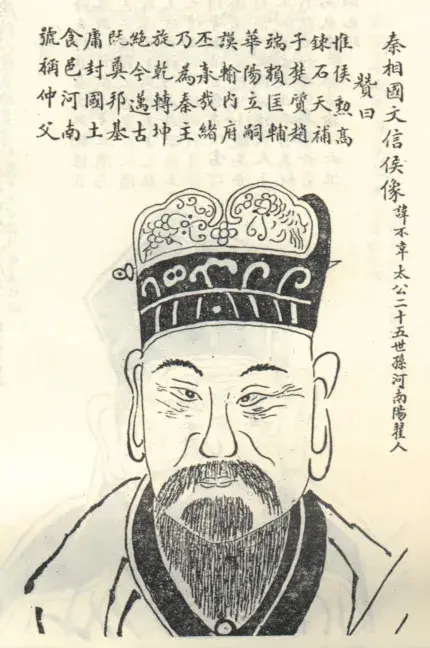
Lü Buwei, ancestral surname Jiang, clan name Lü, given name Buwei, was originally a native of Puyang, capital of the State of Wey (southwest of present-day Puyang City, Henan Province), who early in life traveled extensively for trade between the bustling Han capital of Yangdi (present-day Yuzhou City, Xuchang City, Henan Province) and the Zhao capital of Handan. Possessing keen commercial acumen, he amassed a fortune of thousands of gold pieces by traveling across the states to "buy low and sell high," becoming a great merchant renowned throughout the Central Plains.
In the fortieth year of King Zhaoxiang of Qin (267 BCE), Crown Prince Dao of Qin died in the State of Wei; in the forty-second year of King Zhaoxiang (265 BCE), King Zhaoxiang invested his second son Lord Anguo (Ying Zhu) as Crown Prince. Lord Anguo had more than twenty sons; his favorite primary consort was Lady Huayang (a noblewoman of the Chu royal house), yet Lady Huayang had no son. Among Lord Anguo's middle sons was a concubine-born son named Yiren, whose biological mother Lady Xia was unfavored, so that Yiren was sent to the Zhao capital of Handan as a hostage of Qin. Because Qin and Zhao were locked in incessant warfare—especially before and after the Battle of Changping—the court and people of Zhao treated Yiren coldly, leaving his carriages, horses, and daily allowance in Handan meager and his life in dire straits.
While trading in Handan, Lü Buwei chanced to meet the destitute Qin hostage prince Yiren. With sharp political intuition, Lü Buwei was overjoyed and remarked privately: "This is truly a rare commodity worth hoarding to await a high price!" (the origin of the Chinese idiom qihuo keju). Returning home, he discussed the matter with his father, asking: "How many times profit does farming the land yield?" His father replied: "Tenfold." Lü Buwei asked again: "How many times profit does trading in pearls and jade yield?" His father replied: "A hundredfold." Lü Buwei asked once more: "How many times profit does establishing the ruler of a state and securing its power yield?" His father sighed: "Countless times—beyond calculation!" Lü Buwei then made up his mind, saying: "Nowadays even diligent farming barely provides food and clothing, whereas establishing a ruler and founding a state brings blessings to future generations. I have decided to undertake this greatest of ventures!"
Lobbying Lady Huayang and Escaping from Handan
Visiting Yiren forthwith, Lü Buwei said to him: "I can enlarge your family gate." Yiren laughed and replied: "Why don't you first enlarge your own gate, and then come enlarge mine!" Lü Buwei answered earnestly: "My gate must wait for your gate to be enlarged before it can be enlarged!" Grasping Lü Buwei's deeper meaning at once, Yiren invited him into his inner chamber for an intimate conversation. Lü Buwei analyzed his situation: "King Zhaoxiang of Qin is already old, and your father Lord Anguo has been invested as Crown Prince. Right now Lord Anguo intends to name your half-brother Zixi as his heir, for Zixi is assisted by Shi Cang and supported by his mother in the palace; whereas you rank in the middle, your mother Lady Xia is unfavored, making it impossible for you to contend for the succession against your brothers, and you reside in the enemy state of Zhao where your life will be in peril the moment war breaks out. Yet Lord Anguo dotes on the childless Lady Huayang; I am willing to spend a thousand pieces of gold from my family fortune to travel west to Qin and lobby Lord Anguo and Lady Huayang to establish you as legitimate heir." Bowing his head to the ground in gratitude, Yiren declared: "If your plan succeeds, I am willing to share the land of Qin with you!"
Lü Buwei immediately gave five hundred gold pieces to Yiren so that he could improve his living conditions in Handan and cultivate guests from the feudal states to build a reputation for worthiness, while using another five hundred gold pieces to purchase rare treasures and traveling west in person to the Qin capital of Xianyang to lobby the court. Adopting a strategy of working from the outside in, Lü Buwei first called upon Lady Huayang's younger brother Lord Yangquan, presenting generous gifts and warning him in alarming terms: "Do you realize, my lord, that you are already guilty of a capital crime? All the retainers under your gate hold high rank and power, and your mansion overflows with fine horses and beauties, whereas not a single man of note serves under Crown Prince Anguo; once the old King of Qin dies and Zixi succeeds to the throne and entrusts power to Shi Cang, your life and family will be as precarious as a stack of eggs! Right now Prince Yiren, who is a hostage in Zhao, is worthy and filial; if you have your elder sister Lady Huayang adopt Yiren as her son and establish him as heir, the childless Lady Huayang will have a lifelong support and you will enjoy wealth and honor as stable as Mount Tai for ten thousand years!" Alarmed, Lord Yangquan agreed to follow his advice in every detail and arranged for Lü Buwei to speak to Lady Huayang through her elder sister.
Presenting rare treasures to Lady Huayang through her elder sister, Lü Buwei praised Yiren's talent, virtue, and wide circle of guests in Zhao, adding that Yiren wept day and night longing for the Crown Prince and Lady Huayang and "revered Madam just like his own biological mother"; Lady Huayang's elder sister further persuaded her with the famous maxim that "one who serves another with beauty sees love fade as soon as beauty decays," urging her younger sister to elevate Yiren as her adoptive son while she was still young and favored. Deeply convinced, Lady Huayang wept before Lord Anguo at a moment of leisure and earnestly begged him to establish Yiren as his legitimate heir. Agreeing on the spot, Lord Anguo and Lady Huayang carved a jade tally as proof of Yiren's status as legitimate heir, sent lavish gifts to Yiren in Zhao, and formally appointed Lü Buwei as Yiren's tutor, causing Yiren's fame to soar among the feudal states.
During this time, while drinking at a banquet in Lü Buwei's Handan residence, Yiren caught sight of a stunningly beautiful dancing concubine of Lü Buwei's (Lady Zhao, daughter of a prominent Handan family), rose to toast Lü Buwei, and asked that the woman be given to him. Angry at first, Lü Buwei reflected that he had already spent his fortune on Yiren in order to "angle for a rare commodity," and reluctantly presented Lady Zhao to Yiren (Sima Qian's Records of the Grand Historian states that Lady Zhao was already pregnant by Lü Buwei before being presented and gave birth after twelve months in the first month of the forty-eighth year of King Zhaoxiang to a son named Zheng, namely Qin Shi Huang Ying Zheng, whereupon Yiren made Lady Zhao his consort; modern historians generally conclude that Ying Zheng was in fact Yiren's biological son and that the tale of "presenting a pregnant concubine and a twelve-month pregnancy" was a slanderous rumor spread by remnants of the six states and political enemies).
In the fiftieth year of King Zhaoxiang of Qin (257 BCE), when Qin general Wang He besieged the Zhao capital of Handan, the furious King of Zhao sought to execute the hostage Yiren. Plotting urgently with Yiren, Lü Buwei paid six hundred catties of gold to bribe the Handan gate officers, disguised Yiren, and fled Handan overnight into the Qin army camp to return safely to Xianyang, while Lady Zhao and the infant Ying Zheng survived by hiding among her wealthy maternal family in Zhao. Before Yiren went to pay his respects to Lady Huayang upon returning to Qin, Lü Buwei specially instructed him to dress in Chu-style robes and cap; originally a native of Chu, Lady Huayang was delighted at the sight of his Chu attire and exclaimed: "I am from Chu; since you are so thoughtful, henceforth you shall be renamed 'Zichu'!" formally adopting him as her son. When King Zhaoxiang died in 251 BCE, Lord Anguo ascended the throne as King Xiaowen of Qin, establishing Lady Huayang as Queen and Zichu as Crown Prince while Zhao sent Lady Zhao and Ying Zheng back to Qin; when King Xiaowen died suddenly just three days after his formal coronation in 250 BCE, Crown Prince Zichu succeeded him as King Zhuangxiang of Qin.
Assisting Qin as Grand Councilor and The Annals of Lü Buwei
In the first year of King Zhuangxiang of Qin (249 BCE), King Zhuangxiang honored his adoptive mother Queen Huayang as Queen Dowager Huayang and his biological mother Lady Xia as Queen Dowager Xia; to repay Lü Buwei's merit in putting him on the throne, he formally appointed Lü Buwei as Grand Councilor of Qin, enfeoffed him as "Marquis of Wenxin," and granted him the rich region of Luoyang in Henan with a fief of 100,000 households. That very year, when Duke Wen of Eastern Zhou plotted with the feudal states against Qin, King Zhuangxiang ordered Lü Buwei to lead troops on a punitive expedition that extinguished the remnant state of Eastern Zhou, relocated the Duke of Eastern Zhou to Yangrenju, and annexed the royal domain of Luoyang; Lü Buwei then directed Qin general Meng Ao and others to advance east, seizing Chenggao and Xingyang from Han to establish Sanchuan Commandery, capturing thirty-seven cities including Jinyang from Zhao to establish Taiyuan Commandery, and taking Gaodu and Ji from Wei, throwing open the gateway to the Central Plains east of the Yellow River.
Reigning for only three years, King Zhuangxiang died of illness in the fifth month of his third year (247 BCE), and the thirteen-year-old Crown Prince Ying Zheng succeeded to the throne as King of Qin. Ying Zheng honored Lü Buwei as "Chancellor of State" (Xiangbang) and addressed him as "Second Father" (Zhongfu). Because King Zheng was young, all military and state power in Qin was monopolized by Lü Buwei, whose mansion maintained ten thousand household servants. Throughout his ten years at the helm of Qin, Lü Buwei vigorously pursued eastward expansion: establishing Dong Commandery so that Qin's territory bordered Qi, supporting the Han hydraulic engineer Zheng Guo in excavating the "Zheng Guo Canal" to enrich Guanzhong agriculture, and routing the last joint expedition of the five-state vertical alliance of Chu, Zhao, Wei, Han, and Yan against Qin in the sixth year of King Zheng (241 BCE).
At that time the custom of maintaining retainers was at its height: Lord Xinling of Wei, Lord Chunshen of Chu, Lord Pingyuan of Zhao, and Lord Mengchang of Qi were known as the "Four Lords of the Warring States," renowned across the world for treating worthy scholars with courtesy. Believing that with Qin so powerful he—as Chancellor of State and Second Father—must not be outshone by the Four Lords, Lü Buwei threw open his mansion to recruit scholars and debaters from across the world with lavish treatment until his retainers numbered three thousand. Seeing masters like Xunzi writing books that circulated everywhere, Lü Buwei ordered his three thousand retainers each to write down what they had learned and heard, compiling their essays into a monumental work of Eight Examinations, Six Discourses, and Twelve Almanacs totaling over 200,000 characters entitled The Annals of Lü Buwei (Lüshi Chunqiu), completed in the eighth year of King Zheng (239 BCE). Lü Buwei had the entire text copied onto silk and hung at the city gate of Xianyang with a thousand gold pieces suspended above it, proclaiming that anyone who could add or delete a single character would receive the thousand gold pieces—yet no one dared alter a single word.
Lao Ai's Rebellion and Suicide by Poisoned Wine
When King Zheng first ascended the throne as a boy, his widowed biological mother Queen Dowager Zhao (Lady Zhao) often carried on a secret affair in the inner palace with her former master Lü Buwei. As King Zheng grew to manhood, Queen Dowager Zhao continued her licentious behavior; terrified that exposure of their affair would bring extermination upon his clan, Lü Buwei secretly sought out a man with an exceptionally large phallus named Lao Ai as a retainer, had him perform at musical gatherings by sticking his phallus through the hub of a paulownia-wood wheel to make it turn as he walked, and arranged for Queen Dowager Zhao to hear of it so as to entice her. When the Queen Dowager eagerly desired him, Lü Buwei arranged for someone to accuse Lao Ai of a crime punishable by castration, while secretly instructing the Queen Dowager to bribe the judicial officers so that Lao Ai could feign castration, pluck out his beard and eyebrows, and enter the palace disguised as a eunuch. Carrying on an affair day and night with Lao Ai and becoming pregnant, the Queen Dowager claimed that divination advised leaving Xianyang and moved to Dazheng Palace in the old Qin capital of Yong, bearing Lao Ai two illegitimate sons and entrusting all palace decisions to him. Enfeoffed as Marquis of Changxin in 239 BCE, Lao Ai kept thousands of servants and over a thousand retainers in overweening arrogance.
In the fourth month of the ninth year of King Zheng (238 BCE), the twenty-two-year-old King Zheng traveled to Qinian Palace in Yong to perform his capping ceremony and assume personal rule. At this moment someone secretly denounced Lao Ai to King Zheng, revealing that he was no real eunuch, had fathered two hidden sons with the Queen Dowager, and had plotted with her that "once the King of Qin dies, we will enthrone our own son." When King Zheng ordered an investigation, the terrified Lao Ai forged the Queen Dowager's seal while the King was at Yong to mobilize palace guards and county troops in an attack on Qinian Palace. Fully prepared, King Zheng ordered Lord Changping and Lord Changwen to send troops against the rebels, routing them at Xianyang, capturing Lao Ai at Haozhi to be torn apart by chariots, exterminating his three kindreds, dashing to death the two illegitimate sons, and confining Queen Dowager Zhao at Fuyang Palace in Yong. During the trial, judicial officers uncovered the full truth of how Chancellor of State Lü Buwei had originally sent Lao Ai into the palace disguised as a eunuch and carried on his earlier affair with the Queen Dowager.
Furious upon learning the truth, King Zheng initially intended to execute Lü Buwei at once; out of regard for Lü Buwei's great service in enthroning the late King Zhuangxiang and the pleas of thousands of retainers and debaters on his behalf, however, the King stayed his hand. In the tenth month of the tenth year of King Zheng (237 BCE), King Zheng formally issued an edict dismissing Lü Buwei as Chancellor of State; soon afterward, when the Qi debater Mao Jiao risked his life to persuade King Zheng to travel to Yong and welcome Queen Dowager Zhao back to Xianyang, King Zheng expelled Marquis of Wenxin Lü Buwei from the capital and ordered him to retire to his fief at Luoyang in Henan.
After Lü Buwei returned to his fief at Luoyang in Henan, despite having lost his office as Chancellor of State of Qin, his prestige across the feudal states remained immense; over the next year and more, envoys and wandering scholars from the six states east of the mountains streamed endlessly to Luoyang to call upon him. Deeply wary lest Lü Buwei collude with the six states to stage a rebellion, King Zheng—now in firm control of Qin—personally wrote a stern, icy edict to Lü Buwei in his twelfth year (235 BCE): "What merit have you toward Qin, that Qin enfeoffs you in Henan with a fief of 100,000 households? What blood tie have you to the royal house of Qin, that you are styled Second Father? You and your entire household shall move forthwith to reside in Shu!" Reading the edict, Lü Buwei realized that King Zheng was closing in on him step by step and that exile to Shu would only end in humiliating execution; in despair, he drank poisoned wine (Zhenjiu) at his Luoyang residence and died. After his retainers secretly buried him on Mount Beimang in Luoyang (present-day Dazhongtou Village, Shouyangshan Subdistrict, Yanshi District, Luoyang City, Henan Province), King Zheng ordered all retainers from Han, Zhao, and Wei who had attended his funeral expelled from Qin and all Qin officials who had attended dismissed from office.
Major Achievements
Investing in Zichu in Handan as a "Rare Commodity Worth Hoarding," Completing History's Most Famous Political Investment
Originally a great merchant of Wey trading between Yangdi and Handan, Lü Buwei displayed extraordinary strategic foresight during the reign of King Zhaoxiang of Qin. Recognizing the potential of the destitute Qin hostage prince Yiren in Handan—who ranked in the middle among his brothers and lacked a favored mother—he treated him as a "rare commodity worth hoarding" and boldly committed a thousand pieces of gold from his family fortune: half to fund Yiren's cultivation of guests in Zhao, and half to purchase rare treasures and lobby Lord Yangquan and the elder sister of Lord Anguo's primary consort Lady Huayang in Qin, successfully persuading the childless Lady Huayang to adopt Yiren as legitimate heir; he then spent six hundred catties of gold to rescue Yiren from besieged Handan, had him wear Chu attire to please Lady Huayang and take the name Zichu, and presented Lady Zhao to him in Handan, who gave birth to Ying Zheng. This tightly linked sequence of maneuvers not only placed Yiren on the throne as King Zhuangxiang of Qin, but elevated Lü Buwei from a merchant to Grand Councilor of Qin, Marquis of Wenxin, and "Second Father" to King Zheng of Qin.
Directing Qin State Affairs for Twelve Years: Extinguishing Eastern Zhou, Founding Three Commanderies, and Building the Zheng Guo Canal
From his appointment as Grand Councilor in the first year of King Zhuangxiang (249 BCE) to his dismissal in the tenth year of King Zheng (237 BCE), Lü Buwei directed the central military and civil administration of Qin for twelve years. In military expansion, he personally led troops to extinguish the state of Eastern Zhou, removing the geographical barrier to Qin's eastward advance, and directed generals such as Meng Ao to seize key territories from Han, Zhao, and Wei, establishing Sanchuan, Taiyuan, and Dong commanderies so that Qin's border reached Qi and enveloped Han, Wei, and Zhao on three sides, while defeating the five-state coalition attack on Qin in 241 BCE; in economic development, he supported and saw through the construction of the "Zheng Guo Canal" by the Han hydraulic engineer Zheng Guo, transforming over forty thousand qing of alkaline land in Guanzhong into fertile fields and laying a solid material foundation for Qin Shi Huang's wars of unification.
Recruiting Three Thousand Retainers to Compile The Annals of Lü Buwei, Leaving the Cultural Monument of "A Thousand Gold Pieces for a Single Word"
To rival the "Four Lords of the Warring States" and construct an ideological blueprint for the coming unified empire, Lü Buwei recruited three thousand scholars and retainers in Xianyang and had them synthesize the strengths of Confucian, Mohist, Daoist, Legalist, Nominalist, Agriculturalist, Military, and Yin-Yang thought around a core of Huang-Lao Daoism and Confucian-Legalist governance, completing in the eighth year of King Zheng (239 BCE) the eclectic masterpiece The Annals of Lü Buwei (Lüshi Chunqiu) in Eight Examinations, Six Discourses, and Twelve Almanacs totaling over 200,000 characters. Displayed at the city gate of Xianyang with a thousand gold pieces suspended above it, it gave rise to the adage "a thousand gold pieces for a single word." Although set aside by King Zheng after Lü Buwei's downfall in favor of the strict Legalist line of Li Si and Han Fei, The Annals of Lü Buwei preserved invaluable pre-Qin philosophical texts and agricultural-scientific records as an encyclopedic monument of late Warring States thought.