Appointment as Handsome Fairness
Upon Emperor Yuan's accession, Lady Fu was appointed Handsome Fairness; she bore Princess Pingdu and Liu Kang (Prince Gong of Dingtao), and was later promoted to Consort of Bright Deportment.
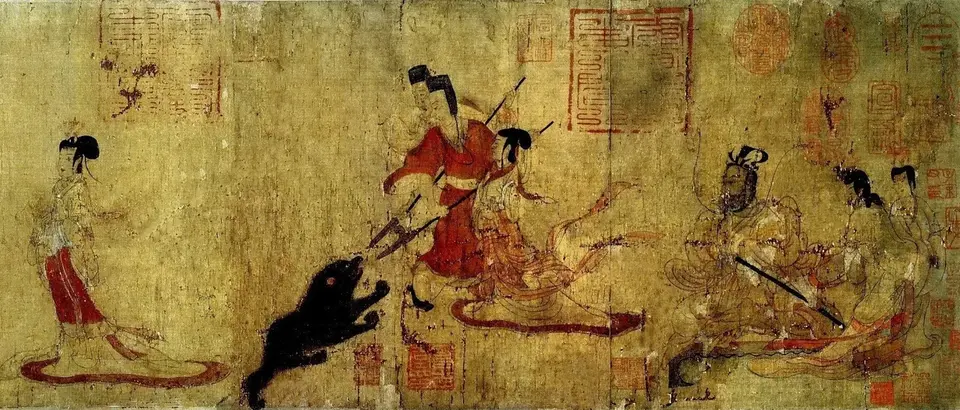
?–2 BCE
傅昭仪
Fu Zhaoyi (傅昭仪, died 2 BCE), a native of Wen County in Henei Commandery (modern-day Wen County, Henan Province), was a favored consort of Emperor Yuan of Han (Liu Shi), the biological mother of Liu Kang (Prince Gong of Dingtao), and the grandmother of Emperor Ai of Han (Liu Xin). Entering the palace in her youth as a Talented Lady attending Empress Dowager Shangguan, she gained the favor of Liu Shi while he was Crown Prince.…
Fu Zhaoyi (傅昭仪, died 2 BCE), a native of Wen County in Henei Commandery (modern-day Wen County, Henan Province), was a favored consort of Emperor Yuan of Han (Liu Shi), the biological mother of Liu Kang (Prince Gong of Dingtao), and the grandmother of Emperor Ai of Han (Liu Xin). Entering the palace in her youth as a Talented Lady attending Empress Dowager Shangguan, she gained the favor of Liu Shi while he was Crown Prince. Upon ascending the throne, Emperor Yuan appointed her Handsome Fairness and subsequently elevated both her and Feng Yuan to the newly created senior consort rank of Consort of Bright Deportment. After Emperor Yuan's death, she accompanied her son Liu Kang to his fief at Dingtao as Queen Dowager of Dingtao. When Liu Kang died young, she personally raised her infant grandson Liu Xin. Because Emperor Cheng had no heir, she lavished treasures upon Zhao Zhaoyi and General of Agile Cavalry Wang Gen to secure Liu Xin's appointment as Crown Prince. After Liu Xin ascended the throne as Emperor Ai, she used the covered passageway from the Northern Palace to enter Weiyang Palace daily, intervening in state affairs, forcing the dismissal of Chancellor Kong Guang, Grand Minister of Works Shi Dan, and Grand Marshal Fu Xi, and obtaining the exalted titles of Empress Dowager Gong, Imperial Grand Empress Dowager, and Grand Empress Dowager at Yongxin Palace. She ennobled numerous members of the Fu and Zheng clans and drove her rival Queen Dowager Feng of Zhongshan to suicide. She died in 2 BCE and was buried with Emperor Yuan at Weiling, but after Emperor Ai's death, Wang Mang stripped her of her posthumous titles and leveled her tomb.
Upon Emperor Yuan's accession, Lady Fu was appointed Handsome Fairness; she bore Princess Pingdu and Liu Kang (Prince Gong of Dingtao), and was later promoted to Consort of Bright Deportment.
Following the death of Emperor Yuan, Fu Zhaoyi accompanied her son Liu Kang to his principality of Dingtao as Queen Dowager of Dingtao.
Liu Kang died and was succeeded as Prince of Dingtao by his young son Liu Xin, whom Queen Dowager Fu personally nurtured to adulthood.
When Liu Xin attended court, Queen Dowager Fu bribed Zhao Zhaoyi and General of Agile Cavalry Wang Gen with treasures to secure the succession for Liu Xin.
Emperor Cheng formally installed Liu Xin as Crown Prince; through the intervention of Empress Dowager Wang Zhengjun, Queen Dowager Fu was permitted to visit the Crown Prince's residence every ten days.
Emperor Ai ascended the throne; taking up residence in the Northern Palace, she used its covered walkway to enter Weiyang Palace and received the title Empress Dowager Gong.
Emperor Ai removed the regional prefix "Dingtao" and honored her as Imperial Grand Empress Dowager at Yongxin Palace after purging Shi Dan, Kong Guang, and Fu Xi.
In the sixth month, Emperor Ai elevated her to Grand Empress Dowager, placing her on par with Grand Empress Dowager Wang Zhengjun and ennobling her Fu and Zheng kinsmen.
Died on the seventeenth day of the first month and was buried with Emperor Yuan at Weiling; in 5 CE, Wang Mang had her tomb excavated, her jade shroud removed, and her remains reburied in Dingtao.
Lady Fu's father was a native of Wen County in Henei Commandery (modern-day Wen County, Henan Province) who died early, after which her mother remarried Zheng Weng of Wei Commandery and bore a son named Zheng Yun and a daughter named Zheng Li. Entering the imperial palace in her youth, Lady Fu served as a Talented Lady (a palace lady-in-waiting) in the household of Empress Dowager Shangguan, the widow of Emperor Zhao. After Liu Shi (later Emperor Yuan) was invested as Crown Prince under Emperor Xuan, Lady Fu gained his favor. When Emperor Yuan ascended the throne in the first year of the Huanglong era (49 BCE), he appointed her Handsome Fairness and favored her deeply.
Endowed with shrewdness and tact, Lady Fu excelled at winning the goodwill of those around her; even palace attendants and servants poured libations of wine upon the ground when drinking to pray for her longevity. She bore Emperor Yuan one daughter, Princess Pingdu, and one son, Liu Kang, Prince Gong of Dingtao. Liu Kang possessed artistic talent and was greatly loved by Emperor Yuan. At that time, Emperor Yuan favored both Handsome Fairness Fu and Handsome Fairness Feng (Feng Yuan), who had borne Liu Xing, Prince Xiao of Zhongshan. Wishing to distinguish the two consorts above the rest of the harem because both had sons who were princes—yet unable to style them Queen Dowagers while he himself was alive—Emperor Yuan created the new title of Consort of Bright Deportment (Zhaoyi), bestowing seals and ribbons upon them and ranking them above Handsome Fairness to signify their exalted deportment.
When Emperor Yuan died in the first year of the Jingning era (33 BCE), Fu Zhaoyi accompanied her son Liu Kang to his fief in Dingtao and was styled Queen Dowager of Dingtao (also known as Queen Dowager Fu). In the second year of the Yangshuo era (22 BCE), Prince Gong of Dingtao died and was succeeded by his young son Liu Xin, born of Consort Ding. Queen Dowager Fu personally nursed and raised Liu Xin to adulthood. Because Emperor Cheng had no sons of his own, the imperial succession remained unsettled, with only Emperor Cheng's younger brother Liu Xing (Prince Xiao of Zhongshan) and his nephew Liu Xin (Prince of Dingtao) as close royal candidates.
In the fourth year of the Yuanyan era (9 BCE), both Prince Xiao of Zhongshan and the Prince of Dingtao came to Chang'an for a court audience. Queen Dowager Fu secretly presented lavish gifts of rare treasures to Emperor Cheng's favorite consort Zhao Zhaoyi (Zhao Hede) and the emperor's maternal uncle Wang Gen, General of Agile Cavalry, privately soliciting their backing to have Liu Xin named heir apparent. Seeing that Emperor Cheng was childless and wishing to secure their own future prosperity by ingratiating themselves with the next ruler, Zhao Zhaoyi and Wang Gen praised Liu Xin before the emperor. Emperor Cheng himself admired Liu Xin's ability and, in the following year (first year of the Suihe era, 8 BCE), summoned the Prince of Dingtao and installed him as Crown Prince, while appointing Liu Jing, grandson of Prince Xiao of Chu, as Prince of Dingtao to maintain Liu Kang's ancestral sacrifices.
When Crown Prince Liu Xin wished to offer formal thanks to his grandmother Queen Dowager Fu and his mother Consort Ding, Grand Tutor Zhao Xuan approved, for which the Imperial Secretariat impeached Zhao Xuan and demoted him to Chamberlain for the Palace Revenues, replacing him with Shi Dan as Grand Tutor. An imperial edict ordered Queen Dowager Fu and Consort Ding to remain in the Dingtao princely residence in the capital, ruling that since the Crown Prince had entered the main imperial line, he could no longer show private partiality by meeting them. Soon afterward, Emperor Cheng's mother, Empress Dowager Wang Zhengjun, intervened on the grounds that Queen Dowager Fu had raised the young prince from infancy like a wet nurse, and Emperor Cheng permitted Queen Dowager Fu alone to visit the Crown Prince's residence once every ten days, while Consort Ding remained barred.
In the second year of the Suihe era (7 BCE), Emperor Cheng died and Crown Prince Liu Xin ascended the throne as Emperor Ai. Grand Empress Dowager Wang Zhengjun resided in Changle Palace and issued an edict allowing Queen Dowager Fu and Consort Ding to visit Weiyang Palace every ten days. When Emperor Ai consulted Chancellor Kong Guang and Grand Minister of Works He Wu regarding where Queen Dowager Fu should reside, Kong Guang—knowing her fierce temper and penchant for political intrigue—feared she would meddle in state affairs and proposed building a separate palace for her. He Wu suggested lodging her in the Northern Palace, which Emperor Ai approved. Because the Northern Palace was linked to Weiyang Palace by the Zifang covered passageway, Queen Dowager Fu used this elevated corridor morning and night to visit the emperor's quarters, relentlessly demanding higher imperial titles for herself and offices and peerages for her kinsmen.
Seeking to curry favor, Dong Hong, Marquis of Gaochang, cited the precedent of Lady Xia, biological mother of King Zhuangxiang of Qin, and petitioned to honor Consort Ding as Imperial Empress Dowager. General of the Left Shi Dan and Grand Marshal Wang Mang jointly impeached Dong Hong for invoking the precedent of fallen Qin to mislead the court; newly enthroned, Emperor Ai accepted their remonstrance and reduced Dong Hong to commoner status. Furious, Queen Dowager Fu coerced Emperor Ai into granting her an imperial title. Emperor Ai persuaded Grand Empress Dowager Wang Zhengjun to issue an edict elevating Prince Gong of Dingtao posthumously to Emperor Gong of Dingtao; citing the Spring and Autumn Annals principle that "a mother is honored through her son," Emperor Ai honored Queen Dowager Fu as Empress Dowager Gong and Consort Ding as Empress Gong, establishing Household Provisioners of the Left and Right for them with fiefs matching Changle and Weiyang palaces, and posthumously enfeoffing Lady Fu's father as Marquis Chongzu.
Still unsatisfied, Empress Dowager Fu demanded a title equal to that of Grand Empress Dowager Wang Zhengjun. Grand Minister of Works Shi Dan, Chancellor Kong Guang, and her own cousin Grand Marshal Fu Xi firmly opposed her request. After several years of deadlock, Empress Dowager Fu's faction collaborated with Zhu Bo to engineer the successive dismissal of Shi Dan, Kong Guang, and Fu Xi, expelling Fu Xi to his marquisate. With court opposition removed, in the fourth month of the second year of the Jianping era (5 BCE), Emperor Ai deleted the regional prefix "Dingtao" from his father's title and elevated Empress Dowager Gong to "Imperial Grand Empress Dowager" and Empress Gong to "Imperial Empress Dowager." In the sixth month of the fourth year of the Jianping era (3 BCE), he further elevated Lady Fu to "Grand Empress Dowager," styling her residence Yongxin Palace and staffing it with a Chamberlain for the Palace Revenues and a Chamberlain for the Imperial Stud at the rank of fully two thousand bushels, alongside the three other empresses dowager.
Once elevated to supreme status, Grand Empress Dowager Fu grew increasingly arrogant, even addressing Grand Empress Dowager Wang Zhengjun disrespectfully as "old woman" (yu) in conversation. Harboring a long-standing grudge against Queen Dowager Feng (Feng Yuan), mother of Prince Xiao of Zhongshan, from their days serving Emperor Yuan together, she fabricated charges of sorcery and cursing the emperor against Feng Yuan, driving her to commit suicide by poison. She also lavished high offices upon her relatives: her cousins Fu Xi and Fu Yan both served as Grand Marshal as Marquis of Gaowu and Marquis of Kongxiang; her cousin Fu Shang was enfeoffed as Marquis of Ruchang to continue the lineage of her father (renamed Marquis Ai of Ruchang); and Zheng Ye, son of her half-brother Zheng Yun, was enfeoffed as Marquis of Yangxin. Across the Fu and Zheng clans, six men were made marquises, two served as Grand Marshal, six reached the Nine Ministers or two-thousand-bushel rank, and more than ten served as Palace Attendants. When Emperor Ai dismissed her grandnephew Fu Qian for corrupt conduct and ordered him sent back to his commandery, Grand Empress Dowager Fu flew into a rage, forcing the intimidated emperor to revoke the edict and reinstate Fu Qian as Palace Attendant.
On the seventeenth day of the first month of the first year of the Yuanshou era (2 BCE), Grand Empress Dowager Fu died and was buried alongside Emperor Yuan at Weiling under the title "Empress Xiaoyuan Fu." After Emperor Ai died in the second year of the Yuanshou era (1 BCE), Wang Mang returned to power, directed officials to impeach the Ding and Fu clans, stripped them of all offices and titles by edict of Grand Empress Dowager Wang Zhengjun, and demoted Lady Fu posthumously to "Mother of Prince Gong of Dingtao." In the fifth year of the Yuanshi era (5 CE), Wang Mang petitioned to excavate the tombs of Lady Fu and Consort Ding on the grounds that Lady Fu's burial mound at Weiling illicitly matched Emperor Yuan's in height and that she had been buried holding the seals of Grand Empress Dowager Huang. During the excavation of Lady Fu's tomb, the earth collapsed and crushed several hundred workers to death; when her inner coffin was opened, a foul stench spread for miles. Wang Mang had her imperial seals destroyed, replaced her imperial zigong coffin and jade burial suit with an ordinary wooden coffin, reburied her beside Liu Kang's tomb in Dingtao, and mobilized over one hundred thousand laborers for twenty days to level her former tomb at Weiling, surrounding the site with thorns as a warning to posterity.
FIGURES ASSOCIATED WITH THIS DYNASTY