Birth | Born into a farming-and-scholarly family at Baiyangping, Xiangxiang County, Changsha Prefecture.
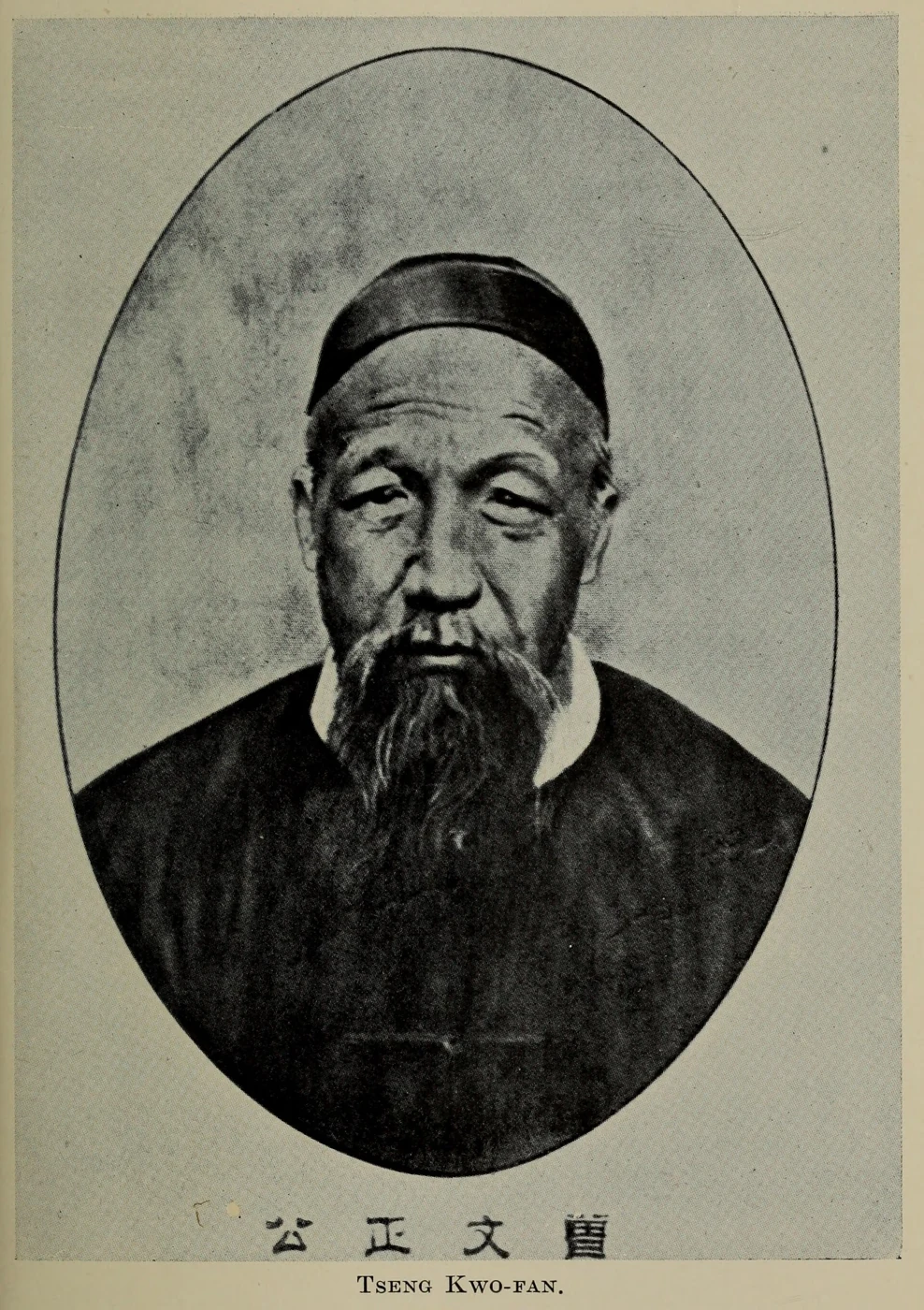
1811 CE–1872 CE
Military commander
Zeng Guofan
曾国藩
Zeng Guofan (November 26, 1811(16th year of Jiaqing)–March 12, 1872(11th year of Tongzhi)), originally named Zeng Zicheng, courtesy name Bohan and art name Disheng, was a native of Xiangxiang, Hunan. He passed the presented-scholar examination in 1838(18th year of Daoguang) and thereafter served in Beijing in the Hanlin Academy and central ministries. After returning home in 1852(2nd year of Xianfeng) to mourn his mother, he…
1811 CE–1872 CEQing Dynasty
PROFILE
Zeng Guofan (November 26, 1811(16th year of Jiaqing)–March 12, 1872(11th year of Tongzhi)), originally named Zeng Zicheng, courtesy name Bohan and art name Disheng, was a native of Xiangxiang, Hunan. He passed the presented-scholar examination in 1838(18th year of Daoguang) and thereafter served in Beijing in the Hanlin Academy and central ministries. After returning home in 1852(2nd year of Xianfeng) to mourn his mother, he was ordered to organize militia in Hunan. He gradually built the Hunan Army and became one of the Qing court's principal commanders in the southeast during the war against the Taiping Heavenly Kingdom. In 1864(3rd year of Tongzhi), Zeng Guoquan led the Hunan Army in capturing Tianjing, bringing the Taiping Heavenly Kingdom to an end. Large-scale burning, looting, and killing followed the capture of the city, and the responsibility of the Zeng brothers and the Hunan Army has long been criticized. Zeng Guofan later participated in campaigns against the Nian Army, reforms of official administration, handling of the Tianjin Massacre, and support for military industry, translation, and plans for overseas study. His political legacy therefore encompasses both military and administrative achievements, the social harm caused by the Hunan Army's wars, and the planning of military industry and education in the late Qing.
- Alternative name
- Zeng Disheng
- Courtesy name
- Bohan
- Art name
- Disheng
- Period
- Qing Dynasty
- Date of Birth
- November 26, 1811 CE(16th year of the Jiaqing era, 10th month, 11th day)
- Date of Death
- March 12, 1872 CE(11th year of the Tongzhi era, 2nd month, 4th day)
- Dynasty / regime
- Qing Dynasty
- Identity
- Military commander
- Ethnicity / ethnic affiliation
- Not reliably established in the available sources
- Native place
- Not reliably established in the historical sources
- Place of birth
- Unknown
- Major achievements
- Commander of the Hunan Army; suppressed the Taiping Heavenly Kingdom and the Nian forces; regarded as one of the foremost statesmen of the late Qing restoration and a major scholar of Neo-Confucianism.
- Original Name
- Zeng Zicheng
- Courtesy Name
- Bohan
- Art Name
- Disheng
- Dynasty/Polity
- Qing
- Ethnicity
- No reliable record has been found in the existing materials
- Ancestral Origin
- Xiangxiang, Hunan (around present-day Shuangfeng County, Hunan)
- Birthplace
- Baiyangping, Xiangxiang County, Changsha Prefecture, Hunan (around present-day Heye Town, Shuangfeng County, Loudi, Hunan)
- Place of Death
- Office of the Governor-General of Liangjiang, Nanjing
- Highest Offices
- Grand Secretary of the Wuying Hall; Governor-General of Liangjiang
- Noble Title
- First-Class Marquis Yiyong
- Posthumous Title
- Wen Zheng
- Principal Offices
- Compiler of the Hanlin Academy, Grand Councillor of the Secretariat, Vice Minister of Rites, Governor-General of Liangjiang, Governor-General of Zhili
- Major Achievements
- Organized and commanded the Hunan Army; participated in suppressing the Taiping Heavenly Kingdom and in the capture of Tianjing; reorganized local military administration and official governance; supported the Anqing Arsenal, the Jiangnan Arsenal, translation work, and educational initiatives; left poetry, prose, memorials, diaries, and family letters
LIFE TIMELINE
Zeng Guofan (November 26 | Zeng Guofan (November 26, 1811(16th year of Jiaqing)–March 12, 1872(11th year of Tongzhi)), originally named Zeng Zicheng, courtesy name Bohan and art name Disheng, was a native of Xiangxiang, Hunan.
Early studies | Took the Changsha Prefecture children's examination and ranked seventh.
In 1826(6th year of Daoguang) | In 1826(6th year of Daoguang), he took the children's examination.
Academy studies | First studied in Hengyang and later entered Lianbin Academy in Xiangxiang.
Civil examinations | Obtained the shengyuan degree.
Civil examinations | Studied at Yuelu Academy and passed the Hunan provincial examination, ranking thirty-sixth among the successful candidates.
Entry to the Yuelu Academy | He entered the Yuelu Academy and placed thirty-sixth in the Hunan provincial examination.
Metropolitan examinations | Failed two metropolitan examinations, remained in Beijing to study, and later returned home.
He failed the metropolitan examination in both 1835(15th year of Daoguang) and 1836(16th y | He failed the metropolitan examination in both 1835(15th year of Daoguang) and 1836(16th year of Daoguang), remained in Beijing to study, and returned home afterward.
He failed the metropolitan examination in both 1835(15th year of Daoguang) and 1836(16th y | He failed the metropolitan examination in both 1835(15th year of Daoguang) and 1836(16th year of Daoguang), remained in Beijing to study, and returned home afterward.
Entered official service | Passed as a presented scholar, ranked forty-second in the third class of the palace examination, and was selected as a Hanlin Bachelor.
On his third attempt in 1838(18th year of Daoguang) | On his third attempt in 1838(18th year of Daoguang), he passed the metropolitan examination, received the status of presented scholar of the third class, and entered the Hanlin Academy as a Hanlin Bachelor.
Hanlin appointment | After completing the Hanlin probationary examination, was appointed Compiler of the Hanlin Academy.
After completing the Hanlin probationary examination in 1840(20th year of Daoguang) | After completing the Hanlin probationary examination in 1840(20th year of Daoguang), Zeng Guofan was appointed Compiler of the Hanlin Academy.
Promotion in Beijing | Successively served as provincial-examination examiner, expositor-in-waiting, reader-in-waiting, Grand Councillor of the Secretariat, Vice Minister of Rites, and in other offices.
Chief examiner for Sichuan | He served as chief examiner for the Sichuan provincial examination and was appointed Reader-in-Waiting of the Hanlin Academy.
Li Hongzhang became his student in 1845 (25th year of Daoguang) and later served for many | Li Hongzhang became his student in 1845 (25th year of Daoguang) and later served for many years within his staff and military-administrative system.
Rise to the Grand Secretariat | He was promoted to Grand Secretary of the Grand Secretariat with the rank of Vice Minister of Rites.
Appointment as Vice Minister of Rites | He was appointed Right Vice Minister of Rites.
Memorial on the emperor’s virtue | He submitted the memorial "Respectfully Setting Out Three Aspects of the Sagely Virtue to Prevent Abuses", pointing directly to the Xianfeng Emperor’s faults.
Memorials on state affairs | Submitted views on appointments, military administration, and court government.
Mourning for his mother | Learned of his mother's death while traveling on official duty and returned home for the mourning period.
In 1852(2nd year of Xianfeng) | In 1852(2nd year of Xianfeng), Zeng Guofan was serving as chief examiner of the Jiangxi provincial examination when, on the road, he learned that his mother, Lady Jiang, had died and returned home to observe mourning.
Creation of the Hunan Army | Ordered to assist in organizing Hunan militia; trained troops at Hengzhou and prepared a naval force.
In August 1853(3rd year of Xianfeng) | In August 1853(3rd year of Xianfeng), Zeng Guofan received approval to train troops at Hengzhou.
Took the field | Issued the Proclamation Against the Guangdong Rebels and led the Hunan Army's land and naval forces eastward.
Defeat at Jinggang and victory at Xiangtan | The Hunan Army's naval force was defeated at Jinggang; forces under Taqibu and Peng Yulin then defeated the Taiping army at Xiangtan.
Advance into Hubei | The Hunan Army took Wuchang and Hanyang; Zeng Guofan was appointed acting Governor of Hubei but did not take up the post.
Tianjiazhen fighting | The Hunan Army captured Tianjiazhen and continued toward Jiujiang.
In early 1854(4th year of Xianfeng) | In early 1854(4th year of Xianfeng), the land and naval forces completed their reorganization.
In April 1854(4th year of Xianfeng) | In April 1854(4th year of Xianfeng), Zeng Guofan's naval force was defeated at Jinggang, and he at one point threw himself into the water before being rescued by his staff member Zhang Shoulin.
On October 14 | On October 14, 1854(23rd day of the 8th month, 4th year of Xianfeng), it took Wuchang and Hanyang, and on December 2, 1854(4th year of Xianfeng) it took Tianjiazhen.
On October 14 | On October 14, 1854(23rd day of the 8th month, 4th year of Xianfeng), it took Wuchang and Hanyang, and on December 2, 1854(4th year of Xianfeng) it took Tianjiazhen.
Defeat at Hukou | Shi Dakai's forces launched a night attack on the Hunan Army's naval camp, captured Zeng Guofan's command vessel, and badly damaged the fleet.
In February 1855(5th year of Xianfeng) | In February 1855(5th year of Xianfeng), Shi Dakai's forces made a night attack on the Hunan Army's naval camp at Hukou, burned warships, captured Zeng Guofan's command vessel, and seized military documents.
Fighting in Jiangxi | Zeng Guofan was for a time confined to Nanchang; the Tianjing Incident occurred within the Taiping Heavenly Kingdom.
Mourning for his father | His father Zeng Linshu died, and Zeng Guofan returned home for mourning.
In 1857(7th year of Xianfeng) | In 1857(7th year of Xianfeng), Zeng Linshu died, and Zeng Guofan returned home for mourning, temporarily leaving military affairs.
Fighting at Jiujiang | Forces under Li Xubin and others took Jiujiang; later that year Li Xubin's troops were defeated at Sanhe.
In 1858(8th year of Xianfeng) | In 1858(8th year of Xianfeng), the Hunan Army captured Jiujiang, but Li Xubin's force was subsequently destroyed at Sanhe by Chen Yucheng and others, showing that the Hunan Army continued to suffer major losses even as it expanded.
Direction of military affairs in Jiangnan | Appointed Governor-General of Liangjiang and Imperial Commissioner, with responsibility for coordinating the southeastern war.
In 1860(10th year of Xianfeng) | In 1860(10th year of Xianfeng), the Qing court appointed Zeng Guofan Governor-General of Liangjiang and Imperial Commissioner and ordered him to direct military affairs in Jiangnan.
Battle of Anqing | The Hunan Army captured Anqing; Zeng Guofan moved his military and administrative headquarters there.
After years of Hunan Army operations around Anqing | After years of Hunan Army operations around Anqing, Zeng Guoquan's forces captured the city on September 5, 1861(11th year of Xianfeng), giving Qing forces an important base for advancing on Tianjing.
Oversight of four provinces | Appointed Assistant Grand Secretary and placed in charge of military affairs in Jiangsu, Anhui, Jiangxi, and Zhejiang, arranging the siege of Tianjing and other operations.
In 1862(1st year of Tongzhi) | In 1862(1st year of Tongzhi), Zeng Guofan became Assistant Grand Secretary and was placed over military affairs in Jiangsu, Anhui, Jiangxi, and Zhejiang.
Fall of Tianjing | Zeng Guoquan led the Hunan Army in capturing Tianjing, and the Taiping Heavenly Kingdom collapsed.
Demobilization of the Hunan Army | Received approval to disband 25,000 Hunan Army troops.
On July 19 | On July 19, 1864(16th day of the 6th month, 3rd year of Tongzhi), the Hunan Army captured Tianjing and the Taiping Heavenly Kingdom collapsed.
Campaign against the Nian Army | Ordered north to deploy containment operations in Shandong, Henan, and other areas.
Campaigns Against the Nian Army | ### Campaigns Against the Nian Army, Military Industry, and Education In 1865(4th year of Tongzhi), the Qing court ordered Zeng Guofan north to campaign against the Nian Army.
Setback against the Nian Army | After Nian forces broke through the defensive line, Zeng Guofan was relieved as Imperial Commissioner and Li Hongzhang took over.
Military industry, translation, and education | Participated in the expansion of the Jiangnan Arsenal and planning for translation and shipbuilding institutions.
In 1866(5th year of Tongzhi) | In 1866(5th year of Tongzhi), Zeng Guofan was relieved of his office as Imperial Commissioner because of the failure of the campaign, and Li Hongzhang replaced him.
Appointment as Grand Secretary | He was appointed a Grand Secretary.
Transfer to Zhili | Became Governor-General of Zhili and dealt with local official administration, litigation, and river affairs.
Governor-General of Zhili | ### Governor-General of Zhili, the Tianjin Massacre, and Final Years In 1868(7th year of Tongzhi), Zeng Guofan was transferred to serve as Governor-General of Zhili and dealt with local litigation, official administration, and river affairs.
Tianjin Massacre | Ordered to Tianjin to investigate conflict between Christians and local residents and negotiate with foreign powers under court policy; after the case was concluded, he faced severe public criticism.
After the Tianjin Massacre in 1870(9th year of Tongzhi) | After the Tianjin Massacre in 1870(9th year of Tongzhi), he was ordered to Tianjin to investigate and negotiate.
Planning overseas education for young students | Together with Li Hongzhang and others, memorialized for the selection of students to study abroad and proposed an agency to administer overseas-study affairs.
Death | Died at his official residence in Nanjing; the Qing court posthumously granted him the title Grand Tutor and the posthumous name Wen Zheng.
On March 12 | On March 12, 1872(4th day of the 2nd month, 11th year of Tongzhi), he died at the office of the Governor-General of Liangjiang in Nanjing.
BIOGRAPHY
Biography
Family Background, Education, and Entry into Office Zeng Guofan was originally named Zeng Zicheng. Born into a farming-and-scholarly family in Xiangxiang, he was the eldest son. His grandfather Zeng Yuping had established the family through farming, while his father Zeng Linshu ran a village school. Zeng Guofan began elementary study at age five and entered the family school at age six. In 1826(6th year of Daoguang), he took the children's examination. He later studied at the Tang clan ancestral hall in Hengyang, Lianbin Academy in Xiangxiang, and Yuelu Academy in Changsha. In 1833(13th year of Daoguang) he obtained the shengyuan degree, and the following year he passed the Hunan provincial examination and became a juren. He failed the metropolitan examination in both 1835(15th year of Daoguang) and 1836(16th year of Daoguang), remained in Beijing to study, and returned home afterward. On his third attempt in 1838(18th year of Daoguang), he passed the metropolitan examination, received the status of presented scholar of the third class, and entered the Hanlin Academy as a Hanlin Bachelor. After completing the Hanlin probationary examination in 1840(20th year of Daoguang), Zeng Guofan was appointed Compiler of the Hanlin Academy. He served in Beijing for more than a decade, successively acting as examiner for provincial and metropolitan examinations and holding posts including expositor-in-waiting, reader-in-waiting, Hanlin expositor, Grand Councillor of the Secretariat, and Vice Minister of Rites. His promotions were concentrated between the 20th and 29th years of Daoguang. While serving in the capital, he studied Cheng–Zhu learning with Tang Jian and associated with Woren, Wu Tingdong, and others. He also befriended Mei Zengliang, Shao Yichen, Liu Rong, Guo Songtao, and others and took an interest in statecraft, military administration, geography, and water management. His scholarly and official careers thus developed together and later formed a basis for recruiting staff and discussing current affairs. In Beijing he also came to know Mujangga, who appreciated and promoted him. Li Hongzhang became his student in 1845 (25th year of Daoguang) and later served for many years within his staff and military-administrative system. Officials and generals whom Zeng Guofan later recommended or recruited were spread across the Hunan Army, the Huai Army, and provincial governorships. His cultivation and use of personnel formed both a personal political network and an important component of local military-administrative operations under the Qing. ### Mourning, Militia, and the Early Hunan Army In 1851(1st year of Xianfeng), Hong Xiuquan launched his uprising at Jintian in Guangxi. The Xianfeng Emperor asked officials for their views, and Zeng Guofan submitted memorials stressing appointments, military administration, and the reform of court government. One memorial displeased the emperor, though it later received a response. In 1852(2nd year of Xianfeng), Zeng Guofan was serving as chief examiner of the Jiangxi provincial examination when, on the road, he learned that his mother, Lady Jiang, had died and returned home to observe mourning. Taiping forces had already entered Hunan. Because the Qing Green Standard Army was insufficient to meet the crisis, local militia came to be regarded as a supplemental source of military manpower. That winter Zeng Guofan was ordered to assist with Hunan militia organization. After Guo Songtao persuaded him to accept the duty during his mourning period, he went to Changsha and discussed arrangements with Governor Zhang Liangji. Zeng Guofan recruited militia in local communities, drawing much of the rank and file from peasants in Xiangxiang and neighboring areas. Men with examination or local administrative experience served as commanders at different levels, and existing local armed groups were also absorbed. He required commanders to recruit their own men and arranged successive layers of personal subordination, with the battalion as the principal organizational unit. Naval and land forces trained separately; soldiers drilled regularly, while battalion officers enforced discipline and rewards and punishments. This recruitment system, sustained by local ties, personal command relationships, and comparatively high pay, strengthened cohesion but also gave the Hunan Army a pronounced character of personal dependence on its commanders. It later became a model for the expansion of provincial military forces. Recruits were also required to have guarantors and to register their home places and relatives so that their identities could be checked and units controlled. Within battalions, units were organized through levels such as shao and dui, while higher commanders and divisional commanders were added as the force expanded. Officers were often personally selected by Zeng Guofan and the commanders of individual battalions, creating a chain in which “soldiers were recruited by commanders, and commanders were controlled by the supreme commander.” This alleviated problems in the Green Standard Army, where officers and soldiers could be unfamiliar with one another and hard to mobilize, but it also tied military loyalty closely to battalion commanders and the overall commander, weakening direct central control over personnel. Zeng Guofan also raised funds from local gentry, sought military pay and equipment, and sent agents to purchase Western artillery. The burden of military finance and methods of raising funds generated controversy. In August 1853(3rd year of Xianfeng), Zeng Guofan received approval to train troops at Hengzhou. He personally attended to the design and drill of firearms, artillery, and warships and organized a naval force. The Hunan Army did not emerge all at once: local militia, earlier traditions of Hunan fighting forces, local social networks, gentry financing, and court authorization all formed its foundation. In early 1854(4th year of Xianfeng), the land and naval forces completed their reorganization. Zeng Guofan issued the Proclamation Against the Guangdong Rebels and led the army toward Hubei and Jiangxi. ### Hunan Army Operations and the War Against the Taiping Heavenly Kingdom The Hunan Army's first campaigns went badly. In March 1854(4th year of Xianfeng), it suffered a reverse at Yuezhou. In April 1854(4th year of Xianfeng), Zeng Guofan's naval force was defeated at Jinggang, and he at one point threw himself into the water before being rescued by his staff member Zhang Shoulin. During the same period, forces under Taqibu and Peng Yulin defeated Lin Shaozhang's troops at Xiangtan, allowing the Hunan Army to regroup. The army then advanced along the Yangtze. On October 14, 1854(23rd day of the 8th month, 4th year of Xianfeng), it took Wuchang and Hanyang, and on December 2, 1854(4th year of Xianfeng) it took Tianjiazhen. Zeng Guofan was briefly ordered to act as Governor of Hubei but did not actually assume the post, instead directing the army while holding the rank of Vice Minister of War. The campaign showed both the Hunan Army's dependence on naval power and continuous supply and its vulnerability to waterways, ships, and coordination among commanders. In February 1855(5th year of Xianfeng), Shi Dakai's forces made a night attack on the Hunan Army's naval camp at Hukou, burned warships, captured Zeng Guofan's command vessel, and seized military documents. The Hunan Army then fought in Jiangxi, and Zeng Guofan was for a time confined to Nanchang. In 1856(6th year of Xianfeng), the Tianjing Incident erupted within the Taiping Heavenly Kingdom, and Qing forces also used the Taiping internal conflict to adjust their offensive. In 1857(7th year of Xianfeng), Zeng Linshu died, and Zeng Guofan returned home for mourning, temporarily leaving military affairs. In 1858(8th year of Xianfeng), the Hunan Army captured Jiujiang, but Li Xubin's force was subsequently destroyed at Sanhe by Chen Yucheng and others, showing that the Hunan Army continued to suffer major losses even as it expanded. Zeng Guofan was later ordered back to military operations in Jiangxi and Anhui and coordinated with Hu Linyi and others to reorganize the front. In 1860(10th year of Xianfeng), the Qing court appointed Zeng Guofan Governor-General of Liangjiang and Imperial Commissioner and ordered him to direct military affairs in Jiangnan. After years of Hunan Army operations around Anqing, Zeng Guoquan's forces captured the city on September 5, 1861(11th year of Xianfeng), giving Qing forces an important base for advancing on Tianjing. In 1862(1st year of Tongzhi), Zeng Guofan became Assistant Grand Secretary and was placed over military affairs in Jiangsu, Anhui, Jiangxi, and Zhejiang. He divided the offensive among Zeng Guoquan, Zuo Zongtang, Li Hongzhang, and other commanders: Zeng Guoquan besieged Tianjing, Zuo Zongtang campaigned in Zhejiang, and Li Hongzhang led the Huai Army into Jiangsu. The siege continued for more than two years. Tianjing's defenders attempted repeated breakouts, while the Hunan Army endured a prolonged siege, disease, and pressure on provisions and military pay. On July 19, 1864(16th day of the 6th month, 3rd year of Tongzhi), the Hunan Army captured Tianjing and the Taiping Heavenly Kingdom collapsed. After the city fell, Hunan Army troops engaged in severe burning, looting, and killing, causing major casualties among civilians and prisoners. Contemporary diaries and later accounts give different figures for the number killed, so no single figure is treated here as definitive. Zeng Guofan stated in his memorials that Tianjing's palaces and property had been burned and destroyed; these claims and the army's looting have remained subjects of discussion among historians and the public. For the victory, the Qing court created Zeng Guofan First-Class Marquis Yiyong and added the title Grand Guardian of the Heir Apparent. Zeng Guofan then obtained approval to disband 25,000 Hunan Army troops, both responding to the court's concerns about provincial military power and showing his effort to reduce the postwar army. The Hunan Army system, the power of governors-general and governors, and Zeng's staff network nevertheless continued to influence late-Qing politics. ### Campaigns Against the Nian Army, Military Industry, and Education In 1865(4th year of Tongzhi), the Qing court ordered Zeng Guofan north to campaign against the Nian Army. Because Nian forces were highly mobile, he attempted to restrict their movements through defenses at strategic points, zonal containment, clearing the countryside, and encirclement based on river lines. Defensive positions were arranged around Zhoujiakou in Henan, Jining in Shandong, Xuzhou in Jiangsu, and Linhuaiguan in Anhui. The strategy depended on cooperation among armies and strong defensive lines but failed to prevent Nian forces from breaking through positions along the Jialu River and moving into Shandong. In 1866(5th year of Tongzhi), Zeng Guofan was relieved of his office as Imperial Commissioner because of the failure of the campaign, and Li Hongzhang replaced him. The operations exposed shortages of manpower after Hunan Army demobilization, unstable coordination between the Hunan and Huai armies, and the limitations of static defenses against mobile cavalry. Zeng Guofan simultaneously supported arms manufacturing and the translation of Western learning. In 1861(11th year of Xianfeng), he established the Anqing Arsenal and commissioned Xu Shou and Hua Hengfang to experiment with steamships, later producing the vessel Huanghu. In 1865(4th year of Tongzhi), the Jinling Arsenal was moved to Shanghai and combined with artillery workshops and purchased machinery associated with Li Hongzhang, gradually developing into the Jiangnan Arsenal. In addition to producing firearms, machinery, and ships, the arsenal established translation, apprenticeship, and technical-education operations. Zeng Guofan supported the purchase of machinery, the employment of craftsmen, and the translation of Western works on science and technology. He argued that knowledge of acoustics, optics, chemistry, electricity, and military technology could serve self-strengthening and defense. His position was grounded in practical concern over foreign threats and did not advocate comprehensive adoption of Western political institutions. Zeng Guofan also supported sending young students to the United States. In 1871(10th year of Tongzhi), he and Li Hongzhang jointly memorialized for the selection of boys to study abroad and proposed the creation of an agency in the United States to administer their affairs. In 1872(11th year of Tongzhi), he again memorialized for faster implementation and recommended personnel to manage the program. The overseas-study project continued after his death, so the entire later process cannot be attributed to work completed during his lifetime. The educational and military-industrial projects involved many officials, craftsmen, and institutions; Zeng Guofan's role was chiefly to advocate, memorialize, plan, and support them. Beyond manufacturing weapons, the Jiangnan Arsenal created translation and technical-education institutions whose translated works covered acoustics, optics, chemistry, electricity, and military technology, while its technical school trained personnel in drafting and machine manufacture. Zeng Guofan's proposals sought to combine machine production, translation of knowledge, and training of personnel. Finance, wartime needs, and court opinion continued to constrain their implementation. ### Governor-General of Zhili, the Tianjin Massacre, and Final Years In 1868(7th year of Tongzhi), Zeng Guofan was transferred to serve as Governor-General of Zhili and dealt with local litigation, official administration, and river affairs. After the Tianjin Massacre in 1870(9th year of Tongzhi), he was ordered to Tianjin to investigate and negotiate. The case arose from conflict involving churches, local residents, and local government, while rumors and testimony conflicted. Zeng Guofan concluded after investigation that allegations of kidnapping children, gouging out eyes, and cutting out hearts lacked evidence. The final settlement included punishment of people involved, compensation, and sending officials to France to apologize. Many at court and among the public viewed the result as a concession to foreign powers. Zeng Guofan therefore faced intense criticism and expressed guilt in memorials and letters. The episode shows the choices he made among his roles as military commander, provincial official, and foreign-affairs negotiator and further complicated his late reputation. After the Tianjin Massacre was concluded, Zeng Guofan returned to his post as Governor-General of Liangjiang and continued handling military and administrative affairs. From 1871(10th year of Tongzhi) to 1872(11th year of Tongzhi), he and Li Hongzhang jointly memorialized to send young students abroad and arranged selection work in Shanghai and administrative offices in the United States. In his final years Zeng Guofan continued to handle military matters, training, and local government, but his health deteriorated. On March 12, 1872(4th day of the 2nd month, 11th year of Tongzhi), he died at the office of the Governor-General of Liangjiang in Nanjing. The Qing court suspended court audiences for three days, posthumously granted him the title Grand Tutor, and gave him the posthumous name Wen Zheng. His son Zeng Jize later inherited the noble title and entered the diplomatic and bureaucratic service.
His System of Family Instruction and His Maxims on Household Management
Zeng Guofan took the education of his sons and younger brothers as an important duty and obligation of his own, and worked out a whole system of family teaching. The most basic part was admonition: he instructed and warned his juniors directly in the way of dealing with the world and of cultivating the self, telling them plainly what to do and what not to do, open and patient, and often summing up his requirements in aphorisms for them to remember and practise — the "eight virtues" of diligence, frugality, firmness, clarity, loyalty, forbearance, modesty and undifferentiation; the "eight roots": reading the old books rooted in glossing the words, composing poetry and prose rooted in tone, serving one's parents rooted in winning their joy, nourishing life rooted in few angers, establishing oneself rooted in not speaking falsely, managing the household rooted in not rising late, holding office rooted in not wanting money, and marching an army rooted in not troubling the people; the "four items": first, that being watchful alone brings peace of mind; second, that holding to reverence strengthens the body; third, that seeking benevolence makes men glad; fourth, that practising toil makes the spirits revere one; and the "four ruins": a house ruined by the luxury and lewdness of its women; ruined by the arrogance and idleness of its sons; ruined by brothers at odds; ruined by insulting teachers and slighting guests. He also summed up his grandfather's household rule as the eight characters "early" (rising early), "sweep" (sweeping), "sacrifice" (to the ancestors), "cherish" (treating kin and neighbours well), "books" (reading), "vegetables" (growing them), "fish" (raising them) and "pigs" (raising them), charging his family to keep them ever in mind and practise them in person, holding that the key was to form a habit and an atmosphere of diligence and thrift. He also often dissected his own words and conduct and told his family of his faults and gains for their instruction. In his family letters those written to his younger brothers were the most numerous, which shows how much he valued the relation among brothers; and he held that the prosperity of families follows a rule: official families generally last one generation only, being mostly sons of luxury; merchant families generally three; families of farming and reading five or six; but families of filial piety and brotherly love, governing the home by harmony, often ten or eight generations. His attention to family teaching came of his upbringing in the Confucian tradition and of his study of the philosophy of principle under Tang Jian, so that the doctrines and ethics of Cheng-Zhu Neo-Confucianism had entered deeply into his words and conduct, and later ages praised him as "a famous scholar of the philosophy of principle"; and his attitude to life being this-worldly, valuing his own social usefulness and pursuing the values of establishing virtue, words and merit, he was strict with his family accordingly.
His Teachers and Friends, and the Origin of His Name
In the Daoguang years Tang Jian, at sixty-three, came up from the office of the Jiangning provincial treasury to be chief of the court of sacrificial worship in the capital, and the emperor received him at the Qianqing gate and praised him for his mastery and personal practice of the Cheng-Zhu learning, calling him a solid and reverent gentleman — a scene which Zeng Guofan, then in attendance, observed. Seeing how the emperor praised Tang Jian, Zeng Guofan felt deep respect for his Hunanese elder, and some days later went to the Nian'er lane where Tang Jian lodged and paid his respects as a disciple; and Tang Jian, finding this younger fellow provincial diligent and so humble, was glad to take him as a new pupil, and from that time had a deep and lasting influence on his life. His change of name had to do with two elders: Lao Chongguang, a graduate of 1832 and then a compiler of the Hanlin academy, generous and fond of talent, hearing that Zeng Guofan was discouraged by a poor examination result, told him that a scholar must set his purpose first, for in learning there is a purpose, in cultivating the self a purpose, and in being a man a purpose, and that with a purpose a man will never be content to be base; and under Lao Chongguang's arrangements Zeng Guofan sat the court examination in due course and paid his respects to Mu Zhang'a, who had presided over the metropolitan examination — Lao Chongguang having already had his poems and essays copied out and shown to Mu Zhang'a and other high officials. Mu Zhang'a admired his policy essays and style, and found him congenial in conversation, urging him not to limit himself to the status of a scholar but to soar high and become a great vessel; and taking the sense of "a hedge and screen for the state," he advised him to change his original name Zeng Zicheng to Zeng Guofan.
His Judgement of Men, His Appearance and Temper, and the Quieting of the People
Zeng Guofan was famous for knowing and employing men. He once followed Jiang Zhongyuan with his eyes and said that this man would certainly make a name in the empire, but would be known for his integrity and martyrdom, and afterwards memorialized specially to recommend him in answer to the call for worthies; and when Hu Linyi as provincial judge led troops under his command he memorialized that his talent was ten times his own, and both were promoted out of order and served with conspicuous loyalty and diligence, while his conduct of military affairs also relied much on their help. At the beginning of his militia work in his native province the men he raised up included Taqibu, Luo Zenan, Li Xubin, Li Xuyi, Wang Xin and Yang Yuebin. The Draft History of the Qing records that he "was of grave and weighty presence, with a fine beard, and eyes triangular and angular; at every meeting with a guest he would gaze at him a long while without speaking, so that those who saw him were awed, and on retiring he would note their merits and defects, never erring"; and that "by nature he loved letters and pursued them all his life without weariness, holding the family tradition without being confined to a single master," his learning combining the Han and Song schools and holding that the way of the ancient kings in governing the world, manifold as it was, was "all threaded on the one cord of ritual." He regretted that Qin Huitian's General Examination of the Five Rites lacked a section on food and goods, and so compiled a supplement on the salt monopoly, sea transport, coinage and river dykes in six scrolls; and lamented that the ancient rites were broken and lacked a separate military ritual, so that later writers said his "regulations for camps and armies came near to the military ritual." In his last years he governed the people much by quietness and gave all his salary to maintaining scholars, so that old and learned men gathered about him; and he treated officers, soldiers and subordinate officials as his own sons and brothers, so that though they stood in awe of him they were glad to serve him, and having long governed in Jiangnan his merit and virtue were greatest there.
The Building of the Fuhou Hall and His Self-Reproach, and His Maxims on Friendship and Conduct
In the autumn of 1865, having never meant to make a lifelong career of office, Zeng Guofan prepared first to send his household home to "establish the family and its work" while he himself retired later; and because his wife Lady Ouyang was uneasy about the pond before the old Yellow Hall, where men had drowned, he had his son Zeng Jize go back to Hunan to consult his two uncles and exchange the Fuyue farmhouse for a new dwelling. The new house took its name from the "eight roots" (afterwards changed by Zeng Jize to the Fuhou Hall from the words of the Later Han History), and the buildings, though on the scale of a marquis's mansion, were plain and generous, expressing his principle that "the house need not be splendid, but must have many bamboos and cypresses and a large vegetable garden, and if it takes up four mu, that is no harm"; the main building was finished in the autumn of 1866, and his wife, children and daughters-in-law moved into it. Yet when he learned that the work had cost seven thousand strings of cash he was greatly shocked, and wrote in his diary on the ninth day of the second month of 1867 that he had received the family letter of the twenty-fifth of the twelfth month telling him that the repairs to the Fuhou Hall had cost seven thousand strings, and that he could not imagine how it could be so extravagant, and was deeply shocked; that all his life he had held building houses and buying land to be the evil habit of officials and had sworn never to do it, and that he had not thought to be so lavish, and with what face could he see anyone, having failed to keep his own word; that if the house was like this, all later extravagance was to be expected; that the sons of great officials' families were all proud, extravagant, idle and lewd, and his anxiety was without end. In friendship and conduct he held that generosity of mind was the essence, requiring "sincerity and uprightness, forbearance and magnanimity, without the fault of private suspicion," that "in all things one must not take the least advantage of others, nor lightly take their wealth," and that one should gather opinions widely and listen to all without losing clear hearing; and he held that "in these disordered times the poorer one is the better," that in high office "few coins and thin property are best," that "in office patience is the first essential," that "virtue is diminished by fullness and blessing by pride," that a man should fix his mind on the single word "bland," and even that "merit need not come from oneself, nor fame from oneself," and that "the sooner one retires after success the better." These sayings are scattered through his family letters and diary and form the counterpart of the system of household instruction described above.
Major Activities
Organization, Discipline, and Warfare of the Hunan Army The Hunan Army created under Zeng Guofan was based on recruited soldiers, drawn mainly from rural communities and selected level by level by their commanders, with battalion officers exercising direct control. The land force was organized into battalions, shao, and dui, while ships formed the basic units of the naval force. Commanders were drawn largely from the scholar-gentry, militia organizations, and local armed groups, and soldiers received higher pay than troops of the Qing Green Standard Army. Zeng Guofan emphasized the selection of commanders, discipline, rewards and punishments, and unit training. He argued that quality was more important than numbers and required commanders to discipline themselves before disciplining their men. This system improved organization over long campaigns but also strengthened a structure in which soldiers followed their commanders and the army was closely bound to personal ties with its leaders. The Hunan Army's campaigns involved repeated setbacks and redeployments. After defeats at Jinggang and Hukou, Zeng Guofan rebuilt the land and naval forces. During the siege of Anqing, he coordinated with Hu Linyi and others. In the campaign against Tianjing, he assigned separate theaters to Zeng Guoquan, Zuo Zongtang, Li Hongzhang, and others. The capture of Tianjing brought the Taiping Heavenly Kingdom to an end, but killing, plunder, and destruction after the city's fall caused severe human and material losses. The Hunan Army's military achievements and its post-capture violence are both parts of its military legacy; its social consequences cannot be summarized only as the “pacification of rebellion.” ### Military Administration and Logistics Zeng Guofan regarded provisions, military pay, ships and weapons, routes of march, and local financing as conditions for sustained campaigning. When he created the Hunan Army, the naval force was intended for warfare on the Yangtze while the land force advanced from fixed bases. The defeat at Hukou led him to recognize the importance of smaller naval vessels, coordination between inner lakes and the main river, and cooperation among military units. During the war he relied on local gentry contributions, lijin taxation, and court allocations to supplement military finance. The Hunan Army's comparatively high pay strengthened recruitment but also increased the burden on local finances and the population. His instructions to “cherish the people” did not always accord with the looting and killing committed by troops during the war, a contradiction that drew particular criticism after the Taiping campaigns. ### Strategy and Results in the Nian Campaign Facing the mobility of the Nian Army, Zeng Guofan advocated using fixed strategic centers and river defenses to compress its area of movement, combined with clearing the countryside, fortified villages, and household control. The approach attempted to restrict a mobile enemy with stationary forces but required interprovincial cooperation, continuous supply, and reliable intelligence. After Nian forces broke through the Jialu River defenses, Qing armies failed to encircle and destroy them as planned, and Zeng Guofan ultimately lost his position as Imperial Commissioner and supreme commander. The campaign was a major setback in his military career and showed the limitations of traditional Hunan Army methods against highly mobile forces. ### Military Manufacturing and Western Learning Zeng Guofan supported experimental steamship construction at the Anqing Arsenal, the purchase of machinery, and the building of firearms and shipbuilding facilities, and worked with Li Hongzhang and others to consolidate manufacturing resources in Shanghai. The Jiangnan Arsenal later became an important late-Qing institution for military manufacturing and translation, producing translations of Western scientific and technical books and creating facilities to train technical personnel. Zeng Guofan also memorialized in support of sending young students to study in the United States. These projects were advanced jointly by Zeng Guofan, Li Hongzhang, Yung Wing, Xu Shou, Hua Hengfang, and many craftsmen and translators and cannot be credited to a single individual. They reflected an approach that used military industry and practical learning to respond to external pressure. ### Official Administration, Finance, and Foreign Negotiation Zeng Guofan regarded official administration, finance, and local livelihoods as foundations of sustainable military and civil government. He held that administration depended first on obtaining capable personnel, advocated punishment of corrupt officials and those who harmed the population, and argued that financial policy should balance surpluses and shortages and pursue gradual reform rather than quick results. He emphasized the importance of agriculture and good harvests for both popular welfare and state finance. As Governor-General of Zhili, in addition to handling the Tianjin Massacre, he made military training, official discipline, and river management major priorities, established mechanisms for clearing litigation, and created venues for recruiting talented people. In foreign affairs he opposed using foreign troops to suppress internal rebellion while supporting the study of military-manufacturing technology. The settlement of the Tianjin Massacre nevertheless drew widespread criticism because it included compensation, punishment, and an apology to France, illustrating the conflict between his preference for observing agreements and avoiding war and the realities of politics and public opinion. ### Cheng–Zhu Learning, Writings, and Literature Zeng Guofan studied Cheng–Zhu learning throughout his life, emphasizing investigation of things, sincerity of intention, ritual governance, and practical self-cultivation. He also drew on evidential scholarship, literary composition, and statecraft. He regarded moral principles, evidential learning, literature, and practical statecraft as connected paths of learning, emphasized the joint pursuit of knowledge and action, and opposed lofty discussion without implementation in concrete affairs. He used his diary to examine his own conduct, organized historical and classical materials, and wrote lessons on self-cultivation, family governance, and official service into letters and family instructions. His literary work included classical prose, poetry, and memorials. His prose continued the Tongcheng tradition of classical writing while developing what later writers called the “Xiangxiang School.” Zeng Guofan's diaries, family letters, memorial drafts, poetry, and prose preserve extensive material on late-Qing politics, warfare, and literati life; later editions and the attribution of individual works still require examination by specific version.
His Path in Learning, His Doctrine of Ritual, and His Practical Bent
Zeng Guofan's path in learning took the philosophy of principle as its base while gathering from many schools. The Draft History of the Qing says that his discussion of learning "combined the Han and Song schools," and that he held that the way of the ancient kings in governing the world, though manifold, must be "all threaded on the one cord of ritual"; he regretted that Qin Huitian's General Examination of the Five Rites lacked a section on food and goods and compiled a supplement on the salt monopoly, sea transport, coinage and river dykes in six scrolls — which shows that he regarded the ritual order and such practical matters as finance, grain transport and river works as one body. He also lamented that the ancient rites were broken and lacked a separate military ritual, and so later writers judged that "the camp and army regulations he drew up came near to the military ritual" — the organization and rules of the Xiang army being for him not merely a technical military matter but invested with the meaning of ritual order. In method he treated the philosophy of principle, textual criticism, belles-lettres and statecraft as related paths, insisting that knowledge and action advance together and opposing lofty talk that does not come down to concrete business; he checked his words and conduct by his diary, arranged the classical and historical texts, and set down his experience of self-cultivation, household government and office in his letters and family instructions. His literary work is chiefly in the ancient prose, poetry and memorials, his prose continuing the Tongcheng tradition yet developing what later ages called the Xiangxiang manner. In intellectual orientation he was both a practitioner of Cheng-Zhu Neo-Confucianism and a supporter of the self-strengthening enterprises: on the one hand requiring of himself and his subordinates a "mind of public sincerity" and a practical footing in all things; on the other, supporting the purchase of machinery, the hiring of craftsmen and the translation of Western scientific books, holding that the study of acoustics, optics, chemistry, electricity and ordnance could serve self-strengthening and defence. This orientation, running conservatism and innovation together, has been seen by later writers as one of his chief contributions to modern Chinese history.
Personal Relations
- Zeng Yuping: Grandfather; began as a farmer, and Zeng Guofan grew up under the family ethos he established.
- Zeng Linshu: Father; village teacher and an important supporter of Zeng Guofan's civil-examination education.
- Lady Jiang: Mother; died in 1852(2nd year of Xianfeng), prompting Zeng Guofan to return home for mourning.
- Lady Ouyang: Wife; lived with Zeng Guofan and had children with him.
- Zeng Guoquan: Younger brother and Hunan Army general; led the siege and capture of Tianjing.
- Zeng Guohua: Younger brother and Hunan Army general; died in battle at Sanhe in 1858(8th year of Xianfeng).
- Zeng Guobao: Younger brother and Hunan Army general; took part in Hunan Army campaigns and died of illness in the army in 1862(1st year of Tongzhi).
- Zeng Jize: Son; late-Qing diplomat who participated in planning the overseas study program for young students.
- Zeng Jihong: Son; known for mathematical research.
- Tang Jian: Teacher and senior scholar; Zeng Guofan studied Cheng–Zhu learning with him in Beijing.
- Mujangga: Superior and patron during Zeng Guofan's Beijing career; supported his advancement after he became a presented scholar.
- Guo Songtao: Fellow Hunan native and friend; persuaded Zeng Guofan to take up militia duties during the mourning period for his mother.
- Liu Rong: Early friend and staff member; associated with Zeng Guofan and participated in Hunan Army administrative work.
- Hu Linyi: Important Hunan Army commander and political ally; coordinated with Zeng Guofan in the Hubei theater.
- Zuo Zongtang: Fellow Hunan native and military collaborator; each later commanded separate forces, and their relationship also included disagreements.
- Li Hongzhang: Student, subordinate, and later military-administrative collaborator; took command of the Huai Army and succeeded Zeng Guofan in the Nian campaign.
- Peng Yulin: Commander of the Hunan Army naval force; took part in the Xiangtan campaign and directed naval affairs.
- Taqibu: Hunan Army land commander; one of the principal generals promoted by Zeng Guofan.
- Li Xubin: Hunan Army general; defeated and killed at Sanhe in 1858(8th year of Xianfeng).
- Hong Xiuquan: Leader of the Taiping Heavenly Kingdom and Zeng Guofan's principal opponent in the Taiping war.
- Shi Dakai: Taiping commander whose forces inflicted a severe defeat on the Hunan Army navy at Hukou.
- Li Xiucheng: Later Taiping commander; captured after the fall of Tianjing and executed on Zeng Guofan's order.
- Xianfeng Emperor: Qing emperor who ordered Zeng Guofan to organize militia and direct military affairs but also restricted his provincial power.
- Empress Dowager Cixi: Qing court power holder who, during the Tongzhi reign, ordered Zeng Guofan to campaign against the Nian Army, govern Zhili, and handle the Tianjin Massacre.
Historical Assessment
Contemporary and Traditional Historical Sources The Draft History of Qing records that Zeng Guofan “in government attended to the larger principles and planned the overall situation,” and praises his ability to recognize and employ people and to plan military and administrative affairs. Such assessments primarily view him through his political achievements as a senior Qing minister and commander of the Hunan Army. Xue Fucheng and other members of his staff praised his ability to judge people, recommend talent, and reform administration. Zuo Zongtang wrote in a funeral couplet that, in loyalty in planning for the state and clarity in recognizing people, he himself was ashamed to be inferior to the senior statesman, reflecting praise of Zeng's administrative ability during periods of cooperation. ### Consequences of War and Political Controversy Zeng Guofan's military achievements were accompanied by severe wartime harm. Zhao Liewen's Nengjingju Diary records killing and plunder after the Hunan Army captured Tianjing. Although accounts differ on casualty totals, the destruction of Nanjing and severe harm to civilians cannot be treated as an insignificant side effect. The Hunan Army commanded by the Zeng brothers therefore long attracted hostile epithets accusing Zeng of slaughter. After the Tianjin Massacre, scholars and members of the public also criticized him for compromising with foreign powers. Any assessment of his political and military achievements must therefore also address his use of force, the expansion of provincial power, and the cost to civilians. ### Later Assessments Liang Qichao, in the preface to Selected Sayings of Zeng Wenzheng, praised Zeng Guofan's determination, diligence, and pursuit of the ideals of establishing virtue, achievement, and words. Modern assessments have varied with political positions, interpretations of the Taiping Heavenly Kingdom, and judgments about late-Qing reform. In his youth Mao Zedong wrote, “Among recent men, I admire only Zeng Wenzheng,” while in later years he assessed Zeng Guofan from a class perspective as “the most formidable figure of the landlord class.” Each statement belongs to a particular historical context. Neither a single praise should erase the violence of the wars nor a single criticism be used to summarize Zeng's entire career.
FIGURES ASSOCIATED WITH THIS DYNASTY
Bibliography
Bibliographic information is not yet available for this entry.