April 27, 1856 CE(twenty-third day of the third month, sixth year of Xianfeng) | Birth | Born in the Palace of Gathered Elegance in the Forbidden City, Beijing; his mother was Lady Yehenara, then Consort Yi
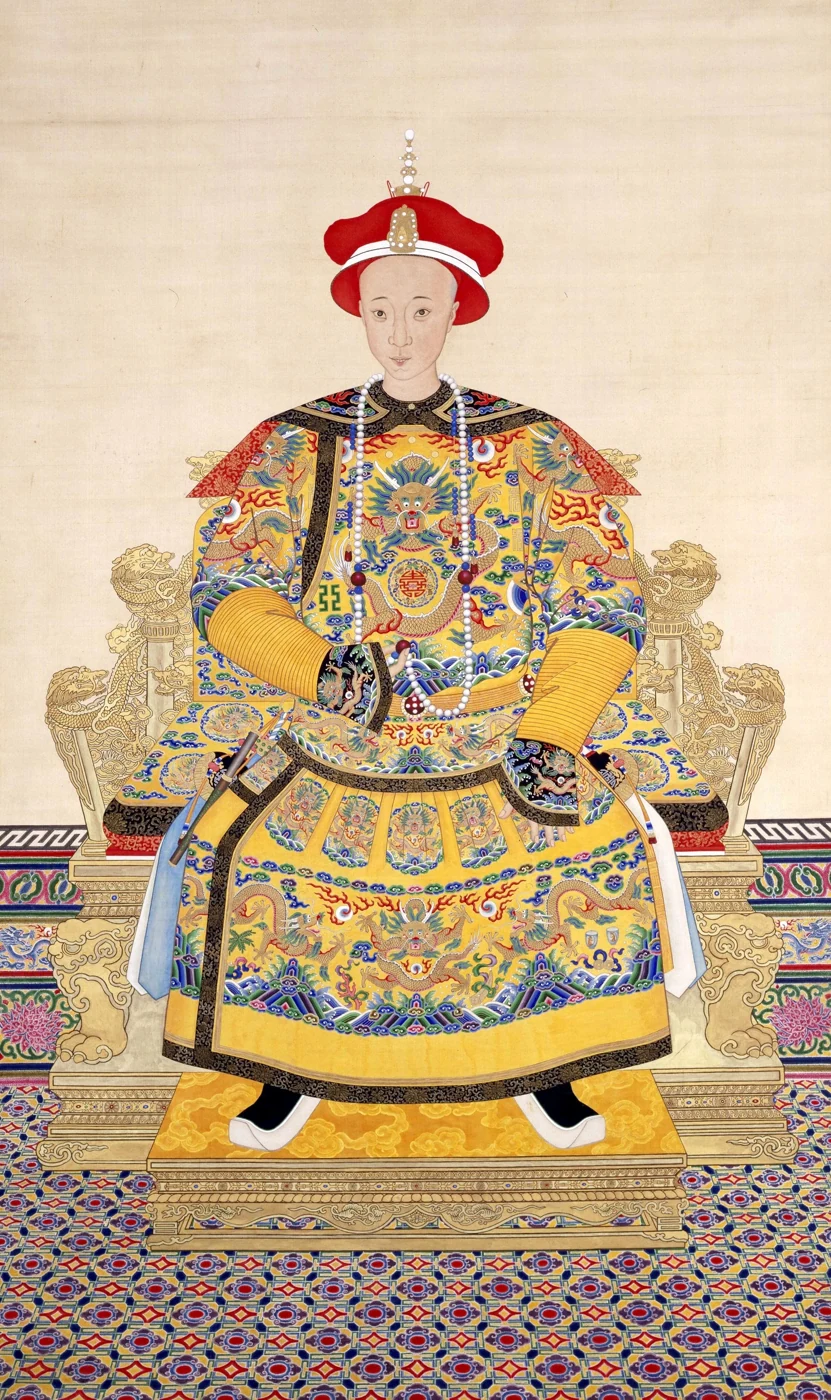
1856 CE–1875 CE
Emperor
Aisin Gioro Zaichun
爱新觉罗·载淳
Emperor Muzong of Qing, Aisin Gioro Zaichun (April 27, 1856–January 12, 1875), was the eldest son of the Xianfeng Emperor and was born to Lady Yehenara, later Empress Xiaoqinxian, better known as Empress Dowager Cixi. He was the tenth emperor of the Qing dynasty, reigning from August 22, 1861 to January 12, 1875, and the eighth Qing emperor after the conquest of China proper. His era name was Tongzhi. He was born in the…
1856 CE–1875 CEQing Dynasty
PROFILE
Emperor Muzong of Qing, Aisin Gioro Zaichun (April 27, 1856–January 12, 1875), was the eldest son of the Xianfeng Emperor and was born to Lady Yehenara, later Empress Xiaoqinxian, better known as Empress Dowager Cixi. He was the tenth emperor of the Qing dynasty, reigning from August 22, 1861 to January 12, 1875, and the eighth Qing emperor after the conquest of China proper. His era name was Tongzhi. He was born in the Palace of Gathered Elegance in the Forbidden City in Beijing. In 1861, after the Xianfeng Emperor died at the Chengde Mountain Resort, the six-year-old Zaichun ascended the throne. Empress Dowager Cixi and Empress Dowager Ci’an then governed behind the curtain in the Hall of Mental Cultivation with the young emperor. During his reign, the Qing government relied on senior officials including Zeng Guofan, Li Hongzhang, and Zuo Zongtang to suppress the Taiping Rebellion and later defeat the Nian forces, the Muslim uprisings in Shaanxi and Gansu and Yunnan, and the Miao rebellion in Guizhou. At the same time, reforms were conducted under the two empress dowagers and Prince Gong Yixin, producing what became known as the Tongzhi Restoration. Zaichun took personal control in 1873. He died in the Hall of Mental Cultivation on January 12, 1875, at the age of eighteen by Western reckoning (twenty by traditional reckoning), making him the shortest-lived Qing emperor. He was buried at Huiling in the Eastern Qing Tombs.
- Other names
- Tongzhi Emperor Zaichun; Emperor Muzong of Qing
- Period
- Qing
- Dynasty/Regime
- Qing Dynasty
- Identity
- Emperor
- Ethnicity
- Manchu
- Clan
- Aisin Gioro
- Native place
- Not recorded in historical sources
- Date of birth
- April 27, 1856 (twenty-third day of the third month, sixth year of Xianfeng)
- Place of birth
- Palace of Gathered Elegance, Forbidden City, Beijing
- Date of death
- January 12, 1875 (fifth day of the twelfth month, thirteenth year of Tongzhi)
- Reign
- August 22, 1861–January 12, 1875
- Predecessor
- Emperor Wenzong of Qing, the Xianfeng Emperor
- Successor
- Emperor Dezong of Qing, the Guangxu Emperor
- Era name
- Tongzhi
- Temple name
- Muzong
- Posthumous name
- Abbreviated as Emperor Yi
- Major achievements
- Ascended the throne as a child and ruled under the regency of the two empress dowagers; nominal emperor during the period known as the Tongzhi Restoration.
LIFE TIMELINE
Age two | His half-brother Prince Min died young, leaving Zaichun as the Xianfeng Emperor’s only surviving son
Age five | Began formal study under the editor Li Hongzao
August 22, 1861 CE(seventeenth day of the seventh month, eleventh year of Xianfeng) | Age six | The Xianfeng Emperor died at Rehe; Zaichun succeeded him, and the proposed era name was Qixiang
Age six | The Xinyou Coup overthrew the Eight Regents; the era name was changed from Qixiang to Tongzhi
Age six | Formal enthronement ceremony in the Hall of Supreme Harmony
Age six | The two empress dowagers began governing behind the curtain in the Hall of Mental Cultivation
Age seven | Began study in Hongde Hall under Qi Junzao and Weng Xincun
Age eight | Qing forces captured Tianjing and suppressed the Taiping Rebellion
Age nine | Sengge Rinchen was killed by Nian forces in Shandong
Age twelve | The Nian rebellion was suppressed
October 16, 1872 CE(fifteenth day of the ninth month, eleventh year of Tongzhi) | Age sixteen | Imperial wedding; Lady Arute was made empress and Lady Fuca Consort Hui
February 23, 1873 CE(twenty-sixth day of the first month, twelfth year of Tongzhi) | Age seventeen | The two empress dowagers ended the regency and Zaichun formally assumed personal rule
Age seventeen | Ordered work on the Summer Palace under the stated purpose of providing for the empress dowagers; work was later halted because of fiscal constraints and remonstrance
Age eighteen | Reconstruction of the Old Summer Palace began and was soon halted because of ministerial opposition and financial difficulties
January 12, 1875 CE(fifth day of the twelfth month, thirteenth year of Tongzhi) | Age eighteen | Died in the Hall of Mental Cultivation without an heir; Empress Dowager Cixi selected Zaitian, son of Prince Chun Yixuan, as the Guangxu Emperor
BIOGRAPHY
Biography
Family Background and Early Years
Zaichun was born on April 27, 1856, in the Palace of Gathered Elegance in the Forbidden City. His birth mother, Lady Yehenara, later Empress Dowager Cixi, was at that time Consort Yi of the Xianfeng Emperor. His principal mother was Empress Niohuru, later Empress Dowager Ci’an. Zaichun was the Xianfeng Emperor’s eldest son and the only son to survive to adulthood. In 1858 his half-brother Prince Min died young, leaving Zaichun as the emperor’s sole surviving son and giving him a unique position in the succession.
In 1860, the Anglo-French forces occupied Beijing and the Xianfeng Emperor fled north to the imperial residence at Rehe, the Chengde Mountain Resort. In 1861, the five-year-old Zaichun began his studies under the editor Li Hongzao. In the seventh month, as the Xianfeng Emperor lay seriously ill at Rehe, he summoned the imperial attendants Zaiyuan, Duanhua, Jingshou, and Sushun together with the Grand Councilors Muyin, Kuangyuan, Du Han, and Jiao Youying. He announced that Zaichun would be crown prince and ordered these eight men to assist in government, creating the group later known as the Eight Regents. The Xianfeng Emperor also gave two small seals, “Imperial Appreciation” and “Hall of Common Principle,” respectively to Empress Niohuru and Zaichun, requiring future edicts to bear both seals. Because Zaichun was a child, his mother Cixi in practice controlled the latter seal. After the Xianfeng Emperor’s death, the six-year-old Zaichun succeeded. Empress Niohuru and Lady Yehenara were both elevated to empress dowager, and Qixiang was initially selected as the new era name.
The Xinyou Coup and Rule Behind the Curtain
After the Xianfeng Emperor’s death, the court was divided among three main political blocs: the regents, the imperial princes led by Prince Gong Yixin, and the two empress dowagers. The young Zaichun stood at the center of all three. Empress Dowager Cixi encouraged Empress Dowager Ci’an to challenge the Eight Regents and secretly contacted Prince Gong in Beijing. Censor Dong Yuanchun proposed that the empress dowagers govern behind the curtain and that Prince Gong assist them. The regents rejected the proposal on the grounds that the Qing had no such precedent. Cixi and Ci’an refused to affix the seals to official decisions, while the Eight Regents responded by suspending government business, forcing a temporary concession. After this limited success, the regents relaxed their guard while their opponents intensified their planning.
After obtaining foreign support, Prince Gong went to Rehe in the ninth month despite the regents’ obstruction, ostensibly to mourn, and secretly discussed plans for a coup with the empress dowagers. He summoned Cao Yuying of the Court of State Ceremonial to draft arrest orders and then returned to Beijing to make arrangements. Prince Gong obtained the backing of senior officials including Jia Zhen, Zhou Zupei, Shen Zhaolin, and Zhao Guang, while commanders Sengge Rinchen and Shengbao also pledged support to the empress dowagers. Under pressure from the two empress dowagers, the Eight Regents agreed to return the court to Beijing.
On November 28, 1861, the two empress dowagers and the young emperor began the journey back to Beijing, traveling ahead of the Xianfeng Emperor’s coffin. On December 2, after reaching the capital, the empress dowagers immediately met Prince Gong and other princes and ministers to finalize the coup. The following day, Zaiyuan, Duanhua, Sushun, and others were stripped of office and arrested, while Jingshou and other Grand Councilors were dismissed. On the third day Prince Gong was appointed Prince-Consultant and entered the Grand Council, and Guiliang and four others became Grand Councilors. On the seventh day the era name Qixiang was replaced with Tongzhi. On the eighth day Zaiyuan and Duanhua were ordered to commit suicide, Sushun was executed, and Jingshou, Kuangyuan, Du Han, and Jiao Youying were stripped of office and exiled to military posts. The Xinyou Coup ended in victory for the two empress dowagers and Prince Gong. On the first day of the eleventh month, the two empress dowagers began governing behind the curtain in the Hall of Mental Cultivation, an arrangement known as the joint regency of the two palaces.
Childhood and Adolescence, 1862–1872
In the first month of 1862, the court ordered Zeng Guofan and Zuo Zongtang to hold Quzhou and relieve the siege of Huizhou, and instructed Zeng to select commanders to defend Shanghai. In the second month, by decree of Empress Dowager Cixi, Zaichun began formal schooling in Hongde Hall under Qi Junzao, Weng Xincun, and others. In the third month, a compilation on imperial government and earlier precedents for rule behind the curtain was completed under the title Precious Mirror for Peaceful Government. In the sixth month, the Tongwen Guan was established in Beijing under the Office for the General Management of Affairs Concerning the Various Countries to train interpreters and support the Self-Strengthening Movement.
In the seventh month of 1863, Prince Hui Mianyu was placed in special charge of the emperor’s studies in Hongde Hall, and his sons Yixiang and Yixun were appointed as Zaichun’s study companions. The imperial tutors sat rather than knelt or stood while teaching, following a precedent attributed to Emperor Huan of Han. The young emperor’s curriculum was extensive: Mongolian, Manchu language and writing, Chinese language and texts, drawing the bow, archery, firearms, and horsemanship. His Chinese studies alone included classics, histories, composition, poetry, and calligraphy. The schedule was tight, with holidays mainly for New Year, Lantern Festival, the imperial birthday, Dragon Boat Festival, Mid-Autumn Festival, and partial summer breaks. In 1864, Xu Tong, Ruichang, Baojun, Zailing, Li Tangjie, and Shan Maoqian were ordered to lecture in rotation each day on the Precious Mirror for Peaceful Government. On December 28, 1865, after the death of Grand Secretary Weng Xincun, his son Weng Tonghe was assigned to Hongde Hall to fill his father’s place. In the third month of 1865, Prince Chun Yixuan was ordered to supervise the emperor’s studies there.
During Zaichun’s childhood and adolescence, the Qing government achieved a series of major military victories. In the sixth month of 1864, Qing forces captured Tianjing and suppressed the Taiping Rebellion. In the fourth month of 1865, Nian forces under Lai Wenguang destroyed the main Qing army commanded by Sengge Rinchen in Shandong, and Sengge Rinchen was killed while breaking out. Zuo Zongtang and Li Hongzhang later destroyed the western and eastern Nian forces, bringing the Nian rebellion to an end in 1868. In the second month of 1871, Liu Jintang and other commanders captured Jinjibao, and Ma Hualong and others associated with the Muslim uprising in Gansu and Shaanxi were killed. In the first month of 1873, Yunnan forces captured Dali and Du Wenxiu, Yang Rong, Cai Tingdong, and others were killed. During the same period the Qing also faced foreign incidents including the Tianjin Massacre of 1870.
Imperial Wedding and Personal Rule
The source states that Empress Dowager Cixi delayed Zaichun’s assumption of personal rule on the grounds that his “classical studies were not yet complete.” On October 16, 1872, an imperial wedding was finally held for the seventeen-year-old emperor. The two empress dowagers disagreed over the choice of empress: Ci’an favored Lady Arute, daughter of Chongqi, while Cixi favored Lady Fuca, daughter of Fengxiu. Zaichun himself preferred Lady Arute, who was therefore made empress, while Lady Fuca became Consort Hui.
In the first month of 1873, as Zaichun prepared to take direct control, the two empress dowagers ordered him to “reverently uphold the family laws, attend to the selection of men and the conduct of government, and not neglect his studies,” while instructing officials inside and outside the capital to “serve publicly and loyally and work together through the difficulties.” On February 23, the twenty-sixth day of the first month, Zaichun formally assumed personal rule, issuing an edict promising to “respectfully follow maternal instruction, revere Heaven and emulate the ancestors, diligently govern and care for the people.” In the sixth month he went to Yingtai, where foreign envoys including the Japanese envoy Soejima Taneomi, the Russian envoy, and the United States envoy presented credentials to him at Ziguang Pavilion in Zhongnanhai.
Personal Rule and Death
In the ninth month of 1873, Zaichun ordered work on the Summer Palace, publicly presented as a project for the retirement and comfort of the empress dowagers but described in the source as also serving his own convenience. The project was estimated to require ten million taels of silver and some three thousand large timbers. At the same time Zuo Zongtang was suppressing the Muslim uprising in the northwest and provincial finances were strained, leaving the Qing government unable to support such expenditure. On October 2, Censor Shen Huai submitted a memorial requesting delay, and the imperial tutor Li Hongzao and Hanlin lecturer Li Wentian also remonstrated, but Zaichun did not accept their advice. On the nineteenth day of the first month of 1874, reconstruction of the Old Summer Palace formally began. It was later stopped because of ministerial remonstrance and financial difficulties.
In the second month of 1874, Japan used the killing of Ryukyuan sailors by indigenous people in Taiwan as a pretext for sending forces to Taiwan; Japanese troops invaded in the third month. In the sixth month, Weng Tonghe was ordered to serve regularly in Hongde Hall. In the tenth month, because the emperor was ill, Li Hongzao was ordered to read memorials on his behalf. In the eleventh month Prince Gong Yixin was ordered to handle responses to memorials in Manchu. Later, memorials from officials inside and outside the capital were ordered to be submitted to the two empress dowagers for review. On January 12, 1875, the fifth day of the twelfth month, the Tongzhi Emperor died in the Hall of Mental Cultivation at only eighteen years of age by Western reckoning. He left no son. Empress Dowager Cixi selected Zaitian, son of the Xianfeng Emperor’s younger brother Prince Chun Yixuan, to enter the senior imperial line and succeed as the Guangxu Emperor. Guangxu also died childless, after which Puyi succeeded and inherited both lines.
Cause of Death
The official histories state that the Tongzhi Emperor died of smallpox. Weng Tonghe’s diary records that the emperor contracted smallpox and that intense internal heat eventually led to a severe oral infection. Yun Yuding, who later served as an imperial diarist under the Guangxu Emperor, likewise wrote in Record of Trustworthy Information on the Chongling Mausoleum that the emperor suffered from smallpox and rejected rumors that he died of a venereal disease.
Popular tradition, however, claimed that he died of syphilis. Some stories assert that after his marriage he slept alone in the Palace of Heavenly Purity and, under the influence of eunuchs and the favored courtier Zaicheng, often left the palace incognito to visit taverns, theaters, and brothel districts outside Chongwen Gate. A Broad View of Unofficial Qing History states that “Tongzhi went to a private prostitute and thereby contracted syphilis.” In 1923, Xiao Yishan’s General History of the Qing Dynasty repeatedly argued that syphilis caused his death. The Taiwanese novelist Gao Yang’s Complete Biography of Cixi adopted the same conclusion. Li Zhen, a descendant of imperial physician Li Deli, and Li Zhisui separately wrote that family oral tradition held that the emperor died of syphilis and that Cixi forced Li Deli to announce smallpox instead. Both explanations continue to circulate, and the source treats the matter as unresolved.
His Studies in the Hongde Hall and the Rules for the Imperial Tutors
In the second month of 1862, by the empress dowager Cixi's decree, Zaitchun entered the Hongde Hall to study, with Qi Junzao, Weng Xincun and others as his tutors; and in the third month the compilation of works on imperial government and on earlier regencies was completed under the title The Precious Mirror of Orderly Government. In the seventh month of 1863 a decree made Mianyu, prince Hui, specially responsible for the emperor's studies in the Hongde Hall, and appointed Mianyu's sons Yixiang and Yixun as his study companions. The tutors, when teaching, neither knelt nor stood but sat, following the precedent of Emperor Huan of Han receiving instruction, with a seat set for the tutor to the right of the imperial desk. The little emperor's lessons were many and heavy: Mongolian, Manchu and Manchu writing, Chinese and Chinese books, drawing the bow, shooting arrows, firing guns and riding; the Chinese books alone included the classics and histories with composition, verse and calligraphy, and the schedule was tight, with holidays only for the New Year, the Lantern Festival, the imperial birthday, the Dragon Boat and Mid-Autumn festivals, and half holidays in summer. In 1864 Xu Tong, Rui Chang, Bao Yun, Zailing, Li Tangjie and Shan Maoqian were ordered by decree to lecture in turn, one each day, on the Precious Mirror. In the third month of 1865 the empress dowager further ordered Prince Chun, Yihuan, to attend the Hongde Hall to urge the emperor's studies; and on the eleventh day of the eleventh month of that year (28 December 1865), the grand secretary Weng Xincun having died, his son Weng Tonghe was appointed to the Hongde Hall as right censor of the household of the heir apparent to fill the vacancy.
The Chronology of Court Affairs and Events at Home and Abroad around His Majority
Most of the decrees issued in Zaitchun's reign concerned military affairs and relief. In the first month of 1862 he decreed that Zeng Guofan and Zuo Zongtang hold Quzhou and go on to raise the siege of Huizhou, that Zeng Guofan choose generals to defend Shanghai against the Taiping, and that Jiang Yili's troops join Zuo Zongtang's army; when the Taiping pressed on Shanghai and Xue Huan memorialized that British and French officers would cooperate in the defence, the court commended him. In the same year the Nian raided Shuyang, and Sengge Rinchen was ordered to attend to north and south alike, while Li Shizhong's army recovered Jiangpu and Pukou. Afterwards the Hubei army recovered Zhushan and Zhuxi and the Guizhou army Tianzhu and Qiongshui, the Taiping fled to Laohekou, Zuo Zongtang recovered Jinhua, Tangxi, Longyou and Lanxi in Zhejiang, and the Sichuan army broke Shi Dakai's Taiping at the Dadu river. In the seventh month of 1864 the court rewarded those who had put down the Taiping: the son of the prince Gong, regent for the government, was made a beile, and two others were given lesser titles, while the grand councillor Wenxiang was given the rank of grand guardian of the heir apparent and Bao Yun and Li Tangjie the rank of junior guardian. In the second month of 1865 several hundred men of Youyang in Sichuan, unable to bear the bullying of the church, destroyed the mission, the Youyang case; in the same year the Hongkong and Shanghai Bank opened a branch in Shanghai and foreign banks began to control China's money market, and Yakub Beg invaded Xinjiang while the Muslim rising was under way. In the third month the empress dowager ordered Prince Chun to the Hongde Hall to press the emperor's studies and stripped Prince Gong of his grand councillorship and regency, giving Wenxiang and others charge of the office for foreign affairs; in the fourth month the Nian under Lai Wenguang destroyed Sengge Rinchen's army in Shandong and Sengge Rinchen himself was killed in the breakout; in the fifth month the Jiangnan Arsenal was founded, the beginning of China's modern military industry; and in the intercalary fifth month Shen Baozhen was called out to take charge of the defence of Jiangxi.
In the second month of 1868 the retired minister Anson Burlingame led a "Chinese mission" to the United States, Britain, Russia, France and Prussia, the first Chinese mission sent abroad; in the eighth month a censor was dismissed for memorializing about repairing the palace gardens. In the first month of 1870 the Yunnan army recovered Lufeng while the Muslim rebels of Gansu and Shaanxi took Dingbian, and in the same month the wood store at the Shenwu gate of the forbidden city caught fire and Zaitchun decreed self-examination. In the second month Liu Songshan, directing the campaign against the Muslims at Jinjibao, was killed by a cannon shot, and the emperor gave the intendant Liu Jintang the rank of a third-grade minister and command of his troops; and because Russian officials went to Qiqihar and Jilin to discuss the frontier, Fuming'a and Deying were ordered to hold to the treaties and not to yield. In the fifth month Chongshi was sent to Guizhou to join Zeng Biguang in investigating a mission case, and in the sixth month Peng Yulin was sent to Jiangnan to reorganize the Yangtze fleet with the governors along its banks. In the second month of 1871 Liu Jintang and others took Jinjibao and Ma Hualong and the other Muslim leaders were executed, whereupon Zuo Zongtang was given a title of light chariot commandant, Liu Jintang a cloud-riding commandant and the yellow jacket, and others were rewarded or restored; in the same month the Jiangsu judge Ying Baoshi was sent to Tianjin to prepare trade with Japan, and Rui Chang was made a grand secretary and Wenxiang associate grand secretary. In the third month Jinshun's army took Ningxia and Ma Wanxuan was executed, the Yunnan army recovered Chengjiang and took the earth town of Jiangna, and Ma He and others were executed; Woren was made grand secretary of the Hall of Literary Glory and Rui Chang grand secretary of the Hall of Literary Profundity, while from the beginning of spring to that month the emperor prayed repeatedly for rain. In the sixth month the risings of the local societies at Yiyang and elsewhere were put down, and the Shaanxi Muslim Bai Yanhu joined the Muslims of Xining to raid Hezhou. In the first month of 1873 the Yunnan army took Dali and Du Wenxiu, Yang Rong and Cai Tingdong were executed, and Zaitchun rewarded and punished according to merit: Cen Yuying was given the yellow jacket and a hereditary title, Liu Yuezhao's penalty was lifted and Yang Yuke given a commandant's rank. In the tenth month of the same year the army took Suzhou and Ma Wenlu was killed, and the emperor went to the two empresses dowager to congratulate them on the victory, rewarding Zuo Zongtang with the associate grand secretariat in addition to his governorship of Shaanxi and Gansu and the rank of a first-class light chariot commandant, restoring Jinshun's post and yellow jacket and giving titles to Xu Zhanbiao and Mutushan. In the fifth month of 1874, on the birthday of the empress dowager Cixi, bannermen in the capital over sixty were given imperial bounty, and in the eleventh month Consort Hui was raised to imperial noble consort and Consort Xun to consort. In the twelfth month a decree remitted the land tax on waste land in Yunnan for ten years, and Li Zongxi, being ill, was replaced as acting governor-general of Liangjiang by Liu Kunyi.
After His Death: The Accession of Guangxu and His Posthumous Titles
Zaitchun had no son, and after his death the two empresses dowager brought in Zaitian, son of Prince Chun, Yihuan, to succeed to the great line as adopted emperor, granting Yihuan the title of prince with perpetual inheritance and excusing him from the ceremonies of court; the princes and ministers received him by the testamentary decree at the prince Chun's residence, and he lived with the empress dowager Ci'an, while the works on the three seas were halted and the following year made the first of Guangxu. Zaitchun's posthumous title in full was "the emperor who inherited heaven and opened the mandate, received the mean and held to correctness, guarded the great and settled merit, was sage, wise, sincere, filial, trustworthy, diligent, generous and firm," with the temple name Muzong. As to his age the sources differ slightly: the Draft History of the Qing records that he was nineteen, while by full years he was eighteen, the shortest-lived emperor of the Qing. Two accounts of his death also stand side by side: according to the official history and Weng Tonghe's diary he suffered from smallpox, which drove the poison inward and killed him through the gangrene of the mouth, and Yun Yuding, once diarist to the Guangxu emperor, also held in his Record of Rumours from the Chongling that he died of smallpox and that the talk of venereal disease was false; yet popular tradition says he died of syphilis, or that after his marriage he slept alone in the Qianqing palace and, led by eunuchs and his favourite Zaicheng, went about in disguise to the wineshops, theatres and pleasure quarters outside the Chongwen gate, the Yuan-dynasty Miscellany of the Qing Palace recording that "he went to private prostitutes and contracted syphilis." In 1923 Xiao Yishan in his General History of the Qing insisted repeatedly that the emperor died of syphilis, and the novelist Gao Yang reached the same conclusion in his Life of Cixi, while the great-grandsons of the imperial physician Li Deli wrote separately that by family tradition he died of syphilis and that Cixi, on hearing the diagnosis, compelled the physician to announce smallpox. The two accounts still stand side by side and no conclusion has been reached.
Major Activities
Nominal Emperor of the “Tongzhi Restoration”
During the Tongzhi Emperor’s reign, the Qing suppressed the Taiping Rebellion in 1864, the Nian rebellion in 1868, the Muslim uprising in Shaanxi and Gansu by 1871, the Muslim uprising in Yunnan by 1873, and the Miao rebellion in Guizhou. Under Empress Dowager Cixi, Empress Dowager Ci’an, and Prince Gong Yixin, the Qing government pursued the Self-Strengthening Movement, established the Office for the General Management of Affairs Concerning the Various Countries and the Beijing Tongwen Guan, supported Zeng Guofan and Li Hongzhang in founding the Jiangnan Arsenal in 1865, and sent the first Chinese diplomatic mission abroad in 1868. This period became known as the Tongzhi Restoration. Zaichun was the nominal emperor during a comparatively stable phase of the late Qing, although he did not exercise real power for most of his reign.
The Wedding and the Limits of Personal Rule
On October 16, 1872, Zaichun held his imperial wedding, making Lady Arute empress and Lady Fuca Consort Hui, while also taking Lady Arute as Concubine Xun, Lady Heseri as Concubine Yu, and Lady Sirin Gioro as Noble Lady Jin. On February 23, 1873, he formally assumed personal rule. During this period he received foreign envoys and handled state affairs, but his practical authority remained constrained by Empress Dowager Cixi.
Dispute over Reconstruction of the Old Summer Palace
In the ninth month of 1873, Zaichun ordered construction at the Summer Palace in the name of providing for the empress dowagers, and in the first month of 1874 he began reconstruction of the Old Summer Palace. Censor Shen Huai, imperial tutor Li Hongzao, Hanlin lecturer Li Wentian, and others repeatedly remonstrated on the grounds of fiscal difficulty and shortages of timber. Zaichun initially refused, but the project was eventually halted because of insufficient funds and intervention by the two empress dowagers. The controversy reflected the limits on Zaichun’s freedom of action after assuming personal rule.
Foreign Relations
Relations between the Qing and the foreign powers were comparatively stable during the Tongzhi reign. In the sixth month of 1873, envoys from Japan, Russia, the United States, Britain, France, the Netherlands, and other countries formally presented credentials to the Tongzhi Emperor at Ziguang Pavilion, described in the source as the first occasion on which foreign envoys formally had audience with a Qing emperor under such diplomatic ceremony. In 1874 Japan sent troops to Taiwan and the Qing ultimately settled the dispute through compensation. The reign also included the Tianjin Massacre of 1870 and other foreign-affairs incidents.
The Titular Emperor of the "Tongzhi Restoration" and the Difficulties of His Majority
In actual government Zaitchun was the titular emperor of the "Tongzhi restoration." During his reign the Qing court in military affairs put down the Taiping (1864), the Nian rising (1868), the Muslim risings in Shaanxi and Gansu (1871) and in Yunnan (1873), and the Miao rising in Guizhou; and under the empresses dowager Cixi and Ci'an with Prince Gong the self-strengthening movement began, with the office for foreign affairs and the Tongwen College set up in 1862, the Jiangnan Arsenal founded with the support of Zeng Guofan and Li Hongzhang in 1865 and other modern military industries, and a Chinese mission sent abroad for the first time in 1868. The period took its name from his era and is known as the Tongzhi restoration, though he himself held no real power in it. After taking up the government he tried to act, decreeing the building of the Summer Palace and the rebuilding of the Old Summer Palace; but the work would have cost ten million taels, and the timber alone required three thousand logs of cedar, cypress, camphor and pine from seven inches to over four feet in girth and from fifteen to forty-eight feet in length, which had to be brought from Sichuan where they had been almost wholly cut since the early Daoguang years and could not be found, with transport immensely difficult; while the suppression of the Taiping and the campaigns in the north-west left the provinces short of funds and all contributions and likin consumed by the armies, so that the treasury could not possibly afford it. The censors Shen Huai, his tutor Li Hongzao and the Hanlin expositor Li Wentian all memorialized against it; he would not listen, but the work was in the end halted for want of money and by the intervention of the two empresses dowager. In foreign relations the Tongzhi years were comparatively quiet: in the sixth month of 1873 the Japanese envoy Soejima Taneomi, the Russian Vlangali, the American Low, and the British Wade, French Godeaux and Dutch Ferguson were received in the Ziguang Hall and presented their letters of credence, the first time foreign envoys were received by a Qing emperor in formal ceremony; in 1874 Japan sent troops to Taiwan on the pretext of the killing of Ryukyuan sailors by the highland people of Taiwan, and the Qing settled the matter by indemnity; and in the interval there was also the Tianjin mission case of 1870.
Personal Relations
- Father: Xianfeng Emperor Yizhu
- Mother: Empress Dowager Cixi, Lady Yehenara
- Principal mother: Empress Dowager Ci’an, Lady Niohuru
- Empress: Empress Xiaozheyi, Lady Arute, daughter of Chongqi
- Consorts: Imperial Noble Consort Shushen, Lady Fuca; Imperial Noble Consort Zhuanghe, Lady Arute; Imperial Noble Consort Xianzhe, Lady Heseri; Imperial Noble Consort Ronghui, Lady Sirin Gioro
- Adopted sons: Pujun (adopted during the 1899 succession arrangement and later returned to his natal line); Puyi (adopted to inherit both branches)
- Uncles: Prince Gong Yixin; Prince Chun Yixuan
- Cousin and successor: Guangxu Emperor Zaitian, son of Prince Chun Yixuan
- Imperial tutors: Li Hongzao, Qi Junzao, Weng Xincun, Weng Tonghe, Xu Tong, Ruichang, Baojun, Zailing, Li Tangjie, Shan Maoqian
- Study companions: Yixiang and Yixun, sons of Prince Hui Mianyu
- Eight Regents: Zaiyuan, Duanhua, Jingshou, Sushun, Muyin, Kuangyuan, Du Han, Jiao Youying
- Prince-Consultant: Prince Gong Yixin
- Senior officials and commanders: Zeng Guofan, Li Hongzhang, Zuo Zongtang, Sengge Rinchen, Wenxiang, Shen Baozhen, Liu Jintang, and others
- Empress Dowager Cixi: disagreements over the choice of empress, timing of personal rule, and other matters
- Eight Regents: overthrown in the Xinyou Coup
- Ministers who opposed palace reconstruction: Shen Huai, Li Hongzao, Li Wentian, and others
Historical Assessment
Qing / Contemporary
- The Draft History of Qing states: “Muzong ascended the throne while still a child. Empresses Xiaozhen and Xiaoqin governed behind the curtain and assisted the government, and the realm was peaceful. When he assumed personal rule, he died not long afterward, leaving the work of restoration unfinished.”
- Weng Tonghe recorded the emperor’s studies and illness in his diary and expressed deep regret over his early death.
- When Censor Chen Yi impeached Wang Qingqi, he accused him of defects in character and integrity, indirectly reflecting concerns about the emperor’s close attendants.
Late Qing and Republican Period
- Yun Yuding’s Record of Trustworthy Information on the Chongling Mausoleum defended the smallpox explanation for the emperor’s death rather than syphilis, reflecting contemporary sympathy for him.
- Xiao Yishan’s 1923 General History of the Qing Dynasty repeatedly argued that the emperor died of syphilis and criticized his private life.
- Liu Tizhi’s Record of Divergent Statements preserves a satirical couplet aimed at Wang Qingqi, reflecting dissatisfaction with favored courtiers around the Tongzhi Emperor.
Modern Period
- Gao Yang’s Complete Biography of Cixi accepts the syphilis explanation and portrays the Tongzhi Emperor as a tragic ruler controlled by Cixi and frustrated by his lack of independence.
- Many modern historians consider him an emperor in name who never acquired substantial power and was continually constrained by Empress Dowager Cixi.
- Some scholars argue that the achievements of the Tongzhi Restoration were mainly due to the two empress dowagers, Prince Gong Yixin, and other actual decision-makers, with Zaichun’s personal role being limited.
FIGURES ASSOCIATED WITH THIS DYNASTY
Bibliography
- Draft History of the Qing, juan 21-22, "Basic Annals 21 and 22."
- Yun Yuding, Records Transmitted from Chongling.
- Xiao Yishan, General History of the Qing Dynasty.