Biography
Family Background and Early Years
Li Hongzhang's paternal ancestors originally bore the surname Xu and came from Hukou, Jiangxi, later moving to Hefei County in Luzhou Prefecture, Anhui. His eighth-generation ancestor Xu Yingxi adopted his second son Xu Shensuo into the household of a relative by marriage, Li Xinzhuang, and the descendants thereafter maintained the Li line. By the generation of Li Hongzhang's father, Li Wen'an, the branch formally used the surname Li. The family had long lived by farming and study. According to the source, only by the time of Li Hongzhang's great-great-grandfather had it accumulated about two qing of land through thrift, and the family had previously lacked success in the imperial examinations. In 1838, the eighteenth year of Daoguang, Li Wen'an passed the jinshi examination under the registered name Li Wengan, in the same year as Zeng Guofan, and the family then rose to local prominence.
Li Hongzhang was Li Wen'an's second son. He was born on February 15, 1823, the fifth day of the first month of the third year of Daoguang, at the old family residence in Citangying, Modian Township, Hefei County. At age six he entered the family school, Dihua Study. He became a xiucai in 1840 and was selected as a yougong student at the Luzhou prefectural school in 1843. His father, then serving in Beijing, wrote urging him to come to the capital for the Shuntian provincial examination. Li traveled north and wrote ten poems titled *Entering the Capital*, using verse to express political ambition.
In Beijing, with introductions from his father, he visited Anhui officials including Lü Xianji, Wang Maoyin, and Zhao Jun and gained their notice. In 1844 he passed the special Shuntian provincial examination as the eighty-fourth successful candidate and married Lady Zhou that year. In 1845 he failed the metropolitan examination and, as the son of his father's examination colleague, entered Zeng Guofan's circle to study statecraft and moral philosophy. In 1847 he passed the jinshi examination and, after the court examination, became a Hanlin Academy bachelor candidate. In the fourth month of 1850 he completed probation, was appointed an editor of the Hanlin Academy, and also served as an editor at Wuying Hall. Zeng Guofan called him a “great vessel,” meaning a man of major potential.
Militia Service and Entry into the Hunan Army Staff
In the first month of 1853, the third year of Xianfeng, Taiping forces occupied Anqing and killed Governor Jiang Wenqing. Li Hongzhang urged Vice Minister of Works Lü Xianji to memorialize the throne and drafted the memorial for him overnight. The Xianfeng Emperor ordered Lü to serve as an official responsible for militia organization in Anhui. Lü told Li that since Li had brought the mission upon him, he would in turn request that Li accompany him. Li therefore returned to Anhui with Lü to organize militia. In the fifth month he defended Yuxikou in Hezhou and fought Taiping forces for the first time. In 1854, Li's father Li Wen'an was also recommended by Wang Maoyin to organize militia at home, and the father-and-son units were described as orderly and usable.
Li successively campaigned in central Anhui under Qing officials including Zhou Tianjue, Li Jiaduan, Lü Xianji, and Fuji against the Taiping and Nian forces. As a scholar leading troops, he was criticized both for reckless fighting and for behaving like a bandit in official robes. The years of militia service nevertheless taught him that command depended on more than temporary victory or personal bravery.
In the second month of 1855, after participating in the recovery of Hanshan County, he received the honorary rank of prefect. In the tenth month, following the recovery of Luzhou, he was registered with the Grand Council for future appointment at circuit or prefectural level. In the ninth month of 1856, after accompanying Fuji in the capture of Chaoxian and Hezhou, he received the honorary rank of provincial judicial commissioner. With growing achievements came increased criticism, and Li found his position in his home region increasingly difficult. In 1857, Fuji reported that Li had entered mourning for his father, ending five years of militia activity.
In 1858 Taiping forces again captured Luzhou. Li fled with his family and eventually reached Nanchang, where he stayed with his elder brother Li Hanzhang. In the twelfth month of that year, January 1859, through Li Hanzhang's mediation, he joined Zeng Guofan's headquarters to assist with military administration. This followed the defeat at Sanhe, when Zeng urgently needed capable staff. The source describes Zeng as giving Li special attention and carefully instructing him in political and military affairs, producing major changes in Li's thought, temperament, and habits.
In the autumn of 1860, Li and Zeng Guofan seriously disagreed over moving headquarters to Qimen and over the impeachment of Li Yuandu. Li argued that Qimen was a strategically dangerous “dead ground” and opposed the move. He also disagreed with Zeng's handling of Li Yuandu, whom Li Hongzhang considered a man of exaggerated literary talk rather than a capable commander. Refusing to draft the impeachment, he argued with Zeng and angrily left headquarters. After persuasion by Hu Linyi, Chen Nai, Guo Songtao, and others, and repeated invitations from Zeng, he returned to the Hunan Army camp in the sixth month of 1861. Zeng thereafter treated him with increased respect and consulted him on major military and state affairs.
Formation of the Huai Army and Campaigns in the Lower Yangtze
In 1860 the Taiping forces destroyed the Jiangnan Camp for a second time, leaving the Qing government without its last major field force in the lower Yangtze. Gentry and landowners fled to Shanghai, where local elites and compradors organized a joint Chinese-foreign defense organization and sent Qian Dingming and others to Anqing to request assistance from Zeng Guofan. Zeng initially considered sending Zeng Guoquan or veteran Hunan commander Chen Shijie but eventually turned to Li Hongzhang, who accepted. In the summer of 1861 Li was ordered back to Anhui to recruit Huai troops. Drawing on earlier militia networks and local connections, armed groups led by Zhang Shusheng, Zhou Shengbo, Pan Dingxin, Liu Mingchuan, and others joined him.
After the Lunar New Year of 1862, the first units of the Huai Army—the Shu, Ming, Ding, and Qing battalions—went to Anqing for training. Li also sent his younger brother Li Hezhang to Hefei to recruit former followers. Zeng Guofan transferred complete Hunan Army units and officers to Li, including the Chun, Ji, Kai, Lin, Xiong, and Yuan battalions and two personal guard battalions. The newly formed Huai Army comprised fourteen battalions, each organized with 505 regular soldiers and 180 laborers, for a total of 685 men per battalion according to the source.
In the second month Zeng inspected the Huai Army, marking its formal establishment. Shanghai gentry spent 180,000 taels of silver to charter seven British merchant ships and transport the force in batches. Li arrived in Shanghai on the tenth day of the third month with the first contingent. On Zeng's recommendation he became acting governor of Jiangsu and was formally confirmed at year's end. At the time, Taiping troops were attacking Shanghai, and some members of the Chinese-foreign defense organization mocked the poorly equipped Huai troops. Li encouraged his men by saying that an army's value lay in its ability to fight and that victory would earn respect. In the second half of the year the Huai Army fought independently in three severe battles at Hongqiao, Beixinjing, and Sijiangkou. Li personally directed operations and held Shanghai, changing foreign and Chinese opinion of the force.
Within less than a year in Shanghai, the Huai Army extensively altered the earlier Hunan Army system and adopted foreign rifles and artillery, employing foreign instructors and greatly increasing combat effectiveness. Through accepting surrenders and absorbing various armed groups, Li expanded the army from slightly more than six thousand men to sixty or seventy thousand in two years. He concluded agreements with British naval commander James Hope and army commander Charles Staveley for joint operations against the Taiping forces. In the spring of 1863 he and Staveley agreed on the *Sixteen Articles on the Joint Command of the Ever Victorious Army*, placing that force under his direction. He maintained good relations with its new commander Charles Gordon, whom the source describes as becoming his friend and beneficiary.
In personnel matters Li dismissed comprador officials whom he regarded as excessively deferential to foreigners and employed practical Self-Strengthening officials such as Guo Songtao and Ding Richang, forming a staff that valued administrative effectiveness and knowledge of foreign affairs. Financially he used customs revenue for the Ever Victorious Army and likin revenue for the Huai Army. The source also criticizes heavy grain levies, taxation, and contributions as producing widespread resentment and impoverishment. In foreign relations, Li used Robert Hart and Pan Zengwei as intermediaries to manage Gordon's anger over the execution of surrendered Taiping commanders at Suzhou and later maneuvered to disband the Ever Victorious Army, revealing what the source characterizes as emerging diplomatic skill.
In the eleventh month of 1863, Taiping commanders including Gao Yongkuan killed Tan Shaoguang and opened Suzhou in surrender. Accepting Cheng Xueqi's advice, Li lured eight surrendered commanders, including Gao, to their deaths and dispersed the remaining forces. Gordon strongly objected, but Li defended the action as cruel yet necessary to the larger situation. Zeng Guofan praised his decisiveness in his diary. After the capture of Suzhou, Li received the honorary title Junior Guardian of the Heir Apparent and the privilege of wearing the yellow riding jacket. In the fifth month of 1864 he captured Changzhou, and after the defeat of the Taiping Heavenly Kingdom was enfeoffed First-Rank Count Suyi.
Campaign against the Nian Army and Administration of Zhili
After the fall of the Taiping Heavenly Kingdom in 1865, the Nian Army became a major threat to the Qing court. Li was promoted to acting Governor-General of Liangjiang and ordered to supervise anti-Nian operations. In 1866 he succeeded as imperial commissioner and directed the campaign. After the Nian forces divided into eastern and western branches, Li adopted a strategy of blocking territory and encircling them, using river defenses and scorched-earth methods to restrict their movements. In 1867 he was appointed Governor-General of Huguang while continuing to direct the war from the field. In 1868 the eastern and western Nian forces were defeated in succession. Li received the honorary title Grand Guardian of the Heir Apparent and, while Governor-General of Huguang, became an assistant grand secretary.
In 1870, after the Tianjin Massacre and Zeng Guofan's unsuccessful handling of the crisis, Li was transferred to become Governor-General of Zhili and superintendent of trade for the northern ports, replacing Zeng. For more than twenty years he then dominated Beiyang administration and became one of the central officials of the Tongzhi and Guangxu reigns. The source notes that some contemporaries described him as “sitting in command of Beiyang while remotely directing court government.”
Self-Strengthening and Beiyang Coastal Defense
As Governor-General of Zhili and Beiyang minister, Li vigorously promoted the Self-Strengthening Movement. In 1872 he founded the China Merchants' Steam Navigation Company, described in the source as China's first domestically operated steamship transport enterprise. In 1875 he began directing Beiyang coastal defense and organizing the Beiyang Fleet. In 1879 he proposed the Tianjin Naval Academy to train naval personnel. In 1888 the Beiyang Fleet was formally organized, with ironclads including *Dingyuan* and *Zhenyuan*, and the source describes it as at one time the strongest navy in Asia.
During the Self-Strengthening Movement, Li also established or promoted the Jiangnan Arsenal, Jinling Arsenal, Shanghai Guangfangyan Guan, Tianjin Telegraph Bureau, and Chinese Engineering and Mining Company, spanning armaments, shipping, mining, telegraphy, railways, and education. He argued that China needed peace externally and reform internally and sought to strengthen state power through imported Western technology and trained personnel.
Defeat in the First Sino-Japanese War and Final Years
The First Sino-Japanese War began in 1894. The Beiyang Fleet suffered defeat in the Yellow Sea and was later surrounded and destroyed at Weihaiwei. As Beiyang minister, Li bore major political responsibility. In 1895 he was sent to Japan as special envoy and signed the Treaty of Shimonoseki, ceding Taiwan and agreeing to an indemnity of two hundred million taels of silver. He was dismissed from office but retained for service, and his reputation suffered severely.
In 1896 Li toured Europe and the United States for six months, inspecting political, economic, and military institutions and advocating reform after his return. In 1899 he was recalled as Governor-General of Liangguang. During the Eight-Nation Alliance invasion of 1900, Li participated in the Mutual Protection of Southeast China and was ordered north to negotiate. In 1901 he and Prince Qing Yikuang represented the Qing government in signing the Boxer Protocol with the foreign powers. He died soon afterward at Xianliang Temple in Beijing, aged seventy-eight. He was posthumously granted the rank Grand Preceptor, raised to marquis, and given the posthumous name Wenzhong.
His Lineage and His Old Home
The ancestors of Li Hongzhang were originally surnamed Xu. In the time of his eighth-generation forebear Xu Yingxi, the second son Xu Shensuo was given in adoption to Li Xinzhuang of the same village, and so from Xu the family changed its surname to Li, and the Hefei Li line began here. Their old house was at Citang Ying in Modian of Hefei county; and in the epitaph Li Hongzhang wrote for his father, the Geyuan muzhi, there is also a statement that the family's old cottage was at Xiongjia Zhuanjing in the eastern district, while another account says he was born in the old house at Daxingji in the eastern district of Hefei. The accounts stand side by side, but the genealogies and shrines of later ages mostly took Citang Ying in Modian as the native place. The Li family tilled and studied for generations and rose with Li Hongzhang; afterwards six brothers were all noted for degrees, military merit and office, and the Li family of Hefei became a clan of consequence.
The Moulding of Him in Zeng Guofan's Secretariat
Li Hongzhang's father, Li Wen'an, had taken the same examination as Zeng Guofan, and so Li Hongzhang early entered Zeng's school and received his teaching. Zeng Guofan's instruction appeared especially in small daily matters: Li Hongzhang loved to sleep late, and Zeng Guofan would not take his morning meal until all his secretaries had assembled, forcing Li Hongzhang to rise early every day; Li Hongzhang was fond of boasting and empty talk to court notice, and Zeng Guofan repeatedly admonished him plainly that in dealing with men the only thing was the single word sincerity; and when Li Hongzhang met difficulty and failure, Zeng Guofan would speak much of the classic of "holding firm". Zeng Guofan also from time to time set Li Hanzhang and others deliberately to contend with Li Hongzhang in words, to blunt his edge; and Zeng himself practised what he taught, influencing Li Hongzhang by his own example. By such pains he gradually transformed Li Hongzhang's thought, character and even habits of life. Li Hongzhang said of himself that he had had many masters but that none taught as well as this old man, who gave instruction at every time, place and matter; and he said again that in former days, serving various commanders, he had been at a loss whither to turn, and that now he knew the compass and gained greatly by it. Zeng Guofan was by nature hesitant and slow, while Li Hongzhang's manner was brisk and decisive, and on great plans Zeng Guofan often wavered and was decided by a few words from Li Hongzhang at his side. The two were different in temper, and the effect of their mutual correction was a matter often dwelt on by later ages in speaking of the Huai army and of the foreign affairs movement.
The Reorganisation and Expansion of the Huai Army
In military organisation Li Hongzhang saw in actual fighting the power of Western weapons and conceived the thought of humbly and patiently learning one or two of the foreigner's secret methods. Before the Huai army had been a year in Shanghai it had wholly changed the old system of the Xiang army and imitated the foreign troops, becoming a modern force armed with foreign rifles and guns and drilled by foreign instructors, its fighting power greatly increased. At the same time he used a series of measures of accepting surrenders and taking in all comers to expand his strength: within half a year the Huai army had grown suddenly to fifty battalions of about twenty thousand men, and thereafter expanded the more rapidly, so that on the eve of the attack on Tianjing its total strength had reached more than seventy thousand. For military funds Li Hongzhang used the policy of separating the customs from the likin and supporting the pay with the likin: the customs revenue paid for the Ever Victorious Army, the joint defence bureau and the defence troops at Zhenjiang, while the likin supported the Huai army; and as the campaigns advanced and the Xiang and Huai forces grew, likin barriers were added layer upon layer, securing the source of pay. To support foreign troops with customs revenue and the Huai army with likin was the financial arrangement that let the Huai army stand and maintain itself, while the multiplying likin barriers were also the source of the deep-seated evil of the late Qing likin system.
The Suzhou-Changzhou Campaign and the Killing of the Surrendered at Suzhou
In the second year of Tongzhi the Taiping commanders surrendered one after another, and Li Hongzhang took the occasion to launch the campaign to recover Suzhou and Changzhou. After repeated hard fighting with the Taiping forces that came to suppress the revolt, the Huai army took Changshu, Taicang and Kunshan; and after clearing the outskirts of Suzhou, Li Hongzhang made a plan of advance by three routes, the central route under Cheng Xueqi going straight from Kunshan to Suzhou, while Li Hanzhang and others advanced by separate roads on the north, until they pressed below the walls of Suzhou. The commanders of Suzhou opened the gates and surrendered. After the Huai army entered the city, the eight surrendered Taiping princes kept their troops in half the city, unwilling to shave their heads and lay down their arms, and demanded titles and establishment. Li Hongzhang therefore took Cheng Xueqi's advice and treacherously killed the surrendered commanders Gao Yongkuan and seven others; and Cheng Xueqi, after entering the city, searched out and killed more than two thousand of the fierce partisans and dismissed the rest. The killing at Suzhou, though it caused Gordon's displeasure and led for a time to a violent quarrel, removed for Li Hongzhang the hidden danger of treachery at his elbow, as he said in a letter to his mother: that he had killed the eight false princes, Yunkuan and the rest, with several hundred of their party, and that though the deed was too unkind, it concerned the great situation and could not but be done. Later ages have disputed much over the affair, some charging him with treachery in killing those who had surrendered, others holding that with the military situation unsettled the inner enemy could not but be removed; and Li Hongzhang himself plainly explained it with the four words, that it concerned the great situation.
The Joint Attack on Tianjing and the Title of Suyi Bo of the First Rank
At that time the Xiang army had long besieged Tianjing without success, and the court repeatedly ordered Li Hongzhang to lead the Huai army to join the attack. Considering his relations with the Zeng brothers, Li Hongzhang reckoned that to meddle in Nanjing would be taken for snatching the credit and would offend the Zengs; so he kept his troops unmoving in Suzhou and Changzhou while turning south to invade Zhejiang, which angered the governor-general of Fujian and Zhejiang, Zuo Zongtang, who memorialised the court accusing Li Hongzhang of crossing the border to seize merit. On the thirteenth day of the fifth month, hearing that the Xiang army's mine beneath the wall was nearly ready and pressed by the court, Li Hongzhang sent Liu Shiqi's artillery and the twenty-seven battalions of Liu Mingchuan, Pan Dingxin and Zhou Shengbo to join the attack on Tianjing. On the fifteenth day Zeng Guoquan showed his officers Li Hongzhang's letter announcing the troops, to spur them to attack; the next day the Xiang army took Tianjing. Afterwards Zeng Guofan grasped Li Hongzhang's hand and thanked him, saying that his brothers' poor reputation had been preserved by him. On the twenty-ninth day of the sixth month the court, on the ground that Nanjing had been recovered, enfeoffed Li Hongzhang as Suyi Bo of the first rank. In the affair of Tianjing Li Hongzhang had both the thought of avoiding credit and the duty of obeying orders, and much deliberation over advancing or halting; and his relations with the Zengs and with Zuo Zongtang were all fully revealed in it.
The Pacification of the Western Nian and the Humiliation of His Degradation
As the eastern Nian were being pacified, the western Nian came urgently to their aid, threatening the capital region by marching into Zhili and forcing the Qing armies to turn back. In the first month the western Nian reached Baoding, and the court was greatly shaken, hastily ordering Li Hongzhang, Zuo Zongtang and the governors of Zhili, Shandong, Henan and Anhui to lead troops north to rescue the throne. Li Hongzhang was then at Jining keeping the New Year, and though he sent orders to the various commanders to go north, not one would obey, but all sought leave to retire and quarrelled endlessly among themselves, so that the Huai army came near to dissolution. For failure to relieve the situation Li Hongzhang was punished by the removal of his double-eyed peacock feather, the stripping of his yellow jacket and the deprivation of his title of cavalry commander; and he regarded it as Zuo Zongtang's letting the bandits out of the mountains to involve him. Yet in the crisis Li Hongzhang patiently persuaded Pan Dingxin and the other commanders to obey the order and go north, while the court ordered Prince Gong to command the various armies and to reconcile Zuo and Li. With the Qing forces blocking him on all sides, Zhang Zongyu led the western Nian back and forth on the Zhili-Shandong border in the second and third months. On the twenty-ninth day of the fourth month Li Hongzhang and Zuo Zongtang met at Sangyuan in Dezhou and agreed on the policy of enclosing the ground where they stood: letting the water of the Grand Canal into the Jian River and the water of the Yellow River into the canal, with Huai, Eastern and Anhui troops holding sections, and picked Xiang and Huai troops as the roving force of pursuit. In the beginning of the sixth month the western Nian engaged the pursuing Xiang and Huai armies several times and was repeatedly worsted; in the middle of the month Zhang Zongyu's force tried several times to force the canal in the region of Dezhou without success, and with the waters of the Yellow River, the canal and the Tuhai River suddenly rising his position was the harder; and on the twenty-eighth day of the sixth month he met the main Huai force of Liu Mingchuan, Guo Songlin and Pan Dingxin on the march, and in a hard fight the western Nian were cut to pieces, Zhang Zongyu and some twenty others breaking out to the bank of the Tuhai and being heard of no more. The pacification of the western Nian, using rivers as troops and water as walls, was the height of Li Hongzhang's tactics against the Nian.
The Disbanding of the Huai Army and His Governorship
Li Hongzhang perceived that the court both relied on him and held him down, and that with the collapse of the Nian and the ascendancy of the Huai army his relations with the court must grow more tense; he therefore resolved to imitate Zeng Guofan's policy of advancing by retreating after the taking of Tianjing, and memorialised for the disbanding of part of the Huai army. In the eighth month of the seventh year of Tongzhi Li Hongzhang came to the capital by order and was received, receiving extraordinary favour, and was allowed to retain part of the Huai army in preparation for helping Zuo Zongtang against the Hui. In the tenth month he returned to Nanjing and took counsel with Zeng Guofan on the disbanding or retention of the Huai army, deciding to disband fifty battalions of horse and foot and memorialise to keep seventy-five. Soon after, Zeng Guofan went north to be governor-general of Zhili, and Li Hongzhang first went home to see his family, then in the first month of the eighth year of Tongzhi reached Wuchang and took up the post of governor-general of Huguang, in the second month acting concurrently as governor of Hubei. From the raising of the Huai army to a provincial governorship was no more than eight or nine years; and his disbanding of troops was a type of how a military man carried himself under the late Qing pattern in which great merit overawed the sovereign.
His Missions to Europe and America and His Days at the Zongli Yamen
In the twenty-second year of Guangxu Li Hongzhang made a tour of Europe and America with considerable success, some foreigners going so far as to take him for a symbol of China: his lack of pedantry and the directness of his speech and conduct suited foreign taste, and Europe and America praised him greatly, so that some said that the war between Qing China and Japan had really been a war between Li Hongzhang and Japan. On the thirteenth day of the sixth month of that year Li Hongzhang, then on his round-the-world tour, went by train from Russia to Germany, and of his German programme the one that most interested the reporters of the day and later ages was his visit to the former chancellor Bismarck, of which the foreign correspondents present made detailed records. On the thirtieth day of the eighth month Li Hongzhang, visiting the United States, went specially to pay his respects at Grant's grave and attended a dinner with Grant's widow Julia Grant; and when he reached America Grant's son had come in person to meet him, and Julia Grant gave him her late husband's cane on his behalf. A year after returning to China Li Hongzhang entrusted the Qing minister to the United States with his thanks. This journey gave him direct knowledge of the wealth and strength of Europe and America; yet on his return, full of ambition, Li Hongzhang was received by the Guangxu emperor and the empress dowager Cixi and spoke in detail of what he had seen, proposing that China, being poor and weak, must urgently find means; but his views were not attended to nor was he himself given high office, being appointed on the twenty-fourth day of the tenth month of the twenty-second year of Guangxu merely as an additional member of the Zongli Yamen, an official on probation without real authority. After his return Li Hongzhang worked at the Zongli Yamen and, drafting the memorial himself, asked the court to make extensive changes in form to the Double Dragon Order of the seventh year of Guangxu; and on the court's approval the version of the twenty-third year of Guangxu was produced. As Qing diplomacy multiplied after the end of the nineteenth century, this version of the Double Dragon Order was produced, conferred and preserved in very great numbers, and is the commonest version in modern collections.
The Turmoil of 1900 and the Journey North to Negotiate
In the twenty-sixth year of Guangxu the Boxer troubles arose and the eight-power army entered the capital; on the twelfth day of the sixth month the court again appointed Li Hongzhang governor-general of Zhili and commissioner of the Beiyang, telegraphing repeatedly for him to go north. Li Hongzhang thought the time unsuitable and pleaded delay; when he could not avoid it he set out slowly, and after reaching Shanghai by steamer lingered there on the plea of illness, seeking news from the north while sounding the intentions of the foreign ministers at Shanghai, and jointly with Liu Kunyi memorialising the court to protect foreign merchants and missionaries. His subordinates and kinsmen too urged him, with Shimonoseki as a warning, not to go north again. Only when the northern situation could not be settled at all, with the capital fallen and the two palaces in flight, did Cixi telegraph from her flight for him to go north, giving him discretion to act as he saw fit; and the provincial officials all showed the greatest concern for his going, holding that the day he arrived earlier was a day earlier of peace for the court. Li Hongzhang required that Prince Qing, Yikuang, should be joint plenipotentiary with him before he would go. These months of hesitating and watching were a hinge in the confusion of 1900: he dared not set himself alone against the edge of the powers, yet could not but come forward when the state was tottering. His joint memorial with Liu Kunyi at Shanghai for the protection of foreign merchants and missionaries answered to the mutual protection of the southeast by the southern governors, keeping the Yangzi valley from disorder, and later ages in discussing 1900 have generally counted this to his credit.
The Negotiations with Russia After 1900 and His Death
During the peace negotiations of 1901 Li Hongzhang bore heavy burdens in his frail old age, worn by care and toil, ill and somewhat better by turns. On the twenty-third day of the seventh month of the twenty-seventh year he caught cold again, with his nose stopped and his voice heavy and his spirits weary; on the twenty-fifth day, disregarding his doctor's orders, he went in despite of illness to the Spanish legation and signed the Protocol, and after returning to his lodging had alternate fever and chills, was choked with phlegm and could not eat, the court on hearing it allowing him twenty days' leave. After a fortnight's quiet he improved somewhat and at once resumed with Russia the negotiations on the transfer of the three eastern provinces; but to the Russian wish that the Qing government should by a private agreement make over to Russia all the rights of railway and mines and other interests in the three provinces, and that a bank agreement should be concluded first and a withdrawal treaty after, he firmly would not consent. On the nineteenth day of the ninth month, eight days before his death, Li Hongzhang went to the Russian legation to discuss matters, and the Russian minister exhausted every means of intimidation and compulsion upon him; after returning Li Hongzhang vomited about a bowlful of blood and was diagnosed by Western physicians as suffering from gastric bleeding. On the twenty-seventh day of the same month, the seventh of November, Li Hongzhang died at Beijing at the age of seventy-nine. The illness had its origin in the excessive loss of blood from the bullet at Shimonoseki in his earlier years, after which any fatigue brought on a stubborn dizziness; and to the end he was busy with the Russian negotiations, so that the toil of his last years may be seen in this.
His Last Hours and the Honours After His Death
In his final hours his trusted Zhou Fu and another were at his bedside. It is recorded that the day before his death he had already put on the grave clothes and answered when called, but could not speak; and by noon of the next day his eyes were still open and would not close. Zhou Fu stroked him and wept, saying: Master, what is on your mind that you cannot bear to go? What is unfinished in your hands we can do; please set your heart at rest and go. Then Li Hongzhang suddenly opened his eyes and moved his mouth, wishing to speak, and tears flowed; Zhou Fu wiped them away with his hand, wiping and calling to him, and only then did Li Hongzhang close his eyes and presently breathe his last. Those who stood by also saw that in the hour and more before his death the Russian minister had come to his sickbed with documents demanding his signature to the treaty on the transfer of Chinese and Russian territory, even trying to force Li Hongzhang's assistant to produce his seal; hearing it, Li Hongzhang closed his eyes and made no answer, and Zhou Fu wept aloud, and his weeping woke Li Hongzhang, who suddenly opened his eyes again and startled all about him, so that Zhou Fu had to console him, saying that the Russians had said that after the Grand Secretary's death they would never trouble China, and that the two palaces would soon reach the capital; and only then did Li Hongzhang close his eyes. The report that the Russian minister had provoked Li Hongzhang to death was recorded at the time in the New York Times under the title that Li's death was a dispute with a diplomat. After his death the Ming shi gao, in its life of Li Hongzhang, records that he died of vomiting blood from accumulated toil at the age of seventy-nine; that on the report of it the two palaces were shaken with grief, granted sacrifices and burial, conferred on him the title of grand tutor and advanced him to Marquis of the first rank with the posthumous name Wenzhong, and placed his tablet in the Shrine of the Worthy; and that shrines were built to sacrifice to him in Anhui, Zhejiang, Jiangsu, Shanghai, Jiangning and Tianjin, with an order that a special shrine be built for him at the capital, that a Han minister should be sacrificed to at the capital being an extraordinary distinction. The Yici lu adds that when the news of Wenzhong's death reached the travelling court at Xi'an the two palaces were shaken with grief, an edict granting special favour, and he was about to be given a place in the ancestral temple; but when the ministers of the Grand Council went out to draft the rescript, Lu Wenzhuan of Dingxing suddenly asked where he was to be sacrificed to, and as with Emperor Wenzong Li Hongzhang was then still in office without merit achieved, with Emperor Muzong the meritorious of the restoration were not few and no distinction could well be drawn, and with Emperor Dezong the emperor was still in his prime, the rescript could not easily be worded, and the matter was shelved. The mourning honours after death and the debate over a place in the temple are both seen here. The sacrificial hall at Hefei was built in the twenty-eighth year of Guangxu, facing south, with the imperial stele, screen wall, gate, front hall, chamber and side rooms, a granary east of the hall and west of it the joint tomb of Li Hongzhang and his wife with the spirit way and stone figures, covering about thirteen hundred square metres; while the Li shrine at Tianjin was built under the direction of Yuan Shikai, governor-general of Zhili, in the thirty-first year of Guangxu, its gate on the bank of the Ziya River, a bronze statue of Li Hongzhang in the middle of the court and a great hall of nine bays as the main building.
The Talent of His Secretariat and Its Change Over Time
From the moment he was ordered to raise the Huai army Li Hongzhang began to build his own secretariat; and as his political standing rose his staff grew larger and larger. Taking his transfer to the governor-generalship of Zhili in the ninth year of Tongzhi as the dividing line, the earlier secretariat was chiefly military in function, made up of men of his own district, schoolmates, kinsmen, friends, former members of Zeng Guofan's staff and the gentry and compradors of Shanghai, still mainly men of the traditional old type; while in its later phase its function turned to administrative business, and for this he gathered a large number of modern men with special skill in running mines and factories, coastal defence, education and foreign affairs, a part of the older members also being transformed under Western influence. Scholars have held that before the war with Japan Li Hongzhang's secretariat could be called the one and only reservoir of modern talent in China at that time. Its members managed foreign affairs, conducted negotiations, led troops or excelled in documents; the government of the late Qing for several decades passed largely through their hands, and the power of the Huai faction thereby spread north and south.
His Relations with the Reform Party
Li Hongzhang's thinking was in many ways close to that of the reformers, and he therefore, though he would not openly declare himself, in fact lent them secret support. It is recorded that in a discussion of several hours with Kang Youwei and the others, Li Hongzhang asked only one question, whether, if the six ministries were wholly abolished, their regulations would be wholly abandoned, after Kang Youwei said that the laws should be changed and the official system put first, and gave no clear declaration. To give no open declaration was not to have no position: toward Kang Youwei and Liang Qichao and their party Li Hongzhang in fact gave secret support, as at the beginning of the Hundred Days Reform he twice held back or delayed memorials opposing the reforms; and because many of his ideas were close to those of the reformers, someone sent up an impeachment accusing him of being one of them. The empress dowager Cixi showed him these impeachments and asked him whether people said he belonged to Kang's party. Li Hongzhang answered that he was indeed of Kang's party; that in the matter of deposing and setting up emperors he had no part; that the six ministries might indeed be abolished, for if the old laws could make China strong she would long ago have been strong and would not be waiting until today; and that whoever advocated reform was pointed at as of Kang's party, from which he could not escape, and he was indeed of that party. Cixi was silent on hearing it. On the whole, though Li Hongzhang sympathised with and supported the reform movement in his thinking, yet because he wished to avoid the struggle between the emperor's party and the empress dowager's party, because of his long accumulated quarrel with the reform-supporting great minister Weng Tonghe, and because of his own neglect after the war with Japan, he supported the reformers only where it did not endanger his own political safety, guarding himself the more carefully.
His Relations with Grant
The acquaintance between Li Hongzhang and President Grant of the United States is an anecdote of late Qing diplomatic history. When Grant visited China he was received at Tianjin by Li Hongzhang, then governor-general of Zhili, and the two took to each other at once and became quite close. Li Hongzhang said to Grant with some self-satisfaction that they were the two greatest men in the world, for they had put down two famous rebel armies. At the banquet he asked Grant to help mediate the dispute between China and Japan over the Ryukyus, and Grant readily agreed and became the special diplomatic envoy of the Qing government. When Grant visited China he carried a cane set with diamonds, and Li Hongzhang, seeing so precious a cane, could not put it down; Grant told him that the cane had been given by the businessmen of all America and that he would give it to him after obtaining the consent of the business leaders at home; but Grant died in the eleventh year of Guangxu after returning to America, and never gave the cane to Li Hongzhang in person. On the thirtieth day of the eighth month of the twenty-second year of Guangxu Li Hongzhang, visiting the United States, went specially to pay his respects at Grant's grave and attended a dinner with Grant's widow, Julia Grant; and when Li Hongzhang reached America Grant's son came in person to meet him, and Julia Grant gave him her late husband's cane on his behalf. A year after his return Li Hongzhang entrusted the Qing minister to the United States with his thanks. Through the matter of a cane a link was made between China and America, and Li Hongzhang's liking for the company of foreigners and for hearing of foreign affairs may be seen in it.
His Appearance and Health in Later Years
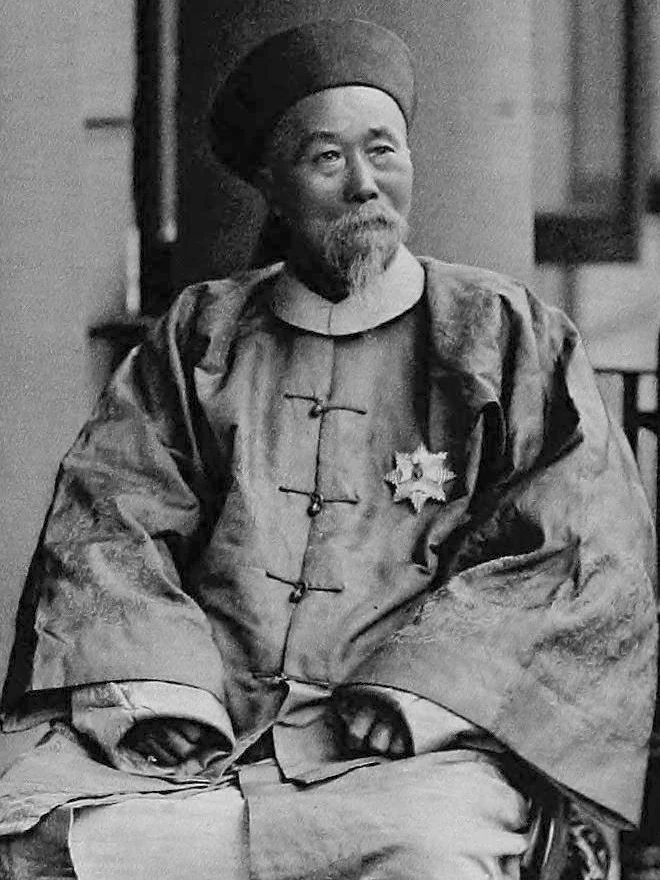
From photographs of Li Hongzhang it may be seen that in his youth and prime he had something of the martially air, after middle age a look of fatigue, and in old age a certain stoutness; and in his later years he was troubled by the loss of many teeth on the right, so that his cheeks were full on the left and sunken on the right. In old age he liked to wear reading glasses, perhaps because of overuse of his eyes in youth. At the Shimonoseki negotiations there was added the scar of the bullet wound from the Japanese assassination, the scar standing out a little because the bullet still remained beneath the skin; and after the shooting Li Hongzhang's health declined from day to day, so that in his last years he needed a wheelchair. The excessive loss of blood from the Shimonoseki shooting in his earlier years left him with a stubborn dizziness on any fatigue, and during the peace negotiations of 1901 he fell ill with phlegm and coughing and could not eat, dying at last of gastric bleeding at Beijing. That a great minister of state should bear wounds of body corresponding thus to the wounds of his country's fortunes may be noted.
His Appearance as Foreigners Described It
On his missions to Europe and America many foreigners left eyewitness accounts of him. The American missionary and diplomat Chester Holcombe, in his book on the Chinese character, said that his bearing and way of thinking were more those of a soldier than a statesman; that he was taller than the ordinary Chinese, with a hoarse but vigorous voice, and gave an impression thoroughly plebeian and easy of approach. The Englishman Curzon, in his writings, described the scene of his meeting with Li Hongzhang and called it the finest memory of his life, observing him closely and finding him more than six feet tall, in a long grey silk robe and a black silk hat, of great dignity, with a heavy moustache covering half his mouth and Chinese-style whiskers on his chin, his hair a dark grey beginning to turn white. The American writer Sterling Seagrave, sketching Li Hongzhang at seventy-six, thought he looked a hypocrite, wearing thick-soled satin court boots, standing more than six feet four inches tall, and added that Li Hongzhang had had a stroke which left part of his face motionless, so that he always seemed to smile. Such accounts, though variously praising and blaming, are what later ages have mostly drawn on to know Li Hongzhang's appearance and bearing.
His Relations with the Court in Later Years and the Naval Funds
Li Hongzhang's relations with the court in his later years were marked by both reliance and restraint. He had long been on bad terms with Weng Tonghe, who controlled the Ministry of Revenue, and the funds for the Beiyang Navy were often withheld, so that most of its ships grew old; Ding Ruchang, before the war, proposed mounting quick-firing guns on the chief ships to offset the Japanese advantage in quick-firing guns, at a cost of six hundred thousand taels, and Li Hongzhang did not approve it. After the Beiyang fleet was defeated in the battle of the Yellow Sea, Li Hongzhang at last memorialised the state of the great naval funds previously raised and deposited in various places, among which one hundred and seven thousand two hundred and ninety taels lay in the Hongkong and Shanghai Bank. With such difficulty in raising money and so many restraints, and with naval expenditure thus entangled with court personnel, the causes of the defeat in 1894 lay by no means only at sea.
An Outline of His Life
Li Hongzhang, whose family name in the genealogy was Zhangtong and whose courtesy names were Jianfu and Zifu, styled Shaochuan, was a man of Hefei in Anhui and took the presented scholar's degree in the twenty-seventh year of Daoguang. Entering Zeng Guofan's secretariat in his early years, he was ordered at the end of the Xianfeng period to raise the Huai army and carried thirteen battalions, some nine thousand men, by sea to Shanghai; from the first year of Tongzhi he recovered Suzhou and Changzhou with the Huai army, in the second year killed the eight surrendered commanders at Suzhou, in the third joined the attack on Tianjing and was enfeoffed as Suyi Bo of the first rank. From the fourth to the seventh year he campaigned against the Nian, first destroying the eastern and then the western Nian, and became governor-general of Huguang and then of Zhili and commissioner of the Beiyang, being advanced to grand secretary of the Wenhua Hall and enfeoffed as Suyi Bo of the first rank. In the twenty-first year of Guangxu he went to Japan and signed the Treaty of Shimonoseki, in the twenty-second toured Europe and America, and in the twenty-seventh signed the Boxer Protocol, dying at Beijing in that year with the posthumous name Wenzhong.