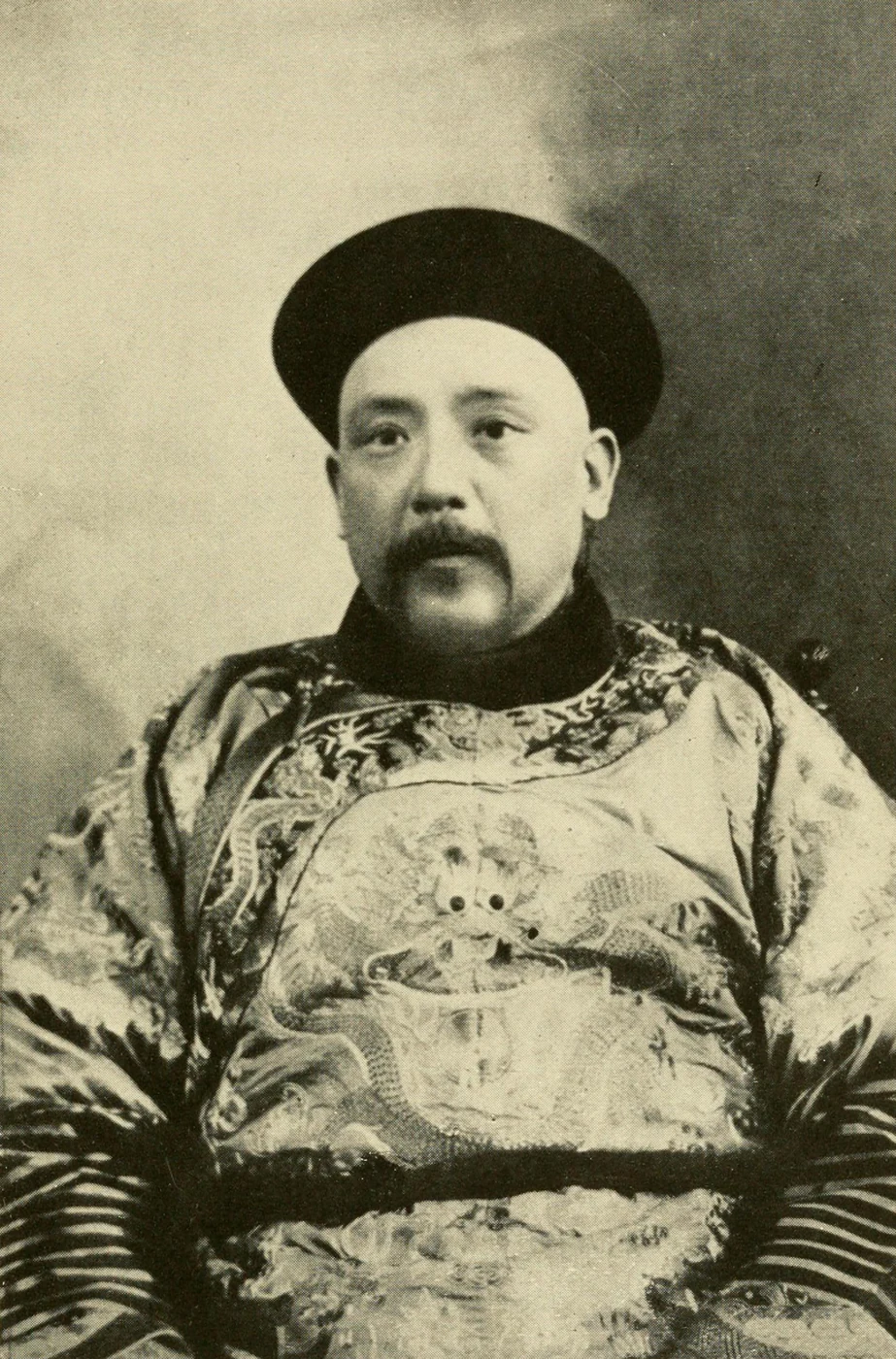
Biography
Family Background and Early Life
Yuan Shikai came from a large family in Xiangcheng, Henan, and was described in the source text as a descendant of the Runan Yuan clan. His great-uncle Yuan Jiasan rose to the office of Governor-General of Grain Transport and participated in suppressing the Taiping and Nian forces, becoming the leading figure of the family. Yuan Shikai's biological father Yuan Baozhong was a landholding notable in Xiangcheng who had purchased the official title of subprefect. Yuan Shikai was Yuan Baozhong's fourth son; his biological mother was Lady Liu, a concubine of Yuan Baozhong. He was born on September 16, 1859, the twentieth day of the eighth lunar month in the ninth year of Xianfeng, at Yuanzhangying in Xiangcheng County, Chenzhou Prefecture, Henan. On the day of his birth Yuan Jiasan happened to send home a letter reporting a victory over Nian forces. Delighted, Yuan Baozhong chose the name “Kai,” meaning triumph, and following the family's generational sequence “Bao–Shi–Ke–Jia, Qi–Wen–Shao–Wu,” named the child Shikai.
Yuan Shikai was raised by his aunt Lady Niu, wife of Yuan Baoqing, and in 1864, the third year of Tongzhi, was formally adopted by the childless Yuan Baoqing as his heir. When Yuan was six, Yuan Baoqing found him an elementary tutor, Yuan Zhizhong, who taught him the Four Books and Five Classics. Yuan later traveled with Yuan Baoqing during official postings in Jinan, Yangzhou, and Nanjing. In Nanjing he studied martial arts under Qu Zhao and was said to enjoy visiting scenic sites and to be skilled at riding and archery, riding in his spare time to Qingliang Mountain, Mochou Lake, Taiping Lake, and other places. Yuan liked military treatises from childhood and wanted to master the art of defeating vast armies. He once remarked that although the commander of the three armies could not be taken from them, if he himself held one hundred thousand elite troops he could move freely across the empire. He spent heavily collecting editions of military works and was mocked as a “military-book pedant.” At age thirteen he wrote a couplet about a dragon coiled in the wilderness and a fat deer in the Central Plain, reflecting the ambition attributed to his youth in the source text.
In the summer of 1873, the twelfth year of Tongzhi, Yuan Baoqing died while in office in Nanjing. Yuan Shikai escorted the coffin home for burial and afterward lived in Huaiyang County. Early in 1874, his collateral uncle Yuan Baoheng, son of Yuan Jiasan, considered Yuan Shikai idle and ordered him to study in the family school in Beijing. From 1874 to 1877 he studied there seriously for four years and made substantial progress. Yuan Baoheng and Yuan Baoling supervised him strictly, while Yuan himself applied himself under demanding teachers. Yuan Baoling wrote to Yuan Baoheng that Shikai could indeed be developed; although his composition had “not yet entered the gate,” he had already become “fine material of above-average quality.”
In the autumn of 1876 the Yuan brothers sent Yuan Shikai back to Henan for the civil-service examination, but he failed. In the tenth lunar month he married a woman of the Yu clan from Shenqiu, at age seventeen. Early the next spring he returned to Beijing. Northern China was then struck by severe drought. Yuan Baoheng was ordered to Kaifeng to assist famine relief and took Yuan Shikai with him. Yuan displayed considerable administrative ability and enthusiasm in the relief work. In 1878 Yuan Baoheng died after contracting an epidemic disease. Yuan Shikai returned to Xiangcheng and moved to Chenzhou, where he met Xu Shichang, then working as a teacher. They formed a sworn friendship, and Xu later became an important adviser throughout Yuan's life. In 1879 Yuan received the nominal title of secretary in the Secretariat through a donation made in Yuan Baoheng's name for relief work. That autumn he again failed the provincial examination. In anger he burned his poems and essays and declared that a great man should serve on the frontier, secure order within and repel threats without, rather than remain trapped among brush and ink and waste his time.
Having failed twice in the examinations and unwilling to remain a rural landowner, Yuan looked for a career elsewhere. He wrote the poem “Reflections on Current Affairs,” which the source text presents as evidence of early ambition. Huai Army general Wu Changqing had been a sworn brother of Yuan Baoqing, and Yuan decided to seek his patronage. Yuan Baoling also wrote to Yuan Shikai, inviting him to learn military affairs in gratitude for Yuan Baoqing's kindness. In October 1881 Yuan therefore traveled to Dengzhou in Shandong and joined Wu Changqing's garrison.
Period in Korea
Wu Changqing's staff included educated figures such as Zhang Jian and Zhou Jialu. Under their guidance Yuan Shikai disciplined himself, lost some of the habits of a privileged youth, became more modest, and was regarded as a promising man. He was unusually appointed assistant in the camp administration office. Although he had grown tired of the civil examinations, he had not entirely abandoned the ambition. While in Wu Changqing's staff he continued studying for a degree and wrote to his third elder brother Yuan Shilian in March 1882 that he could not die content without obtaining even the lowest examination degree. The year 1882 was an examination year, and Yuan intended to sit for it, but events in Korea changed the direction of his life.
In 1882 the Imo Mutiny broke out in Korea. Yi Ha-eung, the Heungseon Daewongun and father of King Yi Hui (Gojong), used the military revolt to seize power. The faction of Queen Min, which was hostile to the Daewongun, appealed to the Qing court for military intervention. Yuan Shikai crossed to Korea with Wu Changqing's troops. Yuan led a Qing unit in the operation and killed several dozen participants in the mutiny. According to the source text, he fired continuously and advanced at the front, and his courage encouraged his troops, helping suppress the revolt quickly. Wu Changqing praised him to the Qing court for strict troop management, sound deployment, and exceptional courage in attacking, and reported him for first merit. Qing forces then seized the Daewongun and sent him to Baoding for questioning. Yuan Shikai, then twenty-three, remained in tributary Korea as an assistant for Korean military affairs and helped train a new army, beginning his later career in military organization.
During his stay Yuan received favorable comments from people in Korea. The source text quotes a Korean assessment that he was precociously capable and, after a year in the capital Seoul, had won the support of the city's population. He formed close friendships with Korean officials and scholars including Kim Yun-sik and Kim Byeong-si.
In 1884 members of the Enlightenment Party led by Kim Ok-gyun launched the Gapsin Coup in an attempt to overthrow the faction identified in the source text as the “Serving the Great” party. Japanese troops in Korea also acted and attempted to control the royal house. Yuan Shikai commanded Qing troops in driving the Japanese forces back, thereby preserving Qing suzerainty and related privileges in Korea. The source text treats his suppression of the coup as important because it checked Japanese influence, frustrated Japan's attempt to exploit the Sino-French War to gain Korea, and delayed the outbreak of war between China and Japan. Yuan's role drew the attention of Li Hongzhang, Viceroy of Zhili and Beiyang Minister, but also caused intense hostility among Japanese observers. Colleagues such as Wu Zhaoyou also became jealous and accused Yuan of recklessly provoking border conflict and misappropriating military funds. Yuan therefore returned to China early in 1885 and remained inactive for a time to avoid the attacks.
Li Hongzhang nevertheless decided to use him. In October 1885 Yuan escorted the Daewongun back to Korea, and in November Li appointed him “Imperial Resident in Korea for General Supervision of Diplomatic and Commercial Matters,” with rank equivalent to a third-rank circuit intendant. Yuan exerted extensive influence over Korean politics. His task, in the source text's formulation, was to reinforce the Qing tributary relationship with Korea, prevent moves toward Korean independence, and check Japan, Russia, and other powers. This led him to intervene directly in Korean domestic affairs and, on more than one occasion, to consider removing King Yi Hui.
Yuan's interference produced resentment from the Korean king and some officials, while officials within the Qing court repeatedly impeached him. In January 1888 King Yi Hui wrote requesting Yuan's removal, and the Korean representative Kim Myeong-gyu later appealed to Li Hongzhang for a replacement. Qing officials including Zhang Peilun also criticized Yuan as arrogantly self-important and claimed that keeping him long in Korea was of no benefit to the general situation. Li Hongzhang rejected these objections, kept Yuan in his post, and in February 1890 praised him as loyal by nature, keen in talent and judgment, able to uphold the larger situation, and willing to bear exceptional difficulty.
The source text concludes that although Yuan sometimes used excessive and rough methods during his twelve years in Korea because of his youth, his activities effectively checked Japanese and Russian penetration.
In 1894 the Donghak Peasant Rebellion broke out. Yuan encouraged the Korean government to request Qing military assistance. Japanese forces then quickly entered Korea, creating conditions for war. On July 19, shortly before the First Sino-Japanese War, Yuan escaped in civilian disguise and reached Tianjin on July 22. On August 6 he was ordered to the Liaodong front to assist Zhou Fu in transporting grain and weapons and gathering scattered soldiers. He remained until taking leave to visit home the following May. His Korean experience gave him substantial diplomatic and military experience and, according to the source text, made him one of the Qing officials with a comparatively deep understanding of Japan.
Xiaozhan Army Training and the 1898 Coup
During ten months connected with the Sino-Japanese front, Yuan witnessed the collapse of Qing armies and developed the idea of retraining forces on Western lines. He wrote that repeated defeats resulted not only from poor command but also from defective military institutions, and that unless the system was thoroughly reformed and Western methods adopted for serious training, the lessons of failure were alarming. Yuan had gained a reputation for understanding military affairs in Korea and strongly advocated new training, which opened the Xiaozhan phase of his career.
After the First Sino-Japanese War, reform movements spread across the country. Yuan Shikai also participated. At the end of June 1895, Liu Kunyi, Li Hongzhang, and Wang Wenshao jointly memorialized recommending him, and Emperor Guangxu ordered Yuan to Beijing for an audience. After meeting the emperor, Yuan submitted a long memorial at the end of August presenting a complete reform program: nine measures for cultivating talent, nine for financial administration, twelve for military training, and four for foreign relations. The source text presents these proposals as evidence of his reform ideas. He especially valued military reform, recognizing the political opportunity in command of a newly trained army. His memorial set out twelve measures for Western-style training, and he drafted regulations for the Newly Created Army, taking German infantry drill as the main model.
His proposals won support from Emperor Guangxu and senior officials. On December 8, 1895, Prince Yixin, Ronglu, and other princes and ministers jointly memorialized that Yuan should supervise the Newly Created Army. Guangxu approved the proposal the same day. Yuan formally took charge at Xiaozhan and began organizing what the source describes as China's first modern army trained on Western lines. During the period between his audience and the Xiaozhan training, Yuan actively associated with reform circles. He joined the Society for Strengthening Studies founded by Kang Youwei, Liang Qichao, and others and interacted closely with reformers, who increasingly regarded him as an ally. This later shaped their expectations during the 1898 crisis.
Yuan recruited 2,250 infantry and 300 cavalry in Shandong, Jiangsu, Anhui, Henan, and other areas, and combined them with 4,750 men of the Dingwu Army to form the “Newly Created Army.” At Xiaozhan he used the German army as a model and developed modern systems for recruitment, organization, officer appointment and training, military education, pay, and supply. He emphasized modernization and standardization of weapons and adopted advanced Western techniques, while demanding strict implementation of the new drills. This force later developed into the six divisions of the Beiyang New Army, the principal late Qing army. Many early Republican Beiyang military figures came from it. Yuan hired more than ten German officers as instructors and selected more than one hundred students from the Tianjin Military Academy as officers. He also recruited and promoted personal associates in order to strengthen his control. Many later became major military and political figures, including Duan Qirui, Feng Guozhang, Wang Shizhen, Cao Kun, and Zhang Xun. The Beiyang New Army gradually became Yuan's personal political base, and the source text describes him as progenitor of the Beiyang warlord group. American scholar Ralph L. Powell is quoted as observing that although Yuan's discipline was severe, soldiers liked him because he cared for them and paid them on time, and because he instilled loyalty primarily to Yuan himself rather than to the emperor.
In 1897 Yuan was promoted to Provincial Judge of Zhili while continuing to direct Xiaozhan training. In September 1898 he became Right Vice Minister of Works and was summoned to Beijing, becoming caught in the political crisis surrounding the Hundred Days' Reform. Emperor Guangxu relied on Kang Youwei, Liang Qichao, Tan Sitong, and other reformers, while the conservative group centered on Empress Dowager Cixi opposed them. Reformers had begun approaching Yuan in late July, when Xu Renlu went to Xiaozhan to test his attitude. Kang Youwei believed Yuan had been won over and recommended him for the vice-ministerial post.
On September 18, after receiving a secret edict from Guangxu saying that even his throne could not be secured, Kang and his associates felt the situation was urgent. They decided on a dangerous plan to surround the Summer Palace, seize Empress Dowager Cixi, and kill her favored official Ronglu, Viceroy of Zhili. The reformers assigned the military role to Yuan Shikai. That night Tan Sitong visited Yuan at Fahua Temple, informed him of the plan to “surround the palace grounds and seize the Empress Dowager,” and pressed him to mobilize the Newly Created Army. Yuan reluctantly agreed in the conversation and sent Tan away. On the morning of September 20 Yuan was received by Emperor Guangxu and later that day took a train to Tianjin. On the morning of September 21 Empress Dowager Cixi entered the Forbidden City from the Summer Palace, announced that she would again supervise government, dismissed Kang and other reformers, and ended the Hundred Days' Reform in what became known as the 1898 coup.
The source text notes that earlier interpretations often claimed Yuan's report to Ronglu caused Cixi's coup, but argues this was not accurate: the coup itself did not result from Yuan's report. Yuan did, however, report the reformers' scheme after returning to Tianjin. He had already learned from conservative censor Yang Chongyi that Cixi was about to take power and feared that Tan Sitong's request that he attack Cixi might become known and implicate him. He therefore informed Ronglu, allowing Cixi to learn of the reformers' plan and intensifying the consequences. At first Cixi had only denounced Kang Youwei for disorderly political speech and suspended him pending investigation, without yet addressing Tan Sitong and the others. Yuan's disclosure was followed by orders to arrest reformers and the execution of Tan Sitong and the other Six Gentlemen of the Hundred Days' Reform, while Guangxu was confined at Yingtai. The source text interprets Yuan's action as self-preservation after weighing the risks rather than support for the reformers' radical plan, which Yuan regarded as militarily hopeless and politically treasonous.
Late Qing New Policies, Dismissal, and Recall
In 1899 Yuan became acting Governor of Shandong and used the New Army to suppress the Boxer Movement. In 1901 he became acting Viceroy of Zhili and Beiyang Minister and was formally confirmed the following year. As Viceroy of Zhili, Yuan actively implemented the late Qing New Policies, including creating modern police forces, establishing new schools, promoting local self-government, and reorganizing finances. The source text describes Zhili under him as a model province for the New Policies.
In 1903 Yuan memorialized for establishment of the Army Training Office and became associate minister of army training. Building on the New Army, he expanded the Beiyang New Army to six divisions with roughly sixty to seventy thousand troops, making it the Qing court's principal military force. In 1907 Yuan was transferred to serve as Grand Councillor and Minister of Foreign Affairs, entering the central decision-making apparatus.
In 1908 Emperor Guangxu and Empress Dowager Cixi died in succession. Regent Zaifeng, Guangxu's younger brother and father of the Xuantong Emperor Puyi, distrusted Yuan. In January 1909, in the twelfth lunar month of the thirty-fourth year of Guangxu, Yuan was removed from office on the stated ground of a foot illness and ordered home to recuperate. Yuan returned to Huanshang Village near Zhangde, present-day Anyang in Henan, and lived in apparent retirement while continuing close contact with former Beiyang subordinates and watching political developments.
On October 10, 1911, the Wuchang Uprising began and revolutionary movements spread rapidly. Unable to suppress them militarily, the Qing court recalled Yuan. On October 14 he was appointed Viceroy of Huguang but declined on various pretexts. On October 27 the court named him Imperial Commissioner with authority over land and naval forces in Hubei, and on November 1 appointed him Prime Minister of the Cabinet. After obtaining military and political authority, Yuan used a strategy combining suppression and negotiation. He ordered Beiyang forces to take Hankou and Hanyang, placing military pressure on the revolutionaries, while secretly negotiating with them. The bargain described in the source text was that Yuan would force Qing abdication and establish a republic in exchange for revolutionary support for his assumption of the presidency.
Republican Period
On February 12, 1912, under Yuan Shikai's pressure and persuasion, Empress Dowager Longyu issued the Qing abdication edict in the name of the Xuantong Emperor Puyi, bringing the Qing dynasty to an end. On February 15 the Provisional Senate in Nanjing elected Yuan Provisional President of the Republic of China. On March 10 he took office in Beijing and established the Beiyang Government.
After becoming provisional president, Yuan's conflict with Sun Yat-sen's Tongmenghui, later reorganized as the Nationalist Party, deepened. In March 1913 Song Jiaoren, acting leader of the Nationalist Party, was assassinated in Shanghai. Public opinion widely suspected Yuan of involvement, an episode known as the Song Jiaoren assassination. In April Yuan concluded the Reorganization Loan with a consortium of British, French, German, Japanese, and Russian banks, pledging the salt tax and obtaining £25 million, which he used in part to suppress revolutionary opponents. In July Sun Yat-sen launched the Second Revolution against Yuan, but Yuan's forces quickly defeated it. In October Yuan pressured parliament to elect him the first formal President of the Republic of China.
In 1914 Yuan dissolved parliament, abolished the *Provisional Constitution of the Republic of China*, and promulgated the *Constitutional Compact of the Republic of China*, replacing cabinet responsibility with a presidential system and greatly strengthening presidential power. In May 1915, seeking Japanese support for his monarchical ambitions, Yuan accepted Japan's Twenty-One Demands except Group Five. In August, with Yuan's tacit approval, Yang Du and others organized the Society for Planning Security to promote monarchy. In December Yuan announced that the following year would be the first year of the Hongxian era and proclaimed himself emperor, an episode known as the Hongxian monarchy.
The imperial move provoked strong opposition across the country. On December 25, 1915, Cai E, Tang Jiyao, and others declared independence in Yunnan and launched the National Protection War against Yuan. Guizhou, Guangxi, Guangdong, and other provinces followed. Under severe internal and external pressure, Yuan announced on March 22, 1916 that the monarchy was cancelled and abolished the Hongxian era name, while retaining the title of president. The National Protection Army nevertheless continued its opposition, and divisions also appeared within the Beiyang camp. Yuan Shikai died of uremia in Beijing on June 6, 1916, aged fifty-seven.
His Family and Early Years
Yuan Shikai, courtesy name Weiting, also written Weitang, styled himself the Recluse of Rong and Master of the Pavilion of Washed Hearts, was a man of Xiangcheng in Henan, known to his age as Yuan of Xiangcheng. He was the fourth son of Yuan Baozhong by the concubine lady Liu and was born on 16 September 1859 at Yuanzhangying in Xiangcheng; and on the day of his birth Yuan Jiasan happened to send a letter home saying that he had won a battle, at which his father, overjoyed, named the child Kai and, following the family sequence of characters, named him Shikai. He was brought up by his aunt lady Niu and in 1864 was adopted as heir by the childless Yuan Baoqing. At six his adoptive father found him a first teacher, and following his father from post to post he learned arms at Nanjing under Qu Zhao and "delighted in roaming the hills and waters and was moreover good at riding and shooting, and in the intervals of his lessons would ride out to gaze from the heights." From boyhood he loved the art of war and resolved to learn to be the match of ten thousand men, saying that a commander could not be deprived of his command and that if he could hold a hundred thousand picked troops in his hand he might range at will over the realm; he would spend lavishly to collect every edition of the military books and would be mocked as the book-dolt Yuan, and at thirteen he wrote the couplet that the great dragon was still coiled and the deer of the central plain was fat. When Yuan Baoqing died at his post in Nanjing, Yuan Shikai brought the coffin home for burial and afterwards lived in Henan.
His Studies, His Relief Work, and His Two Failures
Yuan Shikai studied steadily at Beijing for four years, closely controlled by his brothers Yuan Baoheng and Yuan Baoling, and he himself knew how to exert himself, so that with a strict teacher's guidance he made great progress in those years; and at the end of one year Yuan Baoling wrote to Yuan Baoheng that Shikai was worth training, for though "his essays have not yet entered the door" he had already become "fine material of the upper middle class." He married a lady of the Yu family at seventeen and early the next spring returned to Beijing; and the north of China being then stricken with drought, Yuan Baoheng was ordered to Kaifeng to help manage relief and took Yuan Shikai with him, and in the relief work Yuan Shikai showed considerable capacity for affairs, being zealous and performing notably well. In 1878 Yuan Baoheng died of plague and Yuan Shikai went home; in 1879 he obtained an office through money his family had contributed for relief. Afterwards, failing again in the examinations, he burnt his poems and essays in a rage and said that a great man should do his service on the battlefield, keeping the realm at peace within and driving off the enemy without, and how could he moulder away so long among ink-stones and ruin his own life. He wrote a poem on his feelings to encourage himself, saying that the dragons and tigers before his eyes could not finish their fight and their murderous breath went up to the clouds, and that he wished to open a great mouth at heaven and swallow the braggart of the northern sky at one gulp. To repay Yuan Baoqing's kindness, Wu Changqing at that time wrote to him, calling him to come and learn the soldier's trade.
His Going to Wu Changqing and His Twelve Years in Korea
Yuan Shikai went to Wu Changqing, then stationed in the region, whose secretariat included such famous men as Zhang Jian, and under their guidance he polished himself so that his foppish air gradually fell away; he became modest and self-deprecating and inclined to learning, and being thought a man of promise he was exceptionally made an assistant in the office of military affairs. In 1882 he crossed to Korea with Wu Changqing's troops and, leading a body of Qing troops in support, in the fighting kept firing as he went and was first into the front, his resolution and courage infecting his men so that the mutiny was quickly put down; and the Qing court's report praised him for strict discipline in his troops, good direction of them, and particular valour in pressing to the attack, and awarded him the first merit. The Qing then took the prince regent Taewongun to Baoding for trial, and Yuan Shikai, then twenty-three, remained in Korea with the title of assistant in the Korean military service, and this was the beginning of his training of troops. His stay in Korea was well spoken of by all ranks there, and afterwards he commanded the Qing troops that drove back the Japanese and maintained the court's standing and privileges in Korea; and his suppression of the Gapsin coup of 1884 was of great significance, for it beat back the Japanese penetration, destroyed Japan's design of seizing Korea in the confusion and delayed the outbreak of war between China and Japan. For this Yuan Shikai was valued by the Qing court, and the Japanese hated him to the bone and plotted his ruin by a hundred devices. In early 1885 he returned home and stayed idle to avoid attack, but Li Hongzhang resolved to employ him and ordered him in October 1885 to escort the prince. His task in Korea, amid the trade of all nations and the watchfulness of neighbouring states, was to make Korea "understand the duty of honouring its superior and fix its wavering will, reforming its government within and joining friendly states without," and to prevent Korea's tendency to independence and the designs of Japan and Russia; and so he unavoidably interfered in Korean affairs and more than once plotted the deposition of the king. This drew the displeasure of the king and some of his ministers, and at the Qing court too there were repeated impeachments of him: in January 1888 the Korean king Yi Hui wrote asking the Qing to withdraw Yuan Shikai, and Korean officials at the Chinese court attacked him as arrogant and self-important, boastful and quarrelsome, whose long stay in Korea did no good to the general situation. Li Hongzhang overrode all objection, not only keeping him in Korea but writing in February 1890 that he was of loyal blood, of keen talent and insight, who upheld the general interest and alone undertook its difficulties. His twelve years in Korea, though he used violent and rough means in his young ardour, effectively checked the expansion of Japan and Russia.
The Sino-Japanese War and the Training at Xiaozhan
On 19 July, on the eve of the Sino-Japanese war, Yuan Shikai disguised himself as a common man and fled, reaching China on 22 July; he then took charge of the transport of grain and weapons and the gathering of stragglers, and in May of the next year went home on leave to see his family. In those ten months at the front, seeing the Qing armies collapse like a landslide, he conceived the idea of training troops on Western methods, saying that in this war they had been taken at advantage again and again, and that though this was due to bad direction it was in truth because the military system was not good, so that unless they measured the times and cleared away and remade, using Western methods and training earnestly, the lesson of the overturned cart ahead was enough to chill the heart. At the end of June 1895 an edict summoned the home-returning Yuan Shikai to audience at the capital, and he then presented a ten-thousand-word memorandum setting out a complete programme of reform: nine articles on storing up talent, nine on managing finance, twelve on training troops and four on foreign dealings; and he valued the training of troops above all, not only proposing twelve measures for Western-style drill but drafting the regulations for a new army. On 8 December 1895 the princes and great ministers jointly memorialised that Yuan Shikai be appointed to train the Newly Built Army, and the Guangxu emperor approved it the same day, so that Yuan Shikai formally took charge at Xiaozhan and began training China's first new-style army on Western lines. In the interval between his audience and the training at Xiaozhan he worked actively for the reform movement, was on the closest terms with the reformers, and was therefore taken by them for one of themselves, which laid the ground for the later affair of his informing. The training at Xiaozhan took the German army as its model and laid down a whole modern scheme of recruitment, organisation, appointment and training of officers, drill and instruction, and pay and rations; in equipment he attended to modernisation and standardisation, and he insisted on strictness in the new drill; and this force afterwards grew into the six divisions of the Beiyang. He also brought in and fostered a body of personal confidants to strengthen his hold on the whole army, most of whom afterwards became the military and political figures of the late Qing and early Republic; and the Beiyang New Army gradually became his own political capital, making him the founder of the Beiyang warlords.
His Informing in 1898
After Xiaozhan he was drawn into the political storm. The reformers had from the first placed their hopes in him, sending Xu Renlu to Xiaozhan at the end of July to sound him out, and Kang Youwei, judging that he "was moved on my behalf," recommended him. On the third day of the eighth month Kang Youwei and the rest obtained the secret edict of the Guangxu emperor that his own throne could not be preserved, and feeling the crisis pressing, took the desperate course of resolving to surround and control the empress dowager Cixi, who was then living there, and to kill her favourite the governor-general of Zhili, and this task was entrusted to Yuan Shikai. That night Tan Sitong entered Yuan Shikai's lodging, told him of the plot to surround the garden and seize the empress dowager, and pressed him to mobilise his troops to carry out the reformers' plan; and Yuan Shikai, unable to refuse, agreed and sent Tan Sitong away. On the morning of 20 September he was received by the Guangxu emperor and the same day took the train to Tianjin; and on the morning of 21 September the empress dowager announced that she would hold court and govern, dismissed Kang Youwei and the other reformers, and the reform of 1898 thus failed. By the findings of scholars, the claim that his informing caused Cixi's coup is not true and the coup was unconnected with it, but he did indeed inform: reaching Tianjin he had already learned from a censor of the empress dowager's party that she was about to take power, and fearing that Tan Sitong's urging him to send troops against her would come out and involve him, he informed, so that Cixi learned the reformers' plot and the consequences of the coup were the heavier — at first Cixi only reproved Kang Youwei for dangerous words and suspended him pending inquiry, saying nothing of Tan Sitong and the rest, whereas what followed from Yuan Shikai's informing was her order to arrest Kang and Liang and to put Tan Sitong and the others to death. In truth Yuan Shikai did not support the reformers' extreme course and knew well that to use troops to surround the garden and seize the empress dowager was to throw an egg against a stone and was moreover the crime of treason, so that his informing was wholly a measure of self-preservation in weighing the situation; and the matter became a burden to him, so that he was obliged to write his Record of 1898 in his own defence.
Governor of Shandong, Governor-General of Zhili and the New Policies
By his informing Yuan Shikai won the confidence of the empress dowager's party and his standing soared. In the winter of 1899 he was made governor of Shandong, at forty his first appointment as a frontier official; and Shandong being then full of the anti-foreign Boxers, Yuan Shikai on taking office judged them a depraved heresy and, reversing his predecessor's indulgence, suppressed the Boxers with all his force, so that they could not stand in Shandong and fled towards Beijing; and when the allied armies invaded in 1900 Shandong remained stable under his government. In November 1901 Li Hongzhang died and Yuan Shikai was appointed acting governor-general of Zhili and commissioner of the northern ports, confirmed the next year, so that he leapt to be a man of power that all at home and abroad watched. From the twenty-seventh to the thirty-third year of Guangxu he was governor-general of Zhili for seven years, and in that first rank of frontier officials devoted himself to carrying out the new policies of the late Qing and transplanting Western institutions and methods of production wholesale, setting up many new bodies within the system to conduct and supervise them: a military office for the training of troops; an office of education, afterwards the department of schools, to run the new schools in place of the old private academies, for Yuan Shikai held that education was the root of founding a state and primary schooling the root of education; an office of manufactures to promote mines and industry in every prefecture and county; an office of agriculture to promote the improvement of farming; a police bureau to create a modern police and extend it through the province, with modern municipal works in such great cities as Tianjin; the introduction of Western judicial institutions and the building of courts and a judicial system; the founding of chambers of commerce as modern organisations of industrialists; and the founding of banks to establish a modern financial system. Within a few years Zhili became the model province for the new policies throughout the land. He also took part in decisions and administration in every field of national government, politics, military affairs, economy and foreign relations, and in the new technology of transport and telegraphy, and strongly recommended Zhan Tianyou as chief engineer of the Peking-Kalgan railway. In 1903 he memorialised for the setting up of an office for the training of troops and became its minister, in which post, though nominally a co-director, he was in fact the decider and commander, and within three years the Beiyang army was trained; and he afterwards organised and commanded the joint manoeuvres of the new armies north and south. In 1905, on his initiative, he joined the governor-general of Huguang and other provincial officials in memorialising for the abolition of the examination system, ending the traditional civil examinations. In 1906 the court proclaimed its intention to prepare for constitutional government and appointed seventeen officials to compile the new official system, of whom sixteen were princes, nobles and ministers of the grand secretariat, the grand council and the boards, and only Yuan Shikai a provincial official, yet he held the real power in the preparation for constitutional rule and in the daily working of the compilation, the office of compilation being staffed from top to bottom with his own men. In August of that year the court held a conference before the throne on constitutional matters, and Tieliang, on the ground that Yuan Shikai was too precipitate, quarrelled hotly with him; and afterwards Yuan Shikai joining others in impeaching Tieliang for obstructing the new policies, he rather roused Cixi's suspicion and became the target of the whole court. In November the court decreed a reform of the official system, merging the board of war and the office for training troops into a board of the army to which all military business passed, with Tieliang as its minister, which marked the passing of the leadership of army training from Yuan Shikai to Tieliang. Yuan Shikai, retreating in order to advance, himself asked that the first, third, fifth and sixth divisions be transferred to the direct control of the board of the army while requesting that the two most picked divisions, the second and fourth, remain under Zhili, which the court granted. In the summer of 1907, on the eve of entering the grand council, he memorialised for the immediate realisation of constitutional government; and the court then moved him up to be a grand councillor and minister of foreign affairs, becoming a chief minister of the day, a move that in truth stripped him of his last military power by a nominal promotion. At the end of the thirty-fourth year of Guangxu, 1908, the empress dowager and the Guangxu emperor died, and during the hundred days of mourning the prince regent Zaifeng, on the ground of a foot ailment, ordered Yuan Shikai to be relieved and sent home. He returned to Henan and at first lived in retirement at Yanshang near Zhangde, fishing and waiting for the moment to come out again.
His Recall in 1911, the Peace Negotiations and the Abdication
The Wuchang rising was the occasion of his return. On the fourth day after it the court called him back, made him governor-general of Huguang and ordered him to the front to take part in military affairs, but only as the deputy of the minister of the army who had gone south before him, without giving him command at the front, and sent his confidants to Yanshang to urge him; and after weighing the matter he thanked the throne by memorial two days later and formally came out, attaching to his memorial eight demands, chiefly for a force of his own to command, the transfer of a body of generals, the grant of funds, and independent command, the general staff and the board of the army not to hamper him from afar. On the fifth day of the ninth month he telegraphed that he would set out south on the ninth, saying that he dared not promise victory at the front but that while he had a day for his country there would be no fear of a move northwards; and on the fourth and fifth he sent two long secret telegrams asking the court, in this great hour of arms, to follow the precedents of former dynasties and set up a military affairs office as a central unified organ, to keep information secret, quicken decisions and unify command. On the eleventh day of the ninth month of the xinhai year, when the Qing and the revolutionary armies were fighting at Hankou, Yuan Shikai took the field in Hubei and took his seat at Xiaojia harbour in Xiaogan; and that day the edict reached the front that Yuan Shikai was now made prime minister, with all the land and sea forces sent to Hubei and the river fleet still under his command. The same day the ministers of the cabinet resigned. Having thus won power enough to control the court and command the armies, he asked the court to stop the attack on the one hand and on the other sent a delegation south to negotiate, first to Wuhan and at last to Shanghai, his bottom line being a constitutional monarchy under the Qing and a united north and south. In December the two sides opened talks in the municipal hall, the first meeting agreeing to an armistice and mutual orders to that effect; and on 20 December a second meeting, the truce being nearly out, agreed to extend it seven days and to include Shaanxi, Shanxi and Sichuan, the first nationwide armistice. That settled, the two sides turned to substance and agreed that a national assembly should decide the questions at issue; and from 29 to 31 December they discussed the execution of the truce, the treatment of the abdicated Qing emperor and of the Manchus, Mongols, Muslims and Tibetans, debating long the composition of the national assembly and the place of meeting, and resolving to move it into the Shanghai foreign concessions. On the other hand, by the year's end the revolutionaries could not let the new government stand headless, and since Yuan Shikai had never clearly declared for a republic and could not at once be persuaded to abandon constitutional monarchy, the Nanjing government had to choose another to preside; and Sun Yat-sen, who returned on 21 December, became the best choice, being elected provisional president by the provincial delegates at Nanjing on 29 December by secret ballot, seventeen provinces voting one vote each, Sun receiving sixteen of the seventeen. This displeased Yuan Shikai, who tore up the agreements already reached, publicly asked what was meant by electing a president, and secretly had Duan Qirui and Feng Guozhang rally the Beiyang officers to telegraph against the republic and declare that they would fight hard for constitutional monarchy. The revolutionaries, however, had no wish to break with Yuan, and Sun Yat-sen's provisional presidency was only "a temporary filling of the place," to be resigned when the moment came: he explained this on the day of his election, telegraphed Yuan Shikai again on 2 January 1912 that he could not bear a civil war and the ruin of the people and did not oppose the negotiations, that whether the state were democratic or monarchical need not be debated again, that Yuan's labours would be understood, and that if by his efforts war could be spared, the people's wish attained, the races reconciled and the Qing house given ease, then the merit and the ability made him the natural choice; and on 15 January he declared publicly that if the Qing emperor would in fact abdicate and proclaim a republic, the provisional government would not break its word but he would formally resign, and with merit and ability the first to be recommended was Yuan. Having tested the ground and been assured by Sun Yat-sen, Yuan Shikai, fearing delay, quickened his pressure on the palace. On 6 February 1912 the provisional senate at Nanjing passed the articles of favourable treatment for the Qing house, and on the twelfth the court was obliged to accept them and issued the emperor's edict of abdication, so that the negotiations of 1911 succeeded. In the abdication edict Yuan Shikai had inserted the words that the provisional republican government should be organised with full powers by Yuan Shikai, to show that the succession of the state was received from the Qing; and he telegraphed at once to the Nanjing provisional government and Sun Yat-sen that a republic was the best form of state and that he would never let a monarchy come again in China. On 13 February 1912 Sun Yat-sen was obliged to offer his resignation to the provisional senate, attaching three conditions: that the capital be at Nanjing with the provisional government there; that Yuan Shikai come to Nanjing to take office; and that he abide by the Provisional Constitution. Yuan Shikai understood perfectly that Sun Yat-sen's Provisional Constitution, made after his resignation and turning the presidential provisional government into a cabinet system, was cut to his measure, and that his immediate business was to find a pretext to make Nanjing accept his taking office at Beijing. On 10 March 1912 he took up the provisional presidency at Beijing and appointed Tang Shaoyi prime minister; the Tang Shaoyi cabinet was formed on 21 April, by which time Sun Yat-sen had formally resigned.
His Rule in the Early Republic, the Twenty-one Demands, and the Monarchy
In 1913 the Nationalist party won the parliamentary elections and its leader was assassinated; the second revolution failed, and in October the parliament elected Yuan Shikai president, whereupon he dissolved it and set up a political conference. In foreign affairs the negotiations over Japan's twenty-one demands were the gravest: early in 1915 the Japanese government put the demands to Yuan Shikai's government, Japanese power seeking to enter the heart of China; and Yuan Shikai wrote comments on each article, directing the foreign ministry to negotiate on principle, hoping by delay to draw international attention and the intervention of the European and American powers. From 2 February to 7 May 1915, over a hundred and five days, his government negotiated with Japan more than twenty times, the Chinese delegates resisting many of the demands; and his government used every device to delay and leaked the unreasonableness of the demands to all ranks of society, hoping for international intervention and to rouse public opinion at home against Japan. On 6 May 1915, in his telegram to the provinces, Yuan Shikai said that China's coastal bays and islands could not be ceded or leased to other powers, and that Japanese advisers, joint Sino-Japanese policing and joint control of arms were "the chief means of strangling us"; that China should not break off and ruin all for this, but should strive with all her strength to recover a fraction at a time. The Japanese government, angered at last, sent an ultimatum on 7 May demanding an answer by six in the afternoon of the ninth. On 8 May Yuan Shikai called his chief officials, held that Japan having withdrawn the fifth group of demands most injurious to China they were no longer terms of national extinction, and that to avoid war the terms should be accepted; he said that though China was weak, should her sovereignty be infringed and her internal government fettered as in the fifth group he would resist to the death, that the foreign ministry had held to his instructions and refused to the end with all its strength, and that after this great trial all should take the acceptance as bitter shame and with the spirit of sleeping on brushwood and tasting gall set about vigorous work, hoping to meet Japan with head raised after ten years of burying themselves in effort. Under Japan's compulsion his government answered the ultimatum on 9 May 1915; and after further bargaining over the text the treaty concerning Shandong and the treaty concerning southern Manchuria and eastern Inner Mongolia with thirteen exchanges of notes were signed at Beijing on 25 May, known together as the treaty of the fourth year of the Republic. He afterwards abolished the Provisional Constitution and gave the president centralised power, and the conference on the constitution made a law of presidential election changing the five-year term renewable once into a ten-year term renewable without limit, with the successor nominated by the president, so that in effect he might be president for life. Not content even with this, he set about restoring the monarchy and making himself emperor: after repeated refusals he accepted the imperial title, prepared to establish a form of government, changed the presidential palace into the palace of New China, and drafted regulations for the new imperial house, providing among other things that imperial kin might serve as army and navy officers but might not organise parties or hold high political office, that the eunuch system and the selection of palace women and the tribute of the provinces should be abolished for ever, and that no imperial kinsman should trade and compete for profit with the common people. The measure was condemned and rejected by the whole people and brought on the war of national protection, province after province answering; and Yuan Shikai, seeking to rely on Duan Qirui to hold the Beiyang forces together and to crush the southern risings, found that the provinces in revolt did not cease their military action. In the latter part of May he fell ill of grief and anger and died on 6 June 1916 of uraemia at fifty-seven, being buried with full rites at Anyang in Henan on 24 August of that year. By the recollections of those about him, Feng Guozhang and others had secretly joined several provincial generals in preparing to press Yuan Shikai to cancel the monarchy and punish the promoters of it, the so-called secret telegram of the five generals; and the general of Zhili, receiving it, informed Yuan Shikai, who was greatly shaken and all but fainted. Afterwards he received Tang Xiangming's telegram against him, and faced with desertion on every side and enemies all about, he cried out in a fury that all was finished; and his illness worsened and he took to his bed. After his death the newspapers published many couplets of abuse and mockery, one of them playing on the names of two prescriptions: the six gentlemen who brought on the illness being the members of the society for tranquillity, Yang Du, Sun Yujun, Li Xiehe, Liu Shipei, Yan Fu and Hu Ying, who urged his restoration, and the two Chen and the Tang who killed him being the general of Sichuan Chen Huan and the general of Hunan Tang Xiangming, whose telegrams of independence hastened his end.