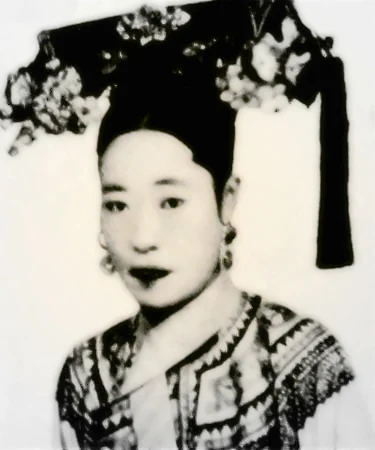
Biography
Family Background and Early Years
Empress Dowager Longyu was born on January 28, 1868, the fourth day of the first lunar month of the seventh year of the Tongzhi era. She was the eldest daughter of Guixiang, a younger brother of Empress Dowager Cixi and a military commander. Her birth mother was Guixiang's secondary wife, Lady Gioro, though another account identifies the principal wife, an Aisin Gioro woman. She had two younger brothers, Deheng and Deqi, and three younger sisters: the second sister became the principal wife of Zaize, a Duke of the Second Rank; the third died young; and the fourth married Nelehe.
The Yehe Nara family had long been associated with Yehe and belonged to the Manchu Bordered Yellow Banner. It was a prominent aristocratic family of the Qing. Her aunt Empress Dowager Cixi had been a consort of the Xianfeng Emperor and the mother of the Tongzhi Emperor, while another aunt, Yehe Nara Wanzhen, was the birth mother of the Guangxu Emperor and principal consort of Prince Chun, Yixuan. Several women of the family married into the imperial house or the wider clan, and uncles such as Zhaoxiang and Fuyou also held important offices. This powerful family background was an important reason for her later selection as empress and reflected Cixi's use of marriage ties to reinforce her own position.
The standard histories do not record her personal name. The First Historical Archives of China preserves her selection tablet. Its front identifies her as “Guixiang's daughter, age twenty-one, chosen as empress,” while the reverse bears the name “Xige.” Modern researcher Wang Miansen therefore considers Xige to have been her childhood name. *Memoirs of Qing Palace Eunuchs* records the childhood name as Xige in another spelling. The popular name “Jingfen” derives from Der Ling's *Two Years in the Forbidden City / Blood on the Terrace* tradition and does not appear in historical records from the Republican period onward; Qing historian Zhu Jiajin explicitly stated that the Guangxu Emperor's empress “simply did not have the name Jingfen.”
Selection as Empress and Palace Life
The Eight Banners selection of women scheduled under the normal rules for 1885 was postponed until the following year. Because it involved the Guangxu Emperor's marriage and the choice of an empress, the process lasted three years and comprised six rounds. During the first round on the 19th day of the second lunar month of 1886, Lady Yehe Nara was retained for further consideration. Her second sister, a female cousin who was Zhaoxiang's daughter, and a female cousin of an older generation who was Huichun's daughter also took part but were rejected.
On November 8, 1888, the fifth day of the tenth lunar month of the 14th year of Guangxu, Lady Yehe Nara and seven other candidates took part in the final selection, including two daughters of Jiangxi governor Dexin. Empress Dowager Cixi ultimately selected Lady Yehe Nara as empress and two women of the Tatara clan as consorts, later Consort Jin and Consort Zhen. According to the recollections of palace eunuch Tang Guanqing, the Guangxu Emperor himself preferred one of Dexin's daughters, but Cixi feared that a woman favored by the emperor would make it more difficult to monitor him and therefore forced him to choose Lady Yehe Nara. This account became a common explanation for the emperor's later affection for Consort Zhen and dislike of the empress; modern researchers have regarded it as possessing “a certain degree of credibility.”
In early December of the same year, shortly before the imperial wedding, the Gate of Supreme Harmony in the Forbidden City was destroyed by fire. To avoid delaying the wedding date, Cixi ordered craftsmen to construct a temporary paper-and-bamboo imitation of the gate. On February 26, 1889, the 27th day of the first lunar month of the 15th year of Guangxu, Lady Yehe Nara was formally married into the palace and became the Guangxu Emperor's empress.
After marriage, the empress lived in the Palace of Accumulated Purity in the eastern palaces. The Guangxu Emperor favored only Consort Zhen and had an unhappy relationship with the empress. Cixi's intention in choosing her niece had been for the latter to watch the emperor closely, and the Guangxu Emperor consequently remained guarded toward her. The empress was not regarded as especially beautiful and was described as gentle and timid. She was neither favored by her husband nor particularly liked by Cixi, and she possessed little authority when meeting noblewomen and imperial consorts. According to the *Donghua Records of the Guangxu Reign*, she was mild in temperament but not quick-witted and was frequently reprimanded by Cixi.
Flight to the West and Return to Beijing
In 1900, the 26th year of Guangxu, the Eight-Nation Alliance entered Beijing. Shortly before the forces reached the Forbidden City, the empress fled to Xi'an together with Empress Dowager Cixi, the Guangxu Emperor, and the other palace women. During the journey she and Consort Jin shared a small room behind the emperor's quarters; each morning they attended him while he washed and dressed and took meals with him. In 1901 the group returned to the Forbidden City. By then Consort Zhen was dead. Although the Guangxu Emperor was no longer under the same formal confinement, he remained despondent, and his relationship with the empress became even more distant.
Empress Dowager and Regency Era
On November 14, 1908, the 21st day of the tenth lunar month of the 34th year of Guangxu, the Guangxu Emperor died in the Hanyuan Hall on Yingtai in the Southern Sea. Empress Dowager Cixi died the next day. Under Cixi's final arrangement, Puyi, son of Prince Chun Zaifeng, succeeded as the Xuantong Emperor. By testamentary decree the empress was honored as Empress Dowager Longyu and described as a “mother empress of the dual succession.” Her rank stood above the surviving consorts of the Tongzhi Emperor, and she moved to the Palace of Eternal Spring in the western palaces, later renamed the Hall of Supreme Principle.
The Xuantong Emperor was only three years old at accession and was raised by Longyu. Puyi later recalled that while she lived he paid morning respects every day and that she required him to recite what he had learned from the Four Books and Five Classics. Under Cixi's final instructions, however, major state affairs were to be decided by Prince-Regent Zaifeng, and only matters of exceptional importance required the empress dowager's decree. Longyu therefore held exalted status in name but was largely confined to the palace and possessed limited practical authority. Her political relationship with Zaifeng was uneasy, and the two clashed at times over appointments and dismissals. To counterbalance him she at one point relied on Prince Qing Yikuang, Yuan Shikai, and others, but could not halt her gradual political marginalization. Relations with the widows of the Tongzhi Emperor were also tense because of the issue of Puyi's succession.
In 1910, the second year of Xuantong, plague spread through northeastern China, affecting 69 counties and causing more than 60,000 deaths. Longyu appointed Wu Lien-teh, deputy director of the Tianjin Army Medical College, as chief medical officer plenipotentiary with responsibility for epidemic control and treatment in the affected region. In January 1911 she designated the Union Medical College as a center for plague prevention and treatment. On April 23 it was announced that the epidemic in the Three Eastern Provinces had been eliminated.
Abdication and Final Years
In October 1911, the eighth lunar month of the third year of Xuantong, the Wuchang Uprising broke out, followed by declarations of separation from the Qing by numerous provinces. Against this background, southern revolutionaries and Yuan Shikai, who controlled the Qing court's effective military power, reached a north-south negotiated settlement. On January 1 of the first year of the Republic, the Republic of China was founded.
Under persuasion and pressure from Yuan Shikai and others, Longyu issued the Imperial Edict of the Abdication of the Qing Emperor on February 12, 1912, the 25th day of the 12th lunar month of the third year of Xuantong, in the name of the Xuantong Emperor. Eyewitnesses recalled that she wept as the edict was issued and lamented, “How could I not wish to preserve it, but ...,” deeply grieved that her agreement to abdication left her feeling that she had failed the imperial ancestors. The act ended 268 years of Qing rule from the Shunzhi Emperor's entry through the passes, or 276 years if counted from Hong Taiji's adoption of the dynastic name Great Qing in 1636, and also ended roughly two millennia of monarchical autocracy in China.
After issuing the edict, Longyu surrendered all state power. She had already suffered from liver and stomach ailments; grief and anger after abdication aggravated her condition. Before dawn on February 22, 1913, the 17th day of the first lunar month of the second year of the Republic, she died at age 45 after an illness described in the source as rising deficient yang, obstructed qi and phlegm, and stroke. At her death she stared for a long time at the seven-year-old Puyi and said that he had been born into the imperial house without yet understanding anything, that the state had fallen and his mother was dying while he remained unaware, and that the time had come for her to leave him to find his own way.
Although the dynasty had fallen, the former Qing court, out of respect for Longyu's life and status, appointed Nayantu and nine other former imperial ministers to conduct the funeral according to Qing precedent. The former court bestowed the full posthumous title Empress Xiaoding Longyu Kuanhui Shenzhe Xietian Baosheng Jing. The Beiyang government of the Republic set up a mourning hall in the Hall of Supreme Harmony with a plaque reading “Yao and Shun among Women,” ordered flags lowered nationwide for three days, and prescribed 27 days of mourning dress. Yuan Shikai sent Zhao Bingjun and other senior officials to keep vigil alongside former Qing officials. Vice President Li Yuanhong's funeral couplet praised Longyu's “exalted virtue and great merit, a Yao and Shun among women.” On the 23rd day of the first lunar month, the Senate suspended its session for the day of formal rites. The following day a national memorial assembly was held in the square before the Gate of Supreme Harmony, attended by tens of thousands. Longyu's coffin first rested at the Palace of Eternal Spring and later at the Hall of Imperial Supremacy, was transported by special train from Qianmen Station to Chongling, and was finally interred with her husband, the Guangxu Emperor, in the underground palace there. Her funeral became the last great imperial funeral held in China.