Birth in Beijing
Born into the imperial clan in Beijing, originally named Zaijiao, as a descendant of Prince Yuke.
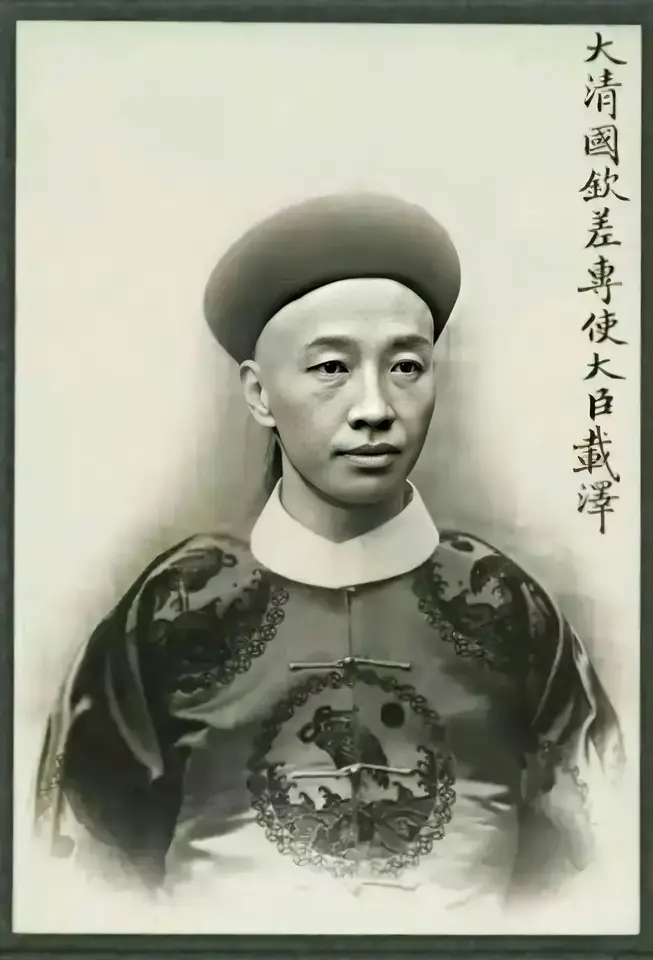
1867 CE–1930 CE
爱新觉罗·载泽
Aisin Gioro Zaize (爱新觉罗·载泽, March 17, 1868 – June 18, 1930), courtesy name Yinping (荫坪), was a prominent Manchu imperial clansman, senior statesman, and leading reformer in late Qing China. A fifth-generation descendant of Prince Yuke of the First Rank (Yinwu, the fifteenth son of the Kangxi Emperor), Zaize was adopted into the lineage of Prince Hui of the First Rank (Mianyu) and inherited the noble peerage of Duke of Zhen.…
Aisin Gioro Zaize (爱新觉罗·载泽, March 17, 1868 – June 18, 1930), courtesy name Yinping (荫坪), was a prominent Manchu imperial clansman, senior statesman, and leading reformer in late Qing China. A fifth-generation descendant of Prince Yuke of the First Rank (Yinwu, the fifteenth son of the Kangxi Emperor), Zaize was adopted into the lineage of Prince Hui of the First Rank (Mianyu) and inherited the noble peerage of Duke of Zhen. In 1905, the Qing imperial court selected Zaize to head the landmark Five Ministers Mission to study foreign constitutional systems across Japan, the United States, Britain, France, and Belgium, marking the inception of the late Qing constitutional preparation movement. Following his return to Beijing in 1906, Zaize submitted an influential confidential memorial arguing that a constitutional monarchy would permanently secure imperial rule, mitigate external aggression, and eliminate internal rebellion, directly prompting Empress Dowager Cixi to decree the official preparation for constitutional governance. In 1907, Zaize was appointed Minister of Finance, where he directed national financial consolidation, established China's earliest modern public budgeting and accounting regulations, restructured the Ta-Ching Government Bank, and unified national silver currency casting. Appointed Minister of Finance in the Prince Qing Cabinet in 1911, he resisted political compromise during the Wuchang Uprising and opposed the recall of Yuan Shikai. Following the fall of the dynasty, he retired to the Tianjin foreign concessions and participated in the Royalist Party, passing away in Beijing in 1930.
Born into the imperial clan in Beijing, originally named Zaijiao, as a descendant of Prince Yuke.
Adopted as heir to Yixun, fourth son of Prince Hui, renamed Zaize, and inherited the title of Bulwark Duke.
Married Lady Jingrong, niece of Empress Dowager Cixi, and was promoted to Duke of Zhen.
Appointed Deputy Lieutenant-General of the Manchu Bordered Blue Banner, overseeing palace guards.
Appointed senior commissioner to lead the constitutional study mission; slightly injured in the Zhengyangmen railway bombing.
Concluded study tours in Japan and the West; presented a secret memorial advocating constitutionalism to preserve the throne.
Appointed Minister of Finance, directing nationwide tax consolidation and fiscal restructuring.
Conferred the rank of Beizi upon the accession of the Xuantong Emperor for his financial services.
Appointed Minister Superintendent of Salt Administration; reorganized the Ta-Ching Government Bank.
Appointed Minister of Finance in the Prince Qing Cabinet; urged uncompromising military resistance after the Wuchang Uprising.
Stepped down following imperial abdication and relocated to the Japanese concession in Tianjin.
Passed away in poverty and illness at his Chengze Garden residence in Beijing at age sixty-two.
Zaize was born on March 17, 1868, in Beijing. His paternal lineage traced directly to Yinwu, Prince Yuke of the First Rank, who was the fifteenth son of the Kangxi Emperor. Zaize was born the seventh and youngest son of General of the Bulwark Yicheng. In March 1877, following the premature death of General of the Standard Yixun (the fourth son of Prince Hui of the First Rank, Mianyu) without biological heirs, Empress Dowager Cixi decreed that Zaijiao be adopted into Yixun's line. His personal name was changed to Zaize, and he inherited the hereditary rank of Supporter Duke.
In 1894, Zaize celebrated his marriage to Lady Jingrong of the Yehe Nara clan, the second daughter of Duke Guixiang. Because Jingrong was the maternal niece of Empress Dowager Cixi and the younger sister of Empress Longyu, Zaize entered the inner circle of imperial in-laws. Following his marriage, he was elevated to the rank of Duke of Zhen. In 1901, following the return of the imperial court from Xi'an, Zaize received his first administrative appointment as Deputy Lieutenant-General of the Manchu Bordered Blue Banner. Demonstrating diligence, he earned senior court favor and was awarded the honorary rank of minister.
In the aftermath of the Russo-Japanese War of 1904 to 1905, in which constitutional Japan defeated autocratic imperial Russia, Chinese intellectual and official opinion overwhelmingly concluded that political reform was vital for national survival. On August 16, 1905, the Qing court issued an imperial edict dispatching Zaize, Vice Minister of Revenue Dai Hongci, Vice Minister of War Xu Shichang, Hunan Governor Duanfang, and Vice Minister of Commerce Shaoying abroad to study foreign political and constitutional frameworks.
On September 24, 1905, as the five ministers prepared to board a special train at the Beijing Zhengyangmen railway station, revolutionary assassin Wu Yue detonated a bomb inside the train compartment. The explosion killed Wu Yue instantly and inflicted minor injuries on Zaize, temporarily delaying the departure. However, the subsequent promulgation of the October Manifesto by the Russian Tsar, establishing a parliamentary Duma, convinced Empress Dowager Cixi that autocracy was globally obsolete. The court promptly replaced the wounded Shaoying and reassigned Xu Shichang with Shandong Provincial Treasurer Shang Qiheng and Shuntian Prefectural Adjutant Li Shengduo.
On December 21, 1905, Zaize, Shang Qiheng, and Li Shengduo departed Shanghai for Tokyo. During their residence in Japan, Zaize held extensive confidential discussions with former Japanese Prime Minister Ito Hirobumi regarding how the Meiji Constitution balanced imperial prerogative with representative parliamentary institutions. Continuing their journey across the Pacific and Atlantic oceans, the delegation conducted comprehensive investigations across the United States, Britain, France, and Belgium, analyzing parliamentary procedure, judicial review, public finance, compulsory schooling, and municipal governance.
Returning to Shanghai in August 1906, Zaize submitted a detailed ten-volume report accompanied by a decisive confidential memorial. He famously argued: "Under current world conditions, nothing short of constitutional governance can rescue the state. Constitutionalism does not diminish imperial prerogative; rather, it consolidates it." Zaize enumerated three supreme benefits of a constitutional monarchy: the eternal security of the imperial throne, the reduction of foreign encroachments, and the pacification of domestic rebellion. The memorial persuaded Empress Dowager Cixi, culminating in the historic imperial decree of September 1, 1906, announcing official preparations for constitutional reform.
In June 1907, during a sweeping reorganization of the metropolitan government, the Board of Revenue was restructured into the Ministry of Finance. At the age of thirty-nine, Zaize was appointed Minister of Finance, assuming centralized control over imperial revenue and expenditures. Confronted by systemic deficits, staggering Boxer Indemnity payments, and the unauthorized retention of regional revenues by provincial governors, Zaize launched a vigorous campaign to enforce central fiscal authority.
Zaize established dedicated fiscal clearing offices both within the ministry and across every province, stationing ministry supervisors to audit land taxes, likin transit duties, salt gabelle revenues, and military disbursements. In 1908, he formulated the Regulations for Fiscal Investigation, laying the institutional framework for modern public accounting in China. In 1910, Zaize presented the national trial budget for the third year of Xuantong to the consultative National Assembly, marking the first time in imperial Chinese history that state revenues and expenditures were subject to transparent institutional review.
Concurrently, Zaize reorganized the Board of Revenue Bank into the Ta-Ching Government Bank in 1909, endowing it with the statutory functions of a central bank responsible for treasury receipts, foreign exchange settlements, and currency reserves. He established the Central Mint of the Ministry of Finance in Tianjin to strike standardized silver coinage, culminating in the promulgation of the Currency Regulations of 1911 and the casting of the renowned Xuantong Year Three silver dollar. By prohibiting provincial authorities from issuing depreciated copper coins, Zaize sought to establish national monetary sovereignty based on a uniform silver standard.
In November 1908, following the simultaneous deaths of the Guangxu Emperor and Empress Dowager Cixi, the three-year-old Puyi ascended the throne under Prince Regent Zaifeng. As a capable first cousin to the regent, Zaize enjoyed immense influence and was rewarded with the noble rank of Beizi. Aligned with young Manchu princes, Zaize sought to curb the military power of northern general Yuan Shikai, repeatedly advising Zaifeng to execute Yuan to safeguard the dynasty before Yuan was dismissed to his home province.
In May 1911, the Qing court abolished the Grand Council and established the Prince Qing Cabinet. Zaize was named Minister of Finance. However, because nine of the thirteen cabinet ministers were Manchus and seven were imperial clan members, the administration was widely condemned by the constitutionalist public as a self-serving royalist clique. During this tenure, Zaize collaborated closely with Minister of Posts and Communications Sheng Xuanhuai to secure foreign loans for the nationalization of trunk railway lines, a policy that directly ignited the Railway Protection Movement in Sichuan.
When the Wuchang Uprising erupted in October 1911, southern provinces rapidly declared independence. Facing imperial collapse, Empress Dowager Longyu and Prince Qing favored recalling Yuan Shikai to command the imperial forces. Zaize staunchly opposed compromise, urging the throne to deploy the elite Imperial Guard and northern units for an unyielding defense, even contemplating a retreat to Manchuria. However, following the defection of northern generals under Duan Qirui, resistance proved futile. On February 12, 1912, Empress Dowager Longyu issued the imperial abdication edict, terminating imperial rule.
Refusing to pledge allegiance to the Republic of China, Zaize resigned all offices, vacated his imperial estate, and relocated to the Japanese concession in Tianjin. In the early years of the Republic, Zaize joined reactionary Manchu aristocrats, including Prince Shanqi and General Tieliang, in founding the clandestine Royalist Party (Zongshedang). Seeking to restore the Qing monarchy, the group collaborated with Japanese military elements in Manchuria to sponsor restoration plots and finance regional irregulars.
Following the abortive restoration attempt by Zhang Xun in 1917 and shifts in Japanese strategic priorities, the royalist schemes collapsed. In his later years, Zaize found himself thoroughly marginalized. His vast personal wealth was dissipated through lavish living, bad investments, and financial subsidies to failed restoration ventures. On June 18, 1930, Zaize passed away in poverty and obscurity at his Chengze Garden residence in Beijing at the age of sixty-two.
In 1905, Zaize led the historic Five Ministers Mission to investigate constitutional systems across the world. Undeterred by an assassination attempt in Beijing, he successfully toured Japan, the United States, Britain, France, and Belgium, conducting in-depth consultations with foreign statesmen such as Ito Hirobumi. His subsequent report and confidential memorial presented an authoritative statecraft justification for constitutional reform, demonstrating to the imperial throne that representative institutions could reinforce rather than undermine the central authority of the monarch. His advocacy served as the decisive catalyst for the formal imperial pledge of 1906 to introduce constitutional government.
During his tenure as Minister of Finance from 1907 to 1911, Zaize broke through entrenched provincial fiscal resistance to establish modern central public accounting. He dispatched imperial inspectors to audit local taxation, eliminated unauthorized levies, and established unified accounting guidelines. His greatest administrative triumph was the compilation of the trial national budget for 1911, which was publicly debated and amended by the consultative National Assembly. This administrative milestone separated state revenues from the imperial household privy purse and introduced the modern legal concept of legislative budgetary oversight to China.
To counter foreign banking monopolies over commercial credit and legal tender issuance, Zaize transformed the Board of Revenue Bank into the modern Ta-Ching Government Bank, establishing statutory central banking functions. Under his direction, the central government enacted the Currency Regulations of 1911 and concentrated coinage production at the modern Tianjin Central Mint. By producing uniform silver dollar coins and banning unregulated regional mintage, Zaize created the institutional framework for a centralized, modern national monetary system.
FIGURES ASSOCIATED WITH THIS DYNASTY