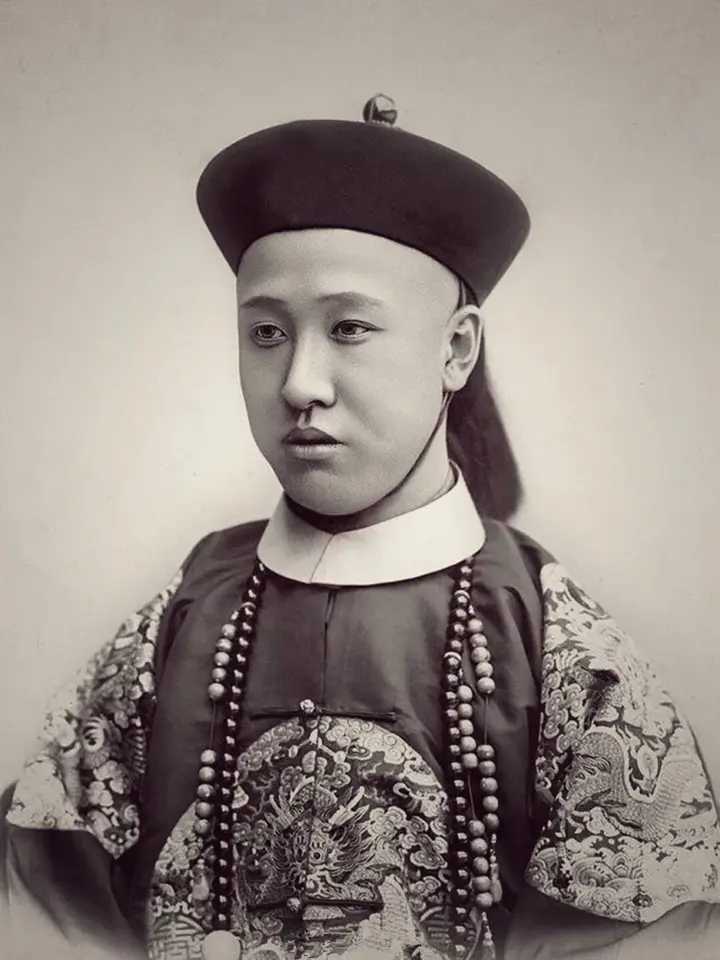
Biography
Early Succession as Prince Chun and Diplomatic Mission to Germany
On February 12, 1883 (the 5th day of the 1st lunar month of the 9th year of the Guangxu era), Aisin Gioro Zaifeng was born at the Mansion of Prince Chun by Taiping Lake in Beijing. His grandfather was the Daoguang Emperor Minning, and his father Aisin Gioro Yixuan was the Daoguang Emperor's seventh son and the first Prince Chun of the First Rank. Yixuan's primary consort, Lady Yehenara Wanzhen, was the younger sister of Empress Dowager Cixi, while Zaifeng's biological mother was Secondary Consort Lady Liujia. Enfeoffed as a Duke of the Second Rank Not Entering the Eight Privileges at age two and promoted to Bulwark Duke at age seven, Zaifeng succeeded to his father's princely peerage as the second Prince Chun upon Yixuan's death in 1890, since his eldest, third, and fourth brothers had died young and his second brother Zaitian had already entered the palace as the Guangxu Emperor. Because of the household's close ties to the throne, Empress Dowager Cixi took a direct hand in Zaifeng's marriage: although his mother Lady Liujia had already betrothed him to the daughter of the banner general Xiyuan, Cixi forced the family to break off that engagement (driving Xiyuan's daughter to commit suicide by poison) and married Zaifeng to her adopted daughter Youlan, the daughter of her trusted minister Guwalgiya Ronglu. Their union produced Puyi, Pujie, and several daughters.
Around the signing of the Boxer Protocol in 1901 (the 27th year of the Guangxu era), the German government demanded that the Qing court dispatch an imperial prince to Berlin to apologize in person for the killing of the German minister Clemens von Ketteler during the Boxer Uprising. On the fifth day of the sixth month, Empress Dowager Cixi and the Guangxu Emperor, then in Xi'an, appointed the nineteen-year-old Zaifeng as Ambassador Extraordinary of the First Class to Germany. In Berlin, Zaifeng firmly resisted Kaiser Wilhelm II's demand that he perform the kowtow and was received with diplomatic courtesy. Impressed by the power of the German imperial house, he asked Prince Heinrich of Prussia about the art of governance; Prince Heinrich replied that to make the imperial house strong, one must first centralize military power, and to make the country prosperous and strong, one must prioritize military preparedness—words that Zaifeng took deeply to heart. When Germany opposed his plan to visit Britain, Italy, and Belgium afterward, Zaifeng cited poor health and his upcoming wedding to return directly to China. The mission broadened his horizons: he brought back a European Brougham carriage, purchased globes and astronomical telescopes, recorded observations of Halley's Comet and eclipses in his diary, and became the first Qing prince to use automobiles and telephones, wear Western suits, and practice photography.
After returning to Beijing, Zaifeng was promoted through a series of key military and court posts: he became a Minister in Attendance in the spring of 1903, Minister Supervising the Light Division (Jianruiying) guarding the capital in the spring of 1906, and Commander of the Manchu Plain Red Banner that autumn. In the fifth month of 1907 he was appointed Probationary Grand Councilor, receiving the privileges of riding horseback inside the Xiyuan Gate and wearing a sable jacket, and in early 1908 he was made a full Grand Councilor.
Regency, Consolidation of Power, and Dismissal of Yuan Shikai
In November 1908 (the tenth month of the 34th year of the Guangxu era), as both the Guangxu Emperor and Empress Dowager Cixi lay critically ill, Cixi summoned Grand Councilors Zhang Zhidong, Shixu, and Zaifeng to her bedside in the Hall of Prosperous Longevity (Fuchangdian) to decide the imperial succession. Cixi resolved to install Zaifeng's three-year-old eldest son Puyi as emperor with Zaifeng serving as Prince Regent. Although Zhang Zhidong and Shixu feared this arrangement would allow the Guangxu Emperor's consort, Empress Longyu (Cixi's niece), to rule behind the curtain and suggested enthroning the adult Zaifeng directly, Cixi insisted on Puyi on the grounds that three consecutive generations of fraternal succession would violate dynastic precedent. Realizing on the following day that her own illness was terminal and doubting Zaifeng's ability to shoulder the burden alone, Cixi issued a final testament stipulating that the Prince Regent should handle major military and state affairs in accordance with the instructions of Empress Dowager Longyu.
After escorting the three-year-old Puyi to the throne on December 2, 1908, Zaifeng held daily audiences in the Palace of Heavenly Purity. To secure the supreme authority of the regency and prevent Longyu from becoming a "second Cixi," Censor Zhao Binglin memorialized that Zaifeng should command the Imperial Guard directly and that all edicts of the Empress Dowager or the throne must bear the Prince Regent's countersignature to be valid. Furthermore, in November 1909, Zaifeng elevated the titles and granted monthly allowances of five hundred taels of silver to five surviving imperial consorts of the Xianfeng, Tongzhi, and Guangxu reigns—Imperial Noble Consorts Qi, Yu, and Xun, and Consorts Jin (Xilinjueluo) and Jin (Tatara)—winning their goodwill and preventing them from allying with Empress Dowager Longyu against him.
Zaifeng's foremost priority upon assuming the regency was to remove Yuan Shikai, the powerful Viceroy of Zhili and Grand Councilor who had betrayed the Guangxu Emperor during the Coup of 1898. Alarmed by Cixi's death, Yuan Shikai fled briefly to Tianjin while young imperial clansmen urged Zaifeng to execute him. When Zhang Zhidong advised against executing a senior minister during national mourning, Zaifeng secretly telegraphed Fourth Division Commander Wu Fengling and Sixth Division Commander Zhao Guoxian of the Beiyang Army; both warned that Yuan's followers permeated the northern divisions and that hasty execution might trigger a mutiny, recommending dismissal instead. On December 5, 1908, Zaifeng issued an edict stating that Yuan Shikai was suffering from a foot ailment that made walking difficult and ordering him to vacate his offices and return to his native place to recuperate.
Imperial Clan Centralization, Administrative Reforms, and the Imperial Clan Cabinet
Following Prince Heinrich's advice to centralize military power, Zaifeng moved rapidly to place the armed forces and finances under young Manchus of the imperial house. In December 1908 he established a 12,000-man Imperial Guard under his personal command, placed all New Army divisions in the metropolitan provinces under direct central control, created the Navy Commission and the General Staff Office, and founded the Nobles' Military College for Manchu youths. On July 15, 1909 (the 1st year of the Xuantong era), he proclaimed the emperor Generalissimo of the Army and Navy with the Prince Regent exercising those powers during the emperor's minority; he appointed his younger brother Zaixun to head the Navy Commission (later Ministry of the Navy) and his brother Zaitao along with Yulang to head the General Staff Office and command the Imperial Guard, while entrusting Zaize, Shanqi, Tieliang, Fengshan, and Yinchang with the Ministries of Finance, Civil Affairs, and War as well as key banner garrisons, and revoking the concurrent Ministry of War titles of provincial governors in December 1910. In finance, adopting Minister of Finance Zaize's proposals, Zaifeng dispatched financial supervisors to strip provincial treasurers of fiscal autonomy and established a Central Salt Administration in Beijing, driving the Qing court's annual revenue budget in 1911 up to nearly 297 million taels of silver—more than triple the level of twenty years earlier.
Zaifeng also attempted to rectify official administration and palace discipline. He ordered ministries to screen recommended officials and dismiss those who were illiterate or incompetent, sent secret investigators to verify impeachments in newly created bureaus, and ordered the Censorate to prosecute central officials who frequented brothels in southern Beijing during the national mourning period. Concerned by the neglect of education among imperial clansmen, he arranged for Puyi to study at the Yuqing Palace, instructed Prince Li to urge young princes to study classical histories and political works, ordered the compilation of the Imperial House Law, and strictly forbade eunuchs from leaving the palace without official passes. Yet because Zaifeng was by temperament indecisive, conflict-averse, and bound by routine ("acting according to precedent"), caught between Empress Dowager Longyu above and squabbling imperial kinsmen below, he grew increasingly apathetic—once cutting short Viceroys Xiliang and Ruicheng by asking if Ruicheng's phlegm illness had healed, and dismissing the impassioned envoy to Japan Wang Daxie by holding up his pocket watch and announcing that it was already ten o'clock.
In constitutional affairs, Zaifeng reaffirmed the preparation for constitutionalism in March 1909, ordering the opening of provincial assemblies that year and convening the Consultative Council in Beijing in 1910. After surviving a bomb plot by Wang Jingwei and Huang Shuzhong at Yinding Bridge in March 1910, Zaifeng abolished the Grand Council on May 8, 1911, and appointed Prince Qing Yikuang as Prime Minister of the first Responsible Cabinet. However, because eight of the thirteen cabinet ministers were Manchus and five were imperial clansmen, public opinion denounced it as the "Imperial Clan Cabinet." When provincial assemblies and censors petitioned for its reorganization, Zaifeng issued a stern edict declaring that cabinet appointments were an imperial prerogative beyond the interference of assemblymen, alienating the constitutionalists completely. Soon afterward, the court's nationalization of trunk railways ignited the Railway Protection Movement across Sichuan, Hubei, Hunan, and Guangdong. When the Wuchang Uprising broke out on October 10, 1911, Zaifeng sent Minister of War Yinchang south with the Beiyang Army, which refused to obey anyone but Yuan Shikai. After Shanxi declared independence and Twentieth Division Commander Zhang Shaozeng issued an armed ultimatum on October 29, Zaifeng was forced on October 30 to issue a penitential edict dissolving the Imperial Clan Cabinet, recalling Yuan Shikai as Prime Minister, and resigning as Prince Regent. Returning to his mansion that day, he remarked to his wife Youlan with relief: "From today on I can go home and hold the children!" On February 12, 1912, Empress Dowager Longyu promulgated the Abdication Edict, bringing the Qing dynasty to an end.
Retirement in Beijing and Tianjin, Refusal of Manchukuo Posts, and Final Years
After the founding of the Republic of China, Zaifeng lived in retirement under the Articles of Favorable Treatment. When Sun Yat-sen visited Beijing in the autumn of 1912, he called on Zaifeng at the Mansion of Prince Chun, praising his patriotic foresight in stepping down peacefully during the 1911 Revolution; when Sun died a month later, Zaifeng enshrined their joint photograph in his study with white flowers and incense. After Feng Yuxiang's Beijing Coup of October 1924 expelled Puyi from the Forbidden City into the Mansion of Prince Chun, Zaifeng moved to Tianjin in 1928.
When Puyi traveled to Northeast China in 1932 to become the puppet ruler of Japanese-backed Manchukuo, Zaifeng opposed the move and refused to accompany him. Although he visited Puyi in Changchun for a month in July 1934, he steadfastly rejected all Japanese inducements to accept any office in Manchukuo. After Japan's surrender in 1945, to prevent the spacious rooms of his mansion from being requisitioned by Nationalist authorities, Zaifeng and his fourth son Puren converted the vacant courtyards into the private Jingye Elementary School in the spring of 1947. Opening on September 1, 1947, with Zaifeng as board chairman under the name Jin Jingyun and Puren as principal under the name Jin Youzhi, the school waived tuition for poor and top-performing students and used Zaifeng's personal globes, tellurion, and natural history specimens as teaching aids.
Following the peaceful liberation of Beiping in January 1949, Zaifeng noted the orderly discipline of the People's Liberation Army in his diary. In 1950, wishing to contribute to national construction and reduce the heavy maintenance costs of the estate, Zaifeng sold the Mansion of Prince Chun to the National Advanced Industrial School for 900,000 jin of millet, retaining half the proceeds to purchase a residence at No. 11 Lipuying and dividing the other half equally among his eight surviving children while abolishing the old Qing household rituals. On February 3, 1951, Zaifeng died in Beijing at the age of sixty-eight after contracting a chill and was buried at Futian Cemetery in the western suburbs.