Birth | Born at the official residence by Liudong Bridge in Guiyang, Guizhou, the fourth son of Zhang Ying.
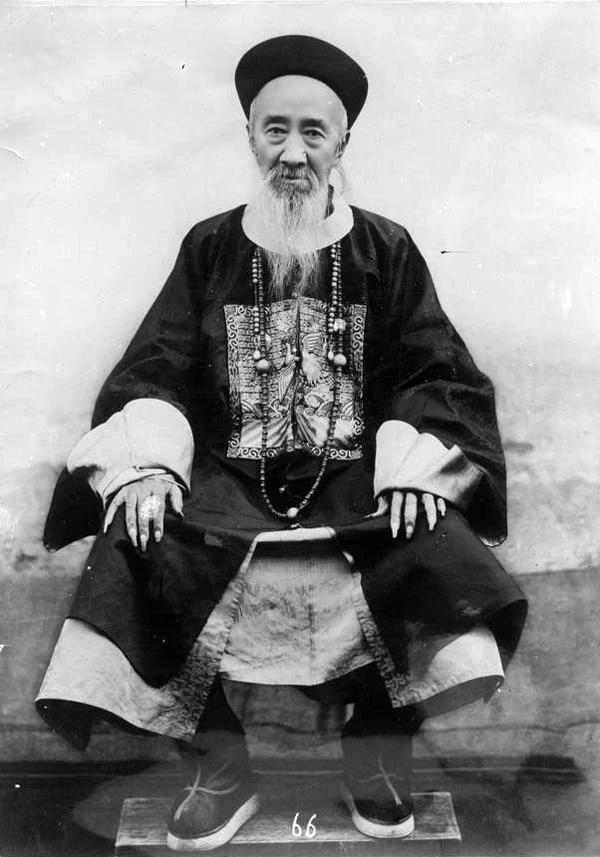
1837 CE–1909 CE
Senior official
Zhang Zhidong
张之洞
Zhang Zhidong (third day of the eighth lunar month of the seventeenth year of Daoguang, September 2, 1837 – twenty-first day of the eighth lunar month of the first year of Xuantong, October 4, 1909), courtesy name Xiaoda, art names Xiangtao and Xiangyan, also known as Hugong and Wujing Jushi, and in his later years as Baobing Laoren, was originally from Nanpi in Zhili (present-day Nanpi County, Hebei) and was born in Guizhu,…
1837 CE–1909 CEQing Dynasty
PROFILE
Zhang Zhidong (third day of the eighth lunar month of the seventeenth year of Daoguang, September 2, 1837 – twenty-first day of the eighth lunar month of the first year of Xuantong, October 4, 1909), courtesy name Xiaoda, art names Xiangtao and Xiangyan, also known as Hugong and Wujing Jushi, and in his later years as Baobing Laoren, was originally from Nanpi in Zhili (present-day Nanpi County, Hebei) and was born in Guizhu, Guizhou (present-day Guiyang). He was a major late Qing statesman and a representative figure of the later Self-Strengthening Movement. Together with Zeng Guofan, Li Hongzhang, and Zuo Zongtang, he was counted among the “Four Great Ministers of the Qing Revival.” Zhang entered official life through the imperial examination system. In 1863, the second year of Tongzhi, he placed third in the first class of the palace examination and was appointed a compiler in the Hanlin Academy. He later served as provincial education commissioner, governor of Shanxi, Governor-General of Liangguang, Governor-General of Huguang, and acting Governor-General of Liangjiang on several occasions, eventually becoming Grand Secretary of the Tiren Pavilion and Grand Councillor. He advocated the formula of “Chinese learning as essence, Western learning for practical use,” and established institutions including Hanyang Ironworks, the Hubei Arsenal, Lianghu Academy, and the Self-Strengthening School. He was one of the most important leaders of the later Self-Strengthening Movement and exerted a major influence on educational, military, and industrial modernization in the late Qing.
- Also Known As
- Zhang Xiaoda
- Courtesy Name
- Xiaoda
- Art Name
- Xiangyan
- Period
- Qing
- Date of Birth
- September 2 1837
- Date of Death
- October 4 1909
- Dynasty/Regime
- Qing
- Identity
- Senior official
- Ethnicity/Ethnic Affiliation
- Not recorded in historical sources
- Ancestral Home
- Nanpi County, Tianjin Prefecture, Zhili (present-day Nanpi County, Cangzhou, Hebei)
- Place of Birth
- Official residence at Liudong Bridge, Guiyang, Guizhou
- Place of Death
- Not recorded in historical sources
- Highest Office
- See Biography and Major Activities
- Major Achievements
- A leading late Qing statesman and representative of the Self-Strengthening Movement; advocated the principle of Chinese learning as the essence and Western learning for practical use; founded Hanyang Ironworks and Lianghu Academy.
LIFE TIMELINE
Age 4 | Followed his father to Xingyi Prefecture and lived and studied there.
Under age 14 | Returned to Nanpi to take the county examination and placed first among the successful licentiates.
Age 15 | Placed first in the Shuntian prefectural provincial examination and became the top provincial graduate.
Age 26 | Took the palace examination, placed third in the first class, and was appointed a compiler in the Hanlin Academy.
Age 29 | Received a second-class rating in the grand examination and later served as deputy examiner for the Zhejiang provincial examination and education commissioner of Hubei.
Age 36 | Served as education commissioner of Sichuan, established Zunjing Academy with Wu Tang, and wrote Youxuan Yu and Shumu Dawen.
Age 39 | Served as proofreader of the Wenyuan Pavilion.
Age 42 | Appointed Vice Director of the Directorate of Education, helped overturn the Dongxiang blood-case verdict, and was grouped with Zhang Peilun, Baoting, and Huang Tifang as the “Four Remonstrant Hanlin Scholars.”
Age 43 | Appointed reader in the Hanlin Academy; submitted the memorial On Weighing the Advantages and Disadvantages of the Russian Treaty and opposed the Treaty of Livadia.
Age 44 | Became governor of Shanxi, reformed official administration, and strictly prohibited opium.
Age 47 | Appointed acting Governor-General of Liangguang; advocated resistance during the Sino-French War and employed Feng Zicai.
Age 48 | In the first lunar month, Feng Zicai won the Battle of Bang Bo (Zhennan Pass); Zhang was demoted one rank but retained in office for having improperly recommended Xu Yanxu.
Age 50 | Established Guangya Publishing House and Guangya Academy in Guangzhou.
Age 52 | Transferred to become Governor-General of Huguang, planned Hanyang Ironworks, and petitioned to build the Lugouqiao–Hankou Railway.
Age 53 | Founded Lianghu Academy.
Age 55 | The Hubei Weaving Bureau began operation in Wuchang.
Age 56 | Hanyang Ironworks was completed; petitioned to establish the Self-Strengthening School.
Age 57 | The First Sino-Japanese War broke out; he was transferred to act as Governor-General of Liangjiang and memorialized against ceding Taiwan.
Age 58 | After the Treaty of Shimonoseki was signed, submitted proposals for annulling the treaty; joined the Strengthening Society.
Age 59 | Returned as Governor-General of Huguang, trained New Army units, and established the Hubei Military Academy.
Age 61 | Published Exhortation to Learning, advocating “old learning as the essence, new learning for practical use.”
Age 63 | Together with Liu Kunyi, Li Hongzhang, and others, implemented the Mutual Protection of Southeast China and suppressed Tang Caichang's Independence Army uprising.
Age 64 | Jointly submitted with Liu Kunyi four proposals on “promoting education and cultivating talent” and took part in drafting the Guimao school system.
Age 65 | Again served as acting Governor-General of Liangjiang.
Age 66 | Submitted the Memorial on Establishing Sanjiang Normal School, regarded as the beginning of modern Nanjing University.
Age 68 | Jointly petitioned with Yuan Shikai for the immediate abolition of the imperial examination system and the expansion of modern schools.
Age 70 | Appointed Grand Secretary of the Tiren Pavilion and Grand Councillor, and placed in charge of the Ministry of Education.
Age 71 | Supervised the Canton–Hankow Railway, was promoted to Grand Guardian of the Heir Apparent, and received a deathbed commission from Empress Dowager Cixi.
Age 72 | Died of illness at his residence on Baimixiejie in Beijing; received the posthumous name Wenxiang and was buried north of Shuangmiao in Nanpi County.
BIOGRAPHY
Biography
Family Background and Early Life
Zhang Zhidong was born on the third day of the eighth lunar month of the seventeenth year of Daoguang (September 2, 1837), at an official residence by Liudong Bridge in Guiyang, Guizhou. His father Zhang Ying was then serving as assistant prefect of Guzhou. Because the residence stood beside Kongming Cave near Liudong Bridge, in the area of present-day Bo'ai Road in Guiyang, he was given the name “Zhidong”; his childhood name was Guanbao. His ancestral home was Nanpi in Zhili, present-day Nanpi County, Hebei. The Zhang family was an official lineage; his clan elder Zhang Zhiwan later became a Grand Councillor and Grand Secretary of the Eastern Pavilion.
After Zhang Zhidong's birth, his father successively acted as prefect of Liping, Zunyi, and Anshun. On the seventeenth day of the ninth lunar month of the twentieth year of Daoguang (October 12, 1840), Zhang Ying, on the recommendation of Guizhou governor He Changling, was presented by the Ministry of Personnel to the Daoguang Emperor and received permission to act as prefect of Xingyi in Guizhou. He formally assumed office the following year, and four-year-old Zhang Zhidong followed his father to Xingyi to live and study.
Zhang showed unusual intelligence from childhood. He entered a family school at age five, studied diligently, and received a strict Confucian education. During his years in Xingyi, he successively studied under He Yangyuan, Lü Xianji, Liu Shunian, Zhu Qi, Zeng Xuhu, Yuan Li, Zhang Guohua, Gui Tianyi, Huang Zhengjun, Wang Hanzhang, Ao Guoqi, Peng Bacai, Bao Jingsu, Zhang Yuanbi, Han Chao, Tong Hui, Hong Diaosheng, Hu Linyi, Ding Jiabao, Weng Tongshu, and others. Before age thirteen he had completed the Four Books and Five Classics and also studied history, philology, literature, and statecraft, while reading military works such as The Art of War and the Six Secret Teachings. These studies provided the foundation for his later administration and scholarship. At age twelve he had a collection of poetry and prose printed under the title Tianxiangge Shi'erling Cao. As a youth he developed the habit of studying and reflecting late at night. It was said that “he would sit by lamplight thinking, often until midnight, and would not stop until he had found the answer.” He later recalled: “When I later served in office and worked on documents through the night, it was because I had enjoyed sitting up at night to read since childhood.” This habit of nocturnal work was later criticized as irregular living and sometimes affected his meetings with subordinates.
In 1850, the thirtieth year of Daoguang, Zhang returned to his ancestral home of Nanpi before the age of fourteen to take the county examination. He placed first among the successful licentiates and entered the county school. Two years later he placed first in the Shuntian provincial examination and became the top provincial graduate, qualifying for the metropolitan examination. Over the next decade, however, he was occupied with helping his father handle military affairs in response to Miao uprisings in Guizhou, as well as marriage, raising children, and mourning his father, and had little opportunity to sit the examinations. At age twenty-three he was due to take the metropolitan examination but withdrew because his clan elder Zhang Zhiwan was an associate examiner and the rules required avoidance. The following year he was again unable to sit the special examination for the same reason.
Entry through the Examinations and Educational Administration
In 1863, the second year of Tongzhi, Zhang Zhidong took the palace examination and placed third in the first class, receiving the jinshi degree. He entered the Hanlin Academy as a seventh-rank compiler and formally began his official career. One account says that Empress Dowager Cixi admired his writing and therefore promoted him exceptionally. In 1866, the fifth year of Tongzhi, he received a second-class rating in the grand examination. He subsequently served as deputy examiner for the Zhejiang provincial examination, education commissioner of Hubei, deputy examiner for the Sichuan provincial examination, and education commissioner of Sichuan.
As education commissioner of Hubei, he worked to reform the academic climate, established Jingxin Academy, and promoted and rewarded people of genuine ability, gaining considerable public support. As education commissioner of Sichuan, he and Governor-General Wu Tang established Zunjing Academy in Chengdu, invited prominent scholars to teach separate fields, modeled its regulations on Ruan Yuan's Gujing Jingshe in Hangzhou and Xuehaitang in Guangzhou, personally drafted its rules, and wrote Youxuan Yu and Shumu Dawen to instruct students on what to read, how to pursue scholarship, and how to cultivate moral character.
Leading Figure of the Qingliu Group
In 1876, the second year of Guangxu, Zhang served as proofreader of the Wenyuan Pavilion. In 1879, the fifth year of Guangxu, he was appointed Vice Director of the Directorate of Education, then Left Rectifier in the Left Spring Bureau of the Court of the Heir Apparent, and later Xima of the Bureau of Classics. That year, because Russia had occupied Ili in Xinjiang, the Qing court sent Wanyan Chonghou to Russia to negotiate its return. Chonghou signed the Treaty of Livadia, which was widely regarded as damaging to Qing interests. Although the treaty nominally restored Ili, Russia gained advantages on the western and southern frontiers, leaving Ili exposed. Public opinion reacted sharply.
In 1880, the sixth year of Guangxu, Zhang submitted the memorials On Weighing the Advantages and Disadvantages of the Russian Treaty and Detailed Proposals for Frontier Defense. He analyzed ten reasons why the agreement should not be accepted, insisted that it must be revised, urged the strengthening of military preparations and postponement of ratification, and called for Chonghou to be punished. After submitting the memorials he was received by Empress Dowagers Ci'an and Cixi and was specially permitted to visit the Zongli Yamen at any time for consultation. Together with Zhang Peilun and Chen Baochen, he helped draft nineteen memorials proposing measures for troops, finances, and frontier defense. Zhang Zhidong, Baoting, Huang Tifang, and Zhang Peilun were then known as the “Four Remonstrant Hanlin Scholars” and identified with the Qingliu group. They supported Grand Councillor and Grand Secretary Li Hongzao as their leader, although Zhang Zhidong was in practice one of the group's central figures. His political reputation rose during the Sino-Russian negotiations and he gained Empress Dowager Cixi's favor.
In 1879 Zhang also took part in overturning the Dongxiang blood-case verdict in Sichuan. During prefectural examinations he had overseen in the summer of 1876, candidates from Dongxiang County had written accounts of the case on their examination papers instead of answering the questions, thereby refusing the examination and seeking redress for villagers who had died. Zhang reviewed their statements, combined them with local discussion, and concluded that the original handling of the case was unjust. When later received by Empress Dowager Cixi, he tactfully requested a retrial and submitted three memorials in a single day. In the tenth lunar month of 1879, Cixi ordered the Ministry of Justice to reverse the judgment. Dongxiang magistrate Sun Dingyang and Sichuan provincial commander Li Youheng were convicted of indiscriminate killing and their previous dismissals were changed to sentences of execution after the autumn assizes. Former and incumbent governors-general of Sichuan, including Wenge and Ding Baozhen, were charged with dereliction and cover-up and referred to the Ministry of Justice for deliberation, while dozens of other officials were punished according to law. The case greatly advanced Zhang's official career.
Governor of Shanxi
From the seventh to the tenth years of Guangxu (1881–1884), Zhang Zhidong served as governor of Shanxi. At the time, official corruption was severe, popular living conditions were poor, and opium use was widespread. Zhang wrote to a friend that Shanxi's officialdom was chaotic, its knowledge narrow, its civil and military administrative talent extremely scarce, and urgent matters in administration, society, and military affairs numerous. He also wrote that Shanxi's gravest problem was not natural disaster but opium, claiming that six in ten people in the countryside and seven in ten in towns were addicted, while nearly all clerks, runners, and soldiers were affected. He described people as emaciated, households rising late, and Taiyuan as presenting a “gloomy and ruined scene like a land of ghosts,” warning that continued decline would make effective government impossible.
Zhang focused on administrative reform. On taking office he closely examined subordinate officials, tried to invigorate government and eliminate abuses, impeached corrupt magistrates who harmed the people, rewarded capable officials, strictly prohibited opium, recommended talent, trained troops, and inspected government granaries. Shanxi iron was shipped to Fengtian and Shanghai at high cost by land, so he redirected transport through Tianjin and the sea, lowering expenses, while also planning a smelting bureau near the production areas. He established Lingde Hall, modeled on Ruan Yuan's Gujing Jingshe and Xuehaitang, appointing Wang Xuan as principal lecturer and Yang Shenxiu as assistant examiner and supervisor. Yang Shenxiu later became one of the Six Gentlemen of 1898.
The British missionary Timothy Richard was active in Shanxi, published pamphlets such as Essentials for Saving the Times, and organized demonstrations of scientific instruments, machine tools, sewing machines, and bicycles. Zhang met Richard and read his writings. Influenced by him, Zhang planned to establish a bureau for Western affairs, although the plan was not carried out at the time.
Governor-General of Liangguang and the Sino-French War
When the Sino-French War began in 1883, the ninth year of Guangxu, Zhang strongly advocated resistance. In 1884, as French forces pressed aggressively in Vietnam and the frontier situation worsened, he memorialized on offensive and defensive policy, urged stricter supervision of the Yunnan and Guangxi campaigns, and called for strengthening the defenses of Tianjin and Guangdong. In the fourth lunar month the Qing court summoned him to Beijing, where he offered extensive proposals on resistance to France. On the twenty-eighth day of that month, the court appointed him acting Governor-General of Liangguang in place of Zhang Shusheng; he was formally confirmed on the third day of the seventh lunar month.
After arriving in Guangzhou, Zhang strengthened defenses and ordered the coastal governors and governors-general to maintain strict precautions. In the sixth lunar month French forces occupied Keelung in Taiwan. Zhang requested that Tang Jingsong, then a principal secretary of the Ministry of Personnel, be sent to coordinate with Liu Yongfu against the French. He argued that supporting Taiwan required urgent action in Vietnam, that fighting in Vietnam was the best way to draw off the enemy, and that using Liu Yongfu was the most practical means of doing so. The Qing court adopted his proposal and placed Liu Yongfu on the list for appointment as provincial commander. Liu's Black Flag Army fought effectively and repeatedly defeated French forces. However, troops led by Guangxi provincial treasurer Xu Yanxu and Yunnan provincial treasurer Tang Jiong performed poorly and were defeated; Tang's troops fled, leaving the Black Flag forces outnumbered and ultimately defeated. Tang and Xu were dismissed and investigated, and in early 1885 Zhang was referred for disciplinary review for having improperly recommended Xu Yanxu, receiving a one-rank demotion while remaining in office.
In the first lunar month of 1885, the eleventh year of Guangxu, French forces occupied Zhennan Pass, present-day Friendship Pass, a key point on the Sino-Vietnamese frontier. Zhang petitioned for former Guangxi provincial commander Feng Zicai and brigade general Wang Xiaoqi to reinforce Guangxi and hold Zhennan Pass. The seventy-year-old Feng led his troops in fierce resistance, won a major victory over the French at the Battle of Bang Bo (Zhennan Pass), and reversed the military situation. The French government of Jules Ferry fell as a result. The Qing court nevertheless decided to seek peace while in a position of strength and ordered the front-line armies to cease fighting and withdraw. Front-line officers and soldiers reportedly reacted with indignation. Zhang repeatedly telegraphed the court asking to postpone the withdrawal and was rebuked through Li Hongzhang.
In 1887 Zhang established Guangya Publishing House and Guangya Academy in Guangzhou. Guangdong already had Duanxi Academy in Zhaoqing. Zhang invited Liang Dingfen to direct it, and Liang later brought its teachers and students to Guangya Academy. Zhang also appointed Zhu Yixin as a lecturer there. Liang Dingfen had been punished for impeaching Li Hongzhang over his peace policy, while Zhu Yixin had been demoted for impeaching the eunuch Li Lianying. Zhang continued to employ them despite criticism.
Governor-General of Huguang and Self-Strengthening Enterprises
In 1889, the fifteenth year of Guangxu, Zhang memorialized the court proposing a railway from Lugou Bridge to Hankou to connect north and south. He argued that the greatest benefit of railways was to circulate local goods and improve livelihoods, with troop movement and fiscal transport secondary. He described the line as “the hub of trunk routes, the foundation of branch lines, and a concentration of great benefits for China.” The court approved the plan, assigning the northern section to the governor-general of Zhili and the southern section to the governor-general of Huguang. Zhang was accordingly transferred to become Governor-General of Huguang.
That winter he began planning Hanyang Ironworks. The project also produced mistakes. Zhang telegraphed Xue Fucheng, the Qing minister in Britain, to purchase steelmaking furnaces. The owner of an English works replied that before a steelworks could be designed, samples of the available iron ore, coal, and coke had to be tested, because furnace design depended on their composition and even small discrepancies could have major consequences. Zhang responded that China was so large that every necessary resource could surely be found and ordered a set of equipment matching that used in Britain. The equipment was therefore purchased. At Hanyang, ore came from Daye and coal from Ma'anshan. The Ma'anshan coal contained too much ash and mineral matter to make suitable coke, forcing the works to import several thousand tons of coke from Germany. From 1890 to 1896, the project consumed 5.6 million taels without successfully producing satisfactory steel. Coal from Pingxiang in Jiangxi was later adopted, but the steel remained brittle and prone to cracking. Zhang then learned that the imported furnaces used an acid process that could not remove phosphorus, so the high-phosphorus steel was brittle. A further three-million-yuan loan from Japan financed conversion to alkaline furnaces, after which high-quality Martin steel could be produced.
Hanyang Ironworks was an integrated iron and steel complex completed in 1893. It included steelworks, ironworks, a foundry, ten large and small workshops, and two furnaces, employing about three thousand industrial workers and one thousand coal miners. It was the first large-scale modern machine-based iron and steel enterprise in China and was also among the earliest and largest steelworks in Asia, preceding major Japanese steel plants by several years.
Zhang also established the Hubei Weaving Bureau. It began operating in Wuchang in 1892 with thirty thousand spindles, one thousand looms, and two thousand workers. The bureau was profitable, but Zhang used its profits to cover losses at the ironworks and arsenal, leaving the weaving enterprise burdened by high-interest debt and limiting its growth. Seeing strong demand for cotton yarn, he decided to establish two spinning mills and ordered machinery from British firms through the Qing legation in Britain. The northern mill was completed in 1897 with more than fifty thousand spindles and became the Hubei Spinning Bureau. The southern mill was never built; its machinery remained exposed at the Shanghai docks until Zhang Jian took it over for the Dasheng Cotton Mill in Nantong. The Hubei Spinning Bureau, Weaving Bureau, Silk-Reeling Bureau, and, by 1902, the Hemp Bureau were leased to the Yingchang Company organized by Guangdong capitalists.
Under Zhang's planning and personal direction, Hubei successively established the Self-Strengthening School, predecessor of Wuhan University; the Military Academy; the Agricultural School, predecessor of today's Huazhong Agricultural University; and the Hubei Industrial School, predecessor of Wuhan University of Science and Technology. While serving as Governor-General of Liangjiang, he established Sanjiang Normal School in Nanjing, a predecessor of Nanjing University. He also supervised construction of the northern and southern Wuchang embankments and the Houhu embankment at Hankou, reducing flood damage and helping define an urban scale for the three Wuhan towns in the early twentieth century close to that of the modern city. He supported Chinese entrepreneurs in developing water, electricity, and other modern municipal services, contributing to Wuhan's modern prosperity.
The First Sino-Japanese War and Liangjiang
After the First Sino-Japanese War began on August 1, 1894, Zhang proposed sending cavalry “to Tianjin to await orders” and also sought foreign assistance. Concluding that Japanese strength was increasing and that their forces would penetrate farther inland, he urged stronger defense of the Tianjin-Dagu area and Shengjing. On October 26 he telegraphed Li Hongzhang proposing three measures: purchase warships, borrow foreign funds, and seek powerful foreign support. After Japanese troops crossed the Yalu River at the end of October and Liaodong and Shenyang were threatened, Zhang added five proposals: purchase fast warships, buy arms, borrow foreign funds, secure foreign support, and make rewards and punishments clear. On November 2 he was transferred to act as Governor-General of Liangjiang. On November 7 he told Li Hongzhang by telegram that “whether we fight or make peace, nothing can be done without ships.” When Japanese forces besieged Lüshun later that month, Zhang repeatedly urged Li Bingheng to relieve the port, without effect.
At the beginning of 1895, as Japanese forces attacked the Shandong Peninsula, Zhang sent urgent telegrams to Shandong governor Li Bingheng, urging local officials to recruit laborers, dig trenches day and night, and lay explosives and mines on key routes to impede the Japanese advance. He also expressed his intention to send firearms and ammunition to support Shandong defenders. After Ding Ruchang committed suicide, Zhang proposed bringing forces stationed in Taiwan to Shandong to resist Japan and defend Yantai. When he learned that the Qing court was considering ceding Taiwan and nearby islands to Japan, he telegraphed the court on February 28, strongly opposing the proposal and explaining its dangers. He suggested two emergency methods to preserve Taiwan: first, borrow a large sum from Britain using Taiwan as security, in the expectation that Britain would then defend it with warships; second, in addition to the loan, grant Britain mining rights in Taiwan for ten or twenty years, giving Britain sufficient interest to protect the island. On March 29 Zhang telegraphed Tang Jingsong, encouraging resistance, recommending the use of the experienced commander Liu Yongfu, and separately urging Liu to set aside lesser disputes, cooperate, and achieve a major success. After the Treaty of Shimonoseki was signed, Zhang submitted a memorial on April 26 proposing that the only available means of annulling the treaty was to seek assistance from a powerful foreign state.
During his acting tenure as Governor-General of Liangjiang, Zhang gave considerable attention to education in Hubei and Jiangsu, establishing and reorganizing academies and modern schools. In Hubei these included Lianghu Academy, Jingxin Academy, an agricultural school, industrial school, military self-strengthening school, and commercial school. In Nanjing he established schools for advanced study, railways, the army, and the navy. He sent students to Japan and reformed curricula to add subjects suited to contemporary needs. He also emphasized military training. During this period he organized the Jiangnan Self-Strengthening Army at Xuzhou, about ten thousand strong, with German officers and Western-style drill. When he returned to Huguang in 1896, he transferred this army to Liu Kunyi, Governor-General of Liangjiang.
The Hundred Days' Reform and Exhortation to Learning
In 1895 Zhang, together with Yuan Shikai, Xu Shichang, and others, joined the Strengthening Society and contributed funds. In 1898 he published Exhortation to Learning, advancing the formula “old learning as the essence, new learning for practical use” in order to uphold traditional Chinese ethical principles while keeping his distance from the more radical proposals of the Hundred Days' Reform. After the Coup of 1898, he escaped punishment in part because Exhortation to Learning had already demonstrated his position.
Mutual Protection of the Southeast and Later Years
In 1900, the twenty-sixth year of Guangxu, the Eight-Nation Alliance invaded China and the Dagu forts fell. Zhang strongly advocated suppressing the Boxer Rebellion. Together with Liu Kunyi, Governor-General of Liangjiang, he negotiated the Mutual Protection of Southeast China with foreign consuls in Shanghai and did not implement Empress Dowager Cixi's order declaring war on the foreign powers. At the same time he suppressed the Independence Army uprising led by reformers including Tang Caichang, Lin Gui, and Qin Lishan.
In 1901 Zhang and Liu Kunyi jointly submitted four proposals to Empress Dowager Cixi on “promoting education and cultivating talent.” Following Japanese models, they helped draft the Guimao school system, which after revision was reissued in 1903 as the Approved Regulations for Schools and became the earliest nationally implemented modern education system in China. Zhang invited Japanese instructors to train the Hubei New Army. The same year he prepared to establish a “Wuchang University” and telegraphed W. A. P. Martin, then returning to the United States, inviting him to serve as chief instructor and teach international law.
In 1902, after Liu Kunyi, Zhang again served as acting Governor-General of Liangjiang. In the second lunar month of 1903 he submitted the Memorial on Establishing Sanjiang Normal School, arguing that teacher training should be the first priority and proposing “first to establish one great normal school as the organizing core of the entire educational enterprise.” He appointed Liu Shiheng, Miao Quansun, and others to organize the school, regarded as the beginning of modern Nanjing University. Later in 1903 he returned to Wuchang as Governor-General of Huguang.
On September 2, 1905, Zhili Governor-General Yuan Shikai and Huguang Governor-General Zhang Zhidong petitioned for the immediate abolition of the imperial examination system and expansion of modern schools. On September 9, Zhang signed in Hankou a loan contract with the government of British Hong Kong for £1.1 million to redeem the Canton–Hankow Railway. On September 27, Huguang under Zhang borrowed one million taels from Britain to develop a municipal water system. On November 4 the Sichuan–Hankow and Hankow–Guangdong railway bureaus were opened.
In 1907 Zhang was appointed Grand Secretary of the Tiren Pavilion. On September 4 the Qing court appointed Grand Secretary Zhang Zhidong and Minister of Foreign Affairs Yuan Shikai as Grand Councillors. On September 21 Zhang was ordered to supervise the Ministry of Education. In 1908 he supervised the Canton–Hankow Railway and was promoted to Grand Guardian of the Heir Apparent. Empress Dowager Cixi entrusted him with responsibilities on her deathbed, and he later urged Prince Regent Zaifeng not to execute Yuan Shikai.
On the twenty-first day of the eighth lunar month of the first year of Xuantong (October 4, 1909), Zhang Zhidong died of illness at his residence on Baimixiejie in Beijing, aged seventy-two. He received the posthumous name Wenxiang and was buried north of Shuangmiao in Nanpi County. Chen Yan wrote the Biography of Grand Secretary Zhang.
Zhang Zhidong was born in Guizhou and named Zhidong after the cave of Zhuge Liang by the Six-Cave bridge near his birthplace, his milk name being Guanbao. His father Zhang Ying, recommended and presented by the board of personnel, was granted the prefectship of a Guizhou prefecture and took up his post at Xingyi the next year, the four-year-old Zhang Zhidong going with him. A gifted child, he entered the family school at five, studious and quick, and was strictly trained in the family tradition, publishing a collection of poems and prose at twelve under the title Twelve-Year-Old's Grass from the Tianxiang Pavilion. In boyhood he liked to sit up thinking by lamplight, saying he would puzzle over a point until he had it, however late; he recalled later that in office he often worked at documents until dawn because of this childhood habit, which was once criticised as keeping irregular hours and hindered his meetings with subordinates.
Two years later he came first in the provincial examination at Shuntian and qualified for the metropolitan examination. With his learning he should have passed early, yet he did not become a presented scholar until he was twenty-seven. In those years he was first busy helping his father with military affairs and the fighting in Guizhou, and with marrying, having children and mourning his father; at twenty-three he was to sit the metropolitan examination but withdrew by rule because his kinsman Zhang Zhiwan was an examiner; and the next year he failed in the special examination. In 1863 he came third in the first class, entered the Hanlin academy as a compiler of the seventh rank, and began his official career.
In 1866 he was graded in the second class in the great examination. He afterward served as assistant examiner for Zhejiang, education commissioner of Hubei, assistant examiner for Sichuan and education commissioner of Sichuan. In Hubei he reformed the tone of the schools, founded the Jingxin academy and promoted and rewarded men of real learning, winning general approval; in Sichuan he worked with the provincial authorities to engage noted scholars and teach by subjects, drawing up rules after the model of Ruan Yuan's academies in Hangzhou and Guangzhou, and wrote works to guide students in their reading, which had a considerable influence on the scholarship of the day.
In the negotiations with Russia over Ili, Chonghou signed a treaty on his own authority which nominally recovered Ili while ceding territory in the west and south and leaving Ili encircled by Russia. The news caused an outcry. The next year Zhang Zhidong submitted memorials on the advantages and disadvantages of the Russian treaty and on frontier policy, setting out ten reasons why it could not be accepted, insisting that it be revised, urging the strengthening of armaments and the delay of ratification, and demanding that Chonghou be punished. The memorials made him a leader of the pure discussion party, and his political reputation rose greatly in the affair; with Zhang Peilun and Chen Baochen he was reckoned among the leaders of that group, being in fact taken as its chief.
About 1881 he became governor of Shanxi, where opium wrought terrible harm. In a letter to a friend he wrote that the official world of Shanxi was in the utmost disorder and the narrowest of views, that men of both the civil and the military sort were utterly wanting, and that the matters demanding attention were endless; and that the province's trouble was not famine but opium, with six in ten of the country people addicted, nine in ten in the towns, and almost all officials, clerks and soldiers, so that men were wasted, households rose late, and Taiyuan was a scene of gloom and decay. Once in office he rewarded good officials, strictly forbade opium, recommended men of ability, trained troops and audited the granaries; and as the iron of Shanxi went to Mukden and Shanghai at heavy cost overland, he had it shipped by sea. In Shanxi he also met the missionary Timothy Richard, read his books, was influenced by him and planned a bureau for foreign affairs, which was never realised.
On the eve of the war with France, with the frontier in danger, Zhang Zhidong memorialized on war and defence, urging strict command of the fighting in Yunnan and Guangxi and the prompt strengthening of the defences at Tianjin and Guangzhou. In the fourth month of 1884 the court called him to the capital, where he set out his plans for resisting France at length, holding that the only way to relieve Taiwan was to press on Vietnam, that the whole situation would be revived by contending for Vietnam, that wearing down the enemy by fighting there was the best course, and that the practical means was the Black Flag army of Liu Yongfu. When Xu Yanxu and others whom he had recommended failed in the fighting, he was censured by the board and reduced one grade but kept in office.
Zhang Zhidong afterward long served as governor-general of the two Guang and then of Huguang. In the two Guang he founded a naval academy and a bureau for foreign affairs and set up an ironworks and a weaving mill; the needs of defence after the war with France led him to press for stronger sea and land defences and for the adoption of Western military technique. As governor-general of Huguang he built the Hanyang ironworks and the Hubei arsenal, opened the four mills for weaving, spinning, silk-reeling and hemp, founded the Lianghu academy and the Ziqiang school, and sent students to Japan, making Hubei one of the chief centres of the late Qing reforms. His work in education and industry in the two Hu provinces was of a piece with his reform of the schools in Shanxi and Sichuan, and shows how much weight he put on men and on education.
His best-known writing is the Exhortation to Study, which sets forth the doctrine of Chinese learning for the substance and Western learning for use — that Chinese ethics and teachings should be the base, with Western techniques and institutions as an aid. The formula had great influence in the late Qing and is often used by later ages to sum up the outlook of the self-strengthening party. He valued both the ordering of the older learning and the introduction of the new: he wrote guides to reading for students and supported the translation and publication of Western books, and his scholarly stance was much representative of the men of knowledge of his day.
Major Activities
Self-Strengthening Enterprises
Zhang Zhidong was a leading figure of the Self-Strengthening Movement after Zeng Guofan and Li Hongzhang. During his tenure in Hubei, with British and German support, he became a major later leader of the movement and worked to foster Chinese industry. He established Hanyang Ironworks, the Hubei Arsenal, the Ma'anshan coal mine, the Hubei Weaving Bureau, the Hubei Silk-Reeling Bureau, and other heavy and light industrial enterprises, and planned the Lugouqiao–Hankou Railway. Hanyang Ironworks was the first large-scale modern machine-based iron and steel enterprise in China and among the earliest and largest steelworks in Asia. He also supported Chinese entrepreneurs in establishing modern water, electricity, and other municipal utilities. In 1889 he memorialized Empress Dowager Cixi proposing the minting of silver “dragon dollars” to compete with foreign trade silver.
Educational Contributions
Zhang placed great emphasis on education and established many academies and schools. As education commissioner of Hubei he founded Jingxin Academy; as education commissioner of Sichuan he and Wu Tang founded Zunjing Academy and he wrote Youxuan Yu and Shumu Dawen; as governor of Shanxi he founded Lingde Hall; as Governor-General of Liangguang he founded Guangya Academy; and while governing Hubei he founded Lianghu Academy, the Self-Strengthening School, the Military Academy, the Agricultural School, and the Hubei Industrial School. As acting Governor-General of Liangjiang he established Sanjiang Normal School in Nanjing. In 1901 he and Liu Kunyi jointly memorialized four proposals on “promoting education and cultivating talent” and helped draft the Guimao school system based on Japanese models, the earliest modern nationwide education system in China. In 1905 he and Yuan Shikai petitioned for the abolition of the imperial examinations and expansion of modern schools. He also sent students to Japan and invited Japanese instructors to train the Hubei New Army.
Political Activities
In his early career Zhang belonged to the Qingliu group, commenting on current affairs, impeaching officials, and criticizing Self-Strengthening officials. During the Sino-Russian Ili negotiations he submitted the memorial On Weighing the Advantages and Disadvantages of the Russian Treaty, opposed the Treaty of Livadia, and demanded punishment for Chonghou, which won Empress Dowager Cixi's favor. During the Sino-French War he advocated resistance and employed Feng Zicai, contributing to the victory at the Battle of Bang Bo (Zhennan Pass). During the First Sino-Japanese War he strongly opposed ceding Taiwan. During the Eight-Nation Alliance invasion he participated with Liu Kunyi, Li Hongzhang, and other southeastern governors in the Mutual Protection of Southeast China. Late in life, as a Grand Councillor, he urged Prince Regent Zaifeng not to execute Yuan Shikai. He took a repressive position toward revolutionaries, ordering the arrest of Liu Jing'an, closure of the Wuchang Rizhi Society, and deployment of New Army troops against the Pingliuli uprising.
Military Reform
While governing Hubei, Zhang reorganized the old Hubei forces into a modern army based on German models and established the Hubei Military Academy. One German instructor, Erich von Falkenhayn, later became Chief of the German General Staff during the First World War. While acting as Governor-General of Liangjiang, Zhang organized the Jiangnan Self-Strengthening Army at Xuzhou, ten thousand strong, with German officers and Western-style training. In 1906, the thirty-second year of Guangxu, the Hubei New Army was reorganized under the central Qing Bureau of Military Training into the Eighth Division and Twenty-First Mixed Brigade.
Chinese Learning as Essence, Western Learning for Practical Use
In 1898 Zhang published Exhortation to Learning, proposing “old learning as the essence, new learning for practical use.” He systematically set out his Self-Strengthening ideas, advocating the study of Western science and technology and Western military, economic, and educational institutions while preserving traditional Chinese ethical norms. This doctrine became an important ideological formulation of the Self-Strengthening Movement and had a lasting influence on late Qing reform.
Personal Relations
- Father: Zhang Ying, prefect of Xingyi in Guizhou.
- Clan elder: Zhang Zhiwan, late Qing Grand Councillor and Grand Secretary of the Eastern Pavilion.
- Teachers: Hu Linyi, Weng Tongshu, Ding Jiabao, and others.
- Staff and subordinates: Liang Dingfen, Zhu Yixin, Wang Xuan, Yang Shenxiu, Miao Quansun, Liu Shiheng.
- Colleagues: Liu Kunyi, Yuan Shikai, Zhang Peilun, Chen Baochen, Baoting, Huang Tifang.
- Foreign advisers: Timothy Richard, British missionary; W. A. P. Martin, American missionary.
- Daoguang Emperor, Xianfeng Emperor, Tongzhi Emperor, Guangxu Emperor, Empress Dowager Cixi, Prince Regent Zaifeng.
- Li Hongzhang: transmitted a rebuke to Zhang during the Sino-French War, although the two later also joined in petitioning for the abolition of the imperial examinations.
- Kang Youwei and Liang Qichao: radical reformers whose political approach differed from Zhang's.
- Tang Caichang, Lin Gui, and Qin Lishan: leaders of the Independence Army uprising suppressed by Zhang.
- Liu Jing'an: member of the Rizhi Society arrested under Zhang's authority.
Historical Assessment
Qing and Contemporary Views
- Empress Dowager Cixi held Zhang in high regard. After the Sino-Russian negotiations she specially permitted him to visit the Zongli Yamen whenever consultation was needed, and in his later years treated him as a senior statesman entrusted with major responsibilities.
- Fellow Qingliu figures including Zhang Peilun and Chen Baochen drafted memorials together with Zhang and regarded him as a central leader of the group.
- Chen Yan, in the Biography of Grand Secretary Zhang, wrote that Zhang “was a Confucian official entrusted with frontier command and a civil official who coordinated military preparedness,” praising his Self-Strengthening activities.
- Some Qing loyalists later regarded him as one of those responsible for the dynasty's fall, arguing that his reforms weakened the traditional foundations of Qing rule.
Late Qing and Early Republic
- Zhang was regarded as personally incorruptible. His family owned only a small amount of land, and he did not add an acre even after attaining high office. However, his use of extraordinary fund-raising powers to support expensive industrial enterprises, including compulsory subscription schemes, offended local merchants.
- Revolutionaries viewed him as part of the Qing ruling establishment and criticized his suppression of revolutionary activists.
- Zhang had substantial knowledge of Western politics, economics, science, and technology, but differed sharply from radical reformers such as Kang Youwei and Liang Qichao.
Modern Assessments
- Zhang was an important figure promoted by Empress Dowager Cixi partly to balance the influence of the Hunan and Huai armies. As a leading Qingliu official, he spent his career near the center of Qing power, attempting to reform China without fundamentally changing the political system.
- He was a major leader of the Self-Strengthening Movement after Zeng Guofan and Li Hongzhang. The Hanyang Ironworks, Hubei Arsenal, and other enterprises he established contributed to the foundations of modern Chinese industry and military production.
- The northern and southern Wuchang embankments and the Houhu embankment at Hankou that he supervised reduced flood damage and helped define the scale of the three Wuhan towns in the early twentieth century. The source text characterizes these achievements as making him one of the greatest figures in world economic history.
- The many schools he established became predecessors of Wuhan University, Huazhong Agricultural University, Wuhan University of Science and Technology, Nanjing University, and other modern institutions, giving him a lasting influence on modern Chinese education.
FIGURES ASSOCIATED WITH THIS DYNASTY
Bibliography
- Draft History of Qing, “Biography of Zhang Zhidong”
- Collected Works of Zhang Wenxiang (Wenhuazhai edition, Beiping, Wuchen year)
- Donghua Records of the Guangxu Reign