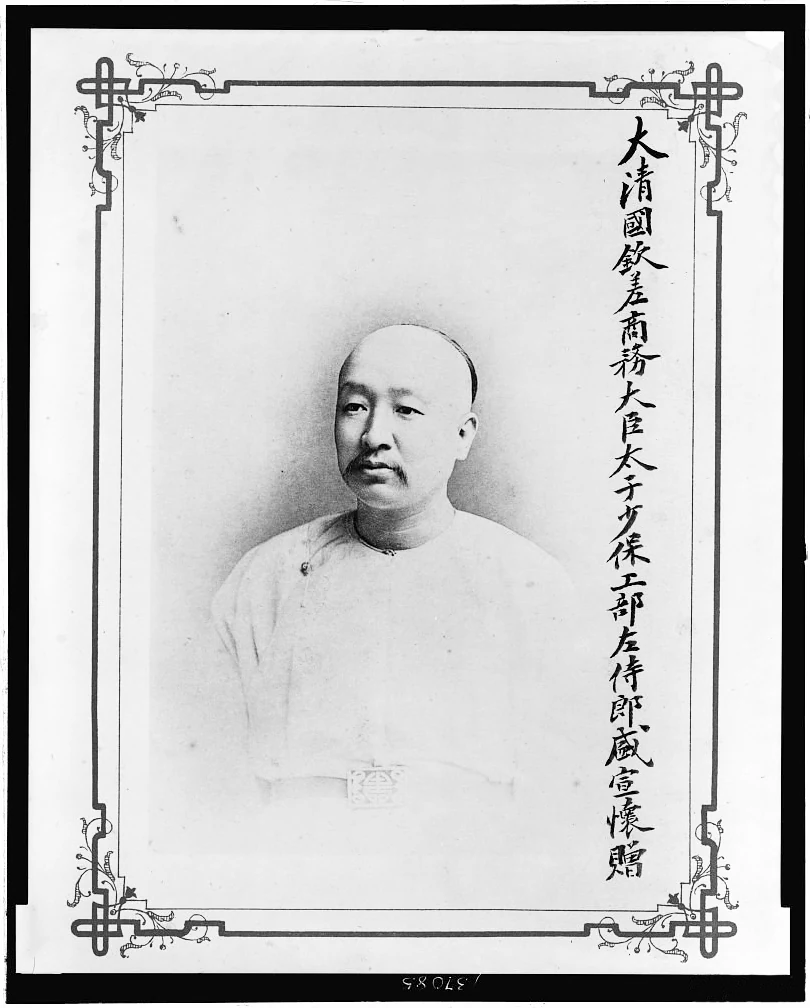
Biography
Family Background and Early Years Sheng Xuanhuai was born on November 4, 1844, the twenty-fourth year of the Daoguang era, in Longxi, Wujin County, Changzhou Prefecture, Jiangsu Province, now Shengjiawan Village in Zhonglou District, Changzhou. His father, Sheng Kang, was a Qing official acquainted with Li Hongzhang and had served in posts connected with the Hubei grain and salt administrations. Sheng Xuanhuai was the eldest of six brothers. In February 1860, the tenth year of the Xianfeng era, as Taiping forces approached Changzhou, Sheng fled with his parents to Changjing in Jiangyin and then to Yancheng. Sheng Kang, then serving in the Hubei grain administration, sent people to bring the family to Hubei. In 1862, the first year of the Tongzhi era, Sheng Xuanhuai married Lady Dong. While Sheng Kang was serving in the Hubei salt administration, Sichuan and northern Huai salt interests were locked in a prolonged dispute over their marketing zones. Sheng Xuanhuai proposed allowing the Sichuan and Huai operations to proceed in parallel, helping resolve the problem. Sheng Kang thereafter encouraged him to pursue practical learning. Hu Linyi and Yan Shusen, both noted statecraft-oriented officials who successively served as governor of Hubei, were known for rigorous military and administrative management. Sheng observed them closely, studied affairs in detail, and came to aspire to serving the needs of his age; the Chinese source states that the foundations of his later achievements were laid in this period. In 1866, the fifth year of the Tongzhi era, Sheng and his second younger brother returned to Wujin to take the children's examination. Both entered the county school. In 1867, after the death of his grandfather Sheng Long, Sheng Kang escorted the coffin home. Sheng Xuanhuai failed the provincial examination and did not subsequently pursue the regular imperial examination system. During Sheng Kang's mourning period at home, the family established a charitable estate, expanded sacrificial lands, built a charitable school, and revised the clan genealogy. Sheng Xuanhuai participated in planning these affairs, experiences that fostered his later interest in clan management and charitable work. ### Entering Li Hongzhang's Staff and Beginning Self-Strengthening Work In 1870, the ninth year of the Tongzhi era, Sheng entered the staff of Li Hongzhang and assisted with Self-Strengthening affairs. Li appreciated his abilities, and Sheng was promoted to the rank of prefect the following year. In 1871, after severe flooding in the capital region, Sheng Kang donated clothing and grain; Sheng Xuanhuai purchased the supplies and transported them to Tianjin for distribution. The Chinese source identifies this as Sheng's first involvement in philanthropy. In 1875, the first year of the Guangxu era, Li Hongzhang commissioned Sheng to handle Hubei coal and iron mining, beginning his involvement in the mining industry. In 1876, Sheng established the General Bureau for the Exploitation of Hubei Coal and Iron at Pantang in Guangji, Hubei, and hired the British mining specialist Guo Shidun to survey coal and iron deposits. In July 1877, Guo and his associates identified the Daye iron mine. In November, Sheng went to Huangshigang with Daye magistrate Lin Zuo and others to survey land rights at Tieshan, and he purchased some of those rights from private owners. He planned to establish an ironworks beside the Dong Wu Wang Temple at Huangshigang, at present-day Shenjiaying, but Li Hongzhang did not approve the scheme because funds were difficult to raise. In 1879, Sheng served in an acting capacity on the Tianjin-Hejian circuit. That year he proposed establishing a telegraph service to Li Hongzhang. The proposal was accepted, and Sheng was ordered to supervise the undertaking. In 1880 he established the Tianjin Telegraph Bureau, described in the Chinese source as China's first telegraph bureau. In 1881 he became director-general of the Tianjin-Shanghai overland telegraph line and thereafter entered the telecommunications field. In 1882, to prevent foreign interests from establishing a telegraph network along China's coast, Li appointed Sheng to build lines from Shanghai to Guangdong, Ningbo, Fuzhou, Xiamen, and other places. ### Expansion in Official and Commercial Affairs In 1883, Sheng supervised Tianjin customs. He diverted customs funds to support the telegraph enterprise, mixing funds belonging to different departments, and was disciplined, although he was not demoted because several people interceded for him. In 1884 he went to Guangdong to handle the Shamian incident and served as acting Tianjin customs intendant. After the Sino-French War began and disrupted shipping, Ma Jianzhong, with Sheng's support, mortgaged company steamships in July to the American firm Russell & Co. so that they would not be endangered by a formal outbreak of hostilities between China and France, while also converting assets into funds to support military expenses. In October, Sheng asked Jardine Matheson to transfer funds to Liu Mingchuan in Taiwan. In 1885, Sheng became superintendent of the China Merchants' Steam Navigation Company. In 1886 he became intendant of the Dengzhou-Laizhou-Qingzhou circuit in Shandong and supervisor of the Eastern Maritime Customs, and established a small-steamer company for Shandong's inland waterways. In 1887 he independently operated passenger and cargo shipping at Yantai, expanded operations along the Shandong coast, and opened a route from Yantai to Lüshun. In the spring of 1891, he established Jiaodong's first Guangren Hall charitable institution in Yantai. In August 1889, Zhang Zhidong decided to relocate to Hubei an ironworks originally planned for Guangdong. When Sheng visited Zhang and the two discussed steelmaking, Zhang said he did not yet have an iron mine. Sheng immediately offered to turn over the mineral rights he had previously acquired at Daye. At the end of the year, Sheng again discussed the development of the mine with Zhang and offered four recommendations. Zhang Zhidong subsequently built the Hanyang Iron Works, while the Daye mine became, according to the Chinese source, the first large mine in Chinese history to use mechanized extraction. In 1892, Sheng became Tianjin customs intendant and customs supervisor in Zhili, while also beginning to supervise the textile industry in Shanghai. In 1894 he established the Huasheng Textile Mill and, under government-supervised, merchant-managed and joint government-merchant arrangements, controlled a number of spinning mills including Dachun, Yuchun, and Yujin. ### Expansion in Education and Finance After the First Sino-Japanese War, Sheng concluded that national self-strengthening required establishing schools and cultivating talent. In a memorial to the court he wrote that “self-strengthening begins with storing up talent, and storing up talent must begin with promoting education,” and that the abundance of capable people in Western countries came from schools. On October 2, 1895, the twenty-first year of the Guangxu era, Sheng, through Zhili governor-general Wang Wenshao, memorialized the Guangxu Emperor to establish a new-style school. The emperor approved the proposal, and the Tianjin Beiyang Western School was established, later renamed the Beiyang University Hall. The Chinese source describes it as the first government-run university in modern Chinese history and as the predecessor of Tianjin University. In 1896, while awaiting appointment at the fourth-rank metropolitan level, Sheng supervised the Railway Corporation and was granted the privilege of submitting memorials directly. He took over the Hanyang Iron Works and Daye iron mine, memorialized to establish Nanyang Public School in Shanghai, the predecessor of Jiaotong University, and received the honorary rank of vice minister of the Court of Imperial Sacrifices. The same year he established the Imperial Bank of China on the Bund in Shanghai. The bank formally opened on May 27, 1897, and thereafter entered provisional railway-loan agreements with Belgian, British, and American parties. In December Sheng received a substantive appointment as vice minister of the Court of Judicial Review. In 1898, Sheng established the Pingxiang coal mine to supply fuel to the Hanyang Iron Works. He then memorialized to send the official Li Weige abroad to study steel production and obtain newer methods. While inspecting European and American steel industries, Li also identified causes of the poor quality of products from the Hanyang works. Sheng therefore purchased new machinery and furnaces and thoroughly reconstructed the plant. After reconstruction and expansion, the Hanyang Iron Works was described in the source as the leading works in East Asia. However, to solve funding problems, Sheng, under inducement from the Japanese steel enterprise, used the Dedaowan mining area of the Daye iron mine and all mine-bureau property as collateral to borrow more than three million yen from the Industrial Bank of Japan. The Chinese source states that this marked the beginning of the loss of control over the Daye mine. ### Mutual Protection of Southeast China and Later Years In 1900, the twenty-sixth year of the Guangxu era, during the Boxer Rebellion, Sheng opposed Empress Dowager Cixi's support for the Boxers. He ordered telegraph bureaus to withhold her edict calling up the Boxers, showing it only to the governors-general and governors, and telegraphed those officials urging them not to obey the order. Through his contacts, the governors-general and governors of the Yangzi region and Jiangsu-Zhejiang area reached the Mutual Protection of Southeast China arrangement with foreign powers. Sheng favored negotiations with the foreign powers. When Li Hongzhang entered Beijing for peace talks, he asked Sheng to accompany him, and Empress Dowager Cixi also summoned Sheng, but Sheng considered the Qing Empire's political situation too uncertain and declined to go. Many enterprises under his management, including telegraph, mining, customs, and railway operations, were major sources of Qing revenue. The source says that Empress Dowager Cixi therefore could do little against him and instead praised him for preserving peace in the Yangzi region and added the title Grand Guardian of the Heir Apparent. In November 1901, for his role in protecting southeastern China, Sheng was awarded the additional title Junior Guardian of the Heir Apparent. In February 1902 he was appointed Left Vice Minister of the Ministry of Works, a second-rank office. In 1905 he helped establish the Chinese Red Cross in Shanghai. That year he transferred control of railway affairs to Tang Shaoyi, which the source describes as the beginning of the Communications Clique centered on Tang in the early Beiyang government. In July, Sheng received special permission to ride on horseback within the Forbidden City. In 1907 Sheng was summoned to Beijing; the following year he was appointed Right Vice Minister of the Ministry of Posts and Communications. In 1908, because the Hanyang Iron Works remained constrained by Japanese interests and was still unprofitable, expansion was considered necessary. Sheng merged the Pingxiang coal mine with the Hanyang Iron Works and Daye iron mine to create the Hanyeping Coal and Iron Company. Its status was changed from a government-supervised, merchant-managed enterprise to a fully merchant-run company, and Sheng was recommended as its general manager. In 1909, the first year of the Xuantong era, Sheng argued that commercial revival depended on shipping and that the development of shipping depended on trained personnel. Nanyang Public School added a navigation program and opened a navigation class; in 1912 this became the independent Wusong Merchant Marine College, identified in the Chinese source as a predecessor of today's Dalian Maritime University and Shanghai Maritime University. In 1911, after Yuan Shikai had been dismissed, Sheng received greater court favor and was promoted to Minister of Posts and Communications. He proposed transferring railways and postal systems established by the provinces to central control. This provoked opposition in many provinces, and the Railway Protection Movement broke out in Sichuan, Guangdong, Hunan, and Hubei. Sheng ordered local authorities to suppress it. After the Wuchang Uprising erupted on October 10, 1911, Sheng urged that Yuan Shikai be recalled. At the same time he was widely condemned, with many blaming his railway policy for helping cause the unrest. On October 26 he was dismissed and barred permanently from official employment, and he fled to Kobe, Japan. At the beginning of 1912, Sheng saw in Japan that the republican government needed military funds. He attempted to improve his unfavorable position by arranging a Sino-Japanese “joint operation” of Hanyeping in exchange for Japanese loans and thereby establishing relations with the new government. Sheng and Japanese financial interests secretly planned the arrangement, while representatives of the republican government signed two broadly similar draft agreements with Mitsui and the Yokohama Specie Bank in Kobe and Nanjing. On February 12, Sheng drew a loan of three million yen from the Yokohama Specie Bank and transferred part of it to Mitsui, which then transferred about 2.5 million yen to the Nanjing government. When news became public, it caused a national uproar. Under strong public pressure, Sheng was forced to agree to cancel the agreement and resigned as general manager of Hanyeping. On November 30, 1912, after the establishment of the Republic of China, Sheng returned from Japan to Shanghai at the invitation of Sun Zhongshan and continued to oversee the China Merchants' Steam Navigation Company and Hanyeping from the Shanghai concessions. In May 1913 he again became chairman of Hanyeping and regained control of the company. To fund infrastructure, on December 2 he signed five contracts with the Japanese steel works and Yokohama Specie Bank, pledging all Hanyeping property as collateral for a loan of fifteen million yen. Nine million yen was to be used to construct the Daye iron works and six million to repay old Japanese debts. The contracts stipulated that fifteen million tons of first-grade ore and eight million tons of pig iron would be supplied to Japan over forty years as repayment, and Japanese personnel would be employed as chief engineering adviser and chief accounting adviser. The Chinese source states that these contracts brought Hanyeping's management under the control of the Japanese steel works and led to the company's gradual decline. Sheng died in Shanghai on April 27, 1916. His will donated half of his estate to a charitable fund. Madam Zhuang arranged an exceptionally elaborate funeral that attracted attention throughout Shanghai, cost 300,000 taels of silver, and produced a funeral procession extending from Xieqiaolong, now Wujiang Road, to the Bund; the authorities in the foreign concessions imposed traffic controls for the occasion.
Sheng Xuanhuai was born on 4 November 1844 in the Changzhou region of Jiangsu; when the Taiping wars reached Jiangnan he fled with his parents, and his father Sheng Kang, then grain commissioner of Hubei, sent men to bring them to his post. In 1862 Sheng Xuanhuai married a lady of the Dong family. While his father was salt commissioner of Hubei, Sichuan and Huaibei quarrelled long over their salt markets; Sheng Xuanhuai proposed that both should be allowed to trade, which settled a stubborn question, and his father urged him the more to study what was of use. The successive governors of Hubei at that time were famous men of the statecraft school, whose military and civil administration was strict and orderly beyond that of other provinces, and hearing and seeing such things and inquiring into everything, Sheng Xuanhuai took it as his aim to set the times to rights, saying that the foundation of his life's work was laid there.
In 1866 he went back to his native place with his younger brother to sit the examinations; the next year his grandfather Sheng Long died, his father took the coffin home to observe mourning, and Sheng Xuanhuai failed the examination. While the family was at home his father devoted himself to the welfare of the clan, founding a charitable estate, adding sacrificial land, opening a charity school and compiling the genealogy, and Sheng Xuanhuai had a hand in all of it. He then entered Li Hongzhang's secretariat to help with foreign affairs, was much valued by Li, and within a year was raised to the rank of prefect.
In 1875 Li Hongzhang charged him with the coal and iron works of Hubei, and from that time he was engaged in mining. In 1876 he set up the Hubei coal and iron general office at Pantang in Guangji and engaged the British engineer A. W. Crookston to survey the coal and iron of Hubei. In the seventh month of 1877 the engineer found the deposits; in the eleventh month Sheng Xuanhuai went to Huangshigang, where with the magistrate of Daye, Lin Zuo, and others he made a careful survey of the land titles about the iron hills, bought part of them from private owners, and prepared to build an ironworks beside the temple of the King of Wu east of Huangshigang — a plan dropped because the funds could not be raised and Li Hongzhang would not approve it. He was made acting intendant of Tianjin and Hejian in 1879, went to Guangdong in 1884 over the Shameen affair, became intendant of Denglaqing in Shandong in 1886, and in 1887 ran a shipping line of his own at Yantai carrying passengers and goods, extending it along the whole Shandong coast and opening the route from Yantai to Lüshun.
In the eighth month of 1889 Zhang Zhidong decided to move to Hubei the ironworks he had meant to build in Guangdong. Sheng Xuanhuai, then visiting Zhang on business, fell to talking of steel-making, and when Zhang said he had no iron mine, Sheng at once offered him the iron hill he had bought at Daye, and at the end of the year discussed the opening of the mine with him in person and put forward four proposals. Zhang Zhidong therefore built the Hanyang ironworks and opened the mine, and the Daye mine thus became the first great mine worked by machinery in Chinese history.
Afterward Sheng Xuanhuai long directed the industrial and communications affairs of the Qing court: he took over the Hanyang ironworks and enlarged it, helped found the Imperial Bank of China, directed the railway general office and managed the telegraph and the China Merchants' Steam Navigation Company, becoming one of the officials of the late Qing who held most of its industrial enterprises. He held that the new enterprises should be managed by officials with merchants' capital, balancing the state's needs against the merchants' interest in their running, a course whose merits have been judged variously.
In 1911 he was made president of the board of posts and communications and urged that the trunk railways built by merchants be nationalised, a policy that touched off the railway protection movement and became one of the sparks of the revolution. After the Wuchang rising he was dismissed and withdrew to Shanghai, dying in 1916. His life was bound up with the foreign affairs, industry and railways of the late Qing: he was both the founder and manager of a number of important modern enterprises and an executor of the court's economic policy, and his merits and faults have long been debated by historians of the period, while the archives he left are important material for the economic history of the late Qing.
Beyond industry Sheng Xuanhuai had a hand in founding new financial and cultural institutions. In 1897 he directed the establishment of the Imperial Bank of China, the first bank founded by Chinese in modern times; before that he had held important posts in the telegraph administration and the China Merchants' Steam Navigation Company — the latter founded about 1872, in which he took part and long served as co-director and then director, and the former set up about 1880, of which he was chief manager, later reorganised as a supervised merchant enterprise with telegraph lines laid through the provinces. In 1896 he took over the Hanyang ironworks and reconstituted it as an official-supervised merchant enterprise, opening the Pingxiang coal mines in Jiangxi to supply it with fuel; in the same year he was put in charge of the railway general office, and the lines from Lugouqiao to Hankou, from Shanghai to Nanjing and from Bianliang to Luoyang were begun one after another. In 1896 he also founded the Nanyang public school, one of the predecessors of the Jiaotong universities, to train men for the new work.
During the Boxer troubles of 1900 Sheng Xuanhuai acted as go-between among the governors of the southeastern provinces and the foreign consuls, and had a part in forming the southeast compact. He went on directing railways and industry, becoming junior vice-president of the board of posts and communications in 1909 and its president in 1911, when his advocacy of railway nationalisation made him the target of public attack, and he was dismissed soon after the Wuchang rising.
Judgments of Sheng Xuanhuai have always been divided. On one side, the shipping, telegraph, banking, railway, mining and modern schools he founded formed a considerable part of China's early industrialisation; on the other, the enterprises he ran under official supervision commonly put the government's interest first, and he himself accumulated a great fortune, so that he was accused of greed in his own day and since. The press of the late Qing and later students of the period have generally taken him as the type of the official-entrepreneur and as a case by which to judge the success and failure of the self-strengthening enterprise.
The enterprises Sheng Xuanhuai ran under official supervision required him to manage at once the authorities, the merchants and the foreign technicians. In his dealings with foreign mining engineers he took care to bring in machinery for mining and smelting, the Daye mine and the Hanyang ironworks owing their establishment in part to British survey and advice; and he valued the training of men, founding the Nanyang public school and sending students abroad to supply the new enterprises with technical and managerial staff. In the official world of the late Qing he was known as a good hand at finance and negotiation and, from his industrial ventures, a rich man, his estate becoming the subject of family litigation after his death. He left a great mass of archives, correspondence, accounts and contracts, which have since become important material for the study of industry, finance and railways in the last years of the dynasty.