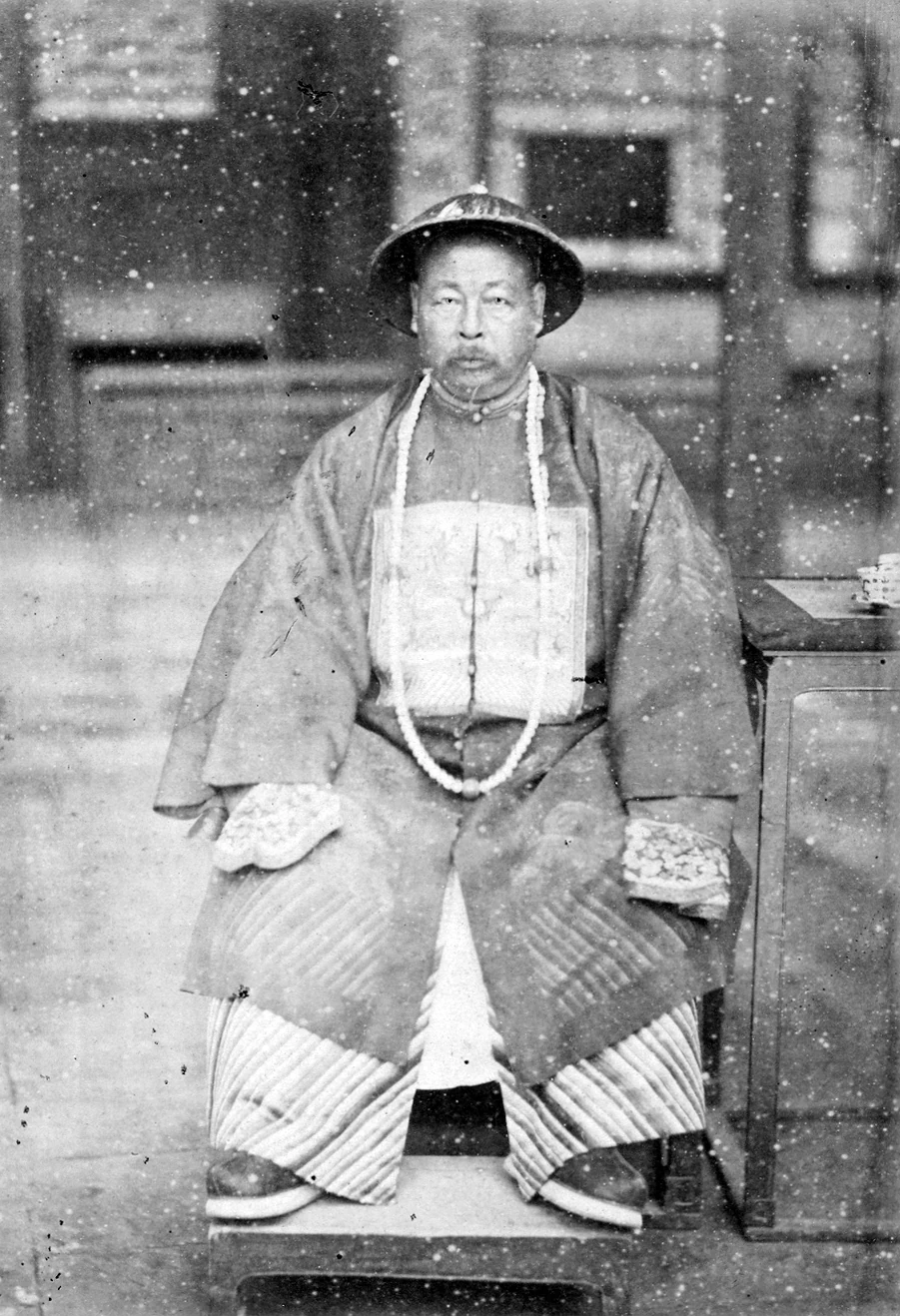
Biography
Family Background and Early Years
Zuo Zongtang was born on November 10, 1812, the seventh day of the tenth lunar month in the seventeenth year of the Jiaqing era, in Zuojia Village in the eastern part of Xiangyin County, Changsha Prefecture, Hunan. His father, Zuo Guanlan, was a state-supported licentiate who made his living by teaching and was known for his learning and conduct; his mother was Lady Yu. The Zuo family had long been a family of scholars, but its fortunes had declined and it was not wealthy. Zuo Zongtang was naturally intelligent and ambitious from youth. In 1816, the twenty-first year of the Jiaqing era, the four-year-old Zuo accompanied his father to Changsha, the provincial capital, to study and was raised under close family instruction.
In 1826, the sixth year of the Daoguang era, the fourteen-year-old Zuo placed first in the Xiangyin county examination. The following year he placed second in the Changsha prefectural examination, but gave up the academy examination because his mother was gravely ill; she soon died, and he entered mourning. From 1829, during his mourning period, he turned to statecraft and practical learning. He treasured and carefully annotated works dealing with Chinese history, geography, military affairs, economics, and water control, including *Huangchao Jingshi Wenbian*, *Tianxia Junguo Libing Shu*, *Dushi Fangyu Jiyao*, and *Shuidao Tigang*. Candidates trained in the eight-legged essay “all laughed privately, thinking such learning useless,” yet it was precisely this study that later formed a foundation for his military command, administration, and finance.
In 1830, Zuo's father died. While in mourning, Zuo visited the prominent practical-minded official and statecraft scholar He Changling in Changsha. He treated Zuo “as a man of outstanding promise,” allowed him free access to his collection of books, asked him about what he had learned whenever books were returned, and discussed points with him tirelessly. He also urged Zuo not to settle for small achievements or limit what he might become.
Examination Frustrations and Scholarship
In 1831, Zuo entered Chengnan Academy in Changsha and studied under He Xiling, the younger brother of He Changling. He Xiling's teaching emphasized moral principles and statecraft rather than concentrating solely on examination composition. He valued Zuo highly, praising him as independent-minded and genuinely learned, and the two families later became related by marriage. The same year, Zuo entered the Xiangshui Jiaojingtang founded in Changsha by Hunan governor Wu Rongguang. He studied diligently, placed first seven times in examinations, and won Wu's recognition.
In 1832, Zuo passed the provincial examination in Changsha through a supplementary selection and obtained the provincial graduate degree. Over the next six years, however, he failed the metropolitan examination three times. In 1833 he made his first trip to Beijing for the examination, became friends with Hu Linyi, and composed the cycle *Yantai Zagan*, which already touched on the situation in Xinjiang. In 1835 he sat the examination again and was initially ranked fifteenth among candidates from Hunan, but the place was removed because the provincial quota had been exceeded; he received only an appointment as a copyist. Unwilling to accept it, he returned home and, with the help of his wife Zhou Yiduan, devoted himself to historical geography. In 1838, after failing for a third time, he stopped in Nanjing on his way home to visit Tao Shu, Governor-General of Liangjiang. Tao himself proposed that his only son Tao Guang marry Zuo's eldest daughter, joining the two families by marriage.
His failures in the examinations prevented Zuo from entering official life through the conventional route, but they encouraged him to pursue statecraft learning even more deeply. In 1836 he lectured at Lujiang Academy in Liling, where he met Tao Shu. Tao at once regarded him as an exceptional talent, talked with him at length about past and present affairs, and kept him overnight; the two became friends despite their difference in age. After Tao Shu's death, Zuo taught in the Tao family household in Anhua from 1840 to 1847, helping manage family affairs. During these years he read widely in the Tao collection, managed Liuzhuang, studied agriculture and geography, and followed the First Opium War, proposing measures such as redesigning fire-ships and gunboats.
In 1849, Lin Zexu, then Governor-General of Yunnan-Guizhou, was returning to Fujian on sick leave and passed through Changsha. He arranged to meet Zuo on a boat on the Xiang River. They spoke through the night about the political situation past and present, assessments of people, and current affairs in the Western Regions, including military colonies and water control. Lin entrusted Zuo with all the materials on Xinjiang that he had assembled, saying in substance that he was old, had long wished to resist Russia, and hoped to entrust this responsibility to someone capable; while others might defend the southeastern coast against foreign powers, “for pacifying Xinjiang in the west, there is no one but you.” This meeting had a profound influence on Zuo's later recovery of Xinjiang. Lin later praised him as an “extraordinary talent” and a “talent rarely seen in any age.”
Service on Provincial Staffs and Early Prominence
In 1852, the second year of the Xianfeng era, Taiping forces besieged Changsha and the provincial capital was in danger. At the urging of Guo Songtao and others, Zuo accepted an invitation from Hunan governor Zhang Liangji to enter service. He was lowered into the city by rope amid the fighting. Delighted at his arrival, Zhang entrusted military planning to him. Zuo worked day and night arranging provisions and documents and planning defenses. Most of his proposals were accepted and immediately carried out. After failing to take Changsha during a three-month siege, the Taiping forces withdrew northward. Zuo's public career began from this point.
In April 1854, at the invitation of Hunan governor Luo Bingzhang, Zuo joined the governor's staff for a second time and remained there for six years. Qing control in Hunan was then precarious: Taiping forces operated across northern Hunan, many towns around Changsha had fallen, and poor peasants across eastern, southern, and western Hunan repeatedly rose in rebellion. Zuo planned constantly, assisting Luo in pacifying the province internally and supporting military operations in five neighboring provinces, while also removing administrative abuses, increasing revenues and reducing expenditures, stabilizing the currency, and raising military funds. Luo trusted him completely and did not recheck documents that Zuo approved. Through Zuo's planning, the military and political situation in Hunan improved, while Hunan Army forces campaigning outside the province repeatedly won victories.
Zuo's work on the Hunan staff attracted attention at court and among officials. A saying circulated that “the realm cannot go a day without Hunan, and Hunan cannot go a day without Zuo Zongtang.” The Xianfeng Emperor also paid close attention to him. In 1855, censor Zong Jichen recommended Zuo in a memorial. In 1856, for supplying funds to Zeng Guofan's forces, the Qing court selected him for appointment as a director in the Ministry of War and awarded him the peacock feather. In 1858, on Luo Bingzhang's recommendation, he received fourth-rank senior status.
In 1859, however, the Fan Xie capital accusation case erupted. Fan Xie, commander of the Yongzhou garrison in Hunan, brought accusations against Zuo that nearly cost him his life. Hu Linyi, Guo Songtao, Pan Zuyin, and others intervened on his behalf. Pan memorialized that “the state cannot go a day without Hunan, and Hunan cannot go a day without Zongtang,” after which the Xianfeng Emperor paid even greater attention to Zuo.
Formation of the Chu Army and Suppression of the Taiping Heavenly Kingdom
In 1860, the tenth year of the Xianfeng era, Taiping forces broke through the Jiangnan Camp. Zuo, then a candidate fourth-rank metropolitan official, assisted Imperial Commissioner and Governor-General of Liangjiang Zeng Guofan in military affairs. He recruited five thousand men in Hunan to form the Chu Army and went to Jiangxi and Anhui to fight the Taiping forces. The Chu Army adopted elements of Wang Zhen's methods and developed its own camp organization. Moving through Jiangxi, Zuo's force captured Dexing and Wuyuan and fought major engagements at Leping and Poyang. The source records “more than one hundred thousand corpses”; Li Shixian escaped in disguise, and the Qing military position in Jiangxi and Anhui recovered.
In 1861, Zeng Guofan memorialized recommending Zuo as governor of Zhejiang. Zuo led eight thousand Chu Army troops eastward to reinforce the province, coordinating forces across more than seven hundred li with composure that impressed Zeng. In the first lunar month of 1862, the Qing court formally appointed him governor of Zhejiang with responsibility for military affairs. Over the next two years he advanced through Zhejiang with assistance from three mixed forces: the Sino-French Ever-Triumphant Army, the Sino-British Ever-Secure Army, and the Sino-British Surely Triumphant Army. He captured Jinhua, Shaoxing, and other places. In 1863 he was promoted to Governor-General of Min-Zhe. In the third lunar month of 1864 he captured Hangzhou, received the rank of Junior Guardian of the Heir Apparent, and was awarded the Yellow Riding Jacket. He then captured Huzhou and other places and secured all of Zhejiang. For his achievements he was enfeoffed as First-Rank Earl Kejing.
In Zhejiang, Zuo adopted measures to restore the economy: he tightened military discipline, encouraged merchants to reopen markets, suspended customs duties at Hangzhou, reduced taxes in Hangzhou, Jiaxing, and Huzhou by one-third, removed seventeen circuit and prefectural officials and commanders who had lost their posts, and recommended Zhejiang scholars such as Wu Guanli for famine relief and reclamation. These measures contributed to the province's postwar recovery.
Governor-General of Shaan-Gan and Suppression of the Muslim Rebellion
In 1866, the fifth year of the Tongzhi era, Zuo was transferred to serve as Governor-General of Shaan-Gan. He took up the post in 1867, supervised military affairs in Shaanxi and Gansu, and suppressed the Shaanxi–Gansu Muslim Rebellion of the Tongzhi era. He combined military suppression with offers of surrender. He first sent Liu Songshan to attack northern Shaanxi. In the twelfth lunar month of 1868, Liu defeated the Han Chinese armed forces of Dong Fuxiang, whose base was in northern Shaanxi. Dong and more than one hundred thousand followers surrendered; Liu selected the best troops and organized them into three Qing battalions. Zuo's forces then attacked the Shaanxi Muslim armies under Ma Zhenghe, Bai Yanhu, and others, and by the fifth lunar month of 1869 had cleared rebel forces from Shaanxi.
The Shaanxi Muslim forces withdrew toward Jinjibao, the base of Ma Hualong's forces in northern Gansu. Liu Songshan continued his advance. Ma Hualong outwardly submitted to the Qing court and sought peace on behalf of the Shaanxi Muslims; when this failed, he rebelled again. Liu was killed while attacking Jinjibao, and his nephew Liu Jintang succeeded him in command. With food exhausted and relief cut off, Ma Hualong finally surrendered to Zuo in the eleventh lunar month of 1870 and was executed in the first lunar month of 1871.
Zuo entered Gansu in 1871. In the fourth lunar month of 1872, Ma Zhanao, a leader of the Muslim forces at Hezhou, surrendered and was incorporated by Zuo into the Qing army. In the tenth lunar month, Qing forces recovered Xining. Bai Yanhu and the remnants of the Shaanxi Muslim forces fled to Xinjiang and joined Yaqub Beg, later escaped to Russia, and eventually died there. In the ninth lunar month of 1873, after defending Suzhou in northwestern Gansu for two years and exhausting his supplies, Muslim leader Ma Wenlu surrendered to Zuo. Zuo executed him that month, bringing the Tongzhi-era Shaanxi–Gansu Muslim Rebellion to an end. The same year, Zuo was appointed Assistant Grand Secretary.
Recovery of Xinjiang
In 1864, while the Taiping Rebellion and the Tongzhi-era Shaanxi–Gansu Muslim Rebellion were affecting Xinjiang, local strongmen rose in various parts of the region and established competing regimes. Kashgar was occupied by the Islamic leader Mahmut Alam of the White Mountain faction, who proclaimed himself ruler. Soon the Kyrgyz tribal leader Sidiq allied with the Hui notable Jin Xiangyin and seized Kashgar. Mahmut Alam wrote to the Khanate of Kokand seeking outside help to expel Sidiq; Sidiq also sent Jin Xiangyin to Kokand, hoping to bring back a descendant of the Black Mountain Khojas. These events brought Yaqub Beg into Xinjiang, and in 1867 he established the so-called “Hongfu Khanate” and dominated the region.
In 1875, the first year of the Guangxu era, debate at court over sending troops to recover Xinjiang produced the dispute between “maritime defense” and “frontier defense.” Li Hongzhang and others stressed maritime defense, regarded Japan as the principal hypothetical enemy, and proposed abandoning frontier defense so that military funds saved there could be redirected to coastal defense. Zuo strongly rejected Li's position, arguing that if China withdrew its frontier screen, every step back would invite an enemy step forward and would especially encourage British and Russian penetration. He argued that losing Xinjiang would deprive the northwest of its defensive barrier, damage state prestige and popular confidence internally, and encourage foreign aggression externally. Grand Councillor Wenxiang was persuaded by Zuo's arguments and fully supported him. Empress Dowager Cixi issued an edict appointing Zuo Imperial Commissioner with full authority over the armies and responsibility for Xinjiang military affairs.
After careful consideration, Zuo adopted a strategy he described as “advance slowly, decide swiftly.” “Advance slowly” meant actively preparing the army: for a year and a half he raised military funds, accumulated fodder and grain, reorganized the troops, and dismissed the weak while retaining the strong. Anyone unwilling to leave the passes for the western expedition was given travel funds and sent home without coercion. “Decide swiftly” reflected the empty state of the treasury: once the army set out, it had to fight rapidly and seek total victory in roughly a year and a half before demobilizing. Zuo personally investigated and calculated requirements, beginning with daily grain and fodder for each soldier and horse, projecting the needs of eighty thousand men and horses for a year and a half, then estimating transport costs and losses, even comparing the expense of donkeys and camels with wheeled transport. After detailed planning he estimated total military expenditure at eight million taels of silver; allowing for unforeseen expenses, he requested ten million. The imperial approval stated that Zuo was a great minister of the state and, because he had undertaken the western expedition for public affairs, the court need not begrudge ten million taels so long as the frontier was secured; five million would be allocated from the treasury and he would be authorized to borrow another five million from foreign lenders.
At the same time, Zuo established the Lanzhou Arsenal, also called the Gansu Arsenal, to manufacture and repair firearms and artillery for the western expedition. It copied German screw-guns and seven-shot breech-loading rifles and modified Chinese pishan cannon and Guangdong shoulder guns without cartridge cases. He also established the Kansu Government Woollen Cloth Factory, also called the Lanzhou Machine Woolen Mill, described in the source as China's first mechanized textile factory.
In the fourth lunar month of 1876, Zuo swore the army to the western campaign. Urumqi was captured in the eighth lunar month. In the fourth lunar month of 1877, his forces captured Dabancheng and Toksun, followed by Turpan in the fifth; Yaqub Beg was defeated and died. Kashgar fell in the twelfth lunar month, completing the recovery of southern Xinjiang. In 1878 all of Xinjiang was recovered. Zuo memorialized for its establishment as a province, arguing that because foreign peoples pressed closely on the region and the old territory had only recently returned, long-term stability required provincial administration and the establishment of prefectures and counties.
Sino-Russian Negotiations over Ili and Later Years
After Xinjiang was recovered, negotiations with Russia over Ili became the central issue. In 1880, the sixth year of the Guangxu era, Zuo advocated “negotiations first, battle thereafter,” using military force as backing for diplomacy. He left Suzhou carrying his own coffin and stationed at Hami to show his determination to recover Ili. The Treaty of Saint Petersburg (1881) was signed, and China recovered Ili. In 1881, the seventh year of the Guangxu era, Zuo entered Beijing as a Grand Councillor and minister of the Zongli Yamen. In the tenth lunar month he was transferred to serve as Governor-General of Liangjiang.
In 1884, the tenth year of the Guangxu era, the Sino-French War broke out. After the defeat at the Battle of Fuzhou, Zuo, acting as Imperial Commissioner, reorganized Hunan Army forces and supervised coastal defense in Fujian and Taiwan. On September 5, 1885, the twenty-seventh day of the seventh lunar month in the eleventh year of the Guangxu era, Zuo died of illness in Fuzhou at the age of seventy-three with his ambitions not yet fulfilled.
Failure in the Examinations and Early Friends
According to his biography in the Draft History of the Qing, Zuo Zongtang "passed the provincial examination in the twelfth year of Daoguang, failed three times in the metropolitan examination and thereupon gave up hope of office, applying his mind to geography and the art of war"; he "delighted in startling the crowd with bold words and was known among the nobles, comparing himself to Zhuge Liang, so that men thought him mad", while Hu Linyi "praised him constantly, saying that looking across the nine provinces there was no talent to surpass him"; and near forty he told his intimates that "unless he is sought out like the man in a dream, there is little hope". He studied under He Xiling in the Chengnan Academy and entered the Xiangshui Scripture Hall, coming first seven times in the examinations and winning the regard of the Hunan governor Wu Rongguang; in 1833, on his first journey to the capital, he became friends with Hu Linyi and wrote the "Miscellaneous Thoughts at Yan Terrace", in which the situation in Xinjiang already appears; in 1835 he passed fifteenth in Hunan but was struck off for exceeding the quota and offered only a copying post, which he refused in disgust, returning home to study geography with the help of his wife Zhou Yiduan. In 1836, teaching at the Lujiang Academy in Liling, he came to the notice of the Liangjiang governor Tao Shu, who was visiting his native place: seeing couplets at the county hostel that praised him and a painting inscribed with the lines that "the good mountains of a county stand for the lord, and twice the green water awaits your purity", Tao Shu asked to meet the author — Zuo Zongtang — and "at once judged him a man of rare talent, discussing antiquity and the present with him and keeping him overnight", an enduring friendship that led Tao Shu to betroth his only son to Zuo's eldest daughter. After Tao Shu's death, from 1840 to 1847 Zuo taught for eight years in the Tao household at Anhua, managing its affairs while reading its library, running his estate at Liuzhuang, studying agriculture and geography and following the Opium War, for which he proposed building steam- and gunboats. In 1849, when Lin Zexu passed through Changsha on his way home to Fujian, he summoned Zuo to a boat on the Xiang river; by the Qingbai Leichao, Zuo, eager to see the famous man, "fell into the water in his hurry and climbed onto the boat in wet clothes", saying after his greeting that "of old, scholars were received with three perfumings and three washings; the three washings I have received, but the three perfumings not yet", at which Lin laughed and told him to change his clothes against the cold, and they talked until dawn; of the frontier Lin suddenly struck his shoulder and said that "he who shall complete my purpose is, I think, you", and wrote out a couplet for him that "here are high mountains, steep ridges, dense woods and tall bamboo; one who can read the Three Mounds, the Five Canons, the Eight Ropes and the Nine Mounds", to "my honoured elder brother Ji Gao" from "your humble younger brother Lin". Zuo said in old age that this had been the greatest honour of his life, and long kept the couplet on his study wall.
Six Years in the Hunan Secretariat and the "Left Censor-in-Chief"
In 1854 he entered Luo Bingzhang's secretariat for a second time, remaining six years. By Xu Zongliang's record he "settled everything, great and small, without consulting", while Luo "spent his days drinking with his women", so that Zuo once mocked him to his face, saying that "you are a puppet, and with nothing to pull you how can you move?", at which Luo only laughed drily; and he once drafted a memorial at midnight and went shouting into Luo's inner chamber, where Luo rose, read it, called it superb, had wine brought and drank with him before he left. Officials of the circuits and below reporting business would ask whether "the Third Mr Left" approved. Xue Fucheng records the tradition that Luo, hearing a gun at the gate, asked what it was and was told that "Lord Left is sending off a military memorial", and, nodding, said slowly that they might bring him the draft to look at; though exaggerated, it shows his trust, and since Luo's rank was only assistant censor-in-chief while Zuo's authority exceeded it, the men of Chu jestingly called him "the Left Censor-in-Chief".
The Fan Xie Case and the Emperor's Attention
In 1859 the case brought by Fan Xie nearly cost him his life. According to Liu Yusheng and local tradition, Fan Xie, the garrison general of Yongzhou, called on Luo Bingzhang, who told him to call also on the secretary Zuo; Fan saluted the governor but not the secretary, and Zuo shouted that "a military officer who comes before me must salute, great or small; salute at once", to which Fan answered that "the court's regulations do not require a military officer to salute a secretary; though a soldier is slight, I am an officer of the second or third rank", whereupon Zuo, enraged, rose as if to kick him and shouted "bastard, get out". Fan retired in fury, and soon the decree dismissing him arrived. Returning home, Fan wrote the six characters "bastard, get out" on a wooden tablet, called the "tablet of washed shame", set it below the ancestral shrine and made his two sons bow to it on the first and fifteenth of each month, hiring famous teachers for them with the vow that they should not remove the tablet until they passed the provincial examination and outdid Zuo Zongtang, and making them wear women's clothes at home — to take off the outer woman's dress on passing the county examination, the inner on passing the provincial, and to burn the tablet on becoming a presented scholar. His second son, Fan Zengxiang, became a Hanlin bachelor. Zuo was saved by Hu Linyi, Guo Songtao and Pan Zuyin, the last memorialising that "the state cannot go a day without Hunan, nor Hunan a day without Zongtang". By Guo Songtao's diary, the emperor Xianfeng asked Guo whether he knew him and bade him tell Zuo that "it is my wish that he should come out and act for me", asking his ability and age; told he was forty-seven, he said that in two years he would be fifty and his strength failing, and that now, while still strong, he should come out and act, adding that he should not weigh a degree so heavily, for what were letters compared with the founding of merit?
The Chu Army and the Pacification of Zhejiang
In 1860 he joined Zeng Guofan as a nominal fourth-rank official, raised five thousand men in Hunan as the "Chu Army" on Wang Zhen's model and went east. In the eighth month of that year, when Shi Dakai raided Sichuan and he was ordered there, Zeng and Hu urged that he be kept because Jiangsu and Anhui were critical; when Li Shixian and Li Xiucheng with hundreds of thousands besieged Zeng at Qimen, he came through Jiangxi, took Dexing and Wuyuan, and, when the rebels cut Zeng's supply line at Jingdezhen, turned back, fought at Leping and Poyang where "the dead lay a hundred thousand", and drove Li Shixian away in disguise, reviving the government position in Jiangsu and Anhui. In 1861 he was made chief of the Court of Imperial Sacrifices and went east into Zhejiang with eight thousand men; his officers being too few, he asked for Jiang Yili from Guangxi and Liu Peiyuan and Wei Yuyi from Hunan, and while awaiting them directed several thousand men across seven hundred li, so that "Zeng Guofan admired his composure". Ordered in the first month of 1862 to move from Quzhou into Zhejiang, he memorialised that "in war one must avoid a long siege and guard the rear; if my army enters Quzhou, Huizhou and Wuyuan will be exposed and I shall be short of grain and help", proposing to take Kaihua from Wuyuan, hold Huabu, and take Suian so that Rao and Guang might be secured and the rebels controlled rather than controlling him. Taking Suian in the second month and repeatedly defeating Li Shixian, he saw Jiang Yili and others take Jinhua and Shaoxing, and eastern Zhejiang was settled. At Hangzhou he "did not like storming fortified places", holding that "the aim of fighting rebels is their destruction, not the profit of the moment", dismissed seventeen officials who had lost their cities, and had the Zhejiang scholar Wu Guanli and others relieve the famine and encourage settlement to supply his army. Made governor-general of Zhejiang and Fujian in 1863, he pressed the siege of Fuyang and Hangzhou, and in the second month of 1864 Chen Bingwen, at his wits' end, asked terms; distrusting him, Zuo attacked in the rain, and the rebels fled by night, Hangzhou was recovered, and Wang Haiyang abandoned Yuhang, Zuo being made junior guardian of the heir apparent and given the yellow jacket. As the remnants fled through Anhui, Jiangxi and Guangdong into Tingzhou, terrifying Fujian, he asked to be relieved of the governor-generalship and sent Wang Debin's army to Fujian; the next year, with Guo Songlin's Jiangsu army, the rebels left Zhangzhou for Dabu, and by the twelfth month, when Jiaying fell and the rebels fled, "more than sixty thousand knelt for pardon, seven hundred and thirty-four rebel officers were taken or killed and sixteen thousand heads counted", for which he received the double-eyed peacock feather. He returned in triumph in the first month of 1866 and the Guangdong rebels were at an end.
The Fuzhou Arsenal
After the Taiping were put down he first proposed reducing the army and its pay while increasing training, and, holding that with the sea ban lifted no self-strengthening was possible without ships and ordnance, founded the shipyard at Mawei below Fuzhou and had Shen Baozhen preside over it. By Chi Zhonghu's record of naval affairs he memorialised in 1866 that "our country has three sides on the sea, and the steam warships of the various powers come straight to Tianjin, so that our fences are nearly void, our trade suffers and the transport of grain is difficult, and nothing but an urgent shipbuilding bureau will serve", and that "the Ma river at Fujian is deep and its soil firm, and a channel may be opened and docks cut, and it will serve for a yard", which the court approved, "and this was the beginning of the Chinese navy". He sent officers abroad to buy machinery and slipways, and founded the naval academy to train seamen and engineers. Chen Shaokuan, discussing the rise of the Chinese navy, held that "at its first beginnings, through the devoted efforts of Zuo, Shen, Zeng and Li and the naval pioneers, the foundation was at last laid", and observed that had the court been of one mind its development would have been measureless.
The Campaign in Shaanxi and Gansu
In the tenth month of 1866 he marched west with three thousand men, ordering Liu Dian to raise three thousand more to meet him at Hankou; diverted by the Nian rebel Zhang Zongyu's raid into Shaanxi, he went there first, and in the spring of 1867 led twelve thousand men west, proposing to break the rebel horse with gun-carts and meet their infantry with his own cavalry, so that "the Nian, seeing the gun-carts, ran without fighting". Entering the passes in three columns, with Liu Songshan's nine thousand old Hunan troops and the Shanxi judge Chen Shi guarding the river, all under his command, he broke the Nian at Fuping; holding that "the Nian are stronger than the Muslims and must be dealt with first", he had the armies camp up along the river to crush them between the Jing and Luo rivers, but the Nian crossed west over the Jing and Wei toward Henan and Hubei and then, in a great storm, fled into the northern hills, where he hastily held Yaozhou. When the Nian were beaten at Yichuan their other column raided Yaozhou and joined the Muslims against Tongguan; his troops drove them off, but because Yan'an and Suide were repeatedly lost he memorialised for punishment and was dismissed by the board. In the twelfth month the Nian entered Henan at Yuanqu, went north to Dingzhou, and their scouts reached Baoding, so that the capital was put under martial law and Zuo with Li Hongzhang, the governor of Henan and the governor-general of Zhili were all stripped of office; at Baoding he held that "one must defend and attack at once, holding the west bank while the eastern road pursues, and so check their wild rush", and the court approved both his view and Li's, and when Zhang Zongyu died by the river the western Nian were pacified. In the tenth month of 1868 he returned to Shaanxi and reached Xi'an, where the bandit Dong Fuxiang with more than a hundred thousand troubled Yan'an and Suide and the Shaanxi Muslims under Bai Yanhu, said to be two hundred thousand, held Dongzhi plain; Liu Songshan broke the bandits and received Dong's surrender, destroyed the Muslims' camp and retook Zhenyuan and Qingyang, "the Muslim dead reaching thirty thousand". He set the able-bodied to farming, teaching them the "section-field" and "alternating-field" methods, and settled a hundred and seventy thousand famine refugees and surrendered men on waste land at great expense. In the fifth month of 1869 he moved to Jingzhou; Ma Hualong, who armed the Muslims while professing surrender, was attacked at Jinjibao, and when Liu Songshan fell his nephew Liu Jintang took his place and pressed the siege until Ma surrendered and was executed, his fortress razed, the Muslims of Gansu being settled at Guyuan and Pingliang and those of Shaanxi at Huaping under strict control, and Ning and Ling were pacified. He then moved from Pingliang to Jingning and Anding, and his armies broke the rebels of Hezhou, where Ma Zhan'ao submitted; in the ninth month of 1873 he took Suzhou and Ma Wenlu surrendered and was executed, ending the rebellion in Shaanxi and Gansu. In his letters he said that "since I began to command troops, whenever the rebels of the Taiping or the Nian surrendered I insisted on the prohibition of killing or plundering, and my officers were not spared if they broke it, and I gave particular care to the settling of the surrendered", adding that "Han and Muslim watch what I do, and the Russians look on; if they had a pretext it would be a great evil to the whole". In the first month of 1874 he asked for a separate examination hall at the provincial capital of Gansu with its own education commissioner, and in the second month reformed the Gansu tea trade by issuing tickets instead of permits, opening a southern depot to attract Hu tea, both being approved; in the seventh month he was made a grand secretary, retaining the governor-generalship, and in the eighth a grand secretary of the Eastern Hall; in the eleventh month the surrendered Muslim Min Chenchen rebelled and was put down by Liu Jintang.
Recovering Xinjiang: Money, Grain and Advance
In 1875 he was made imperial commissioner for the military affairs of Xinjiang. His strategy was to take Urumqi first, "so that our power may be displayed", and then to develop military farming for the long supply while soothing the peoples of Xinjiang, so that "even without immediately demanding Ili, we shall be securely unassailable"; and if diplomacy failed and war with Russia came, the Qing might not lose. The "slow advance" of "slow advance, quick battle" meant thorough preparation: he spent a year and a half raising pay, storing grain, reorganising and thinning the army, even his own Hunan troops losing their empty places, and any who would not march beyond the passes were paid and sent home. He calculated in person the daily grain and fodder of every man and horse, extending it to the needs of eighty thousand men and horses for a year and a half, estimating the cost of transport and comparing the expense of donkeys, camels and carts, and concluding that the whole would cost eight million taels, for which, allowing for the unforeseen, he asked ten million. The imperial rescript said that "Zongtang is a minister of the altars of state, and takes this campaign upon himself as a matter of state; if only the frontier be at peace, why should the court grudge ten million? Five million may be granted from the treasury, and he is permitted to borrow five million more abroad". He borrowed again in 1877, 1878 and 1881, in all some thirteen million seven hundred and fifty thousand taels from foreign and eight million four hundred and sixty thousand from Chinese merchants between 1874 and 1881. He established the Lanzhou Arsenal, copying German screw-guns and seven-shot breechloaders and improving Chinese mountain guns and Cantonese shellless muskets, bringing experts and skilled workmen from Guangzhou and Zhejiang; and the Gansu Woollen Mill, the first machine textile mill in China. He had Zhang Yao's vanguard camp at Hami open irrigation works and farm, the harvest of 1876 being more than five thousand one hundred and sixty piculs, half a year's grain for his force; and he organised four transport routes, once contracting the Russians to carry grain at seven taels five cash per hundred catties, two million catties within the year and three million by the next summer. Because water was scarce he divided the army into columns of a thousand marching every other day, Liu Jintang by the northern road and Jinshun by the southern, meeting at Hami; Liu Jintang's main force marched some seventeen hundred li from Suzhou to Hami, whence the grain brought up from Suzhou was carried over the nine-fold passes of the eastern Tianshan to Barkol and Gucheng. Daban, Tuokexun and Turpan being the gates of the south, he warned Liu Jintang not to advance hastily and laid out a three-column plan, leaving Jinshun to hold Urumqi and making Liu his field commander.
The South and the Ili Negotiation
In the third month of 1876 he reached Suzhou, and in the fifth Liu Jintang crossed the Tianshan to take Urumqi with Jinshun, Bai Yanhu fleeing to Tuokexun; in the ninth month Manas fell and the north was pacified. He ordered that "the Muslim peoples are oppressed by the Usurper and weary of disorder; wherever the great army goes, let there be no plunder and no slaughter; the king's army is as timely rain, and this is its hour". In the third month of 1877 Liu Jintang took Daban, releasing all the Muslim prisoners, and the south was terrified; the next day he took Tuokexun, while Zhanbiao and Sun Jinbiao took the other strongholds and joined Luo Changhu in taking Turpan, more than ten thousand Muslims surrendering; Yaqub Beg took poison and his son Berk Huli killed his brother and fled to Kashgar. In the seventh month Liu Jintang advanced from Tuokexun, in the ninth retaking Karashahr and Kucha, in the tenth Aksu and Wushi, and in the eleventh Yarkand, Hotan, Yingisar and Kashgar. Bai Yanhu fled to the Kaidu river, and Zuo, wishing to take him, was met by the court's view that the frontier should be delimited and the campaign ended; he protested that "the moment may be seized — shall we then draw lines and contract?", and the court agreed with him. When Jinshun asked to surprise Ili in Russia's absence he answered that it could not be done, "for with an unjust cause they would have their pretext". In the eighth month Liu Jintang joined the armies and marched by the great road on the Kaidu as the main force while Yu Huen and others came by a side road; Bai Yanhu fled by way of Kucha to Aksu and thence to Kashgar, the eastern four cities of the south were taken when He Buyun surrendered the Chinese city of Kashgar, and Berk Huli, having taken Bai Yanhu in, attacked it; the great army came and he fled to Russia, the western four cities falling in turn, for which Zuo was made a marquis of the second rank, and fourteen Kirghiz tribes sought to submit. In the Ili negotiation, when Chonghou's hasty treaty was attacked by the court, Zuo memorialised that "in an age when arms do not prevail there are those who buy peace by ceding land; but here not one arrow has been shot, and we are asked to give up a key position — this is a frontier question that cannot be conceded", and that "the plan must first be argument, tactfully and with skill, and then battle, enduring and seeking victory", which the court thought heroic; Chonghou was dismissed and Zeng Jize sent to revise the treaty. In the fourth month of 1880 he left Suzhou with his coffin and reached Hami in the fifth, living there four months, improving the Tianshan road, gathering grain, settling soldiers and refugees in farms, and drilling his troops. Russia, hearing of the army's advance, reinforced Ili and the Narin river and sent ships to sea to shake the capital, alarms reaching Tianjin, Fengtian and Shandong; the court recalled him for consultation and sent Liu Jintang in his place, and in the first month of the next year the treaty was made and Ili returned. In his letter to Yang Shiquan he judged that "by the Sino-Russian agreement Ili is wholly returned and the frontier unharmed; consulates are only at Jiayuguan and Turpan and the rest dropped, so that trade is tolerable; and the Russian ships are withdrawn from the Jilin rivers, and no Russian vessel may come up the Sungari". In 1881 he went to the capital as grand councillor and minister of the Zongli Yamen, in charge of the ministry of war, when it was said that a tall foreign church in the inner city overlooked the palace and the people cried that "Lord Zuo has come, the tower will be destroyed", so that a notice had to be posted; but he quarrelled with his colleagues and disliked office at the centre, and went out in the ninth month as governor-general of Liangjiang and commissioner of trade for the south. He inspected Wusong and Shanghai, where "the foreigners raised the dragon flag and fired guns in salute and escorted him with all reverence"; he managed the works for leading the Huai river to the sea, repaired the dikes of Nantong and Taizhou, asked to restore the Huai salt monopoly, and to mine coal and iron in Tongshan with reduced taxes. When Russia formally returned Ili in 1882 he asked for the fifth time that Xinjiang be made a province, holding that with the army not yet withdrawn the moment should be seized, and in 1884 it was done. In the Sino-French war he was made imperial commissioner for the defence of Fujian, reaching Fuzhou in the tenth month, when the French had closed the port; he sent troops secretly by merchant ships to aid Taiwan, asked for a minister of coastal defence and recommended Zeng Jize, and asked that the governor of Fujian be moved to Taiwan "to hold that gateway of seven provinces", which was granted. On 4 September 1885 he dictated a final memorial saying that "this settlement of the Vietnamese affair with France is the great divide in China's strength or weakness; I have led the army south and have not yet struck a mighty blow to spread our might — this I regret to my dying day". On the nineteenth of the eighth month the court, "deeply grieved", granted him the rank of grand tutor, the posthumous name Wenzhong, sacrifices in the capital and a shrine in Hunan and in every province where he had served, and had his life and achievements recorded by the state historians. Of his age, Wu Rulun's epitaph says seventy-three, but the epitaph also says he passed the provincial examination at twenty-one, which fifty-three years later gives seventy-four at his death, as do his own memorial of 1876, in which he says that he is sixty-five, and Luo Zhengjun's chronological biography.