Birth | Born during the zi hour on the 26th day of the 7th lunar month in rented quarters behind the northern courtyard of the Lin family in Zuoyingsi Lane, Houguan, Fujian
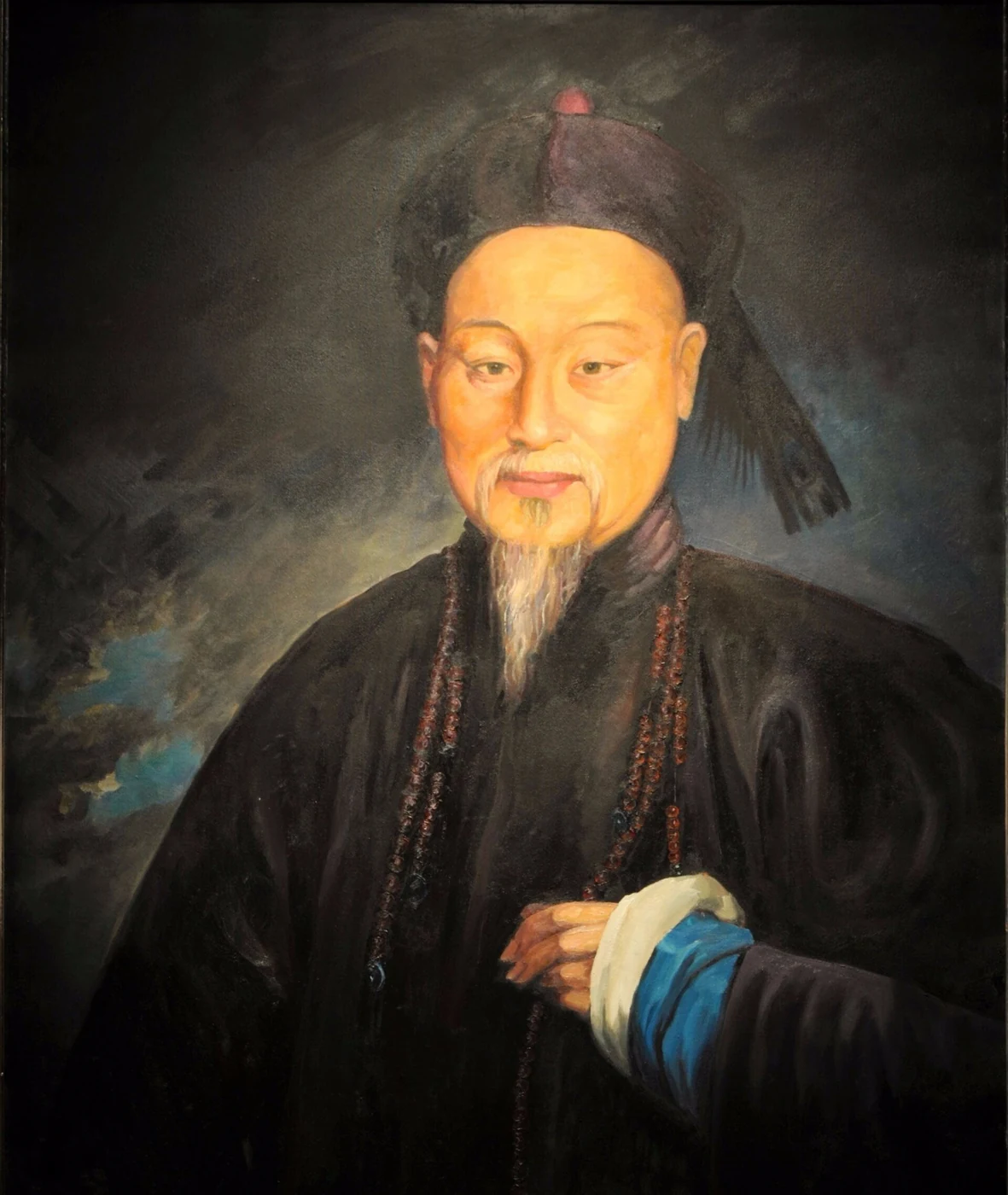
1785 CE–1850 CE
Official and politician
Lin Zexu
林则徐
Lin Zexu (26th day of the seventh lunar month in the 50th year of Qianlong–19th day of the tenth lunar month in the 30th year of Daoguang; August 30, 1785–November 22, 1850), courtesy name Yuanfu and also Shaomu and Shilin, and in later life known by such sobriquets as Sicun Laoren, Sicun Tuisou, Qishierfeng Tuisou, Pingquan Jushi, and Lishe Sanren, was from Houguan County in Fujian, now Gulou District of Fuzhou. He was a…
1785 CE–1850 CEQing Dynasty
PROFILE
Lin Zexu (26th day of the seventh lunar month in the 50th year of Qianlong–19th day of the tenth lunar month in the 30th year of Daoguang; August 30, 1785–November 22, 1850), courtesy name Yuanfu and also Shaomu and Shilin, and in later life known by such sobriquets as Sicun Laoren, Sicun Tuisou, Qishierfeng Tuisou, Pingquan Jushi, and Lishe Sanren, was from Houguan County in Fujian, now Gulou District of Fuzhou. He was a late Qing politician, thinker, and poet who served as Governor-General of Huguang, Governor-General of Shaan-Gan, and Governor-General of Yun-Gui and was twice appointed imperial commissioner. In 1839, the nineteenth year of Daoguang, he went to Guangdong as imperial commissioner to suppress the opium trade and directed the Destruction of opium at Humen, an event regarded in the source as a trigger of the First Opium War. Lin advocated learning advanced Western technology and organized the translation of Western newspapers and books. He has been praised in modern China as “the first person to open his eyes to see the world.”
- Other Names
- Lin Shaomu
- Courtesy Name
- Yuanfu
- Period
- Qing
- Date of Birth
- August 30, 1785 CE(50th year of the Qianlong era, 7th month, 26th day)
- Date of Death
- November 22, 1850 CE(30th year of the Daoguang era, 10th month, 19th day)
- Dynasty/Regime
- Qing
- Identity
- Official and politician
- Ethnicity
- Not recorded in historical sources
- Ancestral Home
- Houguan County, Fujian (present-day Gulou District, Fuzhou, Fujian)
- Place of Birth
- Not recorded in historical sources
- Major Achievements
- Governor-General of Huguang; advocated strict prohibition of opium and directed the Destruction of opium at Humen; a pioneer in modern China's efforts to understand the outside world
LIFE TIMELINE
Age four | His father Lin Binri brought him into the family school and taught him to read
Age twelve | Selected as a ceremonial dancer at the Confucian temple
Age thirteen | Placed first in the prefectural examination
Age fourteen | Passed as a xiucai and became engaged to Zheng Shuqing
Age nineteen | Placed twenty-ninth in the provincial examination; married Zheng Shuqing on the day the results were announced
Age twenty | Sat the metropolitan examination in Beijing for the first time and failed; returned home and opened the Bumei Study to teach students
Age twenty-one | Served as a secretary to the Xiamen subprefect for coastal defense and became aware of the harm caused by opium smuggling
Age twenty-two | Won the appreciation of Fujian governor Zhang Shicheng and entered his staff
Age twenty-six | Passed the metropolitan examination on his third attempt, ranking fourth in the second class in the palace examination; appointed a Hanlin bachelor awaiting assignment
Age twenty-eight | Entered the Hanlin Academy's training institute and studied Manchu and statecraft
Age thirty-one | Served as deputy examiner for the Jiangxi provincial examination; the selection was praised as a “clean list”
Age thirty-four | Served as chief examiner for the Yunnan provincial examination and wrote Record of the Journey to Yunnan
Age thirty-five | Appointed Censor of the Jiangnan Circuit and soon Circuit Intendant of Hangzhou-Jiaxing-Huzhou in Zhejiang, ending his central-government career
Age thirty-six | Resigned and returned home because of his father's illness
Age thirty-seven | Returned to office; appointed Huaihai Circuit Intendant in Jiangsu and acting Zhejiang Salt Controller
Age thirty-eight | Promoted to Jiangsu Provincial Judge, praised by the people as “Lin the Clear Sky”; ordered suppression of opium in Jiangsu
Age thirty-nine | His mother Lady Chen died; returned home for mourning
Age forty-two | Served as acting Provincial Administration Commissioner of Shaanxi and soon as Provincial Administration Commissioner of Jiangning; returned to mourning when his father died
Age forty-five | After completing mourning, appointed Provincial Administration Commissioner of Hubei and soon transferred to Henan
Age forty-six | Transferred to Jiangning as Provincial Administration Commissioner and promoted to Governor-General of the Eastern River Conservancy, responsible for Yellow River management
Age forty-seven | Transferred to Governor of Jiangsu; carried out hydraulic works and disaster relief
Age fifty-two | Promoted to Governor-General of Huguang and vigorously pursued opium suppression
Age fifty-three | Submitted a memorial to the Daoguang Emperor detailing the harm caused by opium and was summoned to Beijing
Age fifty-four | Went to Guangdong as imperial commissioner to suppress opium and directed the Destruction of opium at Humen
Age fifty-five | First Opium War broke out; directed defenses in Guangdong against British forces; soon removed from office
Age fifty-six | Ordered to assist the defense of Zhenhai, Zhejiang; then sentenced to exile in Ili; temporarily retained at Kaifeng to assist with a Yellow River breach
Age fifty-seven | Arrived at his place of exile in Ili
Age sixty | Recalled to service and served as acting Governor-General of Shaan-Gan
Age sixty-one | Appointed Governor of Shaanxi
Age sixty-two | Promoted to Governor-General of Yun-Gui and additionally granted the title Grand Tutor to the Heir Apparent
Age sixty-five | Appointed imperial commissioner again and ordered to Guangxi to suppress the God Worshipping Society; died of illness at Puning County, Chaozhou, Guangdong while en route
BIOGRAPHY
Biography
Family Background and Early Life
Lin Zexu's ancestral home was Cendou Village, Haikou, Fuqing County, Fujian. His family traced itself to the Jiumu Lin lineage that had moved south from the Central Plains into Fujian during the Jin period. His father Lin Binri, courtesy name Mengyang and art name Yanggu, was a sui gongsheng of Houguan during the Jiaqing reign and earned a living by running a school in the residence of a neighboring Luo family. His mother Chen Zhi was the fifth daughter of Chen Shi'an, a sui gongsheng of Min County. Lin Binri and Chen Zhi had eleven pregnancies. Their eldest son Lin Minghe died young; Lin Zexu was the second son. They also had another son, Lin Peilin, and eight daughters.
By the time Lin Zexu was born, the family had declined economically and carried substantial debt. Although Lin Binri taught for a living, most of his income went to repay debts, while the large household generated growing expenses and sometimes lacked enough food for regular meals. Chen Zhi therefore supported the household through needlework and paper-cutting and taught these skills to her daughters. Lin later recalled in Account of My Late Mother that his mother worked late into the night with his sisters, often sewing until cockcrow, and that she taught him that a man should strive for great and far-reaching things rather than regard small household tasks as the highest form of filial piety; only study and achievement, she said, would repay her efforts.
Poverty made Lin mature earlier than many children. Before attending school each day, he took his mother's and sisters' handicrafts to shops to be sold on consignment; after school he collected the proceeds and returned them to his mother. The source states that these experiences fostered his concern for ordinary people and helped shape his later reputation for clean government and attention to popular hardship.
Education and Civil-Service Examinations
Lin Binri placed great importance on his son's education. When Lin was four, his father brought him into the school and taught him characters. At six he learned prose composition; by seven he was familiar with literary forms. Because Lin Binri himself had entered school only at thirteen due to poverty and had been mocked by classmates, he wanted to spare his son the same experience and, while teaching, sometimes seated the child on his knee to listen. When Lin Zexu was eight or nine, the source says he wrote the lines, “Where the sea reaches its boundless edge, the sky forms the shore; when the mountain is climbed to its highest peak, I become the summit,” astonishing those present.
In 1796, the first year of Jiaqing, the twelve-year-old Lin was selected as a ceremonial dancer in the Confucian temple. In 1797 he placed first in the prefectural examination, and the following year passed as a xiucai. He then studied at Aofeng Academy, the leading academy in Fujian, under its head Zheng Guangce. Zheng was known as an upright educator who had dared to oppose the powerful Heshen and advocated practical statecraft. Under Zheng's guidance Lin studied intensively and produced the reading notes Miscellaneous Notes from the Yunzuo Mountain Studio. During this period he also met the Han Learning scholar Chen Shouqi through his father and was influenced by Chen's statecraft-oriented thought. He formed a close friendship with Liang Zhangju, Zheng Guangce's son-in-law, and the two pledged themselves to the ideal of “governing the country and saving the age.”
In the autumn of 1804, the ninth year of Jiaqing, Lin passed the provincial examination at age nineteen, placing twenty-ninth. On the day the results were announced, he formally married Zheng Shuqing, daughter of Zheng Damo, magistrate of Yongcheng in Henan. In the twelfth lunar month he traveled to Beijing for the metropolitan examination but failed the following spring. After returning home, he opened the Bumei Study in Beiku Lane, Fuzhou, and taught students.
Staff Service and Success in the Metropolitan Examination
In 1806, the eleventh year of Jiaqing, Lin accepted employment from Xiamen coastal-defense subprefect Fang Yongqing as a secretary in order to support his family. He handled documentary work concerning merchant and foreign shipping, grain, and military provisions. Opium smuggling in Xiamen was already severe, and the source states that successive subprefects had been corrupt and foreign merchants commonly offered bribes. During this service, Lin came to understand the seriousness of the opium problem and the methods used by smugglers, broadening his experience.
That same year Lin attracted the attention of Bailin, circuit intendant of Tingzhou-Zhangzhou-Longyan, who regarded him as a man of great future promise. In the autumn of the following year, Fujian governor Zhang Shicheng recruited Lin to his staff and placed him in charge of drafting official documents. According to a story preserved by Lin family descendants, on New Year's Eve Zhang asked Lin to draft a court memorial, had firecrackers set off repeatedly outside his residence throughout the night, and repeatedly ordered revisions in order to observe his temperament. Lin continued to copy the document carefully, and Zhang, impressed by his character and ability, retained him on his staff.
Lin served under Zhang Shicheng for four years and was highly valued. He gained extensive knowledge of historical precedent and military, judicial, ritual, musical, and other government affairs, while Zhang taught him practical experience and administrative techniques. From the seventh to the ninth lunar month of 1809, Zhang directed the suppression of the pirate Cai Qian, with Lin participating in the expedition. The source states that the maritime military dispatches were drafted by Lin. Zhang later praised the operation, saying that his subordinates had witnessed the labor of the campaign and agreed that without early information about the pirates' movements and urgent orders to attack, success could not have come so quickly.
In the second lunar month of 1811, the sixteenth year of Jiaqing, the twenty-six-year-old Lin passed the metropolitan examination on his third attempt. He ranked fourth in the second class of the palace examination and fifth in the court examination, received the jinshi degree, and was appointed a Hanlin bachelor awaiting assignment. In May 1813 he arrived in Beijing and entered the Hanlin training institute, where he studied Manchu, geography, astronomy, and practical statecraft. The following year, after completing training, he awaited appointment as an editor in the Hanlin Academy and served as an assistant compiler in the Historiography Office. In Beijing he used the rich holdings of the Hanlin Academy to examine changes in the practices of the Six Boards, the successes and failures of personnel and administration, and water-conservancy issues around the capital, and wrote the statecraft work Book on Water Conservancy in Northern Zhili.
Provincial Service and Administrative Experience
In 1820, the twenty-fifth year of Jiaqing, Lin was appointed Censor of the Jiangnan Circuit and soon afterward Circuit Intendant of Hangzhou-Jiaxing-Huzhou, ending his career as a central official. In Zhejiang he devoted attention to sea dikes and hydraulic works. Yet he found government difficult and was unable to accommodate entrenched bureaucratic habits. In the seventh lunar month of 1821, after learning that his father was ill, he resigned that same day and returned home.
In 1822, Lin returned to office to meet family financial needs. The Daoguang Emperor, aware of his good record, exceptionally ordered that he continue to be employed in his original province at circuit-intendant rank. In the twelfth lunar month he became Huaihai Circuit Intendant in Jiangsu and, while there, acted as Zhejiang Salt Controller and helped reform the salt administration. In the first lunar month of 1823 he was promoted to Jiangsu Provincial Judge. In that office he sought to clarify official administration, reformed judicial procedures, personally decided cases, and even made covert nighttime inspections. Within four months, the source states, he disposed of eight or nine tenths of Jiangsu's accumulated cases and was praised by the people as “Lin the Clear Sky.” He concluded that opium lay at the root of Jiangsu's deteriorating social customs and therefore ordered an opium crackdown. That summer, severe rains caused disaster in Jiangsu. Governor Han Wenqi favored military suppression of starving people, but Lin strongly opposed the idea, personally went to Songjiang, encouraged the sale of grain at fair prices, prohibited hoarding, reduced or delayed taxation, and provided relief to the hungry, restoring social order.
In the seventh lunar month of 1824, Lin proposed to provincial governors and governors-general that the waterways of the three rivers be dredged. He was authorized to coordinate hydraulic work in Jiangsu and Zhejiang. On the seventeenth day of the intercalary seventh lunar month, his mother Lady Chen died, and Lin returned home to observe mourning. Even while in mourning, in 1825 he was ordered to the Gaojiayan breach works to supervise repairs and recommended trial use of maritime grain transport.
In 1827, Lin served as acting Provincial Administration Commissioner of Shaanxi and soon was promoted to Provincial Administration Commissioner of Jiangning. While in Shaanxi, flooding struck Lueyang and he personally inspected the disaster area and arranged relief for residents. In the tenth lunar month his father Lin Binri died and Lin returned south for mourning. During this period he worked with local officials and gentry to redredge Fuzhou's Xiaoxihu.
After completing mourning in 1830, Lin was appointed Provincial Administration Commissioner of Hubei and soon transferred to Henan. The following year he was transferred to Jiangning. From the tenth year of Daoguang onward he served in Hubei, Henan, and Jiangsu and carried out extensive work in water conservancy, disaster relief, and official reform. The source says his reputation for ability spread throughout the empire, while popular praise included the saying, “When Lord Lin comes, I live.”
Governor-General and the Opium Suppression Campaign
In the tenth lunar month of 1831, the eleventh year of Daoguang, Lin was promoted to Governor-General of the Eastern River Conservancy. Faced with major issues affecting both river management and popular livelihood, he resolved to disregard personal considerations and break entrenched habits. In managing the Yellow River, he personally walked hundreds of li in cold winds, inspected stored sorghum stalk bundles and other materials for flood-control works, and examined terrain and water flow along the river.
In 1832, the twelfth year of Daoguang, Lin was transferred to Governor of Jiangsu. He continued hydraulic construction, official reform, and relief work and acquired a strong reputation. In 1837 he was promoted to Governor-General of Huguang and carried out an extensive anti-opium campaign in Hubei and Hunan.
In 1838, the eighteenth year of Daoguang, Lin submitted a memorial to the Daoguang Emperor detailing the harm caused by opium. He warned that if the problem continued to be treated with indifference, within several decades the Central Plain would have virtually no soldiers capable of resisting an enemy and no silver with which to pay them. The Daoguang Emperor was deeply affected and summoned Lin to Beijing. In 1839, Lin went to Guangdong as imperial commissioner to suppress the opium trade. He dispatched agents to investigate, compelled foreign opium merchants to surrender their stocks, and seized approximately 2.37 million jin of opium, which was publicly destroyed at Humen. The Destruction of opium at Humen became, in the source's wording, a trigger of the First Opium War.
Dismissal and Exile
After the First Opium War began in 1840, Lin ordered the military and civilian population of Guangdong to prepare defenses, preventing British forces from achieving their objectives there. He was nevertheless soon framed and removed from office. In 1841 he was ordered to Zhenhai in Zhejiang to assist coastal defense but was then sentenced to exile in Ili. While traveling west he was ordered to remain temporarily in Kaifeng to assist with repairs after a Yellow River breach. In 1842 he reached Ili. During exile he continued to concern himself with frontier administration, developed water conservancy, and promoted karez irrigation, benefiting local residents.
Return to Office and Death
In 1845, the twenty-fifth year of Daoguang, Lin was recalled to service and successively held office as Governor-General of Shaan-Gan, Governor of Shaanxi, and Governor-General of Yun-Gui, receiving the additional title Grand Tutor to the Heir Apparent. As Governor-General of Yun-Gui he handled ethnic affairs, sought to improve official administration, and worked to stabilize the frontier.
In 1850, the thirtieth year of Daoguang, Hong Xiuquan launched the God Worshipping Society uprising in Guangxi. The Qing court again appointed Lin imperial commissioner and ordered him to Guangxi to suppress it. Although ill, he set out, but his condition worsened at Puning County, Chaozhou, Guangdong. He died on the nineteenth day of the tenth lunar month, November 22, 1850, at the age of sixty-five.
Teachers, Secretarial Service and the Examinations
Lin Zexu's ancestors came from Cendou village at Haikou in Fuqing county, Fujian, of the Lin clan of the Nine Pastures that had moved south from the Central Plains in the Jin. His father Lin Binri, a senior licentiate of Houguan, kept a school in a neighbour's house; his mother Chen Zhi was the fifth daughter of a senior licentiate of Min county, and of eleven children the eldest died young and Lin Zexu was the second. At the Aofeng Academy he studied under its head Zheng Guangce, a stern educator who had dared to defy the minister Heshen and who taught practical statecraft; there he wrote the reading notes of the Yunzuo Mountain House, came to know the scholar Chen Shouqi through his father, and formed a close friendship with Zheng Guangce's son-in-law Liang Zhangju, the two vowing together to "order the state and save the world". In the autumn of 1804 he passed the provincial examination twenty-ninth and married on the day the results were posted Zheng Shuqing, daughter of the magistrate of Yongcheng in Henan. In 1806, to support the family, he became secretary to the assistant prefect of Amoy in charge of coastal defence, keeping the records of merchant shipping, grain and pay, where grave smuggling of opium, corrupt assistant prefects and bribery by foreigners opened his eyes. That year the circuit intendant Bailing thought him "a great vessel"; the next autumn the Fujian governor Zhang Shicheng took him as his secretary. Family tradition relates that on New Year's Eve Zhang Shicheng had him draft a memorial, setting off firecrackers all night outside his rooms and repeatedly altering the text to test his temper, and that Lin, copying it out patiently each time, so won his master's esteem. In four years he learned much history and knowledge of war, law, ritual and music, his master passing on his own experience and arts; in 1809 he took part in Zhang's suppression of the pirate Cai Qian, drafting all the naval papers, and Zhang afterwards praised the speed of the campaign. In 1811 he passed third class fourth in the palace examination, was made a Hanlin bachelor; in 1816 he served as assistant examiner for Jiangxi, commenting on every paper presented and every paper withheld, so that the list was called "the clean list" for the poor scholars it admitted; in 1817 he was chief examiner for Yunnan, recording his journey in the Record of the Yunnan Carriage; and about 1819 he briefly joined the Xuannan poetry society.
Hanlin, the Hangjiahu Circuit and His First Jiangsu Posts
In the Hanlin academy he studied Manchu, geography, astronomy and practical statecraft, working through the archives to weigh the changes in the six boards' precedents and the gains and losses of appointments, studied water conservancy in the metropolitan region and wrote the economic treatise On the Waterways of the Northern Metropolitan Region. In 1820 he was made censor of the Jiangnan circuit and then intendant of the Hangjiahu circuit, ending his years as a capital official; in Zhejiang he studied the sea walls and waterworks with care but found government hard, lamenting that "my talents are poor and my tasks thick; propping up the left I lack the right". In the seventh month of 1821, hearing his father was ill, he resigned that day and went home. In 1822, to support his family, he returned to office, and his examiner, knowing his record, had him "posted to his old province as an intendant"; in the twelfth month he took up the Huaihai circuit in Jiangsu and acting salt commissioner of Zhejiang, helping reform its salt administration. In the first month of 1823 he was promoted assistant judge of Jiangsu, where he cleared the administration, reformed judicial procedure, decided cases himself and went about by night in disguise, clearing nearly all the accumulated cases of the province in four months, so that the people called him "Lin of the Clear Sky"; holding that the province's corruption came from opium, he ordered its suppression. That summer, when floods brought disorder and the governor Han Wenqi wished to use troops against the starving, Lin opposed it and went by boat to Songjiang, pacifying prices, banning hoarding, lightening taxes and relieving the hungry. He also had the old channel of the Liu river reopened, and was twice received by the Daoguang emperor in the eleventh month, who praised his work and urged him to be "a good minister". In the seventh month of 1824 he proposed dredging the three rivers with an official advance, and the Zhejiang and Jiangsu authorities asked that he take charge of the waterworks of both provinces, which the emperor allowed; on the seventeenth of the intercalary seventh month his mother died and he went into mourning, yet in 1825 was ordered to hasten the closing of the breach at Gaojiayan, where he worked with care, proposed sea transport on trial and then, pleading illness from the work, asked to retire.
Relief and Administration in Hubei, Henan and Jiangsu
In 1827 he was acting treasurer of Shaanxi and then treasurer of Jiangning; in Shaanxi, when Lueyang flooded, he went to inspect the disaster, settle the people and take part in moving the county town. During his mourning leave in 1828 he and the local gentry reopened the West Lake at Fuzhou. In 1830 he became treasurer of Hubei, in the eleventh month treasurer of Henan, taking office the next February, where he was ordered to collect the arrears of all the counties, settling a fiscal question unresolved for years; when the Yangtze region suffered severe floods he bought grain for Jiangsu at the request of its authorities and advised that merchants be encouraged to buy grain themselves. In the seventh month he was transferred to Jiangning, and for the relief of famine proposed twelve measures — subscriptions, gruel kitchens, transport, shelter, care of children, burial of the dead, clothing, persuading holders to sell, care of tenants, pawning of oxen, seed grain and a ban on distilling — which the grand coordinator Tao Shu adopted and memorialised. From 1830 he served in Hubei, Henan and Jiangsu, working at waterworks, relief and the purification of the administration with such effect that "for a time his good name filled the realm", children and footmen, women and girls taking pride in his presence, and the people saying that "when Lord Lin comes, we live".
River Commissioner, Governor of Jiangsu and of Huguang
In the tenth month of 1831 he was made director-general of the Eastern River. He at once renewed his knowledge of waterworks, hastened the works, punished the slack and ordered the inspection of the fascines, memorialising that he had "gone through every one, measuring height and breadth, testing new and old, solid and hollow, drawing out the loose and pulling down the doubtful, counting bundles to the stack and weighing catties to the bundle, not a stack unmeasured nor a hall undismantled". The emperor exclaimed that never had fascines been so carefully inspected, and that if all officials were so diligent abuses would cease of themselves. He exposed many abuses and sketched a plan to turn the Yellow River to enter the sea through Shandong. As governor of Jiangsu he and Tao Shu, "of one mind and in perfect accord", carried out reforms in the grain transport, relief, waterworks, salt and currency; incorruptible and just, he was called a good official and a clear sky. He promoted agriculture and new implements, saying that "the strength of the land must draw on human strength, and waterworks are all farm work; one part more of water cleared is one part more of profit in the fields", and he indirectly proposed minting silver coin, a forerunner of modern currency reform. In 1837 he became governor of Huguang; against the yearly floods of Hubei he insisted on repair and defence together, so that "for a thousand li along the Han the great dikes were peaceful, and not one gap opened in the branch dikes"; he reformed the salt tax and tightened the pursuit of smugglers; and when the troops at Zhen'gan in Hunan grew unruly he inspected and soothed them and secretly recommended the general Yang Fang.
Prelude to the Suppression of Opium
Through the Daoguang years opium imports grew sharply, silver flowed abroad and the people's health and the dynasty's rule were threatened, so that the emperor resolved on prohibition. In 1836 Xu Nai ji, an assistant minister, proposed legalising sale and use so that home-grown opium might compete with the foreign and stem the outflow, which raised a storm of opposition and strengthened the demand for prohibition. In the intercalary fourth month of 1838 Huang Juezi memorialised for strict prohibition beginning with the punishment of smokers, and the generals and governors were asked to give their views: of twenty-nine replies only eight favoured prohibition and twenty-one opposed it, Lin Zexu leading the prohibitionists. He drafted six measures supplementing Huang's, and began prohibition in Huguang: opium and paste were seized, opium houses closed and pills for breaking the habit made up, so that men who had smoked an ounce a day for thirty years gave it up and grew fat and strong, their families thanking him, "some women kneeling by the roadside to give thanks" that their husbands and sons, long addicted, had broken the habit and grown stronger. On the second day of the eighth month he memorialised that the yamen held most of the smokers and that they were the very men able to shelter the traffickers, warning that "if this is treated with slackness, in a few decades the Central Plains will have hardly a soldier to resist the enemy nor silver to pay them", a memorial that moved the emperor to decide. In the ninth month orders were sent for strict suppression everywhere; on the twenty-third day of the eleventh month Lin Zexu was received, the emperor summoning him eight times in eight days and giving him the seal of imperial commissioner to go to Guangdong to suppress opium and deal with the port, with command of the province's fleet. On leaving he said that "life and death are fate, success and failure Heaven; if it profits the altars of state, dare I not exhaust my strength", and later recalled that he had known the task to be one of boiling water and fire but could not refuse it, having long since put fortune, disgrace, honour and shame out of mind.
Canton and the Burning at Humen
On the twenty-third day of the eleventh month of 1838 he left Beijing, receiving on the way those who knew Guangdong, sending men ahead to investigate in secret, listing the names and addresses of the chief opium offenders in Canton and writing to the provincial treasurer and judge to arrest them; at Anhui he talked with Tian Xiaoquan, formerly magistrate of Xiangshan, about the seizure of opium, at Ganzhou he questioned Guo Guichuan, once secretary to the Canton customs superintendent, and through him obtained documents and maps of the foreign settlements, the passes, the roads and the forts. After more than two months' journey he reached Canton on the twenty-fifth day of the first month of 1839. He established the extent of the opium damage, visited the opium houses and gathered first-hand information; on the fourth day of the second month, with Deng Tingzhen and Yiliang, he summoned the hong merchants, issued two proclamations denouncing their long collusion with the foreign traffickers, and required them to tell the foreigners to surrender the opium and sign a bond that "ships coming hereafter shall never dare to carry opium; if any is found, the goods shall be confiscated and the men executed, and I shall submit willingly". On the tenth day he had the foreign ships at Whampoa closed to cargo, withdrew all Chinese employees and workers from the factories, surrounded them with troops so that no trafficker could escape, and cut off communication, food and water, demanding the surrender of all the opium. On the thirteenth day Elliot agreed, and next day reported that he would deliver twenty thousand two hundred and eighty-three chests; in the end the foreign traffickers, chiefly British, surrendered nineteen thousand one hundred and eighty-seven chests and two thousand one hundred and nineteen bags, more than two million three hundred and seventy-six thousand catties, exceeding what Elliot had promised. From the twenty-second day of the fourth month to the fifteenth of the fifth he and Deng Tingzhen, Yiliang and Guan Tianpei supervised the destruction of the whole consignment on the beach. "The coastal people thronged to see", foreign merchants and missionaries being allowed to watch; the American missionary Bridgman wrote that "we examined every process of the burning again and again, and their care and fidelity throughout far exceeded our expectation". The burning made Lin Zexu famous at home and abroad; the emperor called his report "greatly satisfying to the hearts of men" and sent him, on his fifty-fifth birthday, a tablet with the characters for blessing and long life in his own hand.
The Canton Defence, Dismissal and Exile
While enforcing prohibition Lin Zexu encouraged lawful traders who would sign the bond, insisting that "those who obey the law may come, those who resist it must go", but the emperor rejected the policy and he had to carry out the total severance of trade he disapproved. On the twenty-seventh day of the fifth month of 1839 the villager Lin Weixi of Chinsha Point was beaten to death by British sailors; Lin Zexu sent officers, demanded that Elliot surrender the culprit, and when Elliot refused and held his own "trial", Lin and Deng Tingzhen, using the Western international law they had newly learned, cut off the supply of food and water to the British, withdrew the compradors and servants and expelled Elliot from Macao, and inspected Macao to keep the Portuguese neutral. On the twenty-seventh day of the seventh month Elliot provoked the Kowloon fight, and on the twenty-eighth of the ninth month the Chuanbi sea battle, then attacked Guanchong Hill six times, each time beaten off. For defence Lin adopted the strategy of resting to meet the exhausted, defending to make war, strengthening the forts and waiting quietly, adding coastal works, buying Western guns for the batteries, buying foreign merchantmen to convert into warships, and gathering plans of foreign ships and guns to copy; holding that the people's hearts could be trusted and their strength used, he recruited water braves from fishermen, boat people and salt sellers, gave them great boats and taught them night attacks and fire, and allowed the coastal villages to organise militia, so that Guangdong presented a united front against the British. After the Kowloon fight the emperor, falsely elated by small successes, ordered the British trade stopped; on the twenty-first day of the tenth month Lin announced its cessation from the first of the eleventh, and on the first of the twelfth the court confirmed him governor-general of the Two Guangs, Deng Tingzhen being moved to Liangjiang. In the fifth month of 1840 the British arrived and the first Opium War began; their fleet blockaded the Pearl River and attacked Canton, but Lin's defences held, so they went north, struck Zhejiang in the sixth month and took Dinghai. In the seventh month the emperor changed his policy, ordering the governor-general of Zhili, Qishan, to receive the British papers and negotiate, sacrificing Lin and Deng and the price of the opium for a British withdrawal, and reproving Lin in successive decrees. Lin, though placed at a disadvantage, still resisted, beating British ships at Fanshiyang with the fleet; in the eighth month he asked to be punished and, refuting the charge that the war began with the suppression of opium, secretly memorialised that the foreigners' greed was insatiable and that if force could not check them the trouble would never end; the emperor called this "unreasonable and hateful" and "a pack of nonsense". On the third day of the ninth month the emperor ordered the two men handed to the board for severe punishment, and on the eighth they were both dismissed, remaining in Guangdong for questioning. In the first month of 1841, as "co-adjutant in foreign affairs", Lin opposed Qishan's appeasement, went with Deng Tingzhen through the river passes to study the ground and plan defence, and persuaded Yiliang to memorialise the truth about Qishan's private agreement, so that Qishan was dismissed and sent to Beijing in chains; with the British breaking through Humen and threatening the provincial river, Lin raised funds himself and recruited Fujian braves. In the third month Yishan came to direct operations and ignored Lin's six articles of defence; in the fourth month Lin went to the Zhenhai camp in Zhejiang, supplying gun manuals, helping the foundry cast cannon and having Western-style gun carriages and paddle-wheel warships built, and inspecting the batteries and works. On the tenth day of the fifth month the emperor again blamed him for the defeat at Canton, stripped him of his rank and sent him into exile at Ili; at Jingkou he met his old friend Wei Yuan, gave him the Record of the Four Continents and other translations and urged him to write the Illustrated Gazetteer of the Maritime Countries; at Kaifeng he was ordered to "redeem himself by labour" at the breach at Xiangfu, and when the work was done was still exiled. On the way, parting from his wife at Xi'an, he wrote the lines that "if it profits the state, I will meet life and death; how should I shun it for fortune or disaster?" On the ninth day of the eleventh month he reached Ili.
Exile in Xinjiang and His Last Years
In Xinjiang he followed the fighting in the southeast, writing many patriotic poems, studying the history and geography of the region and its frontier policy. In the autumn of 1843 he helped the Ili general with the reclamation of waste land at Aqiusu; in the fifth month of 1844 he asked leave to contribute funds for the Longkou canal there, finished in the ninth month, and was then ordered to survey reclamation elsewhere; from the second month of 1845 he travelled thirty thousand li, inspecting Kucha, Aksu, Kashgar, Yarkand, Ilar and Tarnachin, promoting waterworks and reclaiming more than five hundred and seventy-eight thousand mu at Ili and introducing the karez. Sensible of the Russian threat, he urged the frontier ministers to mend the fold, had frontier maps drawn, and proposed turning garrison troops into trained farmers and combining arms with agriculture; when asked in retirement about the West he said that "the one who will finally trouble China is Russia, I fear; I am old, but you will see it". Released in the ninth month of 1845, he was in 1846 made governor of Shaanxi. There the contradictions were sharp: besides diverting the salt tax the court had forced Shaanxi to contribute more than a million taels for the war, and the indemnity was apportioned there too, Xianning and Chang'an alone paying over twenty thousand taels a year, a third of their regular levy, while successive famines left the poor destitute and the "sword men" of Weinan, Fuping, Sanyuan, Dali and Pucheng grew bold. He made "removing the violent and easing the good" his first task, beginning with the case of Ma Defeng, executed at once, the accomplices sent to the fever-ridden frontiers of Yunnan, Guizhou, Guangdong and Guangxi; by the year's end a hundred and forty-six had been seized, forty-six of them as "sword bandits", and the emperor praised him for handling it well. He also relieved the famine: more than a million piculs of grain were sold cheap at Xi'an to the poor, the destitute and infirm were sheltered, three or four thousand in the city alone, the gentry were urged to feed their own villages, oxen were bought or pawned to keep the fields in work, and he memorialised for the postponement of taxes. In 1847 he became governor of Yunnan and Guizhou, where Han and Hui had burned and killed one another for more than ten years; he held that "only the good and the bad should be separated, not Han and Hui", and in 1848 led the troops himself, destroyed the nest of the rioters at Midu and, at Baoshan, where the people bound the offenders and came out to meet him, executed the leaders, dispersed the followers and called the Han and Hui elders to hear his kindness and good faith, then arrested the great offenders of Yongchang, Shunning, Yunzhou and Yaozhou, so that the frontier was at peace; he was made grand guardian of the heir apparent and given the peacock feather. He also proposed reform of the Yunnan mines, encouraging private working and merchant management. In the second month of 1849 he was ordered to report on the mines, and in the fifth month, ill again, asked leave to rest. That year, coming by the Xiang river to Changsha, he met Zuo Zongtang, whom he had long wished to know, on a boat at the foot of Mount Yuelu: he talked over old and new times and gave Zuo all the materials and maps he had prepared in Xinjiang, regretting that the reclamation and waterworks there were unfinished. In the third month of 1850 he returned to Houguan; in the fifth month, when the British forced their way into Wushi hill in the city, he declined to act for reasons of health; and in the ninth month the court made him imperial commissioner again, to go with all speed to Guangxi against the God-Worshipping Society. On the second day of the tenth month he set out from Houguan in illness, and at Puning in Chaozhou, Guangdong, his condition became so grave that he had to stop at the post house; at the chen hour on the nineteenth day of the tenth month, with his son beside him, he raised his face to heaven and called three times on the "Southern Dipper", and died at sixty-six. The court granted him the rank of grand tutor to the heir apparent and the posthumous name Wenzhong; Yunnan and Jiangsu enrolled him among the notable officials, and Shaanxi asked leave to build a shrine.
Major Activities
Opium Suppression
Lin Zexu was a central figure in modern China's anti-opium campaign. As Jiangsu Provincial Judge he had already concluded that opium was a root cause of social decline in Jiangsu and ordered its suppression. As Governor-General of Huguang he intensified the campaign, seized raw and prepared opium, closed opium dens, and had medicines prepared to help smokers stop using the drug. In 1838, he submitted a memorial to the Daoguang Emperor warning that within several decades China would have neither soldiers capable of defending the country nor silver to pay military expenses if the opium problem continued. The memorial helped persuade the emperor to adopt a firm prohibition policy.
In 1839, Lin went to Guangdong as imperial commissioner. After arriving in Guangzhou, he resisted British pressure, summoned the Cohong merchants, and ordered foreign opium dealers to surrender their stocks within a set period. After a determined confrontation, approximately 2.37 million jin of opium was handed over. From June 3 to June 25 it was publicly destroyed on the beach at Humen, an event known as the Destruction of opium at Humen. The source describes it as a trigger of the First Opium War and as a public demonstration of the determination of the Chinese people to resist narcotics.
Learning about the Wider World
Lin is presented as a pioneer in modern China's effort to understand the outside world. During the Guangdong opium campaign, he actively gathered information on foreign countries, established a translation office, and organized the translation of English books and newspapers. The resulting materials included Gazetteer of the Four Continents, Foreigners about China, Laws and Regulations of Various Countries, and translations from Macao news sheets. The source states that he had at least some knowledge of English and Portuguese. The late Qing thinker Wei Yuan compiled documents translated by Lin and his staff into Illustrated Treatise on the Maritime Kingdoms, which the source says influenced the late Qing Self-Strengthening Movement and even the Meiji Restoration in Japan. Although Lin was officially engaged in resisting and negotiating with Western powers, he maintained an open attitude toward Western culture, technology, and trade and advocated learning useful Western techniques. The source connects this line of thought to the later phrase “learn the superior techniques of the barbarians in order to control the barbarians,” which Wei Yuan subsequently developed.
Water Conservancy and Popular Livelihood
Lin placed great importance on water conservancy throughout his career. As Hangzhou-Jiaxing-Huzhou Circuit Intendant, he worked on coastal dikes. As Jiangsu Provincial Judge, he advocated dredging the old Liuhe channel for drainage. In 1824 he proposed dredging the waterways of the three rivers. As Governor-General of the Eastern River Conservancy, he personally inspected Yellow River works and materials and sought to eliminate abuses in river administration. During his exile in Xinjiang, he promoted karez irrigation to improve agricultural water supplies. The source notes that local people called these works “Lin Gong Wells.”
Lin also repeatedly directed disaster relief in Jiangsu, Henan, Hubei, and other regions. During the Jiangsu floods of 1823, he opposed proposals to suppress starving people by force and instead encouraged grain sales at fair prices, prohibited hoarding, reduced or delayed taxation, and provided relief. After becoming Provincial Administration Commissioner of Jiangning in 1831, he proposed twelve measures for relief, including soliciting donations, operating soup kitchens, providing travel assistance, maintaining relief shelters, receiving abandoned children, burying exposed coffins, donating clothing, encouraging grain sales, supporting tenant farmers, redeeming cattle, lending seed, and restricting the distillation of grain. Governor-General Tao Shu adopted and implemented the proposals.
Reform of Official Administration
Lin was known for efforts to improve official administration. As Jiangsu Provincial Judge, he reformed judicial procedures, personally decided cases, conducted covert nighttime investigations, and processed most of the province's accumulated cases within four months. As Governor-General of Huguang and Governor-General of Yun-Gui, he again made official discipline a priority. The source emphasizes that he lived frugally throughout his life despite eventually holding first-rank office.
Literary Achievements
Lin was accomplished in poetry, prose, and calligraphy. More than two hundred of his poems survive. Many express patriotic concern for the country and people and are described as grave and forceful in tone. The famous lines, “If it benefits the country, I will face life or death; why should I avoid it because of fortune or misfortune?” come from his poem Lines Composed on Setting Out for My Garrison Post, Addressed to My Family and became a widely quoted expression of patriotism. His prose is described as plain and sincere, his memorials as closely reasoned, and his diaries and letters as historically valuable. His regular-script calligraphy was upright and disciplined, while his running script was fluent and natural and received considerable appreciation.
Translation and "Opening the Eyes to See the World"
While suppressing opium in Canton Lin Zexu set himself to know and study the foreign world. Soon after arriving he gathered the few men then to be found who knew foreign languages and had the newspapers of Macao and the papers of Singapore, India, Australia and Britain searched and translated into the Canton News Sheet, in five parts — on China, on tea, on opium, on the use of troops and on the circumstances of the various foreign countries — which were sent to the emperor and the ministers to read; when Wei Yuan compiled the Illustrated Gazetteer of the Maritime Countries, its section on foreign intelligence likewise used the Macao translations. For the two years from his arrival until his dismissal the translating work he had organised continued without a break. Besides the News Sheet he had Mencius's Geography, abridged from Murray's Encyclopaedia of Geography, compiled as the Record of the Four Continents — the first fairly systematic survey of world geography in China, describing more than thirty countries in five continents and becoming the basis of Wei Yuan's Gazetteer; he had Chinese matters as discussed in the foreign press compiled as Chinese Affairs in Foreign Words; and he had books on gunnery and the manufacture of weapons translated "that the army's weapons and capacity might be improved", the sighting methods being applied in the Canton defences. He also had parts of the Swiss Vattel on international law translated, which some scholars regard as marking the formal introduction of Western international law into China and the beginning of its application in diplomatic dealings, calling Lin "the first man to introduce international law to China, a pioneer of modern Chinese diplomacy and the founder of Chinese international law". In his advice to Yishan after his dismissal he stressed that the materials translated from foreign papers "contain much knowledge of the foreigners, and the means of control and preparation come largely from them". A foreign observer noted that the Chinese authorities knew nothing of foreign affairs, but that "only Governor Lin acts quite otherwise, keeping in his office men skilled in translation and directing twenty or thirty merchants, interpreters and pilots to gather information in all quarters and report daily". Wei Yuan's preface says the Gazetteer rested first on the Record of the Four Continents translated under Lin, and that it added eight tenths in the southeast and southwest seas and six tenths in the Atlantic, northern and far western oceans. These compilations began the study of foreign conditions and awakened modern Chinese thought, influencing also the later development of Japan.
Books, Calligraphy and Buddhism
In his leisure Lin Zexu loved to collect books. After passing the examination he lived at Wenzao hill, taking as his early motto the lines about the library of the eastern wall and the garden of the western grove, and searching for old and modern works; his libraries, the Tower of the Seventy-two Peaks and the Yunzuo Mountain House, held some thirty bays of books, and going into exile at Ili he carried twenty cases in seven carts, writing on the eve of departure that though he might grow horns for three years, a thousand volumes must still be bound at his waist. A manuscript catalogue survives, and more than a dozen of his seals. On calligraphy he held that beginners should start from the Tang models, writing that to pass at once to Zhong You and the two Wangs would be like making a man run before he could stand; his regular script was upright and strict, not confined to one school and in its later years touched with the manner of the Jin, and his running script fluent. From youth he was influenced by Buddhism, his devout wife's fasting and chanting affecting him greatly; as an official he associated with monks, certainly with Juchao of the Dinghui Temple on Jiaoshan at Zhenjiang and Yanqi of the Huating Temple at Kunming, and as governor of Huguang he built a Guanyin shrine in his office and made offerings daily.
Waterworks and Relief
Lin Zexu was an outstanding expert on water. Throughout his career he attended to waterworks, building sea walls in Zhejiang and Shanghai and works on the chief rivers of the Lake Tai basin and on the Grand Canal, the Yellow River and the Yangtze, always on the ground and in person, his steps reaching the Yellow, Yangtze and Huai rivers and the Lake Tai system, and always combining this with relief. He wrote a treatise on the waterways of the northern metropolitan region, and as director of the Eastern River boasted that "not a stack was unmeasured nor a hall undismantled". For Jiangsu's disasters he proposed the twelve measures of subscription, gruel kitchens, transport, shelter, care of children, burial, clothing, persuading holders to sell, care of tenants, pawning of oxen, seed grain and a ban on distilling, adopted by Tao Shu. With the poet Zhang Jiliang he discussed turning the Yellow River north to enter the sea at Lijin in Shandong; the plan failed for want of support, but shortly before his death he still held it right. In Xinjiang he spread the karez, which the people called "Lord Lin's wells".
Commemoration and Legacy
Lin Zexu has been long remembered. Fuzhou has his memorial hall, in the former shrine of 1905, restored in 1982; his birthplace, boyhood school and home, the Yunzuo Mountain House, with three courtyards and the Tower of the Seventy-two Peaks, reopened on 24 August 2025; a park, a reading place and cliff inscriptions. His tomb at Jinshi hill, Mazan village, Gulou district, where he lies with his wife, parents, brother and sister-in-law, with the court's sacrificial and monumental inscriptions of 1851, was made a national protected site in 1988, and his house and shrine joined the seventh national list in 2013. The Humen memorial hall, formerly the Lin Zexu museum, founded in 1957, houses exhibitions on the suppression of opium and the Opium War. A statue stands before the Lin Fung Temple in Macao, where he announced the ban on foreign opium selling, and another at Ili. Internationally, 3 June, the day the burning began, was made an international anti-drug day by the United Nations in December 1987; an asteroid discovered by Chinese astronomers was named after him (permanent number 7145), its monument unveiled at Fuzhou on 20 September 2000; and in New York a bronze statue stands in East Broadway, its base inscribed "Pioneer in the War Against Drugs", the street having been named for him. Stamps were issued for his bicentenary in 1985, and commemorative meetings and conferences were held in 1995, 2005, 2015 and 2025; in 2019 he was listed by the ministry of water resources among the historic masters of water control.
Personal Relations
- Father: Lin Binri, courtesy name Mengyang, art name Yanggu; sui gongsheng of Houguan and schoolteacher
- Mother: Chen Zhi, daughter of Chen Shi'an, a sui gongsheng of Min County
- Wife: Zheng Shuqing, daughter of Zheng Damo, magistrate of Yongcheng, Henan
- Eldest son: Lin Ruzhou
- Second son: Lin Qiubai, died three days after birth
- Third son: Lin Peilin
- Eldest daughter: Lin Chentan
- Second daughter: Lin Jinluan, died young
- Zheng Guangce: head of Aofeng Academy and Lin's teacher
- Chen Shouqi: Han Learning scholar whose statecraft thought influenced Lin
- Liang Zhangju: Zheng Guangce's son-in-law and Lin's close friend in youth; the two pledged themselves to “govern the country and save the age”
- Zhang Shicheng: Governor of Fujian and Lin's patron while he served on staff; helped advance his official career
- Zhang Bailin: circuit intendant of Tingzhou-Zhangzhou-Longyan who recognized Lin's potential
- Tao Shu: Governor-General of Liangjiang and political ally with whom Lin pursued reforms
- Wei Yuan: thinker who organized and developed material from Lin's translations
- Gong Zizhen: poet and thinker, fellow member of a Beijing poetry circle
- Huang Juezi: official and ally in the anti-opium campaign
- Jiaqing Emperor: Lin passed the jinshi examination and entered the Hanlin Academy during his reign
- Daoguang Emperor: repeatedly promoted and entrusted Lin with major offices, including Governor of Jiangsu, Governor-General of Huguang, and imperial commissioner; later dismissed him and sentenced him to exile after the war went badly
- Qishan: Governor of Henan; Lin, while serving as censor, once impeached him for poor river management; later, in Guangdong, Qishan pursued compromise with the British and stood in opposition to Lin's policy
- William Jardine William Jardine: British opium merchant whom Lin ordered to surrender opium in Guangdong
- Lancelot Dent Lancelot Dent: British opium merchant whom Lin ordered to surrender opium in Guangdong
Historical Assessment
Qing and Contemporary Assessments
- After Lin served as Jiangsu Provincial Judge, the Daoguang Emperor praised his record when receiving him and urged him to “strive to be a good minister.”
- The people of Jiangsu praised Lin as “Lin the Clear Sky.”
- Popular praise included the saying “When Lord Lin comes, I live.” Contemporary accounts stated that children, common laborers, and women all regarded service under Lin's administration as an honor.
- Zhang Shicheng praised Lin's role during the campaign against Cai Qian, stating that his staff had witnessed the exertions of the suppression campaign and agreed that without early intelligence on the pirate force and urgent orders to attack, the success could not have come so quickly.
Late Qing and Republican Period
- Wei Yuan incorporated Western materials translated by Lin into Illustrated Treatise on the Maritime Kingdoms and presented Lin as an early exponent of learning useful foreign techniques in order to respond to foreign powers.
- Self-Strengthening figures such as Zeng Guofan, Zuo Zongtang, and Li Hongzhang praised Lin's foresight in seeking to understand the outside world and regarded him as an intellectual forerunner of the Self-Strengthening Movement.
- Reformist Liang Qichao, in An Account of the Hundred Days Reform and other works, affirmed Lin as the “first person to open his eyes to see the world.”
- During the Republican period Lin was honored as a national hero, and the Destruction of opium at Humen was treated as a symbolic event of resistance to foreign aggression.
Modern Assessments
- After the founding of the People's Republic of China, Lin was officially identified as a “national hero,” and the Destruction of opium at Humen has been widely commemorated as an important event in the modern Chinese people's resistance to foreign aggression.
- Historians generally affirm Lin's firm position in the anti-opium movement and his openness toward learning about the outside world and regard him as a pioneer of modern China's study of the West.
- Some scholars note that his methods of prohibition and his understanding of foreign countries remained limited by the conditions of his age, while still valuing his patriotism and practical style of administration.
- Lin's line “If it benefits the country, I will face life or death; why should I avoid it because of fortune or misfortune?” has been widely quoted and has become a classic expression in patriotic education.
FIGURES ASSOCIATED WITH THIS DYNASTY
Bibliography
- Draft History of Qing, “Biography of Lin Zexu”
- Lai Xinxia, Expanded Chronological Biography of Lin Zexu, Shanghai Jiao Tong University Press