Birth | Born in the central quarters of Xiefang Hall in the Forbidden City; originally named Mianning.
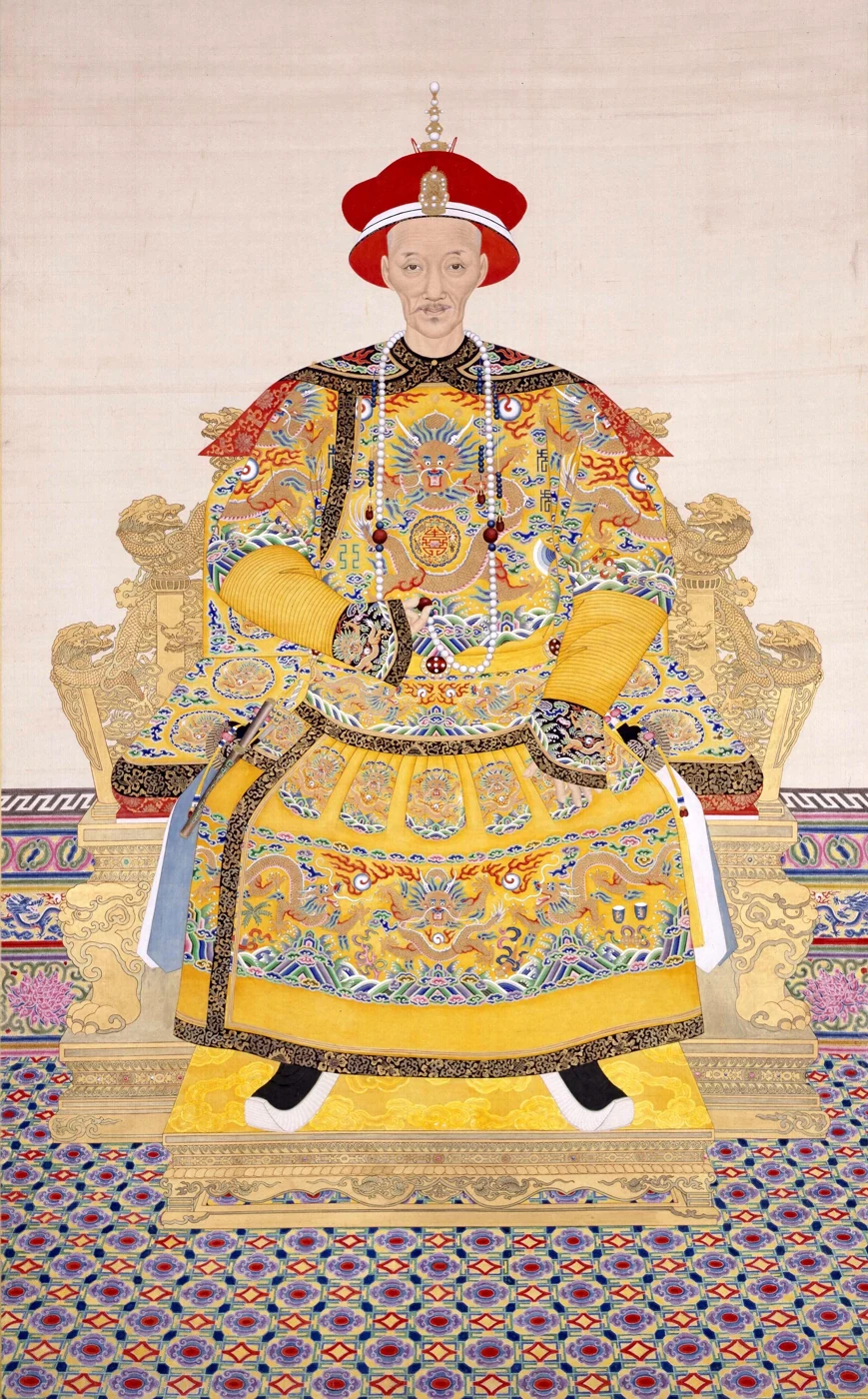
1782 CE–1850 CE
Emperor
Aisin Gioro Minning
爱新觉罗·旻宁
Aisin Gioro Minning (September 16, 1782–February 25, 1850), the Daoguang Emperor and temple-named Xuanzong of Qing, was originally named Mianning and changed his name to Minning after ascending the throne. He was the eighth emperor of the Qing Dynasty and the sixth Qing ruler after the conquest of China proper. His era name was Daoguang, his temple name Xuanzong, and his posthumous title Emperor Cheng. He was born in Xiefang…
1782 CE–1850 CEQing Dynasty
PROFILE
Aisin Gioro Minning (September 16, 1782–February 25, 1850), the Daoguang Emperor and temple-named Xuanzong of Qing, was originally named Mianning and changed his name to Minning after ascending the throne. He was the eighth emperor of the Qing Dynasty and the sixth Qing ruler after the conquest of China proper. His era name was Daoguang, his temple name Xuanzong, and his posthumous title Emperor Cheng. He was born in Xiefang Hall in the Forbidden City, the second son of the Jiaqing Emperor but in practice the eldest surviving son of the principal wife. His mother was Empress Xiaoshurui of the Hitara clan. In 1799(4th year of Jiaqing) he was secretly designated heir apparent, and in 1820(25th year of Jiaqing) he ascended the throne. During his thirty-year reign, the Qing court suppressed the Jahangir Khoja rebellion and attempted reforms to grain transport and salt administration. Minning later faced the opium crisis and First Opium War and approved the Treaty of Nanking after the defeat. On February 25, 1850(14th day of the first lunar month, 30th year of Daoguang), he died of illness at Shende Hall in the Old Summer Palace and was buried at Muling in the Western Qing Tombs.
- Other Names
- Daoguang Emperor; Emperor Xuanzong of Qing
- Era
- Qing
- Dynasty/Regime
- Qing
- Identity
- Emperor
- Date of Birth
- September 16 1782
- Date of Death
- February 25 1850
- Ethnicity
- Manchu
- Clan
- Aisin Gioro clan
- Ancestral Home
- Not reliably confirmed in historical sources
- Place of Birth
- Place of birth unknown
- Reign
- Reign dates unknown
- Successor
- Xianfeng Emperor Yizhu (son)
- Predecessor
- Jiaqing Emperor Yongyan (father)
- Era Name
- Not reliably confirmed in historical sources
- Temple Name
- Xuanzong
- Posthumous Name
- Cheng Emperor
- Major Achievement
- The first late-Qing emperor to confront direct Western pressure; he presided over the First Opium War.
- Aliases
- Daoguang Emperor; Minning
- Dynasty/State
- Qing Dynasty
- Ancestral home
- Not reliably confirmed by historical sources
- Place of birth
- Central quarters, Xiefang Hall, Forbidden City
- Place of death
- Shendetang, Yuanmingyuan
- Era name
- Daoguang
- Temple name
- Xuanzong
- Posthumous title
- Emperor Cheng
- Major achievements
- Implemented partial maritime grain transport and ticketed-salt measures; suppressed the Jahangir Khoja rebellion; faced the opium crisis and First Opium War; and approved the Treaty of Nanking.
LIFE TIMELINE
Imperial grandson | Accompanied the Qianlong Emperor on an imperial hunt at Weisonger, shot a deer with a bow, and was awarded a yellow riding jacket and peacock feather.
Imperial prince | Married a daughter of Buyandalai of the Niohuru clan of the Manchu Bordered Yellow Banner as his principal consort.
Heir-designation period | Following the family practice of secretly designating the heir, the Jiaqing Emperor personally wrote his name and sealed it in the box behind the “Upright and Bright” plaque in Qianqing Palace.
Imperial prince | His principal consort of the Niohuru clan died; he later married a woman of the Tunggiya clan as successor principal consort.
Prince Zhi period | During the Guiyou Incident (the Eight Trigrams uprising of 1813), when Tianli sect followers attacked the Forbidden City, he shot and killed two attackers with a fowling piece, was created Prince Zhi of the First Rank, and had the gun bestowed with the name “Weilie.”
On the eve of accession | The Jiaqing Emperor died at Rehe. The sealed box was publicly opened and the secret edict proclaimed, making Mianning crown prince; he escorted the late emperor's coffin back to Beijing the same day.
Accession | Ascended the throne in the Hall of Supreme Harmony and adopted the era name Daoguang.
Early reign | Further appointed Tojin and Cao Zhenyong each as Grand Tutor to the Heir Apparent and recognized Nguyễn Phúc Kiểu as king of Vietnam.
Campaign against Jahangir Khoja | The Jahangir Khoja rebellion broke out. Changling was appointed General Who Displays Might and Yang Yuchun Imperial Commissioner to conduct the campaign.
Reception of the captive | Jahangir Khoja was brought to Beijing; Minning received him as a captive at the Meridian Gate, and he was subsequently executed.
Mid-reign | Muslim rebels from Andijan again attacked Kashgar. Yulin was ordered to suppress them, and the fighting was pacified in the twelfth lunar month.
Mid-reign | Reissued and standardized legal penalties for officials and commoners who purchased and consumed opium.
Mid-reign | British Chief Superintendent of Trade Lord Napier led warships in shelling Humen.
Mid-reign | Appointed Lin Zexu Imperial Commissioner and sent him to Guangdong to suppress opium.
Mid-reign | Approved the Thirty Regulations for the Suppression of Opium; the Destruction of opium at Humen began.
First Opium War | The First Opium War broke out and British warships blockaded the Pearl River estuary at Guangzhou.
First Opium War | Under British military pressure, dismissed Lin Zexu and Deng Tingzhen and appointed Qishan acting Governor-General of Liangguang.
War and negotiations | After British forces captured the Shajiao and Dajiao forts at Humen, he was compelled to issue a declaration of war and appointed Yishan General for Pacifying the Rebellion.
Treaty of Nanking | With British forces approaching the Southern Capital, approved the signing of the Treaty of Nanking.
Postwar period | Approved the Five-Port Trade Regulations.
Postwar period | Approved the Treaty of Wangxia between China and the United States and the Treaty of Whampoa between China and France.
Later reign | Formally lifted the prohibition on Catholicism.
Later reign | His stepmother Empress Xiaoherui died; he was overcome with grief.
Death | Died of illness at Shende Hall in the Old Summer Palace. His fourth son Yizhu ascended the throne as the Xianfeng Emperor.
BIOGRAPHY
Biography
Family Background and Early Years On the morning of September 16, 1782(10th day of the eighth lunar month, 47th year of Qianlong), Mianning was born in the central quarters of Xiefang Hall in the northern part of the Forbidden City. His father Yongyan, the future Jiaqing Emperor, was then still an ordinary imperial prince, and his mother, a woman of the Hitara clan, was Yongyan's principal consort. Yongyan's eldest son had died in infancy before Mianning's birth, so Mianning was in practice the eldest surviving son of his father's principal wife. Mianning was studious in childhood. He successively studied under the Hanlin compiler Qin Chengye and reviewer Wan Chengfeng, and also held frequent scholarly discussions with Wang Tingzhen, Right Vice Minister of the Ministry of Rites, and Xu Ting, Hanlin Academician Reader, establishing a solid grounding in Chinese learning. In August 1791(56th year of Qianlong), at the age of ten, he accompanied his grandfather the Qianlong Emperor on an imperial hunt at Weisonger, drew his bow, and shot a deer. The Qianlong Emperor was delighted and awarded him a yellow riding jacket and peacock feather, indicating that he was already proficient in riding and archery and enjoyed his grandfather's favor. In 1796(1st year of Jiaqing), the fifteen-year-old Mianning married, by imperial arrangement, a daughter of Buyandalai of the Niohuru clan of the Manchu Bordered Yellow Banner as his principal consort. In April 1799(4th year of Jiaqing), following the family practice of secretly designating an heir, the Jiaqing Emperor personally wrote Mianning's name and sealed it in the box behind the “Upright and Bright” plaque in Qianqing Palace, formally establishing him as the designated heir in the imperial succession. In 1808(first lunar month, 13th year of Jiaqing), his principal consort of the Niohuru clan died, and Mianning subsequently married a woman of the Tunggiya clan as his successor principal consort. ### Period as Prince Zhi In 1813(ninth lunar month, 18th year of Jiaqing), Lin Qing and other members of the Tianli sect launched the Guiyou Incident and broke into the Forbidden City. Mianning had been accompanying the Jiaqing Emperor on the autumn hunt at Rehe but had returned to the capital early for other reasons. The attackers entered the Inner Right Gate and pressed toward the Hall of Mental Cultivation, creating an extremely dangerous situation. Mianning remained composed, took up a fowling piece normally prohibited within the palace, and shot two attackers dead. The rest scattered, and the disturbance was quickly suppressed. When the Jiaqing Emperor heard the news, he praised Mianning as “loyal and filial in equal measure,” created him Prince Zhi of the First Rank, and bestowed the name “Weilie” on the gun he had used. The incident further strengthened Mianning's position in his father's eyes. In 1820(seventh lunar month, 25th year of Jiaqing), the Jiaqing Emperor traveled to Rehe for the autumn hunt, with Mianning accompanying him. On the twenty-fifth day of the seventh lunar month, the emperor suddenly died at the Rehe palace. Imperial guards Saichong'a and Sodnamdorji, Grand Councillors Tojin, Dai Junyuan, Lu Yinpu, and Wenfu, and officials of the Imperial Household Department including Xi'en and Heshetei publicly opened the sealed box from Qianqing Palace, proclaimed the imperial writing from the fourth year of Jiaqing, and established Mianning as crown prince. That same day he escorted the Jiaqing Emperor's coffin back to the capital. In August, Mianning ascended the throne in the Hall of Supreme Harmony, changed his personal name to Minning, and designated the following year the first year of Daoguang. ### Early Reign: Administrative Rectification and Reform Attempts After ascending the throne, Minning ordered investigations into local irregular levies and sought to reform grain transport by waterways, the salt administration, and some mining policies. In 1820(ninth lunar month, 25th year of Jiaqing), he ordered provincial governors and governors-general to investigate irregular charges imposed on transport and merchant households, retained surcharges, balances from miscellaneous taxes, and similar exactions, distinguish which items should be retained or abolished, and draft regulations. The measure set out a direction for investigation, but implementation differed from place to place and did not eliminate official exploitation through irregular levies. In grain transport by waterways, river flooding raised shipping costs, and officials involved in transport also profited from their positions. After Yinghe, Minister of Revenue, proposed maritime transport, Minning ordered the relevant provinces to deliberate on the plan. Part of Jiangsu's tribute grain was shipped by merchant vessels in batches. In the spring and summer of 1826(6th year of Daoguang), roughly 1.6 million shi were transported by sea for the first time, using about nine hundred merchant ships. A central maritime transport office was established in Shanghai, and officials were stationed in Tianjin to inspect deliveries, reducing opportunities for exaction and delay en route. The reform divided grain routes according to producing area and transport conditions: part of the grain from Suzhou, Zhenjiang, Taicang, and other places traveled by sea, while inland areas such as Anhui, Jiangxi, and Huguang continued to use river transport. It was therefore not a universal conversion of the empire's grain transport to maritime routes. In the salt administration, the traditional quota-salt system allowed fixed merchants to operate with salt certificates. Monopoly and multiple stages of distribution contributed to problems involving salt prices, illicit salt, and taxation. After Bao Shichen proposed replacing the quota system with ticketed salt transport, Minning expanded the ticket system in 1831(11th year of Daoguang), allowing tax-paying operators to obtain tickets for distribution and altering the earlier restrictions on commercial qualifications. In the later Daoguang period, he also relaxed some prohibitions on mining and advocated allowing private use of mineral resources. These policies addressed specific fiscal and administrative problems, but their scope and effects varied and cannot be regarded as a fundamental solution to the Qing Dynasty's fiscal difficulties. ### Suppression of the Muslim Regions The Jahangir Khoja rebellion involved repeated incursions and Qing counteroffensives. In 1824(tenth lunar month, 4th year of Daoguang), Jahangir Khoja's forces entered the Uluk checkpoint area, and Qing forces suffered a temporary setback. In 1826(6th year of Daoguang), he again assembled followers and entered southern Xinjiang. Khotan, Kashgar, Yengisar, and Yarkand successively fell, and officials including Qingxiang, Counsellor Minister, died during the fighting. Minning appointed the Ili General Changling as General Who Displays Might and ordered him, together with the Shaan-Gan Governor-General Yang Yuchun, to lead troops to Xinjiang, with Wulong'a and others assisting military operations. The court ordered the army first to secure Aksu and the other four eastern cities, concentrate its forces, and avoid rash advances. It also arranged grain and pay transport through Hami and ordered different treatment for active rebels and people compelled to participate. After Qing forces stabilized the situation around Aksu, they counterattacked according to a plan of advancing by two routes and cutting off the enemy's retreat. Changling, Yang Yuchun, Yang Fang, and their forces first defeated the rebels at Kalpin and then recovered Kashgar before advancing separately: Changling remained to defend Kashgar, Yang Yuchun moved on Yengisar and Yarkand, and Yang Fang attacked Khotan. The four western cities were successively recovered. The court continued to distinguish active participants from coerced followers in order to reduce local support for the rebels, while Hengjing at Hami organized provisions for long-distance campaigning. At the end of 1827(7th year of Daoguang), Jahangir Khoja took advantage of the return of some Qing forces to the interior and led about five hundred men in another attack on Kashgar. Changling ordered Yang Fang to pursue him. The rebels were defeated around Mount Kartiegai and Jahangir Khoja was captured. In the fifth lunar month of 1828(8th year of Daoguang), he was escorted to Beijing, where Minning received the captive and questioned him at the Meridian Gate before he was executed. The campaign restored Qing control over the principal cities of southern Xinjiang, but it involved repeated losses of territory, counterattacks, and logistical mobilization rather than a single battle. ### Opium Prohibition and the First Opium War After ascending the throne, Minning continued to issue orders against opium. He successively restricted opium imports, the outflow of silver, domestic cultivation and trafficking, and consumption by officials and soldiers, and instructed the provinces to arrest traffickers and punish officials who failed in supervision. The early prohibitions targeted different parts of the trade, were enforced unevenly, and did not stop smuggling. In 1838(18th year of Daoguang), Huang Juezi submitted a memorial calling for heavier penalties on smokers, prompting court debate between strict prohibition and legalization. Minning ultimately chose strict prohibition and in December appointed Lin Zexu Imperial Commissioner and sent him to Guangdong. In 1839(19th year of Daoguang), Lin Zexu confiscated and destroyed opium in Guangdong, while Minning approved the Thirty Regulations for the Suppression of Opium and ordered their enforcement in the provinces. Full-scale war did not begin immediately after the Destruction of opium at Humen. In 1839 the British side refused to hand over the British sailors accused of killing Lin Weixi, and Guangdong officials disputed jurisdiction and trade with the British. British warships exchanged fire with Qing forces at Chuenpi, and the Qing court then suspended trade with Britain. In 1840(20th year of Daoguang), after assembling off Guangdong, the British fleet sailed north, occupied Dinghai, reached the Dagu forts near Tianjin, and demanded Qing responses on trade, compensation, and other conditions. Minning shifted between military resistance and negotiation, removed Lin Zexu and Deng Tingzhen from office, and sent Qishan to Guangdong to negotiate. The Convention of Chuenpi reached between Qishan and Charles Elliot covered Hong Kong, trade at Guangzhou, and compensation, but was not formally approved by the Qing court. Minning dismissed and investigated Qishan for making concessions without authorization. In 1841(21st year of Daoguang), after British forces captured the forts around Humen and approached Guangzhou, Minning issued a declaration of war, appointed Yishan General for Pacifying the Rebellion, and dispatched reinforcements to Guangdong. Humen fell and Guan Tianpei was killed. Fighting and negotiation around Guangzhou continued, but Qing forces failed to reverse the situation. In 1842(22nd year of Daoguang), British forces advanced along the Yangtze River and threatened the Southern Capital. Minning authorized Keying and others to negotiate and approved the Treaty of Nanking, accepting clauses ceding Hong Kong Island, providing indemnities, and opening treaty ports. The Qing court later approved the Five-Port Trade Regulations in 1843(23rd year of Daoguang) and the Treaty of Wangxia and Treaty of Whampoa in 1844(24th year of Daoguang). These decisions translated military defeat into a series of treaty arrangements and also changed the Qing system of foreign relations and trade. ### Later Years and Death After the First Opium War, the Daoguang Emperor's earlier vigor had largely faded and the government became still more conservative and routine-bound. In 1849(twelfth lunar month, 29th year of Daoguang), his stepmother Empress Xiaoherui died. The Daoguang Emperor was overwhelmed by grief and insisted on keeping vigil for her, and his health gradually weakened. On February 25, 1850(14th day of the first lunar month, 30th year of Daoguang), he died of illness at Shende Hall in the Old Summer Palace. Before his death he summoned Zaiquan, Director of the Imperial Clan Court; imperial guards Zaiyuan, Duan Hua, and Sengge Rinchen; Grand Councillors Mujangga and Saishang'a; Wenqing of the Imperial Household Department; and others to open the secret box publicly. The imperial writing declared: “The fourth imperial son is to be established as crown prince; the sixth imperial son Yixin is to be created Prince Gong.” His fourth son Yizhu ascended the throne as the Xianfeng Emperor. The Daoguang Emperor received the posthumous title Emperor Cheng and temple name Xuanzong and was buried at Muling in the Western Qing Tombs. Before his death, the Daoguang Emperor reportedly left four final instructions: “do not pair me with Heaven” in the sacrifices, “do not enshrine me in the ancestral temple,” “do not erect a stele of divine and meritorious achievement,” and “only a few garments that I wore in life may be kept for offering in the Sizhi storehouse.” He considered himself, in comparison with his imperial ancestors, to have “truly nothing worthy of recounting” and did not wish to receive the established honors of pairing with Heaven and enshrinement in the ancestral temple. After repeated discussion, the Xianfeng Emperor and his ministers decided to carry out only the latter two instructions; the requests not to pair him with Heaven and not to enshrine him in the ancestral temple were not implemented.
His Years as a Prince
Aisin Gioro Minning, whose original name was Mianning, was born on the tenth day of the eighth month of the forty-seventh year of Qianlong, the second son of the Qing emperor Renzong, Yongyan, his mother being the filial and gentle empress Xiaoshurui of the Xitala clan. His father was then still an ordinary prince. Mianning was most studious in childhood, learning in turn from the compiler Qin Chengye and the reviser Wan Chengfeng, and discoursing morning and evening with the right vice-minister of rites Wang Tingzhen and the Hanlin reader-in-waiting Xu Ting. In the eighth month of the fifty-sixth year of Qianlong, Mianning at ten followed his grandfather the Qianlong emperor hunting and took a deer, at which the emperor was delighted and gave him the yellow jacket and the peacock feather. In the first year of Jiaqing he took a wife, marrying the Manchu empress Xiaomucheng of the Niohuru clan, and in the eleventh month received by the Jiaqing emperor's grant the patent as the senior consort of the prince Mianning. In the fourth month of the fourth year of Jiaqing the emperor, following the family law of secret succession, wrote Mianning's name with his own hand and sealed it in the locked box. In the first month of the thirteenth year of Jiaqing the senior consort Niohuru died, and he married in her place the empress Xiaoshencheng of the Tunggiya clan. In the ninth month of the eighteenth year of Jiaqing, Mianning, having followed the autumn hunt at Mulan, had returned to the capital first when the sectarian rebels of Lin Qing's party broke into the Forbidden City in the rising at the palace. The rebels entered the inner right gate and came south of the Hall of Mental Cultivation meaning to go north, and Mianning shot two of them dead with a fowling piece, whereupon the rest broke and scattered and the disorder was put down. The Jiaqing emperor, hearing the report, was comforted and enfeoffed him as prince Zhi of the first rank, naming the gun he had used Weilic, the awe-inspiring; and thereafter Mianning was much esteemed by the Jiaqing emperor. In the seventh month of the twenty-fifth year of Jiaqing the emperor went in person to the autumn hunt at Rehe, and Mianning followed; and the emperor being then gravely ill, the imperial guard ministers Saichong'a and Suotenamuduobuzhai, the grand councillors Tuojin, Dai Junyuan, Lu Yinpu and Wenfu, and the chief ministers of the imperial household Xien and Heshitai publicly opened the locked box in the Qianqing palace and announced the decree of the fourth year of Jiaqing, establishing Mianning as heir apparent; and when the emperor died they escorted the coffin back to Beijing the same day.
His Accession and the Doubts over the Testament
By the family law of the Qing the locked box should have been placed behind the tablet of great brightness and light in the Qianqing palace; but by the tomb inscription of Duke Dai Junyuan written by Bao Shichen, when Tuojin and Dai Junyuan followed the Jiaqing emperor to the autumn hunt at Rehe in the spring of the twenty-fifth year of the reign, the emperor had no sooner halted than he was suddenly taken ill, the change came in a moment of confusion, and the attendants were much at a loss; and the two of them urged the inner servants to search the emperor's belongings, and at last found the decree of succession in a small golden box at the side of the emperor's personal attendants. The box had not been placed behind the tablet, and the heir was not present when it was opened, which was against the house law. By the Qing History, in the life of the imperial clansman Xien, when Renzong died at the mountain resort of Rehe the matter came in a moment of confusion, and Xien, being of the inner court in attendance, proposed that the Xuanzong emperor had the merit of quelling disorder and should succeed, while the grand councillors Tuojin and Dai Junyuan hesitated. Xien was only a minister of the imperial household and by the family law had no standing to propose Mianning's succession. Moreover, the filial and harmonious empress dowager, on learning in horror of the Jiaqing emperor's death at the Rehe travelling palace, issued a decree that the second son, prince Zhi, being benevolent, filial, intelligent and of martial and upright temper, and being in attendance, should receive the charge and govern the people; and she ordered the princes and ministers left in the capital to send it in haste to the second son, that he take the throne at once. This decree was of the greatest weight for Mianning's succession, and Mianning, receiving it at Rehe, bowed to the ground and was overcome with gratitude. Yet the veritable records of Xuanzong and Renzong both record that when Renzong was gravely ill he summoned the imperial guard ministers, the grand councillors and the chief ministers of the imperial household, who publicly opened the locked box and announced the imperial writing, a vermilion decree of the tenth day of the fourth month of the fourth year of Jiaqing establishing the heir apparent. By this account Mianning's succession had the proposal and agreement of the imperial clan in the person of Xien, the decree of the empress dowager and the assent of his younger brother the prince of Rui, Mianxin, and above all the imperial decree taken from the box by the grand councillors. In the third month of the first year of Daoguang Minning added to Tuojin and Cao Zhenyong the title of grand tutor of the heir apparent, and made Bolin grand secretary of the Hall of Benevolence and Cao Zhenyong grand secretary of the Hall of Military Eminence. And on the tenth day after his accession ceremony he seized on the affair of the testament and made much of it, succeeding thereby in replacing the senior grand councillor, having Tuojin and Dai Junyuan withdrawn from the grand council and Cao Zhenyong appointed to it.
The Suppression of Jahangir's Rebellion
In the tenth month of the fourth year of Daoguang the rebel chief of the Muslim regions, Jahangir, led troops into the Uruk post, and the government troops failed in their attack, the guard officer Huashanbu and others dying; and Bayanbatu and others led troops against Jahangir and beat him, so that he fled to Karatigin. In the seventh month of the sixth year of Daoguang Jahangir gathered the Muslim peoples of Andijan and the Kyrgyz into the government's posts, and the Muslim peoples of Kashgar responded; and Minning ordered Yang Yuchun as imperial commissioner to lead troops against him. Presently Jahangir took the city of Khotan, the brigade commander Yimei and the assistant minister Guibin dying there; and Minning ordered Changling as general displaying majesty and Wulonga as imperial commissioner, with Yang Yuchun to assist in military affairs. In the eighth month the Muslim chief Babuding and others took Yingisar; Jahangir took the city of Kashgar, the assistant minister Qingxiang and the assistant minister Shuerhashan dying there, and went on to take Yarkand, where the administrator Yindenge and the assistant minister Duolongwu died. When Minning learned that the rebels had taken Khotan and Yingisar and were besieging Kashgar he at once issued a decree that the aim must be to hold the four eastern cities, Aksu being the central and vital place and to be guarded above all; and he set out his measures for suppressing the rebellion: in military matters he promptly made Changling, the general of Ili, general displaying majesty, and with the governor-general of Shaanxi and Gansu, Yang Yuchun, to lead more than ten thousand troops to Xinjiang, requiring that they gather a weight of force and sweep it away at one blow to display the punishment of Heaven, and that in their boldness they should keep prudence and not rashly advance into the rebels' snares, and he laid down rules of reward and punishment and of strict military discipline; in political matters he punished grasping and lawless officials and had the local ministers who were most hated condemned, and toward the Muslim city dwellers he made clear favour and awe with strict discrimination, sparing none who willingly aided the rebels and resisting the government troops, but forgiving all the coerced who came over and begged for their lives, so as to isolate the rebels as far as possible; and for supply he sent the minister Hengjing, experienced in grain and pay, to Hami to ensure the provision of grain, pay and other military stores. In the first month of the seventh year of Daoguang the Muslim peoples of Khotan surrendered, and presently Khotan was taken again by Jahangir. Changling, Yang Yuchun and Wulonga, following Minning's intent, sent the Shaanxi commander Yang Fang toward the strategic point of Korla, and Yang Fang destroyed more than three thousand rebels at a blow. In the fourth month Changling and the others took Kashgar, and Jahangir fled and could not be taken; and the government troops, having recovered Kashgar, divided into three columns, Changling remaining at Kashgar, Yang Yuchun advancing on Yingisar and Yarkand, and Yang Fang against Khotan. Yang Yuchun moved swiftly, taking Yingisar on the fifth day of the third month and ten days later recovering Yarkand without bloodshed, while Yang Fang's troops beat five thousand rebels at Pilaman and took Khotan, so that all four western cities of the southern frontier were recovered. At the end of the seventh year of Daoguang Jahangir, learning that most of the government troops had withdrawn to China proper under Yang Yuchun, gathered again a band of more than five hundred men to raid Kashgar by surprise on the eve of the New Year; and Changling, hearing of it, at once had Yang Fang search and destroy them by night, and Yang Fang in three columns came up with them at Mount Karti, where after a fierce fight the rebels were all destroyed and Jahangir taken alive. In the fifth month of the eighth year of Daoguang Jahangir was brought to the capital and Minning came in person to the Meridian Gate to receive the prisoners, announcing with his own mouth the crimes of Jahangir and putting him to the extreme penalty, and sending officers to sacrifice at the ancestral temple and the altars of soil and grain. This was of great meaning for the unity and territorial integrity of the state and the peace of the northwest frontier, and was the greatest achievement of Minning's life. In the ninth month of the tenth year of Daoguang the Andijan Muslims again took Kashgar and besieged the city, the assistant minister Tashiha being defeated and killed; and Minning sent Yulin to Xinjiang against them, and in the twelfth month the Muslims of Kashgar and Yingisar were put down.
Reforms in Grain Transport, the Salt Administration and Mining
In grain transport, the grain brought from the two Jiang provinces had long been prey to the transport officers' peculation, and the canal, damaged by floods, was often blocked and the charges high, so that men advised that sea transport would be easier. Minning referred the proposal to the provinces with tribute grain, and it was at last decided to send all the grain of four prefectures and one department by sea; Minning accepted at once, and the provincial treasurer of Jiangsu went to the ports to hire merchant ships with the local officers and carried it in two voyages, while Anhui, Jiangxi and Huguang, far from the sea, went on by the canal. To cut off the brokers' exactions, delays and vexations, Minning also ordered a general office of sea transport set up at Shanghai, with officers to join the grain-transport vice-minister in inspecting at Tianjin. In the spring and summer of the sixth year of Daoguang the first sea transport of tribute grain succeeded, nine hundred ships carrying more than one million six hundred thousand shi; and this method lasted until the twenty-sixth year of Guangxu. In the salt administration, the Qing had followed the Ming system of class salt, in which fixed merchants held a monopoly of the salt certificates and maintaining a great selling organization raised the price until sales grew difficult, while untaxed private salt flooded the market and the certificates went unsold, salt revenue fell and the system could not last. When someone proposed replacing the classes by certificates and allowing private dealers, Minning supported the system, extended in the eleventh year of Daoguang, by which anyone who paid the tax might take a certificate and carry salt, thus breaking the monopoly of transport and sale, lowering the price, promoting sales, increasing the revenue and taking from officials the means of private profit in the salt administration. In mining, where earlier rulers had feared that mines would breed disorder and had forbidden them, in the later years of the Daoguang reign Minning allowed the people to open mines freely, which helped to develop resources and better the people's living. And in the seventh year of Daoguang, breaking through the traditional view, he had Wang Yinzhi compile the twenty volumes of the Textual Studies of the Dictionary, correcting the errors of the Kangxi Dictionary.
The Suppression of Opium and the Opium War
Before the flood of foreign opium Minning took the policy of prohibition his predecessors had always held. From the beginning of his reign he issued decree after decree: from the eleventh month of the first year of Daoguang to the third month of the fourteenth he many times decreed that the foreign merchant Wu Dunyuan be stripped of his rank for conniving at the concealment and carrying of opium, ordered the governors of Guangdong and the provinces to forbid the export of silver and the import of opium, ordered the governor-general of the two Guangs, Ruan Yuan, to seize opium dealers at the ports, settled regulations on negligence in the matter of opium, deliberated rules strictly forbidding foreign merchants to exchange goods for silver and forbidding the entry of opium, ordered the cabinet to forbid the planting and selling of opium in the interior, ordered the governor-general of the two Guangs, Li Hongbin, to investigate the accumulation and private sale of opium on foreign ships and to devise means of stopping it, ordered the cabinet to forbid officers and soldiers to smoke opium, ordered a strict prohibition of the export of fine silver, ordered the governor-general of Fujian and Zhejiang, Cheng Zuluo, and others to devise means of clearing the sea of private opium dealers, and ordered the governor-general of the two Guangs, Lu Kun, to search out vessels privately selling opium and prevent its sale and its passage into other provinces. In the eighteenth year of Daoguang the chief minister of the court of state ceremonial, Huang Juezi, memorialised on the grievous harm of opium and urged strict prohibition, and Minning made Lin Zexu imperial commissioner and sent him to Guangdong to suppress it. In the fourth month of the nineteenth year he had Lin Zexu proclaim to the English and all foreign merchants in Guangdong the prohibition of the opium traffic and destroy the opium at Humen; in the fifth month, English sailors having killed the villager Lin Weixi and the English consul Elliot refusing to hand over the culprit, an invasion of China's legal sovereignty, Minning ordered Guan Tianpei to lead his troops against them and in the twelfth month stopped the trade with the English. In the first month of the twentieth year the empress Niohuru died and was given the posthumous name Xiaoquan, her son being raised by another; in the fifth month the English fleet gathered off Guangdong and the Opium War broke out, but Lin Zexu's defences were so tight that the English could find no opening; in the sixth month the English went north, massacring wildly, and took Dinghai; and in the seventh month they came to Tianjin, where Qishan negotiated with them and gave way. Minning, overawed by the English, had Lin Zexu and Deng Tingzhen handed to the grand council for severe examination; in the ninth month Lin Zexu and Deng Tingzhen were dismissed and Qishan made acting governor-general of the two Guangs; and in the twelfth month Qishan of himself concluded the Chuanbi convention with Elliot, privately granting the cession of Hong Kong, the opening of Guangzhou and compensation for the opium. In the first month of the twenty-first year the English took the Humen forts, and Minning was forced to declare war on them, sending Yishan as general to quell the rebels to take charge in Guangdong; in the second month the English attacked Humen, bringing on the naval battle of Humen, in which the naval commander of Guangdong, Guan Tianpei, fought to the death; and Minning, because Qishan had given way in the negotiations, took from him the title of grand secretary, had him arrested and his house confiscated. In the fifth month of the twenty-second year the English took the lower Yangtze and Shanghai fell; in the seventh month their ships entered the river at Nanjing, and the imperial commissioner Qiying negotiated with the English plenipotentiary Pottinger aboard a ship in the river, granting all the terms the English demanded; and Minning ratified the Treaty of Jiangning, granting cession of territory, indemnity and the opening of five ports. In the fifth month of the twenty-fourth year Qiying signed the unequal Treaty of Wanghia with the American representative Cushing, and in the ninth month the unequal Treaty of Whampoa with the French representative.
His Death, Anecdotes and Tomb
On the fourteenth day of the first month of the thirtieth year of Daoguang Minning died at the Shen De hall of the Yuanming yuan at sixty-nine. At the end he summoned the imperial clan director Zaiquan and the imperial guard ministers to open the secret box and announce the imperial writing: that the fourth son be established as heir apparent and the sixth son, Yixin, be made a prince. Yizhu took the throne, making the next year the first of Xianfeng. In the fourth month the late emperor was given the posthumous name Cheng and the temple name Xuanzong, and his tomb was the Mu tomb. There survive from his hand the complete prose and verse of the Hall of Cultivating Rectitude, the first and later collections of imperial poems and the poems of his tour of Shengjing. By the records of the Korean and Vietnamese envoys Minning had lost all his teeth by middle age: Pan Huizhu in his notes on his embassy records that the Daoguang emperor was of unusual courage and strategy, having in the Jiaqing years shot two rebels dead with a firelock when they crossed the palace wall and so restored the palace to order, which was the act of a hero, and records what the imperial household said, that the emperor while still a prince had hurt and lost a tooth by mishap in archery; and that he was then forty-five and had lost all his teeth, which was most strange. By other anecdotes, when Minning came to the throne the household by rule gave him forty inkstones inscribed on the back with the words for the imperial use of Daoguang, and Minning, thinking them too many and their idleness a waste, gave them out among his ministers; where the imperial brush had always been of the hardest of the purple hair with the words of the heavenly composition and the river of stars cut on the shaft, Minning, finding them unsuitable, had the minister of revenue Ying Xiekui buy ordinary brushes of pure and mixed goat hair in the market; and his own trousers being worn through at the knee he had a round patch of silk put on, the common mending, at which Cao Zhenyong followed him; and seeing a patch on Cao Zhenyong's trousers, Minning asked whether he too had his trousers mended, and asked what it cost outside the palace, and Cao Zhenyong said three mace, at which Minning said that they made things cheaply outside the palace, but that it cost him five taels within.
Major Activities
Military Administration of the Northwestern Frontier During the Jahangir Khoja rebellion, Minning not only appointed Changling, Yang Yuchun, and others to lead the army but also ordered Qing forces first to hold Aksu and the other four eastern cities, concentrate their strength, and only then counterattack, while arranging provisions and transport. Qing forces first blocked the rebels in the Aksu area and then advanced along separate routes to recover Kashgar, Yengisar, Yarkand, and Khotan. When Jahangir Khoja regrouped about five hundred followers and attacked Kashgar again, Yang Fang's force was ordered to pursue him and captured him. The process demonstrates the court's simultaneous handling of military deployment, frontier personnel, local pacification, and logistical supply, while also revealing the cost of the initial collapse of frontier defence and repeated troop movements. ### Grain Transport by Waterways, Salt Administration, and Mining Policies The partial shift of grain transport by waterways to maritime routes responded to river obstruction, high costs, and profiteering in the intermediate stages of grain administration. After Minning accepted Yinghe's proposal, Jiangsu hired merchant vessels to move grain in batches, established a central maritime transport office in Shanghai, and arranged inspection in Tianjin. The first shipment in 1826(6th year of Daoguang) amounted to roughly 1.6 million shi. The scheme applied only to certain coastal areas; Anhui, Jiangxi, and Huguang still relied on river transport. In salt administration, the ticket system was expanded in 1831(11th year of Daoguang), allowing tax-paying operators to receive distribution tickets in place of part of the system in which fixed merchants monopolized salt certificates. Later in the Daoguang period, some mining prohibitions were also relaxed to permit private extraction. The three policies respectively addressed transport, the organization of salt commerce, and resource use. Maritime transport shifted part of the grain supply from river routes to the sea and created dedicated inspection; ticketed salt distribution altered the fixed-merchants monopoly over salt certificates; and relaxed mining restrictions widened private access to extraction. Their scope differed, and their effects cannot simply be described as a comprehensive reform or a complete solution to fiscal difficulties. ### Decisions and Enforcement in the Opium Prohibition Minning's opium policy developed from multiple prohibitions early in his reign into a nationwide strict-prohibition program. The court had already restricted opium imports, the outflow of silver, domestic cultivation and sales, and consumption by officials and soldiers, but enforcement was dispersed and achieved limited results. In 1838(18th year of Daoguang), Huang Juezi's memorial prompted renewed discussion of anti-opium policy. Minning chose strict prohibition, sent Lin Zexu to Guangdong, and in the following year approved thirty regulations against opium. Enforcement led to the confiscation and destruction of opium in Guangdong but also concentrated Sino-British conflicts over trade and jurisdiction. The causal relationship between prohibition and war cannot be reduced to a single incident, because it also involved British trade demands, the Lin Weixi case, the Chuenpi clash, and Qing responses. ### Wartime Decisions and Treaties During the First Opium War, Minning's decisions passed through stages of negotiation, removal of anti-opium officials, renewed declaration of war, and final peace. After British forces sailed north to Tianjin, he sent Qishan to Guangdong to negotiate. The Convention of Chuenpi reached between Qishan and Charles Elliot was not formally approved, and Qishan was investigated. After British forces captured the Humen forts, Minning appointed Yishan to direct the Guangdong campaign and sent reinforcements, but Qing forces continued to suffer setbacks at Humen and Guangzhou. In 1842(22nd year of Daoguang), when British forces advanced toward the Southern Capital, the Qing court accepted the territorial, indemnity, and trade clauses of the Treaty of Nanking; the treaty provided for the cession of Hong Kong Island, an indemnity of twenty-one million silver dollars, and the opening of five treaty ports. The court later approved the Five-Port Trade Regulations, the Treaty of Wangxia, and the Treaty of Whampoa, extending commercial, consular, and diplomatic arrangements to other countries. During the war Minning at times ordered resistance, at times removed anti-opium officials and sought negotiations, and finally accepted treaties under military pressure. His policy therefore cannot be characterized simply as consistently favoring peace or consistently favoring war.
The Reform of Administration and the Inquiry into Irregular Fees
Within a fortnight of taking the government Minning, on the eleventh day of the ninth month of the twenty-fifth year of Jiaqing, issued a decree inquiring into the irregular fees, saying that the wind of scraping and fleecing grew worse day by day, and that the people's store was drained away by the exactions of the officials, so that their livelihood was at an extreme; and that it was better to give openly than to take privately. The irregular fees of the several provinces, under the names of boat and cart households, of the meltage allowance and the balance, of the residue of miscellaneous taxes, of the salt and pawnshop fees, differed in name, some existing here and not there, some that could be abolished in one place and could not by any means be in another; and though forbidden by decree they were still taken by force, the superiors using them to frighten their subordinates and the people to accuse the officials; and so it was better to fix the rules openly and set limits. Since the circumstances of the provinces differed, he ordered the governors and inspectors of each place to inquire into the irregular fees of their jurisdiction one by one, keeping what should be kept and abolishing what should be abolished, and that any who extorted again, once found out, should be punished with the heaviest penalties. Minning also took action to set the administration of officials in order: since in the Jiaqing and Daoguang periods the ways of official peculation were, besides the grain transport and the salt administration, the river works, to stop this channel Minning in the twenty-fourth year of Daoguang required that the river works funds be forbidden to the officials, tribute students and college students who passed by; and in the fourth month of that year he punished a number of corrupt river officers. He also made various dispositions of his great ministers, adding the title of grand tutor of the heir apparent to Tuojin and Cao Zhenyong, making Bolin grand secretary of the Hall of Benevolence, Cao Zhenyong grand secretary of the Hall of Military Eminence, Songyun minister of war and Qinghui lieutenant-general of Rehe.
Foreign Relations and the Surrounding Countries
In the Daoguang years Minning took various measures in foreign relations: in the first year of Daoguang he enfeoffed Nguyen Phuc Kieu as king of Vietnam; in the thirteenth year the rebel chief Chen Ban of Jiayi in Taiwan was executed; in the fourteenth year the first English superintendent of trade in China, Napier, having been refused a direct meeting on trade, bombarded with his warships; in the fifteenth year the governor-general of the two Guangs memorialised for the building up of the Guangzhou forts, and Guangdong fixed the regulations for guarding against foreign trade; in the sixth month of the twenty-fifth year Qiying addressed the envoy Lanna sent to China for negotiations, permitting Belgium to trade on the terms of the five-port regulations, and in the eleventh month the Shanghai intendant published the first joint regulations with the English settlement, while in the twelfth month the people of Guangzhou opposed the entry of Englishmen into the city and several thousand pressed into the prefectural offices; in the eleventh month of the twenty-sixth year a school principal went to study in America, opening the way for modern study abroad; in the first month of the twenty-eighth year he reaffirmed the prohibition on Frenchmen entering the interior to preach, and in the fifth month refused Russia's request for trade in Xinjiang; and in the second month of the twenty-ninth year the Portuguese governor of Macao, Amaral, illegally declared Macao a free port, abolished the customs duties and ordered the closing of the Guangdong customs house. In the thirtieth year of Daoguang the court permitted Russia to trade in Xinjiang; and in the seventh month of that year Russia seized the temple street at the mouth of the Amur in Heilongjiang, renaming it Nikolaevsk. Besides this, Minning in his reign ordered the coastal provinces to put their navies in order against English merchant ships entering the inner waters.
His Empresses and Sons
Minning had in turn the empress Xiaomucheng of the Niohuru clan, the empress Xiaoshencheng of the Tunggiya clan, the empress Xiaoquan of the Niohuru clan and the empress Xiaojing of the Borjigit clan. The empress Xiaomucheng was the daughter of the minister of revenue and first-class viscount Buyandalai, and being made senior consort while Xuanzong was a prince in the first year of Jiaqing, she died in the first month of the thirteenth year; and after his accession Xuanzong conferred on her posthumously the name Xiaomu, burying her first at Wangzuo village and then at Baohua valley, and, the underground palace being flooded, again at Longquan valley, where afterwards the Mu tomb was built. The empress Xiaoshencheng was the daughter of the third-class hereditary duke Shu Ming'a and became senior consort after the death of the first, and was made empress on Xuanzong's accession, dying in the fourth month of the thirteenth year of Daoguang and being buried at Longquan valley. The empress Xiaoquan was the daughter of the second-class guard and first-class baron Yiling, and served Xuanzong as consort Quan, rising to honoured consort Quan; she bore the Wenzong emperor in the sixth month of the eleventh year of Daoguang, was made honoured imperial consort in the thirteenth year with charge of the six palaces and empress in the fourteenth, and died in the first month of the twentieth year at thirty-three. The empress Xiaojing was the daughter of the vice-director of the ministry of justice Hua Liang'a and served Xuanzong as honoured lady Jing, rising to honoured imperial consort Jing; when the empress Xiaoquan died Wenzong was but ten and she brought him up with kindness, and on Wenzong's accession she was honoured as the imperial concubine of kindness and health of the late emperor in the palace of longevity, and in the seventh month of the fifth year of Xianfeng, being gravely ill, was honoured as empress dowager of kindness and health, dying nine days later at forty-four. Among his sons, the empress Xiaoquan bore the Wenzong emperor Yizhu; the empress Xiaojing bore the prince of Shunhe, Yigang, the prince of Huizhi, Yiji, and the prince Gongzhong of the first rank, Yixin; the honoured imperial consort of Zhuangshun bore the prince Xian of Chun of the first rank, Yixuan, the prince of Zhongduan, Yiqia, and the prince of Fujing, Yihui; the honoured consort He of the Nara clan bore the prince Yinzhi of Yizhi; and the honoured consort Xiang of the Niohuru clan bore the prince Dunqin, Yicong, who was given out as heir to the prince Dunke of Miankai. Among his daughters there were the princess Duanyin of the first rank, the princess Duanshun of the first rank, the princess Shou'an of the first rank, the princess Shouzang of the second rank, the princess Shou'en of the first rank, the princess Shouxi of the second rank and the princess Shouzhuang.
Personal Relations
- Father: Jiaqing Emperor Yongyan
- Mother: Empress Xiaoshurui of the Hitara clan
- Stepmother: Empress Xiaoherui of the Niohuru clan
- Empresses: Empress Xiaomucheng of the Niohuru clan (principal consort); Empress Xiaoshencheng of the Tunggiya clan (successor principal consort); Empress Xiaoquancheng of the Niohuru clan; Empress Xiaojingcheng of the Borjigit clan (posthumous investiture)
- Sons: eldest imperial son Yiwei; second son Yigang; third son Yiji; fourth son Aisin Gioro Yizhu (Xianfeng Emperor); fifth son Yicong; sixth son Yixin (Prince Gong); seventh son Yixuan (Prince Chun), among others
- Daughters: Princess Duanmin of the First Rank; Princess Duanshun of the First Rank; Princess Shou'an of the First Rank; Princess Shou'en of the First Rank; Princess Shouzang of the Second Rank; Princess Shouxi of the Second Rank; Princess Shouzhuang of the First Rank, among others ### Teachers and Associates - Qin Chengye (Hanlin compiler and tutor)
- Wan Chengfeng (Hanlin reviewer and tutor)
- Wang Tingzhen (Right Vice Minister of the Ministry of Rites; frequent scholarly interlocutor)
- Xu Ting (Hanlin Academician Reader; frequent scholarly interlocutor) ### Ruler and Ministers - Changling (General Who Displays Might; commander in the campaign against the Jahangir Khoja rebellion)
- Yang Yuchun (Counsellor Minister; commander in the campaign against the Jahangir Khoja rebellion)
- Lin Zexu (Imperial Commissioner; opium suppression in Guangdong)
- Qishan (Governor-General of Zhili and acting Governor-General of Liangguang; pursued compromise during the First Opium War)
- Keying (Imperial Commissioner; signed the Treaty of Nanking)
- Cao Zhenyong (Grand Secretary of the Wuying Hall and senior court official)
- Mujangga (Grand Councillor; favored peace during the First Opium War)
- Yishan (General for Pacifying the Rebellion; suffered reverses in the Guangdong campaign)
- Guan Tianpei (naval commander; killed in the fighting at Humen)
- Chen Huacheng (Jiangnan military commander; killed at the Battle of Wusong) ### Conflicts - Jahangir Khoja (leader of the rebellion in the Muslim regions of Xinjiang; captured and executed)
- Britain (opponent in the First Opium War)
Historical Assessment
Qing Dynasty / Contemporaries - The Draft History of Qing records the Jiaqing Emperor commending Minning for his conduct during the 1813 palace crisis (Draft History of Qing, juan 17, Basic Annals 17).
- The Daoguang Emperor’s succession edict emphasizes diligence and frugality and expresses a modest assessment of his own virtue and achievements (Succession Edict of Emperor Xuanzong of Qing).
- Mao Haijian cites Zeng Guofan’s criticism of embellished court reports and concealed military defeats in discussing failures of information and decision-making during the war. ### Late Qing and Republican Period - Meng Sen situates the Jiaqing and Daoguang reigns within a broader account of Qing decline (Lectures on Qing History).
- Xiao Yishan, in General History of the Qing Dynasty, criticized the Daoguang court’s limited understanding of Western affairs and linked it to diplomatic failures. ### Modern Period - Mao Haijian, in The Collapse of the Celestial Empire, argued that the failure in the First Opium War resulted not only from differences in weaponry but also from decay in the political and military systems, and that the Daoguang Emperor, as the highest decision-maker, bore major responsibility for the conduct of the war.
- Dai Yi discusses the limitations of the Daoguang court’s response to Western pressure (Concise History of the Qing Dynasty).
FIGURES ASSOCIATED WITH THIS DYNASTY
Bibliography
- Draft History of Qing*, juan 17–18, Basic Annals; juan 367, account of Jahangir Khoja. Local source: the Chinese source text.
- Veritable Records of Emperor Xuanzong Cheng of Qing*. Local source: the Chinese source text.
- Meng Sen, Lectures on Qing History, Zhonghua Book Company.
- Xiao Yishan, General History of the Qing Dynasty, Zhonghua Book Company.
- Dai Yi, Concise History of the Qing Dynasty, Renmin University of China Press.