Birth | Born twenty-six years after the Daoguang Emperor
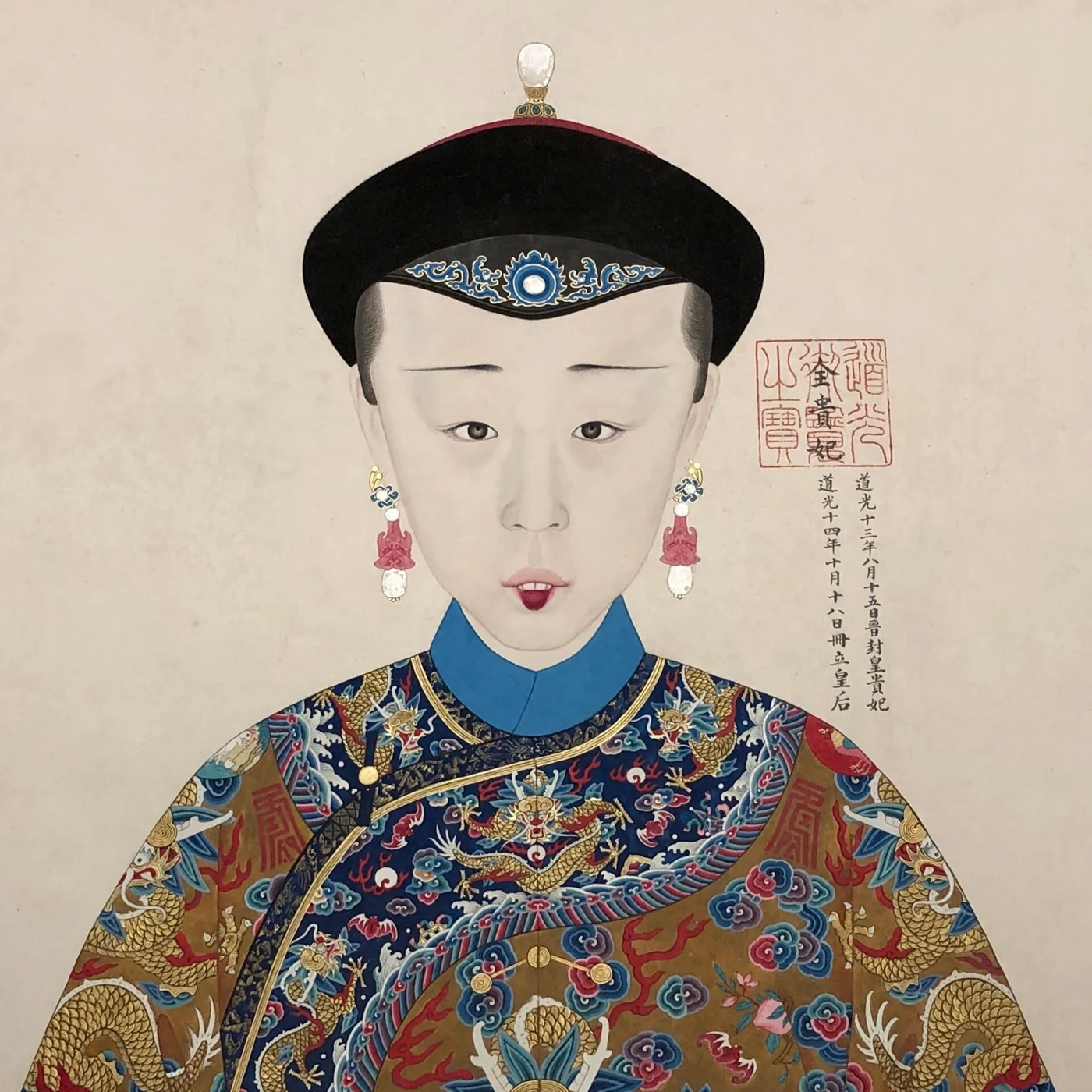
1808 CE–1840 CE
Empress
Empress Niohuru
钮祜禄氏(孝全成皇后)
Empress Niohuru (24 March 1808 – 13 February 1840), posthumously Empress Xiaoquancheng, was the third principal wife of the Daoguang Emperor Minning and the second empress installed after his accession, serving as empress from 1834. She was the mother of the Xianfeng Emperor. Born into the prominent Manchu Niohuru clan, she originally belonged to the Manchu Plain Red Banner and was later transferred to the Bordered Yellow…
1808 CE–1840 CEQing Dynasty
PROFILE
Empress Niohuru (24 March 1808 – 13 February 1840), posthumously Empress Xiaoquancheng, was the third principal wife of the Daoguang Emperor Minning and the second empress installed after his accession, serving as empress from 1834. She was the mother of the Xianfeng Emperor. Born into the prominent Manchu Niohuru clan, she originally belonged to the Manchu Plain Red Banner and was later transferred to the Bordered Yellow Banner. Known for intelligence and perceptiveness, she rose rapidly after entering the palace, gave birth to the emperor's fourth son Yizhu in 1831, the eleventh year of the Daoguang era, and was installed as empress in 1834, the fourteenth year of Daoguang. She died on the eleventh day of the first month of 1840, the twentieth year of Daoguang, at only thirty-three years of age . The Daoguang Emperor was deeply attached to her, personally selected the posthumous title “Xiaoquan,” and had her buried in his own imperial mausoleum at Longquanyu in the Western Qing Tombs.
- Alternative names
- Niohuru clan; Empress Xiaoquancheng of the Daoguang Emperor; Empress Xiaoquancheng; Noble Consort Quan
- Era
- Qing
- Dynasty / polity
- Qing
- Identity
- Empress
- Date of Birth
- March 24, 1808 CE(28th day of the 2nd month, 13th year of Jiaqing)
- Date of Death
- February 13, 1840 CE(11th day of the 1st month, 20th year of Daoguang)
- Ethnicity / affiliation
- Manchu
- Clan
- Niohuru clan
- Banner affiliation
- Manchu Plain Red Banner (later transferred to the Bordered Yellow Banner)
- Ancestral home
- Not reliably established in currently available sources
- Place of birth
- Unknown
- Tenure as empress
- 1834–1840
- Posthumous title
- Empress Xiaoquancheng
- Major achievements
- The most favored of the Daoguang Emperor's consorts; mother of the Xianfeng Emperor; remembered for shrewdness and ability
- Courtesy / Art Name
- Unknown
- Dynasty
- Qing dynasty
- Ethnicity
- Manchu
- Ancestral Home
- Unknown
- Place of Birth
- Unknown
- Place of Death
- Unknown
- Lifespan
- 33 years
- Highest Office
- See Biography
- Major Offices
- See Biography
- Posthumous Name
- Xiaochengquan (Xiaocheng)
- Major Achievements
- Enjoyed a monopoly of imperial favour in the Daoguang reign; gave birth to Emperor Wenzong (Xianfeng); as empress governed the six palaces from the Kunning palace
LIFE TIMELINE
Event | The emperor's third daughter died at the age of ten and was posthumously created Princess Duanshun of the First Rank
Event | Selected in the Eight Banners consort selection as a Noble Lady, though she was directly invested as a concubine at the actual appointment and received the honorific “Quan”
Event | The empress became gravely ill
Event | Died at age thirty-three
Event | Entered the palace together with Noble Lady Mu and Noble Lady Xiang
Event | The Daoguang Emperor personally selected “Empress Xiaoquan” as her posthumous title
Event | Promoted to Imperial Concubine Quan; formal investiture held in the eleventh month
Event | The Daoguang Emperor personally escorted her coffin to the Western Qing Tombs; on the ninth day of the eleventh month she was buried in the underground palace at Longquanyu
Event | Promoted to Consort Quan
At the yin hour on the twentieth day of the second month of 1825 | At the yin hour on the twentieth day of the second month of 1825, the fifth year of Daoguang, she gave birth to the emperor's third daughter, later Princess Duanshun of the First Rank, and on the thirteenth day of the fourth month was promoted to Noble Consort Quan.
Event | Gave birth to the emperor's third daughter, later Princess Duanshun of the First Rank; promoted to Noble Consort Quan on the thirteenth day of the fourth month
At the you hour on the sixth day of the fourth month of 1826 | At the you hour on the sixth day of the fourth month of 1826, the sixth year of Daoguang, she gave birth to the emperor's fourth daughter, later Princess Shou'an of the First Rank.
Event | Gave birth to the emperor's fourth daughter, later Princess Shou'an of the First Rank
On the twenty-fifth day of the third month of 1831 | On the twenty-fifth day of the third month of 1831, the eleventh year of Daoguang, Noble Consort Quan's pulse was stable and she was seven months pregnant.
Event | Gave birth at Zhanjingzhai to the emperor's fourth son Yizhu, later the Xianfeng Emperor
In 1833 | In 1833, the thirteenth year of Daoguang, the emperor directly invoked the precedent of his grandfather the Qianlong Emperor's appointment of a successor empress as Imperial Noble Consort.
Event | Promoted to Imperial Noble Consort in charge of the Six Palaces, in preparation for installation as empress
On the first day of the first month of the fourteenth year of Daoguang (1834) | On the first day of the first month of the fourteenth year of Daoguang (1834), she was proclaimed empress.
Life as Empress and Death On the eighth day of the eleventh month of 1835 | ### Life as Empress and Death On the eighth day of the eleventh month of 1835, the fifteenth year of Daoguang, the emperor's third daughter died at only ten years of age.
By the eighth month of 1839 | By the eighth month of 1839, the nineteenth year of Daoguang, Empress Niohuru was gravely ill.
Event | Proclaimed empress; formal installation ceremony held on the eighteenth day of the tenth month
On the eighth day of the first month of 1840 | On the eighth day of the first month of 1840, the twentieth year of Daoguang, the emperor issued an edict directing that if she died the mourning arrangements should follow the precedent for Empress Xiaoshen in the thirteenth year of Daoguang, with eunuch Luxi and the chief eunuchs of the two palaces rotating in mourning at Danhuaitang until the empress's bier entered the city, after which they were to return to their respective places at the Old Summer Palace.
On the eighth day of the first month of 1840 | On the eighth day of the first month of 1840, the twentieth year of Daoguang, the emperor issued an edict directing that if she died the mourning arrangements should follow the precedent for Empress Xiaoshen in the thirteenth year of Daoguang, with eunuch Luxi and the chief eunuchs of the two palaces rotating in mourning at Danhuaitang until the empress's bier entered the city, after which they were to return to their respective places at the Old Summer Palace.
On the eighth day of the first month of 1840 | On the eighth day of the first month of 1840, the twentieth year of Daoguang, the emperor issued an edict directing that if she died the mourning arrangements should follow the precedent for Empress Xiaoshen in the thirteenth year of Daoguang, with eunuch Luxi and the chief eunuchs of the two palaces rotating in mourning at Danhuaitang until the empress's bier entered the city, after which they were to return to their respective places at the Old Summer Palace.
BIOGRAPHY
Biography
Family Background and Early Years Empress Niohuru came from a prominent Manchu family. Her great-grandfather Chengde served during the Qianlong reign as a general stationed in Tibet; her grandfather was Mukdembu; and her father Yiling served as a second-rank guard at the Gate of Heavenly Purity, held the hereditary rank of second-rank baron, was posthumously made First-Rank Marquis Cheng'en, and was later posthumously advanced to Third-Rank Duke Cheng'en. Her birth mother was Yiling's principal wife, a woman of the Uya clan. The family originally belonged to the Manchu Plain Red Banner and was later transferred to the Bordered Yellow Banner. Concerning her early life, the popular work Qing Palace Verses records: “When Empress Xiaoquan was young she accompanied an official to Suzhou and was exceptionally intelligent. Following the popular game now called the tangram, she cut several square pieces of wood and arranged them into the four characters ‘Liuhe Tongchun’ as a palace New Year toy.” However, official works including Four Genealogical Registers of the Qing Imperial House and Draft Biographies of Qing Empresses and Consorts record that her father Yiling was a second-rank guard at the Gate of Heavenly Purity and could not have served as a garrison general in Suzhou, because no such office existed in Qing Suzhou. Although unofficial accounts cannot be accepted without caution, they show the popular image of the Niohuru woman as highly intelligent. Qing Palace Verses also contains the lines: “Her orchid heart and fragrant nature were unmatched in her age; as a child she was remembered as living in Gusu. She arranged the characters ‘Liuhe Tongchun,’ surpassing even the woven pattern of Xuanji.” ### Entry into the Palace and Promotion On the tenth day of the second month of 1821, the first year of the Daoguang era, as the daughter of Baron Yiling, the Niohuru woman was selected in the first external Eight Banners consort selection of the Daoguang reign as a Noble Lady, although at the formal appointment she was directly invested as a concubine, receiving the honorific “Quan.” Officials of the Imperial Household Department examined the regulations and allotted the portions, vessels, furnishings, and other articles due to Imperial Concubine Quan, and arranged for an assistant household manager to be assigned to her service. At the chen hour on the second day of the eleventh month that year, she entered the palace together with Noble Lady Mu, Noble Lady Xiang, and others. In the seventh month of 1822, the second year of Daoguang, she was promoted to Imperial Concubine Quan. In the eleventh month, at the same time that Empress Tonggiya received her formal investiture, the ceremony for Quan was performed and she formally became Imperial Concubine Quan at the age of fourteen (fifteen by traditional reckoning). On the twelfth day of the second month of 1823, the third year of Daoguang, she was promoted to Consort Quan. A palace medical record dated the first day of the twelfth month of that year states that the imperial physician found Consort Quan's “pulse wiry and slippery, indicating a miscarriage, causing pain in the waist and abdomen; lochia has gradually appeared, while retained blood produces pain.” Whether her promotion to consort was related to pregnancy is unknown. At the yin hour on the twentieth day of the second month of 1825, the fifth year of Daoguang, she gave birth to the emperor's third daughter, later Princess Duanshun of the First Rank, and on the thirteenth day of the fourth month was promoted to Noble Consort Quan. At the you hour on the sixth day of the fourth month of 1826, the sixth year of Daoguang, she gave birth to the emperor's fourth daughter, later Princess Shou'an of the First Rank. Qing palace furnishing registers repeatedly record the Daoguang Emperor presenting rare objects to Noble Consort Quan: on the twenty-seventh day of the tenth month of the sixth year of Daoguang, Laixi transmitted an imperial order to present her with a Western copper clock; in the eighth year of Daoguang, an order presented her with a sandalwood folding mirror inset with glass from the throne bed in Jisuotuo. Jisuotuo was located in the eastern warm chamber of the Hall of Mental Cultivation in the Forbidden City, illustrating Noble Consort Quan's special position in the emperor's affections. ### Birth of the Imperial Son and Installation as Empress In the eighth month of 1830, the tenth year of Daoguang, Noble Consort Quan became pregnant. The Daoguang Emperor ordered buildings including Qinghui Pavilion and Yuanfei Yuyue on the western route of Jiuzhou Qingyan to be demolished and rebuilt as Zhanjingzhai and related halls, providing a new residence for the pregnant consort at Jiuzhou Qingyan. The compound was completed in the third month of the eleventh year of Daoguang, at the same time as the emperor's new residence Shendetang. On the twenty-fifth day of the third month of 1831, the eleventh year of Daoguang, Noble Consort Quan's pulse was stable and she was seven months pregnant. The emperor was informed that day and issued an order: “Beginning on the ninth day of the fourth month, increase her food allowance by half of the prescribed amount and select skilled midwives.” At the chou hour on the ninth day of the sixth month that year, she gave birth at Zhanjingzhai to the emperor's fourth son Yizhu, later the Xianfeng Emperor. Chief eunuch Hao Jinxi brought physicians of the internal and external medical sections to examine mother and child, whose pulses were both stable. The child's bathing ceremony was set for noon on the eleventh day of the sixth month, with women surnamed Zhang and Shao appointed to perform it. The imperial fourth son was born inside Zhanjingzhai. The Daoguang Emperor was delighted and that same day ordered two jade plaques inscribed “Ji'an” and “Chumen Jianxi,” to be placed respectively on the curtain frame in the central bay of the front corridor and at the entrance to the front hall. Before Noble Consort Quan was promoted to Imperial Noble Consort, the Daoguang Emperor specially ordered yellow-glazed spittoons, cups, and fully yellow-glazed vessels made for Zhanjingzhai. This demonstrates her exceptionally high position in the harem, as she had already been permitted to use glazed ware of the type associated with the empress. In 1833, the thirteenth year of Daoguang, the emperor directly invoked the precedent of his grandfather the Qianlong Emperor's appointment of a successor empress as Imperial Noble Consort. At the age of twenty-six, the Niohuru woman was promoted to Imperial Noble Consort in charge of the Six Palaces, in preparation for her installation as empress. She was the second and last Imperial Noble Consort in Qing history formally appointed to oversee the Six Palaces. On the first day of the first month of the fourteenth year of Daoguang (1834), she was proclaimed empress. The formal installation ceremony was held on the eighteenth day of the tenth month. The Zhonghe court music of the Shengpingshu began at Jingyun Gate as processional music, with percussion leading to the eaves of the Palace of Heavenly Purity; the Zhonghe ensemble then continued at the Hall of Union with the soft piece Peaches of Immortality on the Sea. ### Life as Empress and Death On the eighth day of the eleventh month of 1835, the fifteenth year of Daoguang, the emperor's third daughter died at only ten years of age. The Daoguang Emperor was deeply grieved and posthumously created her Princess Duanshun of the First Rank. By the eighth month of 1839, the nineteenth year of Daoguang, Empress Niohuru was gravely ill. On the eighth day of the first month of 1840, the twentieth year of Daoguang, the emperor issued an edict directing that if she died the mourning arrangements should follow the precedent for Empress Xiaoshen in the thirteenth year of Daoguang, with eunuch Luxi and the chief eunuchs of the two palaces rotating in mourning at Danhuaitang until the empress's bier entered the city, after which they were to return to their respective places at the Old Summer Palace. At the third quarter of the early chou hour on the eleventh day of that month, the empress died, only thirty-three years old . Because the Daoguang Emperor was deeply attached to her, he was overwhelmed with grief and personally selected the posthumous title Empress Xiaoquan. ### Posthumous Arrangements Even while facing the immense pressure of the First Opium War, the Daoguang Emperor insisted on holding a grand funeral for the empress. He ordered her coffin placed in Danhuaitang and personally went each day to make wine offerings before her spirit. On the seventeenth day of the first month he personally chose “Xiaoquan” as her posthumous designation. In the fourth month, he held a solemn ceremony formally conferring the posthumous title Empress Xiaoquan. In the tenth month, he personally escorted her coffin to his own imperial mausoleum at Longquanyu in the Western Qing Tombs. In the eleventh month, he personally presided over the entire burial in the underground palace and ordered the princes and ministers to perform rites. In the twelfth month, after returning to Beijing, the emperor took part in the ceremony installing Empress Xiaoquan's spirit tablet in the Imperial Ancestral Hall and “personally went to announce the sacrifice.” He also specifically ordered her biological son, the fourth imperial son Yizhu, to perform rites before her spirit. In the second month of 1850, the thirtieth year of Daoguang, the newly enthroned Xianfeng Emperor ordered the Ruyiguan workshops to paint several portraits of the late Daoguang Emperor, one portrait of his principal mother Empress Xiaomu, and one portrait of his birth mother Empress Xiaoquan. The portrait surfaces of the two empresses measured seven chi nine cun in height and three chi six cun in width. Both portraits were intended for enshrinement on the three screens in Shouhuang Hall on Jingshan. On the twenty-fifth day of the first month of 1871, the tenth year of Tongzhi, eunuch Zhang Delu notified the Imperial Workshops that Han Shuangxi, chief eunuch in the palace of the Empress Dowager Mother, had transmitted an order from Empress Dowager Ci'an directing the workshops to send personnel on the twenty-seventh day to move the “portrait plaque of Empress Xiaoquancheng” from the front hall of Zhongcui Palace to the front hall of Chengqian Palace for installation. After successive additions to her posthumous title during the Xianfeng, Tongzhi, and Guangxu reigns, its full form became Empress Xiaoquan Cijing Kuanren Duanque Anhui Chengmin Futian Dusheng Cheng.
Her Family and Origins
The empress Xiaochengquan, of the Niohuru clan, was born on the twenty-eighth day of the second month of the thirteenth year of Jiaqing, 24 March 1808. Her family belonged at first to the Plain Red Banner of Manchuria and was raised into the Plain Yellow Banner of Manchuria only after she became empress. Her great-grandfather Chengde was a military man who had begun as a vanguard soldier — that is, of common soldier origin; and at a time when the pattern of the banner gentry houses was long since formed, when the sons of such houses entered office chiefly by hereditary privilege or by examination and at worst by qualifying as clerks, and seldom took the soldier's place or were moved to the barracks outside the city, Chengde's origin shows plainly that he was no child of an official house. He afterwards rose from a vanguard soldier, winning merit on campaign in many places, to be a famous general of his day and to have his likeness painted in the Ziguang pavilion, so that the standing of the house was raised at a stroke. Chengde's second son too was a soldier and won merit again and again, and dying in battle in the campaigns to pacify Sichuan was given the title of baron of the second rank; and this title passed to his son Yiling, the transition from military to gentry house thus being made. This Yiling was the father of the empress, a guard of the second class and hereditary baron of the first rank, who died in the nineteenth year of Jiaqing. She had besides an aunt who married the imperial kinsman Shanzheng, a descendant in the sixth generation of Dodo, prince Tong of Yu, and who in the ninth year of Daoguang, after a quarrel with her husband, hanged herself in her distress. Her mother was Yiling's principal wife, lady Uya, and by the records at present available the empress was a daughter by the principal wife. Yiling had also a son named Enxu, who in the twelfth month of the nineteenth year of Jiaqing inherited the barony of the second rank and became a guard of the first class, but who in the eighth year of Daoguang committed an offence and was not in favour with Emperor Xuanzong.
Her Selection and the Rapid Rise of Her Rank
Early in the Daoguang reign she took part, by the rule that no woman might marry without the emperor's selection, in the first great selection after the emperor's accession, and was at once taken by his notice and made a consort of the second rank, being given by special favour the title Quan, "all," because she was complete in talent, wisdom and beauty; and on the second day of the eleventh month of the second year of Daoguang she entered the palace. On the twenty-second day of the second month of the third year Quan the consort of the second rank was advanced to be consort Quan of the first rank; and being soon with child, on the twenty-fifth day of the eleventh month the emperor sent Yijing as second commissioner with the tally and the register to perform the investiture, so that she formally became consort Quan at the age of fifteen, sixteen by Chinese reckoning. Within two years of entering the palace she had risen from the second to the first rank of consort, so swift an advance being proof that she had almost a monopoly of the emperor's favour. In the early summer of the fourth year she conceived again; on the tenth day of the eighth month she was advanced to be noble consort Quan, and on the second day of the eleventh month the chief eunuch Wei Jinchao was ordered to make the furnishings of the Zhongcui palace for her. On the twentieth day of the second month of the fifth year, at the hour of the tiger, she bore her first child, the third princess, who died at eleven, and though a daughter the emperor was greatly pleased. On the thirteenth day of the fourth month of the fifth year, with the assistant grand secretary and minister of revenue Yinghe as chief commissioner and Wang Shouhe as second, she was invested as noble consort Quan; on the thirtieth day she received the register and seal in the Zhongcui palace and rewarded the eunuch Lu Xi, who had served at the music, with a bolt of large-rolled Jiang silk for a robe and two pairs of purses large and small, and gave the other eunuchs five taels of silver besides. In the summer of that year she conceived again; and on the sixth day of the fourth month of the sixth year, at the hour of the rooster, she bore a second daughter, the fourth princess, called in the palace the fourth princess; and though again a daughter, it did not in the least affect the emperor's feeling for her — on the contrary, as the eldest daughter he actually brought up, born of his beloved wife and the only legitimate daughter of the Daoguang reign who did not die young, the fourth princess was the daughter he valued and cherished most. On the day jichou of the sixth month of the eleventh year, at the hour of the ox, the noble consort bore a son, the fourth prince Yizhu, then in fact the emperor's eldest son, afterwards the Xianfeng emperor, "the mother rising with the son's rank."
Her Investiture as Empress
On the twenty-ninth day of the fourth month of the thirteenth year the emperor's second empress, the empress Xiaoshen, died; and as the natural successor, on the fifteenth day of the eighth month, the mid-autumn festival, the emperor informed the grand secretariat of the empress dowager's decree that the noble consort Quan be advanced to be imperial noble consort, that in all matters of dress and carriage she should follow the precedents in the Collected Institutes of the Great Qing, and that she should administer the six palaces, the ceremony of investiture as empress to be held in the tenth month of the following year. On the eighteenth day of the tenth month of the fourteenth year the emperor took his seat in the main hall and sent Yihao as second commissioner with the tally, register and seal to invest the imperial noble consort Niohuru as empress; and the register praised her as of a house of meritorious ancestry and concentrating excellence, long versed in rites and law and conforming to the rules of the histories, of a mild and reverent nature conforming to the measures of the jade pendants, and as serving the empress dowager's countenance with perfect accord and establishing the teaching of the palace with manifest kindness and conspicuous frugality.
Her Children
The empress bore one son and two daughters. The third princess, born in the fifth year, died of illness in the eleventh month of the fifteenth year at the age of ten, eleven by Chinese reckoning, at which the emperor grieved greatly and gave her a posthumous title. The fourth princess, born in the sixth year, was in the second month of the twenty-first year, at sixteen, given the title of princess and betrothed to Demchug Zhab, heir of a Mongol prince, the most distinguished of Daoguang's sons-in-law, and the marriage was a very happy one. The fourth prince Yizhu, born in the eleventh year, came to the throne in the thirtieth year as the Xianfeng emperor. Her father Yiling was posthumously made marquis of Cheng'en of the first rank in the fourteenth year on account of his daughter's elevation, with the posthumous name Rongxi, and on the Xianfeng emperor's accession was further given the posthumous title of duke of Cheng'en of the third rank; and Enxu, his only son, inherited the marquisate of the first rank and was advanced to be duke of Cheng'en of the third rank and baron of the second rank, dying in the thirtieth year of Daoguang.
Her Illness and Death
By the records of the palace physicians, after her miscarriage in the third year she gradually contracted disorders of the menses; and by the ninth year the empress, then noble consort, already showed symptoms of decline from long menstrual illness, and her eldest daughter's death may have dealt her body another blow. In the eighth month of the nineteenth year she fell ill, and on the seventeenth day the emperor with the empress dowager went to see her; on the tenth day of the tenth month, the empress dowager's sixty-fourth birthday, she went to pay her respects, her illness perhaps then quiet or mended, and in the first month of the following year it broke out again. On the sixth day of the first month of the twentieth year the emperor went to the Qichun garden to inquire after the empress dowager's health and in the afternoon went again with her to visit the empress; and on the eighth day, the empress being gravely ill, the eunuch Lu Xi asked for instructions and was told that if anything happened everything should follow the precedent of the empress Xiaoshen in the thirteenth year, and Lu Xi had men wail in turn in the Danhuai hall at the second palace gate. On the eleventh day of the first month, at about a quarter to two in the morning, the empress died in the Zhanjing study, her apartment in the Yuanming yuan, at the age of thirty-three. The emperor, hearing of it, went at once to her apartment, and the empress dowager came in the morning hour to mourn; after the dressing of the body the coffin was laid in the Danhuai hall, the main hall of the Changchun garden, and that day the emperor ordered the prince of Hui and other ministers to conduct the funeral. From the day of her death the emperor wore his cap without its tassel and a plain blue robe for thirteen days; from the eleventh to the twenty-third of the first month he went daily to offer wine before her coffin, and on the seventeenth the empress dowager came in person to offer wine there. At the same time the emperor issued an edict summing up her life in full and praising her virtues in the highest terms, saying that her fair fame was conspicuous, that men looked up to her legacy, that a rich posthumous name should be added to display the great code, that from the very beginning of her entry into the palace she had been given a fair name, that since she came to her rightful place she had matched it in deed, serving the empress dowager with compliant filial piety and holding to gentle virtue in pure completeness, and that the two characters "filial" and "complete" summed up the excellence of her whole life; and he himself gave her the posthumous name Xiaochengquan, "filial, complete." That the empress's posthumous name was not drawn up beforehand by the ritual officers but given directly by the emperor is rare in the Qing and shows how deep the emperor's feeling for her was; and it is notable that from that time he never set up another empress. On the twenty-third day he offered wine before her coffin in the Danhuai hall and put off mourning, and that day the coffin was moved to the Guande hall at Jingshan for temporary repose; afterwards Zaiyuan was sent as second commissioner with register and seal to that hall to confer on her the posthumous name Xiaochengquan. From the thirteenth day of the sixth month to the fifteenth of the seventh, eleven Chan monks were made to worship in the Guandi temple at Jingshan before her coffin, and on the evening of the fifteenth food was set out and burnt before it. On the twenty-seventh day of the tenth month the coffin was moved to the Western Tombs and on the third day of the eleventh month reached Longquan valley; on the fourth the emperor set out from the capital for the Western Tombs to attend the great ceremony of her repose, and on the eighth, the coffin having been moved from the great hall to the reed hall, the emperor reached the Western Tombs and after visiting the several tombs offered wine before her coffin in the reed hall at Longquan valley; on the ninth the coffin was laid in the underground palace, and when it had been set on the stone couch the posthumous register and seal were placed on the stone tables to left and right within, the officers carried out the dragon carriage and wooden rails, and the emperor entered the underground palace to take his last leave of her; on the same day at the hour of the tiger the ceremony of inscribing the tablet was performed and her tablet placed in the Long'en hall, and on the ninth day of the twelfth month the tablet was raised into the ancestral temple. On the twenty-seventh day of the tenth month of the twentieth year the emperor, under the name of visiting the tombs, escorted her coffin in person to the Western Tombs, and on the ninth day of the eleventh month it was laid in the underground palace at Longquan valley; the coffins of the empresses Xiaomu and Xiaoshen had been laid there before, and the emperor's own coffin was laid there after his death, so that three empresses lie with one emperor. After her death she left her only son Yizhu, then ten, who was brought up by the first of the imperial consorts; and on the emperor's death Yizhu came to the throne as the Xianfeng emperor. Thereafter in the Xianfeng, Tongzhi and Guangxu reigns her posthumous name was added to again and again, until it ran in full as the empress Xiaochengquan cijing kuanren duanque anhui chengmin futian dusheng cheng.
The Several Accounts of Her Death and Their Difficulties
The official Qing documents record only that the empress died of illness and do not state its nature; and the accounts handed down since — that the empress dowager had her put to death, that she offended by seeking office for her father, or that the matter touched the succession — lack the support of contemporary official documents. The unofficial histories all say that she died by no natural means and all point at her mother-in-law, the empress dowager Gongci. One version is that she was reproached by the empress dowager for seeking office for her father and killed herself in shame: a poem in the Palace Lyrics runs that her favour came of being petted young, that the cup of drugged wine portended a poisoned feast, and that the empress's favour was like that of the Lady Wen who was ruined by a cup of water, the emperor himself bestowing on her the name "complete"; and the author's note says that she administered the six palaces as imperial noble consort and soon after came to the central palace, and died suddenly a few years later with much that was hidden — from which it would seem that she was poisoned in the wine at a new year's family feast in the palace. But this conflicts with the fact that her father Yiling died as early as the nineteenth year of Jiaqing. A second version is that she killed herself when a plot to murder Yixin was discovered: Yixin, son of the noble consort Jing, being said to have been accomplished in both letters and arms and of surpassing intelligence, while Yizhu, the empress's own son, was described as weak and incapable and unequal to the charge, the empress, to secure the succession for her son, is said to have laid a feast of poisoned fish to kill Yixin, the matter coming to the empress dowager's knowledge, who then ordered the emperor to put the empress to death. A third is that the empress had played a trick when bearing the fourth prince as noble consort, secretly procuring from an imperial physician a drug to hasten the birth so as to be delivered seven days before another, and that this, reported to the empress dowager years later, moved her to force the empress to take her own life. But these accounts have grave difficulties: her family was extremely distinguished, her father holding a hereditary title and the actual offices of guard of the second class and hereditary baron of the first rank, so that she had no need to beg office for him; throughout the Daoguang reign the favour she enjoyed was far beyond anything the noble consort Jing, Yixin's mother, ever had; and Yizhu was then in good health — his injury came after her death — and was said to resemble the empress, and had always a name for benevolence and filial piety, so that at least while she lived no threat to Yizhu had taken shape. As to the "hastened birth," the fourth prince was born at full term, as the archives of the noble consort's confinement show, recording the course of her pregnancy from the eighth month of the tenth year; the palace supervised the bearing of imperial children most strictly; the Qing succession had never known an ancestral rule of "setting up the eldest"; and when the fourth prince was born the empress Xiaoshen was still in good health, so that there was no vacant place in the central palace. All that the surviving material can establish is that in the nineteenth year of Daoguang there is already a record of the emperor going to visit the empress in her illness, and that she died in the first month of the following year. Some, however, hold that the poisoner in the note to the Palace Lyrics was the empress dowager Gongci herself, and for this there are again two versions: one much like the first account of a forced suicide, in which the empress, having offended by seeking office for her father, was reproached by the empress dowager, but instead of killing herself in shame was killed by the empress dowager with drugged wine; the second and more popular being that the two had long been on bad terms and the empress dowager therefore poisoned her. It is said that in the fifteenth year of Daoguang, on the sixtieth birthday of the empress dowager Xiaohe, the emperor to please her composed in person ten poems in celebration of her sixtieth year and read them in her apartment, and that the empress, to please both emperor and empress dowager, joined in, and being accomplished in prose and verse as in everything else dashed off ten poems in harmony with the imperial ones to present to her; and that some days later, when the emperor went to inquire after the empress dowager's health and happened to speak of the empress's verses, the empress dowager said that the empress was clever beyond other women and that it was a pity, and added that a woman should set store by virtue, and that only depth of virtue could carry blessing, while one who showed off a little talent and skill was unlikely to be a woman of blessing. The emperor took no notice, but idlers in the palace carried the empress dowager's careless talk to the empress with additions, and the empress was somewhat displeased, thinking that the empress dowager meant to belittle her; and the empress, complete in beauty and talent and favoured by the emperor, grew the prouder, so that there was a rift, which showed itself in her words. In the winter of the nineteenth year the empress took a slight chill, and the empress dowager came in person to her apartment, very gracious, which much pleased the emperor; and after the new year, her illness mending, she went in her carriage to the Shoukang palace to knock her head in thanks, and the two talked happily and the relation seemed mended — but some days later the empress dowager sent her a bottle of wine, and after drinking it the empress died suddenly the same day. On this account poisoning by the empress dowager seems likely, but there is no other definite evidence for it.
Major Activities
Advancement and Status in the Inner Palace The Niohuru woman rose extremely rapidly after entering the palace. From her entry as an imperial concubine in 1821, the first year of Daoguang, to her installation as empress in 1834, the fourteenth year, only thirteen years passed. She was the second and last Imperial Noble Consort in Qing history formally appointed to oversee the Six Palaces, demonstrating the Daoguang Emperor's exceptional favor. He specially commissioned yellow-glazed porcelain of empress-level status for her and rebuilt Zhanjingzhai at Jiuzhou Qingyan in the Old Summer Palace as her residence, both signs of a position beyond ordinary harem precedent. ### Birth of the Xianfeng Emperor On the ninth day of the sixth month of 1831, the eleventh year of Daoguang, Empress Niohuru gave birth at Zhanjingzhai to the emperor's fourth son Yizhu, the future Xianfeng Emperor. The Daoguang Emperor was delighted and immediately ordered the two jade plaques “Ji'an” and “Chumen Jianxi” to be made and placed at the palace. Yizhu's birth had profound consequences for the succession in the later Daoguang reign. After Empress Xiaoquan's death, her only son, then ten years old, was raised by Noble Consort Jing, mother of Yixin. After the Daoguang Emperor died, Yizhu succeeded to the throne as the Xianfeng Emperor. Some have argued that the Daoguang Emperor's grief over Empress Xiaoquan's death influenced his decision to make her son Yizhu his successor. ### Education and Marriages of Her Children Empress Niohuru had two daughters and one son: the emperor's third daughter, Princess Duanshun of the First Rank, who died young; the fourth daughter, Princess Shou'an of the First Rank; and the fourth son Yizhu. In the second month of 1841, the twenty-first year of Daoguang, the sixteen-year-old fourth daughter was created Princess Shou'an of the First Rank and betrothed to Demchukjab, heir to a Mongol prince. He was among the most prominent of the Daoguang Emperor's sons-in-law, and the couple reportedly had a close relationship. ### Funeral and Mausoleum Despite the pressures of the First Opium War, the Daoguang Emperor insisted on a grand funeral. On the twenty-seventh day of the tenth month of 1840, the twentieth year of Daoguang, under the stated purpose of “visiting the mausoleums,” he personally escorted the coffin of Empress Xiaoquan to the Western Qing Tombs. On the ninth day of the eleventh month (2 December), she was buried in the underground palace at Longquanyu. The coffins of Empress Xiaomu and Empress Xiaoshen had already been placed there, and after the Daoguang Emperor's death his own coffin was also buried there. The site became the Mu Mausoleum of the Daoguang Emperor in the Western Qing Tombs, where one emperor was buried with three empresses.
Imperial Investiture Decrees and Edicts
According to court administrative records in the Veritable Records of the Qing: Daoguang Reign, each promotion conferred upon Lady Niohuru was marked by solemn ceremonial and grand imperial rhetoric. In 1823, when she was created Consort Quan, Associate Grand Secretary Yinghe and Cabinet Reader Yijing served as principal and deputy envoys bearing the imperial patent, which commended her modest conduct and exemplary inner-palace virtue. In 1825, upon her promotion to Noble Consort Quan, Yinghe and Vice Minister Wang Shouhe presented the golden decree and seal, praising her harmonizing influence within the palace quarters. Following the death of Empress Xiaoshencheng in 1833, Daoguang elevated her to Imperial Noble Consort in Charge of the Six Palaces, authorizing full ceremonial prerogatives in accordance with the Collected Statutes of the Great Qing. On December 1, 1834, Daoguang formally installed her as Empress in the Hall of Supreme Harmony, dispatching Grand Secretary Changling and Acting Minister Yihao to present the golden book and seal, hailing her illustrious lineage and moral rectitude. Following her sudden death in 1840, Daoguang appointed Prince Rui Renshou and Prince Yi Zaiyuan to convey her posthumous title of Empress Xiaoquan, praising her diligent filial service to the Empress Dowager and prudent household governance. Later, upon his accession, the Xianfeng Emperor added ten posthumous honorific characters to commemorate her maternal nurture, while subsequent emperors added further characters, underscoring her enduring prestige within dynastic ritual.
The Speed of Her Advancement, the Exceptional Posthumous Ceremony, and Her Image in Later Ages
Several points about the empress's place among Qing consorts should be seen together. First, the speed of her advancement: within less than two years of entering the palace she rose from consort of the second rank to consort of the first, and soon after to noble consort, and before becoming empress she administered the six palaces as imperial noble consort, so that she is one of the few Qing consorts to have completed the whole path from the lower ranks to empress in her own lifetime. Second, the exceptional posthumous ceremony: her posthumous name was not drawn up beforehand by the ritual officers but given directly by the emperor, which is rare in the Qing, and thereafter the Daoguang emperor never set up another empress, which shows her special place after death. Third, the accumulations of the name: on the twenty-second day of the ninth month of the first year of Xianfeng the emperor added ten characters, on the seventh day of the third month of the second year her tablet was raised with Xuanzong's and another empress's into the ancestral temple, in the tenth month of the eleventh year the Tongzhi emperor added the two characters "anhui," and on the twenty-second day of the sixth month of the first year of Guangxu the Guangxu emperor added the two characters "chengmin," so that the full name at last ran as the empress Xiaochengquan cijing kuanren duanque anhui chengmin futian dusheng cheng. Her life and its legends have often appeared in later literary and dramatic works on the Qing court; the empresses of that name in the several operas and films are differently portrayed, some taking the unofficial accounts of her death for their plot and others following the rise of her rank, and such figures belong to invention and should not be used as a basis for judging her, the only thing the official Qing documents can establish being that she died of illness.
Personal Relations
- Grandfather: Mukdembu
- Father: Yiling, second-rank guard at the Gate of Heavenly Purity, hereditary second-rank baron, posthumously First-Rank Marquis Cheng'en and later Third-Rank Duke Cheng'en
- Mother: Lady Uya, Yiling's principal wife ### Spouse - Husband: Daoguang Emperor Minning ### Children - Son: the emperor's fourth son Yizhu, later the Xianfeng Emperor
- Daughters: the emperor's third daughter Princess Duanshun of the First Rank, who died young; and the fourth daughter Princess Shou'an of the First Rank, who married Demchukjab ### Other Palace Women - Empress Xiaomucheng, the Daoguang Emperor's first empress, daughter of Buyandalai
- Empress Xiaoshencheng, the Daoguang Emperor's second empress, of the Tonggiya clan
- Noble Consort Jing, mother of Yixin, who raised the future Xianfeng Emperor
Historical Assessment
Qing Period / Contemporary Assessments - The Daoguang Emperor was deeply attached to her. He personally selected the posthumous title “Xiaoquan” and exceptionally had her buried in his own imperial mausoleum, an arrangement rare among Qing empresses and consorts.
- Qing Palace Verses described her as “exceptionally intelligent.” A popular story held that as a child she lived in Suzhou and used pieces resembling a tangram to arrange the four characters “Liuhe Tongchun” as a New Year toy, reflecting the contemporary image of her intelligence.
- Qing Palace Verses also contains an obscure poem: “A ruyi was often given because she was cherished from youth; an ant-cup and poisoned wine foreshadowed the banquet. The favor of Wencheng was marred by the basin water; imperial words personally praised Xiaoquan.” The verse suggests controversy over the cause of her death, and popular rumor held that she had been poisoned. ### Late Qing and Republican Period - A Broad View of Unofficial Qing History, compiled under the name Master of the Xiaohengxiang Studio, recorded a number of stories about Empress Xiaoquan, including tales of her youth and palace life, shaping an image of an intelligent and quick-witted consort who enjoyed the emperor's deep favor.
- Republican-era works such as Four Genealogical Registers of the Qing Imperial House and Draft Biographies of Qing Empresses and Consorts examined her family and life and argued that the unofficial claim that her father served as a Suzhou garrison general was unreliable. ### Modern Assessments - Modern scholar Li Bo, in A Correct Account of the Twenty-Nine Empresses of the Qing: Empress Xiaoquancheng of the Niohuru Clan, systematically reviewed her life and argued that she was the most favored empress in the Daoguang harem, that her early death dealt the emperor a major blow, and that it indirectly influenced the imperial succession.
- Shi Haiyang, in Biographies of Chinese Empresses, described her as “known for shrewd methods,” arguing that her rise from palace entry to empress within thirteen years demonstrated exceptional political intelligence.
- Yu Shanpu, in The Final Resting Places of Qing Emperors and Empresses, closely examined her funeral and burial and argued that the scale of the rites arranged for her by the Daoguang Emperor was exceptionally high among Qing imperial women.
FIGURES ASSOCIATED WITH THIS DYNASTY
Bibliography
- Draft History of Qing*, “Biographies of Empresses and Consorts,” Zhonghua Book Company edition, compiled by Zhao Erxun et al. in the Republican period
- Draft History of Qing*, “Annals of Emperor Xuanzong,” same edition
- Draft History of Qing*, “Annals of Emperor Wenzong,” same edition
- A Broad View of Unofficial Qing History*, Master of the Xiaohengxiang Studio
- Li Bo, A Correct Account of the Twenty-Nine Empresses of the Qing: Empress Xiaoquancheng of the Niohuru Clan, Unity Press
- Shi Haiyang, Biographies of Chinese Empresses, China Personnel Press
- Yu Shanpu, The Final Resting Places of Qing Emperors and Empresses, Forbidden City Press
- Shangguan Yunfei, Legends of Qing Empresses and Consorts (Illustrated): The Mystery of the Death of the Daoguang Emperor's Empress Xiaoquancheng, Xiyuan Press