Biography
Upright Family Tradition and Benevolent Local Governance
Tang Jie, courtesy name Zifang, was a native of Jiangling Prefecture, Jingnan (modern Jiangling County, Jingzhou, Hubei Province). His ancestors had originally lived in Yuhang (or Qiantang), Hangzhou, serving the Wuyue kingdom during the Five Dynasties; his grandfather Tang Wei served the Northern Song as Director of the Bureau of Operations and relocated the family from Yuhang to Jiangling. His father Tang Gong served as Prefect of Zhangzhou and died in office leaving virtually no savings. Sympathizing with the family's poverty, the officials and residents of Zhangzhou pooled funds to assist them; though still a boy, Tang Jie understood moral principle and politely declined the entire sum on behalf of his family.
In the eighth year of the Tiansheng era (1030) under Emperor Renzong of Song, the twenty-one-year-old Tang Jie passed the palace examination under Wang Gongchen's list. He was first appointed County Defender of Wuling in Dingzhou (modern Changde, Hunan Province) and then Magistrate of Pingjiang County in Yuezhou (modern Pingjiang County, Hunan Province). In Pingjiang lived a wealthy but frugal man surnamed Li; when county clerks repeatedly failed to extort bribes from him, they fabricated charges accusing him of murdering a person to sacrifice to demons. The Prefect of Yuezhou arrested Li's entire family and subjected them to severe torture, yet Li refused to confess. Upon assuming office, Tang Jie re-examined the case, found no evidence of murder, and refused to endorse the prefect's verdict. Angered, the prefect petitioned the court to send a censor to retry the case in another prefecture; the censor confirmed Tang Jie's findings in full, leading to the punishment of the prefect and his clerks, while Tang Jie never boasted of his role in overturning the injustice.
Transferred to Magistrate of Renqiu County in Mozhou (modern Renqiu, Hebei Province), Tang Jie governed a key station along the Song-Liao diplomatic highway where Liao envoys and Song palace eunuchs constantly demanded extra horses and supplies, smashing post-station property whenever displeased. When an arrogant eunuch escort caused a disturbance, Tang Jie ordered his attendants seized and flogged in court, after which envoys passing through Renqiu strictly obeyed the law. When West Lake in Renqiu flooded farmland year after year, the powerful eunuch Yang Huaimin proposed flooding eleven lakeside villages to expand the border water-marsh defenses; Tang Jie overruled the plan and mobilized laborers to build a long protective dike, eliminating the floods while saving the fields and homes of all eleven villages. Later, while serving as Controller-General of Dezhou (modern Lingcheng District, Dezhou, Shandong Province), when Fiscal Commissioner Cui Yi ordered decaying treasury silk sold to commoners at inflated prices, Tang Jie withheld the directive and appealed to the Pacification Commission until the order was rescinded.
Impeaching Wen Yanbo in Open Court and Empire-Wide Renown
In the second year of the Huangyou era (1050), Tang Jie was summoned to the capital Kaifeng for his outstanding local record and appointed Probationary Palace Censor (dianzhong shiyushi lixing), soon advancing to Palace Censor. When the inner-palace Qisheng Cloister secretly constructed a lavish dragon-and-phoenix carriage adorned with pearls and jade, Tang Jie submitted a stern remonstrance, prompting Emperor Renzong to have the carriage dismantled.
In the winter of the third year of the Huangyou era (1051), Zhang Yaozuo—uncle of Emperor Renzong's favored Consort Zhang (posthumously Empress Wencheng)—was suddenly appointed to four major offices simultaneously: Commissioner of the Southern Court of Palace Attendants, Military Commissioner of Huaikang Circuit, Commissioner of the Jingling Palace, and Commissioner for Imperial Herds. Tang Jie joined Bao Zheng, Wu Kui, and Zhang Zexing in submitting repeated memorials demanding the revocation of these appointments. Although the court had Zhang Yaozuo resign two of the posts, it soon reappointed him Commissioner of the Court of Palace Attendants. Outraged, Tang Jie prepared a solo memorial to contest the decision to the end. When Emperor Renzong remarked in court that ministerial appointments were proposed by the Secretariat-Chancellery rather than the inner palace, Tang Jie stepped forward and read aloud an impeachment of Chief Councilor Wen Yanbo.
In his memorial, Tang Jie charged that Wen Yanbo had obtained the premiership by having gold-threaded brocade woven while serving as Prefect of Yizhou (Chengdu) and secretly presenting it through the eunuch Wang Shouzhong to Consort Zhang, and that Wen Yanbo was now promoting Zhang Yaozuo to repay inner-palace favors and solidify his own power; he demanded that Wen Yanbo be dismissed and replaced with Fu Bi, even asking the emperor directly which palace consort had interceded on Wen Yanbo's behalf. Flushing with anger, Emperor Renzong rose to leave the hall, but Tang Jie stepped forward, grasped the hem of the emperor's robe to finish reading the memorial, and declared: "Stirred by loyal indignation, I do not shrink from the boiling cauldron—why should I fear banishment!" Hurling the memorial back at him, Renzong banished Tang Jie to the malarial frontier post of Administrative Aide of Chunzhou (modern Yangchun, Guangdong Province). After Palace Censor Wang Juzheng and Imperial Diarist Cai Xiang remonstrated that an emperor must not bear the reputation of killing a censor, Renzong relented the very next day: he changed Tang Jie's exile to Yingzhou (modern Yingde, Guangdong Province), dismissed Wen Yanbo from the premiership to govern Xuzhou, dismissed Wu Kui for failing to stand firm, and dispatched a palace envoy to escort Tang Jie safely south.
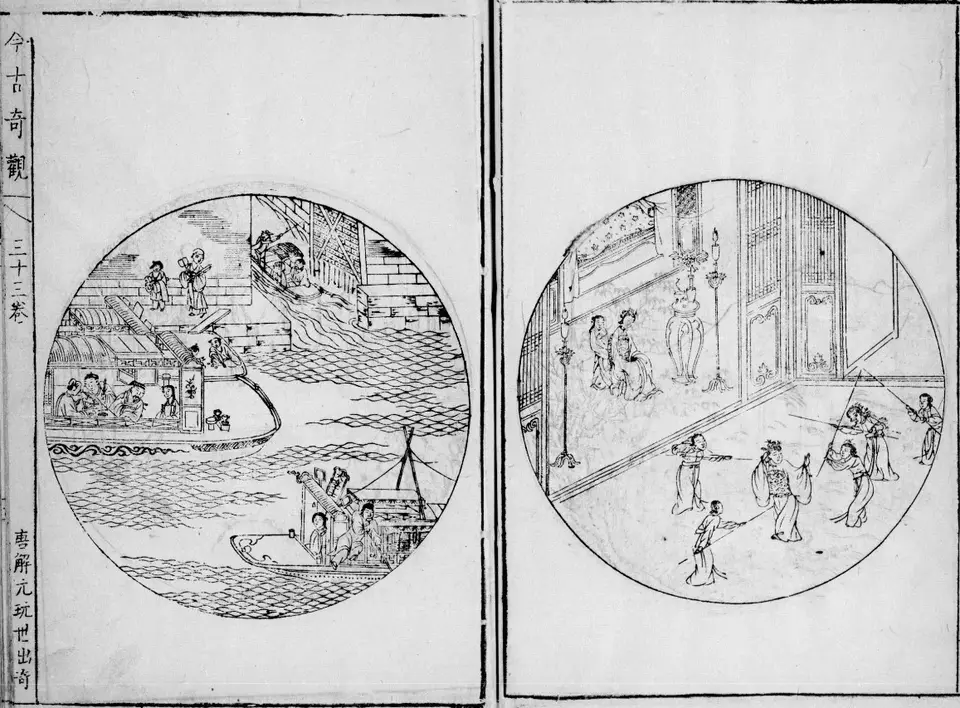
On the day Tang Jie departed Kaifeng, officials and scholars lined the banks of the Bian River to bid him farewell. Leading literati including Mei Yaochen, Ouyang Xiu, and Liu Chang composed parting poems, while Li Shizhong presented the famous lines: "Leaving the capital, your single body is lighter than a leaf; across ten thousand ages, your lofty name is heavier than a mountain. How thick-skinned are the talented men who walk beside you; before they die, the bones of flatterers have already turned cold!" Crossing the Huai River in a fierce storm that nearly capsized his boat, Tang Jie calmly composed the verse: "The sacred Song is not mad Chu; the clear Huai differs from the Miluo River. All my life I have relied on loyalty and good faith; today I leave myself to the wind and waves!" Across the empire, scholars hailed him with the saying, "For a true censor, one must name Tang Zifang."
Provincial Commands and Pacifying the Hedong Frontier
Within a few months of Tang Jie's arrival in Yingzhou, Emperor Renzong reassigned him to supervise taxes in Chenzhou, promoted him to Controller-General of Tanzhou and Prefect of Fuzhou, and recalled him in 1053 as Palace Censor. He subsequently served as Prefect of Yangzhou, Fiscal Commissioner of Jiangdong, Deputy Director of the Bureau of Public Revenue, and in the second year of the Zhihe era (1055) was promoted to Administrator of the Bureau of Policy Criticism (zhi jianyuan) and Acting Prefect of Kaifeng. After impeaching Vice Military Affairs Commissioner Chen Shengzhi in 1056, he went out as Prefect of Hongzhou and later served as Fiscal Commissioner-in-Chief of Hebei and Prefect of Yingzhou.
Upon ascending the throne, Emperor Yingzong admired Tang Jie's "reputation for uprightness in the previous reign" and appointed him Censor-in-Chief (yushi zhongcheng) in the first year of the Zhiping era (1064), transferring him the following year (1065) to Academician of the Longtu Pavilion and Prefect of Taiyuan. When Western Xia troops harassed Daizhou (modern Daixian, Shanxi Province) and built border forts, Tang Jie dispatched troops to demolish their fortifications and sent a letter to the Western Xia commanders explaining the stakes, restoring peace along the border.
Vice Grand Councilor, Debates Over the New Policies, and Death
When Emperor Shenzong ascended the throne in 1067, he recalled Tang Jie to court as Supervising Secretary and State Finance Commissioner (sansi shi), overseeing state finances across the salt-and-iron, census, and public revenue bureaus. In the first month of the first year of the Xining era (1068), he was appointed Participant in Determining Governmental Matters (canzhi zhengshi). When Emperor Shenzong moved to entrust Wang Anshi with power, Tang Jie strongly opposed the appointment and subsequently clashed repeatedly with Wang Anshi over policy. In the fourth month of the second year of the Xining era (May 1069), Tang Jie died of a back carbuncle at the age of sixty. Emperor Shenzong visited his residence in person to mourn him; judging the mourning portrait inadequate, the emperor ordered a portrait preserved in the palace bestowed upon his family, posthumously appointed him Minister of Rites, and granted him the posthumous name "Zhisu," with his burial taking place on the eastern plain of Mount Longshan in Jiangling in the second month of the fourth year of the Xining era (1071).