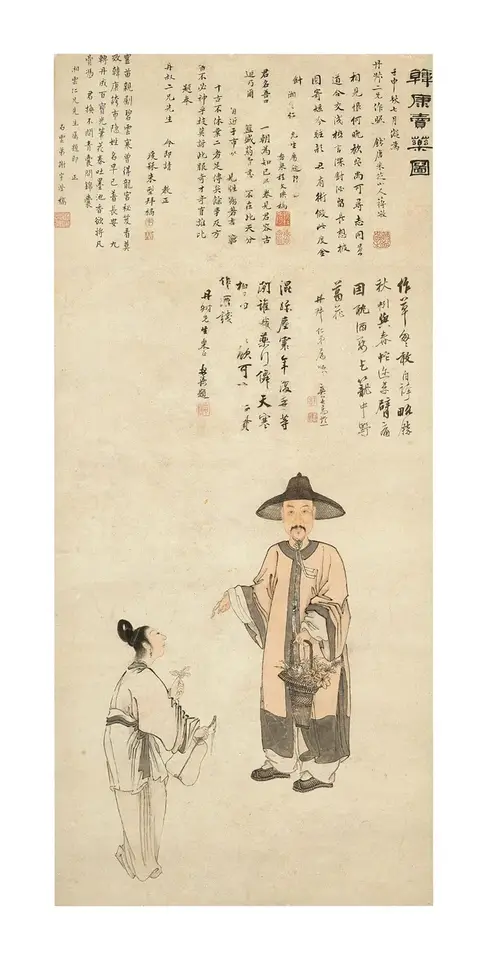
Life and Career
Ministerial Lineage and Examination Triumph
Han Jiang was born in the fifth year of the Dazhong Xiangfu era (1012). His ancestral home was in Yongqiu, Kaifeng, but the family later settled in Changshe, Yingchang Prefecture. His father, Han Yi, served two monarchs as Assistant Grand Councilor and Junior Preceptor to the Crown Prince, celebrated throughout the empire for judicial impartiality and administrative discipline. Governed by strict domestic rules, the Han brothers were exceptionally studious. Ranking third among the brothers, Han Jiang read day and night, mastering administrative statutes, canonical commentaries, and historical institutions.
In October 1037, the twenty-six-year-old Han Jiang took the Kaifeng prefectural examination alongside his brothers Han Gang, Han Wei, and Han Zhen. When the results were published, all four brothers placed among the top candidates. However, court censors voiced suspicions of favoritism due to Han Yi's executive position. Displaying extraordinary rectitude, Han Yi submitted a memorial to Emperor Renzong requesting that his four sons withdraw from the palace examination to avoid suspicion. Renzong consented, and Han Jiang's examination advancement was temporarily halted, leading him to accept minor hereditary posts in the Court of Imperial Sacrifices and Dali Court.
In 1042, thirty-one-year-old Han Jiang sat for the imperial examination in Kaifeng. In a competitive cohort, Han Jiang placed third overall (tanhua), behind champion Yang Zhi and runner-up Wang Gui, and just ahead of fourth-place Wang Anshi. The court and literati widely praised his authentic erudition. Emperor Renzong appointed him palace middle assistant and vice prefect of Chenzhou, formally inaugurating his ministerial career.
Fearless Censorate Service and Judicial Integrity
In 1044, upon the death of his father Han Yi, Han Jiang returned to Changshe to observe three years of filial mourning. In 1047, having completed his mourning, he and his brothers passed palace academy examinations. Renzong appointed him Director of the Court of Imperial Sacrifices and Assistant in the Imperial Academy.
While serving in the Court of Imperial Sacrifices during preparations for major ancestral rites, officials were required by custom to rehearse liturgical movements inside the main ancestral temple before the spirit tablets. Han Jiang objected, arguing that rehearsals involved noisy commands and disorderly ascents and descents, which lacked reverence before the imperial tablets. He urged that rehearsals be relocated to an adjacent pavilion. Emperor Renzong concurred and made Han Jiang's proposal a permanent state statute. Soon afterward, Han Jiang became judicial judge of Kaifeng Prefecture, receiving imperial honors.
During the Zhihe and Jiayou eras, Emperor Renzong promoted Han Jiang to palace censor, vice commissioner of revenue, and Vice Censor-in-Chief, placing him at the helm of the imperial censorate. In this role, Han Jiang investigated official malpractice without hesitation.
When Chancellor Pang Ji intervened in a bribery case involving his confidant Fan Xiang and merchant Zhao Qingkuang, instructing Kaifeng judicial judges to interrogate Zhao brutally to eliminate testimony, Zhao died under torture. Uncovering the truth, Han Jiang submitted scathing memorials impeaching Pang Ji for abusing judicial power and killing an innocent merchant. Renzong dismissed Pang Ji from the chancellorate.
Shortly afterward, hydraulic commissioner Li Zhongchang carelessly breached the Yellow River to divert water through the Liuta River, causing catastrophic flooding that inundated dozens of prefectures in Hebei and drowned tens of thousands of commoners. Han Jiang rode alone into the flood zones, compiled an accurate map of the disaster, and fiercely impeached Li Zhongchang, securing his dismissal and banishment to the far south. For his unwavering integrity, contemporaries hailed Han Jiang as an iron-willed censor.
Directing State Finances and Partnering in the New Policies
In 1067, Emperor Yingzong passed away and Emperor Shenzong ascended the throne. Shenzong was determined to reform the realm's chronic fiscal weakness. Impressed by Han Jiang's lucid grasp of public revenues, Shenzong promoted him to Vice Minister of Revenue and State Finance Commissioner, entrusting him with direction of the three central fiscal bureaus.
Directing state revenue, Han Jiang audited arrears and trimmed redundant imperial expenses, creating a fiscal surplus. In 1069, Shenzong appointed Wang Anshi as Assistant Grand Councilor to launch the Xining Reforms.
As Wang Anshi's former examination classmate and executive colleague, Han Jiang broke with conservative ministers to become an ardent supporter of the reforms. When conservative officials obstructed the Equal Transport Law and Green Sprouts Policy, Han Jiang mobilized central treasury reserves to provide operating capital for local lending bureaus in Huainan and Liangzhe. In May 1070, Shenzong promoted Han Jiang to Assistant Grand Councilor, where he worked hand in glove with Wang Anshi to enact the Hired Service Law, Agricultural Hydraulic Law, and Local Militia System.
Chancellorate Continuity and Stepping Down for Reform Unity
In spring 1074, northern provinces suffered severe drought. Gatekeeper Zheng Xia presented the Illustrations of Refugees to Emperor Shenzong, and imperial empresses wept in private, fueling a fierce conservative backlash. Shaken by the uproar, Shenzong accepted Wang Anshi's resignation.
With Wang Anshi in retirement at Jiangning, conservatives celebrated, anticipating the repeal of the New Policies. However, Shenzong remained committed to the reforms and appointed Han Jiang Grand Councilor of the Secretariat-Chancellery and Grand Academician of the Zhaowen Institute to manage the chancellorate.
Assuming leadership, Han Jiang resisted immense conservative pressure. He maintained all core measures of the New Policies, dispatching supervisory commissioners across the provinces to ensure continued execution. Observing that the reforms survived intact, contemporaries labeled Han Jiang the "Transmitting Chancellor."
However, Assistant Grand Councilor Lu Huiching sought to monopolize power, pursuing harsh persecutions against political rivals and fabricating treason accusations against Wang Anshi's younger brother Wang Anguo. Han Jiang, a man of moderate and dignified temperament, vehemently opposed Lu Huiching's malicious machinations, sparking sharp clashes in the palace.
Recognizing that Lu Huiching's intrigues endangered the reform movement, Han Jiang demonstrated selfless dedication. In early 1075, he secretly memorialized Emperor Shenzong, exposing Lu Huiching's abuses and urging the emperor to recall Wang Anshi to restore political stability. Shenzong agreed and summoned Wang Anshi back to court. On the day Wang Anshi returned to the chancellorate, Han Jiang stepped aside, requesting assignment to govern Xuzhou. His magnanimous willingness to yield power for the greater good won widespread admiration.
Pacifying the Western Frontier and Guiding Border Defense
Earlier in 1070, when Western Xia launched incursions along the Shaanxi border, Emperor Shenzong appointed Han Jiang Pacification Commissioner of Shaanxi, dispatching him to Yan'an to direct six frontier commands.
Arriving at the front line, Han Jiang assessed the vulnerabilities of northern defenses, where overextended supply routes invited nomad raids. He restructured frontier strategy, constructing fortified castles at strategic choke points such as Luochuan and Yongle to obstruct Western Xia cavalry avenues.
Promoting talented generals like Zhong E and Zhe Kexing, he recruited local tribal auxiliary units and expanded agricultural garrisons along the Wuding and Yan rivers. In 1071, Han Jiang directed counteroffensives that reclaimed territory south of Mount Heng. His defensive fortresses and garrison networks laid the logistical foundation for Song border defense throughout subsequent decades.
In later years, while governing Daming Prefecture and Dingzhou, Han Jiang strengthened local archer militias and repaired frontier water dykes, maintaining lasting peace along the northern border with the Liao Empire.
Peaceful Twilight Years and Enduring Stature
During the Yuanfeng era, Emperor Shenzong reorganized the central bureaucracy, rewarding Han Jiang with the rank of Kai-fu Yitong Sansi and creating him Duke of Kang.
In 1086, Emperor Zhezong took the throne under the regency of Grand Empress Dowager Gao, who appointed Sima Guang to rescind the New Policies. Leading reform figures like Lu Huiching and Zhang Dun were exiled. However, because Han Jiang was universally respected for his upright censorate record and personal moderation, Sima Guang treated him with exceptional reverence, promoting him to Minister of Works and permitting him to retire with full salary in Kaifeng.
In November 1088, Han Jiang passed away peacefully in his Kaifeng residence at age seventy-seven. Emperor Zhezong suspended court audiences for a day, granted prominent funeral honors, posthumously conferred the title of Grand Preceptor, and bestowed the posthumous name Xianmin.
Serving across four reigns, Han Jiang maintained unswerving dedication to the realm. As a censor, he demonstrated unyielding fearlessness; as state finance commissioner and chancellor, he provided essential leadership for the New Policies while yielding power magnanimously to preserve reformist unity. His life embodied the finest virtues of the Song scholar-official elite.
Major Achievements
Guiding and Preserving the Xining Reforms
During the transformative Xining Reforms under Emperor Shenzong, Han Jiang served as an indispensable pillar of institutional reform:
When Wang Anshi faced fierce conservative resistance, Han Jiang utilized his authority as State Finance Commissioner to secure the funding for the Equal Transport Law and Green Sprouts Policy. When Wang Anshi was dismissed in 1074, Han Jiang assumed the chancellorate and preserved the entire body of new legislation against conservative counterattacks, serving as the essential protector of Song administrative renewal.
Fiscal Reorganization and Resource Allocation
Heading the State Finance Commission, Han Jiang demonstrated masterful fiscal coordination:
He resolved chronic bureaucratic delays, eliminated redundant expenditures, and recovered millions of strings in back taxes. In implementing the Green Sprouts Policy, he converted dormant granary grain reserves into low-interest agrarian loans, curbing usurious private money-lenders while generating vital revenue for national defense.
Fearless Integrity and Censorate Impeachments
Serving as palace censor and Vice Censor-in-Chief, Han Jiang upheld the rule of law without fear of political consequence:
He relentlessly prosecuted Chancellor Pang Ji for judicial interference and extrajudicial killing, securing the prime minister's dismissal. When hydraulic commissioner Li Zhongchang caused widespread flooding across Hebei through the ill-advised diversion of the Liuta River, Han Jiang conducted on-site surveys and impeached Li, establishing an enduring standard for imperial investigative oversight.
Border Fortifications and Frontier Strategy
Directing Shaanxi frontier defense as pacification commissioner, Han Jiang developed an effective territorial defense doctrine against Western Xia:
Rejecting reckless offensive sorties into arid wastelands, he implemented a strategy of interconnected fortresses and agricultural garrisons along key corridors such as Luochuan and Yongle. Promoting capable local commanders like Zhong E, he secured the northwestern frontier and created a durable logistical infrastructure for the Northern Song military.
Reform of Ancestral Liturgical Protocol
During his early service in the Court of Imperial Sacrifices, Han Jiang instituted an important reform of imperial ancestral rites:
He pointed out that conducting chaotic rehearsals within the ancestral temple hall before the spirit tablets of past emperors violated core Confucian proprieties. He successfully lobbied to relocate all rehearsals to separate halls, an improvement that Emperor Renzong codified into imperial liturgical law.
Institutionalizing Censorate Verification Procedures
During his years leading the censorate, Han Jiang strengthened investigative integrity across imperial oversight organs:
He insisted that imperial censors must ground all accusations in authentic documentary evidence and verified testimony rather than anonymous rumor, establishing rigorous evidentiary standards that checked frivolous slander and protected honest administrators from political witch-hunts.
Frontier Agricultural Colonization and Logistical Planning
Addressing the immense financial burden of transporting grain from central China to northwestern frontier garrisons, Han Jiang established extensive agricultural colonization programs:
Along the Yan and Wuding river valleys, he organized civilian and military farming settlements that brought tens of thousands of acres of wasteland under cultivation. These self-sustaining agricultural colonies produced hundreds of thousands of bushels of grain annually, relieving inland commanderies of onerous transport levies.