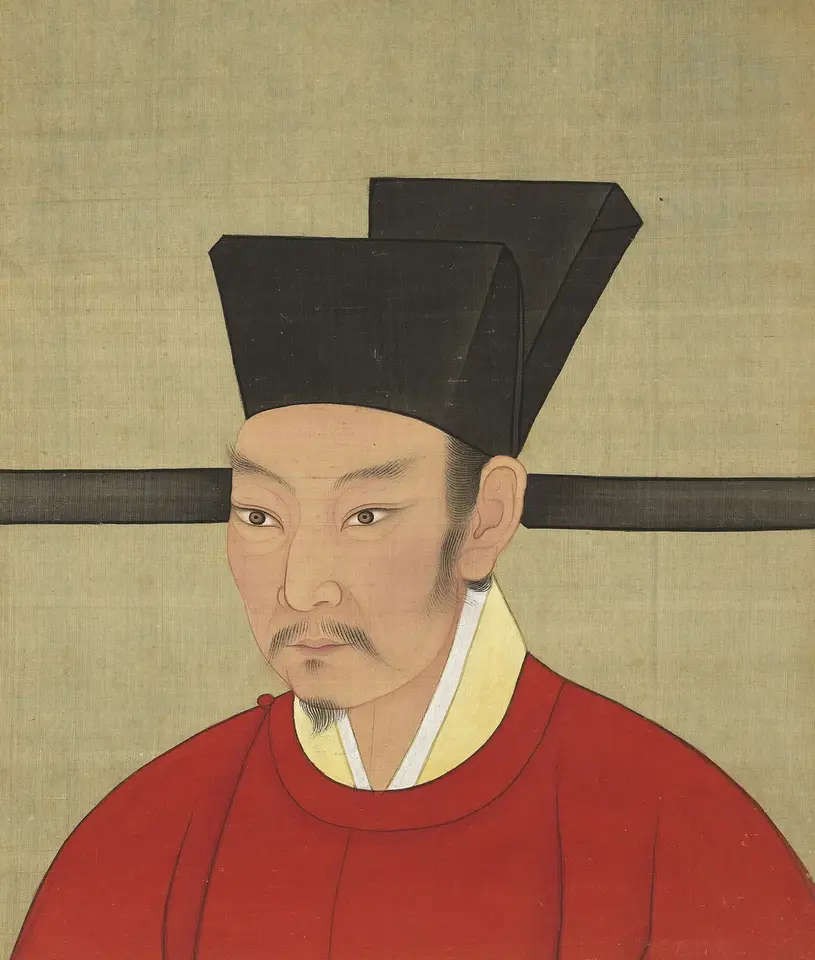
BIOGRAPHY
Chronology
- 1100 | Imperial Birth | Born in Kunning Palace in Kaifeng, named Zhao Dan and created Duke of Han.
- 1115 | Investiture as Crown Prince | Formally invested as heir apparent at Daqing Hall, receiving the dynastic jade tablet.
- 1125 | Reluctant Accession | Ascends the throne following Huizong's panic-driven abdication as Jin armies breach northern borders.
- 1126 (Spring) | First Siege of Kaifeng | Appoints Li Gang to direct city defense, successfully repulsing the initial Jurchen assault.
- 1126 (Summer) | Appeasement and Dismissal | Dismisses Li Gang and disbands loyalist armies, ceding northern border commanderies to Jin.
- 1126 (Autumn) | Fall of Taiyuan | Jin western army captures strategic bastion of Taiyuan, opening the path to central plains.
- 1126 (Winter) | Second Siege and Collapse | Entrusts defense to occultist Guo Jing; outer walls fall and Zhao Huan surrenders at Jin camp.
- 1127 (Spring) | Deposition and Abduction | Deposed by Jin Emperor Taizong; abducted alongside Huizong and three thousand imperial clansmen.
- 1128 | Humiliation at Shangjing | Subjected to the degrading sheep-skin surrender ritual at Shangjing, demoted to Marquis of Chonghun.
- 1156 | Demise in Northern Captivity | Dies in desolate confinement in Jin northern territories at age fifty-seven, ending a tragic life.
Biography
Youthful Enfeoffment and Imperial Heir
Zhao Huan was born on May 23, 1100, in Kunning Palace within the imperial precincts of Bianjing (modern Kaifeng). His father, Emperor Huizong, had recently ascended the imperial throne, while his mother Empress Xiangong belonged to a prominent military lineage. As Huizong's firstborn male child, Zhao Huan's birth was celebrated with immense dynastic prestige. In October of that year, Huizong bestowed the personal name Zhao Dan upon him, conferring military governorships and creating him Duke of Han. In subsequent years he was advanced to Prince of Jingzhao and Prince of Ding. Classical scholars were assigned to instruct him in Confucian canonical texts and administrative histories.
In February 1115, Emperor Huizong issued imperial decrees formally investing the sixteen-year-old prince as Crown Prince, changing his name to Zhao Huan. The grand ceremony was conducted at Daqing Hall, with Huizong seated in formal vestments while Zhao Huan received the imperial credentials and jade tablet in the courtyard before civil and military ministers. Entering the Eastern Palace, Zhao Huan was placed under the political tutelage of Prince Supervisor Geng Nanzhong. Possessing a pedantic and narrow-minded temperament, Geng consistently catered to Zhao Huan's innate anxieties, profoundly influencing the prince's future indecisiveness and aversion to resolute military action.
During his decade as heir apparent, Zhao Huan observed the pervasive corruption that hollowed out the Northern Song state. Unscrupulous favorites, notably Cai Jing, Tong Guan, Wang Fu, and Zhu Mian, dominated imperial patronage, squandering treasury resources on extravagant luxury imports while provoking destructive domestic insurrections like the Fang La rebellion. Although privately distressed by this administrative decay, the reticent prince never dared to confront his father directly. When the ill-fated maritime alliance with the Jurchen collapsed after the fall of Liao, the northern frontier collapsed, bringing catastrophe to Song borders.
Panic Abdication and Reluctant Accession
In the eleventh lunar month of 1125, the Jurchen Jin state launched a massive two-pronged invasion against the Northern Song. The eastern army under Wanyan Zongwang routed imperial forces in Hebei and advanced rapidly toward the Yellow River, while the western army under Wanyan Zonghan laid siege to Taiyuan. On December 21, emergency couriers arrived in Bianjing, plunging the court into complete pandemonium. Terrified of capture and facing immense public indignation, Emperor Huizong resolved to relinquish the imperial title to evade personal culpability, plotting flight to southern provinces.
Suffering a sudden stroke, Huizong collapsed in Xuanhe Hall. Upon regaining consciousness, he was unable to hold a brush, feebly scrawling with his left hand that his physical incapacity precluded managing state affairs. Ministers Wu Min and Li Bangyan urged the immediate transfer of the crown to Crown Prince Zhao Huan. When summoned to the sickbed, the twenty-four-year-old prince prostrated himself and wept bitterly, desperately refusing the imperial robes. Courtiers forcibly draped the yellow gown over his shoulders; Zhao Huan struggled so violently that he collapsed unconscious upon the stone floor. Retainers carried the prince to Funing Hall, where ministers proclaimed him Emperor Qinzong.
Immediately following the abdication, Huizong assumed the decorative title of Retired Emperor, fleeing Kaifeng at dawn under the pretext of burning incense in southern shrines. Accompanied by thousands of elite palace cavalry and substantial treasury wealth, Huizong abandoned his son in the besieged capital. Facing empty arsenals, panic-stricken courtiers, and approaching enemy cavalry, the inexperienced Qinzong adopted the reign title Jingkang, posthumously honored his deceased mother, created Lady Zhu as Empress, and attempted to navigate the mortal crisis confronting his realm.
First Siege of Kaifeng and Armed Resistance
In January 1126, Jin cavalry crossed the frozen Yellow River, pitching camp directly outside Bianjing's northern ramparts. Inside the metropolis, regular garrison forces were meager, and defeatist chancellors Bai Shizhong and Li Bangyan passionately urged Qinzong to abandon the capital and flee south to Xiangyang. Qinzong was terrified, ordering imperial carriages readied for immediate departure. At this desperate juncture, Vice Minister Li Gang knelt before the imperial dais, weeping as he argued that abandoning the ancestral temples would trigger the immediate dissolution of the empire, urging the sovereign to remain and rally provincial loyalist forces.
Li Gang's impassioned appeal swayed palace guard officers, who shouted their readiness to die defending the capital. Reassured by the troops, Qinzong cancelled evacuation orders, promoting Li Gang to Vice Chancellor and Tokyo Defense Commissioner to organize metropolitan defense. Li Gang labored tirelessly, constructing wooden hoardings, mounting ballistas and catapults along the battlements, and recruiting armed volunteers. When Jurchen storming columns launched assaults against Xuanhua Gate, Li Gang personally directed defensive counter-fire, inflicting heavy casualties upon the invaders.
Simultaneously, hundreds of imperial university students led by Chen Dong demonstrated before the imperial palace, supported by tens of thousands of Kaifeng citizens and loyalist soldiers demanding the execution of defeatist ministers and the retention of Li Gang. Rioting crowds killed several corrupt palace eunuchs outside the palace gates. Intimidated by the immense public uproar, Qinzong confirmed Li Gang's command and summoned western army veteran Zhong Shidao to Kaifeng. As tens of thousands of loyalist troops converged upon the capital, Wanyan Zongwang found himself isolated and suspended active storming operations.
Appeasement Diplomacy and the Loss of Taiyuan
Despite early defensive successes, Qinzong's deep-seated constitutional timidity soon reasserted itself. Perceiving imperial hesitancy, Jin commanders exploited Song divisions by offering a temporary truce in exchange for five million ounces of gold, fifty million ounces of silver, millions of bolts of silk, and the territorial cession of three strategic northern commanderies: Taiyuan, Zhongshan, and Hejian. Defeatist councilors Li Bangyan and Geng Nanzhong urged unreserved compliance. Although Li Gang vigorously warned that ceding northern mountain passes would strip central China of all natural defense, Qinzong conceded to every Jurchen demand, sending his younger brother Prince Kang (Zhao Gou) and minister Zhang Bangchang as hostages to the enemy camp.
To extract the demanded tribute, Qinzong instituted ruthless house-to-house confiscations across Kaifeng, seizing imperial heirlooms, aristocratic jewelry, and private household savings, plunging the urban population into financial ruin. Having acquired enormous treasure and formal cession decrees, Jin armies withdrew northward in spring 1126. Relieved by their retreat, Qinzong and Geng Nanzhong succumbed to complacency. Growing deeply suspicious of Li Gang's prestige and military following, Qinzong abruptly dismissed him from high office and dispatched him to the distant Shanxi front to supervise regional pacification.
Meanwhile, the northern fortress of Taiyuan held out heroically under commander Wang Bing for eight months, enduring starvation and bombardment. Rather than mounting a coordinated relief campaign, Qinzong insisted on dictating tactical operations from his palace, compelling veteran commanders Yao Gu and Zhong Shizhong to launch uncoordinated frontal assaults against entrenched Jin positions. Song relief armies were routed in mountain defiles, and Zhong Shizhong died heroically in battle. In September 1126, Taiyuan fell to Jin forces, leaving the central plains defenseless against renewed invasion.
Second Siege and Abject Surrender
Following the capture of Taiyuan, the two main Jin field armies converged upon Kaifeng in late 1126, crossing the Yellow River virtually unopposed. By this time, Qinzong had foolishly disbanded most provincial loyalist armies that had assembled in the capital. Facing an investment by seasoned veteran cavalry, the emperor fell victim to grotesque occult delusions. Courtiers introduced Guo Jing, an illiterate soldier and charlatan who claimed mastery over esoteric Daoist spells capable of summoning divine spirit legions to exterminate foreign armies.
Desperately grasping at occult fantasies, Qinzong conferred military ranks upon Guo Jing and entrusted the defense of the vital Xuanhua Gate to his charlatan cadre. Guo Jing recruited 7,777 street ruffians as his divine warriors. On January 9, 1127, amidst blinding snowstorms, Guo Jing ordered the gate thrown wide open, commanding regular archers to descend from the walls so as not to obstruct celestial spirits. As the disorderly rabble marched out, Jin heavy cavalry swept down upon them, slaughtering them in minutes. Guo Jing fled under the pretext of performing rituals, while Jurchen storming parties ascended the unmanned ramparts, capturing Kaifeng's outer walls within hours.
Trapped within the inner city, Qinzong completely lost the will to resist. Jin commanders Wanyan Zonghan and Wanyan Zongwang established operational headquarters at Qingcheng south of the capital, demanding the emperor's personal appearance to negotiate terms. Advised by defeatist ministers He Li and Sun Di, Qinzong departed Kaifeng on January 14, walking directly into the enemy trap. Kept waiting in freezing pavilions, Qinzong was compelled to submit formal petitions of unconditional surrender, rewriting his self-abasing confession four times until Jurchen marshals approved its degrading phrasing.
Abduction and Demise in the Far North
After returning briefly to the palace, Qinzong functioned as a helpless puppet under Jurchen duress. When ordered to report to the Jin camp a second time on February 11, 1127, he was immediately placed under armed house arrest in a padlocked pavilion. In March, Jin Emperor Taizong issued imperial decrees deposing both Huizong and Qinzong to commoner status, installing former chancellor Zhang Bangchang as puppet ruler of Da Chu, and declaring the Northern Song dynasty extinct.
In April 1127, Jin armies evacuated Kaifeng, marching northward with thousands of prisoners and immense plunder. Qinzong, Huizong, Empress Zhu, Crown Prince Zhao Chen, and over three thousand imperial princes, consorts, and artisans were driven north under armed guard. Clad in crude homespun wool, Qinzong was subjected to constant physical humiliation, while Empress Zhu committed suicide by drowning to escape sexual violation. Arriving at the Jin Supreme Capital in Manchuria in 1128, the royal captives were compelled to perform the degrading sheep-skin surrender ceremony before the Jurchen ancestral shrine.
Demoted to the derisive title Marquis of Chonghun and later Duke of Tianshui, Qinzong was exiled to desolate Wuguo City in the frozen reaches of the lower Songhua River basin. Confined in primitive subterranean earth hovels, he survived on coarse grains, weeping alongside his aging father until Huizong died in 1135. When Southern Song embassies arrived in 1142 following the Shaoxing Peace Accord, Qinzong knelt in the mud before departing envoys, pleading that he be allowed to return south merely to serve as a Daoist priest. Fearful that Qinzong's repatriation would threaten his own imperial legitimacy, Emperor Gaozong ignored his brother's desperate pleas. On June 14, 1156, Qinzong died in northern captivity at age fifty-seven, closing one of the most mournful chapters in Chinese history.
Major Achievements
Succession Crisis and Purging the Six Traitors
When Zhao Huan ascended the throne in December 1125 amidst the chaos of approaching Jin armies, his initial governance focused on reestablishing imperial authority and addressing widespread domestic unrest. Emperor Huizong's reign had been characterized by the dominance of the Six Traitors, a faction of corrupt court ministers including Cai Jing, Tong Guan, Wang Fu, and Zhu Mian, whose financial exactions had provoked severe civil rebellions and hollowed out state treasuries.
Yielding to petitions submitted by imperial university scholar Chen Dong and provincial officials, Qinzong initiated a sweeping political purge against these entrenched favorites. Imperial edicts stripped Wang Fu and Zhu Mian of official titles and confiscated their vast estates, followed by their execution in southern provinces. Tong Guan was tracked down and beheaded, Liang Shicheng was compelled to commit suicide, and Cai Jing was banished to southern Hainan, dying en route. While these purges temporarily rallied public support, Qinzong replaced the disgraced officials with narrow-minded courtiers like Geng Nanzhong, failing to create an effective war cabinet.
Defense of Bianjing Under Li Gang
The defense of Kaifeng in early 1126 stood as the most heroic military episode of Qinzong's brief reign. When Wanyan Zongwang's eastern army crossed the Yellow River and besieged the capital, defeatist ministers urged flight, but Vice Minister Li Gang argued passionately for armed defense. Recognizing the military necessity of holding the ancestral capital, Qinzong appointed Li Gang as Tokyo Defense Commissioner.
Li Gang demonstrated remarkable administrative efficiency, mounting heavy ballistas, trebuchets, and stone barricades along the battlements while organizing disciplined civilian volunteer units. When Jurchen shock columns launched assaults against Xuanhua and Fengqiu gates, Li Gang directed defensive missile fire, repulsing repeated enemy assaults. As western army reinforcements under veteran general Zhong Shidao arrived outside the city, the Jin invasion army found itself encircled, compelling Wanyan Zongwang to suspend offensive operations.
Strategic Vacillation and Purging Loyalists
Following the lifting of the initial siege, Qinzong's lack of strategic constancy produced catastrophic political decisions. Councilors led by Li Bangyan and Geng Nanzhong exploited minor tactical setbacks, such as an unsuccessful night raid led by general Yao Pingzhong, to undermine the standing of hardline commanders. They convinced the anxious emperor that active resistance needlessly provoked Jurchen wrath.
Succumbing to court intrigue, Qinzong abruptly dismissed Li Gang and Zhong Shidao from their military commands. This dismissal provoked massive public protests as thousands of imperial university students and Kaifeng citizens besieged the palace, assaulting Li Bangyan and demanding the restoration of the patriotic commanders. Although Qinzong temporarily reinstated Li Gang under intense public duress, he harbored lingering resentment against the minister's popular acclaim, subsequently reassigning him to distant regional pacification duties.
The Occult Debacle of the Six-Jia Warriors
Qinzong's reliance on occult superstition during the second siege of Kaifeng in late 1126 was among the most disastrous blunders in Chinese military annals. Encircled by two massive Jurchen field armies and having dismissed his loyalist garrisons, Qinzong embraced the claims of Guo Jing, a former soldier who claimed esoteric Daoist spells could animate celestial warriors to destroy the invaders.
Conferring high military rank and immense treasury subsidies upon the charlatan, Qinzong entrusted the defense of Xuanhua Gate to Guo Jing's 7,777 street recruits, styled the Six-Jia Divine Soldiers. On January 9, 1127, Guo Jing ordered the gate thrown wide open and commanded defensive archers to abandon the battlements. As the undisciplined rabble marched out, Jin heavy cavalry annihilated them in minutes. Guo Jing fled, and Jurchen assault teams mounted the unmanned walls, precipitating the fall of the Northern Song capital.
Capitulation and the Jingkang Catastrophe
Following the breach of Kaifeng's outer walls, Qinzong abandoned armed defense and surrendered to enemy demands. Lured by false promises of diplomatic settlement, Qinzong departed the capital on January 14, 1127, surrendering in person at the Jin military headquarters at Qingcheng. Detained in freezing pavilions, the emperor was coerced into composing abject petitions of submission, altering his phrasing repeatedly to satisfy Jurchen commanders.
Using the emperor's person as leverage, Jin generals demanded impossible indemnities of ten million ingots of gold, twenty million ingots of silver, and thousands of young women. Returning briefly to his palace, Qinzong enforced ruthless confiscations across Kaifeng, even handing over palace maidens and junior concubines to satisfy enemy quotas. When summoned to the Jin camp a second time on February 11, Qinzong was permanently detained. In March 1127, Jin authorities formally deposed the Song ruling house, abducting the entire royal family and extinguishing the Northern Song state.
Decades of Confinement in Manchuria
Following his abduction, Zhao Huan endured nearly thirty years of captivity in the northern territories of the Jin empire. Driven north under harsh conditions alongside his father and three thousand imperial kinsmen, he witnessed the suicide of his empress and the death of numerous relatives. In 1128, he was subjected to the humiliating sheep-skin surrender ceremony before the Jurchen ancestral shrine at Shangjing, receiving the derisive title Marquis of Chonghun.
In 1130, the captive emperors were relocated to primitive earth hovels at Wuguo City in modern Heilongjiang, surviving on coarse rations in harsh subarctic winters. Following Huizong's death in 1135, Zhao Huan remained in isolation. Although the Shaoxing Treaty of 1142 led to the repatriation of his stepmother Empress Dowager Wei, Emperor Gaozong deliberately refused to negotiate Zhao Huan's return to prevent dynastic succession disputes. On June 14, 1156, Zhao Huan died in northern captivity at age fifty-seven, concluding his tragic life.
Metropolitan Exactions and Confiscations
To satisfy Jurchen indemnity demands, Qinzong orchestrated devastating financial extractions across Kaifeng between December 1126 and February 1127. Demanding ten million ingots of gold and twenty million ingots of silver, imperial magistrates conducted coercive searches of private residences, arresting and torturing citizens suspected of concealing wealth.
The municipal government established coerced exchange markets, compelling starving residents to surrender family heirlooms in exchange for modest grain rations. Wealthy merchant families and scholar-officials were reduced to destitution, with many committing suicide. Despite these brutal measures, the collected sums failed to satisfy the occupying forces, serving only to dismantle domestic support and destroy the capital's social fabric.
Cession of the Northern Bastions
The decision to cede the strategic northern commanderies of Taiyuan, Zhongshan, and Hejian was Qinzong's most disastrous diplomatic capitulation. These fortified mountain bastions had guarded the north China plain against nomadic invasions for centuries. During the first siege of Kaifeng, Jin commanders made the cession of these territories an absolute prerequisite for withdrawal.
Ignoring urgent warnings from Li Gang that surrendering the three commanderies would leave the capital defenseless, Qinzong signed formal cession decrees. When the heroic garrison of Taiyuan under Wang Bing refused to surrender, Qinzong dispatched imperial commissioners ordering the defenders to yield. The subsequent fall of Taiyuan removed the final barrier protecting the central plains, enabling Jurchen armies to march unopposed to Kaifeng during the second invasion.
Dismissal of Military Commanders
Throughout the crises of 1126, Qinzong demonstrated profound suspicion toward experienced military commanders, repeatedly undermining his own defense forces. After veteran commander Zhong Shidao marched to Kaifeng's relief, he advised the emperor to deploy forces along the Yellow River crossings and strike the retreating Jurchen army as it navigated the river. Fearing renewed conflict, Qinzong rejected this plan and stripped Zhong of active command, causing the veteran general to die of grief and illness.
Similarly, Qinzong vacillated in his treatment of Li Gang, removing him from the Privy Council and dispatching him to coordinate impossible military operations in Shanxi without adequate logistical support. When civilian councilors Xu Han and Geng Nanzhong forced frontline commanders into reckless advances, Song relief forces were annihilated at the Battle of Shaoxiongling, destroying the empire's remaining field armies.
Sorrows of Subarctic Captivity
The decades of confinement endured by Zhao Huan at Wuguo City formed one of the most poignant episodes of dynastic downfall in Chinese history. Separated from their homeland, the former monarchs inhabited primitive earth huts, enduring subarctic winters with inadequate clothing and coarse rations.
Following Huizong's death in 1135, Zhao Huan buried his father in the frozen northern soil under the supervision of Jurchen guards. When Southern Song diplomatic missions visited Jin territory, Zhao Huan prostrated himself in the mud, begging envoys to convey his willingness to live as a private Daoist monk if allowed to return to southern China. His desperate entreaties were ignored by Emperor Gaozong, leaving Zhao Huan to perish in subarctic isolation.
The Hostage Mission of Prince Kang
In early 1126, Qinzong's decision to dispatch his younger half-brother Prince Kang (Zhao Gou) as a peace hostage to the Jin military camp produced profound historical repercussions. Demanding an imperial prince and chancellor as security for their withdrawal, Jin commanders required high-ranking hostages to accompany their retreat across the Yellow River.
While other princes shrank from the perilous assignment, the twenty-year-old Zhao Gou accepted the mission. In the enemy camp, Zhao Gou demonstrated composed dignity, displaying remarkable archery skill that led Jin commander Wanyan Zongwang to suspect he was an impostor. The Jin court demanded a replacement, allowing Zhao Gou to return to Kaifeng before being reassigned to Hebei, where he survived the fall of the capital and subsequently founded the Southern Song dynasty.
Suppression of Student Demonstrations
Qinzong's volatile treatment of student activists and popular patriotic movements reflected the autocratic suspicion of his administration. During the first siege of Kaifeng, thousands of imperial university scholars under Chen Dong mobilized public sentiment to defend the capital, forcing Qinzong to retain Li Gang.
However, as soon as the immediate military danger receded, Qinzong and Geng Nanzhong viewed this civic activism as dangerous sedition. The government enacted strict bans against unauthorized political assemblies, deploying military police to arrest citizens who had participated in demonstrations against Li Bangyan. Several protest leaders were executed, and Chen Dong was placed under official surveillance. This suppression of public patriotism extinguished civic morale, leaving the population alienated and dispirited when Jin armies returned.
Power Struggles with the Retired Emperor
Following his sudden accession, Qinzong engaged in tense political maneuvers against his abdicated father, Emperor Huizong. After fleeing Kaifeng during the initial invasion, Huizong resided in Zhenjiang with personal guards and treasury wealth, establishing an alternative center of royal authority.
When Huizong returned to Kaifeng in mid-1126 after the Jin withdrawal, Qinzong viewed his father's return with intense paranoia, fearing a coup by conservative factions. Instructed by Geng Nanzhong, Qinzong dispatched troops to intercept Huizong outside the walls, confiscating his personal guard and confining the retired monarch within the secluded Longde Palace. Forbidden from communicating freely with outside ministers, Huizong spent his final months in Kaifeng as a virtual prisoner of his son, fracturing dynastic unity on the eve of final collapse.
Personal Relationships
Kinship
- Father: Emperor Huizong of Song (Zhao Ji), eighth emperor of the Northern Song, who abdicated in late 1125 and died in captivity at Wuguo City in 1135.
- Mother: Empress Xiangong of the Wang clan, native of Pingyuan, who died in 1100 and was posthumously honored as Empress Dowager.
- Consort: Empress Renhuai (Empress Zhu), daughter of Duke Zhu Baicai, invested as Crown Princess in 1116 and drowned herself during northern deportation in 1127.
- Brother: Emperor Gaozong of Song (Zhao Gou, Prince Kang), ninth son of Huizong, who escaped capture and founded the Southern Song dynasty.
- Sons: Crown Prince Zhao Chen, born to Empress Zhu in 1117, abducted to Manchuria with his parents; Zhao Jin and Zhao Xun, both born in captivity.
Loyalist Ministers and Patriots
- Li Gang: Vice Chancellor and Tokyo Defense Commissioner, unwavering leader of armed resistance who orchestrated the successful defense of Kaifeng in early 1126.
- Zhong Shidao: Veteran commander of the western armies, whose timely arrival relieved Kaifeng during the first siege, died of illness after dismissal.
- Zhong Shizhong: Commander of the Hebei forces, brother of Zhong Shidao, killed in action at the Battle of Shaoxiongling while attempting to relieve Taiyuan.
- Chen Dong: Student leader of the Imperial University who rallied metropolitan citizens to support Li Gang and resist defeatist councilors.
Defeatist Ministers and Collaborators
- Bai Shizhong: Grand Chancellor inherited from Huizong's court who advocated immediate evacuation of Kaifeng and urged territorial cessions.
- Li Bangyan: Vice Chancellor who consistently favored appeasement, assaulted by angry citizens outside the palace gates for his defeatist policies.
- Geng Nanzhong: Crown Prince tutor and chancellor who systematically purged patriotic commanders and promoted abject submission to Jin demands.
- Zhang Bangchang: Vice Chancellor sent as hostage to the Jin camp, later installed by Jurchen forces as puppet emperor of Da Chu.
- Guo Jing: Charismatic military vagrant whose fraudulent claims of commanding divine occult legions directly caused the fall of Kaifeng's outer defenses.
Adversaries
- Wanyan Zongwang: Second Prince and commander of the Jin eastern army, who led the first siege of Kaifeng and extracted immense territorial and financial concessions.
- Wanyan Zonghan: Field marshal of the Jin western army, who captured Taiyuan, orchestrated the final siege of Kaifeng, and deposed the Song dynasty.
- Wanyan Sheng (Emperor Taizong of Jin): Second emperor of the Jin dynasty who issued decrees abolishing the Song dynasty and demoted Qinzong to Marquis of Chonghun.
Historical Evaluations
Zhao Huan's brief reign as the last emperor of the Northern Song remains one of the most tragic and heavily criticized episodes in Chinese imperial history. While inheriting an empire weakened by decades of administrative corruption, his personal vacillation, strategic incompetence, and dismissal of loyal commanders precipitated total dynastic ruin.
The official History of Song, compiled under Toqto'a, provides a somber verdict: "Emperor Qinzong reigned for merely fourteen months, yet endured the most profound catastrophe. The momentum of rebellion had already formed beyond remedy. Sovereign and ministers gazed at one another, unable to unite in counsel to overcome the crisis, trembling in ceaseless pursuits of appeasement. In the end, father and son were carried away into northern captivity, and the ancestral altars were reduced to overgrown ruins. He was yielding and ignorant of righteousness. Bearing rule for a brief span, he suffered catastrophic misfortune."
Ming philosopher Wang Fuzi condemned Qinzong's self-destructive governance in his On Song: "When Qinzong ascended the throne, the empire was far from lost. Li Gang directed the court, Zhong Shidao mobilized armies in the field, and loyalist forces assembled from every quarter. Yet Qinzong heeded the treacherous counsel of Geng Nanzhong and Li Bangyan, believed the absurd charlatanry of Guo Jing, ceded territories, and purged loyal commanders. He opened his own gates to welcome the fierce invader; how could the empire avoid destruction?"
Modern historians characterize Zhao Huan as a tragic ruler completely unsuited for wartime governance. Lacking strategic vision and moral resolve, his constant oscillation between resistance and capitulation, combined with his ruthless extraction of private wealth to satisfy enemy demands, cemented his historical reputation as an archetype of dynastic failure.
Related Entries
- Jingkang Incident
- Emperor Huizong of Song
- Li Gang
- Zhong Shidao
- Defense of Kaifeng
- Marquis of Chonghun
- Wuguo City
- Guo Jing