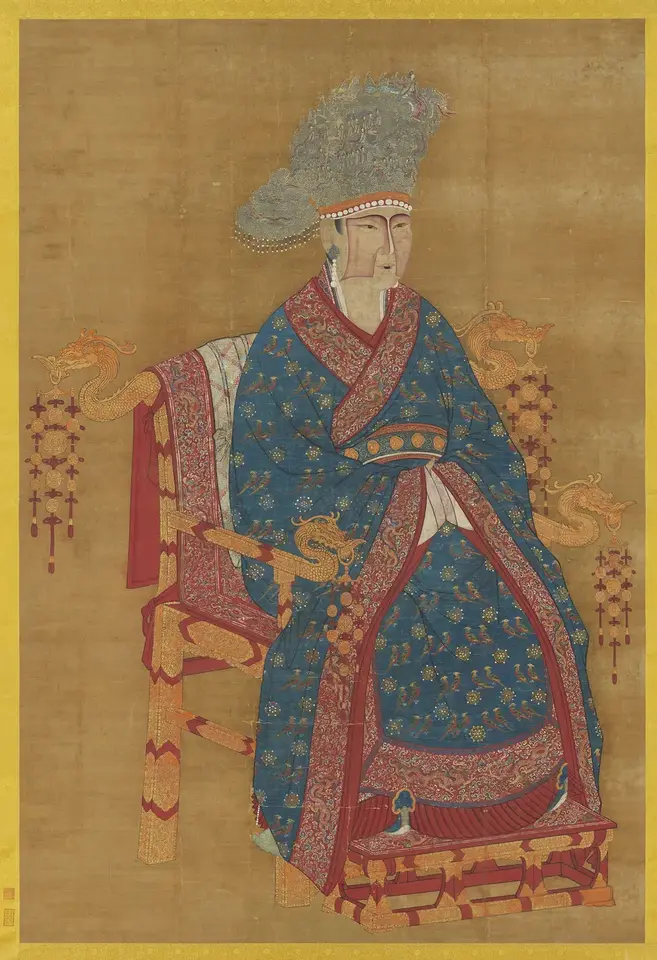
Life Story
Modest Early Life and Palace Attendant
Lady Wei was born in the third year of Yuanfeng (1080). Traditional sources record differing details regarding her origins. The History of Song records her as a native of Kaifeng, identifying her father as Wei Anli. However, Southern Song scholar Zhou Bida noted in his records that Lady Wei hailed from Kuaiji in Liangzhedong Circuit. During the Shaosheng era, when retired chancellor Su Song dwelt in Danyang, Lady Wei and her sister served as domestic maids in his household. Legend relates that Su Song was impressed by her remarkable presence and predicted her future imperial elevation, assisting the sisters to move to the capital.
In the final year of Yuanfu, Emperor Zhezong chose daughters of respectable commoners to distribute among princely households. Recommended by palace officer Li Congyue, Lady Wei entered the residence of Zhao Ji, Prince of Duan. Following Emperor Zhezong's premature death, Zhao Ji ascended the throne as Emperor Huizong. Lady Wei entered the inner palace and was assigned to wait upon Consort Zheng, who later became Empress Zheng.
Sworn Sisterhood and the Birth of Prince of Kang
In Consort Zheng's palace, Lady Wei formed an intimate bond of sisterhood with another young attendant, Lady Qiao. Living humbly at the base of the court hierarchy, the two maidens entered into a pact: whichever of them attained imperial favor first would assist and recommend the other. During the Chongning era, Lady Qiao attracted Emperor Huizong's attention and rapidly advanced to Noble Consort. Remembering their solemn vow, Consort Qiao continuously extolled Lady Wei before the sovereign. Emperor Huizong summoned Lady Wei to his presence and conferred upon her the title of Lady of Pingchang Commandery in 1106.
In the second month of 1107, Lady Wei advanced to Lady of Handsome Fairness. On the twenty-first day of the fifth month, she gave birth to Huizong's ninth son, Zhao Gou. Following the prince's one-month anniversary, she was promoted to Lady of Complete Deportment, and in 1108 rose to Lady of Cultivated Demeanour. In an inner court filled with captivating beauties, Lady Wei maintained a reserved, modest deportment, residing quietly in the Longde Palace.
The Hostage Sacrifice and Captivity in the North
During the late Xuanhe era, the Jurchen armies of the Jin dynasty swept across the northern plains, placing Kaifeng under direct siege. In the eleventh month of 1126, Jurchen commander Wanyan Zongwang demanded an imperial prince and a prime minister as hostages as a condition for temporary negotiations. While other imperial sons recoiled in terror, Prince Zhao Gou stepped forward with determination, offering his person to the enemy camp.
Emperor Huizong was deeply moved by Zhao Gou's courage and filial devotion. To honor the prince's sacrifice, the sovereign issued a special decree elevating his mother Lady Wei to Worthy Consort of Longde Palace. However, imperial concessions failed to sate Jurchen ambition. In the spring of 1127, Kaifeng's defensive walls fell, Emperor Qinzong surrendered, and northern Song imperial authority collapsed.
On the twenty-seventh day of the third month of 1127, Jurchen forces commenced the forced northward march of over two thousand imperial males and more than three thousand female royals and palace attendants. Worthy Consort Wei, along with Zhao Gou's primary wife Lady Xing and numerous imperial daughters, was driven into exile. Exposed to biting cold, starvation, and continuous humiliation, more than half of the captives perished before reaching Yanshan.
During the grueling trek, Lady Wei encountered captive courtier Cao Xun. She secretly passed to him a segment of raw silk from her garments, tearfully entreating him that if he managed to escape to the south, he must deliver it to Prince Zhao Gou, urging her son not to jeopardize state preservation for her sake, but to ascend the throne promptly and preserve the ancestral lineage. Cao Xun survived perilous journeys, arrived in southern territory, and delivered her maternal message to Zhao Gou.
Tribulations in Huining and Transfer to Wuguo
Upon reaching Yanshan, Emperors Huizong and Qinzong were detained while Lady Wei, Lady Xing, and younger consorts were forced onward into the far north. On the twenty-third day of the fifth month, they reached the Jurchen capital of Huining Prefecture. On the seventh day of the sixth month, Lady Wei was brought to the Qianyuan Hall before Emperor Taizong of Jin, who immediately consigned her and eighteen fellow imperial women to hard labor in the Laundry Bureau.
In the eighth month of 1128, Emperors Huizong and Qinzong reached Huining. Emperor Taizong commanded a humiliating submission ritual, forcing the captive emperors, Lady Wei, and Lady Xing to strip to the waist, don sheepskins, and prostrate themselves before the ancestral shrine of Aguda. Following the ceremony, Lady Wei was returned to the Laundry Bureau alongside three hundred captive royal women to perform menial tasks under harsh scrutiny.
Meanwhile, Prince Zhao Gou had ascended the imperial throne at Yingtiandian in the fifth month of 1127, founding the Southern Song dynasty as Emperor Gaozong. He proclaimed his mother Empress Xuanhe in absentia, and designated Lady Xing as Empress. In his official proclamations, Gaozong repeatedly declared that securing the return of his captive mother and the ancestral coffins constituted his supreme filial mandate, utilizing it as an emotional rallying cry for state survival.
In the second month of 1135, Emperor Xizong of Jin ascended the throne, relaxing harsh policies toward the captive Song house. Lady Wei was finally released from the Laundry Bureau and permitted to travel to Wuguo City to join the ailing Emperor Huizong. However, only two months after their reunion, the broken sovereign died in captivity. Lady Wei wept inconsolably over his remains in the desolate northern settlement.
The Shaoxing Accord and Farewell to Consort Qiao
Over the ensuing decade, Southern Song armies under Yue Fei and Han Shizhong inflicted major defeats upon Jurchen forces. Seeking a negotiated peace, Emperor Gaozong and Chancellor Qin Hui concluded the Shaoxing Peace Accord in the eleventh month of 1141, in which the Song agreed to nominal vassalage and territorial concessions in exchange for the return of Lady Wei and the coffins of Huizong, Empress Zheng, and Empress Xing.
In the spring of 1142, the Jin court authorized Lady Wei's journey south. Before her departure, Noble Consort Qiao, her companion in captivity, hosted a tearful farewell banquet. Offering a cup of wine with trembling hands, Consort Qiao wept that Lady Wei was returning to her son to enjoy the supreme honor of Empress Dowager, while she herself was destined to perish on northern soil.
Embracing her companion in grief, Lady Wei swore by heaven that if she ever forgot their shared suffering, divine retribution would befall her. Jurchen general Wanyan Zongxian marshaled elite cavalry to escort the funeral cortege and Lady Wei's carriage across the Huai River into Southern Song territory.
Return to Lin'an and Exposing the Impostor
On the thirteenth day of the eighth month of 1142, Lady Wei's procession reached the northern outskirts of Lin'an. Emperor Gaozong, accompanied by civil and military ministers, rode forth to receive her. Dismounting before her carriage, the emperor knelt in the dust, weeping profusely as mother and son reunited after sixteen agonizing years of separation.
Emperor Gaozong escorted Lady Wei to the newly constructed Cining Palace, formally investing her as Empress Dowager. Huizong's coffin was entombed in the Yongyou Mausoleum in Kuaiji. The emperor spared no resource in providing for his mother's comfort, ensuring that her every wish in the Cining Palace was fulfilled with royal splendor.
Prior to Lady Wei's return, a young woman had arrived in Lin'an claiming to be Emperor Huizong's daughter, Princess Roufu, asserting she had escaped from northern captivity. Emperor Gaozong and senior eunuchs had examined her, confirming her physical resemblance and intimate familiarity with palace affairs, overlooking her enlarged feet after she explained that walking thousands of miles barefoot had transformed them. The emperor had invested her as Princess of Fuguo and arranged an aristocratic marriage.
Upon her arrival in Lin'an, Empress Dowager Wei exposed the deception, testifying that the authentic Princess Roufu had died of illness under Wanyan Zongxian's custody at Wuguo City a year prior to the repatriation. Gaozong transferred the impostor to the Court of Judicial Review, which discovered she was actually an itinerant nun named Jingshan from Kaifeng who had capitalized on wartime chaos to usurp royal identity. The impostor was executed, purifying the imperial lineage.
Peaceful Longevity and Mausoleum Rites
In her final decades at the Cining Palace, Empress Dowager Wei led a life of quiet modesty. Having witnessed the devastation of war and displacement, she refrained from establishing consort factions, ensuring that her male relatives served with humble diligence.
Recognizing that Emperor Gaozong had lost his only son during the Miao-Liu Mutiny and was unable to produce another heir, the Empress Dowager warmly embraced the emperor's decision to foster Zhao Shen, a descendant of Emperor Taizu. Treating the future Emperor Xiaozong with maternal devotion, she shielded him from palace intrigue and solidified his position as crown prince, facilitating a seamless transfer of sovereign authority.
On the twentieth day of the ninth month in the twenty-ninth year of Shaoxing (1159), Empress Dowager Wei passed away in the Cining Palace at the venerable age of eighty. Emperor Gaozong was overwhelmed with grief, canceling court audiences for thirteen days and bestowing upon his mother the posthumous name Empress Xianren. In the eleventh month of 1159, she was interred in the Yongyou Mausoleum alongside Emperor Huizong.
Major Achievements
Exemplary Fortitude During Severe Captivity
During the catastrophic Jingkang Incident and the subsequent exile to northern frontiers, Lady Wei endured fifteen years of unimaginable hardship in the Laundry Bureau and northern border outposts. Throughout this ordeal, she maintained her resolve and preserved the dignity of the Song house.
Her clandestine message entrusted to Cao Xun, urging Prince Zhao Gou to prioritize state survival over personal ties, provided a moral mandate that bolstered Gaozong's authority during the founding of the Southern Song.
Facilitating Coffin Repatriation and Peace Settlement
As the surviving consort of Huizong and mother of the reigning sovereign, Empress Dowager Wei was the focal point of Southern Song diplomatic negotiations. Gaozong made her release and the repatriation of ancestral coffins the indispensable baseline of diplomacy.
Her return to Lin'an relieved the dynasty of a profound moral and filial crisis, assuaging widespread trauma across the realm and cementing the geopolitical stability achieved through the Shaoxing Peace Accord, which granted the southern dynasty decades of economic revitalization.
Unmasking the Impostor and Protecting Royal Bloodline
Upon returning to the southern capital, Empress Dowager Wei displayed resolute decisiveness in resolving the sensational case of the counterfeit princess. Relying upon her firsthand knowledge from northern captivity, she exposed the fraud and safeguarded the purity of the royal genealogy.
Her intervention eliminated a major source of political rumor, reaffirming the administrative authority of the inner palace in imperial lineage matters.
Nurturing Prince Zhao Shen and Securing Succession
Following the death of Gaozong's infant heir, the succession remained precarious. When Gaozong adopted Zhao Shen, a descendant of Emperor Taizu, Empress Dowager Wei embraced the boy with grandmotherly affection, protecting him from factional suspicion and fostering his education.
Her maternal patronage was instrumental in securing Zhao Shen's standing as crown prince and ensuring an orderly dynastic transition to Emperor Xiaozong.