Forest Birth
Born into the royal Wanyan clan along the Anchuhe River; grew rugged, mastering archery and horse-riding in boreal forests.
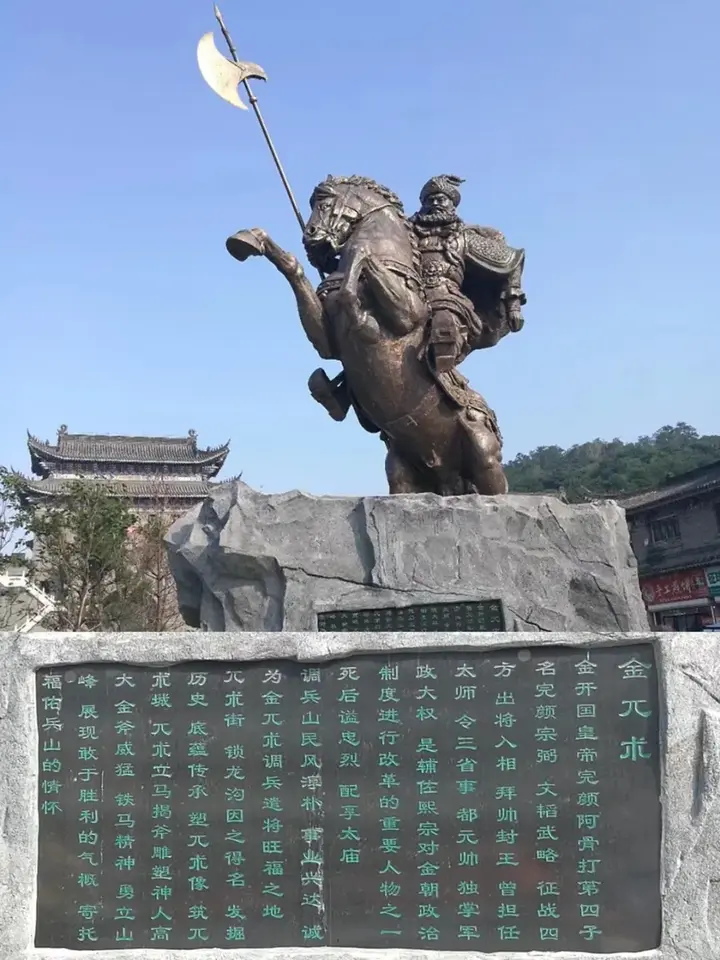
?–1148 CE
完颜宗弼
Wanyan Zongbi (c. 1100–1148 AD), Jurchen name Wozhu, popularly known in folklore as "Wuzhu" or "Jin Wuzhu", was a native of the Anchuhe River basin (present-day Acheng, Harbin, Heilongjiang Province). He was an illustrious founding prince, grand military commander, strategist, and Chancellor of the Jurchen Jin Dynasty. The fourth son of Emperor Taizu Wanyan Aguda, he rose to Grand Guardian, Grand Marshal, and Director of the…
Wanyan Zongbi (c. 1100–1148 AD), Jurchen name Wozhu, popularly known in folklore as "Wuzhu" or "Jin Wuzhu", was a native of the Anchuhe River basin (present-day Acheng, Harbin, Heilongjiang Province). He was an illustrious founding prince, grand military commander, strategist, and Chancellor of the Jurchen Jin Dynasty. The fourth son of Emperor Taizu Wanyan Aguda, he rose to Grand Guardian, Grand Marshal, and Director of the Three Departments, was ennobled as Prince of Liang and Prince of Yue, and received the posthumous title "Zhonglie". Demonstrating precocious bravery and equestrian mastery from youth, Zongbi participated in the campaigns that extinguished the Khitan Liao and Northern Song dynasties. In 1129 AD, he commanded a deep cavalry sweep south across the Yangtze River, seizing Lin'an and Mingzhou and conducting an aggressive manhunt across southern China that forced Emperor Gaozong to flee to sea. Withdrawing north in 1130 AD, he was trapped by Han Shizhong's naval forces in the dead-end waterway of Huangtiandang for forty-eight days before escaping via fire attack. Later that year, his heavy cavalry served as the tactical anchor at the Battle of Fuping, routing a Song coalition of four hundred thousand troops to secure Shaanxi and the western approaches. In 1140 AD, Zongbi tore up past peace accords to launch an invasion, only to suffer crushing defeats against Liu Qi at Shunchang and Yue Fei at Yancheng and Yingchang, where his elite heavy cavalry units, the "Iron Pagoda" and "Flank Horses", were decimated. Falling back on Kaifeng, Zongbi sent secret correspondence to Chancellor Qin Hui demanding that "Yue Fei must be killed before peace can be signed". Following Yue Fei's judicial murder, Zongbi orchestrated the Treaty of Shaoxing, establishing the Huai River boundary and reducing Song to a tributary vassal. He directed Jin imperial governance for eight years until his death in 1148 AD. Zongbi remains the foremost martial pillar of Jurchen expansion into central China.
Born into the royal Wanyan clan along the Anchuhe River; grew rugged, mastering archery and horse-riding in boreal forests.
Pursued Emperor Tianzuo of Liao to Mount Qingling; charged enemy formations alone to seize weapons and horses.
Served as vanguard officer under his brother Wanyan Zongwang, besieging Kaifeng and joining the Jingkang Incident.
Led an elite cavalry force south across the Yangtze, capturing Lin'an and driving Emperor Gaozong into naval exile.
Trapped for forty-eight days by Han Shizhong at Huangtiandang before burning out; crushed Song armies at Fuping.
Invaded the Huai basin with puppet Qi armies; suffered severe losses from Han Shizhong's tactical ambush at Dayi.
Launched a four-pronged invasion but was decisively routed by Yue Fei at Yancheng and Yingchang, losing his elite heavy cavalry.
Demanded Yue Fei's execution; concluded the Treaty of Shaoxing establishing the Huai River border.
Passed away in office as Grand Guardian and Director of the Three Departments; honored as Prince of Yue.
Wanyan Zongbi was born into the core royal family of the Jurchen Wanyan clan along the Ashi River in modern Heilongjiang. His father was the founding dynastic monarch, Emperor Taizu Wanyan Aguda. Ranking fourth among Aguda's sons, Zongbi grew up enduring rigorous nomadic hunting and mounted archery in the northern forests, cultivating formidable strength, physical endurance, and fierce operational resolve.
In 1122 AD, the twenty-two-year-old Zongbi accompanied his uncle Wanyan Xieye in hot pursuit of Emperor Tianzuo, the last monarch of the Khitan Liao dynasty, near Mount Qingling. When his detachment exhausted its arrows, Zongbi charged alone into the Liao defensive line, speared several enemy warriors to death, captured multiple warhorses, and returned uninjured, his martial reputation echoing across the camps. In 1125 AD, the Jin Empire launched a two-pronged invasion to crush Northern Song. Assigned to the eastern army under his elder brother Wanyan Zongwang, Zongbi served as vanguard shock commander, storming Zhending and Linzhang, forcing the Yellow River crossings, and driving his horsemen to the walls of Kaifeng, culminating in the Jingkang Incident of 1127 AD that abducted the Song emperors.
In the autumn of 1129 AD, seeking to extinguish the fledging Southern Song court, the Jin throne commissioned Zongbi as Field Vanguard Commander, dispatching his elite cavalry south across thousands of miles. Sweeping across the Huai River, Zongbi defeated Song river defenses at Majiadu and occupied the secondary capital of Jiankang (Nanjing).
Zongbi then drove his cavalry across the Yangtze River, blitzing through present-day Zhejiang to seize Huzhou, Lin'an (Hangzhou), and Mingzhou (Ningbo). Terrified, Emperor Gaozong abandoned the mainland and fled onto naval vessels off the coast. Zongbi dispatched amphibious units in pursuit, but violent ocean gales and Song naval counter-strikes forced him back to shore. After pillaging the wealthy cities of Jiangnan for three months, Zongbi commenced his withdrawal north in the spring of 1130 AD, laden with vast plunder.
Reaching Zhenjiang on the Yangtze, Zongbi encountered Han Shizhong's fleet of eight thousand naval marines blockading the waterway. Accustomed to overland steppe charges, the Jurchen horsemen were clumsy afloat; Han's towering warships repeatedly smashed and sank Jin river craft. Forced into the dead-end shallows of Huangtiandang, Zongbi's one hundred thousand troops were encircled by Han's marine picket lines for forty-eight days. Facing mass starvation, Zongbi bribed a local collaborator, who revealed an overgrown ancient ditch leading into the Qinhuai River. Excavating a thirty-li channel under darkness, Zongbi waited for a windless morning to pour boiling sulfur and pitch onto the sails of the Song fleet, igniting their lines and barely escaping across the river to safety.
Reorganizing his forces after the Huangtiandang escape, Zongbi redeployed to the Shaanxi front. Song commissioner Zhang Jun had assembled forty thousand western troops at Fuping (present-day Fuping, Shaanxi), seeking to retake the northern plains. In the ninth month of 1130 AD, the Battle of Fuping commenced. When the Song right wing threatened to envelop the Jin lines, Zongbi led his armored heavy cavalry into the vortex, slaying several Song commanders in close-quarters combat and steadying the front. General Wanyan Loushi subsequently shattered the Song central command banner, triggering a general rout. The triumph at Fuping shattered the elite western army of the Song, transferring Shaanxi and the Guanzhong corridor permanently into Jurchen hands.
In 1134 AD, Zongbi led joint Jin and puppet Qi armies into the Huai basin, only to suffer severe losses when Han Shizhong laid an ambush at Dayi Town. In 1139 AD, following internal power struggles in the Jin court, Zongbi eliminated the appeasement leaders Wanyan Zongpan and Wanyan Chang, assuming office as Grand Marshal and Prince of Yue, securing supreme command over Jin military and civil administration.
In the fifth month of 1140 AD, Zongbi ripped up prior agreements with Song, personalizing command over one hundred thousand troops across four invasion routes. At Shunchang (present-day Fuyang, Anhui), Zongbi encountered fierce resistance from Song general Liu Qi, suffering catastrophic casualties and retreating to Kaifeng.
Shortly thereafter, Yue Fei launched his historic northern counter-offensive, liberating central commanderies and closing in on Yancheng and Linying. Furious, Zongbi deployed fifteen thousand elite cavalry to strike Yancheng, unleashing his premier shock formations: the "Iron Pagoda" (three-horse units linked by leather cables, horse and rider encased in heavy plate armor) supported by agile "Flank Horses". In the climactic battle, Yue Fei instructed his infantry to wield heavy axes and hooked spears, striking down the armored mounts. The Iron Pagoda collapsed in heaps of entangled horses, and the Flank Horses were scattered. Zongbi suffered another devastating defeat at Yingchang, losing his brother-in-law and thousands of veteran warriors. Weeping in despair, Zongbi lamented: "Since taking arms from the northern seas, never have we suffered such catastrophic humiliation!"
Confronting total military collapse, Zongbi exploited Emperor Gaozong and Qin Hui's desperate yearning for appeasement. From his encampment, Zongbi sent an ultimatum to Qin Hui: "You seek peace day and night, yet Yue Fei advances to reconquer the central plains. You must kill Yue Fei before peace can be signed!" Gaozong and Qin capitulated, issuing twelve gold tallies in a single day to force Yue Fei's withdrawal, subsequently poisoning him in the Lin'an dungeons.
With Yue Fei removed, Zongbi finalized the Treaty of Shaoxing in late 1141 AD. Under its terms, Song formally accepted vassal status, yielding northern lands north of the Huai River and Dasan Pass, and pledging annual tributes of two hundred and fifty thousand ounces of silver and bolts of silk to the Jin throne.
In 1142 AD, Zongbi returned to the northern capital in triumph, appointed Grand Guardian and Director of the Three Departments, and created Prince of Liang. As Emperor Xizong descended into alcoholism and erratic paranoia, Zongbi, as the surviving senior founding uncle, exercised plenary authority over Jin administration, finance, and foreign diplomacy for eight years. In October 1148 AD, Zongbi passed away in his residence at age forty-nine. Emperor Xizong declared nationwide mourning, posthumously bestowing the title Grand Preceptor, advancing his peerage to Prince of Yue, and awarding the posthumous name "Zhonglie". Across decades of warfare, Zongbi was the indispensable military architect who forged the Jurchen conquest of northern China.
Accompanying Wanyan Zongwang in 1125–1127 AD, Wanyan Zongbi distinguished himself in the campaigns that toppled the Northern Song.
In 1129 AD, he led Jurchen forces across the Yangtze to capture Jiankang, Lin'an, and Mingzhou, forcing Emperor Gaozong out to sea.
After escaping Han Shizhong's blockade at Huangtiandang in 1130 AD, he rallied Jin forces to defeat Zhang Jun at the Battle of Fuping.
In 1140 AD, his elite Iron Pagoda and Flank Horse cavalry were decisively routed by Yue Fei at Yancheng and Yingchang.
Unable to defeat Yue Fei in the field, he wrote to Qin Hui insisting that Yue Fei be eliminated as a precondition for peace talks.
After concluding the Treaty of Shaoxing in 1141 AD, he governed the Jin court as GrandPreceptor and Director of the Three Departments until 1148 AD.
FIGURES ASSOCIATED WITH THIS DYNASTY