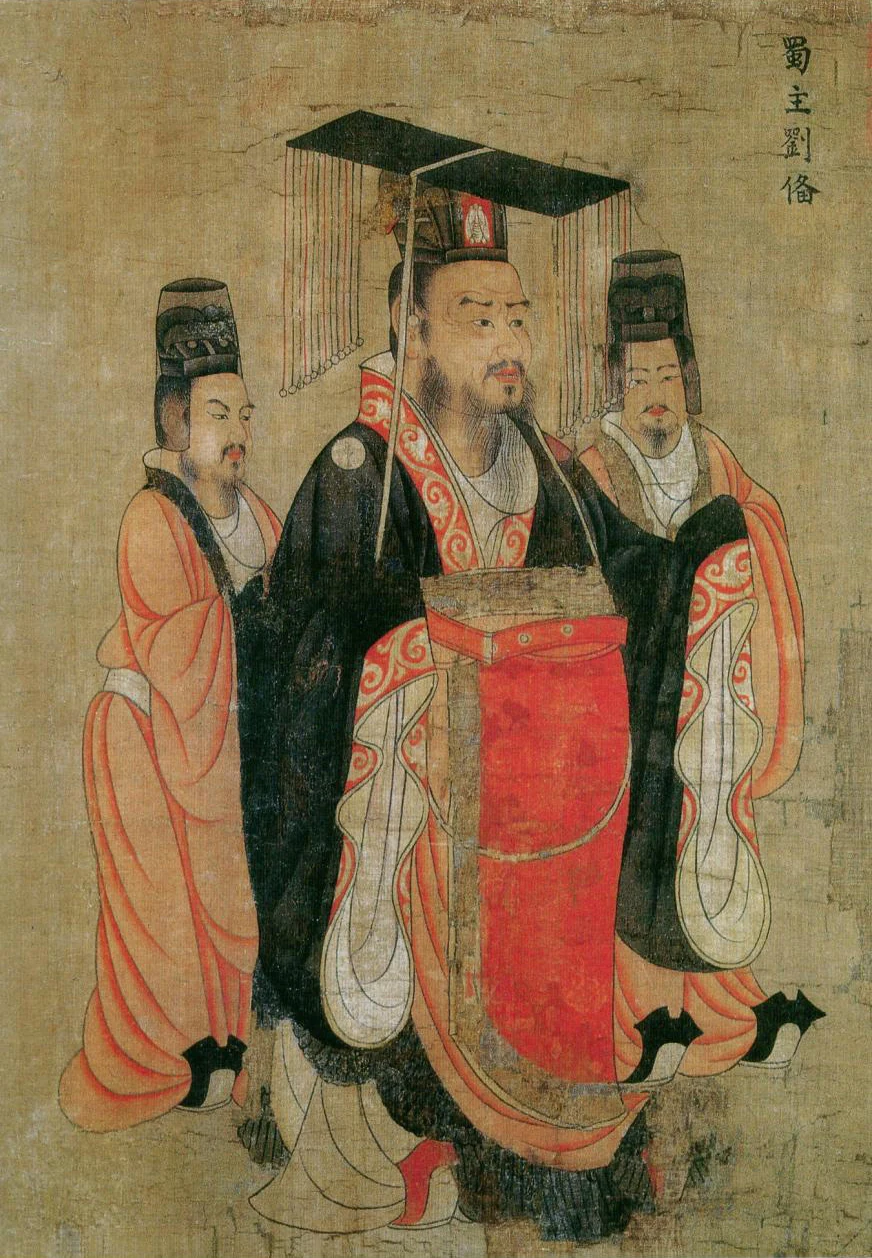
BIOGRAPHY
Biography
Liu Bei was born in 161 and died on 10 June 223. His courtesy name was Xuande; he was a man of Zhuoxian in Zhuo commandery, in what is now Zhuozhou in Hebei, with his ancestral home at Fengyi in present-day Xuzhou in Jiangsu; he was a statesman of the late Eastern Han and the founding emperor of Shu Han in the Three Kingdoms, reigning from 15 May 221 to 10 June 223, and he died at sixty-three, receiving the posthumous name Emperor Zhaolie and burial at Huiling. Historical writers usually call him the Former Ruler, to distinguish him from the Later Ruler Liu Shan. Of his life in sum: as a youth he studied under Lu Zhi and later took part in suppressing the Yellow Turbans; because his own strength was limited, his undertakings failed repeatedly during the wars among the lords at the end of the Han, and he attached himself in turn to Gongsun Zan, Tao Qian, Cao Cao, Yuan Shao and Liu Biao; yet he held consistently to the principle of winning men by virtue, and was therefore respected by men of name in every quarter, so that Tao Qian and Liu Biao one after another gave up the plan of passing their lands to their sons and chose instead to offer Xu and Jing to him. Through long effort he took Jing and then Yi after the battle of Red Cliff; shortly after Guan Yu was killed by Wu he founded Shu Han, and then, disregarding the objections of his ministers, insisted on war with Wu, was defeated at Yiling, and died at Baidi in the third year of Zhangwu, that is 223.
Family Background and Early Years
Liu Bei claimed descent from Liu Sheng, Prince Jing of Zhongshan, a son of Emperor Jing of the Western Han. According to the “Biography of the Former Ruler” in the *Records of the Three Kingdoms*, Liu Sheng’s son Liu Zhen was enfeoffed in 117 BCE, the sixth year of Yuanshou, as Marquis of Luchengting in Zhuo County. He later lost his title in the gold-contribution affair and settled in Zhuo Commandery. Liu Bei’s grandfather Liu Xiong was recommended as filial and incorrupt and eventually served as magistrate of Fan County in Dong Commandery. His father Liu Hong also held local office but died early. Liu Bei therefore grew up with his mother and supported the household by weaving mats and selling sandals.
A mulberry tree more than five zhang tall stood southeast of Liu Bei’s family home. From a distance its canopy resembled a carriage cover, and passersby thought the house was destined to produce an extraordinary person. As a child Liu Bei once pointed to the tree while playing with children of his clan and said, “I will certainly ride in such a carriage with a feathered canopy.” His uncle Liu Zijing rebuked him and warned him not to make reckless statements that might bring disaster upon the family. The story was later taken as an indication of his ambition from an early age.
In 175, the fourth year of Xiping, when Liu Bei was fifteen, his mother sent him away to study. Together with his clansman Liu Deran and Gongsun Zan of Liaoxi, he studied under Lu Zhi, a noted scholar from the same commandery who had formerly served as Administrator of Jiujiang. Liu Deran’s father Liu Yuanqi frequently supported Liu Bei financially and believed he was no ordinary young man. Liu Bei became close to Gongsun Zan and treated him as an elder brother because Gongsun Zan was older. Liu Bei did not enjoy reading and instead favored dogs, horses, music, and fine clothing. He was said to be seven chi five cun tall, with arms long enough to reach below his knees and ears visible to himself. He spoke little, treated others generously, did not readily show joy or anger, and liked associating with men of courage. Local strongmen gathered around him. Two wealthy merchants from Zhongshan, Zhang Shiping and Su Shuang, considered him unusual and gave him considerable money, enabling him to gather followers.
Raising Troops and Repeatedly Seeking Patrons
In 184, the first year of Zhongping, the Yellow Turban Rebellion broke out. Liu Bei led his followers under Commandant Zou Jing against the rebels and received an appointment as commandant of Anxi County for his service. The court later ordered that officials appointed for military merit be reviewed and dismissed where appropriate. When an inspector arrived at Anxi intending to remove Liu Bei, Liu Bei asked for an audience and was refused. He forced his way into the station, bound the inspector, flogged him two hundred times, and then abandoned office and fled with Guan Yu and Zhang Fei. He later joined a force under Colonel Guanqiu Yi, whom General-in-Chief He Jin had sent to recruit troops in Danyang. After distinguishing himself against bandits at Xiapi, Liu Bei became assistant magistrate of Xiamì County, soon resigned, and later served as commandant and magistrate of Gaotang. When Gaotang was overrun by bandits, he fled to Gongsun Zan.
In 191, the second year of Chuping, Gongsun Zan recommended Liu Bei as Major of a Separate Command and sent him with Qingzhou Inspector Tian Kai against Yuan Shao, Governor of Jizhou. After repeated military achievements, Liu Bei was promoted to acting magistrate of Pingyuan County and later Chancellor of the Pingyuan kingdom. There he resisted bandits externally and practiced generosity internally, sitting and eating together with ordinary people and gaining popular support. A local man named Liu Ping resented him and sent an assassin. Liu Bei, unaware of the plot, treated the assassin with such courtesy that the man could not bring himself to strike, revealed the scheme, and departed. The story was later presented as an example of Liu Bei’s ability to win people through benevolence.
In 192, the third year of Chuping, Yuan Shu and Yuan Shao became enemies. Yuan Shu requested aid from Gongsun Zan, who sent Liu Bei to Gaotang to threaten Yuan Shao, but Liu Bei was defeated by the combined forces of Yuan Shao and Cao Cao. Later, remnant Yellow Turban forces under Guan Hai attacked Beihai. Kong Rong, Chancellor of Beihai, sent Taishi Ci to break through the encirclement and ask Liu Bei for help. Liu Bei reportedly exclaimed in surprise, “Does Kong of Beihai truly know that Liu Bei exists in this world?” He immediately sent three thousand elite troops with Taishi Ci, and the Yellow Turbans withdrew on learning of the relief force.
Taking Xuzhou and Losing It
In 194, the first year of Xingping, Cao Cao attacked Xuzhou in retaliation for his father’s death. Tao Qian, Governor of Xuzhou, sought assistance from Tian Kai. Liu Bei accompanied Tian Kai and Tao Qian gave him four thousand Danyang troops; Liu Bei then left Tian Kai and entered Tao Qian’s service. Tao Qian recommended him as Inspector of Yuzhou and stationed him at Xiaopei. Later that year, when Tao Qian became gravely ill, he told his aide Mi Zhu that “no one but Liu Bei can bring peace to this province.” After Tao Qian died, Mi Zhu led Xuzhou officials and residents in inviting Liu Bei to take control. Liu Bei initially declined on the ground that Yuan Shu came from a family that had held the Three Excellencies for four generations, but Chen Deng and Kong Rong urged him to accept, and he became Governor of Xuzhou.
In the Xingping years the governor of Xu, Tao Qian, memorialized to have Liu Bei made governor of Yu province. When Tao Qian lay gravely ill he told his aide Mi Zhu that no one but Liu Bei could bring peace to the province. After Tao Qian died Mi Zhu led the men of the province to welcome Liu Bei, who did not venture to accept. Chen Deng of Xiapi told him that with the Han declining and the empire overturned, the time to establish merit was now, and that the province was rich with a million households, and asked him to take charge of its affairs. Liu Bei declined, saying that Yuan Shu was near at Shouchun, that for four generations five members of his house had held the three highest offices, and that the province might be given to him. Chen Deng answered that Yuan Shu was arrogant and extravagant and no master for a disordered age; that they wished to gather a hundred thousand foot and horse for Liu Bei, with which he could above support the ruler and succor the people and achieve the work of the five lords, and below hold territory and record his merit on bamboo and silk; and that if he would not consent, Chen Deng himself could not follow him either. The chancellor of Beihai, Kong Rong, added that Yuan Shu was no man to forget his family for the state's sake, a mere skeleton in a tomb not worth a thought, and that in the present business the people give themselves to the capable, and heaven's gift untaken cannot be regretted later. Liu Bei then took Xu. This exchange of refusal and acceptance marks the moment he obtained his first territory, and the phrase about heaven's gift untaken became the standard gloss on his acceptance.
In 195, the second year of Xingping, Lü Bu, after being defeated by Cao Cao, sought refuge with Liu Bei. Liu Bei treated him well and stationed him at Xiaopei. In 196, the first year of Jian'an, Yuan Shu attacked Xuzhou. Liu Bei met him in battle and the two armies faced one another around Xuyi and Huaiyin for more than a month. Lü Bu then seized the opportunity to attack Xiapi. Zhang Fei was defeated and Liu Bei’s wife and children were captured. As Liu Bei withdrew, his army disintegrated. He moved to Haixi, where conditions became so desperate that officers and soldiers reportedly resorted to cannibalism. Mi Zhu of Donghai supported him with his family fortune and gave Liu Bei his younger sister in marriage, allowing him to recover. Liu Bei then sought peace with Lü Bu, who returned his family, and Liu Bei went back to Xiaopei.
His conflict with Yuan Shu then brought in Lü Bu. Yuan Shu sent his officer Ji Ling with thirty thousand foot and horse against Liu Bei, who asked help of Lü Bu. Lü Bu's officers told him that he had long wished to kill Liu Bei and might now do it through Yuan Shu, but Lü Bu said that if Yuan Shu destroyed Liu Bei he would join with Taishan in the north and leave him surrounded, so he had no choice but to rescue him, and rode out with over a thousand horse. When Ji Ling and the others heard Lü Bu had come they halted their troops, and Lü Bu camped outside Pei, summoned Liu Bei and invited Ji Ling and the rest to feast with him. He told Ji Ling that Xuande was his younger brother, that he had come to rescue him because he was beset, and that by nature he disliked joining battles and liked only to part them; he had a lance planted at the camp gate, bent his bow and said that they should watch him hit its small side-blade, and if he hit it they should each withdraw, and if not they might stay and fight. His single shot struck the blade, and Ji Ling and the others said in amazement that the general's power was heaven's; the next day they feasted again and then went their ways. The shot at the gate both made Lü Bu's archery famous and showed how weak Liu Bei was, able to protect himself only by another's strength.
In 198, the third year of Jian'an, Lü Bu sent Gao Shun and Zhang Liao against Xiaopei. Liu Bei was defeated and his wife was captured again. Cao Cao personally campaigned against Lü Bu, met Liu Bei in Liang, and together they destroyed Lü Bu. When Lü Bu later asked Cao Cao to accept his surrender, Liu Bei reminded Cao Cao of Lü Bu’s betrayals of Ding Yuan and Dong Zhuo. Lü Bu was ultimately strangled at Baimen Tower. Liu Bei accompanied Cao Cao back to Xuchang, was recommended as General of the Left, and received exceptional courtesy from Cao Cao, who rode with him in the same carriage and seated him at the same table.
Alliance with Sun Quan and the Emergence of a Tripartite Balance
In 199, the fourth year of Jian'an, Emperor Xian secretly ordered Dong Cheng to kill Cao Cao, and Liu Bei joined the conspiracy. Liu Bei later used an opportunity to break away from Cao Cao, killed Xuzhou Inspector Che Zhou, and retook Xuzhou. In 200, the fifth year of Jian'an, Cao Cao personally attacked Xuzhou. Liu Bei was defeated, Guan Yu was captured, and Liu Bei fled to Yuan Shao. After the Battle of Guandu, he moved south and joined Liu Biao, who stationed him at Xinye.
While in Jingzhou, Liu Bei recruited talented men and made the Three Visits to the Thatched Cottage to invite Zhuge Liang into his service. In 208, the thirteenth year of Jian'an, Cao Cao invaded south. Liu Biao died and his son Liu Cong surrendered. Liu Bei fled south with large numbers of civilians and was overtaken at Changban by Cao Cao’s cavalry, suffering severe losses. He then accepted Lu Su’s advice and sent Zhuge Liang to Eastern Wu, helping create the Sun–Liu alliance. At the Battle of Red Cliffs, the allied forces of Sun Quan and Liu Bei defeated Cao Cao. Liu Bei subsequently occupied the four commanderies south of the Yangtze in Jingzhou and later obtained Nan Commandery from Sun Quan, steadily expanding his power.
After repeated defeats in the north Liu Bei went south and attached himself to Liu Biao, governor of Jing, who received him with the courtesy due an honored guest but never used his abilities. In 208 Cao Cao campaigned south into Jing, and just then Liu Biao died, his son Liu Cong took his place and sent envoys to submit to Cao Cao. Liu Bei was then at Fan city and did not know of Cao Cao's sudden arrival until the army had reached Wan, whereupon he withdrew south with his followers. Liu Cong dared not tell Liu Bei of the surrender, and Liu Bei long remained ignorant of it; discovering it at last he sent a close associate to question Liu Cong, who sent Song Zhong to announce the decision. Cao Cao being then at Wan, Liu Bei was greatly shocked and told Song Zhong that they had done things in this fashion without telling him earlier and informed him only when disaster had come, which was too much; he drew his sword on the man and said that cutting off his head would not vent his anger and that he would be ashamed as a great man to kill such people at parting; then he sent Song Zhong away and called his officers to council. Some advised seizing Liu Cong and the officials of Jing and going straight to Jiangling, and Liu Bei answered that Liu Biao at his death had entrusted his orphan to him, and that to betray the trust for his own advantage was what he would not do, and that he could not face Liu Biao in death if he did. Passing Xiangyang, Zhuge Liang urged him to attack Liu Cong and take Jing, and Liu Bei said he could not bear to; he reined in his horse and called to Liu Cong, who was too frightened to rise. Liu Cong's attendants and many of the men of Jing went over to Liu Bei.
At Dangyang his following had grown to more than a hundred thousand with several thousand carts of baggage, making only some ten li a day, and he sent Guan Yu with several hundred boats to meet him at Jiangling. Some advised him to hurry to secure Jiangling, since with so many people and so few armored men he could not resist Cao Cao if he came, and Liu Bei answered that to accomplish a great undertaking one must take the people as the foundation, and that now that they had come to him he could not bear to abandon them. Cao Cao, fearing Liu Bei would seize the stores at Jiangling, left his baggage and came light to Xiangyang; learning that Liu Bei had passed, he took five thousand picked horsemen in pursuit, covering more than three hundred li in a day and a night, and caught him at Changban in Dangyang. Liu Bei abandoned his wife and children and fled with Zhuge Liang, Zhang Fei, Zhao Yun and some dozens of riders, and Cao Cao took his people and baggage; Cao Chun's cavalry, pursuing Liu Bei to Changban, captured his two daughters and his baggage and gathered up his scattered troops. Liu Bei made for Hanjin, met Guan Yu's boats by chance, crossed the Mian river, joined Liu Qi, Liu Biao's eldest son and governor of Jiangxia, with more than ten thousand men, and came with him to Xiakou, where he at once sent Zhuge Liang to form a connection with Sun Quan.
When Liu Bei went to Jingkou to meet Sun Quan, Zhou Yu plotted to keep him in Wu. He memorialized that Liu Bei had the bearing of a fierce hero and had Guan Yu and Zhang Fei, generals like bears and tigers, and would never long remain another's servant; that the wise course was to move him to Wu, build him fine palaces and surround him with beauties and amusements for his eyes and ears, and separate those two men to different quarters, so that men like himself might hold them and use them in war, whereupon the great matter could be settled; and that to carve out territory to give him substance and gather these three together on the frontier was to fear that a dragon, given clouds and rain, would never remain a creature of the pond. Sun Quan, with Cao Cao in the north, needing to gather heroes, and fearing Liu Bei could not be abruptly controlled, did not accept it. Liu Bei himself raised the matter afterwards: according to the Jiangbiao zhuan, talking at leisure with Pang Tong he asked whether, Pang Tong having been Zhou Yu's aide, it was true that this man had secretly advised Sun Quan to detain him, and asked him to conceal nothing, in the service of his own lord as he would in his; Pang Tong said it was true. Liu Bei sighed that in his extremity he had had requests to make and so had been obliged to go, and had narrowly escaped Zhou Yu's hands; that wise men of the empire see alike, and that Zhuge Liang had urged him not to go with special earnestness for the same reason; that he himself had judged Sun Quan's defense to lie in the north and to require him as an ally, and so had resolved without hesitation; and that it was indeed to go by a dangerous road and no plan of full safety.
This account, taken with his later advice to Sun Quan on the capital at Moling, shows his position well: after Red Cliff he was one of the victors, yet still lodged under another's roof and liable at any time to be held in check, so that the journey to see Sun Quan was in his own eyes a dangerous road rather than a safe plan. Zhou Yu's scheme failed half because Cao Cao's pressure in the north obliged Sun Quan to use Liu Bei as an ally, and half because Liu Bei had become a power not to be controlled in haste — which is the same observation as Guo Jia's that he would never remain another's subordinate and Cao Cao's that he was a hero of men and must be attacked or become a danger later. In the eyes of his contemporaries his weight lay no longer in how many troops or how much land he held, but in the fact that he had become a man no one else could dispose of.
Several details survive of the dealings between Liu Bei and Sun Quan. According to the Jiangbiao zhuan, when Liu Bei returned from Jingkou Sun Quan accompanied him in the flying-cloud barge with Zhang Zhao, Qin Song, Lu Su and others to see him off; and the Shanyanggong zaji records that after his return Liu Bei told those about him that Sun Quan, being long of body and short of leg, would not easily serve under another, and that he could not see him again. Read beside Zhou Yu's scheme to detain Liu Bei in Wu, such notices show the mutual wariness beneath the alliance of the years after Red Cliff.
The scale of the aid Liu Bei received on entering Yi is also recorded. The Wu shu says that Liu Zhang sent him two hundred thousand measures of rice, a thousand horses, a thousand carriages and quantities of silk and cloth; the Wei shu records that Liu Bei provoked his own troops by saying he had been fighting strong enemies for Yizhou's sake and that his officers and men were worn out without rest, while the treasuries were full, and so roused them. Some actions of the campaign are also preserved: Liu Zhang sent Zhang Ren and Liu Gui with picked troops to hold Liu Bei at Fu, where he broke them and they fell back to Mianzhu; advancing again, Liu Bei met Li Yan commanding the forces of Mianzhu, who surrendered with his men, after which Liu Bei's army grew stronger and he detached forces to pacify the counties. As Chengdu was about to fall, Ma Chao came over from Hanzhong and Liu Bei set him to camp north of the city, which spread terror within it; Jian Yong then went in to persuade Liu Zhang, who came out and surrendered. As to the empress he set up after taking the imperial title, the Record of Huayang says that on the xinsi day of the fifth month of the first year of Zhangwu he made the lady Wu empress, she being the younger sister of Wu Yi and formerly the wife of Liu Mao, elder brother of Liu Zhang; her biography adds that the lady Mu, mother of the heir, was of Chenliu, that her brother was Wu Yi, and that Wu Yi's father had long been a friend of Liu Yan and had therefore moved his household with him into Shu. This marriage connection shows that the ties between the old men of Yi and the new government went beyond the mere employment of former subordinates.
In 211, the sixteenth year of Jian'an, Liu Zhang, Governor of Yizhou, heard that Cao Cao intended to attack Hanzhong and, following Zhang Song’s advice, invited Liu Bei into Shu for assistance. Liu Bei left Zhuge Liang and Guan Yu to guard Jingzhou and entered Shu with Pang Tong, Huang Zhong, and others. In 212, the seventeenth year of Jian'an, Liu Bei and Liu Zhang broke with one another and went to war. In 214, the nineteenth year of Jian'an, Zhuge Liang, Zhang Fei, Zhao Yun, and others led reinforcements into Shu. Liu Bei captured Chengdu, Liu Zhang surrendered, and Liu Bei became Governor of Yizhou, giving him control of both Jingzhou and Yizhou.
Liu Bei's entry into Yi began with Liu Zhang's fear and Zhang Song's persuasion. Liu Zhang, governor of Yi, heard from afar that Cao Cao meant to send Zhong You and others against Zhang Lu in Hanzhong and was frightened, and Zhang Song, his aide and a man of Shu commandery, asked him who could withstand Cao Cao, whose armies were strong beyond challenge in the empire, if he should use Zhang Lu's resources to take the land of Shu. Liu Zhang said he had long worried about it without finding a plan, and Zhang Song said that the governor Liu Bei was of his own imperial clan and Cao Cao's bitter enemy, skilled in arms, and that if he were sent against Zhang Lu, Zhang Lu would certainly be broken; and that with Zhang Lu broken Yi would be strong and Cao Cao could do nothing even if he came. Liu Zhang agreed, sent Fa Zheng with four thousand men to welcome Liu Bei and made him gifts worth many millions, and Fa Zheng accordingly set out for Liu Bei the plan by which Yi might be taken. Liu Bei left Zhuge Liang and Guan Yu to hold Jing and entered Yi with several tens of thousands of foot soldiers. At Fu, Liu Zhang came out in person to welcome him and they met with great pleasure. Zhang Song had Fa Zheng tell Liu Bei, and the strategist Pang Tong likewise urged, that Liu Zhang might be seized at the meeting itself; Liu Bei said the matter was too great to be done in haste. Liu Zhang proposed Liu Bei as acting grand marshal and colonel director of retainers, and Liu Bei proposed Liu Zhang as acting general of the west and governor of Yi as before; Liu Zhang increased his troops and sent him against Zhang Lu, and gave him command of the White Water army. Liu Bei had more than thirty thousand men in all with chariots, armor, weapons and stores in abundance; that year Liu Zhang returned to Chengdu, and Liu Bei went north to Jiameng, where instead of attacking Zhang Lu at once he planted kindness and virtue deeply in order to win the hearts of the people.
Liu Zhang's ministers had much to say against the invitation. The registrar Huang Quan set out the consequences: the general of the left had a name for fierceness, and if he came and were treated as a subordinate he would be dissatisfied, while if he were treated as an honored guest then one state could not hold two rulers; the guest's security of Mount Tai meant the host's danger of a stack of eggs. The aide Wang Lei of Guanghan hung himself upside down at the province's gate to remonstrate at the risk of his life, and Liu Zhang accepted none of it. After delivering Liu Zhang's message Fa Zheng secretly offered Liu Bei a plan: with his own ability and Liu Zhang's weakness, with Zhang Song, the province's right arm, responding from within, and with the wealth of Yi and its natural defenses, the imperial enterprise could be achieved as easily as turning the hand. Liu Bei was delighted, left the army adviser Zhuge Liang and the generals Guan Yu and Zhang Fei to guard Jing, and went up the Yangzi with ten thousand men. Reaching Ba commandery, its governor Yan Yan struck his breast and sighed that this was what was called sitting alone on a barren mountain and letting a tiger guard oneself. These protests, Huang Quan's warning that one state cannot hold two rulers, Wang Lei's hanging, and Yan Yan's image of the tiger, were all later taken as the most exact prophecies of what Liu Bei's entry into Shu would bring.
The break came in 212. Cao Cao campaigned against Sun Quan, who called on Liu Bei for help, and Liu Bei sent word to Liu Zhang that Cao Cao's attack on Wu put Wu in danger, that Sun Quan and he were as lips and teeth, that Yue Jin was facing Guan Yu at Qingni and that unless Guan Yu were succored Yue Jin would win a great victory and encroach on the province, a graver matter than Zhang Lu, who was a mere self-defending bandit unworthy of concern. He then asked Liu Zhang for ten thousand men and stores for the move east, and Liu Zhang granted only four thousand and half of the rest. Zhang Song wrote to Liu Bei and Fa Zheng that the great enterprise was on the point of being achieved and asked how he could let it go; Zhang Song's elder brother Zhang Su, governor of Guanghan, fearing the affair would reach him, informed Liu Zhang, who seized and executed Zhang Song, and from that time the breach was made. Liu Bei sighed that Zhang Su had killed his man inside by a false charge, and Liu Zhang ordered the officers at the passes to hold no further communication with Liu Bei. Liu Bei in anger summoned Yang Huai, Liu Zhang's White Water commander, charged him with disrespect and killed him, and sent Huang Zhong and Zhuo Ying forward against Liu Zhang. Pang Tong offered three plans: to pick picked troops in secret, march day and night and strike straight at Chengdu, which Liu Zhang being no warrior and wholly unprepared would lose at a blow, was the best; Yang Huai and Gao Pei were Liu Zhang's famous generals holding the passes with strong forces and had repeatedly written urging him to send Liu Bei home, so Liu Bei might send word that he was going east and bid them prepare quickly, and the two, respecting his name and pleased at his departure, would surely come to him with light horse, whereupon he might seize them and take their troops and then move on Chengdu, which was the middle plan; to withdraw to Baidi, link up with Jing and return to the attempt later was the worst. Liu Bei took the middle plan, killed Yang Huai and the rest at once, and sent Huang Zhong, Zhuo Ying and Wei Yan forward; the magistrate of Zitong, Wang Lian, held his walled town firm, and Liu Bei, respecting his sense of duty, did not press the attack.
In the summer of 214 Luocheng fell, Liu Bei besieged Chengdu for several tens of days, and Liu Zhang surrendered. Shu being rich and prosperous, Liu Bei feasted his soldiers, distributed the gold and silver of the city among his officers and returned the grain and silk to the people. Liu Zhang's surrender came from his own words: for more than twenty years father and son had governed the province without conferring any benefit on its people, and for three years of war the flesh and fat of the people had been smeared on the fields because of him, which he could not bear. He sent Zhang Yi to Liu Bei, and Liu Bei sent the aide Jian Yong to persuade him; Liu Zhang had always respected Jian Yong and went out to surrender in the same carriage with him, and officials and people alike wept and sobbed. Liu Bei returned the seal and cord of the general who overawes the distant and his goods, and moved him to Gong'an in Nan commandery. From his arrival at Fu to the change of masters at Chengdu was no more than three years, and the decisive stroke — planting kindness at Jiameng to win the people's hearts — was of a piece with sitting at the same mat and eating from the same vessel at Pingyuan years before.
In 219, the twenty-fourth year of Jian'an, Liu Bei fought Cao Cao for Hanzhong. At Dingjun Mountain, Xiahou Yuan was killed and Liu Bei won the struggle for the region. That same year Liu Bei declared himself King of Hanzhong. Also in 219, however, Sun Quan sent Lü Meng to seize Jingzhou. Guan Yu was defeated and killed, and Jingzhou fell to Eastern Wu.
In the seventh month of the autumn of 219 Liu Bei took the title king of Hanzhong. He set up an altar and the array of troops at Mianyang, the assembled ministers took their places, and only after the memorial had been read did he receive the seal and cord and put on the royal crown; he then sent by post-horse a memorial returning the seal and cord of the acting general of the left and marquis of Yicheng precinct that he had held. He made his son Liu Shan heir to the kingdom, promoted Wei Yan, commander of the gate of fangs of Yiyang, to be general of the distant reaches and governor of Hanzhong to hold Hanchuan, and returned to govern from Chengdu, making Xu Jing grand tutor, Fa Zheng director of the secretariat, Guan Yu general of the vanguard, Zhang Fei general of the right, Ma Chao general of the left and Huang Zhong general of the rear, the rest advancing in rank according to degree. The ministers urging the step numbered a hundred and twenty, from Ma Chao, general who subdues the west and marquis of the pavilion of state, Xu Jing, and Pang Xi, to Zhuge Liang, Guan Yu, Zhang Fei, Huang Zhong, Lai Gong, Fa Zheng and Li Yan. Their memorial recounted how the Han had suffered Dong Zhuo's disorders and how Cao Cao had seized the balance of heaven, with empress and heir poisoned, and the emperor cast into want and danger, and cited the ancient documents on the ordering of the nine degrees of kinship, the Zhou enfeoffment of kinsmen, and the early Han's exaltation of imperial sons which had in the end broken the Lü family. It argued that Liu Bei, as flesh and blood and a screen of the imperial house, should be given the title of king of Hanzhong and generalissimo, with Hanzhong, Ba, Shu, Guanghan and Qianwei for his kingdom and appointments in the manner of the early Han kings, since a provisional arrangement, if it served the state, might be undertaken on one's own responsibility, and they asked only that when the work was done they might submit themselves for punishment, not regretting death.
Not long after he took the title, the loss of Jing followed. In the same year Guan Yu besieged Cao Ren at Xiangyang and Cao Cao sent the general of the left, Yu Jin, to relieve him; the Han river suddenly rose, and Guan Yu with his boats took Yu Jin's thirty thousand foot and horse and sent them to Jiangling, only the city of Xiangyang holding out. Sun Quan, fearing Guan Yu while wishing to make the deed his own merit, wrote to Cao Cao offering to attack Guan Yu, and Cao Cao, wishing to make the two consume each other, sent Sun Quan's letter by post-horse and had Cao Ren show it to Guan Yu by crossbow, so that Guan Yu wavered and could not withdraw. In the intercalary month Sun Quan moved against him, first sending Lü Meng to seize Gong'an and capture the general Shi Ren; reaching Nan commandery, its governor, Mi Fang, surrendered the city; Lü Meng held Jiangling, succored the old and weak and released Yu Jin from prison; Lu Xun separately took Yidu and, with Zigui, Zhijiang and Yidao, returned to camp at Yiling to guard the gorge against Shu. Guan Yu came back to Dangyang and held Maicheng in the west; Sun Quan sent to induce him to surrender, he pretended to do so, set up banners and straw men on the wall and slipped away, his soldiers scattering until he had only a dozen riders; Sun Quan had first sent Zhu Ran and Pan Zhang to cut off his road, and in the twelfth month Pan Zhang's commandant Ma Zhong captured Guan Yu with his son Guan Ping and the commander Zhao Lei at Zhangxiang, and Jing was subdued. That Guan Yu and Liu Bei had been sworn to life and death together made his death the starting point of everything Liu Bei did afterwards.
Proclaiming the Empire and His Final Defeat
In 221, the first year of Zhangwu, Liu Bei proclaimed himself emperor at Chengdu, named his state Han, and adopted Zhangwu as the era name; the regime is known to later historians as Shu Han. After becoming emperor, he launched a campaign against Wu to avenge Guan Yu, despite opposition from Zhuge Liang, Zhao Yun, and other ministers. In 222, the second year of Zhangwu, Liu Bei personally led the eastern expedition and advanced deeply into Wu territory. Sun Quan appointed Lu Xun commander-in-chief. Lu Xun refused battle until the Shu army had become exhausted, then attacked with fire at Yiling and inflicted a crushing defeat. Liu Bei retreated to Baidicheng and died the following year, in the fourth lunar month of 223, at Yong'an Palace, aged sixty-three. Before his death he entrusted Liu Shan to Zhuge Liang and instructed Liu Shan to “serve him as a father.” He also admonished his son not to commit an evil merely because it was small and not to neglect a good deed merely because it was small. Liu Bei received the posthumous title Emperor Zhaolie and was buried at Huiling in Chengdu.
In the fourth month of the summer of 221 Liu Bei proclaimed a general amnesty and the new era name, made Zhuge Liang chancellor and Xu Jing minister of the masses, established the hundred offices and the ancestral temple and sacrificed to the high emperor and those after him; in the fifth month he made the lady Wu empress and his son Liu Shan heir apparent; in the sixth month he made his sons Liu Yong prince of Lu and Liu Li prince of Liang. Before this he had resumed the governorship of Yi with his seat at Chengdu. To establish the hundred offices, the ancestral temple and the sacrifices of a dynasty on the strength of a single province was the concrete way of claiming to continue the Han line, and the words of his accession proclamation about succeeding the two ancestors and executing heaven's punishment answered in name to the ministers' memorial about continuing the Han succession.
Against this may be set Wu's handling of the provincial governorship. Its edict on abolishing the office recalls that in high antiquity and the middle ages there were provincial governors, or inspectors, or supervising censors, all of whom kept the general order without administering government, the governing of the people being left to the feudal lords and commandery governors; that when the Han fell into disorder in its last years Wu and Shu each took their own way, and from then on the inspector attended to the people's affairs within and commanded troops without, which was a convenience of the time; and that now, by the blessing of the ancestral temple and the strength of the officials, the region south of the river was pacified and the empire united, so that arms should be laid by and the world given rest, the troops of the provinces at peace disbanded, and the inspector's duties restored as under the Han, promulgating edicts abroad and reporting at the capital, while the two-thousand-picul officials attended solely to governing the people and the supervising officers remained austere above them, which was the enduring form. The phrase about the inspector attending to the people's affairs within and commanding troops without shows that the union of civil and military authority in the provincial governor had become the norm since the end of the Han, and the arrangement by which Liu Bei held Yi as governor with Zhuge Liang as chancellor took shape within that institutional change. In name Shu Han claimed to continue the Han and so had its ancestral sacrifices; in fact its structure was still that of a warlord turned provincial governor and then a state, which is what later writers meant by his holding the lands of Yong and Shu.
In the seventh month of the autumn of 221 Liu Bei, enraged that Sun Quan had killed Guan Yu by surprise, led his armies against Wu. Sun Quan sent a letter asking for peace and Liu Bei in his fury refused. The Wu generals Lu Yi, Li Yi and Liu A held Wu and Zigui; Liu Bei's generals Wu Ban and Feng Xi attacked and defeated Li Yi from Wu and advanced to Zigui, and the barbarians of the five streams of Wuling sent envoys offering troops. In the first month of 222 Liu Bei's army returned to Zigui and the generals Wu Ban and Chen Shi stationed their fleet at Yiling on the eastern and western banks of the Yangzi. In the second month Liu Bei advanced from Zigui with his generals along the hills and over the ridges, camped at Xiaoting in Yidao, opened a way from Henshan to Wuling, and sent the attendant Ma Liang to reassure the barbarians of the five streams, who came over in response one after another; the general of the north, Huang Quan, commanded the forces north of the river and faced the Wu army on the Yiling road.
In the sixth month of the summer a yellow vapor rose over more than ten li around Zigui, several tens of fathoms wide. Some ten days later Lu Yi crushed Liu Bei's army at Xiaoting, and the generals Feng Xi and Zhang Nan were among the dead. Liu Bei withdrew from Xiaoting to Zigui, gathered his scattered troops, abandoned his boats and returned by land to Fufu, changing its name to Yong'an; Wu sent the generals Li Yi and Liu A after him and they camped on the southern hills. In the eighth month he collected his troops back to Wu; the minister of the masses Xu Jing died; in the tenth month he ordered the chancellor Zhuge Liang to lay out the northern and southern suburban altars at Chengdu. Sun Quan, hearing that Liu Bei was at Baidi, was much afraid, sent envoys for peace, and Liu Bei agreed, sending the grand master of the palace Zong Wei with his reply. Of this campaign later writers observed that Liu Bei and Guan Yu had been bound to life and death, and that had he not avenged him the relation of ruler and minister could not have been brought to a proper end; yet it would have sufficed to send one or two generals east, whereas he took upon himself the weight of an emperor to toil through the hills and valleys and face the enemy for more than half a year, and was at last brought to a stand by younger upstarts; that though the veteran's heart was still strong it was a grave miscalculation that damaged his authority; and that Zhuge Liang's silence must mean Liu Bei's mind was made up beyond the reach of argument.
Major Activities
Political Activity
Throughout his life Liu Bei presented restoration of the Han as his political goal. From his first raising of troops in Zhuo Commandery to his proclamation as emperor at Chengdu, he consistently emphasized his status as a member of the Han imperial clan. His successive positions as Governor of Xuzhou, Governor of Yizhou, King of Hanzhong, and finally emperor all stressed his claim to continue Han political legitimacy. After Cao Pi ended the Eastern Han in 220, Liu Bei proclaimed himself emperor the following year and continued to call his state “Han” to present it as the continuation of the dynasty.
Liu Bei’s political style was characterized in the source as ruling through virtue and valuing popular support. As Chancellor of Pingyuan he defended against bandits while practicing benevolent government and gained the affection of local people. When he took control of Xuzhou, Tao Qian entrusted the province to him on his deathbed and Mi Zhu, Chen Deng, Kong Rong, and others urged him to accept, reflecting his reputation. In Yizhou, Liu Bei reduced punishments and taxes, employed former subordinates of Liu Zhang, and stabilized the region.
The direction of government that Liu Bei established after taking Shu was one that combined law with moral teaching. As the biography of Zhuge Liang in the Records of the Three Kingdoms describes the administration of Shu: those who served loyally and benefited the times were rewarded even if they were enemies, while those who broke the law or shirked duty were punished even if they were kin; those who confessed and yielded their feelings were released however grave their offense, while the glib and the deceitful were executed however light it was; no good was too small for reward and no evil too slight for censure; all affairs were handled with skill, the root of each matter was sought, and name was required to answer to fact. Later writers sum this up by saying that Liu Bei and Zhuge Liang governed by law and ritual together and by awe and virtue side by side, insisting on the clear proclamation of statutes and the encouragement of good with the punishment of evil; that is, they took law as the substance, with emphasis on fairness and objectivity, and virtue as the function, with emphasis on moral suasion as the foundation. They adopted Shang Yang's law without superstitious reverence for his authority.
The other face of this policy was criticism of Liu Zhang's old government. Zhuge Liang identified the causes of the abuses in the government of Yi, saying that what Liu Zhang called benevolent rule was no more than buying men with small favors and honoring his ministers with high place, overstepping the law until the abuses had become unmanageable. A passage preserved among the five matters concerning him states the point more plainly: that to favor a man with place makes place cheap when it can go no higher, and to gratify him with kindness makes kindness slack when it is exhausted, and that this was the true source of the abuses; and that he would therefore overawe men with law, so that when law prevailed they would know kindness, and limit them with rank, so that when rank was granted they would know honor, kindness and honor working together and high and low each keeping its measure — in which lay the essentials of government. This was both a correction of Liu Zhang's faults and the basis on which the leniency of taxes and punishments and the clear proclamation of statutes could stand together after Liu Bei entered Shu. A related dispute concerns amnesties: the Comprehensive Mirror records that after a general amnesty in Shu Han, the grand minister of agriculture Meng Guang reproved Fei Yi before the assembled court, saying that an amnesty is a one-sided thing not proper to an enlightened age and to be used only as a last resort in extremity, and that with the ruler benevolent and wise and the officials all equal to their posts it was not needed. Within the Shu Han court, then, the limits of clemency were openly argued, and the argument presupposed the standard of law and kindness together that Liu Bei had fixed at the founding.
Liu Bei and Gongsun Zan fought together against Yuan Shao, governor of Jizhou, and for his repeated services Liu Bei was promoted to acting magistrate and then chancellor of the kingdom of Pingyuan. There he resisted the rebels abroad and at home was generous, so that even commoners who were not men of learning might sit at the same mat and eat from the same vessel as he, without distinction. He won men's hearts accordingly: a man of the commandery named Liu Ping, unwilling to accept his government, set an assassin on him, and Liu Bei, knowing nothing of it, treated the assassin with such courtesy that the man was moved, could not bring himself to kill him, and confessed and left. These two incidents, the beating of the inspecting secretary and the assassin at Pingyuan, spread widely among the people: the first was taken as a satisfying blow against corrupt officials, the second as proof of a nature so sincere that even an assassin was converted. In the few years from commandant of Anxi to chancellor of Pingyuan he had risen from a recruiting officer's beginnings to the chancellorship of a kingdom under a province, and in the interval he had repeatedly left office, gone into hiding and attached himself to others, an unsettled course like that of the rest of his life.
The occasion of his revolt was Dong Cheng's plot. The chariot general Dong Cheng, uncle of Emperor Xian, claimed a secret edict hidden in the emperor's girdle ordering Cao Cao's destruction, and Liu Bei had not yet acted. Meanwhile Cao Cao remarked to him in leisure that of all the heroes of the empire there were only the two of them, and men like Yuan Shao were not worth counting; Liu Bei, who was eating, dropped his spoon and chopsticks. According to the Record of Huayang, thunder happened to crash and Liu Bei said that the sage had spoken of sudden thunder and violent wind as things that must change men's countenances, and that there was good reason, since the awe of one peal could come to this; and Cao Cao regretted having spoken. After Liu Bei returned, Cao Cao had him watched and saw him peeling scallions and having a servant do it, striking the man with a staff when it was done unevenly, and Cao Cao said the long-eared fellow had noticed nothing. That night Liu Bei hurried east, and when Cheng Yu and Guo Jia spoke again Cao Cao sent riders after him but could not catch him. Liu Bei then conspired with Dong Cheng, the colonel Zhong Ji and the generals Wu Zilan and Wang Zifu; when the plot came to light Dong Cheng and the rest were executed, and Liu Bei held Xiapi, killed the governor of Xu, Che Zhou, left Guan Yu to guard Xiapi and returned to Xiaopei; Chang Ba of Donghai rebelled, many commanderies and counties turned from Cao Cao to Liu Bei, his following grew to tens of thousands, and he sent Sun Qian to make alliance with Yuan Shao.
Liu Bei's alliance with Sun Quan began with Lu Su's initiative. After Liu Biao's death Lu Su told Sun Quan that Jing and Chu bordered their state, that the waters ran northward, that the region had the Yangzi and Han outside it and mountains within, a stronghold of metal walls, with ten thousand li of fertile fields and a rich and populous people, and that to hold it would be the foundation of an imperial enterprise; that Liu Biao was newly dead and his two sons had long been at odds, the officers of the army each taking one side, and that Liu Bei, a fierce hero of the empire at odds with Cao Cao, was lodging with Liu Biao whose abilities he resented and could not use; that if Liu Bei and Liu Biao's people were of one mind they should be conciliated and an alliance made, and if they were divided the situation should be turned to account. He asked leave to go and condole with Liu Biao's sons, encourage those in charge of the army, and persuade Liu Bei to conciliate Liu Biao's following and join in resisting Cao Cao, which Liu Bei would gladly do; and Sun Quan sent him at once. Reaching Xiakou he learned Cao Cao had already moved on Jing and pressed on day and night; by the time he reached Nan commandery Liu Cong had surrendered, and Liu Bei was fleeing in alarm and meant to cross the Yangzi southward. Lu Su went straight to meet him and met him at Changban in Dangyang, conveyed Sun Quan's intentions, set out the strength of the east and urged Liu Bei to join forces with Sun Quan, at which Liu Bei was much pleased. Zhuge Liang was with Liu Bei, and Lu Su told him that he was a friend of Zhuge Jin, and the two at once became friends. Liu Bei then went to Xiakou, sent Zhuge Liang as envoy to Sun Quan, and Lu Su returned to report.
According to the Jiangbiao zhuan, Lu Su asked Liu Bei at Dangyang whither he intended to go; Liu Bei said he had an old connection with Wu Chen, governor of Cangwu, and meant to join him. Lu Su urged him rather to send a trusted man to attach himself to the east and work with it for the common cause; Liu Bei was delighted, moved to E county, and at once sent Zhuge Liang with Lu Su to see Sun Quan and swear the alliance. After the battle of Red Cliff Liu Bei memorialized to make Liu Qi governor of Jing, then campaigned south against the four commanderies, and the governors of Wuling, Jin Xuan, of Changsha, Han Xuan, of Guiyang, Zhao Fan, and of Lingling, Liu Du, all surrendered; Lei Xu of Lujiang came over with tens of thousands of retainers. After Liu Qi died of illness his subordinates promoted Liu Bei to be governor of Jing with his seat at Gong'an. Sun Quan began to fear him and gave him his sister in marriage to secure the tie, and Liu Bei went to Jingkou to meet Sun Quan, who sent an envoy proposing a joint attack on Shu. Some held it should be accepted, since Wu could not after all cross Jing to hold Shu and Shu might be had for himself, but the registrar of Jing, Yin Guan, advised that if they acted as Wu's vanguard they would neither take Shu nor escape being taken in the rear by Wu, and the enterprise would fail; the thing to do was to approve the attack on Shu while pleading that the newly held commanderies could not move, for Wu would not dare cross their territory to take Shu alone, and by such a plan they might profit from both Wu and Shu. Liu Bei followed it, Sun Quan indeed dropped the plan, and Yin Guan was promoted to aide of the province.
The ownership of Jing then became a dispute with the east. In 215, since Liu Bei had gained Yi, Sun Quan sent envoys demanding the return of the Jing commanderies, and Liu Bei answered that when he had Liang province he would give Jing to Wu; Sun Quan in anger sent Lü Meng to seize Changsha, Lingling and Guiyang, and Liu Bei led fifty thousand men down to Gong'an and sent Guan Yu into Yiyang. It happened that Cao Cao had pacified Hanzhong and Zhang Lu had fled to Baxi, and Liu Bei on hearing it made peace with Sun Quan and divided Jing: Jiangxia, Changsha and Guiyang to the east, and Nan commandery, Lingling and Wuling to himself, then led his army back to Jiangzhou. The contest for Hanzhong followed at once: Cao Cao had put Xiahou Yuan and Zhang He in Hanzhong and they repeatedly raided the borders of Ba, so Liu Bei sent Zhang Fei against them, and Zhang Fei fought Zhang He at Wakou and broke him. Fa Zheng urged Liu Bei to take Hanzhong, arguing that Cao Cao had brought about Zhang Lu's surrender and pacified Hanzhong at a single stroke, yet instead of using that momentum to take Ba and Shu he left Xiahou Yuan and Zhang He on guard and hurried north himself, which could only be because troubles at home pressed him, not for want of wisdom or strength; that by their abilities Xiahou Yuan and Zhang He were no match for a state's commanders and could certainly be beaten if attacked in force; and that once beaten they might farm widely and store grain, watch for an opening, and so above overturn the enemy and honor the royal house, in the middle nibble at Yong and Liang and broaden their territory, and below hold the vital points for a long defense — a gift of heaven whose moment must not be lost. Liu Bei approved and advanced with his generals. In the spring of 219 he crossed the Mian river south from Yangping, moved forward along the hills and made camp on the heights of Dingjun mountain; Xiahou Yuan came with troops to contest the ground, and Liu Bei ordered Huang Zhong to attack with drums and shouting from the height, broke Xiahou Yuan's army and killed him together with Zhao Yong, the inspector of Yi whom Cao Cao had appointed. Cao Cao came south from Chang'an in full force, and Liu Bei forecast from afar that though Cao Cao came he could do nothing and that he himself would hold Hanchuan; and when Cao Cao arrived Liu Bei gathered his troops and held the defiles, never joining battle, so that for months the place could not be taken and his losses mounted daily. In summer Cao Cao indeed withdrew, and Liu Bei had Hanzhong, sending Liu Feng, Meng Da and Li Ping against Shen Dan at Shangyong.
In 220 the Wei emperor Wen took the imperial title and changed the era name, and there were reports that the Han emperor had been killed. Liu Bei then went into mourning, wore the garments of grief and gave the emperor the posthumous name Xiaomin. Thereafter auspicious signs were reported throughout Shu one after another, and the gentleman of the court Liu Bao, marquis of Yangquan, Xiang Ju, marquis of Qingyi, the generals Zhang Yi and Huang Quan, Yin Chun, Zhao Zuo, Yang Hong, He Zong, Du Qiong, Zhang Shuang, Yin Mo and Qiao Zhou presented a memorial citing the river chart, the book of Luo and the apocryphal commentaries of the five classics, quoting such phrases as that virtue would flourish in three days of red and that in the ninth generation would come the one prepared, that heaven's measure and the way of emperors are fulfilled in the prepared one who takes the imperial title, and that in the third establishment of the emperor the nine would meet in the prepared one. They added that Liu Bao's father had said in his lifetime that over the southwest a yellow vapor stood several tens of feet high for years together, and that in the twenty-second year a vapor like a banner ran from west to east through mid-heaven, wherefore the charts said a son of heaven must come from that quarter; and citing the movements of the planets they said a sage ruler would rise in that province to bring about a restoration, asking Liu Bei to comply with heaven and the people and at once assume the great enterprise. Liu Bei then took the imperial throne south of Wudan in Chengdu, with the proclamation: in the fourth month of the twenty-sixth year of Jian'an, the emperor Bei ventures with a black bull to announce to the high heaven, the sovereign on high, the earth and the spirits that the Han held the empire with a mandate without end; that when Wang Mang usurped, the emperor Guangwu in his wrath punished him and the altars of the state survived; that now Cao Cao, relying on arms and hardened in cruelty, had put the empress and the heir to death, and his son Pi carried on the treason and stole the sacred vessels; and that the ministers and officers held that the altars being fallen, he should repair them, succeed the two ancestors and execute heaven's punishment. He added that he had inquired of the common people and of the lords of the barbarians, and that all said the decree of heaven must be answered, the ancestral work must not long be left vacant, and the four seas must not be without a master, so that on a chosen day he and the hundred officials had ascended the altar to receive the imperial seal and cord. There was dissent as well: the marshal of the vanguard, Fei Shi, memorialized that since Cao Cao and his son had coerced the ruler and usurped the throne, his highness had wandered ten thousand li to gather his forces in order to punish the rebels, and that with the great enemy unbeaten to declare himself first would unsettle men's minds; and he cited the founder of Han, who had agreed with Chu that whoever first destroyed Qin should be king, and who after sacking Xianyang and taking Ziying still yielded precedence, asking whether his highness could declare himself before going out of his own gate. Liu Bei was displeased and demoted Fei Shi to be an aide of Yongchang. After the ceremony he proclaimed a general amnesty and the era name Zhangwu, made Zhuge Liang chancellor and Xu Jing minister of the masses, established the offices and the ancestral temple and sacrificed to the high emperor and those after him; in the fifth month he made the lady Wu empress and his son Liu Shan heir apparent; in the sixth month he made his sons Liu Yong prince of Lu and Liu Li prince of Liang. In that same month the chariot general Zhang Fei was murdered by those about him.
Several sources throw a different light on the campaign against Wu. According to the Record of Huayang, when the advance was to begin in the second month of 222, Huang Quan remonstrated that the men of Wu fought fiercely and that a fleet moving with the current could advance easily but withdraw with difficulty, and asked to go first with the vanguard to test the enemy while the emperor followed in the rear. Liu Bei would not hear of it and gave Huang Quan command of the forces north of the river, with the result that his retreat was cut and he could not return, surrendering instead to Wei — so that the losses of Yiling were not confined to the battlefield. After the defeat Zhuge Liang lamented greatly that had Fa Zheng been alive he could certainly have prevented the eastern campaign, which shows that in the eyes of his contemporaries whether Liu Bei could be stopped depended directly on whether there was anyone about him bold enough to speak plainly.
In the spring of 223 Liu Bei lay gravely ill and left a testamentary edict to his heir: that his illness had begun as mere dysentery and turned into a mixture of other complaints from which he would hardly recover; that a man of fifty was not called short-lived and he was already past sixty, so that he had nothing more to regret and did not grieve for himself, but thought only of his sons; that She Jun had come and reported how the chancellor marveled at the heir's intelligence and great improvement beyond expectation, so that if it were indeed so he had no further anxiety; that he should strive, strive, and that he should do no evil because it was small and omit no good because it was small, and that only worth and virtue could win men; that his father was of little virtue and should not be imitated; that he should read the history and the book of rites, and in leisure look through the philosophers and the six secret teachings and the book of Shang Yang, which would enlarge his mind; and that the chancellor had finished a copy of Shen Buhai, Han Fei, Guanzi and the six secret teachings but it had been lost on the road before being sent, so he must seek them again for himself. The edict says nothing of private matters but speaks only of his sons and of study and virtue, and its two phrases about small evil and small good, and about worth and virtue alone winning men, have been much repeated since.
After Liu Bei's death the chancellor Zhuge Liang memorialized to the heir: that the late emperor had advanced benevolence and planted virtue with shelter without bound, that heaven had not shown pity but let him lie ill at the point of death and on the twenty-fourth of the month suddenly ascend on high, so that servants and consorts wailed as for a father or mother; that in view of the edict the principal line should take precedence and the ritual be adapted, so that the hundred officials should mourn and put off mourning after three days, resuming it at the burial, while the governors, chancellors, commandants and magistrates of the commanderies and kingdoms should put off mourning after three days; and that he, having received the charge in person and standing in awe of the spirits, dared not disobey, and asked that it be proclaimed and followed. In the fifth month the coffin came back from Yong'an to Chengdu and Liu Bei was given the posthumous name Emperor Zhaolie; in the eighth month he was buried at Huiling. Later the chancellor memorialized to honor the lady Gan: that the lady Huangsiren had cultivated benevolence and been virtuous and careful, that the late emperor in his days as a general had been joined with her and she had borne the sacred person, and that in his lifetime he had shown kindness in remembering that her coffin lay far away and drifting, and had sent envoys to bring it home; that the coffin having arrived while the imperial one was on the road and the tomb about to be finished, and since by the meaning of the Spring and Autumn annals a mother is honored through her son, she should have a title to comfort the longing of the cold spring, and by the rules of posthumous naming should be called Empress Zhaolie and buried with the late emperor; and the decree was approved. As for the end of the Shu Han state, it is recorded in Wei's patent to the heir Liu Shan: when the heir moved with his household east to Luoyang, Wei made him duke of Anle county, the patent saying that at the time his late father, with the fierce heroes of the empire fighting like tigers and the nine regions unsettled, had taken advantage of distance and difficulty to hold the lands of Yong and Shu, severing the western corner and blocking off the outer regions, and that Liu Shan had not feared to humble himself and give pledges, esteeming the love of the people and the preservation of the state above all; he received a fief of ten thousand households with ten thousand bolts of silk and a hundred servants. The words of the patent that his father held the lands of Yong and Shu are the official formulation of Liu Bei as the founder of the state.
The situation after Liu Bei withdrew to Yong'an is likewise recorded. In the twelfth month of 222 Huang Yuan, governor of Hanjia, hearing that Liu Bei was gravely ill, raised troops and held his ground; in the second month of the following year the chancellor Zhuge Liang hurried to Yong'an from Chengdu; in the third month Huang Yuan advanced on Linqiong and the court sent the general Chen Hu against him, and Huang Yuan was defeated. Shu was thus unsettled while Liu Bei lay dying. Of the entrustment itself, the words he spoke to Zhuge Liang carried more than the single sense of the famous phrase: the biography of Zhuge Liang in the Records of the Three Kingdoms says that Liu Bei, gravely ill at Yong'an, summoned Zhuge Liang from Chengdu and charged him with his affairs, saying that his ability was ten times that of Cao Pi and that he would surely settle the state and accomplish the great work; that if the heir could be assisted he should assist him, and if he proved incapable he might take the place himself; and Zhuge Liang, weeping, accepted the charge. Liu Bei also took measures of institution after entering Shu: the biography of Yi Ji records that Yi Ji was later made general of manifest culture and that with Zhuge Liang, Fa Zheng, Liu Ba and Li Yan he framed the code of Shu, the ordinances of Shu dating from these five men. Beyond the posthumous name given him by Shu Han, the Han-Zhao ruler Liu Yuan also honored the Han house: the Book of Jin records that he proclaimed a general amnesty within his territory under the era name Yuanxi and posthumously honored Liu Shan as emperor Xiaohuai, setting up tablets of the three ancestors and five lineages from the Han founder down and sacrificing to them — further evidence of later ages treating Shu Han as the continuation of the Han.
After his death Shu Han passed to the heir Liu Shan with Zhuge Liang as chancellor and regent, and lasted forty-one years before it fell; the state never gave Liu Bei a temple name, and it was only when the Han Zhao emperor Liu Yuan honored the Han house that a temple was assigned to him. This epilogue contrasts with his testamentary edict: there he gave no thought to the imperial enterprise but entrusted only his sons, repeating that they should read and advance in virtue and that worth and virtue alone could win men; and the Shu Han that followed was held up for more than ten years by the Zhuge Liang he had entrusted, and by his successors for some decades after, ending only when the heir moved east with his household and was enfeoffed as duke of Anle. After his death historians continued to disagree over whether Shu Han counted as a continuation of the Han, but their judgment of the man himself settled broadly on two points: that he began in poverty and in the end founded a state, and that he won men by virtue and did not lose them through repeated defeat. Those two points are both the facts of his life and the outline by which his image was transmitted through the thousand years after the Three Kingdoms.
Military Activity
Liu Bei spent much of his life at war, though the source does not present him as an outstanding battlefield commander. In his early years he suffered repeated defeats by Cao Cao, Lü Bu, Yuan Shu, and others. His strength lay partly in selecting and employing capable subordinates, which eventually enabled him to establish a state. His major military activities included suppressing the Yellow Turban Rebellion, relieving Xuzhou, joining Cao Cao in destroying Lü Bu, allying with Sun Quan to defeat Cao Cao at Red Cliffs, taking Yizhou, defeating Cao Cao in the struggle for Hanzhong, and suffering a major defeat by Lu Xun at Yiling.
The Hanzhong campaign represented the high point of Liu Bei’s military career. In 219, the twenty-fourth year of Jian'an, he fought Cao Cao for Hanzhong. Following Fa Zheng’s advice, the veteran Huang Zhong killed the Cao commander Xiahou Yuan at Dingjun Mountain, and Liu Bei ultimately secured Hanzhong, helping establish the territorial basis of Shu Han. The Battle of Yiling, by contrast, became his greatest military setback. Ignoring remonstrance, Liu Bei attacked Wu and was defeated when Lu Xun used fire against his extended camps. Shu forces suffered serious losses, and Liu Bei died not long afterward.
At the end of Emperor Ling's reign the Yellow Turbans rose and the commanderies raised volunteers; Liu Bei led his followers with the colonel Zou Jing against the rebels, did good service, and was appointed commandant of Anxi. When later an inspecting secretary came to the county on business and Liu Bei asked to see him and was refused, he went straight in, seized the man, gave him two hundred strokes of the rod, tied his own official cord to the man's neck and hitched him to a hitching post, and then abandoned his post and went into hiding. Not long afterwards the general-in-chief He Jin sent the commandant Wuqiu Yi to recruit troops in Danyang, and Liu Bei went with him; meeting rebels at Xiapi he fought hard, did good service and was made assistant magistrate of Xiami, from which he again resigned. He then served as commandant and then magistrate of Gaotang, and when the rebels took Gaotang he went over to the general of the household Gongsun Zan, who memorialized to have him made a separate command adjutant.
Liu Bei's relation with Cao Cao was the turning point of his life. Pei Songzhi's commentary quotes the Fu Zi: when Liu Bei first came to submit, Cao Cao received him with the courtesy due a guest and made him governor of Yu, and Guo Jia told Cao Cao that Liu Bei had great ability and won men's hearts, that Zhang Fei and Guan Yu were each a match for ten thousand men and would die for him, and that in his judgment Liu Bei would never remain another's subordinate and his designs could not be fathomed; as the ancients said, to let an enemy go for a day is the calamity of generations, and he should be dealt with early. Cao Cao, then supporting the emperor to command the empire and courting heroes to display good faith, did not follow the advice. Later, when Cao Cao sent Liu Bei to intercept Yuan Shu, Guo Jia and Cheng Yu drove up together to remonstrate that to release Liu Bei would be to invite rebellion, but Liu Bei had already gone and at once raised troops and revolted, and Cao Cao regretted not having taken Guo Jia's counsel. The record places the judgment that Liu Bei would never be another's subordinate before his revolt, and explains why Cao Cao insisted on striking him first even while facing Yuan Shao at Guandu.
In the first month of 200, when Dong Cheng's plot was exposed, Cao Cao resolved on a campaign east. His officers objected that Yuan Shao was the man contending for the empire, and that to turn east while Yuan Shao was coming would let him strike from behind; Cao Cao answered that Liu Bei was a hero of men and must be attacked or he would be a danger later, while Yuan Shao, for all his ambition, was slow to see things and would not move. Guo Jia urged him on, so he struck east, defeated Liu Bei and took his officer Xiahou Bo alive. Liu Bei fled to Yuan Shao and Cao Cao took his wife and children; Guan Yu, holding Xiapi, was attacked and surrendered. Liu Bei afterwards served in Yuan Shao's army and at the battle of Yanjin came up with five or six thousand horse together with Wen Chou; Cao Cao charged with fewer than six hundred and broke them, killing Wen Chou. Through these years Liu Bei repeatedly lost his army and his family, and the judgment that he would never remain another's subordinate was cited again and again to explain how he could stand on his own after so many defeats.
Another estimate of his weight appears in Jia Xu. After Emperor Wen of Wei took the throne he asked Jia Xu whether, in subduing the disobedient and unifying the empire, Wu or Shu should come first. Jia Xu answered that conquest begins with military power while founding a state depends on moral influence; that the emperor, having received the abdication in due season and come to rule the whole land, need only pacify it by civil virtue and await developments, whereupon the settlement would not be difficult; that Wu and Shu were small states but rested on mountains and rivers, and Liu Bei had great ability, Zhuge Liang was skilled in government, Sun Quan understood strengths and weaknesses and Lu Yi knew the shape of battles, so that holding the defiles and ranging the rivers and lakes, none of them could be brought to bay in haste; that the art of war is to win first and fight after, measuring the enemy and weighing the commander, so that no plan miscarries; and that in his private judgment none among the emperor's ministers was a match for Liu Bei or Sun Quan, and that even with the imperial majesty brought to bear there was no prospect of certain victory; that as Shun danced with shield and axe and the Miao submitted, the present course was civil measures before military. Emperor Wen did not take the advice, and afterwards undertook the campaign of Jiangling, in which many soldiers died. In the mouth of an enemy's strategist Liu Bei's ability was named together with his ministers' talents as the chief obstacle, which shows that the state he founded was small but the threat it posed was not.
A few further incidents appear scattered in the records. One is the defection of Chang Xi: the chronicle of Emperor Wu says that Chang Xi revolted and joined Liu Bei and that Cao Cao attacked and broke him. Such repeated shifting of commanderies and officers between Liu Bei and Cao Cao was the normal state of the Xu region in the early Jian'an years, and shows that Liu Bei, though able to gather tens of thousands, never had a firm base. Another is the death of Zhang Fei: in the sixth month of 221 the chariot general Zhang Fei was murdered by those about him, just as Liu Bei had resolved on the campaign against Wu, and it stands in the record beside the defeat at Yiling. Guan Yu and Zhang Fei had sworn to live and die with Liu Bei, and their ends, one taken by Wu and one killed by his own men, are closely linked in time with the last two campaigns of Liu Bei's life, the vengeance for Jing and the attack on Wu.
Recognizing and Employing Talent
The source presents Liu Bei’s most notable ability as recognizing and employing capable people. He visited Zhuge Liang three times at his thatched cottage to recruit him and entrusted the state and his heir to Zhuge Liang before his death, later becoming a celebrated example of harmony between ruler and minister. Liu Bei also employed Guan Yu, Zhang Fei, Zhao Yun, Ma Chao, and Huang Zhong, along with advisers including Fa Zheng, Pang Tong, Mi Zhu, Jian Yong, and Sun Qian. In the *Memorial on Dispatching the Troops*, Zhuge Liang recalled that Liu Bei “visited me three times in my thatched cottage and consulted me on the affairs of the age,” illustrating his eagerness to seek talent.
His judgment of Ma Su was likewise remembered. Before his death Liu Bei told Zhuge Liang that Ma Su’s words exceeded his actual abilities and that he should not be given major responsibility. During Zhuge Liang’s later Northern Expeditions, Ma Su lost Jieting, a result later seen as confirming Liu Bei’s warning.
After taking Shu, Liu Bei showed in his appointments a capacity to take in those who had opposed him. He resumed the governorship of Yi, with Zhuge Liang as his right arm, Fa Zheng as chief strategist, Guan Yu, Zhang Fei and Ma Chao as his claws and teeth, and Xu Jing, Mi Zhu and Jian Yong as honored friends; and men like Dong He, Huang Quan and Li Yan, whom Liu Zhang had employed, Wu Yi and Fei Guan, who were Liu Zhang's kin by marriage, Peng Yang, whom Liu Zhang had rejected, and Liu Ba, whom Liu Bei himself had long hated, were all given prominent posts and the full use of their abilities, so that men of ambition vied to exert themselves. His rewards were fixed in amount: five hundred catties of gold, a thousand of silver, fifty million cash and ten thousand bolts of silk each to Zhuge Liang, Fa Zheng, Guan Yu and Zhang Fei, and the rest in proportion. As for Xu Jing, Liu Bei at first would not use him, and Fa Zheng said that Xu Jing had a false reputation without substance, but that his empty name was spread through the empire and men would say Liu Bei slighted scholars, so Liu Bei made him chief of staff. The meaning of that list is that the old and new elements in Shu, Liu Zhang's former subordinates and his kin by marriage, and men who had once opposed or hated Liu Bei, were all brought into the new government, which is precisely why after decades of wandering he could quickly settle a region. To the same period belongs the episode of Yan Yan: Zhang Fei took Ba commandery and captured the general Yan Yan, asking him how he dared fight when the great army came instead of surrendering, and Yan Yan answered that they had behaved outrageously by invading and seizing his province, and that in his province there were beheaded generals but no surrendering ones; Zhang Fei in a rage ordered him taken away to be beheaded, and Yan Yan said with a stern face that if he was to be beheaded he might as well be beheaded and there was no call for anger; and Zhang Fei, respecting his spirit, received him as a guest.
Winning People Through Benevolence
Liu Bei was renowned for benevolence, a reputation often contrasted with Cao Cao’s more forceful style. When Cao Cao pursued him at Dangyang, Liu Bei refused to abandon the civilians who had followed him and continued south with more than one hundred thousand people, moving only a little more than ten li per day. When urged to leave the civilians behind, he replied that great undertakings must be founded on people and that since the people had chosen to follow him, he could not bear to abandon them. Although this contributed to the defeat at Changban, it strengthened his reputation among the population.
Stories of an assassin refusing to kill him while he was Chancellor of Pingyuan, Tao Qian offering him Xuzhou, and Liu Biao considering yielding Jingzhou to him were all used in the source to illustrate the depth of Liu Bei’s reputation for benevolence.
The most revealing anecdote about Liu Bei is his exchange with Xu Si on Chen Deng. Xu Si and Liu Bei were both seated with Liu Biao, governor of Jing, and Liu Biao and Liu Bei were discussing the men of the empire when Xu Si said that Chen Yuanlong was a man of lakes and seas whose overbearing air had never left him. Liu Bei asked Liu Biao whether Xu Si's judgment was sound, and Liu Biao said that to call it wrong would be to charge a good man with falsehood, and to call it right would be to fault one whose name weighed heavily in the empire. Liu Bei then asked Xu Si whether, in saying he was overbearing, he had any instance, and Xu Si said that in the disorders he had once passed through Xiapi and gone to see Chen Deng, who showed no sense of host and guest, said nothing to him for a long time, and went up to sleep on the big bed, leaving the guest on the low one. Liu Bei answered that with the name of a scholar of state, in an age when the empire was in disorder and the sovereign had no place, a man should wish to forget his household for the state's sake and think of saving the world, whereas Xu Si sought fields and houses and said nothing worth taking, which was what Chen Deng disliked; why then should he have spoken with him; and that he himself would have slept a hundred feet up and left Xu Si on the ground, and not merely on the high bed against the low. The phrases about seeking fields and houses and about sleeping a hundred feet up were later used to mock those who cared only for property and had no thought of saving the age.
Another story shows his humor. When Liu Bei met Liu Zhang at Fu, Liu Zhang's aide Zhang Yu sat by, and Zhang Yu had a heavy beard, so Liu Bei mocked him by saying that when he lived in Zhuo county there were particularly many people surnamed Mao, Mao everywhere north and south, and the magistrate of Zhuo called them nothing but the Maoes dwelling all around Zhuo. Zhang Yu at once retorted with a story of a man who was magistrate of Lu in Shangdang and was later promoted to be magistrate of Zhuo; retiring home, he received a letter whose writer wished to address him as magistrate of Lu but then omitted Zhuo, and wished to address him as magistrate of Zhuo but then omitted Lu, and so addressed him as lord of Lu-Zhuo. Since Liu Bei had no beard, Zhang Yu used this to mock him in return. There is also the matter of the capital: Zhang Hong had urged Sun Quan to make Moling his capital and Sun Quan thought well of it without acting; later Liu Bei came east, lodged at Moling, surveyed the terrain and also urged him to establish the capital there, and Sun Quan said that wise men think alike and moved the capital. As for the beating of the inspecting secretary, since Liu Bei went straight in, bound the man, gave him two hundred strokes and abandoned his post, readers of later ages have taken delight in it, one writer asking how all the corrupt officials of the empire, present and to come, might be handed over to the hero's rod. These three together show the two faces of his later image: the leader of great ambition who could command heroes, and the figure of whom common readers cry out with satisfaction.
Some scattered incidents show Liu Bei's credit among men of standing. Cao Cao once told him to convey an order to Zang Ba that Zang Ba hand over the heads of Xu Xi and Mao Hui, who had fled to him. Zang Ba told Liu Bei that what had enabled him to stand on his own was that he did not do such things; that he had received from Cao Cao the kindness of being spared and dared not disobey; but that a lord of the kingly and hegemon kind could be approached with reasons, and he asked the general to plead for him. Liu Bei reported Zang Ba's words to Cao Cao, who sighed and told Zang Ba that this was a thing of the ancients and that his doing it was what Cao Cao himself wished; and both men were made governors of commanderies. Liu Bei's part was to convey and to soften the matter, and Cao Cao and Zang Ba each came out of it with credit — a small affair later cited as evidence of the trust he enjoyed among the contending leaders.
Later judgment of the man habitually contrasts him with Cao Cao and says that Liu Bei was as quick as Cao Cao, while Guan Yu and Zhang Fei, one severe and one violent, were yet of one mind with him and swore to live and die together, which shows what in him drew men to pledge their lives. His life is commonly summed up by two things: that he began in poverty, and that he won men by virtue. Born poor, selling sandals and weaving mats, he started with no territory and no wealth, attaching himself in turn to Gongsun Zan, Tao Qian, Cao Cao, Yuan Shao and Liu Biao, yet by an unchanging manner toward others he won the respect of men of name in every quarter, so that Tao Qian and Liu Biao one after another gave up the idea of passing their lands to their sons and offered Xu and Jing to him, and at last after Red Cliff he took Jing and Yi and founded Shu Han. This course of repeated defeat without losing men's allegiance and his conduct in sitting at the same mat at Pingyuan and refusing to abandon the people at Dangyang present, in the record, the same face throughout.
As for the circulation of his last instructions, the sentences about doing no evil because it is small and omitting no good because it is small, and about worth and virtue alone winning men, because they come from a deathbed edict were much used in later family precepts and primers. One writer calls them excellent and worthy of imitation, and infers from them that Liu Bei was by nature gifted and also strong in self-discipline; and setting his edict, with not one word of private matter, against Cao Cao's deathbed record of dividing incense and disposing of shoes and garments, he holds the difference between them plain. Against such judgment, others question Shu Han's title, holding that though Liu Bei claimed descent from the prince of Zhongshan the generations cannot be verified and that with Emperor Xian still on the throne he should not have declared himself. So in praise or blame the argument about Liu Bei tends to return to the same question: how much justification there was in claiming to continue the Han at a time when the Han existed in name only. That question, taken with his lifelong winning of men by virtue, makes up the two standing sides of his image in traditional historical writing.
Liu Bei's treatment of a man who surrendered and of his family was another case later ages praised. Huang Quan, his retreat cut off at Yiling, surrendered to Wei, and by the ordinary law of the time his family should have suffered for it; Shu Han, however, did not punish them. Pei Songzhi, in his commentary, sets the Han emperor Wu's destruction of Li Ling's household on a false report against Liu Bei's refusal to follow the censors' demand and his sparing of Huang Quan's house, holds the gain and loss of the two rulers far apart, and quotes the ode's words about the noble man preserving his descendants as praise. This handling stands in the record beside his courtesy to the assassin when he was chancellor of Pingyuan, his unwillingness to abandon the people at Dangyang, and his employment of Liu Zhang's former subordinates after taking Shu, in a consistent light. Later writers on his character often begin from this point. One compares him with Cao Cao: Cao Cao campaigned in person for more than thirty years and granted no fief to a single deserving officer or counselor, showed no affection to his kin and let no benefit reach the people, whereas Liu Bei was awe-inspiring yet kind, brave yet just, magnanimous and of large design. Others note his limits: Chen Shou, in the Records of the Three Kingdoms, judges that the Former Ruler was firm and generous, knew men and treated scholars well, and had something of the founder of Han's manner and the equipment of a hero, but that in strategy and expedient he fell short of Emperor Wu of Wei, which is why his territory was narrower. This appraisal, which grants his strength in winning men and marks his weakness in maneuver, is the most often quoted of all the verdicts on him: that the founding of his state was possible because he could gather men, and that its limits came from his inability to win by cunning.
Personal Relations
- Grandfather: Liu Xiong, recommended as filial and incorrupt, later magistrate of Fan County in Dong Commandery
- Father: Liu Hong, died early
- Mother: surname unknown; supported the family by weaving mats and selling sandals
- Uncle: Liu Zijing
- Clansmen: Liu Deran and Liu Yuanqi
- Wives: Lady Gan (posthumously Empress Zhaolie), Lady Mi, Lady Sun (younger sister of Sun Quan), and Empress Wu (younger sister of Wu Yi, posthumously Empress Mu)
- Sons: Liu Shan (Later Ruler), Liu Yong (Prince of Ganling), Liu Li (Prince of Anping)
- Adopted son: Liu Feng
- Daughters: two, both captured by Cao Chun at the Battle of Changban in 208, the thirteenth year of Jian'an
- Descendants: Liu Chen (son of Liu Shan, Prince of Beidi); Liu Yuan (founding emperor of Han-Zhao, who claimed descent from Liu Bei)
- Teacher: Lu Zhi, a noted Eastern Han scholar and former Administrator of Jiujiang
- Fellow students: Gongsun Zan and Liu Deran
- Close companions: Guan Yu and Zhang Fei, traditionally associated with the Oath of the Peach Garden and described as close as brothers
- Subordinates: Zhuge Liang, Zhao Yun, Ma Chao, Huang Zhong, Wei Yan, Fa Zheng, Pang Tong, Mi Zhu, Jian Yong, Sun Qian, Yi Ji, Liu Ba, and others
- Emperor Xian of Han, Liu Xie: Han emperor whom Liu Bei professed to uphold; restoration of the Han was presented as Liu Bei’s political objective
- Cao Cao: initially an ally and later an enemy; Liu Bei treated him as an opponent of the Han
- Sun Quan: ally at the time of Red Cliffs; later became an enemy over Jingzhou
- Lü Bu: was once given refuge by Liu Bei, later seized Xuzhou from him, and was eventually destroyed with Cao Cao’s help
- Yuan Shu: fought Liu Bei repeatedly for control of Xuzhou
- Yuan Shao: Liu Bei once entered his service and later departed
- Liu Zhang: a fellow member of the Liu clan who invited Liu Bei into Shu but later fought him and lost Yizhou
- Lu Xun: opponent at the Battle of Yiling who decisively defeated Liu Bei
Historical Assessment
- Cao Cao: “Today the heroes under Heaven are only you and me. Men such as Benchu are not worth counting.” — *Records of the Three Kingdoms*, “Biography of the Former Ruler”
- Cheng Yu: “In my view Liu Bei possesses heroic talent and has greatly won the hearts of the people; he will never remain subordinate to another.” — *Records of the Three Kingdoms*, “Annals of Emperor Wu,” quoting the *Book of Wei*
- Zhuge Liang: “Lord Liu possesses talent surpassing the age, holds the lands of Jing, and has won the hearts of the people.” — *Records of the Three Kingdoms*, “Biography of Zhuge Liang”
- Lu Xun: “Liu Bei is a hero of the age, one on whom the state has depended.” — *Records of the Three Kingdoms*, “Biography of Lu Xun”
- Chen Shou: Liu Bei’s perseverance, generosity, ability to know men, and treatment of scholars were said to resemble Emperor Gaozu of Han; Chen Shou especially praised his complete trust in Zhuge Liang when entrusting the heir to him. — *Records of the Three Kingdoms*, “Biography of the Former Ruler”
Tang and Song Periods
- The Tang poet Du Fu praised the relationship between Liu Bei and Zhuge Liang in “The Chancellor of Shu,” writing of the three visits and of the old minister who supported two reigns.
- The Tang historian Liu Zhiji described Liu Bei as an outstanding member of the imperial clan who possessed heroic strategy and affirmed the political position he claimed through Han legitimacy.
- The Song historian Sima Guang referred to Liu Bei in the *Comprehensive Mirror in Aid of Governance* as Emperor Zhaolie of Han, recognizing the legitimacy claimed by the Shu Han regime.
- The Song scholar Su Shi wrote that the Former Ruler’s broad benevolence had something of Emperor Gaozu’s style.
Ming and Qing Periods
- The Ming thinker Li Zhi praised the benevolence of Emperor Zhaolie as reaching an exceptional degree.
- The Qing historian Zhao Yi, in *Notes on the Twenty-Two Histories*, wrote that Liu Bei treated people with sincerity and, though repeatedly defeated, did not lose popular support, which enabled him to establish a state in Shu.
- The Qing scholar Wang Fuzhi, in *Du Tongjian Lun*, argued that Liu Bei preserved the Han succession on the basis of his descent from the imperial house.
- The novel *Romance of the Three Kingdoms* shaped Liu Bei into an archetype of the benevolent ruler, and its tendency to honor Liu and disparage Cao had a profound later influence.
Modern Period
- The historian Lü Simian, in *Informal History of the Three Kingdoms*, wrote that although Liu Bei did not possess extraordinary personal talent, he could employ capable people and possessed a reputation for benevolence, enabling him to succeed.
- Qian Mu regarded Liu Bei’s state as founded on benevolent rule and contrasted his political ideal with Cao Cao’s.
- Lu Xun remarked that *Romance of the Three Kingdoms*, in trying to emphasize Liu Bei’s generosity and sincerity, made him appear artificial, highlighting the difference between literary image and historical reality.
- The modern scholar Tian Yuqing, in *Studies in Qin, Han, Wei, and Jin History*, described Shu Han as a regional regime that used Han legitimacy as its political rallying point.
Later judgment of Liu Bei revolves mainly around the fact that he began in obscurity and made himself. One writer surveys the scene: at the end of the Han the fierce and the mighty rose together, men like Dong Zhuo, Lü Bu, the two Yuans, Han Sui, Ma Teng, Zhang Yang and Liu Biao holding whole provinces and several commanderies with tens of thousands under them, each in a moment of bluster thinking he might follow the founder of Han or surpass the lords Huan and Wen; and Cao Cao with godlike skill cut them all down. At that time Liu Bei had neither name nor many followers, yet he rose like a dragon and a phoenix, became chief of Yu, ruled Xu, took shelter in Jing and Chu, soared over the lands of Liang and Yi, and continued the Han succession, so that Wu and Wei stood with him as three feet of a tripod — which none but a man of world-class talent could have done. The same writer notes what may be criticized: having concluded that the Cao family had usurped the Han, he ought to have upheld the faithful and obedient to make the highest principle clear; to restore only the name and title laid him open to the censure of righteous men. Yet in entrusting his orphan to Zhuge Liang with a heart free of doubt, Chen Shou called theirs the highest impartiality between ruler and minister and the grandest model of ancient and modern times.
Another line of judgment proceeds by contrast: Cao Cao campaigned in person for more than thirty years without granting a fief to a single meritorious officer or counselor, showed no affection to his kin and let no benefit reach the people, whereas Liu Bei was awe-inspiring yet kind, brave yet just, magnanimous and of large design. Zhuge Liang, who understood government and change and was almost a royal helper, pledged himself to Liu Bei although Liu Bei had no strong position; Zhang Fei and Guan Yu, each a hero of men, were subdued and used by him. Hence the conjecture that had Liu Bei held the central plains he would have rivaled the house of Zhou, and not merely have had three heroes. His deathbed words are especially often quoted: some say that knowing Liu Shan to be untalented and finding among his ministers none to surpass Zhuge Liang, he spoke plainly at the end in the hope that Zhuge Liang would remember his kindness and not take his place; and this is rejected as measuring a gentleman's mind by a petty man's, since Liu Bei's temper was open and level and his bond with Zhuge Liang combined ruler and minister with teacher and friend, unmatched since the three dynasties, so that he would not have dealt with him as a deceiver deals with a market companion. Cao Cao is said to have settled the age by fraud and to stand in the ranks of heroes only by name, but on examination to be a petty man: harsh and overbearing, killing without scruple, yet at his death, with sons and grandsons about him, whimpering and weeping, lingering among his concubines, dividing the incense and disposing of shoes and garments, his lifelong falseness showing plain at the last — beside which Liu Bei's last commands, with not a word of private matter, are as weeds beside a tall pine.
Those who withhold full assent are not few. Tao Zongyi's notes observe that though Liu Bei claimed descent from the prince of Zhongshan, the degree of kinship was remote and the generations hard to verify, so that Sima Guang likened him to the founder of the Liu Song claiming descent from the prince of Chu, and the Comprehensive Mirror dared not treat Shu Han as continuing the Han line; that he was moreover not the man to whom men's hopes turned — Zhou Yu called him a fierce hero, Liu Ba asked who he was, Sima Yi despised him as a schemer, and Sun Quan called him a cunning slave — so that it is hard to see on what ground Zhuge Liang gave himself to him; and that even granting his descent, with Emperor Xian still on the throne he ought, like Guangwu serving Gengshi, to have taken orders in every campaign east and west. Another argues from his origins: that Liu Bei began in poverty, a poor man selling sandals and weaving mats, yet alone had great ambitions, made friends of heroes and fought rebels for the state, whereas Cao Cao was already a court official sent out with troops, so that the difficulty of the two was by no means the same and their loyalty not of the same kind, nor was it merely that one was of the Han blood and the other the grandson of a eunuch; and that Guan Yu and Zhang Fei, the one severe and the other violent, were yet of one mind with Liu Bei and swore to live and die together, which shows that in handling heroes he had in him what made men willing to pledge their lives to him.