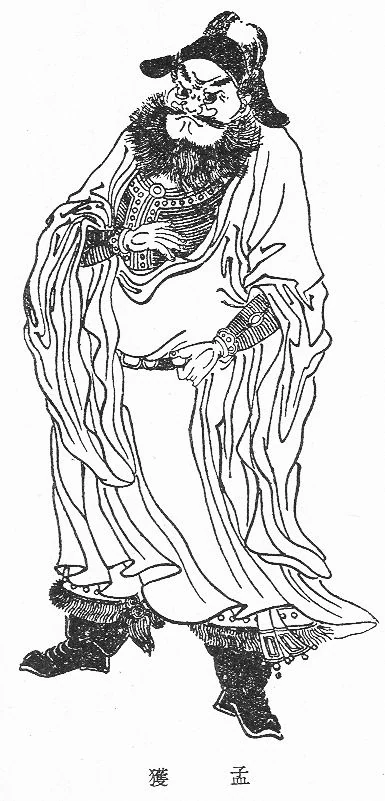
Later artistic depiction of Meng Huo in a historical painting or book illustration.

200 CE–250 CE

General

Meng Huo

孟获

Meng Huo (dates of birth and death unknown), courtesy name Junhou, was a native of Jianning Commandery in Yizhou (around present-day Qujing, Yunnan) in the late Eastern Han and Three Kingdoms period. He belonged to a powerful local clan in Nanzhong and was respected by both the indigenous and Han populations. In 223, the first year of the Jianxing era of Shu Han, he joined the rebellion led by the prominent Yizhou clansman…

200 CE–250 CEShu Han

PROFILE

Meng Huo (dates of birth and death unknown), courtesy name Junhou, was a native of Jianning Commandery in Yizhou (around present-day Qujing, Yunnan) in the late Eastern Han and Three Kingdoms period. He belonged to a powerful local clan in Nanzhong and was respected by both the indigenous and Han populations. In 223, the first year of the Jianxing era of Shu Han, he joined the rebellion led by the prominent Yizhou clansman Yong Kai. In 225, the third year of Jianxing, Zhuge Liang campaigned south and, according to the traditional account, captured and released Meng Huo seven times until he submitted sincerely. After Nanzhong was pacified, Meng Huo followed Zhuge Liang into Shu and rose to Vice Censor-in-Chief. His submission became the emblematic result of Zhuge Liang's strategy of “attacking the heart as the highest principle,” and during Zhuge Liang's lifetime Nanzhong saw no further large-scale rebellion.

Other name
Meng Junhou
Period
Shu Han
Dynasty / Regime
Shu Han
Identity
General
Ethnicity / affiliation
Not reliably established in the historical sources
Native place
Jianning Commandery, Yizhou (around present-day Qujing, Yunnan)
Date of birth
Unknown
Place of birth
Jianning Commandery, Yizhou (present-day Qujing, Yunnan)
Date of death
Unknown
Place of death
Unknown
Highest office
See Life and Principal Deeds
Principal achievements
Powerful leader in Nanzhong; after Zhuge Liang's southern campaign and the tradition of seven captures and seven releases, he submitted sincerely; later entered Shu and served as Vice Censor-in-Chief.

LIFE TIMELINE

Birth year unknown | Born into a prominent local clan in Jianning CommOpen

Birth year unknown | Born into a prominent local clan in Jianning Commandery, Yizhou (present-day Qujing, Yunnan)

Liu Bei pacified the Shu region and established the office of the LaixOpen

Liu Bei pacified the Shu region and established the office of the Laixiang Commander to govern Nanzhong

Liu Bei died; the powerful Yizhou clansman Yong Kai rebelled, and MengOpen

Liu Bei died; the powerful Yizhou clansman Yong Kai rebelled, and Meng Huo was sent by him to incite indigenous communities to join the revolt

Zhuge Liang launched his southern campaign; Yong Kai was killed by folOpen

Zhuge Liang launched his southern campaign; Yong Kai was killed by followers of Gao Ding, and Meng Huo gathered scattered troops and became leader of the rebels

Zhuge Liang crossed the Lu River and captured Meng Huo alive; after seOpen

Zhuge Liang crossed the Lu River and captured Meng Huo alive; after seven releases and seven captures, Meng Huo submitted sincerely

The four commanderies of Nanzhong were pacified; Meng Huo followed ZhuOpen

The four commanderies of Nanzhong were pacified; Meng Huo followed Zhuge Liang to Chengdu and was appointed Vice Censor-in-Chief

Year of death unknown; approximately died in the later Shu Han periodOpen

Year of death unknown; approximately died in the later Shu Han period

BIOGRAPHY

Biography

Family Background and Early Years

Meng Huo came from the prominent Meng clan of Nanzhong. During the Eastern Han, many Han settlers had already moved into Nanzhong, roughly present-day Yunnan, Guizhou, and southwestern Sichuan, producing powerful local clans such as the Jiao, Yong, Lou, Cuan, Meng, Liang, Mao, and Li families. The Meng were among the prominent groups and included branches associated with Zhuti and Jianning. Members of the Zhuti Meng had served in the interior since the Western Han, while the Jianning Meng are generally regarded as having moved south from the Zhuti branch.

Meng Huo's ethnic affiliation has long been disputed. One view identifies him as a Han local strongman whose ancestors had migrated south, another as a Yi leader, while still others regard him as a powerful local figure who had become culturally mixed or “barbarized.” A claimed Yi name is Jieduo Awen.

Although he came from a prominent clan, Meng Huo lived for many years in a region where indigenous and Han populations were intermingled. He enjoyed substantial prestige among both groups; the historical phrase says that he was “respected by the indigenous and the Han.” This dual standing gave him considerable mobilizing power in Nanzhong and later helped make him both a rebel leader and a key figure in Shu Han's governance of the region.

There is also disagreement over his native place. The *Chronicles of Huayang* contains different references to Jianning and Zhuti, and the matter remains disputed. During the Republican era, scholar Zhang Hualan wrote *A Critique of Meng Huo*, questioning whether Meng Huo was a fictitious figure. He argued that the *Records of the Three Kingdoms* described rebels such as Yong Kai and Gao Ding in detail and would not have omitted a man supposedly “respected by indigenous and Han alike,” and that a man “captured seven times” being named Huo, meaning “capture,” appeared suspiciously convenient. More scholars, including Huang Chengzong, have argued that Meng Huo was historical, pointing to the Eastern Han “Meng Xiaoju Stele” excavated at Zhaotong in Yunnan as evidence that the Meng surname was indeed prominent in Nanzhong.

Participation in the Rebellion

After Liu Bei pacified Shu in 214, the nineteenth year of Jian'an, he sent General Who Pacifies the Distant Deng Fang to administer Nanzhong as Administrator of Zhuti and Laixiang Commander, with his headquarters at Nanguang. Deng Fang was said to regard wealth lightly and to be resolute and courageous, earning respect among both indigenous and Han people. After Deng Fang died, Liu Bei asked administrative aide Li Hui who could replace him. Li Hui compared himself to Zhao Chongguo, and Liu Bei appointed him commander, moving the headquarters to Pingyi County.

In 223, the first year of Jianxing, Shu Han emperor Liu Bei died and the situation in Nanzhong changed abruptly. Yong Kai, a prominent Yizhou clansman; Gao Dingyuan, an indigenous leader of Yuexi; and Zhu Bao, Administrator of Zangke, successively rose in rebellion. Yong Kai killed Administrator Zheng Ang and bound the succeeding administrator Zhang Yi, sending him to Eastern Wu, where Sun Quan appointed Yong Kai remotely as Administrator of Yongchang. The indigenous people of Yizhou initially did not wish to follow Yong Kai, so he sent Meng Huo to stir them up. Meng Huo falsely told the elders: “The court wants three hundred black dogs with entirely black chests, three dou of mann nao, and three thousand lengths of zhuo wood, each three zhang long. Can you provide them?” Zhuo wood was hard and curved and did not grow even two zhang tall, making the demand impossible. The people therefore believed him and followed Yong Kai in rebellion.

Because the state had only recently suffered the death of its ruler, Zhuge Liang did not immediately send a punitive army and instead adopted a policy of conciliation. He sent official Chang Qi to inspect Nanzhong and had Protector-General Li Yan write to admonish Yong Kai. Yong Kai replied arrogantly: “I have heard that there cannot be two suns in Heaven nor two kings on earth. Now the realm is divided and there are three legitimate calendars. People in distant lands are bewildered and do not know whom to follow.” When Chang Qi reached Zangke, he arrested and interrogated the registrar there and was killed by Zhu Bao, further widening the rebellion.

Seven Captures and Seven Releases

In the spring of 225, the third year of Jianxing, Zhuge Liang personally led a large army south in three columns: Ma Zhong attacked Zangke, Li Hui advanced toward Yizhou, and Zhuge Liang led the main force against Yuexi. Yong Kai led his troops toward Yuexi to support Gao Ding but was instead killed by Gao Ding's followers. Meng Huo gathered Yong Kai's scattered troops and became the new rebel leader. Zhuge Liang killed Gao Dingyuan, Ma Zhong pacified Zangke, and Li Hui fought in Nanzhong. Meng Huo withdrew to a base south of the Jinsha River and between there and Yongchang, roughly in the area from present-day Heqing to Dali in Yunnan.

Zhuge Liang heard that Meng Huo was respected by both indigenous and Han people and ordered that he be taken alive. According to the *Spring and Autumn Annals of the Han and Jin*, after capturing Meng Huo, Zhuge Liang took him around the Shu encampment and asked, “What do you think of this army?” Meng Huo replied: “Before, I did not know what was real and what was empty, and so I was defeated. Now that I have been permitted to inspect your camp, if this is all there is, it will certainly be easy to defeat.” Zhuge Liang laughed and released him to fight again. This process of seven releases and seven captures ended with Meng Huo sincerely submitting and refusing to leave again. He said: “My lord, this is Heaven's might. The people of the south will rebel no more.”

Before the campaign, staff officer Ma Su had accompanied Zhuge Liang for several dozen li and advised him: “In the method of warfare, attacking the heart is superior and attacking cities inferior; warfare of the mind is superior and warfare with weapons inferior. I hope, my lord, that you will simply make their hearts submit.” Zhuge Liang adopted the advice. The seven captures and seven releases were later treated as the fullest example of the principle “attacking the heart is superior.”

It should be noted that the story of the seven captures and seven releases first appears in the *Chronicles of Huayang* and the *Spring and Autumn Annals of the Han and Jin*. The *Records of the Three Kingdoms*, the standard dynastic history, does not record it, and its historicity has therefore been debated. Pei Songzhi's commentary on the *Records of the Three Kingdoms* nevertheless quotes the passage from the *Spring and Autumn Annals of the Han and Jin* in full, and Sima Guang's *Zizhi Tongjian* also includes the episode; the source text notes that it does not directly contradict the *Records of the Three Kingdoms*.

Service in Shu

In the autumn of 225, the third year of Jianxing, the four Nanzhong commanderies of Yizhou, Yuexi, Zangke, and Yongchang were pacified. Zhuge Liang renamed Yizhou Commandery as Jianning and appointed Li Hui administrator. He separated territory from Jianning and Yuexi to form Yunnan Commandery and appointed Lü Kai administrator, and separated territory from Jianning and Zangke to form Xinggu Commandery, with Ma Zhong as Administrator of Zangke. He also moved more than ten thousand households of strong soldiers known as the Qing Qiang into Shu, organized them into five divisions called the “Flying Army,” and assigned weaker people as retainers to the powerful Jiao, Yong, Lou, Cuan, Meng, Liang, Mao, and Li clans, establishing five division commandants known as the “Five Sons.”

Zhuge Liang adopted a conciliatory policy described as “leaving no garrison and transporting no grain.” He brought outstanding men from Nanzhong into the central government. Meng Huo, together with Cuan Xi of Jianning and Meng Yan of Zhuti, entered government service. Meng Huo followed Zhuge Liang to Chengdu and was appointed Vice Censor-in-Chief. Cuan Xi eventually became a military commander, while Meng Yan became General Who Supports Han. By these appointments, Zhuge Liang both won the loyalty of Nanzhong and incorporated potential rebel forces into the Shu Han bureaucracy.

After his submission, Meng Huo assisted Shu Han in stabilizing Nanzhong. During Zhuge Liang's lifetime, the region saw no further major rebellion. Gold, silver, cinnabar lacquer, plow oxen, warhorses, and other resources from Nanzhong were supplied steadily for Shu Han's military and state needs and became important logistical support for Zhuge Liang's northern campaigns. When Cao Wei invaded Shu in 263, Nanzhong did not send troops to relieve Chengdu. The source text gives several possible explanations, including that Meng Huo may already have died or become elderly, that his power was not the only major force in Nanzhong, and that relations between the central government and Nanzhong were limited in late Shu Han.

Major Activities

Participation in the Nanzhong Rebellion

After Liu Bei died in 223, the first year of Jianxing, a large rebellion broke out in Nanzhong. As an important supporter of Yong Kai, Meng Huo was sent among indigenous communities to stir up resistance. He falsely claimed that the court demanded three hundred black dogs, three dou of mann nao, and three thousand lengths of zhuo wood, persuading indigenous people that the Shu Han government was imposing impossible exactions and thereby inducing them to follow Yong Kai. The source presents this episode as evidence that Meng Huo's influence among indigenous communities exceeded Yong Kai's and that tensions among the indigenous and Han populations formed part of the background to the rebellion.

Seven Captures and Seven Releases

The seven captures and seven releases are the best-known episode of Meng Huo's life. During Zhuge Liang's southern campaign, Zhuge Liang repeatedly captured and released him so that he would submit in his heart. According to the *Spring and Autumn Annals of the Han and Jin*, Zhuge Liang showed him the camp, and Meng Huo replied that “if this is all there is, it will certainly be easy to defeat.” Zhuge Liang laughed and released him. After seven confrontations, Meng Huo finally exclaimed that Zhuge Liang possessed “Heaven's might” and that the people of the south would rebel no more. The episode came to be regarded not only as a military victory but also as an example of political strategy and the principle of “attacking the heart as the highest method.”

Entering Shu as an Official

After Nanzhong was pacified, Zhuge Liang accepted Meng Huo into government service and appointed him Vice Censor-in-Chief. This was an important supervisory office within the Censorate. The appointment of a former rebel leader to a central supervisory position is presented in the source as evidence of Zhuge Liang's confidence in those he chose to employ and of Shu Han's policy of winning over powerful Nanzhong families. While serving in Chengdu, Meng Huo assisted in maintaining stability in Nanzhong, allowing gold, silver, cinnabar lacquer, plow oxen, warhorses, and other resources to continue supplying Shu Han's military and government.

Personal Relations

Family

  • Meng Yan: clansman from Zhuti; recruited into government by Zhuge Liang and rose to General Who Supports Han
  • Meng Qiu: traditionally said to have been his son, appearing in Zhang Shu's Qing-dynasty *Collected Writings of Marquis Zhongwu Zhuge*; generally rejected by historians
  • Lady Zhurong: traditionally said to have been his wife, also appearing in Zhang Shu's *Collected Writings of Marquis Zhongwu Zhuge*; generally rejected by historians

Alliances and Conflicts

  • Yong Kai: political ally and prominent Yizhou clansman; leader of the Nanzhong rebellion who sent Meng Huo to incite indigenous people. After Yong Kai was killed by Gao Ding's followers, Meng Huo gathered his scattered troops and became leader
  • Gao Dingyuan: member of the rebel camp and indigenous leader of Yuexi; later quarreled with Yong Kai and was killed by Zhuge Liang
  • Zhu Bao: Administrator of Zangke and participant in the rebellion; suppressed by Ma Zhong
  • Zhuge Liang: relationship changed from enemies to ruler and minister; the southern campaign and seven-captures tradition ended with Meng Huo's submission and appointment as Vice Censor-in-Chief
  • Ma Su: indirectly connected; his principle that “attacking the heart is superior” was adopted by Zhuge Liang and directly affected Meng Huo's fate
  • Li Hui: one of the commanders of the southern campaign and a man from the same broader region; later Administrator of Jianning

Historical Assessment

Three Kingdoms and Jin Periods

  • Zhuge Liang: Meng Huo became the key figure demonstrating the successful practice of the “attacking the heart is superior” strategy in the pacification of Nanzhong, according to the *Spring and Autumn Annals of the Han and Jin*
  • Chen Shou's *Records of the Three Kingdoms* does not contain a separate biography of Meng Huo, but Pei Songzhi's commentary quotes the *Spring and Autumn Annals of the Han and Jin* in detail on the seven captures and releases, indicating that the story circulated by the Jin period
  • Chang Qu, author of the *Chronicles of Huayang*, listed Meng Huo together with Cuan Xi and Meng Yan among the “outstanding men” of Nanzhong and recognized their contribution after submission to Shu Han

Tang and Song Periods

  • Sima Guang's *Zizhi Tongjian* includes the entire seven-captures episode as an important part of Zhuge Liang's southern campaign, showing that the account was accepted in Tang-Song historical tradition
  • The *Tongdian* also records Meng Huo and treats the episode as a representative case in governing Nanzhong
  • Tang-period writings generally followed the portrayals in the *Chronicles of Huayang* and the *Spring and Autumn Annals of the Han and Jin*, presenting Meng Huo as a local leader who submitted to the central state

Ming and Qing Periods

  • Li Zhi commented: “Meng Huo had many clever plans and was indeed a worthy opponent for Kongming, ha! People say Meng Huo was a barbarian, but how was he barbaric? It was only that his heart had not submitted. Once he submitted, he submitted forever, unlike people today who may submit in heart but not in words.” He regarded Meng Huo not as foolish or uncivilized but as an opponent with determination
  • Luo Zhaopei wrote: “To take up arms for the people of one region—how could that alone be heroic? To lay down the drums for all the people under Heaven—still more admirable is the commander's breadth of mind.” This praised Meng Huo's choice from the perspective of the population
  • *Romance of the Three Kingdoms* portrayed him as the “King of the Southern Man,” brave but lacking in strategy, becoming the best-known popular image of Meng Huo
  • Zhang Shu's Qing compilation *Collected Writings of Marquis Zhongwu Zhuge* records Lady Zhurong as Meng Huo's wife and Meng Qiu as his son. Although these claims are not considered reliable, they show the expansion of Meng Huo legends in the Qing period

Modern Assessments

  • Republican-era scholar Zhang Hualan wrote *A Critique of Meng Huo*, arguing that Meng Huo may have been fictional because the *Records of the Three Kingdoms* does not record him
  • Huang Chengzong and other scholars argue that Meng Huo was historical and that the “Meng Xiaoju Stele” from Zhaotong, Yunnan, demonstrates that the Meng were indeed a prominent Nanzhong clan
  • Yi folk traditions revere Meng Huo as an ethnic hero and protective deity, and temples dedicated to him survive in parts of Sichuan and Yunnan
  • Modern scholarship remains divided between Han and Yi interpretations of his ethnicity, reflecting the complexity of ethnic interaction in Nanzhong

LOCAL NETWORK

Zhuge Liang↗Linked from this entry

Original note (Chinese): 南中叛军首领,被诸葛亮七擒七纵后心服(据《汉晋春秋》)

Zhuge Liang↗Related entry

Original note (Chinese): 诸葛亮南征时对孟获七擒七纵,使其心服归降,后任命其为御史中丞

Li Hui (Three Kingdoms)↗Related entry

Original note (Chinese): 南征将领之一,建宁人,后任建宁太守,与孟获同乡

Liu Bei↗Related entry

Original note (Chinese): 刘备为蜀汉开国皇帝,其去世后南中叛乱爆发,孟获参与其中

Shu Han↗Era association

Original note (Chinese): 蜀汉;蜀汉

雍闿 · No matching entry available

雍闿为南中叛乱首领,孟获受其指派煽动夷人附逆,雍闿死后孟获收集其散兵继任首领

高定元 · No matching entry available

同为南中叛军首领,与雍闿发生内讧并杀之,后被诸葛亮斩杀

朱褒 · No matching entry available

牂牁太守,参与南中叛乱,与雍闿、高定元同为叛军阵营

马谡 · No matching entry available

马谡建议诸葛亮“攻心为上”,直接影响了诸葛亮对孟获的策略

孟琰 · No matching entry available

朱提人,与孟获同被诸葛亮收为官属,官至辅汉将军

爨习 · No matching entry available

建宁人,与孟获同被诸葛亮收为官属,官至领军

CONTEMPORARIES

Bibliography

  • *Records of the Three Kingdoms*, Shu section, “Biography of Zhuge Liang,” Pei Songzhi's commentary quoting the *Spring and Autumn Annals of the Han and Jin*
  • *Taiping Yulan*, vol. 322, quoting the *Spring and Autumn Annals of the Han and Jin*