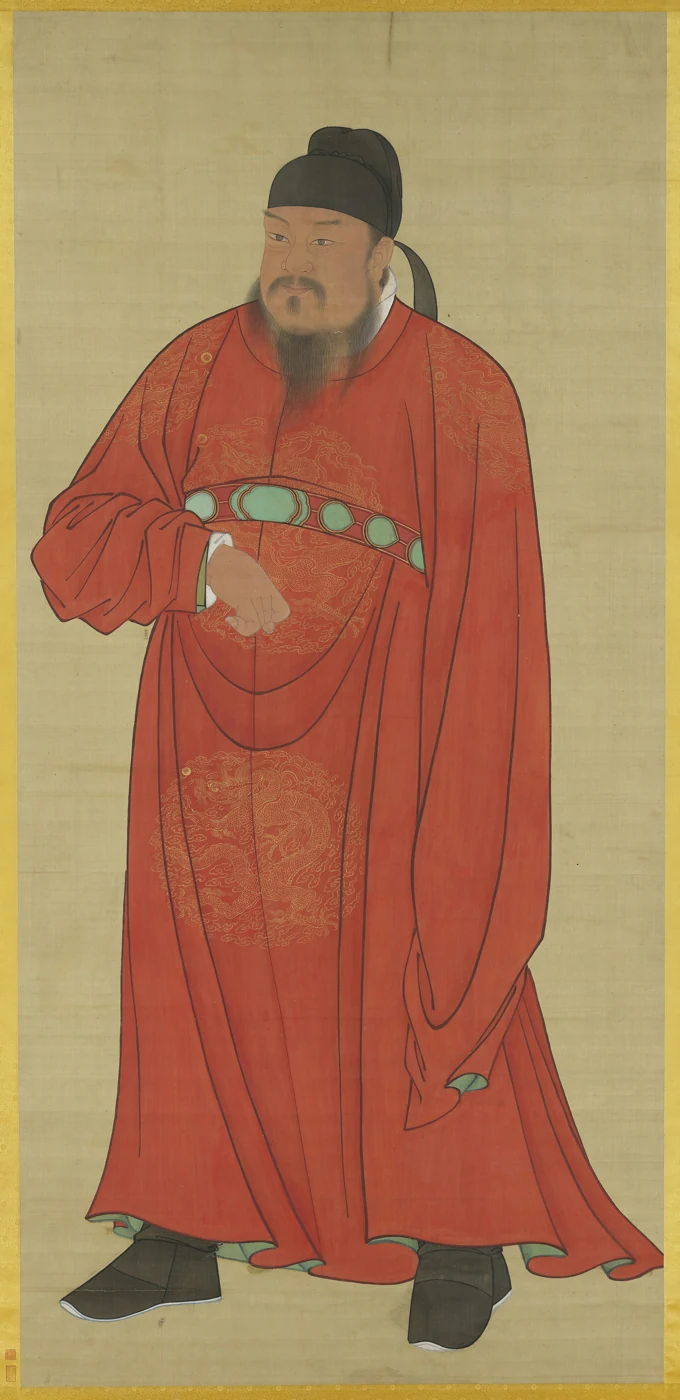
Biography
Family Background and Early Life
Li Yuan was born in Chang'an on December 21, 566, the twenty-fourth day of the eleventh lunar month in the first year of the Tianhe era of Northern Zhou. Volume 2 of *Cefu Yuangui*, in the section on emperors, records: "Emperor Gaozu of Tang was born on the dingyou day of the eleventh month in the first year of the Tianhe era of Later Zhou." According to historical records, Li Yuan was a descendant of Li Gao, founder of Western Liang during the Sixteen Kingdoms period. His grandfather Li Hu rose to the office of Grand Commandant in Western Wei and was one of the Eight Pillars. He was granted the surname Daye, and Li Yuan therefore once bore the name Daye Yuan. After the Northern Zhou was established, Li Hu was posthumously enfeoffed as Duke of Tang. Li Yuan's father, Li Bing, served the Northern Zhou as Pillar-of-State General and commander of Anzhou and inherited the title Duke of Tang. Li Yuan's mother was a daughter of Dugu Xin, a powerful Northern Zhou in-law, and a sister of Empress Dugu Qieluo, wife of Emperor Wen of Sui. Li Yuan was therefore closely connected with the upper ruling elite of the Sui dynasty.
In 574, the third year of the Jiande era, Li Yuan's father died when Li Yuan was seven, and he inherited the title Duke of Tang. As an adult, Li Yuan was described as free-spirited, open, and tolerant, able to win the goodwill of people regardless of status. The *Old Book of Tang*, in the Basic Annals of Gaozu, described him as "dashing and broad-minded, candid and true to his nature, generous and tolerant, winning the goodwill of high and low alike." After Yang Jian became grand chancellor of Northern Zhou, he restored the Li family's original surname. In 581, the first year of the Kaihuang era, Yang Jian founded the Sui dynasty, and Li Yuan entered Sui service as a qianniu beishen, an imperial guard officer. Because of the favor shown him by Empress Dugu and Emperor Wen of Sui, he successively served as governor of Qiaozhou (present-day Bozhou, Anhui), Qizhou (present-day Fengxiang, Shaanxi), and Longzhou (present-day Long County, Shaanxi).
Service under the Sui Dynasty
Early in the reign of Emperor Yang of Sui, Yang Guang, Li Yuan successively served as governor of Xingyang (present-day Xingyang, Henan) and Loufan (present-day Jingle, Shanxi) commanderies, and later entered court service as deputy director of the Palace Administration. In the spring of 613, the ninth year of the Daye era, he was transferred to vice minister of the Imperial Guard, with responsibility for palace security, marking a move from civil to military office. That same year, while Emperor Yang campaigned against Goguryeo, Li Yuan supervised grain transport at Huaiyuan Garrison, near present-day Liaozhong in Liaoning. In the sixth lunar month, Yang Xuangan rebelled against the Sui. By imperial order, Li Yuan guarded Honghua Commandery, in present-day Qingyang, Gansu, while also overseeing military affairs west of the passes. During this period, his broad contacts with prominent men aroused Emperor Yang's suspicion. When an edict ordered Li Yuan to join the emperor on tour, illness prevented him from going. Emperor Yang asked Li Yuan's niece, Lady Wang, why her uncle had not come. When she answered that Li Yuan was ill, the emperor asked, "Can he die?" After learning of this, Li Yuan became increasingly fearful and sought to protect himself by drinking heavily and accepting bribes so as to tarnish his own reputation.
In 615, the eleventh year of the Daye era, Emperor Yang visited Fenyang Palace and ordered Li Yuan to conduct inspections and suppress disorder in Shanxi and Hedong. At Longmen he encountered an uprising led by Wu Duan'er, a native of the area. Li Yuan attacked, reportedly firing seventy arrows without missing, and the rebels fled. He piled the bodies into a victory mound and recovered his arrows from them. He later defeated the rebel Chai Baochang of Jiangzhou and accepted the surrender of tens of thousands. The following year, 616, Li Yuan was promoted to General of the Right Xiaowei Guard after repeatedly presenting hunting hawks and hounds to Emperor Yang. When the Turks raided the frontier, Li Yuan and Wang Rengong, governor of Mayi Commandery, advanced north against them. Lacking troops, Li Yuan selected two thousand mounted soldiers skilled in archery, had them imitate Turkic ways of life, and used leisurely hunting to mislead the enemy while placing other expert archers in ambush. He ultimately defeated the Turks.
The Jinyang Rising
In 617, the thirteenth year of the Daye era, Li Yuan formally became pacification commissioner for Shanxi and Hedong, garrison commander of Taiyuan, and supervisor of Jinyang Palace, making him the highest military and civil authority in the Taiyuan region. By then, rebellions at the end of the Sui had spread widely and divisions within the Sui ruling elite had intensified. While Li Yuan was serving as pacification commissioner for Shanxi and Hedong, his deputy Xiahou Duan had already advised him to prepare for the future, and Li Yuan strongly agreed. After taking office at Taiyuan, he told his second son Li Shimin: "Tang was originally my fief, and Taiyuan is where Tang is located. Now that I have come here, this is an opportunity granted by Heaven. If what is granted is not taken, calamity will follow." This indicated that he was already considering rebellion.
After arriving, Li Yuan first defeated the forces of Zhen Zhai'er, a subordinate commander of the Lishanfei rebels operating south of Taiyuan in Queshu Valley, stabilizing the situation in Shanxi. During defenses against a Turkic incursion, however, deputy garrison commander Gao Junya and Wang Rengong, governor of Mayi, were defeated. Emperor Yang ordered Li Yuan arrested and Wang Rengong executed. The emperor soon sent another envoy pardoning Li Yuan, but the episode accelerated Li Yuan's preparations for rebellion. He instructed his eldest son Li Jiancheng to make secret contacts with talented men in Hedong, while Li Shimin secretly recruited heroes and able men in Jinyang. Liu Wenjing, magistrate of Jinyang County, saw that Li Yuan harbored ambitions beyond the region, cultivated ties with him, and planned an uprising with Li Shimin while in prison. Li Shimin also consulted Pei Ji, deputy supervisor of Jinyang Palace. Pei Ji arranged for palace women to attend Li Yuan while he was intoxicated and used this to pressure him into agreeing to rise in rebellion.
In the second lunar month of 617, Liu Wuzhou, an officer of the Yingyang Guard at Mayi, mutinied, killed Governor Wang Rengong, proclaimed himself emperor, and allied with the Turks before advancing south. Emperor Yang was furious and intended to summon Li Yuan to Jiangdu for punishment, greatly alarming him. Although another pardon followed, Li Yuan's close associates, including Pei Ji and Xu Shixu, urged him to advance his plans, and he finally resolved to rebel against the Sui. Under the pretext of campaigning against Liu Wuzhou and defending against the Turks, he sent Li Shimin, Liu Wenjing, Zhangsun Shunde, Liu Hongji, and others to recruit troops in various places. Within a month they gathered nearly ten thousand men, while Li Jiancheng and Li Yuanji were secretly summoned to Jinyang. Deputy garrison commanders Wang Wei and Gao Junya suspected Li Yuan of plotting rebellion and planned to eliminate Li Yuan and his sons during a rain-prayer ceremony at the Jin Shrine. The plan was discovered by Liu Shilong, a local headman of Jinyang, who informed Li Yuan. On the fifteenth day of the fifth lunar month, Li Yuan struck first, instructing Liu Zhenghui, a staff officer of the Yingyang Guard, to accuse Wang Wei and Gao Junya of colluding with the Turks; both were imprisoned. On the seventeenth day, tens of thousands of Turkic troops happened to attack Jinyang. Li Yuan ordered Wang and Gao executed and used an empty-city stratagem against the Turks. He then sent Liu Wenjing as envoy to the Turks, adopting a deferential tone and offering rich gifts to Shibi Qaghan, thereby gaining Turkic support. On the thirtieth day of the fifth lunar month, Li Jiancheng and Li Yuanji reached Jinyang, removing Li Yuan's remaining concerns. In the sixth lunar month he styled himself Grand General and established a staff administration, making Li Jiancheng Duke of Longxi and Grand Commander of the Left Army, and Li Shimin Duke of Dunhuang and Grand Commander of the Right Army. He also opened the granaries to relieve the poor. Supporters came from near and far, and within twenty days his forces numbered in the tens of thousands.
Capture of Chang'an and Founding of the Tang
On the fifth day of the seventh lunar month in 617, Li Yuan personally led thirty thousand armored troops in a formal oath ceremony and set out from Jinyang, moving south through the Fen River valley toward Hedong. Under the slogan of "upholding the Sui," he declared his intention to enthrone Prince Dai, Yang You. In the eleventh lunar month, Li Yuan entered Chang'an and placed Yang You on the throne as Emperor Gong of Sui, while honoring Emperor Yang, then at Jiangdu, as Retired Emperor. Li Yuan appointed himself Grand Chancellor and Prince of Tang and in practice controlled the Guanzhong government.
In 618, the second year of the Yining era, after Emperor Yang was killed at Jiangdu, Li Yuan accepted Yang You's abdication, proclaimed himself emperor, founded the Tang dynasty, and adopted the era name Wude. After becoming emperor, he used Chang'an as his political center and directed royal relatives and generals including Li Jiancheng, Li Shimin, Li Yuanji, Princess Pingyang Zhao, Li Xiaogong, Li Jing, and Li Shiji. They successively defeated or absorbed the rival forces of Xue Ju, Xue Rengao, Liu Wuzhou, Li Gui, Song Jingang, Wang Shichong, Dou Jiande, Xiao Xian, and Du Fuwei, largely completing the unification of the realm. The last remaining separatist force, Liang Shidu, was not defeated until 628, the second year of the Zhenguan era.
Institutional Construction during the Wude Era
During his reign, Li Yuan laid foundations for the institutional structure of the Tang dynasty. In 624, the seventh year of the Wude era, he promulgated the Tang bureaucratic system, largely following Sui institutions. In agriculture, he introduced the equal-field system of land distribution and taxation and adjusted taxation to reduce burdens on recipients of state land. In law, he abolished many harsh policies of Emperor Yang of Sui and promulgated the Wude Code. These measures provided an important basis for the Zhenguan era of good government under Emperor Taizong. Li Yuan also used the rivalry between the Eastern and Western Turks to stabilize the northern frontier, enabling him to concentrate forces on the conquest of the Central Plains.
Xuanwu Gate Incident and Abdication
During Li Yuan's reign, he failed to settle the succession issue early or manage it effectively. Although he had made his eldest son Li Jiancheng crown prince at an early stage, he repeatedly tried to conciliate his sons as their rivalry intensified, hoping they would balance one another rather than imposing control. His second son, Li Shimin, accumulated great military achievements during the wars of unification and gained many supporters, intensifying his conflict with Crown Prince Li Jiancheng and Prince of Qi Li Yuanji.
In the sixth lunar month of 626, the ninth year of the Wude era, Li Shimin launched the Xuanwu Gate Incident, ambushed and killed Li Jiancheng and Li Yuanji at Xuanwu Gate, and had his troops take control of Chang'an. Li Shimin falsely reported to Li Yuan that the two had rebelled and been executed. With officials also supporting Li Shimin, Li Yuan had little choice but to hand military and state affairs to him. Li Jiancheng and Li Yuanji were posthumously demoted to commoner status and removed from the imperial clan register, and all ten of their sons were killed. Three days later, Li Yuan made Li Shimin crown prince. Three months afterward, he abdicated in Li Shimin's favor and became Retired Emperor. In 629, the third year of the Zhenguan era, he moved to Hongyi Palace.
Death
Li Yuan, by then Retired Emperor, died on June 25, 635, the sixth day of the fifth lunar month in the ninth year of the Zhenguan era, at the age of sixty-nine. His initial posthumous name was Emperor Taiwu, his temple name was Gaozu, and he was buried at Xianling, in present-day Sanyuan, Shaanxi. In the eighth lunar month of 674, the first year of the Shangyuan era under Emperor Gaozong, his posthumous title was changed to Emperor Shenyao. In the second lunar month of 754, the thirteenth year of the Tianbao era under Emperor Xuanzong, the honorific title Emperor Shenyao Dasheng Daguangxiao was conferred.
Li Yuan, styled Shude, was a native of Chengji in Longxi (some sources say Didao), a seventh-generation descendant of Li Gao, Prince Wuzhao of Liang, and came of the Guanlong aristocracy of the Northern Zhou. The Tang history traces his line: Li Gao begot Li Xin; Li Xin begot Zhong'er, who served the Wei as governor of Hongnong; Zhong'er begot Li Xi, a garrison commander at Jinmen who led his retainers to guard Wuchuan and settled there; Li Xi begot Li Tianxi, a standard-bearer under the Wei; his grandfather Li Hu, left vice director of the Northern Wei and Duke of Longxi, helped to found the Zhou along with Yuwen Tai, Li Bi and Dugu Xin and was one of the "eight pillars," being given the surname Daye, and was posthumously enfeoffed Duke of Tang with the name Xiang, the original surname being restored under the Sui; and his father Li Bing, commander of Anzhou and pillar general of the Zhou, inherited the dukedom of Tang with the posthumous name Ren. Li Yuan was born at Changan in 566, and it is recorded that at his birth purple vapour filled the court and a divine light shone in the room, that he had three nipples and a purple mark like a dragon under his left arm; at seven he inherited the dukedom of Tang. Grown up, he was free and open, natural and direct, generous and tolerant, winning the hearts of high and low alike. The physiognomist Shi Shiliang told him that his frame was no common one and that he would be a ruler of men, and Li Yuan took some pride in the words. On the Sui accession he became a bodyguard officer, and as the empress Dugu was his father's cousin he was specially favoured, serving as prefect of Qiao, Long and Qi. Under the Daye era he was prefect of Xingyang and Loufan, then an assistant of the palace treasury; in 613 he became assistant of the imperial guard, and in the eastern campaign against Koguryo he supervised transport at Huaiyuan. When Yang Xuangan rebelled he was sent by post to hold Honghua and command the military affairs west of the pass. Steadily employed at home and abroad and long known for his kindness, he gathered about him men of spirit, and as the emperor grew suspicious, a summons to the imperial quarters found him ill and unable to attend; the emperor asked his nephew's daughter Wang in the palace why her uncle was so late, and on being told he was ill, asked whether he was likely to die. Li Yuan, hearing of it, was the more afraid, and took to drinking and to taking bribes to blur his traces. His wife was a daughter of Dou Yi. Hearing of the Sui accession she had thrown herself down and lamented that she was not a man to save her uncle's house, and her father, marvelling at her, would not betroth her lightly: he painted two peacocks on a screen and required each suitor to shoot two arrows, promising his daughter to whoever pierced an eye; dozens failed and Li Yuan, arriving last, hit an eye with each shot. In the Daye years, when Li Yuan as prefect of Fufeng had several fine horses, she urged him to present them to the emperor, who loved hawks and horses, and to keep none, lest they bring him trouble; he hesitated and suffered for it, and after her death at forty-five in Zhuojun he remembered her words, sought out hawks and dogs to present, and was soon promoted general, telling his sons with tears that had he followed their mother's advice he would long since have held this office. It is also told that the emperor, who feared the prophecy that a Li would be king, called Li Yuan "Granny Face" at a great feast for the wrinkles in his face; and that his wife, hearing of it, congratulated him, saying that as he inherited the dukedom of Tang and "Tang" means "hall," Granny Face meant master of the hall, at which he was delighted. In 615 the emperor was at Fenyang palace and sent Li Yuan into Shanxi and Hedong to suppress rebels. At Longmen the rebel leader Mu Duan'er came against the city with several thousand men, and Li Yuan with a dozen horsemen killed seventy in as many shots, breaking the rebels, collecting their corpses into a mound and recovering his arrows from the bodies; he also defeated the rebel Chai Baochang at Jiangzhou, bringing over tens of thousands. When the Turks raided the frontier he and the prefect of Mayi, Wang Rengong, attacked them; their troops being few, Li Yuan picked two thousand good horsemen as a flying column, living and eating by the water and grass as the Turks did and showing themselves at leisure hunting, while placing picked archers in ambush, so that the enemy, mistrusting, would not fight and were beaten when he charged. In 616 he became general of the right awe-inspiring guard. With rebellion spreading through the empire and the Sui court racked by suspicion, Li Yuan, then commissioner of Shanxi and Hedong, so conducted himself that when an associate was defeated and the emperor ordered him arrested and Wang Rengong killed, he had Li Shimin prepare for revolt, and when the emperor pardoned him he judged the moment come, his plans fixed from then. Eager to save the age and with the empire in his mind, he remembered a face for years and a strategic point at a glance, and while suppressing rebels he took in the surrendered and enlarged his forces, telling his eldest son Li Jiancheng to gather men of spirit at Hedong. Xu Shixu, an officer of the Sui, told him that the dynasty would fall, that his name was in the prophecies, and that holding the troops of five commanderies at a crossroads he should raise the banner of the empire; and Li Yuan, admiring him, kept him close. Li Shimin and the magistrate Liu Wenjing planned the rising without Li Yuan's knowledge; and Pei Ji, his friend and deputy of the Jinyang palace, having first placed palace women in his bed, told him of the plot over wine, at which Li Yuan, greatly alarmed, heard that the fault was capital and that this was why it had been done; and when Li Shimin told him the rest, Li Yuan at first pretended to refuse and to have him arrested, then consented, saying that he loved him and could not bear to inform on him. In the second month of 617, when the disaffection of Liu Wuzhou and the Turks moved the emperor to summon Li Yuan to Jiangdu for punishment, Li Shimin said the crisis was upon them and the rising should be made, and the emperor's pardon came too late to matter. The deputy commanders Wang Wei and Gao Junya, suspecting the gathering of troops, plotted to seize him at the rain-prayer in the Jinci; but Li Yuan, warned, made secret preparation. On the jiazi day of the fifth month, as he sat in state with them, Liu Zhenghui, the equerry of the Kaiyang office, accused them of treason and they were seized where they sat; two days later, when the Turks raided, Li Yuan told the army that they had called the Turks and they were killed, and the rising began, Liu Wenjing being sent to make peace with the Turks. In the sixth month a proclamation was sent to the commanderies, the great general's headquarters opened and three armies formed. On the thirtieth day of the fifth month Li Jiancheng and Li Yuanji arrived from Hedong, and Pei Ji and the brothers asked that the emperor be deposed and the Prince of Dai set up, that the righteous army be proclaimed and the banners changed to please the Turks, to which Li Yuan agreed. In the sixth month, because the commandery of Xihe would not obey, Li Jiancheng and Li Shimin took its city and killed its assistant; Li Yuan then styled himself great general, set up his staff, made Li Jiancheng Duke of Longxi with the left army, Li Shimin Duke of Dunhuang with the right, opened the granaries to the poor, and within twenty days had tens of thousands of men, resolving to enter the pass. Song Laosheng with tens of thousands held Hedong against him; the autumn rains made the roads impassable and food ran short, and it was rumoured that the Turks and Liu Wuzhou would fall on Jinyang, so that Pei Ji advised turning back while Li Jiancheng and Li Shimin urged advance, and Li Yuan decided to go on. In the eighth month, the rain ceasing and grain arriving from Taiyuan, he attacked Huoyi: after a feint by light horse, Song Laosheng came out with thirty thousand by two gates, and Li Yuan's troops gave way, so that Song, thinking him afraid, advanced and formed a li from the city; Li Yuan opposed him with infantry while his sons circled to the rear and held the gates, and in the midst of the fight he had it cried that Song Laosheng was slain, at which his army broke in confusion and he was killed, the city being taken by storm. At the distribution of rewards the staff would have ranked the enlisted bondmen below the free, but Li Yuan said that between arrow and stone there was no noble or base and that merit should be rewarded as it stood; he reviewed the officials and people of Huoyi, rewarded those of Xihe, enlisted the strong, and gave the fifth rank of nominal office to the soldiers of the pass who wished to go home, answering those who thought it too lavish that Sui had lost men's hearts by stinting rewards and that to win men with office was better than to fight for them. He then advanced on Hedong; finding the city strong, he hesitated to go west, and Pei Ji advised taking Hedong first lest he be caught between two fires, while Li Shimin urged speed. Li Yuan adopted both, leaving troops to blockade Hedong and leading the main army west, crossing the river at Hukou and encamping at the Changchun palace at Chaoyi, whither the people of the pass flocked; he sent Li Jiancheng and Liu Wenjing with ninety thousand to join the "ladies' army," and Li Jiancheng with the granary troops by Xinfeng to the Changle palace while Li Shimin went north of the old city of Changan; and as he marched he abolished the travelling palaces and pleasure parks and released their women to their kin. Entering Changan, he bound his army by twelve articles, putting to death only murderers, robbers, deserters and rebels and pardoning the rest. He had the emperor honoured as retired emperor and the Prince of Dai set up, was given the yellow axe, the staff, command of all military affairs inside and outside, the chancellorship and the secretariat, and was made Prince of Tang, with Li Jiancheng as his heir, Li Shimin as internal secretary and Duke of Qin, and Li Yuanji as Duke of Qi. In the third month of 618 Yuwen Huaji murdered the retired emperor at Jiangdu; Li Yuan was advanced to chancellor with the nine gifts, and on the jiazi day took the throne in the Taiji hall, sacrificed in the southern suburb, proclaimed a general amnesty and changed the era to Wude, making Li Jiancheng crown prince, Li Shimin Prince of Qin and Li Yuanji Prince of Qi. His territory then took in only the pass and Hedong, and his strategy was to secure the pass, then move east and unify the realm by stages, which he did by turns of surrender and conquest through the defeats of Xue Ju and his son, Li Gui, Liu Wuzhou, Wang Shichong, Dou Jiande and Xiao Xi, and the submission of Du Fuwei, until the destruction of Liang Shidu in 628 completed the reunification. In the third month of 621, when Dou Jiande marched to relieve Luoyang, Li Shimin, encircling Zheng and striking at Xia, rode to the Wu pass and held it; Dou Jiande, unable to advance, lay idle for months until his army's spirit failed and he was taken, and Wang Shichong then surrendered. Liu Heita's rebellion, however, recurred: with Turkic aid he raided Shandong and the prefectures of Hebei rebelled again, and when Li Yuanji, sent in the eleventh month, would not advance, Li Jiancheng was sent to press the campaign until Liu Heita was taken and killed in 623 and Xu Yuanlang fled and died. In the south Li Jing went by the passes to Guizhou and brought over ninety-six prefectures with more than six hundred thousand households. Descended himself from Sui officials, Li Yuan valued the abler of the Sui clan and of its old servants, employing them and receiving the surrender of many Sui generals, so that the government of the new dynasty was soon in good order. On the first day of the fourth month of 621 he decreed that the scholars of the prefectures, graduates of the classics, the talent examinations and the presented scholar degree who were of good repute in their districts should be examined by their counties and reviewed by their prefects, and the qualified presented in the tenth month each year - the beginning of the Tang examinations; and he ordered officials of the fifth rank and above and the governors of prefectures to recommend one man each, and permitted those of ability but no fame to state their own case. In law he had proclaimed leniency at the rising, bound the army by twelve articles at Changan, and had the Wude code drawn up on the principle of weighing what to keep and cut, suiting the times, correcting deviations and keeping the essentials, following the Kaihuang code of the Sui in its headings but forming with its statutes, ordinances, regulations and forms a complete Tang code. In 624 the statutes were fixed and the equal-field system established: a ding or middle-aged man received a hundred mu, the gravely ill forty, a widow thirty, a householder twenty more, two tenths being hereditary and eight tenths held for life; the rent and service were two bushels of millet a year, two lengths of silk or its equivalent in cloth, twenty days' service commutable at three feet of cloth a day, with remissions for additional service, and tax in rice in Lingnan, half-rates for the aboriginal households and money or sheep from the inner barbarians, and remissions of rent, or of rent and tax, or of all, for losses of four, six or seven tenths by flood, drought, insects or frost. This rent-and-service system, based on population and land, enlarged and steadied the revenue of the early Tang and promoted the growth of population and economy. In coinage he kept the Sui five-zhu at first, and in 621 abolished it for the Kaiyuan tongbao, eight tenths of an inch across, two zhu four lei in weight and ten to the ounce, which men found well proportioned and convenient and which set the standard for later coin. He issued edicts inviting plain speaking and attacking the abuses of the former government, ordering the encouragement of agriculture and the reduction of corvée, forbidding the slaughter and sale of liquor in the prefectures within the pass, ending the tribute of dwarfs, small horses and strange beasts, and abolishing the travelling palaces and releasing their palace women; and he had the histories of Wei, Zhou, Sui, Liang, Qi and Chen compiled. In 624 Fu Yi petitioned against Buddhism, and Li Yuan would have acted on it had he not shortly given up the throne. In his dealings with the frontier he took differences of culture as natural, and pursued a policy of peace, treating Koguryo, Paekche and Silla alike, making Kim Baekjeong a pillar of state and King of Silla and Prince of Lelang, so containing Koguryo and steadying the frontier; and in 626, when Koguryo closed the roads to Silla and Paekche, he sent an officer to look into it. Of his sons, the eldest, Li Jiancheng, was crown prince, generous and capable, assisting in government, steadying the rear and supplying the front; while Li Shimin had the greatest share in the rising at Jinyang and, commanding in the field, won conspicuous merit. As his fame rose a struggle for the succession grew between him and the crown prince, with Li Yuanji supporting the crown prince. In his later years Li Yuan had many favorites and some twenty young princes, whose mothers sought to attach themselves to the elder sons; and while Li Jiancheng and Li Yuanji courted the palace consorts with gifts and flattery, Li Shimin alone did not, so that the consorts praised the two and belittled him. In 626 Li Jiancheng feasted Li Shimin by night and he vomited blood; and Li Yuan told him that since the brothers could not live together he should return to the eastern province, the plot against him deepening. In the sixth month Li Shimin entered the Xuanwu gate with troops and killed the crown prince and the Prince of Qi; and Li Yuan, greatly shocked, made him crown prince and decreed that all military and state business, great and small, should be decided by the heir and then reported to him. In the eighth month Li Shimin took the throne in the Xiande hall, honouring Li Yuan as retired emperor and moving him to the Hongyi palace, renamed Tai'an. In the third month of 634 Li Yuan feasted the envoys of the western Turks in the Liangyi hall and told Zhangsun Wuji that never in antiquity had the barbarians been so submissive; that year he reviewed the troops west of the city, inspected them himself and rewarded the soldiers; and at a banquet in the Weiyang palace, with all of the third rank and above present, he had the Turkic khan Ilteber dance and the southern chief Feng Zhidai recite verse, and laughed, saying that Hu and Yue were now one family, a thing unknown in antiquity. On the gengzi day of the fifth month of 635 he was gravely ill and decreed that after the burial the emperor should hold court elsewhere and that the mourning should follow the Han system of a day for a month, with a frugal tomb; he died that day in the Chuigong front hall of the Tai'an palace at seventy, with the posthumous name Great Martial Emperor and the temple name Gaozu, and was buried in the tenth month at the Xianling. That tomb faces south, an earthen truncated pyramid on a long rectangular plan, with rammed-earth walls, a gate on each side and a pair of stone tigers outside each, and before the south gate a pair of tall pillars and a pair of stone rhinoceroses; the burial precinct, running from Xinzhuang and Daoli village in Fuping county in the west to Chujiayuan in the east and from Beilü village in the north to Hejiayuan and Wangjiazhuang in the south, has by archaeological survey ninety-three satellite tombs.