Age one | Born into an official family in Yangdu County, Langya Commandery
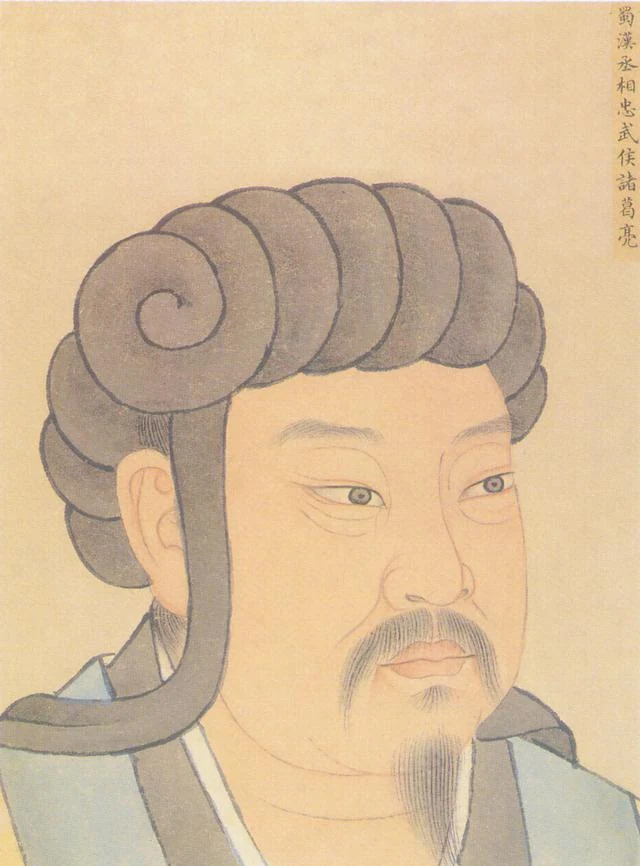
181 CE–234 CE
Official and politician
Zhuge Liang
诸葛亮
Zhuge Liang (181–October 8, 234), courtesy name Kongming and art name Wolong, was a native of Yangdu in Langya (present-day Yinan County, Linyi, Shandong). He was Grand Councilor of Shu Han and an outstanding politician, military leader, and strategist of the Three Kingdoms period. In his early years he lived in retirement at Longzhong. After Liu Bei's Three Visits to the Thatched Cottage, he entered Liu Bei's service and…
181 CE–234 CEShu Han
PROFILE
Zhuge Liang (181–October 8, 234), courtesy name Kongming and art name Wolong, was a native of Yangdu in Langya (present-day Yinan County, Linyi, Shandong). He was Grand Councilor of Shu Han and an outstanding politician, military leader, and strategist of the Three Kingdoms period. In his early years he lived in retirement at Longzhong. After Liu Bei's Three Visits to the Thatched Cottage, he entered Liu Bei's service and proposed the Longzhong Plan, which set out a strategy for dividing the realm into three. After the Battle of Red Cliffs, he helped Liu Bei establish control over Jing and Yi provinces and found Shu Han. After Liu Bei's entrustment of his heir at Baidicheng, Zhuge Liang assisted the Later Ruler Liu Shan, opened an administrative headquarters as Grand Councilor, pacified Nanzhong, and launched five Northern Expeditions against Cao Wei. Worn down by overwork, he died in the army camp at Wuzhang Plains and was given the posthumous title Marquis Zhongwu. His life came to be associated with the phrase “to devote oneself fully and die only after exhausting one's efforts,” and he became an enduring exemplar of loyalty and wisdom in Chinese history.
- Alternate Names
- Zhuge Kongming; Wolong; Marquis of Wuxiang
- Courtesy Name
- Kongming
- Art Name
- Wolong
- Period
- Shu Han
- Date of Birth
- 181
- Date of Death
- October 8 234
- Dynasty/State
- Shu Han
- Identity
- Official and politician
- Ethnicity/Ethnic Affiliation
- Han Chinese
- Native Place
- Yangdu, Langya (present-day Yinan County, Linyi, Shandong)
- Place of Birth
- Not recorded in historical sources
- Major Achievements
- Grand Councilor of Shu Han; formulated the tripartite strategy in the Longzhong Plan, served two rulers, and devoted himself to the Northern Expeditions.
LIFE TIMELINE
Age four | His mother, Lady Zhang, died
Age eight | His father Zhuge Gui died; he and his younger brother Zhuge Jun were raised by their uncle Zhuge Xuan
Age fourteen | Followed Zhuge Xuan to his post in Yuzhang and later went with him to Liu Biao in Jing Province
Age seventeen | Zhuge Xuan died; Zhuge Liang settled at Longzhong and farmed while studying
Age twenty-one | Liu Bei sought refuge with Liu Biao in Jing Province and stationed troops at Xinye
Age twenty-seven | Liu Bei made the Three Visits to the Thatched Cottage; Zhuge Liang presented the Longzhong Plan and entered Liu Bei's service
Age twenty-eight | Served as envoy to Eastern Wu, helped form the Sun-Liu alliance, and Cao Cao was defeated at the Battle of Red Cliffs
Age twenty-nine | Appointed Military Adviser General of the Household, overseeing Lingling, Guiyang, and Changsha commanderies and arranging their tax revenues for military use
Age thirty-one | Guarded Jing Province with Guan Yu while Liu Bei entered Shu
Age thirty-four | Led Zhang Fei, Zhao Yun, and others upriver into Shu, joined Liu Bei in the attack on Chengdu, became Military Adviser General, and handled affairs of the Left General's headquarters
Age thirty-nine | Liu Bei became King of Hanzhong; Zhuge Liang remained Military Adviser General
Age forty-one | Liu Bei proclaimed himself emperor and appointed Zhuge Liang Grand Councilor
Age forty-three | Liu Bei entrusted his heir to Zhuge Liang at Yongan; Liu Shan succeeded, Zhuge Liang was enfeoffed as Marquis of Wuxiang, appointed Governor of Yi Province, and opened an administrative headquarters
Age forty-five | Led a southern expedition and pacified the rebellion in Nanzhong
Age forty-seven | Submitted the Memorial on Dispatching the Troops, moved the army to Hanzhong, and began the Northern Expeditions
Age forty-eight | First Northern Expedition; Jieting was lost, Ma Su was executed, and the army withdrew
Age fifty-one | Fourth Northern Expedition; Zhang He was killed by missile fire, and Zhuge Liang withdrew when supplies ran out
Age fifty-four | Fifth Northern Expedition; died of illness in the army camp at Wuzhang Plains
BIOGRAPHY
Biography
Family Background and Early Years
Zhuge Liang was born in 181, the fourth year of the Guanghe era under Emperor Ling of Han, into an official family in Yangdu County, Langya Commandery. The Zhuge clan was a prominent family of Langya. His ancestor Zhuge Feng served as Colonel Director of Retainers under Emperor Yuan of Western Han and was known for his uprightness. His father Zhuge Gui, courtesy name Jungong, served as Assistant Administrator of Taishan Commandery in the late Eastern Han. His mother, Lady Zhang, died when Zhuge Liang was three. His father remarried but also died when Zhuge Liang was eight, after which Zhuge Liang and his younger brother Zhuge Jun were raised by their uncle Zhuge Xuan.
In 194, the first year of the Xingping era, Yuan Shu, who had longstanding ties with Zhuge Xuan, appointed him Administrator of Yuzhang. Zhuge Xuan took Zhuge Liang, Zhuge Jun, and their two elder sisters with him. Their elder brother Zhuge Jin remained behind to care for their stepmother and later fled with her to Jiangdong, where he eventually entered the service of Sun Quan. The Eastern Han court later appointed Zhu Hao to replace Zhuge Xuan as Administrator of Yuzhang. Because Zhuge Xuan had old ties with Liu Biao, Governor of Jing Province, he went to Jing Province to seek refuge. Zhuge Xuan married Zhuge Liang's elder sister to Kuai Qi of Zhonglu and his second sister to Pang Shanmin, son of Pang Degong.
In 197, the second year of the Jian'an era, Zhuge Xuan died. At age seventeen, Zhuge Liang settled at Longzhong, twenty li west of present-day Xiangyang in Hubei, where he farmed and studied. According to Chronicles of Han and Jin, Longzhong lay in Deng County of Nanyang Commandery, west of Xiangyang. Zhuge Liang was said to be eight chi tall, approximately 185 centimeters in modern measurement. He enjoyed chanting the Liangfu Yin and often compared himself to Guan Zhong and Yue Yi. Most contemporaries did not take these comparisons seriously, but his friends Cui Zhouping and Xu Shu believed in his ability.
While in Jing Province, Zhuge Liang studied with Shi Tao, Xu Shu, and Meng Jian. The three sought detailed mastery of texts, whereas Zhuge Liang “grasped their general import.” Morning and evening he would sit calmly, clasp his knees, and let out a long whistle. He once told the others that they could attain office as provincial governors or commandery administrators. When they asked what office he himself might hold, Zhuge Liang merely smiled. Later, when Meng Jian wished to return north because he missed home, Zhuge Liang told him that there were many scholar-officials in the Central Plain and that he could travel widely rather than hurry back to his native place.
During his years at Longzhong, Zhuge Liang married the daughter of Huang Chengyan, a noted scholar from south of the Mian River. Huang told him that he had an unattractive daughter, yellow-haired and dark-complexioned, but well matched to him in talent. Zhuge Liang accepted and married her at once. The marriage became a local anecdote, and a saying warned others not to choose a wife as Kongming had and end up with “Old Huang's ugly daughter.”
Three Visits to the Thatched Cottage and Entry into Service
In 201, the sixth year of the Jian'an era, Liu Bei was defeated by Cao Cao and sought refuge with Liu Biao in Jing Province. Liu Biao received him as an honored guest, increased his troops, and stationed him at Xinye. Liu Bei asked Sima Hui about current affairs. Sima Hui replied that ordinary Confucian scholars could not understand the times and that only outstanding men could do so, adding that the region had its “Crouching Dragon” and “Young Phoenix.” Asked who these were, he named Zhuge Kongming and Pang Shiyuan.
In 207, the twelfth year of the Jian'an era, Xu Shu recommended Zhuge Liang to Liu Bei, saying that Zhuge Kongming was the Crouching Dragon and asking whether Liu wished to meet him. Liu Bei told Xu to bring Zhuge Liang along. Xu replied that Zhuge Liang could be visited but could not be summoned and that Liu himself should go to see him. Liu Bei therefore visited in person and met Zhuge Liang only on the third attempt.
Liu Bei dismissed the others and asked Zhuge Liang for a strategy, explaining that the Han house had declined, powerful ministers had seized authority, the sovereign was in distress, and although he wished to uphold righteousness under Heaven, his own abilities had proved insufficient. Zhuge Liang then set out a plan to divide the realm into three, later known as the Longzhong Plan and also called the Caolu Plan. He argued that Cao Cao commanded a vast army and controlled the emperor while issuing orders to the lords, so he could not be directly challenged; Sun Quan had held Jiangdong for three generations, with defensible terrain and popular support, and could be allied with but not conquered; Jing Province commanded access to the Han and Mian rivers, the south, the Wu-Hui region, and Ba-Shu, making it strategically valuable, though its ruler could not hold it; and Yi Province was naturally defensible and fertile, while Liu Zhang was weak and capable men there wanted an able ruler. Zhuge Liang advised Liu Bei to control Jing and Yi, secure their natural defenses, maintain good relations with peoples to the west and south, ally externally with Sun Quan, and strengthen government internally. If the realm later changed, a leading general could advance from Jing toward Wan and Luoyang while Liu Bei himself marched from Yi through Qin, making hegemony possible and allowing the Han to be restored.
Liu Bei greatly praised the plan and strongly urged Zhuge Liang to enter his service. Their relationship soon became extremely close, which displeased Guan Yu and Zhang Fei. Liu Bei explained that having Kongming was like a fish having water and asked them to say no more. They stopped objecting. Zhuge Liang was twenty-seven when he entered Liu Bei's service.
The Weilüe and Jiuzhou Chunqiu, however, record a different version in which Zhuge Liang sought out Liu Bei himself, differing from the account of the Three Visits to the Thatched Cottage found in the Records of the Three Kingdoms and the Memorial on Dispatching the Troops.
Battle of Red Cliffs and Alliance with Eastern Wu
In 208, the thirteenth year of the Jian'an era, Liu Biao died and was succeeded by his younger son Liu Cong. Cao Cao led a large army south, and Liu Cong sent envoys to surrender. Liu Bei, then at Fancheng, did not initially know Cao Cao had arrived so suddenly. He learned of it only upon reaching Wancheng and then led his followers south. Passing Xiangyang, Zhuge Liang urged him to attack Liu Cong and seize Jing Province, but Liu Bei replied that he could not bring himself to do so.
Earlier, Liu Biao's eldest son Liu Qi had been endangered by slander from his stepmother Lady Cai and repeatedly asked Zhuge Liang how to protect himself. Zhuge Liang initially refused to advise him. Liu Qi then arranged matters so that Zhuge Liang was left upstairs after a ladder had been removed, forcing him to answer. Zhuge Liang asked whether Liu Qi had not heard how Shensheng was endangered by remaining inside while Chong'er was safe outside. Liu Qi understood. When Huang Zu was killed, he took up the post of Administrator of Jiangxia and thereby removed himself from danger.
Cao Cao defeated Liu Bei's army at Changban near Dangyang, and Liu Bei fled to Xiakou. Zhuge Liang volunteered to go as envoy to Eastern Wu and traveled with Lu Su to Chaisang to meet Sun Quan. Zhuge Liang told Sun Quan that disorder had spread throughout the realm, that Sun had raised forces in Jiangdong while Liu Bei had gathered men south of the Han River to contend with Cao Cao, and that Cao's conquest of Jing Province had left heroes with little room to act. He urged Sun to judge his own strength: if Wu and Yue could resist Cao, it was better to break with him at once; if they could not, why not lay down arms and submit northward.
When Sun Quan asked why Liu Bei did not surrender, Zhuge Liang replied that even Tian Heng of Qi had kept faith and refused humiliation, and Liu Bei was a descendant of the imperial house, a man of outstanding talent whom men followed as streams run to the sea; if his cause failed, it would be Heaven's will, and he could not submit to another. Sun Quan answered angrily that he could not hand all of Wu and its hundred thousand troops over to another's control and declared his decision made.
Zhuge Liang then analyzed the military situation. Liu Bei's scattered troops were returning, Guan Yu had ten thousand picked naval troops, and Liu Qi's Jiangxia forces also numbered no fewer than ten thousand. Cao Cao's army had come from afar and was exhausted; his light cavalry had marched three hundred li in a day and a night while pursuing Liu Bei, like “the end of a powerful crossbow, unable to pierce even Lu silk.” Northerners were not accustomed to naval warfare, and the people of Jing had submitted to Cao only under military pressure rather than from genuine loyalty. Zhuge Liang concluded that if Sun sent a capable commander with several tens of thousands of troops to coordinate with Liu Bei, Cao's army could certainly be defeated. Sun Quan was delighted and sent Zhou Yu, Cheng Pu, Lu Su, and others with thirty thousand naval troops to join Liu Bei against Cao Cao.
That winter, the Battle of Red Cliffs ended in Cao Cao's defeat and retreat north. While traveling to Eastern Wu, Zhuge Liang passed Moling and reportedly remarked that Zhongshan coiled like a dragon and Shitou crouched like a tiger, making the place truly fit for an imperial residence. Sun Quan later moved his capital to Moling and renamed it Jianye.
Entry into Shu and the Founding of Shu Han
After the Battle of Red Cliffs, Liu Bei occupied the four commanderies south of the Yangzi in Jing Province. Liu Qi died in 209, the fourteenth year of the Jian'an era, and Liu Bei's followers acclaimed him Governor of Jing Province. Liu Bei appointed Zhuge Liang Military Adviser General of the Household and placed Lingling, Guiyang, and Changsha commanderies under his supervision, with responsibility for gathering tax revenues for military supplies. According to Lingling Xianxian Zhuan, Zhuge Liang was stationed at Linzheng because it lay between the three commanderies and was convenient for arranging their revenues.
In 211, the sixteenth year of the Jian'an era, Liu Zhang, Governor of Yi Province, sent Fa Zheng to invite Liu Bei into Shu to help attack Zhang Lu. Zhuge Liang remained in Jing Province with Guan Yu. In 212, Liu Bei broke with Liu Zhang and turned from Jiameng to attack him. Zhuge Liang left Guan Yu to guard Jing and led Zhang Fei, Zhao Yun, and others upriver into Shu. They divided their forces to pacify the commanderies and counties and joined Liu Bei in the siege of Chengdu. In 214, the nineteenth year of the Jian'an era, Chengdu fell. Liu Bei became Governor of Yi Province, appointed Zhuge Liang Military Adviser General, and placed him in charge of affairs of the Left General's headquarters.
When Guan Yu heard that Ma Chao had submitted, he wrote to Zhuge Liang asking whom Ma could be compared with. Knowing Guan Yu's pride, Zhuge Liang replied that Ma Chao was accomplished in both civil and military matters and possessed extraordinary courage, a hero of his age comparable to Qing Bu and Peng Yue and worthy of being ranked with Zhang Fei, but still not as outstanding and peerless as the “Bearded Lord.” Guan Yu was delighted by the letter.
In 221, the first year of the Zhangwu era, Liu Bei proclaimed himself emperor at Chengdu and founded Shu Han, appointing Zhuge Liang Grand Councilor. The same year Liu Bei attacked Wu to avenge Guan Yu. Zhuge Liang opposed the expedition and lamented that if Fa Zheng were still alive, he could have prevented the ruler from marching east. Liu Bei suffered a major defeat at the Battle of Yiling and withdrew to Yongan.
Entrustment at Yongan and Regency
In 223, the third year of the Zhangwu era, Liu Bei fell gravely ill and summoned Zhuge Liang to Yongan to entrust him with affairs after his death. Liu Bei told him that his talent was ten times that of Cao Pi, that he could surely secure the state and complete the great undertaking, and that if the heir could be assisted he should assist him, but if the heir proved unworthy, Zhuge Liang could act as he saw fit. Zhuge Liang wept and replied that he would exhaust the strength of his limbs, maintain loyal integrity, and continue until death. Liu Bei also instructed Liu Shan to serve Zhuge Liang as he would a father.
After Liu Shan succeeded, Zhuge Liang was enfeoffed as Marquis of Wuxiang, appointed Governor of Yi Province, and opened an administrative headquarters. As Grand Councilor he effectively directed the military and civil affairs of Shu Han. He reorganized offices, revised laws and regulations, restored the alliance with Eastern Wu, improved relations with southwestern peoples, and implemented Tuntian to strengthen military preparedness.
Southern Campaign and Northern Expeditions
In 225, the third year of the Jianxing era, rebellion broke out in Nanzhong. Zhuge Liang led a southern campaign and adopted Ma Su's advice that winning hearts was superior to attacking cities and psychological victory superior to battle. According to Pei Songzhi's annotations citing Chronicles of Han and Jin, Zhuge Liang captured and released Meng Huo seven times, finally convincing him to submit. Meng Huo is said to have declared that Zhuge Liang's authority was like that of Heaven and that the southern peoples would never rebel again. This story is legendary in character and does not appear in the main text of the Records of the Three Kingdoms. After Nanzhong was pacified, Zhuge Liang used local leaders to govern and neither stationed troops nor appointed outside officials there; the region thereafter remained stable.
In 227, the fifth year of the Jianxing era, Zhuge Liang submitted the Memorial on Dispatching the Troops, moved his army to Hanzhong, and began Zhuge Liang's Northern Expeditions against Cao Wei. Over the next seven years, he launched five expeditions.
First Northern Expedition (228, sixth year of the Jianxing era): Zhuge Liang used a diversion, sending Zhao Yun and Deng Zhi as a feint at Jigu while personally leading the main force toward Qishan. Nan'an, Tianshui, and Anding commanderies rebelled against Wei in response, shaking Guanzhong. Emperor Ming of Cao Wei, Cao Rui, went personally to Chang'an and sent Zhang He to resist. Zhuge Liang assigned Ma Su to defend Jieting, but Ma disobeyed orders and lost the position, placing the entire campaign at a disadvantage. After withdrawing, Zhuge Liang executed Ma Su and memorialized to demote himself by three grades.
Second Northern Expedition (winter 228, sixth year of the Jianxing era): Zhuge Liang besieged Chencang but withdrew after his supplies ran out. Wei general Wang Shuang pursued and was killed by Zhuge Liang's forces.
Third Northern Expedition (229, seventh year of the Jianxing era): Zhuge Liang sent Chen Shi to attack Wudu and Yinping commanderies. Wei general Guo Huai led troops to their relief, but Zhuge Liang advanced in person. Guo withdrew, and Shu Han obtained both commanderies.
Fourth Northern Expedition (231, ninth year of the Jianxing era): Zhuge Liang again advanced toward Qishan and used the wooden ox and flowing horse for transport. Sima Yi led the defending army. During Zhuge Liang's withdrawal, Wei general Zhang He was killed by missile fire in an ambush.
Fifth Northern Expedition (234, twelfth year of the Jianxing era): Zhuge Liang led the army out through Xie Valley and encamped at Wuzhang Plains, where he faced Sima Yi for more than one hundred days. Sima Yi remained behind his defenses. Zhuge Liang sent women's clothing to taunt him, but Sima still refused battle. He instead questioned a Shu envoy about Zhuge Liang's food and daily routine. On learning that Zhuge Liang ate little and was burdened by many affairs, Sima judged that he could not endure for long.
After the two armies had faced one another for more than one hundred days, Zhuge Liang died of illness in the army camp at Wuzhang Plains in the eighth lunar month of 234, aged fifty-four. Before his death he arranged the order of retreat, assigning Wei Yan to cover the rear and Jiang Wei behind him. After the Shu army withdrew, Sima Yi inspected its camp and exclaimed that Zhuge Liang was “an extraordinary talent under Heaven.”
After Zhuge Liang's death, Liu Shan granted him the posthumous title Marquis Zhongwu. Later generations commonly honored him as Marquis Wu or Zhuge Marquis Wu.
Zhuge Liang, whose courtesy name was Kongming, was a native of Yangdu in Langya and a descendant of Zhuge Feng, who had been a metropolitan commandant of the Western Han. His father Zhuge Gui, styled Jungong, was an assistant to the governor of Taishan at the end of the Eastern Han. Zhuge Liang lost his mother when he was three and his father at eight, and lived with his younger brother Zhuge Jun; his father's younger brother Zhuge Xuan, appointed by Yuan Shu as governor of Yuzhang, took the boys with him to his post, and when the court sent Zhu Hao to replace him Zhuge Xuan, an old friend of the governor of Jingzhou, Liu Biao, went to attach himself to him. After Zhuge Xuan's death Zhuge Liang ploughed the fields at Longzhong, twenty li west of Xiangyang in the Deng district of Nanyang, fond of singing the "Liangfu Song", a man of eight chi in height who often compared himself to Guan Zhong and Yue Yi; his contemporaries mostly did not believe it, and only Cui Zhouping of Boling and Xu Shu of Yingchuan, his friends, thought it true.
Studying in Jingzhou, he and Shi Guangyuan of Yingchuan, Xu Shu and Meng Gongwei of Runan read together; the other three sought mastery of detail, while Zhuge Liang "took only the broad outline". Morning and evening he would sit with his arms about his knees and whistle, and he once told the other three that their official careers would reach the governorship of a province or a commandery; asked what his own would be, he only smiled and said nothing. When Meng Gongwei later longed for home and wished to go north, Zhuge Liang told him that the Central Plains had scholars in plenty and that a man on the move had no need of his native place. That early circle both showed his confidence in the times and built his reputation among the gentry of Jingxiang. Liu Qi, the eldest son of the governor Liu Biao, also esteemed him greatly; when Liu Biao, heeding his second wife of the Cai family, favored his younger son Liu Cong and cooled toward Liu Qi, Liu Qi asked Zhuge Liang repeatedly for a way to secure himself and was put off, until he contrived to take him up a tower for wine and have the ladder removed, saying that between heaven and earth, with the words passing only from his own mouth to Liu Qi's ear, they could speak; Zhuge Liang answered with the lesson of Shensheng, who was endangered at home, and Chong'er, who was safe abroad, and Liu Qi, taking the point, sought a post away from the center and, on Huang Zu's death, became governor of Jiangxia.
Liu Bei, then dependent on Liu Biao, was told first by Sima Hui that pedants and ordinary scholars knew nothing of the times, and that men who knew the times were the outstanding — that here were a Crouching Dragon and a Fledgling Phoenix, namely Zhuge Kongming and Pang Shiyuan; and then, on Xu Shu's strong recommendation, that Zhuge Kongming was the Crouching Dragon, a man to be visited and not summoned, whom the general should wait upon in person. Liu Bei therefore went three times to Longzhong before he saw him, and dismissing his attendants told him that the Han house was falling, that wicked ministers had usurped its commands and the sovereign was in the dust; that he had not measured his own virtue and strength but wished to extend great righteousness through the empire, yet with shallow wisdom and short craft had met defeat after defeat; his purpose, however, was unspent, and he asked what plan there might be. Zhuge Liang then set out what later ages called the Longzhong plan: since Dong Zhuo, heroes had risen without number and held whole provinces and commanderies; Cao Cao, compared with Yuan Shao, was of small name and few followers, yet had beaten him, and not by heaven's timing alone but by men's planning; now Cao Cao had a million troops and, holding the emperor, commanded the lords — he was not to be contested in the field. Sun Quan held Jiangdong for three generations, with strong terrain, a people attached to him and able men in his service: he was to be an ally, not a target. Jingzhou, resting on the Han and Mian rivers, drawing the profits of the southern sea, joining Wu and Kuaiji in the east and Ba and Shu in the west, was a country for war whose master could not hold it — a gift of heaven to the general. Yizhou was a natural fortress of rich fields in which the founder of the Han had made his empire, but Liu Zhang was weak and Zhang Lu was to the north, and its people, wealthy and well supplied, were not cared for, so that able men looked for a wise lord. The general, a scion of the imperial house whose righteousness was known throughout the empire, who gathered heroes and sought talent as a thirsty man seeks water, should hold both Jing and Yi, guard their fastnesses, be at peace with the Rong in the west and gentle with the Yi and Yue in the south, make alliance with Sun Quan abroad and order his government within; then, when the empire changed, one general should lead the army of Jingzhou toward Wan and Luo while the general himself brought the host of Yizhou out through Qin, and who among the people would not welcome him with food and wine? So the hegemony might be achieved and the Han restored. Liu Bei said it was good, and from then on the two were ever closer, so that when Guan Yu and Zhang Fei were displeased Liu Bei explained that with Kongming he was as a fish with water.
In 208, Cao Cao, having unified the north, came south into Jing and Chu with a great army; Liu Biao had died, Liu Cong succeeded and sent envoys to surrender. Liu Bei was then at Fancheng and heard of Cao's approach only at Wan, and marched south with his people; crossing Xiangyang, Zhuge Liang urged him to attack Liu Cong and take Jingzhou, and Liu Bei refused, saying he could not bear it. Cao Cao's cavalry caught and broke him at Changban in Dangyang, and he fell back on Xiakou. Lu Su came to observe the situation and proposed that Liu Bei ask help of Sun Quan, and Zhuge Liang offered to go to the east himself. At Chaisang he met Sun Quan and set out the situation, urging him either to join Liu Bei against Cao or to submit at once rather than waver; within Jiangdong, Lu Su and Zhou Yu stood for war, and Sun Quan resolved on an alliance with Liu Bei against Cao Cao.
Zhuge Liang's argument at Chaisang was the decisive step in forming the alliance. He asked Sun Quan first to weigh his strength: if the host of Wu and Yue could stand against the Central Plains he should break with Cao Cao at once, and if he judged he could not, he should lay down his arms and serve Cao as a subject; to keep the outward name of submission while wavering within, and to hesitate when the crisis was upon him, would bring disaster at once. Sun Quan asked in return why Liu Bei did not himself submit. Zhuge Liang answered that Tian Heng was only a brave man of Qi and yet kept his honor unstained; how much less could Liu Bei, a scion of the royal house whose talents overshadowed his age and to whom the hosts of the realm looked as rivers to the sea, bow to another — and if his cause failed, that would be heaven's will. Sun Quan, roused, said he would not take all Wu and a hundred thousand men and submit to another's control; his mind was made up, and he asked only whether Liu Bei, so lately beaten, could withstand Cao. Zhuge Liang then took up the forces in detail: those of Liu Bei's troops who had rallied and Guan Yu's marines made ten thousand picked men, and Liu Qi's Jiangxia troops were no fewer; Cao's host was wearied from far off, having chased Liu Bei three hundred li in a day and a night with light cavalry — the arrow at the end of its flight that cannot pierce thin silk, which the art of war warns against; and the northerners were unused to fighting on water, while the people of Jingzhou followed Cao only by force, not in their hearts. He concluded that Cao would certainly be beaten and that the outcome would decide whether the three powers stood. Sun Quan, delighted, sent Zhou Yu, Cheng Pu and Lu Su with thirty thousand marines to join Liu Bei against Cao. In the winter of 208 the allied fleets broke Cao Cao heavily at Red Cliff; his losses were great, plague broke out in his army, and he withdrew north.
After Red Cliff, Liu Bei took the southern commanderies of Jingzhou and made Zhuge Liang general of the army of the center, charging him with the three commanderies of Lingling, Guiyang and Changsha and with their taxes for the army's needs. In 210 Pang Tong, then acting magistrate of Leiyang, was dismissed for neglecting his county; Lu Su wrote to Liu Bei that Pang Shiyuan was no talent for a hundred li, and that only as an assistant governor could he stretch his legs, and Zhuge Liang spoke for him too, so that Liu Bei summoned him, talked with him at length, valued him greatly and made him assistant governor, second only to Zhuge Liang in his favor, both being generals of the army of the center. In 211 the governor of Yizhou, Liu Zhang, alarmed by word that Cao Cao meant to send Zhong You against Zhang Lu in Hanzhong, was advised by Zhang Song to invite Liu Bei into Shu to attack Zhang Lu; Fa Zheng was sent with four thousand men to welcome him, and privately laid out how Yizhou might be taken. Zhuge Liang, judging the moment not to be lost, urged Liu Bei to accept; he himself stayed with Guan Yu, Zhang Fei and Zhao Yun to hold Jingzhou while Liu Bei entered Yizhou with several tens of thousands of foot. Hearing that Liu Bei had gone west, Sun Quan sent ships for his sister, and when she would have taken Liu Bei's son Liu Shan back to Wu, Zhang Fei and Zhao Yun barred the river with troops and kept the boy. The next year Liu Bei and Liu Zhang fell out, Zhang Song was executed, and Liu Bei turned to attack Chengdu, sending his generals to reduce the counties while Zhuge Liang with Zhang Fei and Zhao Yun went up the Yangtze, pacifying Baidi, Jiangzhou and Jiangyang, Guan Yu alone holding Jingzhou. In 214, after a long siege, Liu Zhang surrendered; Liu Bei took the governorship of Yizhou and made Zhuge Liang general of the army.
Governing Shu, Zhuge Liang was strict, and many complained. Fa Zheng, holding the capital region without and acting as chief counsellor within, repaid every meal's kindness and every glance of enmity and killed several who had spoken against him; when men urged Zhuge Liang to restrain him, he answered that Fa Zheng had given Liu Bei wings to soar and should not be forbidden to have his way a little, and let the matter drop. On the general policy of government, however, he held his own view: Fa Zheng, citing the founder of the Han who entered the passes with a law of three articles, urged him to relax punishments and lift prohibitions to win the people; Zhuge Liang answered that he knew one thing and not the other — the Qin had been harsh and the people resentful, so that a common man's shout brought the empire down and the founder could afford to be lenient; but Liu Zhang had been weak and benighted, and since Liu Yan's time the laws had been tangled and the government without virtue or authority, so that the great clans of Shu took their own way and the relation of ruler and minister decayed: favor shown through office ends when office is exhausted, and kindness answered by compliance ends when kindness is exhausted. His remedy was to awe them with law, so that when the law ran they would know favor, and to limit them by rank, so that when rank was given they would know honor — favor and honor together, with order above and below. This insistence on law as the maker of authority and rank as the measure of distinction set the tone of Shu-Han government thereafter.
In 219, when Liu Bei faced Cao Cao at Hanzhong and sent urgently for troops from Chengdu, Zhuge Liang asked the Shu commandery official Yang Hong, who answered that Hanzhong was the throat of Yizhou and that without it there would be no Shu, that this was a calamity at the family gate and a matter of survival, that men should fight and women carry, and that there could be no doubt about sending troops; Zhuge Liang sent them at once. Liu Bei held the defiles and would not give battle, and after months of failure Cao Cao withdrew, so that Liu Bei gained Hanzhong and in the autumn was made king of Hanzhong by his assembled subordinates — the Longzhong design of holding Jing and Yi together was now all but achieved. Yet the Eastern Wu had always meant to hold the whole Yangtze: in the winter of 219 Lü Meng crossed the river in white robes, took Jingzhou and killed Guan Yu, a heavy blow to that design. In 220 Cao Pi usurped the Han throne, and with word in Shu that the Han emperor had been murdered, Liu Bei went into mourning and gave him the posthumous title Xiaomin; the grand tutor Xu Jing, the general Mi Zhu, Zhuge Liang as general of the army and more than eight hundred others memorialized together, citing auspicious signs and prophecies, asking Liu Bei to take the throne. In the fourth month of 221 he took it south of Wudan in Chengdu, proclaimed a general amnesty and changed the era name to Zhangwu, making Zhuge Liang chancellor and director of the secretariat with the staff of authority.
After Liu Bei took the throne, Zhuge Liang was chancellor, director of the secretariat and holder of the staff of authority, and on Zhang Fei's death he also took the office of metropolitan commandant. In 222 Liu Bei, in the name of vengeance for Guan Yu, campaigned east against Wu and Zhuge Liang could not stop him; in the spring of the next year he came from Chengdu to Yong'an. In the third month Huang Yuan rose at Linqiong and Zhuge Liang sent the general Chen Hu against him; Huang Yuan was beaten, went downriver and was bound by his own guards and sent to Chengdu for execution. In the fourth month of 223, as Liu Bei lay dying, he entrusted the future to Zhuge Liang with Li Yan as his second, telling him that his ability was ten times Cao Pi's, that he would surely settle the state and complete the great work, and that if the heir could be helped he should help him, but if he were unfit he might take the place himself. Zhuge Liang, weeping, answered that he would exhaust the strength of his limbs and uphold his loyal duty to the death. Liu Bei also left a decree for his heir to serve the chancellor as a father. On Liu Bei's death Liu Shan succeeded, made Zhuge Liang marquis of Wuxiang with his own establishment and soon after governor of Yizhou, and all business great and small was decided by him.
In the first year of Jianxing (223) the commanderies of the south rebelled one after another on the news of Liu Bei's death. Judging the time unfit for war in a year of mourning, Zhuge Liang sent envoys to Wu to make peace and let the people rest, and only in the spring of 225 took the field against the four commanderies, completing the campaign by autumn and returning to Chengdu in the twelfth month. According to the Han-Jin Spring and Autumn Annals, he was victorious everywhere in the south, and hearing that Meng Huo was obeyed by both the Yi and the Chinese, contrived to take him alive and showed him his camps and ranks, asking what he thought of the army. Meng Huo answered that he had failed before through ignorance of the facts but now, seeing the formations, found them easy enough to beat; Zhuge Liang laughed and released him to fight again, capturing and freeing him seven times and again offering to send him home, until Meng Huo stayed of his own will and said that this was heavenly power and the southerners would not rebel again. Having pacified the south he went on employing the local chiefs in their own districts. Remonstrated with, he explained that to keep outsiders there would require troops, and troops would have nothing to eat — the first difficulty; that the Yi, newly broken and in mourning for their fathers and brothers, would certainly turn any outsider without troops into a disaster — the second; and that the Yi, having repeatedly been guilty of deposing and killing their own, would never trust an outsider — the third. He meant, he said, to leave no troops and carry no grain, and yet to give the region rough order and the Yi and Chinese rough peace. The commanderies were then reorganized and the revenues of the south fed the state, so that Shu, well supplied, could drill and arm for a great campaign.
In 227 Zhuge Liang moved to Hanzhong and camped at Yangping Shima north of the Mian, and presented the Memorial on the Expedition, setting out that the late emperor had died with his work half done, that the empire was divided in three and Yizhou worn out, urging his sovereign to draw near to worthy men and keep the petty at a distance, and declaring that he had taken up his charge in the hour of defeat and received his commission in the midst of peril. In the spring of the next year he made a show of marching through the Xie valley against Mei, sending Zhao Yun and Deng Zhi as a decoy to Jigu, which the Wei general Cao Zhen held with all his force; he himself led the armies against Qishan with his ranks in order and rewards and punishments clear, so that Nan'an, Tianshui and Anding went over to him and Guanzhong shook. The Wei emperor Ming went west to hold Chang'an and sent Zhang He against him, and Zhuge Liang put Ma Su in command of the forward troops; Ma Su disobeyed his orders and was heavily beaten at Jieting, so that Zhuge Liang took the thousand households of Xi county and fell back on Hanzhong, and had Ma Su executed before the army. He then memorialized that his own shallow talents and misplaced trust had brought about the failure at Jieting and the neglect at Jigu, and asked to be reduced three grades; he was made general of the right, acting as chancellor with the same powers.
In the winter of 228 he came out through Sanguan and besieged Chencang, held by Cao Zhen, and withdrew for want of grain, turning to cut down the Wei general Wang Shuang who pursued him. In 229 he sent Chen Shi against Wudu and Yinping; when the Wei governor Guo Huai moved to attack, Zhuge Liang came out to Jianwei in person, Guo Huai withdrew and the two commanderies were taken; the emperor restored him to the chancellorship, noting that the fault at Jieting had been Ma Su's while he had blamed himself, and that his recent services — Wang Shuang killed, Guo Huai driven off, the Di and Qiang brought in — were plain. In the autumn of 230 Wei sent Sima Yi by Xicheng, Zhang He by Ziwu and Cao Zhen by the Xie valley against Hanzhong; Zhuge Liang waited for them at Chenggu and Chiban, and thirty days of rain cut the roads, so that they all withdrew, while Wei Yan broke Guo Huai at Yangxi.
In 231 he came out through Qishan again, using the wooden ox for transport, and on withdrawing for want of grain fought and shot down Zhang He. In that campaign his troops broke Sima Yi's command badly near Lucheng, taking three thousand armored heads, five thousand suits of black armor and three thousand one hundred crossbows, and Sima Yi fell back behind his ramparts, earning the Wei soldiers' taunt that they feared Shu as they feared tigers. In 234 he led the army out through the Xie valley and camped on the Wuzhang plain, facing Sima Yi for more than a hundred days while part of his troops farmed the fields along the Wei, living among the people without alarming them. In the eighth month Zhuge Liang died in camp at fifty-four, having ordered his burial at Dingjun mountain in Hanzhong, on the hillside, in a grave just large enough for the coffin, dressed in ordinary clothes without grave goods. Shu gave him the posthumous name Zhongwu; among the people it was said that the dead Zhuge Liang put the living Sima Yi to flight, and that Sima Yi, seeing his camps after his death, called him a genius such as the world had seldom seen.
After the fourth campaign Zhuge Liang did not give up the plan of moving north. In 232 he rested his troops, encouraged farming and built the wooden ox and flowing horse at Huangsha while drilling and training the army for another expedition; in the winter of 233 he had the troops transport grain and concentrated the army at the mouth of the Xie valley, improving the depot there. In the second month of 234 he led the whole host out through the Xie valley and took up position at Wuzhang plain on the Wu river, facing Sima Yi south of the Wei. Because his earlier campaigns had time and again failed for want of transport, he divided his troops to farm as a base for a long stay, the ploughmen living among the people along the Wei, who were undisturbed and suffered nothing from the army. Sima Yi built his ramparts with his back to the river, intending to wear the Shu army out and make it withdraw for hunger, and though Zhuge Liang challenged him repeatedly he would not come out; Zhuge Liang even sent him a set of women's clothes and a kerchief to shame him into battle, at which the Wei generals were furious and demanded to fight, until Sima Yi pretended to memorialize for permission and the Wei emperor sent the commandant Xin Pi with the staff of authority to forbid it.
The two armies faced each other for more than a hundred days. Sima Yi asked the Shu envoy about Zhuge Liang's sleeping and eating and the weight of his business, saying nothing of military matters; the envoy answered that his master rose early and slept late, that he personally read every punishment above twenty strokes, and that he ate less than a few pints — whereupon Sima Yi told those about him that a man who ate so little and worked so much could not last long. Zhuge Liang indeed fell gravely ill from overwork. The president of the secretariat Li Fu came to inquire after him and to ask about the state's affairs, took his leave, and returned some days later; Zhuge Liang said he knew why he had come and named Jiang Wan as fit to take up his charge, and when Li Fu asked who after Jiang Wan, he named Fei Yi, and to a third question he gave no answer. In the eighth month Zhuge Liang died in camp at fifty-four. His last dispositions had Yang Yi and others keep the death secret, draw the army off in good order with Wei Yan and Jiang Wei covering the rear, and Jiang Wei had Yang Yi turn the banners and beat the drums as if to attack, so that Sima Yi drew back and did not press; only after the army was through the valley was the death announced. The people made a saying that the dead Zhuge Liang had put the living Sima Yi to flight, to which Sima Yi remarked that he could reckon with the living but not with the dead, and later, inspecting the abandoned camps, he called Zhuge Liang a genius such as the world had seldom seen.
Zhuge Liang ordered that he be buried at Dingjun mountain in Hanzhong, on the hillside, in a grave just large enough for the coffin, clad as he was, without grave goods. He had earlier memorialized that he owned eight hundred mulberry trees and fifteen qing of thin land in Chengdu, enough for his family's food and clothing, and that in service he depended on the state for all he wore and ate, held no other property and would leave behind neither surplus silk nor unearned wealth to disappoint his sovereign — and it was as he said. After his death the commanderies asked that temples be raised to him, and the court refused on grounds of ritual order, so that the people sacrificed privately by the roads at the four seasons; only in the spring of 263 did the emperor decree a temple at Mianyang — for, as the commandant Xi Long and the palace secretary Xiang Chong memorialized, the men of Zhou spared the pear tree for the sake of Shao's virtue and the king of Yue cast a likeness to remember Fan Li, whereas a man whose virtue reached far and near and on whom the survival of the royal house had in fact depended was being worshipped by the people in the lanes and by the Yi and the Rong in the open fields, which was no way to remember merit and virtue; better to raise a temple near his tomb so that his kin might sacrifice at the proper seasons and old servants come there to do him honor, and private worship be ended in favor of regular rite.
With Zhuge Liang's death the fortunes of Shu-Han ran out. In the winter of 263 the Wei general Deng Ai invaded Shu by the path beside the Jinggu road from Yinping; Zhuge Zhan led the armies to Fu and halted, and after his vanguard was broken withdrew to Mianzhu. Deng Ai sent a letter offering to have him made prince of Langya if he surrendered, and Zhuge Zhan in anger killed the messenger, went out to fight, was badly beaten and died in the field at thirty-seven, his eldest son Zhuge Shang dying with him. Deng Ai drove on to Chengdu and Shu-Han came to an end. A grandson, Zhuge Jing, was afterward given office under the Jin, and the line was not extinguished.
Major Activities
Longzhong Plan
In 207, the twelfth year of the Jian'an era, after Liu Bei's Three Visits to the Thatched Cottage, Zhuge Liang presented the Longzhong Plan. It systematically analyzed the political situation and laid out a strategy of holding Jing and Yi provinces, allying with Wu against Cao, establishing a tripartite balance, and waiting for an opportunity to advance north. This plan became the basic strategic framework followed by Shu Han for the following decades.
Alliance with Wu against Cao
In 208, the thirteenth year of the Jian'an era, Zhuge Liang traveled to Eastern Wu as envoy. Through diplomacy and strategic analysis he persuaded Sun Quan to ally with Liu Bei, helping bring about victory at the Battle of Red Cliffs and establishing the conditions for a tripartite division of the realm.
Governance of Shu Han
During his regency, Zhuge Liang reorganized administration and maintained strict but clear rewards and punishments. Together with Fa Zheng and others, he formulated The Laws of Shu Han and promoted rule through law. He appointed men for ability and promoted Jiang Wan, Fei Yi, Dong Yun, Jiang Wei, and others. He valued agricultural production and implemented Tuntian to secure military grain. He also improved relations with southwestern peoples and stabilized Shu Han's rear areas.
Pacification of Nanzhong
In 225, the third year of the Jianxing era, Zhuge Liang led a southern campaign and pacified rebellion in Nanzhong. He followed a strategy of prioritizing the winning of hearts, which secured local acceptance and removed a threat to the rear before the Northern Expeditions.
Five Northern Expeditions
From 227, the fifth year of the Jianxing era, to 234, the twelfth year of the Jianxing era, Zhuge Liang launched five Northern Expeditions against Cao Wei. Later tradition called them the “Five Campaigns from Qishan,” although in fact only the first and fourth campaigns passed through Qishan, while the “Six Campaigns from Qishan” belongs to later fictional tradition. The expeditions did not achieve the restoration of the Han, but they maintained an offensive posture and prevented Cao Wei from dismissing Shu Han as insignificant.
Technological Inventions
The Records of the Three Kingdoms, Biography of Zhuge Liang, states that Zhuge Liang had a particular aptitude for ingenious devices and that improvements to the repeating crossbow and the wooden ox and flowing horse all came from his ideas. He improved the repeating crossbow and designed the wooden ox and flowing horse for transport in mountainous terrain. Later sources also state that he developed military methods and created the Eight Formations Diagram; this appears in later works such as the Commentary on the Water Classic rather than as firm evidence in the standard histories.
Literary Achievements
Zhuge Liang was associated with celebrated writings including the Memorial on Dispatching the Troops, the Later Memorial on Dispatching the Troops, and Admonition to His Son. The Memorial on Dispatching the Troops is known for its earnest language and emotional force and was included in the Wen Xuan. Lines from Admonition to His Son advocating self-cultivation through tranquility and virtue through frugality, and stating that one cannot clarify one's aspirations without detachment or reach far without serenity, became famous maxims of self-cultivation.
The core of Zhuge Liang's government of Shu was law and the use of men. With Yi Ji, Fa Zheng, Liu Ba and Li Yan he drew up the Code of Shu to bind officials and great clans by plain statute, and he administered it impartially, so that the histories say he opened his heart and laid out the just way, rewarding those who served loyally even if they were his enemies and punishing the lawless and the negligent even if they were close to him. Li Yan, a regent of the testament, was dismissed and banished to Zitong for failing to deliver grain and then glossing over it, and the official Liao Li was exiled for slander; yet both, on hearing of Zhuge Liang's death, one fell ill and died and the other wept — severity that did not lose men's hearts. In appointments he raised Jiang Wan as chief of staff and Fei Yi as military adviser, put Dong Yun over the palace, and found fitting posts for Guo Youzhi and Xiang Chong; the Memorial on the Expedition names worthy ministers for his sovereign to keep close, and the survival of Shu-Han for decades after him rested on precisely this group. Jiang Wei, who came over from Wei, was valued by him and given troops — another instance of his care for military talent.
In economy and livelihood his line was to farm, grow grain and let the people rest: agriculture and weaving were encouraged and waterworks maintained, with officials appointed for the Dujiang weir and regular dredging to keep the Chengdu plain irrigated; offices for salt and iron managed those revenues, and the weaving of Shu brocade was promoted and traded, becoming an important source of funds for the army and for commerce with Wu and Wei. After the pacification of the south, gold, silver, cinnabar and lacquer, plough oxen and war horses came in from those commanderies, further filling the treasury. These measures allowed a single province to sustain years of northern campaigns, and the state's capacity for finance and supply was a large part of it.
In military technique Zhuge Liang was inventive. He improved the repeating crossbow, named the Yuanyong, which could shoot ten bolts at once, and built the wooden ox and the flowing horse for transporting grain, partly solving the problem of supply over the Qinling tracks; his camps and formations were so well ordered that later ages called his array the Eight Formations, and Sima Yi, seeing his ramparts, is said to have called him a genius such as the world had seldom seen. His discipline was strict and his rewards and punishments clear — "ranks in order, rewards and punishments exact, and orders plain", as the histories put it — and that was the ground on which so weak a state as Shu dared attack again and again.
In governing Shu, Zhuge Liang treated the selection and use of men as the root of government. In his essay on measures he wrote that the way of governing lies in raising the worthy, since a state's helpers are as a house's pillars — thin pillars do harm and weak helpers overturn — and he cited Yao's raising of a recluse, Tang's summoning of the man of Shen and the Duke of Zhou's taking up the lowborn to show that a state is settled only when the upright are advanced and the crooked set aside. On standards he wanted virtue and ability together with virtue foremost: the chapter on careful observation in the Art of War of the general lists fifteen qualities — forethought, purity, courage, integrity, fairness, patience, generosity, good faith, respect, clarity, caution, benevolence, loyalty, judgment of shares, and strategy — most of them virtues, only three of them aptitudes. His principle was to employ the worthy according to capacity, regardless of birth or faction: after taking Yizhou he gathered talent far and wide, and by his death thirty-seven of the officials he had appointed came from Liu Zhang's old staff, his own kin and the native families of Yizhou, more than the thirty-three who had come with Liu Bei or surrendered from elsewhere. Fei Yi and Dong Yun of Jing and Chu were given weight for the singleness of their loyalty, Fei Yi rising to the chancellorship; Lai Min, of a great Jing-Chu family and an old servant of the heir's palace, was employed to bind that group to the regime; Wang Lian, a trusted minister of Liu Zhang who had shut his gates against Liu Bei, was made commissioner of salt on the ground of his ability and uprightness; the famous scholar Du Wei refused office again and again until courtesy won him over as a remonstrating grandee; and Jiang Wan, an obscure minor official, was examined, found able and made chief of staff, keeping the base supplied with men and grain while Zhuge Liang campaigned, and succeeding to the generalate and the government of Shu after his death.
On listening to counsel he insisted on gathering the wisdom of many. A ruler who refuses remonstrance, he wrote, leaves loyal ministers unable to offer plans and lets the wicked run the government, which ruins a state; and in his instruction to his subordinates he said that the office of advice exists to collect many minds and broaden loyal service, asking that no one hold back for fear of small offense, so that he himself might make fewer mistakes. He created an office of counsellors in the chancellery as a body of advisers, so that the views of those below might be gathered; Dong He, the general of the central army, blunt and conscientious, gave him much good advice which he valued; and before the southern campaign he adopted Ma Su's counsel that in war the winning of hearts comes first and the storming of cities last, and that it is the battle for men's minds, not the battle of arms, that decides — which proved the key to pacifying the south.
Law was the other pillar of his government, notable for being openly made and evenly applied. Against the disorder since Liu Zhang's time, when virtue went unpractised and authority unenforced and the clans of Shu did as they pleased, he insisted on the place of law: with the three bonds and six relations unrectified, great confusion follows; and that a single man may hold a million in silence, shoulders bowed and feet together, not daring to look up, is the work of law. Without punishments above and propriety below, a ruler may hold the empire and its wealth and still not save himself; therefore the order must not be treated lightly nor authority bent to convenience. Besides the Code of Shu drawn up with Yi Ji, Fa Zheng, Liu Ba and Li Yan, he drafted several dozen sets of regulations himself, including the Eight Duties, Seven Warnings, Six Fears and Five Dreads, and military statutes such as the two rolls of legal inspection and the two of army orders, so that reward and punishment had their warrant.
In foreign policy, after Liu Bei's death he adopted the strategy of resisting Wei in the north and making peace with Sun Quan in the east. In the tenth month of 223 he sent Deng Zhi on a mission to Wu which succeeded, freeing Shu to attend to its internal affairs and the south; in 224 he set about replacing and training troops for the southern campaign, and by early 225 he was ready. Though frictions continued between Wu and Shu, the alliance held in the main and was a chief condition of Shu-Han's survival in the southwest.
Zhuge Liang's handling of troops drew early and settled praise; Chen Shou in the Records of the Three Kingdoms says that he excelled in ordering an army, and he himself said that in planning within a tent he was far below Liu Ba, but that to take up the drum at the gate of the camp and make the common people delight in courage was something he could discuss with any man. His discipline rested first on clarity: he set out explicit moral requirements — as in the chapter on careful observation, where an army marches by law and without law comes to grief, and the fifteen heads of law include courage, integrity, fairness, patience, generosity, good faith, respect, clarity, caution, benevolence, loyalty and judgment of shares; the chapter on the materials of a general requires benevolence, righteousness, propriety, wisdom and good faith; and he laid down strict statutes, drafting himself the two rolls of legal inspection and two of army orders and drawing up the Eight Duties, Seven Warnings, Six Fears and Five Dreads, with the chapter on decapitation prescribing severe treatment for the seven offenses of levity, insolence, theft, deceit, desertion, disorder and negligence. Second, he founded all on good faith: faith, he said, is keeping one's word, and a man without sincerity breaks it, while laws that cannot be executed make a million men useless; hence his insistence that in commanding troops good faith is the root, and that rewards and punishments must be trusted — the trustworthy general being one who gives rich rewards for advance and severe punishment for retreat, "reward without delay, punishment without regard to rank".
In military writing and technique he was notably productive. The pieces on the southern campaign, the northern expeditions and the marches out are traditionally his, and the Art of War of the general and the Sixteen Strategies of Expediency bear his name, though the authenticity of parts of them has been argued ever since; what is plain is how long that tradition attached itself to him. Chen Shou states that he was by nature inventive, that the improved repeating crossbow and the wooden ox and flowing horse were his devising, and that he extended the art of war into the Eight Formations, all of which he mastered — the three most emblematic proofs of his military talent. While resting and encouraging farming in Hanzhong he took measures suited to local conditions to develop production, so that the supplies for the northern campaigns were largely raised on the spot; after his death and the Shu withdrawal the Wei army still found "books and grain in great quantity" in the Shu camps, a measure of his husbandry. The people of the region lived at their ease, and Hanzhong recovered from emptiness; the irrigation works he had built remained among the chief means of watering it for a thousand years.
As a strategist he was highly regarded by later military men. Sima Yi called him a genius such as the world had seldom seen; the Tang emperor Taizong and Li Jing in their dialogue on war discuss his methods and his Eight Formations repeatedly and with high praise, adding that Chen Shou's verdict showed how rarely an historian understands war; and when the Tang established its temple to the god of war, Zhuge Liang was among the ten worthies sacrificed there. Chen Shou, on the other hand, observed that his repeated campaigns failed of success, perhaps because flexibility in strategy was not his strong point, and later writers have argued it ever since — some holding that a single province could not have shaken Wei again and again in the Qishan passes unless its commander was a master, others that his repeated failure shows precisely a want of inventive strategy. That division of opinion is itself part of the complexity of his figure.
The northern campaigns were the main line of Zhuge Liang's public life in his later years. By the records of the Records of the Three Kingdoms, after moving to Hanzhong in 227 he took the field five times: through Qishan in the spring of 228, out through Sanguan against Chencang in the winter of that year, against Wudu and Yinping in 229, again through Qishan in 231, and out through the Xie valley to Wuzhang plain in 234. The popular "six marches out through Qishan" counts either the defensive campaign of 230, when the Wei armies came by three routes and he waited for them at Chenggu and Chiban, or one of his withdrawals separately, and so differs slightly from the histories.
The strategic ground of the campaigns remained his own Longzhong design. That plan had envisaged two thrusts, one from Jingzhou toward Wan and Luo and one from Yizhou through Qin; but with Guan Yu's loss of Jingzhou in 219 and Liu Bei's disastrous campaign against Wu, the two-pronged condition no longer existed, and Shu-Han had only Yizhou, with land and population far below Wei's. In that situation the northern campaigns were at once a proclamation of legitimacy — that Han and the usurper could not stand together — and a strategy of attacking to defend: if Shu sat still, Wei's advantage in wealth and men would only grow, whereas striking out might hold the state together and keep alive the appeal of restoring the Han. The passage in the Memorial on the Expedition calling on the army to march north and settle the Central Plains expresses exactly this reasoning.
What defeated the campaigns above all was the transport of grain. The Qinling tracks were steep, and carrying supplies from Hanzhong over the mountains into Guanzhong consumed enormous quantities; Zhuge Liang attacked the problem from several sides — improving transport with the wooden ox and flowing horse, resting and encouraging farming in Hanzhong with military colonies to raise supplies on the spot, and in his last campaign dividing troops to farm along the Wei for a long stay. Even so he was several times forced to withdraw for want of grain: the siege of Chencang in the winter of 228 ended so, and in 231 Li Yan, failing to deliver the grain, forged an order recalling the army, which turned the campaign back and later cost Li Yan his office. A graver error of personnel was putting Ma Su in the van at Jieting; he disobeyed orders and lost the position, and Nan'an, Tianshui and Anding, which had come over, were lost again. The Records note that on his deathbed Liu Bei had warned Zhuge Liang that Ma Su talked beyond his worth and should not be greatly employed, and that the warning was not taken; afterward Zhuge Liang asked to be demoted in acknowledgment.
Yet the campaigns achieved a good deal. Shu took Wudu and Yinping, extending its western frontier, killed the Wei general Wang Shuang, shot down Zhang He, drove off Guo Huai, and broke Sima Yi badly near Lucheng, taking three thousand armored heads, five thousand suits of black armor and three thousand one hundred crossbows. That a single province should attack the Wei empire again and again and win tactical advantage in a number of engagements is evidence both of Zhuge Liang's skill in organizing an army and supplying it, and of the reason later military men rated him so high. At the same time the years of campaigning added to the burdens of Shu-Han's taxpayers, and the balance of gain and cost has been argued by writers of every age.
The Zhuge family occupied a singular place in the three-way division of the empire. Zhuge Liang's elder brother Zhuge Jin served Wu, rising to general-in-chief and left guard, renowned for his magnanimity; a clansman, Zhuge Dan, served Wei as general-in-chief of the eastern expedition and later rose in Huainan against the Sima clan and was destroyed; Zhuge Liang himself was chancellor of Shu-Han. One house serving three states and high in each, the age called it a family of canopies over three quarters of the world. His younger brother Zhuge Jun also served Shu, and among the next generation Zhuge Ke for a time held the government of Wu and Zhuge Zhan rose in Shu to general of the guards and shared the conduct of affairs. Of his marriage the Record of Xiangyang relates that the famous Huang Chengyan of Mianan told him he had an ugly daughter whose talents matched his own, and that Zhuge Liang took her, whence the saying of the time that one should not follow Kongming in choosing a wife, since he got Huang's ugly girl — a tale that shows he weighed talent above looks.
After his death his writings were collected under the Jin. Chen Shou was ordered to compile the Collected Works of the Zhuge Family in twenty-four sections, a hundred and four thousand and a hundred and twelve characters in all, and in his memorial said that Zhuge Liang was strict and clear in his ordinances, sure in reward and punishment, punishing every evil and displaying every good; and that he excelled in ordering an army, though flexibility in strategy was not his strength. The Memorial on the Expedition in that collection, telling in its own voice that he was a commoner who ploughed the fields in Nanyang and warning his sovereign to draw near worthy men and keep the petty at a distance, is reckoned among the great memorials of antiquity; the Letter of Admonition to His Son attributed to him, with its lines that stillness cultivates the person and frugality the virtue, and that without detachment the will cannot be made clear nor without tranquility the distance reached, is among the most widely quoted pieces of family instruction in the language. The military works that bear his name, the Art of War of the general and the Sixteen Strategies of Expediency among them, are largely pseudonymous, but they show how the tradition came to be claimed for him by later ages.
In commemoration and image there are few to compare with him. The people of Shu sacrificed to him privately along the roads as soon as he died, and a temple was raised at Mianyang in the Jingyao years; afterward the temple at Chengdu came to stand beside that of the founding emperor Liu Bei, while temples and tombs were built at his grave in Mianxian, at Longzhong in Xiangyang where Liu Bei had sought him three times, and at Wuzhang plain in Qishan, repaired and sacrificed in through the dynasties; the Jin once gave him the posthumous princely title of Wuxing. In the Tang his image was among the ten worthies of the temple to the god of war; Du Fu's poems at Chengdu — where, he asks, is the chancellor's shrine, beyond the walls among dense cypresses, and how his fame rests on the three-way division and the Eight Formations — fixed the figure in the common imagination, as did Lu You's line that the Memorial on the Expedition is truly a name for the world. In popular literature and opera, episodes such as borrowing the east wind, taking arrows with straw boats, the empty-city ruse and thrice besting Zhou Yu are widely known and vary from the histories — some have no basis there, others belonged to other men and were transferred to him; but it is these accumulated legends that made Zhuge Liang one of the two most representative figures in Chinese culture of wisdom, and of the loyal minister.
Zhuge Liang's early circle of acquaintance is one clue to his political outlook. Having come with his uncle Zhuge Xuan from Yuzhang to Jingzhou, he lived ten years at Longzhong after his uncle's death, in close touch with the scholarly network of Jingxiang: Pang Degong and Sima Hui stood at its head, Pang Degong gave him the name Crouching Dragon, and Sima Hui, recommending him to Liu Bei, named him with the Fledgling Phoenix — Pang Tong. Huang Chengyan, Cui Zhouping, Shi Guangyuan, Meng Gongwei and Xu Shu were relatives by marriage, fellow students or friends. Liu Biao's establishment of schools in Jingzhou and his gathering of migrant scholars shaped the environment in which Zhuge Liang read "for the broad outline" and reached his overall judgment that Jing and Yi must be held together; most of the advisers on whom Liu Bei relied after coming into Jingzhou came out of that network, and the staffing of the Shu-Han regime descended from it.
On a number of his deeds the sources do not agree, and they must be weighed separately. The Records of the Three Kingdoms, for the fighting near Lucheng in 231, record only that he withdrew for want of grain and that Zhang He was shot down, saying nothing of losses on either side; the annals of Sima Yi in the History of the Jin describe Sima Yi sending a detachment to draw the enemy, the Shu army falling back to Qishan, and the Wei forces breaking its encirclement and taking more than ten thousand prisoners and heads — in pointed contrast to the silence of the Records, and later scholars generally attribute the difference to the standpoints of the two sources rather than deciding between them. So too with the second Memorial on the Expedition attributed to him: it first appears in the Memorandum of the Wu writer Zhang Yan, and its line about bending every effort and only then ceasing, which is among the most quoted in the language, is not found in the collection Chen Shou compiled, nor do its allusions and tone match the first memorial, so that since the Qing scholars have mostly doubted that he wrote it; the attribution of the Art of War of the general, the Sixteen Strategies of Expediency and several poems and letters has been disputed in the same way. The fullness of the record is uneven in time as well: the biography in the Records is terse for the years after 227, and it is Pei Songzhi's commentary, citing the Han-Jin Spring and Autumn Annals and the Record of Xiangyang, that supplies the seven captures of Meng Huo, the memorial on his private property and the debate over his temple. Only with these layers in view can one judge the man and his deeds with any accuracy, and see how his image came to be built up in later ages.
The form of Zhuge Liang's government was a classic instance of the "opening of a secretariat" that had developed since the late Han. After the testament of Liu Bei he was chancellor and director of the secretariat, governor of Yizhou, with his own establishment, its staff working alongside the regular bureaus, and all business decided by him. In the Memorial on the Expedition he took care to tell his sovereign that within the palace and within the chancellery all was one body, and that promotion, punishment, praise and blame should follow the same rule, precisely to keep the court and the chancellery from working at cross purposes. During the Jianxing years he placed Dong He, Jiang Wan, Fei Yi and Dong Yun in the key offices and the palace secretariat; Dong Yun, long in charge of palace business, checked the imperial favorites repeatedly, so that no eunuch gained power in the young emperor's reign until after Dong Yun's death, when Huang Hao began to meddle in affairs. After Zhuge Liang's death Jiang Wan, Fei Yi and Dong Yun held office in turn, and the Shu-Han state lasted close to thirty years more within the framework of men and institutions he left behind.
Chen Shou's general estimate of his government is the best summary of his administrative style. As chancellor, he says, Zhuge Liang soothed the people, set up norms, kept offices within bounds, followed expedient rules, opened his heart and laid out the just way; he rewarded those who served loyally even if they were his enemies and punished the lawless and negligent even if they were his kin; those who admitted their guilt and spoke plainly were released however grave the offense, while the glib and evasive were put to death however light it was; no good was too small for reward, no evil too fine for demotion; he was thorough in affairs and went to the root of things, matched name to substance and despised the false; so that within the borders all feared and loved him, and his punishments were severe without resentment because his heart was even and his warnings clear. That passage describes severity of law and, at the same time, why severity did not cost him men's hearts.
The other side of his style was that he took everything on himself. He rose early and slept late, and personally read every punishment above twenty strokes; his registrar Yang Yong remonstrated that government has its proper divisions and that high and low should not encroach on one another, asking him not to handle details himself, and Zhuge Liang thanked him for the thought without changing his ways. It was from an envoy that Sima Yi learned that he ate little and worked much, and judged that he could not last. He died in camp at Wuzhang plain at fifty-four, and his diligence bore directly on the fortunes of Shu-Han: that all within the borders feared and loved him, and that he wore himself out to death, are two faces of the same character.
The base of Shu-Han's strength shows what Zhuge Liang was up against. At the fall of Shu the state counted two hundred and eighty thousand households, nine hundred and forty thousand souls, a hundred and two thousand soldiers and forty thousand officials; Wei, over the same period, had several times the households, population and troops, and held the economic and demographic heartland of the time. To hold one province against the Central Plains, to keep a hundred thousand soldiers and tens of thousands of officials on the books and to carry the cost of grain transport for campaign after campaign, was a fiscal and social burden easy to imagine. That Zhuge Liang kept the state solvent with military colonies, salt and iron, brocade and the revenues of the south, and held it internally to a condition in which all within the borders feared and loved him, is a measure of his government only when set against that disparity. That Shu-Han survived nearly thirty years after him likewise shows how stable the administrative system he built had become.
In his handling of relations with Wu, Zhuge Liang showed how he weighed things. When Sun Quan took the imperial title in 229, most of the Shu ministers urged breaking the alliance; Zhuge Liang held that Sun Quan's usurping ambitions were of long standing, and that the state had overlooked them precisely in order to have him as a force on the other flank — to break with him would drive Wu to combine with Wei, and Shu would then have to conquer Wu before it could march north, which was no affair of a moment. He therefore not only kept the alliance but sent Chen Zhen with congratulations, and the two states concluded a treaty dividing the empire between them. Shu-Han was left free to face north, and the alliance, though troubled, was never broken — a chief external condition of a single province standing against the Central Plains.
Personal Relations
- Zhuge Feng: distant ancestor; Colonel Director of Retainers under Western Han
- Zhuge Gui: father, courtesy name Jungong; Assistant Administrator of Taishan Commandery under Eastern Han
- Lady Zhang: mother; died when Zhuge Liang was three
- Zhuge Xuan: uncle; formerly Administrator of Yuzhang and raised Zhuge Liang and his siblings
- Zhuge Jun: younger brother; later served Shu Han
- Zhuge Jin: elder brother; served Eastern Wu and rose to General-in-Chief
- Lady Huang: wife; daughter of Huang Chengyan
- Zhuge Zhan: son; General of the Guards of Shu Han, killed at the Battle of Mianzhu
- Zhuge Shang: grandson, son of Zhuge Zhan; died in battle with his father
- Sima Hui: Jing Province scholar who called Zhuge Liang the “Crouching Dragon”
- Pang Degong: Jing Province scholar and father-in-law of Zhuge Liang's second elder sister
- Huang Chengyan: scholar from south of the Mian River and Zhuge Liang's father-in-law
- Xu Shu: friend and fellow student who later joined Cao Cao
- Cui Zhouping: friend and one of the few people who believed in Zhuge Liang's abilities
- Shi Tao: fellow student who later served Wei
- Meng Jian: fellow student who later served Wei
- Pang Tong: known as the “Young Phoenix,” ranked alongside Zhuge Liang; was killed by an arrow during the campaign into Shu
- Liu Bei: founding ruler of Shu Han; made the Three Visits to the Thatched Cottage and entrusted his heir to Zhuge Liang before death
- Liu Shan: Later Ruler of Shu Han and the ruler whom Zhuge Liang assisted
- Sun Quan: ruler of Eastern Wu; Zhuge Liang's diplomacy helped create the Sun-Liu alliance
- Cao Pi: Emperor Wen of Cao Wei and one of the principal rulers opposed by Zhuge Liang's Northern Expeditions
- Guan Yu: senior general under Liu Bei whom Zhuge Liang called the “Bearded Lord”
- Zhang Fei: senior general under Liu Bei who accompanied Zhuge Liang into Shu
- Zhao Yun: Shu Han general who took part in Zhuge Liang's Northern Expeditions
- Ma Su: general valued by Zhuge Liang, executed after the loss of Jieting
- Wei Yan: senior Shu Han general and important commander in the Northern Expeditions
- Jiang Wei: successor cultivated by Zhuge Liang who continued the northern campaigns
- Jiang Wan, Fei Yi, and Dong Yun: governing talents promoted by Zhuge Liang
- Fa Zheng: Shu Han strategist whom Zhuge Liang believed could have restrained Liu Bei from the eastern campaign
- Li Yan: senior Shu Han official and fellow recipient of Liu Bei's final charge, later removed from office for wrongdoing
- Cao Cao: founder of the Cao Wei regime and chief opponent of Zhuge Liang's alliance with Wu against Cao
- Sima Yi: Cao Wei general who faced Zhuge Liang several times and often remained on the defensive
- Zhang He: prominent Cao Wei general killed by missile fire while pursuing Zhuge Liang's withdrawing army
Historical Assessment
Three Kingdoms to Western and Eastern Jin
- Liu Bei: “Having Kongming is like a fish having water.” (Records of the Three Kingdoms, Biography of Zhuge Liang)
- Sima Yi: “An extraordinary talent under Heaven!” (Records of the Three Kingdoms, Biography of Zhuge Liang)
- Chen Shou praised Zhuge Liang's administration for caring for the people, establishing standards, regulating offices, adapting institutions, acting sincerely and fairly, rewarding loyal service even among enemies and punishing wrongdoing even among intimates, examining affairs carefully, and ensuring that the people both feared and loved his government. He concluded that Zhuge Liang was an outstanding talent in governance comparable to Guan Zhong and Xiao He. (Records of the Three Kingdoms, Biography of Zhuge Liang)
- Chen Shou also observed that repeated mobilizations failed to achieve final success and suggested that flexible battlefield command may not have been Zhuge Liang's greatest strength. (Records of the Three Kingdoms, Biography of Zhuge Liang)
- Jia Xu: “Zhuge Liang is skilled at governing a state.” (Records of the Three Kingdoms, Biography of Jia Xu, citing Jiuzhou Chunqiu)
- Liu Shan's edict praised Zhuge Liang for combining civil and military ability, being enlightened and sincere, accepting Liu Bei's charge to assist the orphaned heir, supporting the ruler, restoring what had declined, and dedicating himself to pacifying disorder. (Records of the Three Kingdoms, Biography of Zhuge Liang)
Northern and Southern Dynasties to Sui and Tang
- Pei Songzhi described Zhuge Liang's political ability as comparable to that of Guan Zhong and Xiao He. (Annotated Records of the Three Kingdoms)
- Xi Zuochi wrote that Zhuge Marquis Wu's name covered the realm and that he personally took up the drumsticks of command to campaign against enemies. (Chronicles of Han and Jin)
- Li Shimin: “In former times Zhuge Liang governed Shu; there was no amnesty for ten years, yet Shu was greatly transformed.” (Essentials of Government in the Zhenguan Reign)
- Li Bai praised the meeting between ruler and minister, Zhuge Liang's establishment of Shu, and his ambition to seize the central region in “Reading the Biography of Zhuge Marquis Wu and Expressing My Feelings.”
- Du Fu's “The Prime Minister of Shu” praised the Three Visits, Zhuge Liang's service to two rulers, and his death before the northern campaign succeeded.
- Du Fu also praised Zhuge Liang's enduring fame, lofty image, and strategic role in the tripartite division of the realm in “Meditations on Ancient Sites.”
Song, Yuan, Ming, and Qing
- Su Shi wrote that Zhuge Kongming did not seek fame for literary composition, but his ability to initiate affairs and his attention to names and realities were naturally evident in his language. (“Preface to the Collected Writings of Master Lequan”)
- Zhu Xi: “Zhuge Kongming had the great principles right, but his talent did not fully match them.” (Classified Conversations of Master Zhu)
- Lu You praised the Memorial on Dispatching the Troops as a work of true fame whose equal had scarcely appeared across a thousand years, in “Shufen.”
- Wang Fuzhi wrote that from Zhuge Liang's first advice to Liu Bei, he had planned for an advance from Jing toward Wan and Luoyang while Liu Bei marched from Yi through Qin, and that after Liu Bei's death he devoted himself fully until death. (Du Tongjian Lun)
- Mao Zonggang's commentary on Romance of the Three Kingdoms called Zhuge Liang the supreme embodiment of “wisdom” among the novel's “Three Supremes.”
Modern Period
- Qian Mu described Zhuge Liang as a major politician whose administration of Shu had methods, achievements, and ideals. (New Discussions on National History)
- Lü Simian called Zhuge Liang a first-rank figure of the Three Kingdoms whose abilities were broadly complete. (Stories of Three Kingdoms History)
- Fan Wenlan described Zhuge Liang's administration of Shu as politically clear, strict in rewards and punishments, supportive of production, and attentive to ethnic relations, calling him the most outstanding politician of the Three Kingdoms period. (Concise General History of China)
FIGURES ASSOCIATED WITH THIS DYNASTY
Bibliography
- Chen Shou, Records of the Three Kingdoms, Book of Shu, Biography of Zhuge Liang, Zhonghua Book Company collated edition
- Pei Songzhi, Annotated Records of the Three Kingdoms
- Fang Xuanling et al., Book of Jin, Annals of Emperor Xuan
- Qian Mu, New Discussions on National History, SDX Joint Publishing Company
- Lü Simian, Stories of Three Kingdoms History, Zhonghua Book Company
- Tian Yuqing, Studies in Qin-Han and Wei-Jin History, Zhonghua Book Company