Biography
Family Background and Early Years
Lu Xun came from the Lu clan of Wu Commandery, one of the great Jiangdong families and one of the four prominent surnames of Wu Commandery. His grandfather Lu Yu served as Commandant of the City Gates, and his father Lu Jun served as Commandant of Jiujiang. According to the *Zhiyuan Jiahe Zhi*, Lu Xun was born at Huating in Wu Commandery, present-day Songjiang in Shanghai. His father died while he was young, and he studied at Shu County while living with his older kinsman Lu Kang, Administrator of Lujiang. In 194, Yuan Shu came into conflict with Lu Kang and sent Sun Ce to attack Lujiang. Lu Kang defended the city for two years; after it fell in 195, he died of illness about a month later. During the siege, war and famine killed nearly half of the Lu clan's more than one hundred members. Before the battle, Lu Kang had already sent Lu Xun and other relatives back to Wu Commandery. Lu Kang's young son Lu Ji was six years younger than Lu Xun, so Lu Xun, as the elder, managed the household for him.
As a young man Lu Xun was gentle and cultivated. Among the scholars of Wu County, Lu Ji and Gu Shao were especially known for wide reading, with Lu Xun, Zhang Dun, Bu Jing, and Wu Can ranked next among their peers.
Service under Sun Quan
After Sun Ce was assassinated in 200, Sun Quan succeeded to his followers. In 203, at the age of twenty-one, Lu Xun entered Sun Quan's staff and served as a clerk in the eastern and western bureaus. He was later appointed Agricultural Commandant and county magistrate of Haichang, present-day Haining in Zhejiang. After successive droughts in Haichang, he opened public granaries to relieve the poor and organized agricultural recovery, gaining popular support.
At the time, concealed households and armed Shanyue groups were common in Wu, Kuaiji, and Danyang. Lu Xun memorialized Sun Quan on the benefits of suppressing the rebels and recruiting their manpower. The Kuaiji rebel leader Pan Lin had caused trouble for years; Lu Xun campaigned against and pacified him, increasing his personal forces to more than two thousand. In 216, when the Poyang rebel leader You Tu rose in revolt, Lu Xun joined General He Qi in suppressing him and killed several thousand of the rebels. For this he was appointed Commandant Who Establishes Might and stationed at Lipu.
Expanding the Army and Suppressing the Shanyue
In 217, Lu Xun advised Sun Quan that with powerful rivals contending for the realm, distant campaigns could not be undertaken before internal threats were settled and that the state should enlarge its forces and select the best men. Sun Quan accepted the proposal, appointed him Right-Sector Commander under the headquarters, granted him ceremonial authority, and placed him over military affairs in Kuaiji, Poyang, and Danyang.
That year the Danyang rebel leader Fei Zhan received a seal from Cao Cao and incited the Shanyue to rebel. Lu Xun had few troops, so he created the appearance of a larger army with many banners, drums and horns, concealed troops in the valleys at night, and advanced with loud battle cries. He defeated Fei Zhan, then moved Shanyue communities onto the plains, registered them in households, recruited the strong as soldiers, and enrolled the weaker as taxpayers, obtaining tens of thousands of elite troops. After returning to Wuhu, he was impeached by Kuaiji Administrator Chunyu Shi for unlawfully requisitioning people. When Lu Xun later returned to the capital, he instead praised Chunyu Shi as a good official, which impressed Sun Quan with his generosity of character.
Seizure of Jingzhou
In 219, Guan Yu launched the Xiangfan campaign, captured Yu Jin, killed Pang De, and gained great prestige. Lü Meng, stationed at Lukou, planned with Sun Quan to seize Jingzhou and returned to Jianye on the pretext of illness. While passing Wuhu, Lu Xun told Lü Meng that Guan Yu was proud of his recent victories and focused only on advancing north; if he heard that Lü Meng was ill, he would become even less guarded against Wu, creating an opportunity for a surprise attack. Lü Meng later recommended Lu Xun to Sun Quan as his replacement, saying that Lu Xun was thoughtful and capable of heavy responsibility but was not yet famous enough to arouse Guan Yu's suspicion. Sun Quan therefore appointed Lu Xun General of the Household and Right-Sector Commander and sent him to replace Lü Meng at Lukou.
After reaching Lukou, Lu Xun wrote Guan Yu a deliberately humble letter praising his achievements and describing himself as an inexperienced scholar unworthy of the post. Guan Yu was reassured and reduced his precautions against Wu, transferring rear-area troops to the front at Fancheng. Lu Xun reported that the opportunity was ripe. In the eleventh month, Sun Quan ordered Lü Meng and Lu Xun to lead the advance into Jingzhou. Lu Xun drove forward rapidly, became Administrator of Yidu and General Who Pacifies the Frontier, and was made Marquis of Huating. Fan You, the Yidu administrator appointed by Liu Bei, abandoned his city, while local officials and non-Han leaders surrendered. Lu Xun sent Li Yi, Xie Jing, and others to defeat Zhan Yan and Chen Feng and also defeated Fangling Administrator Deng Fu and Nanxiang Administrator Guo Mu. His forces occupied Zigui, Zhijiang, and Yidao and secured the mouth of the gorges, cutting off Guan Yu's retreat. In the twelfth month Guan Yu fled to Maicheng and was captured and killed by Ma Zhong, a subordinate of Pan Zhang. The source states that Lu Xun killed, captured, or accepted the surrender of tens of thousands. Sun Quan appointed him Right Protector of the Army and General Who Guards the West and promoted him to Marquis of Lou.
Battle of Yiling
In 221, Liu Bei personally led an army against Wu to recover Jingzhou and avenge Guan Yu. Sun Quan's attempt to negotiate peace failed. He nominally submitted to Wei while appointing Lu Xun chief commander with an imperial tally to organize the defense.
In the second month of 222, the Shu army advanced into the Yiling and Zigui region, established camps stretching for hundreds of li, and received support from the Wuxi peoples of Wuling. Shu repeatedly challenged the Wu army. Wu generals wanted to fight, but Lu Xun refused. He judged that Shu's morale was at its height and that the difficult land and waterways of the Three Gorges favored the attackers if Wu fought too far upstream. He therefore withdrew strategically to favorable ground around Yiling and Xiaoting and blocked the exit from the gorges.
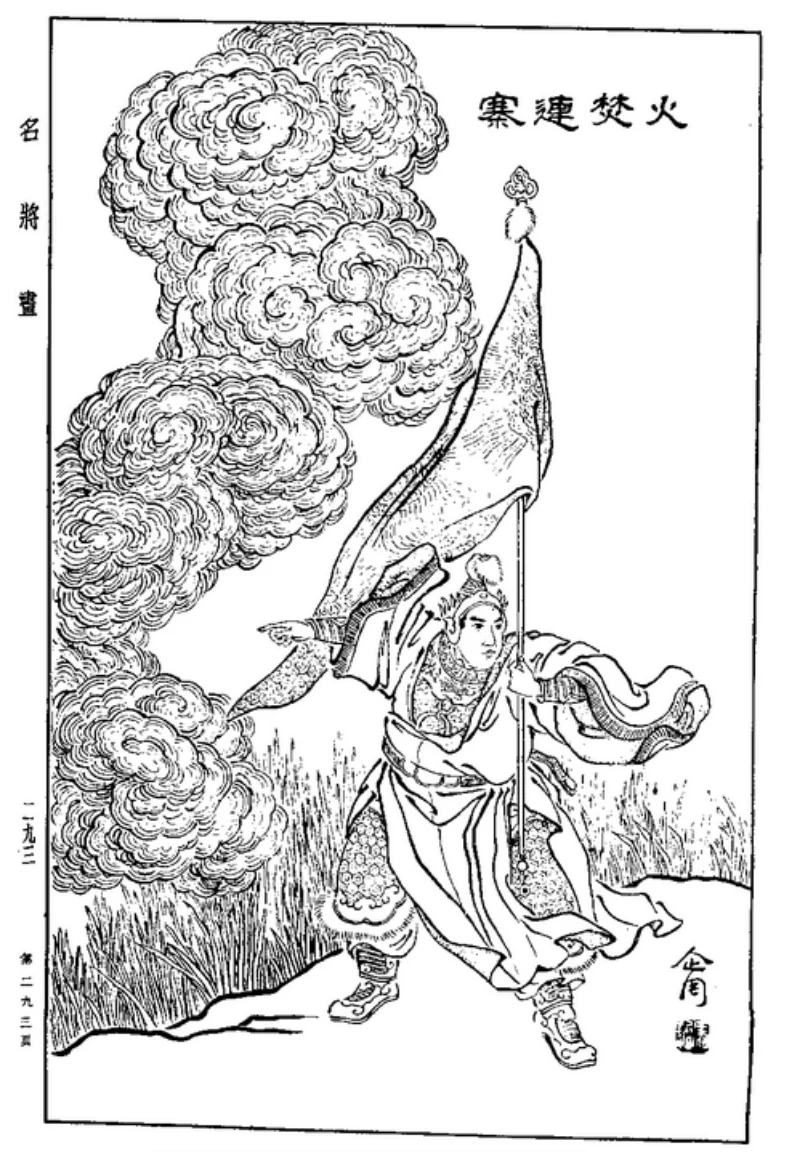
The armies faced each other for about half a year. By the heat of the sixth month, the Shu troops were exhausted and had moved their camps into wooded terrain. Lu Xun then counterattacked with fire. More than forty Shu camps were burned, and the source describes their boats, equipment, and supplies as almost entirely destroyed. Feng Xi, Zhang Nan, Fu Rong, Ma Liang, Wang Fu, the non-Han commander Shamoke, and others were killed. Huang Quan's retreat was cut off and he surrendered to Wei. Liu Bei withdrew by night to Baidicheng.
Wu commanders wanted to pursue him, but Lu Xun believed that Cao Pi had assembled armies ostensibly to assist Wu against Shu while actually harboring hostile intentions. He therefore returned to Jiangling. Soon afterward Wei did attack Wu by three routes, but withdrew when it found Wu prepared. After the battle Sun Quan appointed Lu Xun General Who Assists the State, made him Governor of Jingzhou, and transferred his marquisate to Jiangling.
Governing Jingzhou and the Battle of Shiting
After Liu Bei's death, Zhuge Liang governed Shu and restored the alliance between Shu and Wu. From then on Sun Quan sought Lu Xun's opinion on relations with Shu. Documents sent to Shu were shown to Lu Xun first, and he was authorized to revise them. Sun Quan even had a special seal made for Lu Xun to use in handling Wu-Shu affairs.
In 226, because local troops lacked grain, Lu Xun proposed expanding military agriculture. Sun Quan approved and said that he and his sons would personally take an allotment of fields and use the oxen that drew his carriage for plowing. Lu Xun also urged broader benevolence, lighter punishments, and reduced land taxes. Sun Quan emphasized the unusual closeness of their relationship and ordered officials to send draft regulations to Lu Xun and Zhuge Jin for review.
In 228, Wei Grand Marshal Cao Xiu launched a major attack on Wu. Poyang Administrator Zhou Fang, acting with Sun Quan, feigned surrender and lured Cao Xiu forward with one hundred thousand infantry and cavalry. Sun Quan granted Lu Xun the ceremonial yellow axe and placed him over Zhu Huan, Quan Cong, Zhou Fang, and other commanders, totaling ninety thousand troops. Lu Xun commanded the center while Zhu Huan and Quan Cong formed the wings. At Shiting they heavily defeated Cao Xiu, killing or capturing more than ten thousand and seizing large quantities of vehicles, weapons, and supplies. Cao Xiu escaped but died soon afterward in anger and distress. When Lu Xun returned, Sun Quan rewarded him lavishly and personally honored him at court.
Assisting the Crown Prince and Northern Campaigns
In 229, after Sun Quan proclaimed himself emperor at Wuchang, Lu Xun was appointed Senior General-in-Chief and Right Protector-General, with rank above the Three Dukes. When Sun Quan moved east to Jianye, he left Crown Prince Sun Deng, the imperial princes, and senior officials at Wuchang and ordered Lu Xun to assist the crown prince and manage military and state affairs involving Jingzhou and parts of Yangzhou.
Lu Xun also instructed members of the imperial family. When Sun Lü, Sun Quan's second son, devoted himself to duck fighting, Lu Xun rebuked him for neglecting the classics, after which Sun Lü dismantled his duck enclosure. Sun Song, a nephew of Sun Quan, failed to maintain military discipline, and Lu Xun had members of his unit punished in his presence. When crown-prince attendant Xie Jing praised a doctrine favoring punishment before ritual, Lu Xun sharply rejected it and urged him instead to uphold benevolence and righteousness while serving in the Eastern Palace.
In 234, Sun Quan campaigned north and sent Lu Xun and Zhuge Jin against Xiangyang. A relative carrying Lu Xun's memorial to the court was captured by the enemy on the return journey. Zhuge Jin panicked and urged immediate withdrawal. Lu Xun did not reply but calmly had men plant beans and continued playing board games and archery with the generals. When Zhuge Jin came in person, Lu Xun explained that Wei knew the emperor had withdrawn and would now focus on them. If Wu retreated in panic, the enemy would press hard. Instead, they should first steady the army, devise a flexible plan, and then withdraw. Lu Xun and Zhuge Jin arranged a feint: Zhuge Jin prepared boats while Lu Xun advanced troops toward Xiangyang. Wei forces, already wary of Lu Xun, withdrew into the city. Lu Xun then reorganized his men and boarded the ships without being pursued. At Baiwei he feigned a hunting expedition while secretly sending Zhou Jun, Zhang Liang, and others against Xinshi, Anlu, and Shiyang, where they killed or captured more than one thousand.
Appointment as Grand Councilor and the Two Palaces Dispute
In 244, the seventh year of the Chiwu era, Lu Xun became Grand Councilor and took charge of the affairs of the highest offices while continuing to manage Wuchang. At the time Sun Quan favored Prince of Lu Sun Ba, placing Crown Prince Sun He's position in danger. Lu Xun supported the crown prince, repeatedly memorialized the throne on the distinction between heir and junior prince, and asked to come to the capital to present his case in person. Sun Quan was displeased and repeatedly sent envoys and eunuchs to reproach him. Lu Xun's nephews Gu Tan, Gu Cheng, Yao Xin, and others were exiled for supporting the crown prince. Crown Prince Grand Tutor Wu Can was imprisoned and executed for corresponding with Lu Xun. Under repeated imperial rebukes, Lu Xun became ill from anger and distress and died on 19 March 245, at the age of sixty-three. Under Sun Xiu he was posthumously named Marquis Zhao.
Family and Early Years
Lu Xun, courtesy name Boyan, originally named Yi, was a native of Wu county in Wu commandery of the great Jiangdong clan of Lu of Wu. By the genealogical table of chancellors in the New History of Tang, the Lu descended from the Gui surname, the youngest son of King Xuan of Qi, Tong, having been enfeoffed at Lu township in Ban county of Pingyuan, "the old land of Lu Zhong, whence they took their surname," his descendants becoming men of Wu county. Lu Xun lost his father young and followed his great-uncle Lu Kang, governor of Lujiang, in office; and when Yuan Shu, having a quarrel with Lu Kang, was about to attack him, Lu Kang sent Lu Xun and his kinsmen back to Wu. By the Later Han, Yuan Shu in a rage sent his general Sun Ce against Lu Kang and invested the city in several rings, and Lu Kang held it obstinately, so that "officers and men who had been on leave all slipped back and entered the city by night over the wall," and after two years under attack the city fell; and a month later he fell ill and died at seventy, "and of more than a hundred of the clan, meeting famine and hardship, nearly half died." Lu Xun being some years older than Lu Kang's son Lu Ji, he kept the household in order for him. Sun Quan gave him the second daughter of his elder brother Sun Ce in marriage and often consulted him on affairs; in the eighth year of Jian'an, 203, he entered Sun Quan's secretariat, serving successively as commandant of the garrison farm at Haichang, colonel of established majesty, and commander of the right division of the guards. As commandant at Haichang his record was notable and the people greatly favoured him: starting from the poverty of the soil there and years of drought, he opened the granaries to relieve the poor on the one hand and on the other encouraged farming and sericulture and production, so that "the people relied on him" and called him the divine lord.
The Suppression of the Mountain Yue and the Muster of the Three Eastern Commanderies
At that time Wu, Kuaiji and Danyang had many people in hiding, and Lu Xun memorialised on the advantages of recruiting them. The great chief of the bandits of Kuaiji, Pan Lin, "had long been a scourge wherever he was, and for years could not be taken," and Lu Xun with his own men raised troops and hunted him through the deep fastnesses, "and wherever he went all submitted," his retainers numbering more than two thousand; and when the bandit chief of Poyang, You Tu, rose in rebellion he went against him too, being made colonel of established majesty and camping at Lipu. In the twenty-second year of Jian'an, 217, he proposed to Sun Quan that the heroes now stood each in his own quarter contending, that the wolf-like enemy watched for his chance, and that to overcome the enemy and quiet the disorder numbers were needed, while the mountain bandits, of old enmity with them, relied on the deep country, so that with the heart of the land unquiet no distant enterprise could be planned, and the ranks should be greatly enlarged by taking the picked men. Sun Quan adopted his plan and made him commander of the right division of the guards. Just then the bandit chief of Danyang, Fei Zhan, receiving Cao Cao's seal, stirred up the mountain Yue as an inside support, and Sun Quan sent Lu Xun against him; and Fei Zhan's partisans being many and Lu Xun's troops few, he planted many banners and distributed drums and horns, and at night stole through the valleys and "advanced with drums and shouting, and they broke and scattered at once." He then mustered the three eastern commanderies, the strong as soldiers and the weak enrolled as households, getting several tens of thousands of picked troops, so that the long-standing evil was swept away and all he passed was made clean, and he returned to camp at Wuhu. The governor of Kuaiji, Chunyu Shi, memorialised that Lu Xun had wrongly seized people and troubled the region; and Lu Xun afterwards coming to the capital and speaking with Sun Quan, praised Chunyu Shi as a good officer, and Sun Quan asking why, since Chunyu Shi had informed against him, he recommended him, Lu Xun answered that Chunyu Shi's mind was to nourish the people and that was why he had informed, and that if he in turn slandered him to confuse the imperial hearing, such a practice must not be allowed to grow; and Sun Quan said that this was truly the act of a man of age, which others could not do, and greatly admired his conduct.
The Deception of Guan Yu and the Seizure of Jingzhou
Lü Meng, pleading illness, went to Jianye, and Lu Xun went to see him, asking how, with Guan Yu on the border, he could go down so far and leave the future unguarded; and Lü Meng saying that it was indeed as he said but that his illness was grave, Lu Xun said that Guan Yu "prided himself on his prowess and trampled on others," and having just won a great merit was proud in mind and loose in purpose, thinking only of advancing north and suspecting nothing of them, so that if he heard of the illness he would be the more unguarded, and that a surprise attack would take him. Lü Meng reaching the capital, Sun Quan asked who could replace him, and Lü Meng answered that Lu Xun's thought was deep and far, his ability equal to a heavy charge, and that from his plans he would in the end be fit for great employment, but that he had no distant fame and was not feared by Guan Yu, so that none was better; and if he were used, he should be made to hide himself outwardly and inwardly watch the shape of things, and then he could succeed. Sun Quan therefore summoned Lu Xun and made him lieutenant-general and commander of the right division in place of Lü Meng. Reaching Lukou, Lu Xun wrote to Guan Yu, praising his "small effort and great victory, how towering," and saying that he himself was "a mere scholar, slow and negligent, unworthy of his post, but delighting in the virtue of his neighbour and glad to pour himself out," so humbling himself and flattering Guan Yu's merit and professing admiration and no thought of hostility; and Guan Yu reading the letter took it as an expression of humility and self-commitment, "was greatly at ease and no longer suspicious," and drew off some of his rear troops to Fancheng. Lu Xun reported the whole shape of things and set out the essentials of how he might be taken. Sun Quan then moved his army up secretly, making Lu Xun and Lü Meng the van, and on arrival they took Gong'an and Nanjun; and Lu Xun advancing directly became governor of Yidu, was made general of the frontier and enfeoffed as marquis of Huating. Liu Bei's governor of Yidu, Fan You, abandoned his commandery and fled, and the senior clerks of the cities and the chiefs of the barbarians all submitted, Lu Xun asking for gold, silver and bronze seals to grant to the newly submitted, in the eleventh month of the twenty-fourth year of Jian'an, 219. Afterwards he sent the generals Li Yi and Xie Jing with three thousand men against the Shu generals Zhan Yan and Chen Feng, Li Yi with the fleet and Xie Jing with the foot, cutting the strongpoints, so that Zhan Yan was broken and Chen Feng taken alive; and he attacked the governors of Fangling and Nanxiang, Deng Fu and Guo Mu, and heavily defeated them. The great families of Zigui, Wen Bu and Deng Kai, joining several thousand barbarian troops, held the west end and the east end, and Lu Xun again sent Xie Jing against them and broke them; and the two escaping and being made generals by Shu, Lu Xun had them enticed, and Wen Bu brought his men back and submitted, so that between beheading, capturing and drawing in, the total came to several tens of thousands; and Sun Quan made Lu Xun commander of the right guards and general of the western garrison, and raised him to marquis of Lou. At that time the scholars of Jingzhou, newly returned, had not all found their places, and Lu Xun memorialised that Jingzhou being newly settled and its men not yet advanced, he begged that a general grace of promotion be granted so that all might advance of themselves; and Sun Quan respectfully accepted his words.
The Battle of Yiling
In the first year of Huangwu, 222, Liu Bei led a great host westward, and Sun Quan made Lu Xun grand commander with the imperial tally, commanding fifty thousand men under Zhu Ran, Pan Zhang, Song Qian, Han Dang, Xu Sheng, Xianyu Dan and Sun Huan against him. Liu Bei from the Wu gorge and Jianping linked his camps to the Yiling border, setting up several dozen garrisons, luring the various barbarians with gold and brocade and rank, and first sending Wu Ban with several thousand men to pitch camp on level ground to provoke a battle; and the generals all wishing to attack, Lu Xun said that there must be some trick in it and to wait and see, whereupon Liu Bei, knowing his plan would not work, brought out eight thousand hidden troops from the valley, and Lu Xun said that his refusal to let them attack Wu Ban was because he had judged there must be some cunning in it. Sun Huan, sent aside against Liu Bei's van at Yidao, was surrounded by Liu Bei and asked help of Lu Xun, who said it could not be done yet; and the generals saying that Sun of Andong was of the ruling house and, being surrounded and hard pressed, must be helped, Lu Xun answered that Sun of Andong had the hearts of his soldiers, his walls were firm and his grain sufficient, and there was nothing to fear, for when his plan unfolded, though he did not help him, Sun would be relieved of himself; and when the plan was fully executed Liu Bei indeed collapsed and fled, and Sun Huan afterwards said to Lu Xun that he had indeed resented not being helped, but that now that the outcome was settled he knew his dispositions had their method. When the Shu armies challenged repeatedly and the Wu generals all burned to attack, Lu Xun held them back, saying that Liu Bei's army coming down east was at the height of its keenness and, holding the heights and strongpoints, could not be attacked at once, and that now they should only reward and encourage the officers and men and spread their plans widely while watching for a change, for along the mountains the army could not deploy, and must tire itself among the rocks and trees, when its weakness might slowly be worked upon; and the generals, not understanding, thought him afraid and each nursed resentment. At that time the generals were either old officers of Sun Ce's time or noble kinsmen of the ruling house, each proud and not obeying one another; and Lu Xun, laying his hand on his sword, said that Liu Bei was known throughout the realm and feared by Cao Cao, and being now on their border was a strong opponent, that they all bore the state's grace and should be in harmony to cut down this enemy and repay what they had received, and that to disobey was not the thing; that he, though a scholar, had received the sovereign's commission, and that the state had bent them to obey him because he had some small measure of merit and could bear disgrace and a heavy charge, and that each had his duty and might not decline it, for military law was constant and could not be broken. The two armies faced each other for half a year, until in the height of summer the Shu army could not force a quick victory, its men tired and its spirit slack; and its fleet being ordered ashore, it lost the initiative of mutual support between land and water, and with camps strung out over several hundred li its supply grew difficult. Lu Xun memorialised that Yiling was the key pass of the state, easy to take and easy to lose, and that Liu Bei having in all his campaigns won few and lost many, there was little to fear, and that he had now given up his ships for foot and camped at every point, in which dispositions there could be no other change, begging Sun Quan to sleep at ease; and when the generals said that Liu Bei should have been attacked at the beginning and that now he had been let in five or six hundred li and the standoff had lasted seven or eight months with all the strongpoints held, Lu Xun answered that Liu Bei was a cunning rogue of much experience, whose army, newly gathered, was of concentrated mind and not to be touched, but that having stayed long without gaining any advantage over them, its men were tired and its spirit low and its plans would not come again, and that the moment to corner this enemy was now. He first attacked one camp without success, and the generals all said that it was but killing men for nothing; and Lu Xun saying that he had learned the art of breaking them, he ordered each man to carry a bundle of thatch and took the camp by fire attack, and once the tide turned he led all the armies to attack together, cutting off the heads of Zhang Nan, Feng Xi and the barbarian king Shamoke and breaking more than forty of their camps; and Liu Bei, climbing Ma'an mountain and drawing up his troops about him, was pressed on all sides by Lu Xun's armies and crumbled, with ten thousand dead, and fled by night with the post-station men carrying his gear and burning his gongs and armour to cover the retreat, only just reaching Baidi city, "his ships and equipment, land and water stores, all lost at once, and the corpses floating down river so as to choke it"; and Liu Bei in great shame and rage said that he had been humiliated by Lu Xun, and asked whether it was not heaven. Afterwards Xu Sheng, Pan Zhang and Song Qian each vied in memorialising that Liu Bei could surely be taken and begging to attack again, and Sun Quan asking Lu Xun, he with Zhu Ran and Luo Tong held that Cao Pi was gathering a great host, outwardly professing to help the state against Liu Bei but inwardly having treacherous designs, and that they had resolved to return; and before long the Wei army did come out, and Wu was attacked on three sides. Liu Bei, hearing that the Wei army had come out in force, wrote to Lu Xun asking whether, with the enemy now at Jiangling, he might go east again and whether the general thought he could; and Lu Xun answered that he feared the army newly broken had not yet healed its wounds and was first seeking a marriage connexion, and must mend itself and had no leisure for exhausting war, but that if without reckoning he wished again to send the remnant of a defeat far to visit them, it would find no escape. Sun Quan learning that the generals had disobeyed his orders, asked Lu Xun why he had not reported it at first, and Lu Xun answered that these generals were some his confidants, some fit for claw and fang, some men of merit, all of whom the state should join in accomplishing the great work, and that though he was weak and timid he privately admired the yielding of Lin Xiangru and Kou Xun in order to serve the state; and Sun Quan laughed aloud and approved, making him general of the auxiliary state and governor of Jingzhou and changing his fief to marquis of Jiangling. Having won the great victory, Lu Xun again stopped the pursuit in good time, so that Wei had no opening.
Relations with Shu and His Counsels on Government
Liu Bei dying soon after and his son Liu Shan succeeding, Zhuge Liang took the government and made peace with Sun Quan; and whatever the times required, Sun Quan had Lu Xun speak of it to Zhuge Liang, and carved his own seal to keep at Lu Xun's residence, "and whenever he wrote to Shan or Liang he would first show it to Lu Xun, and if the weight of any matter were doubtful or uneasy he would have it revised and sealed with the seal and sent." In the spring of the fifth year of Huangwu, 226, Lu Xun, his station being short of grain, memorialised that the generals should open up farmland widely, and Sun Quan replied that the plan was excellent and that from that day he and his son would each take a share of the fields, with the eight oxen of his carriage pulling four ploughs, so that though it fell short of the ancients he too might labour on equal terms with the rest; and in the tenth month Lu Xun memorialised urging Sun Quan to spread grace, lighten punishments, relax the collection of the land tax and stop the pressing of the household tax, and Sun Quan agreeing said that their bond was quite out of the common and their joy and grief in truth the same. Lu Xun, though in office abroad, had his heart in the state, and memorialised on current affairs that the statutes were severe and offenders many, that though the officers who had fallen into crime in recent years were not lightly to be excused, the realm was not yet one and advance must be planned, so that a little grace should be shown to quiet the feelings below, and that with the business of the world daily growing, ability should come first, and he begged that those stained by vileness be again displayed and used to show their strength, citing that the founder of Han forgave Chen Ping's fault and used his rare strategy, so building a merit that lasted a thousand years, and holding that harsh laws and severe punishments were no flourishing enterprise for a king and that punishment without pardon was no broad rule for embracing the distant. When Sun Quan wished to send a detached force against Yizhou and Zhuya and consulted him on both, Lu Xun memorialised that a raid a thousand li away had incalculable winds and waves, that the people would sicken in a changed climate, and that to gain their people would not help the cause nor to lack their troops weaken his own, so that the soldiers and people should be nourished and their taxes lightened before anything was attempted; and Sun Quan nevertheless attacked Yizhou, gaining less than he lost. When Gongsun Yuan broke faith and Sun Quan wished to go against him, Lu Xun memorialised that he who sets his mind on a journey of ten thousand li does not halt halfway, and that he who plans the four seas does not let a small matter harm a great one, and begged him to rest the armies and overawe the great enemy and settle the middle land betimes; and Sun Quan accepted his words.
The Battle of Shiting, His Guardianship of the Heir, and the Jiahe Years
In the seventh year of Huangwu, 228, Sun Quan had the governor of Poyang, Zhou Fang, feign submission to the Wei grand marshal Cao Xiu, and Cao Xiu indeed brought his host into Wan, whereupon Sun Quan summoned Lu Xun, gave him the yellow battle-axe, and made him grand commander against Cao Xiu. Lu Xun taking the centre himself and making Zhu Huan and Quan Cong the two wings, the three columns advanced together and indeed broke Cao Xiu's hidden troops and drove them off, pursuing the fugitives as far as Jiashi, taking more than ten thousand, with horses, cattle, mules and donkeys and carriages by the ten thousand and military stores and weapons almost all lost, and Cao Xiu returning died of a carbuncle on his back; and as the armies marched back past Wuchang, Sun Quan had those about him shelter Lu Xun with the imperial umbrella as he went in and out of the palace gate, and all that was given him was of the emperor's own treasures, with which none at the time could compare. In the first year of Huanglong, 229, Sun Quan took the throne and made Lu Xun grand general of the upper army and right protector of the capital; and that year, going east to inspect Jianye, he left the heir apparent and the imperial sons and the nine officers of the secretariat, summoning Lu Xun to assist the heir and to have charge of Jingzhou and of the three commanderies of Yuzhang, supervising the military and civil government. The marquis of Jianchang, Sun Lü, having built a fighting-duck pen in front of his hall with much petty ornament, Lu Xun said gravely that the marquis should diligently read the classics for his own improvement and asked what use this was; and Sun Lü demolished it at once. The archery colonel Sun Song, of all the imperial sons the most favoured, drilling his troops without order, Lu Xun in his presence had his staff shaved as a punishment; and when Xie Jing of Nanyang praised Liu Yi's doctrine of punishment before ritual, Lu Xun rebuked him, saying that the pre-eminence of ritual over punishment was of long standing, that Liu Yi with petty quibbles perverted the teaching of the sages, and that serving in the eastern palace he should follow benevolence and righteousness to make virtue known. In the fifth year of Jiahe, 236, Sun Quan going north in person had Lu Xun with Zhuge Jin attack Xiangyang, and Lu Xun sent his trusted man Han Bian with a memorial, who on his return was taken by the enemy patrols on the Mian; and Zhuge Jin, much alarmed, wrote that with the emperor's train already returned and the enemy knowing all their dispositions, and the river running low, they should withdraw at once. Lu Xun did not answer, but set men to sow turnips and beans and played chess and shot arrows with the generals as usual; and Zhuge Jin coming in person, Lu Xun said that the enemy, knowing the imperial train had returned, had nothing more to fear and could turn all their strength on them, and that holding the strongpoints already they must steady their own men to quiet them, use shifting devices, and then come out, for if they showed retreat the enemy would think them frightened and press them, which must mean defeat. He then secretly agreed with Zhuge Jin that the latter should command the ships while he put all the troops aboard and turned toward Xiangyang city, and the enemy, ever in fear of Lu Xun, hurried back to the city, so that Zhuge Jin could bring the ships out while Lu Xun calmly ordered his ranks and made a great display, marching to the ships while the enemy dared not interfere; and reaching Baiwei he gave out that he was halting to hunt and secretly sent the generals Zhou Jun and Zhang Liang against Jiangxia, Xinshi, Anlu and Shiyang, where Shiyang being a busy market and the attack sudden, the people threw down their goods and fled into the city, so that the gate was choked and could not be shut, and the enemy killed their own people before it could be closed; and of heads taken and prisoners, a thousand odd. To those he took he gave good treatment, forbidding the soldiers to molest or insult them, and where families came he had them cared for, and where a man had lost wife or children he gave clothing and grain and comforted him and sent him home, and some were so moved that they came over with their families, and the neighbouring districts were drawn to him, so that the merit clerk of Jiangxia, Zhao Zhuo, the garrison general of Yiyang, Pei Sheng, and the barbarian king Mei Yi all brought their partisans to submit, and Lu Xun spent his own wealth to relieve them. In the sixth year of Jiahe the general of the household troops Zhou Zhi asked to recruit in Poyang, and the matter being referred to Lu Xun, he held that the people of that commandery were easily stirred and hard to settle and should not be recruited lest bandits arise, but Zhou Zhi pressing the matter, the people of the commandery under Wu Ju indeed rose, killed Zhou Zhi and overran the counties, and the long-standing evil folk of Yuzhang and Luling joined Wu Ju as bandits; and Lu Xun, hearing of it himself, attacked at once and broke them, Wu Ju and the rest surrendering in a body, so that he reckoned more than eight thousand picked troops and the three commanderies were pacified. At that time Xie Yuan, Xie Hong and others each set out expedients, wishing to promote profit and change the system, and the matter being referred to Lu Xun, he said that the state takes the people as its root, its strength comes from the people's strength and its wealth from the people, and that a people rich with a state weak, or a people poor with a state strong, had never been, so that the ruler who gains the people governs and he who loses them is in disorder, and that to give the people no benefit and yet require their utmost service was very hard; he begged that grace be shown and the people relieved, so that in a few years the state's means might be a little fuller and the matter considered again.
The Quarrel of the Two Palaces, His Chancellorship and His Death
In the first month of the seventh year of Jiahe, 244, Gu Yong died and Sun Quan made Lu Xun chancellor in his place, decreeing that he himself, unworthy as he was, had met his time and mounted the throne while the road of kings was not yet one and the wicked filled the ways, but that Lu Xun, of heaven-given intelligence and shining virtue, held the high command and saved the state from trouble, and citing that as Yi Yin prospered Tang and the Grand Duke winged Zhou, Lu Xun now combined the duties within and without; he therefore made him chancellor and sent the holder of the tally and acting master of ceremonies Fu Chang to give him the seal, charging him to display bright virtue, cultivate excellent merit, reverently obey the royal commands and pacify the four quarters, and his former offices as governor and protector with the charge of Wuchang to remain as before. Previously, when the two palaces stood equal, the officers within and without had mostly sent their sons to serve the heir Sun He or the prince of Lu, Sun Ba, and Quan Cong writing to tell him, Lu Xun held that if a man's son had ability he need not fear not being used, and should not privately seek honour and profit, and that if he were unfit it would bring ruin, and that the two palaces being of equal power there must be sides, which the ancients had greatly abominated. Sun Quan discovering that words spoken within the palace had leaked, questioned Yang Zhu, Lu Yin and Wu Can in turn, and Yang Zhu's confession produced twenty charges against Lu Xun; and though Lu Xun was not at once arraigned with them, envoys were sent to reprove him for prying into the palace secrets, and he died of grief and anger at sixty-three, leaving no wealth at home. By Xiao Fang's History of the Thirty Kingdoms Lu Xun hanged himself; and at his death Lu Kang, then twenty, was made colonel of established martial might and given the five thousand men of Lu Xun's command, bringing the coffin east for burial and coming to the capital to return thanks, and Sun Quan questioning him on the twenty charges Yang Zhu had reported, barring him from his retainers and sending palace envoys to press him, Lu Kang asked nothing back but answered every item in order, so that Sun Quan's mind gradually eased. In the first year of Taiyuan, 251, Lu Kang coming to the capital for treatment and being about to return when cured, Sun Quan parted from him in tears, saying that he had formerly listened to slander and been less than firm in his great duty to his father, and had wronged him thereby, and that all the questions of those times he had burned, so that no man should see them. Lu Xun was chancellor of Wu and marquis of Lou, and his grandsons Lu Ji and Lu Yun were famous men of letters of the Western Jin. By the treatise on rites and music in the New History of Tang, when the court had the history office determine those worthy to be sacrificed to in the temple of the Martial Accomplished King, sixty-four famous generals of all ages were painted there, among them "the Wu lieutenant-general and governor of Nanjun Zhou Yu and the chancellor, marquis of Lou, Lu Xun."