Birth | Born in the residence of the Prince of Yu, the third son of the future Emperor Muzong of Ming
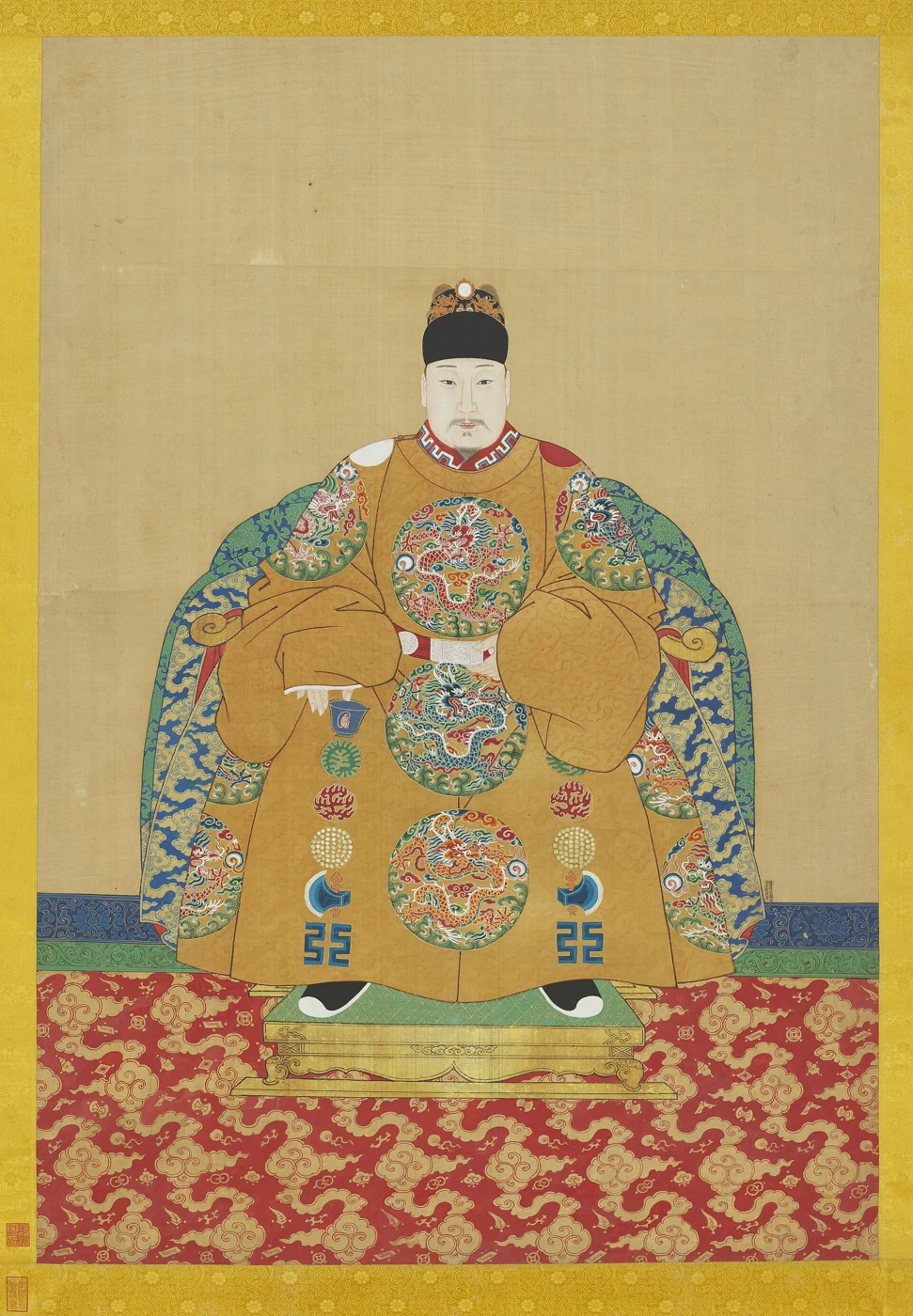
1563 CE–1620 CE
Ming emperor
Zhu Yijun
朱翊钧
Zhu Yijun (the seventeenth day of the eighth lunar month in the forty-second year of Jiajing, September 4, 1563 – the twenty-first day of the seventh lunar month in the forty-eighth year of Wanli, August 18, 1620), art name Yuzhai, was the third son of Zhu Zaiji, Emperor Muzong of Ming, and Noble Consort Li. He was the thirteenth emperor of the Ming Dynasty. His era name was Wanli, and his forty-eight-year reign was the…
1563 CE–1620 CEMing Dynasty
PROFILE
Zhu Yijun (the seventeenth day of the eighth lunar month in the forty-second year of Jiajing, September 4, 1563 – the twenty-first day of the seventh lunar month in the forty-eighth year of Wanli, August 18, 1620), art name Yuzhai, was the third son of Zhu Zaiji, Emperor Muzong of Ming, and Noble Consort Li. He was the thirteenth emperor of the Ming Dynasty. His era name was Wanli, and his forty-eight-year reign was the longest of any Ming emperor. Zhu Yijun was made crown prince at the age of six and ascended the throne in the sixth lunar month of 1572, the sixth year of Longqing. During the first ten years of his reign he strongly supported Grand Secretary Zhang Juzheng's reform program, producing what became known as the “Wanli Restoration.” After taking personal control of government, he presided over the “Three Great Campaigns of Wanli,” which strengthened the frontier. After 1586, the fourteenth year of Wanli, disputes such as the succession controversy left him increasingly disengaged from government. He ceased attending court for long periods, administration deteriorated, and factional struggles intensified. He died of illness in 1620, the forty-eighth year of Wanli, and was buried in the Dingling Mausoleum.
- Alternate name
- Wanli Emperor
- Art name
- Yuzhai
- Period
- Ming Dynasty
- Date of Birth
- September 4 1563
- Date of Death
- August 18 1620
- Dynasty/Regime
- Ming Dynasty
- Identity
- Ming emperor
- Ethnicity
- Not recorded in historical sources
- Ancestral home
- Not recorded in historical sources
- Place of birth
- Residence of the Prince of Yu
- Place of death
- Not recorded in historical sources
- Reign
- 1572–1620
- Predecessor
- Emperor Muzong of Ming (Zhu Zaiji)
- Successor
- Emperor Guangzong of Ming (Zhu Changluo)
- Era name
- Wanli
- Temple name
- Shenzong
- Posthumous name
- Fantian Hedao Zhesu Dunjian Guangwen Zhangwu Anren Zhixiao Xian Huangdi
- Highest office
- See Biography and Major Deeds
- Major achievements
- Thirteenth emperor of the Ming; reigned under the era name Wanli for forty-eight years; political withdrawal in the middle and later reign contributed to factional conflict and frontier pressures
LIFE TIMELINE
Age four | On the eighteenth day of the first lunar month, Emperor Muzong bestowed on him the name Zhu Yijun
Age five | On the eleventh day of the third lunar month, formally established as crown prince
Age eight | Underwent the capping ceremony marking adulthood
Age nine | Emperor Muzong died on the twenty-sixth day of the fifth lunar month; Zhu Yijun ascended the throne on the tenth day of the sixth lunar month and adopted the Wanli era name the following year
Age ten | Zhang Juzheng introduced the performance-assessment system, beginning the reform program
Age fifteen | Ordered a trial land survey in Fujian
Age eighteen | The Single-Whip tax reform was implemented throughout the empire
Age nineteen | Zhang Juzheng died in the sixth lunar month; later that year Zhu Yijun moved against Zhang's legacy and confiscated the family's property
Age twenty | Began personal rule, pursued active government, and repeatedly remitted taxes
Age twenty-three | Began indulging heavily in alcohol and sexual pleasures; his health worsened and he became increasingly disengaged from government
Age twenty-six | Ceased regularly receiving court officials and left many memorials unanswered
Age twenty-nine | The Ningxia Campaign began, opening the Three Great Campaigns of Wanli
War in Korea | Ming forces fought the Japanese invasion led by Toyotomi Hideyoshi
Age thirty-seven | The Bozhou Campaign suppressed Yang Yinglong's rebellion
Age fifty-two | The Palace Assault Case occurred; Zhu Yijun personally settled the case and received court officials
Age fifty-three | The Later Jin regime was founded
Age fifty-five | Later Jin captured Fushun and open Ming–Jin war began
Age fifty-six | Ming forces suffered a severe defeat at the Battle of Sarhu and thereafter adopted a defensive posture against Later Jin
Age fifty-eight | Died of illness in Hongde Hall and was buried in the Dingling Mausoleum
BIOGRAPHY
Biography
Family Background and Early Life
Zhu Yijun was born on the seventeenth day of the eighth lunar month in the forty-second year of Jiajing, September 4, 1563. At the time his father Zhu Zaiji was still Prince of Yu. His grandfather, the Jiajing Emperor Zhu Houcong, had become deeply involved in Daoist religious practices late in life and avoided discussion of the succession. As a result, no one dared report Zhu Yijun's birth to the Jiajing Emperor or give the infant a formal name. Only after court officials memorialized in the first lunar month of 1567, the first year of Longqing, asking that a crown prince be established did Emperor Muzong formally bestow the name “Yijun” on him on the eighteenth day of that month. The emperor explained the character jun by comparing the ruler's governance of the realm to the turning of a potter's wheel, emphasizing the weight of the name's meaning.
Zhu Yijun's mother, Lady Li, came from a humble background and had originally been a palace woman in the Prince of Yu's household. After bearing a son, she was promoted to noble consort. Empress Dowager Li disciplined her son with great severity. Whenever Zhu Yijun showed the slightest laziness as a child, she summoned him to kneel before her. During palace lectures she required the lecturers to teach him directly, and on days of early court she came to his bedchamber at the fifth watch, woke him personally, had attendants help him wash and dress, and sent him to his carriage. Zhu Yijun later recalled that he had been able to read from the age of five. Though this claim may contain some self-praise, the strictness of his early education was unusual among Ming emperors.
On the eleventh day of the third lunar month in 1568, the second year of Longqing, Zhu Yijun was made crown prince. In the winter of 1571, the fifth year of Longqing, Emperor Muzong held his capping ceremony. On the twenty-second day of the fifth lunar month in 1572, the emperor became critically ill and summoned Grand Secretaries Gao Gong, Zhang Juzheng, and Gao Yi to receive his final instructions. The testament ordered the crown prince to rely on the three senior ministers and the Directorate of Ceremonial for guidance, cultivate learning and virtue, employ worthy and capable men, avoid idleness and neglect, and preserve the imperial enterprise. Emperor Muzong died in Qianqing Palace on the twenty-sixth day of the fifth lunar month. On the tenth day of the sixth lunar month, the nine-year-old Zhu Yijun formally ascended the throne and adopted the Wanli era name the following year.
Young Emperor and Zhang Juzheng's Regency
Zhu Yijun was only nine at accession, and political uncertainty accompanied the rule of a child emperor. Emperor Muzong had appointed three senior ministers to assist him, but Gao Gong was in deep conflict with the eunuch Feng Bao, seal-holder of the Directorate of Ceremonial. Gao Gong had reportedly lamented, “How can a ten-year-old crown prince govern the realm?” Feng Bao distorted this into the claim that Gao had said a ten-year-old child could not make decisions as emperor and reported it to the empress dowager. When Zhu Yijun heard of this, suspicion of Gao's desire for exclusive power became deeply fixed in his mind. On the sixteenth day of the sixth lunar month in 1572, Gao Gong was dismissed, and Zhang Juzheng became senior grand secretary.
Zhu Yijun showed Zhang Juzheng extraordinary respect, addressing him as “Senior Assistant Teacher Zhang” or “Teacher Zhang” rather than by name. On the nineteenth day of the sixth lunar month, only days after Zhang took office, Zhu Yijun summoned him alone to the palace platform to discuss government. Over the following decade the emperor entrusted palace affairs to Feng Bao and the major civil and military business of state to Zhang Juzheng. With Zhu Yijun's support, Zhang implemented the performance-assessment system to tighten official discipline, conducted land surveys, expanded the Single-Whip tax reform, and strengthened military preparedness, reversing the decline that had accumulated since the Zhengde and Jiajing periods. In the early Wanli years the Taicang granaries reportedly held thirteen million shi of grain, enough for ten years of use; the Court of the Imperial Stud held more than four million taels of silver; and the Taicang treasury held more than ten million taels. This period became known as the “Wanli Restoration.”
Zhu Yijun himself continued daily lectures and attended classical discussions, reading the Confucian classics and historical works. Except on the regular court days falling on the third, sixth, and ninth days of the month, he continued these studies even through severe winter and summer heat. Shen Defu's Wanli Yehuo Bian described his learning as improving day by day during these ten years and praised the peace produced by his early diligence.
Zhang Juzheng's authority, however, grew so great that it nearly overshadowed the throne. In 1580, the eighth year of Wanli, Zhu Yijun behaved frivolously while going out with the eunuchs Sun Hai and Keyong. Feng Bao informed Empress Dowager Li, who threatened him with deposition, and Zhang Juzheng took the opportunity to draft an imperial self-criticism in the emperor's name. On another occasion at a palace lecture, Zhu Yijun misread the character bo in a passage from the Analects. Zhang corrected him sharply, frightening the young emperor. Experiences such as these left a lasting psychological mark on him.
Personal Rule and the Three Great Campaigns of Wanli
Zhang Juzheng died in the sixth lunar month of 1582, the tenth year of Wanli, and Zhu Yijun began to rule personally. The following year he stripped Zhang of posthumous honors, confiscated the Zhang family's property, rehabilitated Liu Tai, and recalled officials who had been demoted for opposing Zhang. In the early phase of personal rule, Zhu Yijun showed considerable energy, repeatedly remitting taxes and expressing concern for popular hardship. During a severe drought in Beijing in 1583, the eleventh year of Wanli, he walked to the Temple of Heaven to pray for rain, a round trip of nearly twenty li without riding in a carriage. People who saw the emperor reportedly acclaimed his virtue.
After taking direct control, Zhu Yijun presided over the famous Three Great Campaigns of Wanli. In 1592, the twentieth year of Wanli, the Ningxia deputy commander Bo Bai rebelled; Zhu Yijun ordered Li Rusong to suppress the rebellion in the Ningxia Campaign. That same year Toyotomi Hideyoshi invaded Korea. The Korean king appealed to the Ming for assistance, and Zhu Yijun decided to send troops. Li Rusong, Ma Gui, and other commanders led Ming armies into Korea and fought major engagements including the victory at Pyongyang, the Battle of Byeokjegwan, and the Battle of Noryang. After seven years of war, Japanese forces were driven from Korea in 1598, the twenty-sixth year of Wanli. In 1600, the twenty-eighth year of Wanli, the Bozhou tusi Yang Yinglong rebelled; Zhu Yijun ordered Li Hualong to suppress the revolt in the Bozhou Campaign. All three campaigns ended in victory and strengthened Ming control, although they consumed large military expenditures. According to the source, the costs were paid from both the imperial treasury and Taicang funds, and silver reserves still remained after the campaigns.
Withdrawal from Government and Later Years
From the eleventh lunar month of 1586, the fourteenth year of Wanli, Zhu Yijun increasingly indulged in drinking and sexual pleasures, and his health deteriorated. In 1589, the seventeenth year of Wanli, Luo Yuren, an assistant judge of the Court of Judicial Review, submitted the “Four Admonitions on Wine, Sex, Wealth, and Temper,” bluntly stating that the emperor's illness lay in those four excesses. Thereafter Zhu Yijun almost completely ceased attending court, left many memorials unopened, and handled state affairs chiefly through written edicts. The bureaucracy became badly understaffed. In 1606, the thirty-fourth year of Wanli, Grand Secretary Shen Li reported that the Ministry of Personnel had lacked a minister for three years, the Censorate had lacked a chief censor for a year, and the ministries of Justice and Works were being run by a single vice minister; of thirty-one senior posts in the ministries and courts, twenty-four were vacant. By 1617, the forty-fifth year of Wanli, only four officials remained in the Six Offices of Scrutiny and only five censors remained among the Thirteen Circuits.
In 1586 Zhu Yijun favored Noble Consort Zheng and wished to make her son Zhu Changxun crown prince, while court officials insisted on the emperor's eldest son Zhu Changluo. This began the succession controversy, which lasted for more than a decade. It was accompanied by such episodes as the Anonymous Pamphlet Case of 1603, when the work Xu Youwei Hongyi signed by an anonymous “Crown Prince of Chu” circulated and accused Noble Consort Zheng of plotting to establish the Prince of Fu; the dispute over the Prince of Fu's estates, during which Zhu Yijun insisted that the prince receive enough land to reach forty thousand qing before allowing him to leave for his fief; and the Palace Assault Case of 1615, when a man from Jizhou named Zhang Cha entered the Ciqing Palace carrying a club and attempted to reach Crown Prince Zhu Changluo. Because the case implicated Noble Consort Zheng, Zhu Yijun personally characterized Zhang Cha as a deranged criminal, executed only Zhang and the eunuchs Pang Bao and Liu Cheng, and on the twenty-eighth day of that same month unusually summoned court officials to announce the closure of the case. It was reportedly his first direct audience with senior officials in twenty-five years.
In 1616, the forty-fourth year of Wanli, Nurhaci established the Later Jin regime at Hetu Ala. In 1618 Later Jin captured Fushun, and Zhu Yijun strongly favored a punitive campaign. The following year Ming armies suffered a disastrous defeat at the Battle of Sarhu and thereafter adopted a defensive strategy. Zhu Yijun died on the twenty-first day of the seventh lunar month in the forty-eighth year of Wanli, August 18, 1620, at the age of fifty-eight by traditional reckoning. He received the posthumous name Fantian Hedao Zhesu Dunjian Guangwen Zhangwu Anren Zhixiao Xian Huangdi and the temple name Shenzong and was buried at Dingling.
Zhu Yijun was the third son of the Ming emperor Muzong and of the consort Li. Even as a child he understood that to rule he must be educated early in the lessons of former sovereigns, in the statutes and precedents of the court and in the arts of governing, and his father appointed ministers to teach him, in which he applied himself hard. His mother was strict: for the least slackness she had him kneel before her, at every lecture she made him repeat the lesson of the day, and on court days she came to his chamber at the fifth watch, called him up, had the attendants raise him, wash his face and set him on the carriage. He used afterwards to boast that he could read at five. When Muzong lay dying in 1572, the ten-year-old heir stood at the right of the couch with the empresses behind the curtain, and the emperor, taking Gao Gong's hand, entrusted the empire to him. The eunuch of the ceremonial directorate read the testament, bidding the heir be guided by the three grand secretaries and the directorate, study, cultivate virtue, employ the worthy and neglect nothing; and the three grand secretaries came out in tears. At a time when the sovereign was a child and the court suspicious, Feng Bao distorted Gao Gong's cry of how a ten-year-old heir could govern the empire into a claim that a ten-year-old could not be emperor, and the suspicion of usurpation sank deep into the young emperor's mind; Gao Gong was dismissed on the sixteenth day of the sixth month and died vomiting blood for three days, leaving Zhang Juzheng alone of the three testamentary ministers. From the first he kept to the ancestral rule of daily lectures and the imperial colloquy, reading the classics and histories: on lecture days he heard the classics expounded, rested briefly, returned to hear the histories, and went back to his palace only after the midday meal, omitting the lectures only on the third, sixth and ninth days when court was held, and never, in cold or heat. In ten years, it was said, his learning advanced daily and a peaceful government was achieved; the envoys of Korea praised his diligence, saying that he held court on the third, sixth and ninth days, never omitted the colloquy however severe the weather, sat in hall at sunrise, heard the lecturers and their counsels on current affairs, and dismissed them only at noon with a feast. He wrote a fine regular script and from boyhood practised the eight-fold script, for which the eunuch Sun Long had ink made for him that he prized; in 1574 he gave Zhang Juzheng and others characters in his own hand, and later excelled in running and cursive script, so that under his encouragement a rhyming primer of cursive forms was in nearly every scholar's house, the edition with his own preface and colophon of 1584 being especially prized. To Zhang Juzheng he gave great power and honour, never naming him but as Master Zhang; days after the new chancellor took office the emperor summoned him alone in the Pingtai to plan the government, a thing unheard of under Muzong, which raised both his own reputation for resolve and Zhang's authority. In 1574 he ordered the Ministry of Personnel to select the education commissioners strictly, and in the next year approved Zhang's eighteen-point programme for the schools as meeting the abuses of the day, ordering it enforced and the numbers of students in the prefectural, departmental and county schools much reduced; on Zhang's advice he had the private academies of the realm destroyed. When the censor Liu Tai in 1576 impeached Zhang for arrogating power, Zhang offered to resign and would not rise from the ground, and the emperor came down from his seat, raised him with his own hand and told him to rise, promising to punish Liu Tai in his honour, and Liu Tai was imprisoned, given a hundred strokes and exiled. When Zhang died in 1582 he suspended court for a day and granted him the posthumous name Wenzhong, the title of pillar of state, office for a son and five hundred taels for the funeral; yet two years later, in the eighth month of 1584, he endorsed an impeachment declaring that Zhang had slandered the imperial kinsmen, seized princely graves and estates, gagged the censors, deceived the throne and misgoverned, and that though his body deserved to be disinterred and mutilated, his long service should be remembered and the penalties remitted; his property was confiscated, a single empty house and ten qing of land being left at his family's plea. In economic reform the emperor's purpose was clear and Zhang's direction effective. The survey of land began in the south-east, and when Fujian finished in the ninth month of 1580 the emperor at once ordered it extended to the realm, the Ministry of Revenue issuing eight regulations in the eleventh month on scope, duties, methods, costs and time; by the twelfth month of 1582 the provinces had completed it within three years, some hundred and forty thousand qing of new land being entered, and in places the fish-scale registers were remade. The single-whip reform, likewise grown from experiments since the Jiajing era, was extended by the emperor's support to the whole empire by 1581, merging the land tax and the labour service, assessing by land and adult males, commuting all charges into silver levied by the mu and collected by the officials - a decisive change in the fiscal history of imperial China. The system of assessing performance, introduced in 1573 against bureaucratic slackness and paperwork, required that every task be assigned, completed within a time limit and supervised at each level, the Grand Secretariat checking the six bureaux, the bureaux the ministries, and the ministries the provincial authorities. In the third month of 1592 the retired deputy commander of Ningxia, Bobai, killed the grand coordinator and rebelled; the court sent Wei Xuezeng and then Li Rusong against him, and in the fifth month the armies closed on Ningxia and the rebel was taken and delivered at the frontier. That same month the Japanese invaded Korea and took its capital, its king fleeing to Uiju for help; Zu Chengxun, sent with troops, was beaten at Pyongyang. Seeing that with the lips gone the teeth would be cold, the emperor resolved to send an army to Korea, and the war, on and off, lasted more than seven years. As early as 1597 the vice censor Xie Jie reproached him that since taking the government in his own hands he had ceased to be what he had been, in filial piety, study, diligence, reverence for Heaven, love of the people, frugality and openness to counsel. In 1612 the censors of Nanking memorialised that the central offices stood empty and the business of the state neglected, the emperor having lived in retirement for more than twenty years without once meeting his ministers, while Ye Xianggao and three other chief ministers, sick with anxiety, passed their duty hours measuring the length of the sun's shadow. In 1606 Shen Li and others memorialised that the Ministry of Personnel had lacked a head for three years and the censorate for one, that the ministries of Justice and Works were managed by a single vice minister each and the Ministry of Revenue had one president, that of thirty-one senior posts in the ministries and courts twenty-four stood vacant, and asked whether the state could be governed so. After 1592 the emperor's early audiences grew fewer and the sacrifices were usually deputed; even when held, the audience was simpler than in earlier reigns, held not in the main hall but at the Xuanzhi gate, without the ceremonial horses and elephants, and the oral reports had become a formality since everything was submitted in writing. In the twelfth month of 1589 the judge Luo Yuren presented his admonition on wine, lust, avarice and temper, saying that the emperor's illness lay in those four and that drunkenness rotted the stomach, lust sapped the nature, greed disordered the mind and temper injured the liver. On the succession he would not make his eldest son heir, wishing to raise the son of Consort Zheng, and the ministers contended with him; when the Prince of Fu was to go to his principality at Luoyang the emperor insisted that his estate reach forty thousand qing before he would let him leave, and a quarrel over the prince's lands lasted seven or eight years. A year after the prince's departure, on the fourth day of the fifth month of 1615, came the famous attack with a club; and the emperor, seeing that the Zheng family was involved and that men had long said he did not treat the heir fairly, quickly declared Zhang Chai a madman acting alone, forbade any implication of the innocent, executed only Zhang Chai and the two eunuchs Pang Bao and Liu Cheng, and on the twenty-eighth of that month, for the first time in twenty-five years, met his ministers to announce the order, so closing the case. Fiscally, the privy purse was ultimately audited by the Ministry of Revenue, which strictly governed the emperor's use of it, and the mining and commercial taxes went largely to state expenditure, above all to the frontier garrisons. When Gansu's grand coordinator asked in 1592 for money from the privy purse, the emperor, though blaming the ministry for not keeping a reserve, sent funds at once; in 1594 he sent thirty-three thousand taels for famine relief in Henan, Shandong and Jiangbei; and in 1603, on the ministry's plea that the northern frontier was short of pay, he granted a million taels, being, it was said, most mindful of frontier conditions. By 1618, when war broke out in Liaodong, the treasury was empty; of the million taels needed the emperor allowed only a hundred thousand, and that with delay, and after five months the court imposed an additional land tax of three and a half li per mu, then another three and a half, and in 1620 two more, nine li in all within three years, yielding five million two hundred thousand taels and fixed thereafter as a permanent levy known as the Liaodong surcharge. Towards foreign and intellectual contacts, he trusted Matteo Ricci and the missionaries who brought him the atlas of the nations and a Western keyboard instrument, and Ricci gave him a gilt-edged map showing the road by which he had come from the West; through them Western astronomy, mathematics and geography entered China. On the first day of the ninth month of 1619 a Russian mission under Petlin reached Beijing; having neither gifts nor credentials they were not received, but the government entertained them warmly and allowed them to trade, and they left after more than a month. He also sent eunuchs with treasury money to build the Taoist palace on Mount Laojun at Luanchuan, and in 1603 ordered the printing of more than four hundred and sixty fascicles of the Taoist canon to be presented to that mountain. On the first day of the first month of 1616 the Later Jin state was founded and became the chief threat to the Ming; in 1618 it took Fushun and began the war, and the following year the Ming army was crushed at Sarhu, after which the Ming stood on the defensive. In the third month of 1620, worn out by long indulgence and by the disasters in Liaodong, the emperor fell gravely ill; on the twenty-first day of the seventh month he died in the Hongde hall at fifty-eight, mourning being proclaimed on the twenty-second and his testament issued on the twenty-third, bidding the heir apparent succeed. His tomb, the Dingling, had been begun in 1584 and completed in six years at a cost of eight million taels; the emperor was only twenty-eight when it was finished, and it stood unused for thirty years until 1620. Between 1956 and 1958, by permission of the State Council, it was scientifically excavated in the first such project of the new China, yielding quantities of silk, jade and gold, though the technical means of the time could not preserve the silks, which hardened and rotted; and the excavation showed that the right leg in the coffin was drawn up in pain and that, restored, it was markedly shorter than the left, proof that the emperor had suffered from a grave disease of the foot.
It is recorded that on his accession the emperor impressed his ministers by his noble bearing, his voice deep and resonant with a lingering echo. Being so young at the outset, he needed at audiences to draw from his sleeve a paper written out for him beforehand, reading from it as he answered the memorials of the officials, unable to grasp fully the meaning of the replies, a child merely performing the duties of emperor. After Zhang Juzheng's death he escaped the tutelage of the grand secretaries and the empress dowager ceased to direct his life; grown to manhood and no longer amused by playing with the young eunuchs, he became a reader, having his ministers copy out the veritable records of his ancestors for him and eunuchs buy up in Beijing the new books of every kind - poetry, essays, medicine, plays and novels. His consorts and children may be traced. The account of the palace records that Consort Zheng, of the noble rank, bore the second, third and fourth princes, the third being the Prince of Fu, and the second, sixth and seventh princesses, the seventh being enfeoffed as Princess Shouyang. On the eighteenth day of the first month of 1609 the Ministry of Rites was ordered to enfeoff his seventh daughter as Princess Shouning and to choose Ran Xingrang, son of the deputy commander of the southern city, as commandant, the wedding to be held on the thirteenth day of the fourth month of that year with the customary patents, insignia and ceremonies. His tomb, the Dingling, is one of the three largest of the Ming imperial tombs, its buildings covering a hundred and eighty thousand square metres, with three courts before and a great treasure city behind, three white marble bridges before the main gate, a tall stele pavilion beyond them, more than three hundred buildings about it including the sacristy, the animal-killing pavilion and the tomb office, and an outer wall beyond the wall.
Major Activities
Wanli Reform Program
After Zhu Yijun's accession, he strongly supported Zhang Juzheng's reforms. Politically, the performance-assessment system was introduced in 1573 to discipline officials and improve administrative efficiency. Economically, a nationwide land survey was ordered in 1578 and was largely completed by 1582, with the source stating that more than 1.4 million qing of additional land was registered. In 1581 the Single-Whip tax reform was implemented nationwide, marking a major success of Zhang Juzheng's program. The reforms reversed the deterioration that had accumulated since the Zhengde and Jiajing periods and briefly created the appearance of dynastic recovery.
Three Great Campaigns of Wanli
From 1592 to 1600, Zhu Yijun directed three major military operations: the Ningxia Campaign, which suppressed Bo Bai's rebellion; the Korean Campaign, which resisted Toyotomi Hideyoshi's invasion of Korea through major battles including Pyongyang and Noryang over seven years; and the Bozhou Campaign, which suppressed Yang Yinglong's rebellion. All three ended in victory and strengthened Ming control over its territories.
Succession Controversy
In 1586 Zhu Yijun wished to make the son of Noble Consort Zheng, Zhu Changxun, crown prince, while the officials insisted on Zhu Changluo, the emperor's eldest son. The dispute continued for more than a decade and involved the Anonymous Pamphlet Case of 1603, disputes over the Prince of Fu's estates between 1612 and 1614, and the Palace Assault Case of 1615. Zhu Yijun finally established Zhu Changluo as crown prince in 1601, but the controversy seriously damaged trust between the emperor and his officials and became an important factor in his political withdrawal.
Political Withdrawal and Administrative Decline
After 1589 Zhu Yijun remained away from court for long periods, left many memorials unanswered, and allowed serious vacancies to accumulate in the Grand Secretariat, the Six Offices of Scrutiny, and the Censorate. In 1612, the fortieth year of Wanli, Nanjing censors memorialized that the supervisory institutions were empty, government business was deteriorating, the emperor had remained secluded for more than twenty years without meeting senior officials, and the realm faced the danger of collapse.
Introduction of Western Learning
During the Wanli era the Italian missionary Matteo Ricci came to China, was permitted to live in Beijing, and was received by Zhu Yijun. Ricci presented objects including chiming clocks and a world map. Zhu Yijun showed interest and allowed him to remain in the capital to preach, contributing to the eastward transmission of Western learning.
Zhu Yijun reigned forty-eight years, the longest of any Ming emperor, and is remembered above all for the reforms of his first decade and for three great campaigns. The system of assessing performance, introduced in 1573 against bureaucratic slackness and paperwork, aimed at upholding the sovereign's authority, testing officials' duties, ensuring trustworthy rewards and punishments and unifying orders and commands: every task was to be assigned, completed within a term and supervised at each level, the Grand Secretariat checking the six bureaux, the bureaux the ministries and the ministries the provincial authorities. He supported the extension of the land survey and the single-whip reform to the whole empire, so that the fish-scale registers were remade and the taxes assessed by land and commuted into silver, preparing the way for a money rent. The three campaigns decided by him in person - the suppression of Bobai's rebellion in Ningxia, the war in aid of Korea and the suppression of Yang Yinglong in Bozhou - all ended in Ming victories and secured the Han territories. In education he ordered the strict selection of education commissioners in 1574 and, the following year, on Zhang Juzheng's proposal, the reform of the schools and the reduction of their quotas. He wrote well from boyhood, giving characters of his own hand to his ministers and to Zhang Juzheng, and by his encouragement a rhyming primer of cursive script became common in every scholar's house, the edition of 1584 with his own preface and colophon being particularly prized. He was also a patron of Taoism, sending eunuchs with treasury money to build the palace on Mount Laojun at Luanchuan and ordering in 1603 the printing of more than four hundred and sixty fascicles of the Taoist canon. In his last years he imposed the additional land tax three times, nine li per mu, five million two hundred thousand taels in all, which was fixed as the permanent levy called the Liaodong surcharge.
Personal Relations
- Grandfather: Zhu Houcong, Emperor Shizong of Ming
- Father: Zhu Zaiji, Emperor Muzong of Ming
- Mother: Empress Dowager Xiaoding, Lady Li
- Principal mother: Empress Xiao'an, Lady Chen
- Brothers: Zhu Yiyue (died young), Zhu Yiling (died young), Zhu Yiliao, Prince of Lu
- Empress: Empress Xiaoduanxian, Lady Wang
- Sons: Zhu Changluo (Emperor Guangzong of Ming), Zhu Changxun (Prince of Fu), Zhu Changhao (Prince of Rui), Zhu Changrun (Prince of Hui), Zhu Changying (Prince of Gui), and others
- Daughters: Princess Rongchang Zhu Xuanying and others
- Zhang Juzheng: imperial tutor and senior grand secretary; led the Wanli reform program
- Feng Bao: seal-holding eunuch of the Directorate of Ceremonial and political ally of Zhang Juzheng
- Empress Dowager Li: biological mother, who disciplined him severely
- Gao Gong: senior minister entrusted with the succession; dismissed after accusations by Feng Bao
- Zhang Juzheng: senior minister and grand secretary; central figure in the Wanli reforms
- Shen Shixing: succeeded Zhang Juzheng as senior grand secretary
- Wang Xijue: senior grand secretary in the twenty-first year of Wanli; urged Zhu Yijun to resume active government
- Ye Xianggao: senior grand secretary late in the Wanli reign; repeatedly requested that vacant posts be filled
- Li Rusong: principal commander in the Ningxia and Korean campaigns
- Ma Gui: commander in the Korean campaign
- Li Hualong: principal commander in the Bozhou campaign
- Qi Jiguang: famous anti-wokou commander who supervised training in the Jizhou, Changping, and Baoding defense zones
- Gao Gong: dismissed after accusations by Feng Bao
- Zhang Juzheng: posthumously purged; titles and posthumous honors stripped and family property confiscated
- Luo Yuren: submitted the “Four Admonitions on Wine, Sex, Wealth, and Temper” and was rebuked
- Qian Ruogeng: imprisoned for thirty-seven years after remonstrating
- Noble Consort Zheng: favored consort and central figure in the succession controversy
Historical Assessment
Ming Period / Contemporary Assessments
- The Veritable Records of Emperor Shenzong of Ming praised his early reign for continuous progress in imperial learning and peaceful government, but described the later period as one in which memorials remained unanswered and state affairs deteriorated.
- Shen Defu's Wanli Yehuo Bian praised his early diligence as worthy of comparison across the ages, while also recording the great weight of political power in the later reign.
- In 1597, the twenty-fifth year of Wanli, Right Vice Censor-in-Chief Xie Jie criticized the emperor for no longer sustaining the filial piety, reverence for ancestors, learning, diligence, respect for Heaven, care for the people, frugality, receptiveness to advice, affection for kin, and esteem for the worthy that had characterized his earlier rule.
- In 1612, Nanjing censors warned that “the realm may face the danger of sinking into ruin.”
Early Qing
- The Qing-compiled History of Ming, in the annals of Shenzong, stated that he ascended the throne young and under Zhang Juzheng's administration the state nearly became rich and strong, but later fell into delay, obstruction, seclusion, breakdown of discipline, and estrangement between ruler and officials. It also famously judged that “the Ming's fall truly began with Shenzong.”
- Tan Qian's Guoque discussed how Gao Gong's remark about a ten-year-old crown prince was distorted by Feng Bao and left Zhu Yijun deeply suspicious of ministers seeking exclusive power. Tan nevertheless argued that although Shenzong grew weary of government in later years, court and palace no longer allowed the same unrestricted concentration of authority seen in the early reign and that his grasp of rulership retained an important strength.
- Gu Yingtai's Ming Shi Jishi Benmo stated that of Shenzong's forty-eight years, the first ten were marked by energetic government but the following thirty-eight by deep palace seclusion and deteriorating institutions, presenting this as an early stage in the dynasty's collapse.
Late Qing and Republican Period
- Zhao Yi's Nian'er Shi Zhaji argued that after the middle of his reign Shenzong grew weary of government, failed to examine memorials, and encouraged officials to become accustomed to expediency as state affairs steadily worsened.
- Meng Sen's Lectures on Ming History described the Wanli reign as a decisive period for the survival of the Ming, emphasizing the sharp contrast between the emperor's energetic early years and negligent later years and criticizing his failure to end as carefully as he began.
Modern and Contemporary Assessments
- Ray Huang's 1587, A Year of No Significance uses the fifteenth year of Wanli as an entry point for analyzing Shenzong's withdrawal and the Ming's institutional crisis, interpreting the emperor's passive resistance as a reaction against the moral constraints of the civil bureaucracy.
- Fan Shuzhi's biography of the Wanli Emperor argues that Zhu Yijun supported Zhang Juzheng's reforms and helped create the early Wanli recovery, but that his later withdrawal intensified factionalism and frontier problems and that his personality and experiences directly affected the Ming decline.
- Many contemporary scholars argue that Zhu Yijun was not simply an incompetent or foolish ruler. His early reign showed considerable ability, while his later withdrawal was connected to physical illness, the succession controversy, and the experience of being tightly controlled by Zhang Juzheng in youth. Nevertheless, his long absence from court objectively accelerated the Ming Dynasty's decline.
FIGURES ASSOCIATED WITH THIS DYNASTY
Bibliography
- Zhang Tingyu et al. (Qing), History of Ming, Annals of Shenzong
- Veritable Records of Emperor Shenzong of Ming
- Meng Sen, Lectures on Ming History