Birth in Beijing
Born on the nineteenth day of the tenth lunar month in the Gui Prince mansion in Beijing.
1623 CE–1662 CE
朱由榔
Zhu Youlang (November 1, 1623 – June 1, 1662), native of Daxing, Shuntian Prefecture, was a grandson of Emperor Wanli (Zhu Yijun) and the fourth son of Zhu Changying, Prince Duan of Gui. He was the fourth and last widely recognized monarch of the Southern Ming dynasty, known posthumously as Emperor Kuang and by his era title as the Yongli Emperor. Initially created Prince of Yongming in 1633, he fled south to Hunan and…
Zhu Youlang (November 1, 1623 – June 1, 1662), native of Daxing, Shuntian Prefecture, was a grandson of Emperor Wanli (Zhu Yijun) and the fourth son of Zhu Changying, Prince Duan of Gui. He was the fourth and last widely recognized monarch of the Southern Ming dynasty, known posthumously as Emperor Kuang and by his era title as the Yongli Emperor. Initially created Prince of Yongming in 1633, he fled south to Hunan and Guangxi following the outbreak of peasant uprisings led by Zhang Xianzhong. Following the collapse of the Longwu regime in Fujian, he was proclaimed Prince Regent in Zhaoqing, Guangdong, in October 1646, and ascended the imperial throne in November of the same year. Throughout his sixteen-year reign, Zhu Youlang faced relentless military offensives by the advancing Qing armies. Under his nominal leadership, the Southern Ming court formed crucial coalitions with remnant forces of the peasant rebellions, notably the Shun army remnants led by Li Laiheng and Hao Yongzhong, as well as the Xi army remnants commanded by Li Dingguo and Sun Kewang. This unified resistance briefly reversed the tide of war, culminating in the recovery of seven southern provinces and the celebrated elimination of two prominent Qing princes. However, internal factionalism, warlord rivalries, and the betrayal of Sun Kewang crippled the Southern Ming cause. Driven into Yunnan and eventually exiled into Burma, Zhu Youlang was betrayed during the Curse of the Water disaster when his entourage was slaughtered by Burmese troops. In 1662, he was extradited to Qing commander Wu Sangui and executed by strangulation at Bicipo in Kunming at the age of forty. In Taiwan, Zheng Jing mourned his demise and bestowed upon him the posthumous title of Emperor Kuang with the temple name Zhaozong.
Born on the nineteenth day of the tenth lunar month in the Gui Prince mansion in Beijing.
Accompanied his father Zhu Changying to the fiefdom of Hengzhou, created Prince of Yongming in 1633.
Escaped capture after Zhang Xianzhong seized Hengzhou, rescued by officer Jiao Lian in Yongzhou.
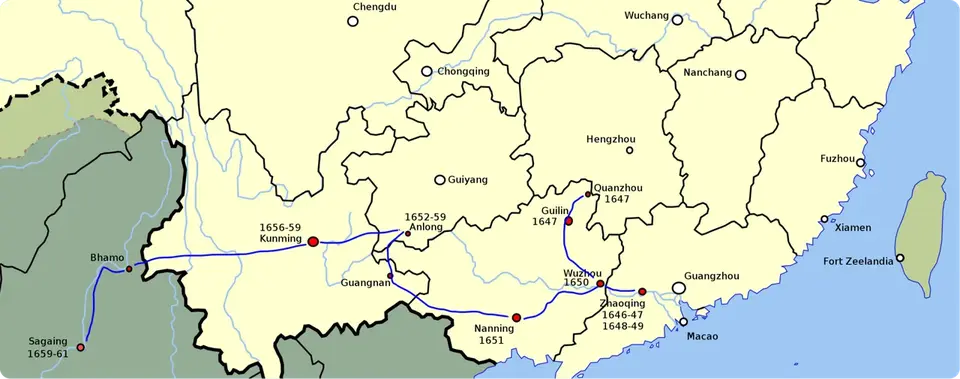
Proclaimed Prince Regent in Zhaoqing in October, enthroned as emperor in November to inaugurate the Yongli era.
Evacuated Zhaoqing ahead of Qing advances, wandering through Wuzhou, Guilin, and Quanzhou under warlord duress.
Qing generals Jin Shenghuan and Li Chengdong defected back to Ming allegiance, restoring southern provinces.
Massive Qing counteroffensive captured Guangzhou and Guilin, leading to the heroic martyrdom of Qu Shisi and Zhang Tongchang.
Relocated to Anlong in Guizhou under the control of Xi warlord Sun Kewang, enduring virtual house arrest.
Sun Kewang suppressed a secret imperial petition, executing eighteen loyal ministers in the Anlong massacre.
General Li Dingguo rescued the emperor from Anlong and escorted the court to Kunming, creating him Prince of Jin.
Fled westward across the border into Burma following the defeat at Battle of Mount Mopan, interned at Zhegeng.
New Burmese monarch Mangbai ambushed and butchered forty-two Ming courtiers, holding the emperor captive.
Handed over to Wu Sangui, strangled with a bowstring in Kunming on June 1, ending the Ming imperial succession.
Zhu Youlang was born on November 1, 1623, in the princely mansion of the Gui lineage in the imperial capital of Beijing. As the fourth son of Zhu Changying, Prince Duan of Gui, and grandson of the Wanli Emperor, he was recognized for his striking physical resemblance to his imperial grandfather, possessing a broad countenance and a mild, reserved temperament. In the autumn of 1627, when he was four years old, his father took up residence at his designated princely fief in Hengzhou, modern Hunan Province. Under the established ancestral statutes of the Ming clan, Zhu Youlang was officially invested as the Prince of Yongming in 1633.
In the eighth lunar month of 1643, peasant insurgent forces commanded by Zhang Xianzhong launched a devastating assault on Hengzhou and captured the city. The elderly Prince of Gui hastily evacuated his household by boat along the Xiang River, but both the heir apparent and second son of the prince were captured and executed by rebel forces. Fleeing southward toward Shiqishi near Yongzhou, the princely family was forced to abandon their river vessels and scatter on foot amid heavy pursuit. While military officer Wang Shangyong mounted a desperate rearguard action allowing Zhu Changying and his third son Zhu Youxuan to reach Quanzhou, Zhu Youlang became separated in the chaos and was captured by rebel troops.
An educated clerk under Zhang Xianzhong named Wu Jisi recognized the princely status of the captive and sought to delay his execution through administrative procrastination. On the evening of August 23, 1643, imperial officer Jiao Lian launched a surprise assault on Yongzhou, broke into the prison compound, and smashed open the wooden cage holding Zhu Youlang. Finding the young prince unable to ride a horse, Jiao Lian personally carried him on his back for over a mile and ferried him across the river to safety in Guilin. Provincial authorities subsequently arranged for the Gui princely household to take up temporary residence in Wuzhou to avoid conflict with the existing princely establishment in Guilin.
Following the fall of Beijing in 1644 and the subsequent accession and demise of the Hongguang regime in Nanjing, Prince Duan of Gui died of grief in late 1644. The succeeding Longwu Emperor in Fuzhou invested Zhu Youxuan as the new Prince of Gui and relocated the family to Zhaoqing, Guangdong. In mid-1646, as Qing armies advanced toward Jiangxi, Zhu Youxuan retreated to Wuzhou, where he suddenly fell critically ill and died after entrusting Zhu Youlang to the guardianship of Grand Secretary Qu Shisi. Shortly thereafter, news arrived of the capture and martyrdom of the Longwu Emperor in Tingzhou, leaving the anti-Qing resistance in southern China without a recognized dynastic leader.
Upon receiving news of the Longwu Emperor's death, civil and military leaders in Guangdong and Guangxi deliberated urgently on the imperial succession. Under the leadership of Guangxi Governor Qu Shisi, officials reached a consensus to elevate Zhu Youlang, as the senior surviving grandson of the Wanli Emperor, to the imperial regency. Empress Dowager Wang initially harbored grave reservations, counseling that her gentle son lacked the ruthlessness required to govern in times of catastrophic upheaval. Nevertheless, yielding to persistent appeals from high ministers, she gave her consent. On October 14, 1646, Zhu Youlang assumed the title of Prince Regent at Zhaoqing, issuing proclamations to loyalist forces across Hunan, Yunnan, Guizhou, and Sichuan.
The newly formed administration immediately faced acute internal tension. High offices were conferred upon former grand coordinator Ding Kuichu as senior grand secretary and former court eunuch Wang Kun as director of ceremonial, drawing severe condemnation from integrity-minded censors who resigned in protest. Simultaneously, Prince of Tang Zhu Yuyue, younger brother of the late Longwu Emperor, fled to Guangzhou and was proclaimed emperor under the era name Shaowu with the backing of Grand Secretary Su Guansheng. The competing regimes engaged in bitter military clashes near Sanshui over ritual precedence, squandering vital resources while Qing armies led by Li Chengdong rapidly descended upon Guangdong.
On November 18, 1646, Zhu Youlang was formally enthroned as emperor at Zhaoqing, declaring that the following year would mark the first year of the Yongli era. In December, Qing vanguard forces executed a daring amphibious strike against Guangzhou, capturing the city and annihilating the Shaowu regime in less than a month. Terrified by the rapid Qing advance, the Yongli court hastily abandoned Zhaoqing and retreated westward along the West River toward Wuzhou and Guilin. By early 1647, the emperor had reached Quanzhou on the northern border of Guangxi, beginning a protracted sequence of perilous retreats across the rugged frontier.
The itinerant court soon fell prey to the ambitions of regional warlord Liu Chengyin, who commanded powerful military garrisons in southern Hunan. Boarding the imperial vessel under the guise of loyalty, Liu Chengyin openly arrested eunuch Wang Kun and seized effective control over the monarch. In April 1647, Liu Chengyin coerced the emperor into relocating the court to Wugang in Hunan, renaming the locality Fengtian Prefecture and confining the imperial household within the former Min princely palace. Zhu Youlang lived under constant surveillance, weeping in secret with his mother over his helplessness while dispatching covert appeals to commander He Tengjiao for rescue.
In August 1647, when Qing forces converged on Wugang, Liu Chengyin secretly negotiated terms of surrender, intending to deliver the emperor as a prize to the enemy. Imperial loyalists and palace guards managed to persuade the warlord's younger brother to open the city gates at night, allowing the imperial family to escape into the rain-soaked wilderness. Loyal officer Xie Furong sacrificed his life alongside five hundred rearguard troops to stall pursuing cavalry, enabling Zhu Youlang to reach Liuhe, where loyal admiral Hou Xing evacuated the exhausted party by river transport to Liuzhou.
During this desperate crisis, Guangdong loyalist leaders Chen Zizhuang, Zhang Jiayu, and Chen Bangyan launched coordinated insurrections that tied down Qing main forces in the Pearl River Delta. In Guangxi, general Jiao Lian won a succession of battlefield victories, recovering Yangshuo, Pingle, and Wuzhou, thereby expelling Qing forces from the province. However, discipline among allied troops remained fragile. In early 1648, mutinous soldiers under Hao Yongzhong plundered Guilin, forcing Zhu Youlang to flee from his sleeping quarters in disguise and escape by bamboo litter to Nanning, enduring acute deprivation and humiliation.
In the spring of 1648, the anti-Qing resistance experienced an extraordinary strategic revival. Former Ming defectors Jin Shenghuan and Wang Deren in Jiangxi renounced their Qing allegiance and raised the imperial banner in Nanchang. Concurrently, Qing commander-in-chief Li Chengdong mutinied in Guangdong and declared his allegiance to the Yongli Emperor. These dramatic defections restored massive territories across Guangdong, Jiangxi, and Hunan to Southern Ming control. Zhu Youlang rewarded the defecting generals with high ducal titles and returned in triumph to Zhaoqing, while Li Chengdong mobilized an army of two hundred thousand troops to advance northward.
Despite these dramatic territorial gains, the court was immediately paralyzed by vicious factional infighting. Factional leaders within the administration divided into the Wu and Chu factions, exchanging vitriolic impeachments over appointments and authority while the military commanders pursued conflicting strategic agendas. Exploiting these internal fractures, the Qing regency dispatched Prince of Yu Jierhalang with imperial banner forces to execute a crushing counteroffensive. In early 1649, He Tengjiao was captured and executed in Xiangtan, while Jin Shenghuan and Wang Deren perished defending Nanchang, and Li Chengdong drowned following a catastrophic defeat at Xinfeng.
By late 1650, Qing armies commanded by defected generals Kong Youde, Shang Kexi, and Geng Jimao launched a three-pronged invasion of the south. Guangzhou fell after a brutal siege, followed shortly by the storming of Guilin in November. Rather than flee, Grand Secretary Qu Shisi and military commissioner Zhang Tongchang donned formal court attire, offered sacrifices to the dynastic ancestors, and chose honorable martyrdom upon their capture. Learning of the disaster, Zhu Youlang abandoned Wuzhou and fled once again toward Nanning, with the surviving elements of his central court in complete disarray.
Facing total collapse in Guangxi, the emperor had no choice but to seek protection from the remnant forces of Zhang Xianzhong's Xi army based in Yunnan and Guizhou. The dominant Xi chieftain, Sun Kewang, had long demanded the title of Prince of Qin, which Senior Grand Secretary Yan Qiheng had consistently rejected as a violation of dynastic precedent. In early 1651, Sun Kewang dispatched general He Jiuyi with five thousand troops to Nanning, where he murdered Yan Qiheng and eighteen other integrity officials by throwing them into the river. Thoroughly intimidated, Zhu Youlang conferred the princely title upon Sun Kewang and was escorted in early 1652 to Anlong in southwestern Guizhou.
At Anlong, Zhu Youlang was subjected to humiliating confinement in a remote mountain outpost. Sun Kewang established an autonomous administration with his own six ministries, cast fraudulent imperial seals, and restricted the court's living expenses to a meager stipend. Local magistrates treated the monarch with open insolence, listing imperial allowances on ledger sheets under the derogatory label of one emperor and several concubines. The emperor was reduced to melting down personal silver artifacts to reward destitute retainers, living in perpetual terror of assassination or forced abdication.
In 1653, Zhu Youlang secretly dispatched a trusted courier bearing an imperial decree written in blood to Li Dingguo, a rival Xi commander who had recently achieved sensational victories by slaying Qing Prince Kong Youde in Guilin and Prince Nikan in Hengzhou. The secret communication was betrayed to Sun Kewang by Grand Secretary Ma Jixiang. In March 1654, Sun Kewang dispatched inquisitors to Anlong who arrested Grand Secretary Wu Zhenyu, compiler Jiang Qianchang, and sixteen other loyalists. Despite brutal torture, the ministers refused to implicate the emperor, with official Zhang Juan openly declaring Sun Kewang a treasonous usurper. All eighteen officials were executed outside Anlong, entering history as the Eighteen Martyrs of Anlong.
Following the Anlong massacre, Sun Kewang planned to usurp the throne directly, but his coronation ceremony was aborted due to bad weather and ill omens. In January 1656, Li Dingguo launched a rapid march from Nanning, bypassed Sun Kewang's border outposts, and entered Anlong amid heavy morning fog. Embracing Li Dingguo with tears of gratitude, Zhu Youlang was escorted out of Guizhou and arrived in Kunming on February 11, 1656. The emperor established his palace in the provincial capital, bestowing the titles of Prince of Jin upon Li Dingguo and Prince of Shu upon Liu Wenxiu, thereby restoring unity between the imperial house and loyalist field armies.
Enraged by the loss of the imperial person, Sun Kewang mobilized a massive army of one hundred and forty thousand troops from Guizhou in August 1657, styling his force at seven hundred thousand, and launched an all-out invasion of Yunnan. Li Dingguo and Liu Wenxiu deployed their forces to meet the challenge at Jiaoshui near Qujing. In the midst of the decisive battle, Sun Kewang's vanguard generals Bai Wenxuan and Ma Bao defected to the imperial cause, causing Sun's entire army to disintegrate in panic. Ruined and abandoned, Sun Kewang fled to Baoqing and surrendered unconditionally to the Qing dynasty, handing over detailed military maps and defense assessments of the southwestern frontier.
Armed with Sun Kewang's intimate intelligence, the Qing court deployed three large armies commanded by Wu Sangui, Zhuobutai, and Prince Doni to conquer Yunnan in 1658. Overwhelmed along the border passes, Ming defensive lines collapsed in late autumn. On December 15, 1658, as enemy columns approached the gates of Kunming, Zhu Youlang led hundreds of thousands of weeping citizens on an agonizing westward exodus toward Yongchang and Tengyue. At Mount Mopan in early 1659, Li Dingguo prepared an elaborate ambush to destroy Wu Sangui's pursuing cavalry, but a defecting secretary betrayed the tactical plans, precipitating a bloody engagement that decimated Ming military reserves.
In January 1659, Zhu Youlang and eighteen hundred exhausted retainers arrived at the Nam Kham river along the Burmese frontier. The King of Toungoo Burma demanded that all Chinese soldiers lay down their arms before crossing the border. Despite passionate objections from Duke Mu Tianbo, Grand Secretary Ma Jixiang forged an imperial rescript ordering total disarmament. Once stripped of weapons, the imperial party was interned in bamboo huts at Zhegeng near Ava, completely surrounded by waterways and guarded by hostile native troops.
During the prolonged internment, Ma Jixiang and his faction indulged in gambling and banqueting, ignoring the desperate plight of the court while sabotaging multiple rescue attempts mounted by Li Dingguo and Bai Wenxuan. In July 1661, a violent palace coup placed Prince Mangbai on the Burmese throne. Eager to curry favor with the encroaching Qing dynasty, Mangbai summoned the Chinese ministers to the Zhegeng pagoda under the pretext of taking an oath of alliance over consecrated water. Upon arrival, Duke Mu Tianbo, Ma Jixiang, and forty-two high officials were ambushed and butchered by Burmese soldiers, leaving the emperor completely unprotected.
Hearing of the massacre, Zhu Youlang attempted suicide by hanging but was forcibly restrained by loyal bodyguard Deng Kai. In December 1661, Wu Sangui advanced into Upper Burma with an army of one hundred thousand troops and demanded the immediate surrender of the Ming sovereign. The terrified Burmese authorities bundled Zhu Youlang and his remaining family onto boats under false pretenses and delivered them in the dead of night to the Qing vanguard camp. When Zhu Youlang inquired of the officer carrying him ashore and learned he served Wu Sangui, he fell into silent tears.
Brought into the Qing command tent, Zhu Youlang maintained imperial dignity throughout the night while curious officers gathered to view the captive monarch. When Wu Sangui entered, initially adopting an arrogant posture, the emperor stared at him fixedly and demanded his name. Paralyzed by ancestral guilt and imperial majesty, Wu Sangui collapsed to his knees and prostrated himself repeatedly in cold sweat. Zhu Youlang sternly reproached him for betraying the dynastic benefactors of his family, asking only to be permitted to return to Beijing to die beside the tombs of the Ming emperors. Unable to reply, Wu Sangui was assisted from the tent in disgrace.
In March 1662, the emperor was transported back to Kunming and confined in the former regional military headquarters. Former Minister of Revenue Gong Yi was granted an audience, where he offered wine in tears before smashing his head against the stone steps in fatal martyrdom. On June 1, 1662 (the fifteenth day of the fourth lunar month), Wu Sangui ordered his subordinates to strangle Zhu Youlang and his teenage heir apparent Zhu Cixuan with bowstrings at the Jinchan Temple on Bicipo in Kunming. The young prince fiercely cursed Wu Sangui as a treacherous rebel before drawing his last breath.
Following the execution, Wu Sangui ordered the bodies cremated and the ashes scattered across the wilderness to erase all physical trace of the dynasty, though local loyalists secretly gathered bone fragments for burial outside the North Gate. Empress Dowager Ma and Empress Wang committed suicide en route to Beijing to preserve their honor. When news of the emperor's martyrdom reached the borderlands, Li Dingguo spat blood in grief and died at Mengla, while surviving retainer Deng Kai shaved his head to become a Buddhist monk. In Taiwan, Zheng Jing proclaimed dynastic mourning and honored Zhu Youlang with the posthumous title of Emperor Kuang and the temple name Zhaozong, officially closing the book on the legitimate line of Ming emperors.
The primary historic accomplishment of Zhu Youlang lay in his role as the paramount rallying symbol for Chinese resistance during the darkest hours of the Manchu conquest. Following the rapid collapse of the Hongguang and Longwu courts, his enthronement at Zhaoqing established an unbroken continuum of Ming imperial legitimacy. For sixteen turbulent years across rugged frontier provinces, the Yongli era title served as the recognized legal and moral standard under which disparate military forces, scholar-gentry, and common citizens united against foreign conquest.
Despite his personal reluctance and gentle demeanor, Zhu Youlang's willingness to maintain the imperial court under extraordinary hardships provided an indispensable constitutional framework for the resistance. His official rescripts and decrees sustained the authority of loyalist commanders, allowing local administrators to mobilize resources, maintain public order, and resist assimilation. By enduring sixteen years of continuous nomadic warfare, he ensured that the Southern Ming cause retained genuine international and domestic legitimacy long after the central plains had fallen.
Zhu Youlang's most significant strategic breakthrough was the complete dismantling of traditional Ming taboos against cooperating with peasant insurgent armies. Encouraged by patriotic statesmen such as Qu Shisi and He Tengjiao, the Yongli court formally recognized and integrated the veteran forces of the former Shun and Xi rebellions into the regular imperial military hierarchy. Leaders such as Li Laiheng, Sun Kewang, and Li Dingguo were granted high noble titles and military commands, transforming former rebels into defenders of the realm.
This historic reconciliation created a formidable united front that brought about the strategic zenith of the Southern Ming resistance. Under the unified command of Prince of Jin Li Dingguo, allied forces launched sweeping counteroffensives across Hunan and Guangxi, culminating in the death of Qing Generalissimo Kong Youde in Guilin and Prince Nikan in Hengzhou. This unprecedented feat of eliminating two premier Qing field commanders in quick succession shook the Qing empire to its foundations and demonstrated the immense potential of united national resistance.
Operating from precarious mountain capitals, the Yongli court initiated one of the most remarkable diplomatic endeavors in early modern Eurasian history. Recognizing the advanced military capabilities of Western Europe, Zhu Youlang welcomed Austrian Jesuit Andreas Xavier Koffler and Polish Jesuit Michel Boym into his inner circle. Following the baptism of Empress Dowager Helena, Empress Anne, and Crown Prince Constantine into the Catholic faith, the emperor authorized Father Boym to embark on a hazardous diplomatic mission to the Holy See and the Republic of Venice in 1650.
Carrying imperial credentials written in Chinese and Latin, Father Boym traversed continents to deliver petitions pleading for spiritual intercession and European military assistance. Although geographical distance prevented the realization of military aid, the letters of the Yongli court and the subsequent papal replies from Pope Alexander VII remain preserved in the Vatican Secret Archives. This historic mission represented an extraordinary effort by an embattled Asian dynasty to engage the global diplomatic community through cross-cultural religious diplomacy.
In addition to transcontinental overtures, the Yongli administration maintained active diplomatic relationships with neighboring Southeast Asian polities. In 1647, Zhu Youlang elevated the ruler of the Later Le Dynasty of Vietnam, Le Duy Huu, to the status of King of Annam, subsequently appointing Trinh Lord Trinh Trang as Vice King of Annam in exchange for annual financial subsidies and tributary missions. Furthermore, the court negotiated mutual defense pacts with the Mac regime in Cao Bang, creating vital corridors of refuge for imperial clansmen.
While these regional alliances ultimately dissolved under the immense weight of subsequent Qing diplomatic and military pressure, they demonstrated the persistent vitality of traditional Chinese tributary diplomacy during dynastic collapse. Even during the final tragic evacuation into Upper Burma, the court attempted to leverage ancient suzerain-vassal conventions to preserve dynastic continuity, underscoring the enduring reach of Ming imperial prestige across the Southeast Asian frontiers.
To sustain hundreds of thousands of combat troops within the resource-scarce mountain regions of Yunnan and Guizhou, the Yongli administration implemented innovative wartime agrarian policies. The central feature was the Yingzhuang military farming system, developed in cooperation with the Xi army leadership. Under this system, abandoned farmland was distributed directly to military battalions, with soldiers and their families cultivating the soil under a fixed tax-sharing formula of sixty percent retained by the cultivators and forty percent allocated for military provisions.
This decentralized system of agricultural self-sufficiency minimized the logistics burden on civilian populations and enabled large field armies to maintain operational readiness without devastating the local agrarian economy. Coupled with emergency revenue measures such as regulated tribute contributions, these pragmatic economic innovations preserved the fiscal viability of the Southern Ming state through years of relentless blockade and military encirclement.
In the late phase of the dynasty centered on Yunnan, salt revenues constituted the primary fiscal lifeline of the imperial treasury. The Yongli court enacted sweeping structural reforms of the salt industry, establishing the official-and-furnace profit-sharing system. Production quotas and profit margins at major salt wells, including the critical Heijing complex, were systematically reorganized to guarantee equitable wages for hereditary salt-boiling households while maximizing state revenue for the war effort.
Under this military-administered framework, annual salt revenues from Heijing quadrupled late Ming figures, reaching ninety-six thousand taels of silver. By balancing rigorous state extraction with guaranteed livelihoods for production workers, the administration maintained stable salt supplies across the southwest while generating the essential hard currency needed to procure gunpowder, iron, and cavalry mounts for the frontier campaigns.
Despite relentless warfare and displacement, Zhu Youlang remained deeply committed to the preservation of Confucian civil governance and imperial educational traditions. In the spring of 1657, the emperor issued formal edicts authorizing the restoration of provincial civil service examinations in Yunnan, appointing veteran scholars Chen Xi and Liu Mingfeng to supervise testing in Sichuan and Yunnan. In the autumn of that year, provincial examinations were successfully conducted in Kunming according to ancient statutory regulations.
Fifty-four candidates were selected as provincial graduates, receiving traditional scholar robes and participating in the celebrated Luming banquets before the imperial court. Following the examinations, the emperor mandated the restoration of local academies, the promotion of community compacts, and the honoring of filial citizens and virtuous widows across the province. This deliberate reaffirmation of civil culture provided immense psychological encouragement to southern intellectuals and demonstrated the enduring moral authority of the dynastic heritage.
The Yongli court distinguished itself through its generous and open-minded reception of European scientific culture and Catholic missionaries. When Jesuit Father Koffler was presented to the monarch in Wuzhou, he presented optical devices, mathematical instruments, and devotional religious paintings, which the emperor received with profound intellectual curiosity. Court ritual was adjusted to exempt foreign scholars from humiliating prostrations, encouraging fruitful dialogues on astronomy, geography, and mechanics.
Although Zhu Youlang refrained from receiving baptism himself to adhere to ancestral ancestral rites, he actively encouraged his household in Christian observances and allowed his infant son to be christened Constantine in the hope that he might emulate the Christian emperors of antiquity. This enlightened cultural accommodation fostered a rare atmosphere of mutual respect between Chinese imperial authority and Western intellectuals, creating a poignant chapter in the history of early modern intercultural exchange.
The stoic personal dignity and tragic martyrdom of Zhu Youlang left an indelible impression upon the collective memory of the Chinese people. As he was conducted across the Jiming Bridge in Kunming following his capture, local citizens wept openly in the streets, memorializing the event by renaming the bridge in his honor. Even elements of the Manchu garrison were reportedly moved by his serene bearing, forming secret conspiracies to attempt his rescue before the plot was uncovered and suppressed.
In the twentieth century, republican authorities led by Yunnan Governor Cai E erected a solemn marble monument at Bicipo in Kunming commemorating the exact location of the emperor's sacrifice. Popular indignation over Wu Sangui's treason permanently rechristened the execution ground as Bicipo, or the Slope of Despair, ensuring that historical opprobrium would attach to the regicide. From the Yongli Tomb in Guizhou to the imperial palace pavilion in Zhaoqing, Zhu Youlang's unwavering refusal to surrender his imperial honor continues to be revered as a supreme symbol of cultural integrity and patriotic perseverance.
FIGURES ASSOCIATED WITH THIS DYNASTY