Birth in Jining
Born into a hereditary military family; raised under severe discipline by his father Qi Jingtong, studying classics and tactics.
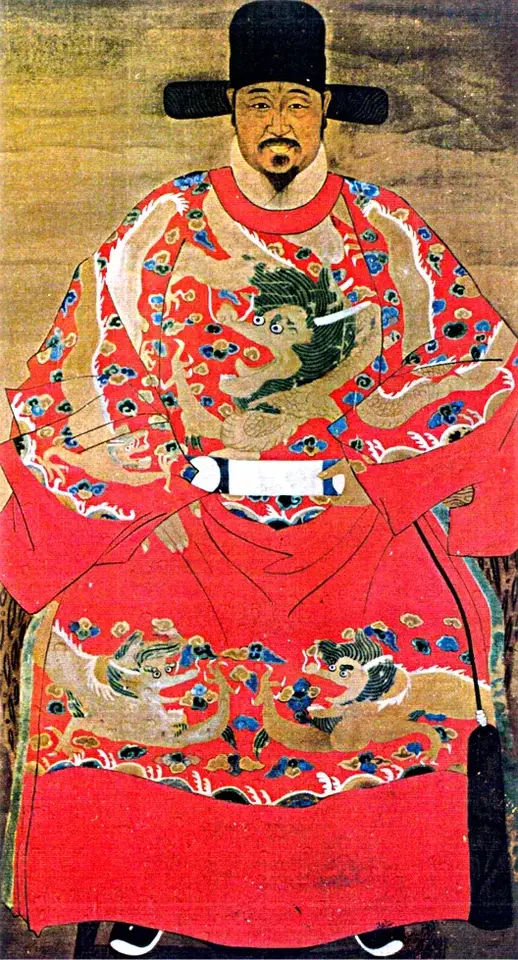
1528 CE–1588 CE
戚继光
Qi Jiguang (戚继光, November 12, 1528 – January 17, 1588), courtesy name Yuanjing and art name Nantang, was a native of Penglai County, Dengzhou Prefecture, Shandong. He was an illustrious military strategist, general, national hero, and defensive theorist of the Ming dynasty, rising to Left Senior Commander-in-Chief and Regional Commander of Jizhou, revered alongside Yu Dayou as "Yu the Dragon and Qi the Tiger." Inheriting…
Qi Jiguang (戚继光, November 12, 1528 – January 17, 1588), courtesy name Yuanjing and art name Nantang, was a native of Penglai County, Dengzhou Prefecture, Shandong. He was an illustrious military strategist, general, national hero, and defensive theorist of the Ming dynasty, rising to Left Senior Commander-in-Chief and Regional Commander of Jizhou, revered alongside Yu Dayou as "Yu the Dragon and Qi the Tiger." Inheriting command at Dengzhou, Qi was transferred to Zhejiang to repel Japanese pirates. He recruited miners from Yiwu to forge the legendary "Qi's Army," invented the Mandarin Duck Formation, and standardized firearms. In 1561, he won nine consecutive victories at Taizhou, before sweeping pirate bases across Fujian and Guangdong, permanently pacifying southeastern waters. Under Grand Secretary Zhang Juzheng, Qi commanded the Jizhou frontier for sixteen years, constructing 1,017 hollow watchtowers along the Great Wall and drilling combined chariot-infantry divisions to secure northern borders. His treatises New Treatise on Military Efficiency and Practical Records of Military Training established lasting foundations for Chinese military science.
Born into a hereditary military family; raised under severe discipline by his father Qi Jingtong, studying classics and tactics.
Following his father's passing, inherited the rank of assistant commander of Dengzhou Guard at seventeen, drilling garrison troops.
Promoted to assistant regional military commissioner; penned his celebrated verse "Fame and nobility are not my desire; I wish only that the sea waves be calmed."
Recruited four thousand miners and farmers in Yiwu; instituted strict discipline and invented the tactical Mandarin Duck Formation.
Achieved nine consecutive victories against Wokou hordes at Taizhou, annihilating thousands of invaders with minimal casualties.
Marched into Fujian; commanded soldiers carrying bundles of straw to traverse muddy flats, storming the island citadel of Hengyu.
Coordinated with Yu Dayou to assault Nan'ao Island, crushing pirate chieftains and clearing southeastern maritime borders.
Promoted by Emperor Longqing and Viceroy Tan Lun to direct training across Jizhou, Changping, and Baoding.
Backed by Grand Secretary Zhang Juzheng, renovated the Great Wall, constructing 1,017 multi-tiered hollow watchtowers.
Ambushed invading Doyan Mongols at Dongjiakou, capturing chieftain Changtu and forcing supreme leader Dong Huli to submit.
Following Zhang Juzheng's death, censors impeached Qi as a partisan; reassigned to Guangdong and forced into retirement.
Died in poverty and sickness on January 17 at his Penglai residence at age sixty; posthumously honored as Wuyi in 1602.
Qi Jiguang was born on November 12, 1528, in Jining, Shandong. His ancestral seat was Penglai in Dengzhou Prefecture. His family was an eminent founding martial house of the Ming dynasty; in 1381, his ancestor Qi Xiang had fallen in battle in Yunnan while serving under Zhu Yuanzhang, earning for his heirs hereditary succession as assistant commanders of Dengzhou Guard (rank 4a).
His father Qi Jingtong was an upright, incorruptible officer who served as commander of Dasong Guard and assistant regional commissioner. Experienced in statecraft and Confucian philosophy, Qi Jingtong disciplined his son severely. Once, observing young Jiguang wearing ornate silk shoes, the father shredded the shoes on the spot, reprimanding him: "Born into a martial family, if you indulge in finery in youth, you will grow up cowardly and crave luxury; how could you then defend the realm!" Henceforth, Jiguang embraced Spartan frugality, studying classical philosophy alongside Sun Tzu's military treatises.
In 1544, upon his father's death, seventeen-year-old Qi Jiguang inherited the post of assistant commander of Dengzhou Guard. Drilling his garrison in archery and maneuvers, he curbed absenteeism and restored order. In 1553, twenty-six-year-old Qi was elevated to acting assistant commissioner, charged with coastal defense across Dengzhou, Laizhou, and Qingzhou. Gazing upon the turbulent waters from the Dengzhou watchtowers, he penned his famous seven-character regulated verse:
"Fame and nobility are not my desire; I wish only that the sea waves be calmed!"
In the autumn of 1555, coastal piracy erupted with unprecedented ferocity across Jiangnan. Japanese corsairs (Wokou) joined forces with Chinese maritime renegades like Xu Hai and Wang Zhi, plundering Zhejiang and Jiangsu. The traditional Ming hereditary garrisons were demoralized and corrupt, fleeing at the first sight of flashing Japanese broadswords. In 1555, Qi was transferred to Zhejiang, soon rising to Assistant Regional Commander of Ning-Shao-Tai.
In skirmishes at Cen Port and Longshan in 1558, Qi watched in fury as thousands of imperial soldiers scattered before small bands of marauders. He realized that traditional garrison troops were useless, and that a professional army composed of disciplined, uncorrupted recruits had to be forged from scratch.
In the autumn of 1559, Qi traveled to Yiwu County in Jinhua Prefecture. The local miners and farmers were renowned for unbending toughness, having waged bloody collective battles over mine claims without retreat. Recognizing that their rustic honesty and stubborn physical endurance offered raw material for a formidable military force, Qi enlisted four thousand volunteers with the support of Viceroy Hu Zongxian.
When enlisting recruits in Yiwu, Qi established strict criteria for selecting soldier material. Personally inspecting thousands of candidates in the village squares, he summarily rejected urban drifters, smooth-tongued townspeople, and former yamen bailiffs, knowing that cunning men panicked under fire. Instead, he selected rugged miners and agrarian peasants marked by weather-beaten faces, calloused hands, and solemn eyes. Qi understood that while unlettered, these rustic men held unyielding loyalty to clan oaths; once welded together through rigorous discipline, they would die rather than retreat.
In Jinhua, Qi established a training camp, promulgating the ironclad discipline of his Rules of the Five-Man Squad: if an individual soldier retreated, his entire squad was executed; if the squad leader fled, the platoon commander was decapitated; looting civilian crops was punished with death. He established transparent rewards: thirty taels of silver for each verified enemy head, while promotions were granted solely on combat merit rather than family connections. Solider stipends were paid directly in full every month, abolishing embezzlement and firing morale. Recognizing that the Wokou possessed deadly skill with long samurai swords in single combat, Qi discarded traditional one-on-one melee tactics, inventing the twelve-man "Mandarin Duck Formation."
The formation consisted of one squad leader, two shield-bearers carrying rattan shields and throwing javelins for defensive cover, two operators carrying the Langxian (massive bamboo branches fitted with barbed, poison-tipped iron blades to entangle enemy blades), four spear-bearers with eighteen-foot pikes to impale the entangled foe, two trident-and-firearm specialists protecting the flanks, and one logistical cook. This tactical system neutralized individual Japanese swordsmanship through coordinated squad mechanics, transforming the recruits into the celebrated "Qi's Army."
In April 1561, thousands of veteran Japanese raiders under pirate captain Xin Wulang launched a coordinated assault against Taizhou Prefecture (modern Linhai, Zhejiang), threatening coastal strongholds at Xinhe and Taohu.
Qi Jiguang responded with lightning mobility. When enemy detachments besieged Xinhe, the walled town held only civilian households and Qi's family. Qi's wife, Lady Wang, exhibited heroic courage, distributing armor to women and citizens to mount the parapets while beating war drums. Deceived into believing the fortress was heavily defended, the invaders hesitated.
Qi's Army marched hundreds of miles through the night, falling upon the besiegers like a thunderbolt. Deploying the Mandarin Duck Formation with muskets and pikes, the soldiers smashed the enemy lines, slaying hundreds and breaking the siege.
Following the relief of Xinhe, the main pirate army assaulted Huajie along narrow causeways bordered by dense bamboo groves and wet paddy fields. The pirate vanguard formed an aggressive wedge, shouting battle cries with raised blades. Ascending a vantage point, Qi commanded musketeers to advance in three rolling ranks, holding fire until the charging raiders reached within thirty paces. A thunderous volley tore through the enemy ranks. Immediately, squads deployed their barbed Langxian barriers to pin the enemy's blades, enabling pikemen to thrust through the foliage. The pirate formation broke into wild panic, pursued across the marshes of Baishuiyang until completely annihilated.
Immediately, Qi marched to Huajie, crushing the Wokou vanguard, before executing a rapid night march to Baishuiyang to annihilate escaping detachments. Over a single month, Qi fought nine pitched battles—at Xinhe, Huajie, Baishuiyang, Datian, Changsha, and Taozhu—achieving nine consecutive total victories (Taizhou Jiuzhan Jiujie). Over three thousand invaders were slain, thousands captured or drowned, and over twenty thousand captive civilians rescued, while Qi's Army suffered only a few dozen casualties. The Battle of Taizhou shattered Wokou supremacy in Zhejiang.
Defeated in Zhejiang, surviving Wokou bands fled south into Fujian, capturing county seats across Funing and Xinghua. In the autumn of 1562, Viceroy Hu Zongxian dispatched Qi Jiguang with six thousand veterans to liberate the province.
The main pirate lair lay upon Hengyu Island off Ningde. Encircled by deep coastal mudflats flooded by tides, the island was inaccessible to warships and unnavigable for heavy infantry. For years, the pirates had operated unmolested behind stone bastions.
Surveying the terrain, Qi ordered each soldier to carry a bundle of dry straw. Advancing during low tide, the troops threw the straw across the muddy shallows, sprinting across the mudflats. In a three-hour daylight assault supported by mortar fire, Qi's Army stormed the citadel, slaying over one thousand pirates and razing the stronghold to ashes.
Continuing southward, Qi advanced toward Niutian, the largest pirate citadel in Fujian, fortified by dozens of redoubts against coastal hills. Qi executed a daring night assault: while feigning a daylight frontal advance, he dispatched two thousand shock troops to scale sheer mountain precipices in a torrential downpour, rappelling into the rear of the enemy encampments with muffled weapons. Setting fire to granaries and firing mortars simultaneously, the attackers sowed total panic, while Qi's main columns breached the front stockades, leveling the stronghold.
At the subsequent Battle of Lindun, confronting fortified earthworks surrounded by waist-deep stagnant swamps, Qi's soldiers stripped off armor and waded through deep mud under heavy crossbow fire. Commander Lin Dian led the assault, severing the drawbridge ropes despite multiple arrow wounds. Storming into the compound, Qi's Army fought hand-to-hand until all two thousand defenders were eliminated, liberating thousands of captured coastal inhabitants. Promoted to Regional Commander of Fujian in 1563, Qi joined forces with veteran general Yu Dayou and Viceroy Tan Lun to recapture Xinghua Prefecture, slaughtering over two thousand pirates. In 1565, Qi led amphibious assaults against pirate warlord Wu Ping on Nan'ao Island off Guangdong, pursuing the remnants into the sea. The coastal piracy that had afflicted southeastern China for decades was permanently extinguished.
In 1568, with maritime borders secure, the Ming court shifted strategic focus to northern frontiers, where Mongol cavalry repeatedly breached the Great Wall to threaten Beijing. Minister of War Tan Lun recommended Qi Jiguang: "Qi Jiguang possesses brilliant strategic intellect and masterly training methods; placing him at Jizhou will secure the peace of the capital for generations!"
Appointed Regional Commander of Jizhou, Qi took charge of two thousand li of mountainous Great Wall defenses from Shanhaiguan to Juyongguan. Backed by Senior Grand Secretary Zhang Juzheng, Qi revolutionized frontier architecture by constructing 1,017 multi-tiered "hollow watchtowers."
Towering three to five stories, these stone towers were hollow within, housing thirty to fifty garrison troops, storage granaries, and cisterns. The middle levels featured embrasures for heavy cannons and firearms, while upper parapets provided observation perches. Spaced within mutual musket range, the watchtowers transformed the Great Wall from a passive masonry obstacle into an active, interlocking defensive fortress system.
Concurrently, to counter nomadic cavalry mobility, Qi invented the "Chariot Battalion" (Cheying). Each battalion integrated 128 tactical wagons equipped with defensive timber mantlets and gun-ports. In battle, the wagons formed defensive perimeter enclosures sheltering musketeers, heavy artillery, and armored cavalry. When enemy cavalry charged, Ming artillery and musketry decimated their ranks, before wagon gates swung open to unleash armored cavalry counter-charges.
In the winter of 1575, Doyan Mongol chieftains Dong Huli and Chang'ang raided Dongjiakou with thousands of horsemen. Qi deployed artillery and cavalry ambushes in blinding snowstorms, routing the nomads and capturing Dong Huli's nephew Changtu alive. Terrified by the impenetrable defenses, Dong Huli led his entire tribe to prostrate before Qi's mount, weeping and swearing eternal allegiance. During his Jizhou tenure, Qi executed massive tactical field exercises along the Great Wall. In one historic review, one hundred thousand soldiers assembled across the muddy parade grounds under blinding rain and gale-force winds. Standing motionless in full battle array from dawn until dusk without breaking formation, the army demonstrated such iron discipline that inspecting imperial ministers gasped in awe.
In 1579, when tens of thousands of Chahar Mongol horsemen invaded Liaodong and threatened General Li Chengliang's positions, Qi mobilized Jizhou chariot and cavalry columns, riding hundreds of miles across mountain passes to reinforce Liaodong. Forming impenetrable wagon barriers across the open plains, Qi's artillery smashed the nomadic charges in coordination with Li's flanking cavalry, driving the invaders far beyond the northern borders and ensuring peace across the marches for sixteen years.
In firearms engineering, Qi exhibited extraordinary technical genius. To overcome the excessive weight of traditional cannons on mountainous terrain, he designed the famous "Crouching Tiger Mortar" (Hudun Pao). Weighing thirty pounds and fitted with two iron claw-legs anchored into the earth to absorb recoil, this light mortar could be carried over mountain ridges by infantrymen, firing hundreds of lead pellets in a lethal shotgun spread against cavalry. Moreover, he standardized musket specifications and added weather-resistant flash-pan covers, ensuring reliable firing in humid coastal conditions. By harmonizing firearms with defensive architecture, Qi pioneered a modern combined-arms doctrine in the early modern world.
In June 1582, Senior Grand Secretary Zhang Juzheng passed away. The ascension of Emperor Wanli to personal rule ushered in political retribution against Zhang's associates. Hostile censors impeached Qi as a partisan of the late chancellor, transferring him to Guangdong before forcing his dismissal in 1585.
Stripped of emoluments, Qi returned to his modest ancestral cottage in Penglai. Having distributed his salary to soldiers and arsenals, he possessed no private savings. Afflicted by tuberculosis and near blindness, he spent his twilight years editing his military classics, New Treatise on Military Efficiency and Practical Records of Military Training, alongside his poetry collection Zhizhitang Collection. On January 17, 1588, the titan passed away in poverty in Penglai at the age of sixty.
His surviving officers financed his burial in the family cemetery at Bainigou. In 1602, Emperor Wanli rehabilitated his memory, conferring the posthumous title Wuyi and Junior Protector. Across centuries, Qi Jiguang's memory endures as an unyielding pillar of Chinese national defense and tactical genius.
In 1559, Qi raised four thousand recruits from Yiwu, creating the fabled "Qi's Army." Enforcing ironclad discipline and group accountability, he eliminated garrison cowardice.
Over sixteen years of active coastal warfare, Qi's Army maintained near-flawless tactical records, setting a historical standard for professional military discipline in East Asia.
Qi's training regimen encompassed deep psychological conditioning alongside physical and weapon drills. He drilled soldiers relentlessly in battlefield signals: halting upon gongs, advancing upon drums, and maneuvering according to banners, decreeing death for anyone breaking formation without signal. He argued that victory in combat depended on transparent command communication. Furthermore, he instituted mutual battlefield responsibility: if a soldier fell and his squad retreated without recovering his body, the survivors were punished; conversely, those who fought to recover fallen comrades were rewarded with silver. This integration of clan honor and collective discipline forged Qi's Army into an unbreakable fighting instrument.
Qi invented the twelve-man Mandarin Duck Formation to counter single-combat Japanese swordsmanship.
By coordinating defensive shields, barbed bamboo Langxian, eighteen-foot thrusting pikes, and flanking firearms, he demonstrated that collective synchronization overcomes individual martial prowess, establishing a landmark in infantry small-unit tactics.
Even more ingenious was that Qi's Mandarin Duck Formation was never a rigid, static formation, but rather a dynamic tactical unit capable of fluidly transforming into the "Three Powers Formation" or "Two-Squad Arrays." When operating along narrow dikes, dense canals, or cramped village alleys across southern China, the twelve-man squad rapidly bisected into two self-sufficient five-man combat cells flanking the commander. Each cell paired one shield-bearer and one Langxian operator with two pikemen and one trident-bearer. This flexibility allowed the units to absorb heavy frontal assaults as an unbroken line, or split into independent flanking squads to encircle retreating enemies, making Qi's Army invincible across mountain ravines, marshlands, and street combat.
In the 1561 Battle of Taizhou, Qi achieved nine consecutive victories against overwhelming pirate forces, shattering Wokou dominance in Zhejiang.
His subsequent victories at Hengyu, Niutian, Lindun, and Nan'ao Island eradicated maritime piracy, restoring agricultural and commercial stability across southern China.
Commanding Jizhou for sixteen years, Qi constructed 1,017 hollow watchtowers along the Great Wall.
Combining garrison quarters, arsenals, and multi-directional artillery embrasures, his architectural innovations modernized Great Wall defenses into an impenetrable bastion against nomadic horsemen.
Synthesizing decades of operational command, Qi authored the military classics New Treatise on Military Efficiency and Practical Records of Military Training.
Covering recruitment, firearms drills, combined-arms tactics, camp fortifications, and military psychology, his writings served as the tactical foundation for Ming and Qing armies while influencing military development across Japan and Korea.
During the Imjin War (Wanli War in Korea), when Joseon armies were initially routed by Toyotomi Hideyoshi's Japanese invasion force, King Seonjo embraced Qi Jiguang's New Treatise on Military Efficiency as a sacred manual of dynastic salvation on the advice of Ming relief generals. Prime Minister Ryu Seong-ryong published the treatise across the Korean peninsula, reorganizing Joseon forces into the "Military Training Command" composed of three coordinated arms: musket artillerymen, archers, and close-combat pikemen trained in the Mandarin Duck Formation. This tactical adoption turned the tide of ground defense against Japanese invaders, demonstrating that Qi Jiguang's military science served as a shared bulwark of tactical modernization across East Asia.
| Relationship Type | Name | Historical Intersection and Factual Context |
|---|---|---|
| Comrade in Arms | Yu Dayou | Veteran anti-Wokou commander; celebrated alongside Qi as "Yu the Dragon and Qi the Tiger"; coordinated assaults on Nan'ao. |
| Provincial Patron | Hu Zongxian | Viceroy of Zhejiang and Fujian; recognized Qi's talents and granted full support to recruit the Yiwu volunteers. |
| Military Mentor | Tan Lun | Minister of War and Viceroy of Jiliao; partnered with Qi in coastal and northern frontier defense, recommending his Jizhou post. |
| Supreme Chancellor Patron | Zhang Juzheng | Senior Grand Secretary; served as Qi's indispensable political patron for sixteen years, granting full command autonomy. |
| Frontier Peer | Li Chengliang | Commander of Liaodong; coordinated northern defenses alongside Qi, establishing mutual support across the Great Wall. |
| Hereditary Heir | Qi Zuoguo | Eldest son; inherited the hereditary rank of assistant commander of Dengzhou Guard, continuing family service. |
| Pirate Chieftain | Xin Wulang | Japanese pirate warlord; commanded forces at Taizhou and was utterly routed during the Baishuiyang engagement. |
| Subdued Nomadic Chieftain | Dong Huli | Chieftain of Doyan Mongols; led horsemen against the Great Wall, submitting after Qi captured his nephew Changtu. |
FIGURES ASSOCIATED WITH THIS DYNASTY