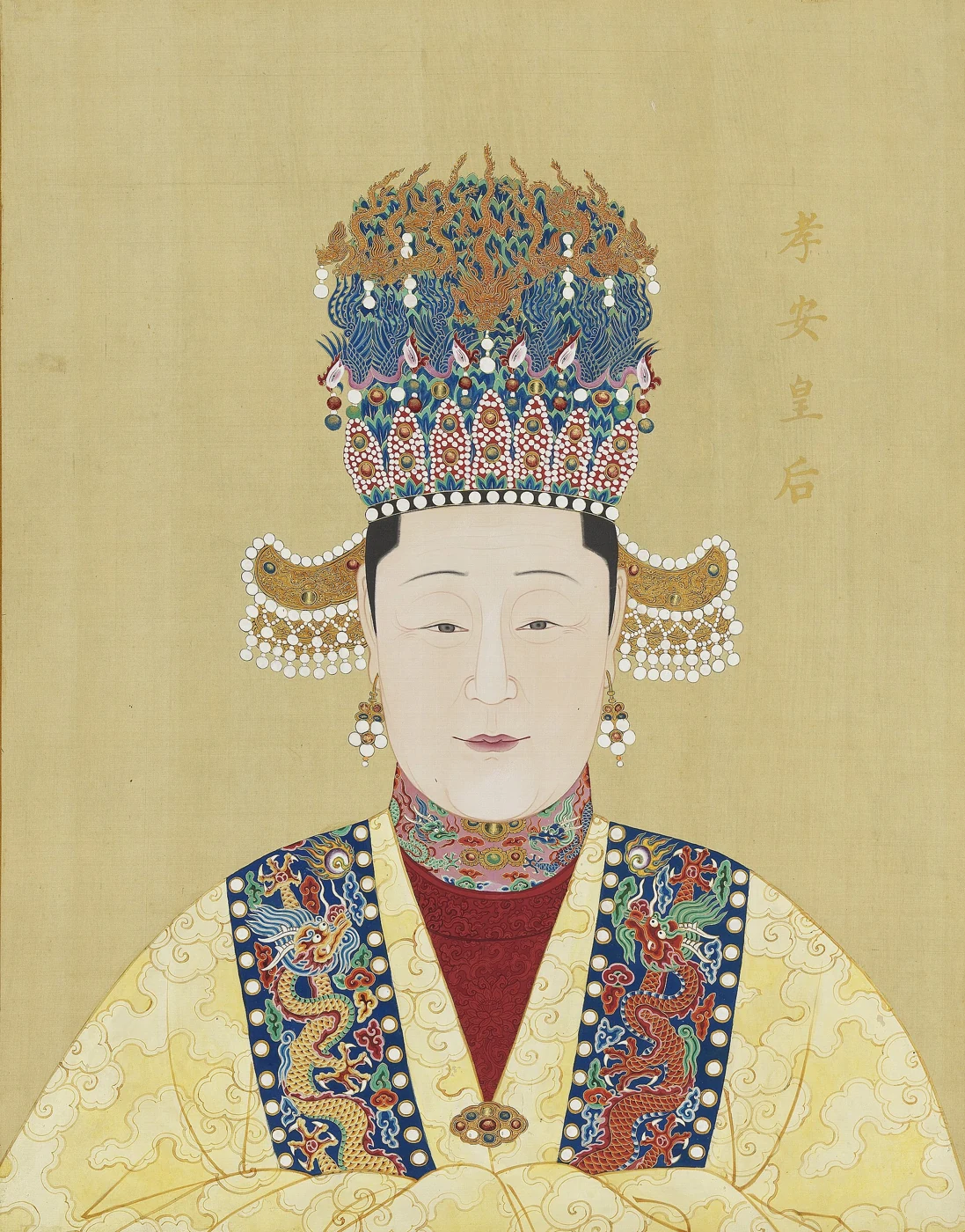
Later artistic depiction of Empress Chen (Longqing) in a historical painting or book illustration.

?–1596 CE

Empressempress dowager

Empress Chen (Longqing Emperor)

陈氏(明穆宗皇后)

Empress Chen (date of birth unknown – 6 August 1596), known posthumously as Empress Xiaoan and identified in the Chinese source by the personal name Chen Shou, was a native of Tongzhou in Shuntian Prefecture, Northern Zhili, in present-day Beijing. She was the second principal wife of Zhu Zaiji, the future Longqing Emperor, and the daughter of Chen Jingxing, a deputy battalion commander in the Embroidered Uniform Guard. In…

?–1596 CEMing Dynasty

PROFILE

Empress Chen (date of birth unknown – 6 August 1596), known posthumously as Empress Xiaoan and identified in the Chinese source by the personal name Chen Shou, was a native of Tongzhou in Shuntian Prefecture, Northern Zhili, in present-day Beijing. She was the second principal wife of Zhu Zaiji, the future Longqing Emperor, and the daughter of Chen Jingxing, a deputy battalion commander in the Embroidered Uniform Guard. In 1558, the thirty-seventh year of the Jiajing era, she was selected as the successor consort of the Prince of Yu. In 1567, the first year of the Longqing era, she was installed as empress. After Zhu Yijun, the Wanli Emperor, ascended the throne, she was honored as Empress Dowager Rensheng. She died in 1596, the twenty-fourth year of the Wanli era, and received the full posthumous title Empress Xiaoan Zhenyi Gongchun Wenhui Zuotian Hongsheng. Empress Chen had no surviving son. Although she lost the Longqing Emperor's favor after remonstrating with him and was moved to a separate palace, she was remembered for calmness and kindness. She maintained a harmonious relationship with Empress Dowager Li, the Wanli Emperor's biological mother, and supported the reforms associated with Zhang Juzheng, giving her a distinctive position in the history of the Ming inner court.

Courtesy / Art Name
Empress Chen of Longqing; Empress Xiao'an of the Chen clan; Empress Xiao'an; Empress Dowager Rensheng
Era
Ming
Dynasty
Ming
Identity
Empress; empress dowager
Date of Birth
Not recorded in historical sources
Date of Death
August 6, 1596 CE(24th year of the Wanli era, 7th month, 13th day)
Ethnicity
Not reliably confirmed in available sources
Ancestral Home
Tongzhou, Shuntian Prefecture, Northern Zhili (present-day Tongzhou District, Beijing)
Place of Birth
Unknown
Place of Death
Unknown
Lifespan
Unknown
Major Offices
See the Biography section
Peerage
her father was Count of Gu'an
Posthumous Name
Empress Xiao'an
Major Achievements
Empress of Emperor Muzong, of quiet and upright character; after Muzong removed her to the cold palace she was given the posthumous title Empress Xiao'an Zhen.
LIFE TIMELINE

CE – 1560 CE(36th year of the Jiajing era – 39th year of the Jiaj

1557 CE – 1560 CE(36th year of the Jiajing era – 39th year of the Jiajing era) | Died | ; received the full posthumous title Empress Xiaoan Zhenyi Gongchun Wenhui Zuotian Hongsheng and was enshrined in a separate chamber of Fengxian Hall

Event | The Prince of Yu's principal consort Lady Li died; Lady Chen was selected as his successor consort
Event | Gave birth to Princess Taihe; the princess died in 1560
Empress and Loss of Favor In 1567 | ### Empress and Loss of Favor In 1567, the first year of the Longqing era, Lady Chen was installed as empress.
CE – 1572 CE(1st year of the Longqing era – 6th year of the Longq

1567 CE – 1572 CE(1st year of the Longqing era – 6th year of the Longqing era) | ### Empress and Loss of Favor In 1567 | ### Empress and Loss of Favor In 1567, the first year of the Longqing era, Lady Chen was installed as empress.

Event | Zhu Zaiji ascended the throne; Lady Chen was installed as empress; her father Chen Jingxing was enfeoffed as Earl of Gu'an
Event | After remonstrating with the emperor over his indulgence, she angered him, was moved to a separate palace, and suffered prolonged illness
Empress Dowager and Later Years In the fifth lunar month of 1572 | ### Empress Dowager and Later Years In the fifth lunar month of 1572, the sixth year of the Longqing era, the Longqing Emperor died.
Event | Zhu Yijun ascended the throne as the Wanli Emperor; his principal mother Empress Chen was honored as Empress Dowager Rensheng and resided in Ciqing Palace
In 1578 her title was enlarged to Empress Dowager Rensheng Zhenyi | In 1578 her title was enlarged to Empress Dowager Rensheng Zhenyi, and in 1582 to Empress Dowager Rensheng Zhenyi Kangjing.
Event | Her title was enlarged to Empress Dowager Rensheng Zhenyi
In 1578 her title was enlarged to Empress Dowager Rensheng Zhenyi | In 1578 her title was enlarged to Empress Dowager Rensheng Zhenyi, and in 1582 to Empress Dowager Rensheng Zhenyi Kangjing.
Event | Her title was enlarged to Empress Dowager Rensheng Zhenyi Kangjing
On 6 August 1596 | On 6 August 1596, the thirteenth day of the seventh lunar month of the twenty-fourth Wanli year, Empress Dowager Chen died.

BIOGRAPHY

Biography

Family Background and Early Years Lady Chen was born in Tongzhou, Shuntian Prefecture, Northern Zhili. Historical records cited in the Chinese source do not give her year of birth. Her father Chen Jingxing was then a deputy battalion commander in the Embroidered Uniform Guard and was later enfeoffed as Earl of Gu'an because of his daughter's status. Chen Jingxing was described as respectful and cautious. Before participating in sacrificial missions or investiture ceremonies he would observe purification, and at home he instructed his sons to behave humbly and yield to others. The source presents this family discipline as an important influence on Lady Chen's character. Her elder brothers included Chen Changyan, Chen Jiayan, and Chen Shanyan. In September 1558, the thirty-seventh year of the Jiajing era, Lady Li, the original principal consort of Zhu Zaiji, Prince of Yu, died. Lady Chen was selected to become the prince's successor consort. At the time Zhu Zaiji occupied a difficult position. His father, Zhu Houcong, the Jiajing Emperor, was deeply committed to Daoist practices and alchemy and, under the influence of the belief that “two dragons should not meet,” long delayed naming a crown prince and treated the Prince of Yu coolly. Yan Song dominated the court, and the prince lived in an atmosphere of constant uncertainty. Lady Chen entered the Prince of Yu's household under these circumstances and accompanied Zhu Zaiji through the following eight difficult years. ### Years in the Prince of Yu's Residence When Lady Chen entered the household, a palace woman surnamed Li, later Empress Dowager Xiaoding, was already present. Lady Li had originally served Lady Chen and later became favored by the Prince of Yu. In 1563, the forty-second year of the Jiajing era, she gave birth to Zhu Yijun, the future Wanli Emperor. Although Lady Chen was the principal successor consort, the source states that she did not become jealous after Lady Li bore a son and instead maintained a harmonious relationship with her. This relationship later helped secure Lady Chen's position within the palace. Between the thirty-sixth and thirty-ninth years of the Jiajing era, 1557–1560, Lady Chen is said to have given birth to Princess Taihe, who died in 1560. She had no further children. In the twelfth lunar month of 1566, the forty-fifth year of the Jiajing era, the Jiajing Emperor died. Zhu Zaiji succeeded him and adopted the Longqing era name the following year. ### Empress and Loss of Favor In 1567, the first year of the Longqing era, Lady Chen was installed as empress. After years of pressure before his accession, Zhu Zaiji, once emperor, became increasingly indulgent in sensual pleasures and maintained many consorts. Although the source describes Empress Chen as beautiful, she lacked imperial favor and had no son. Concerned for the emperor's health and the stability of the state, she remonstrated gently, telling him that the throne had not been easily obtained, that he bore the ancestral trust, and that he should act cautiously and take care of his health. The emperor reacted angrily. He replied that under ancestral law, although an empress served as mother of the realm, women of the palace were not to interfere in political affairs, and told her not to comment on his conduct. Using this as a pretext, he moved Empress Chen to another palace, creating the appearance that she might be cast aside altogether. The source states that she became ashamed and distressed at being punished for loyal remonstrance, fell ill, and was confined to bed. ### Years in a Separate Palace and the Wanli Emperor's Filial Attention After Empress Chen was moved away from the central palace, officials submitted repeated memorials asking the Longqing Emperor to restore her. In an imperial note responding to Zhan Yangbi, the emperor wrote that the empress was childless and frequently ill and had been moved so that she could live more comfortably and recover, rebuking the official for speaking about inner-palace affairs. He made a similar reply to Wang Zhiyuan, stating that she had served him for a long time, was childless and sick, and had been moved for her own comfort. Wang memorialized again, arguing that she had been selected for the emperor by the previous sovereign and possessed the virtues celebrated in the “Guanju” and “Jiumu” traditions; he asked how separation of husband and wife could possibly improve her spirits. The emperor then said that once her health improved somewhat, she would be allowed to return to the main palace. In practice, however, she was never restored there. Although she had lost the emperor's favor, Empress Chen was respected by Crown Prince Zhu Yijun. Every morning, after visiting Fengxian Hall and paying respects to his father and his biological mother, Noble Consort Li, Zhu Yijun would go to the side palace to greet his principal mother, Empress Chen. The source says that hearing the prince's footsteps made her extremely happy and that she would often force herself to rise from her sickbed to meet him. Noble Consort Li was likewise pleased to hear that the empress was happy. ### Empress Dowager and Later Years In the fifth lunar month of 1572, the sixth year of the Longqing era, the Longqing Emperor died. Zhu Yijun, then ten years old, succeeded as the Wanli Emperor. He honored his principal mother Empress Chen as Empress Dowager Rensheng, who resided at Ciqing Palace, and his biological mother Lady Li as Empress Dowager Cisheng, who resided at Qianqing Palace. In 1578 her title was enlarged to Empress Dowager Rensheng Zhenyi, and in 1582 to Empress Dowager Rensheng Zhenyi Kangjing. The Wanli Emperor was described as equally filial toward both empress dowagers. Because he was still young, the source states that Empress Dowager Chen and Empress Dowager Li jointly presided over court affairs and supported the appointment of Zhang Juzheng as senior grand secretary to implement reforms. Empress Dowager Chen, though living at Ciqing Palace and not directly intervening in day-to-day government, supported Zhang's program. The source links the early Wanli improvement in fiscal balances and frontier administration to these reforms and states that Empress Dowager Chen's support was an important condition for their success. On 6 August 1596, the thirteenth day of the seventh lunar month of the twenty-fourth Wanli year, Empress Dowager Chen died. She received the full posthumous title Empress Xiaoan Zhenyi Gongchun Wenhui Zuotian Hongsheng and was enshrined in a separate chamber of Fengxian Hall.

Major Activities

Remonstrating with the Longqing Emperor After the Longqing Emperor ascended the throne in 1567, he indulged increasingly in sensual pleasures. Empress Chen, placing the ruler's health and the state first, urged him gently to take care of himself and conduct himself cautiously. Rather than accepting the advice, the emperor invoked the principle that women of the palace should not participate in government and moved her to a separate palace. She became ill from grief and anger. The episode attracted broad attention at court, and officials including Zhan Yangbi and Wang Zhiyuan memorialized in her defense. ### Caring for the Wanli Emperor Although Empress Chen had no son of her own, the source states that she treated Crown Prince Zhu Yijun as if he were her own child. Each morning, after the prince visited Fengxian Hall and paid respects to his father and biological mother, he would visit Empress Chen. Hearing his footsteps delighted her, and even while ill she would force herself to rise and meet him. The relationship helped establish a foundation for harmony between the two empress dowagers after Zhu Yijun's accession. ### Support for Zhang Juzheng's Reforms After the Wanli Emperor came to the throne, Empress Dowager Chen and Empress Dowager Li jointly supervised the inner court and supported Zhang Juzheng as senior grand secretary. Empress Dowager Chen did not directly manage political affairs, but the source credits her support with helping his reform program proceed. Early in the Wanli reign, fiscal deficits were reversed and frontier conditions improved, developments closely associated in the source with the reform period. ### Harmony between the Two Empress Dowagers Empress Chen is described as having treated Lady Li as an equal rather than resenting her for bearing the crown prince. Lady Li in turn showed great respect toward Empress Chen. Their harmonious relationship was unusual in the Ming inner court and, according to the source, provided an important domestic foundation for stability under the Wanli Emperor. ### Family Instruction Lady Chen's father Chen Jingxing was enfeoffed as Earl of Gu'an because of his daughter's status but continued to behave with caution and restraint. He fasted and purified himself before major ritual assignments and instructed his sons at home to be humble and yielding. The source connects Empress Chen's calm and dignified character with this upbringing.

Personal Relations

  • Mother: Lady Zhang
  • Elder brothers: Chen Changyan, Chen Jiayan, Chen Shanyan ### Spouse - Husband: Zhu Zaiji, the Longqing Emperor ### Inner Court - Empress Dowager Li, formerly Noble Consort Li: Originally a palace woman serving Lady Chen; later mother of the Wanli Emperor; maintained a harmonious relationship with Empress Chen
  • Zhu Yijun, the Wanli Emperor: Not her biological son, but treated her with exceptional filial respect and visited her daily
  • Empress Xiaoyizhuang Li: Previous principal consort of the Prince of Yu, died early ### Ruler-Subject Relations - Zhu Houcong, the Jiajing Emperor: Father-in-law; treated the Prince of Yu coolly
  • Zhang Juzheng: Senior grand secretary supported by the two empress dowagers
  • Zhan Yangbi and Wang Zhiyuan: Officials who memorialized in defense of Empress Chen

Historical Assessment

Ming / Contemporary - The History of Ming described Empress Chen as “calm and dignified.” Although she lacked favor and had no surviving son, she was remembered for her conduct.

  • Wang Zhiyuan said she possessed the virtues associated with the “Guanju” and “Jiumu” poems, meaning that she was virtuous and not jealous.
  • The Wanli Emperor was said to show uninterrupted filial devotion to both empress dowagers, illustrating Empress Chen's position in his affections. ### Early to Mid-Qing - The History of Ming, vol. 114, “Biographies 2: Empresses and Consorts II,” gives a detailed account of Empress Chen and presents her calmness and kindness favorably.
  • Qing historians often praised her courage in remonstrating with the Longqing Emperor and compared her with other virtuous Ming empresses. ### Late Qing and Republican Period - Republican-era scholarship on Ming palace history often focused on Empress Chen's harmonious relationship with Empress Dowager Li and treated it as an important factor in the stability of the Wanli inner court.
  • Cai Dongfan's popular historical work Mingshi Yanyi dramatized her story and generally adopted a sympathetic and approving tone. ### Modern Period - Modern scholars have examined Empress Chen from the perspectives of women's history and court politics and have described her as a Ming palace figure whose position rested more on moral reputation than political maneuvering.
  • Some scholars argue that her support for Zhang Juzheng was an important condition for the success of early Wanli reforms.
  • The 2010 television production Wanli Shoufu Zhang Juzheng included a dramatic portrayal of Empress Chen.

LOCAL NETWORK

FIGURES ASSOCIATED WITH THIS DYNASTY

Bibliography

  • History of Ming*, vol. 114, 'Biographies 2: Empresses and Consorts 2'
  • Veritable Records of Emperor Muzong of Ming*
  • Veritable Records of Emperor Shenzong of Ming*
  • Cai Dongfan, Romance of the History of Ming