Birth | Zhu Zaiji was born, the third son of Zhu Houcong
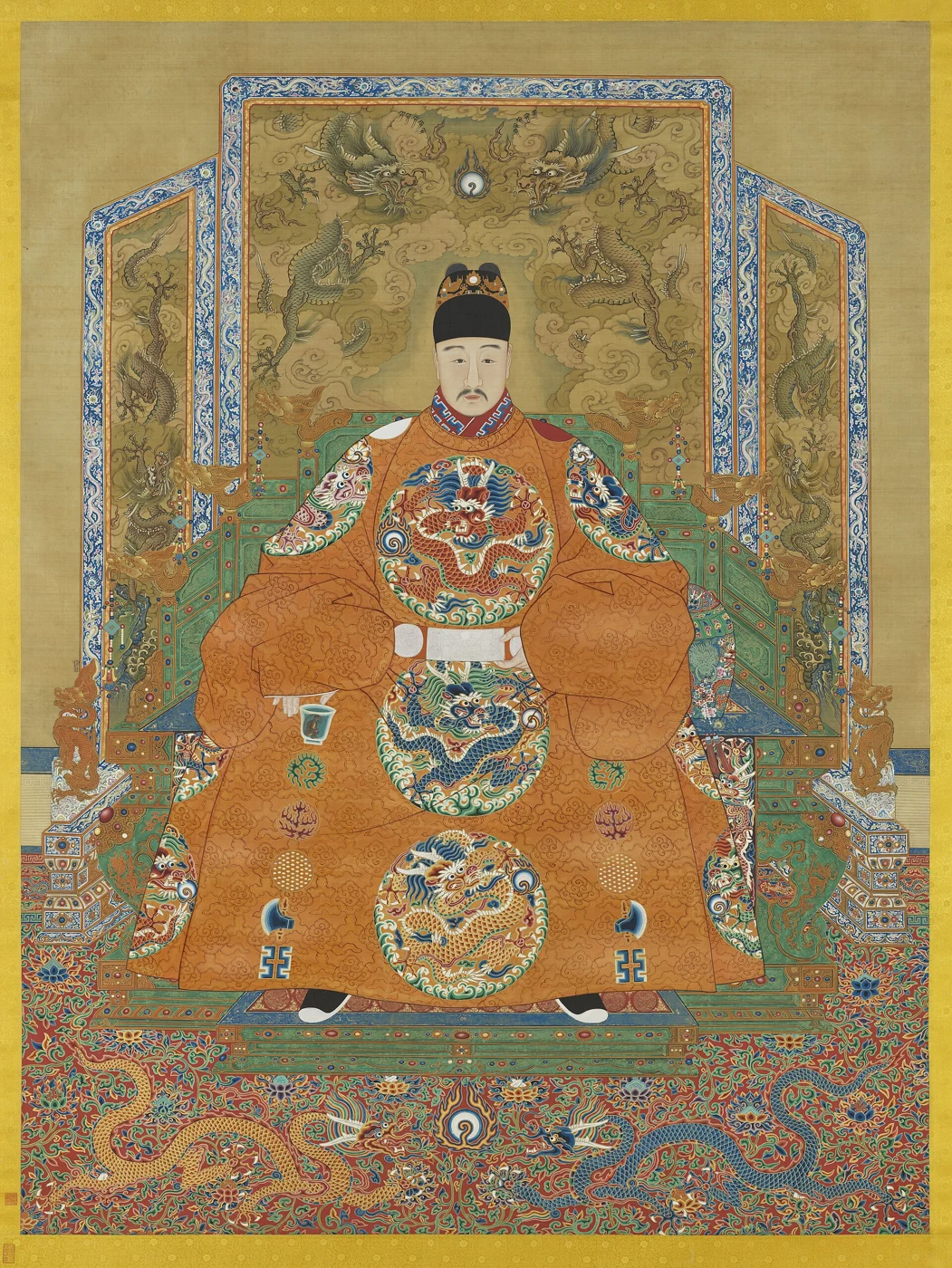
Twelfth emperor of the Ming Dynasty (Emperor Muzong)
Zhu Zaiji
朱载坖
Zhu Zaiji (March 4, 1537 – July 5, 1572), also written as Zhu Zaihou, courtesy name Shunzhai, was the twelfth emperor of the Ming Dynasty (reigned February 4, 1567 – July 5, 1572), the third son of the Jiajing Emperor Zhu Houcong, with Empress Xiaoke Du as his mother. In 1539, he was made Prince of Yu. In 1549, the Heir Apparent died, and by succession order Zhu Zaiji should have been named crown prince, but the Jiajing…
Ming Dynasty
PROFILE
Zhu Zaiji (March 4, 1537 – July 5, 1572), also written as Zhu Zaihou, courtesy name Shunzhai, was the twelfth emperor of the Ming Dynasty (reigned February 4, 1567 – July 5, 1572), the third son of the Jiajing Emperor Zhu Houcong, with Empress Xiaoke Du as his mother. In 1539, he was made Prince of Yu. In 1549, the Heir Apparent died, and by succession order Zhu Zaiji should have been named crown prince, but the Jiajing Emperor never formally established a new one. In 1565, his rival brother Zhu Zhai died. In January 1567, the Jiajing Emperor died, and Zhu Zaiji finally ascended the throne with the era name Longqing. He delegated state affairs to capable Grand Secretariat ministers including Xu Jie, Gao Gong, Chen Yiqin, and Zhang Juzheng, and employed capable generals including Tan Lun, Qi Jiguang, and Wang Chonggu to strengthen border defenses. His reign saw two major achievements: the Longqing Opening (permitting maritime trade) and the peace treaty with Altan Khan, laying the foundation for the Wanli era's prosperity. However, he himself indulged in sensual pleasures, leading to deteriorating health. He died on July 5, 1572, at age thirty-six.
- Dynasty / polity
- Ming Dynasty
- Period
- Ming Dynasty
- Date of Birth
- March 4, 1537 CE(16th year of the Jiajing era, Ming)
- Date of Death
- July 5, 1572 CE(6th year of the Longqing era, Ming, 5th month, 26th day)
- Ethnicity
- Han
- Role
- Twelfth emperor of the Ming Dynasty (Emperor Muzong)
- Place of birth
- Beijing
- Reign
- February 4, 1567 – July 5, 1572
- Era name
- Longqing
- Temple name
- Muzong
- Posthumous name
- Qitian Longdao Yuanyi Kuanren Xianwen Guangwu Chunde Hongxiao Zhuang Huangdi
- Burial place
- Zhaoling Mausoleum, Ming Tombs
- Predecessor
- Zhu Houcong (Jiajing Emperor)
- Successor
- Zhu Yijun (Wanli Emperor)
- Father
- Zhu Houcong (Jiajing Emperor)
- Mother
- Empress Xiaoke Du
- Major achievements
- Longqing Opening permitting maritime trade; peace treaty with Altan Khan; appointed capable ministers Xu Jie, Gao Gong, Zhang Juzheng; strengthened border defenses with Qi Jiguang
LIFE TIMELINE
Enfeoffed as Prince Yu | Enfeoffed as Prince Yu, while his elder brother Zhu Zairui was made crown prince
Death of Zhu Zairui | Zhu Zairui died and Emperor Shizong never again formally installed an heir
Death of his mother | His mother, of the Du clan, died; the rivalry for the succession between Prince Yu and Prince Jing continued
Death of Prince Jing | Zhu Zaizhen, Prince Jing, died and Prince Yu became the only surviving adult son of Emperor Shizong
February 4, 1567 CE(45th year of the Jiajing era, Ming, 12th month, 26th day) | Accession | Zhu Zaiji came to the throne and afterwards changed the era name to Longqing
Opening of the sea ban | The court permitted merchants and people of Yuegang in Fujian to trade with the eastern and western oceans, known as the Longqing opening
Bayanachi enters Ming territory | Bayanachi entered Ming territory, creating the occasion for negotiations with Altan Khan over tribute and border markets
Altan Khan enfeoffed | The court enfeoffed Altan as Prince Shunyi, and an arrangement of tribute and border markets took shape on the Ming-Mongol frontier
Death | Zhu Zaiji died in the Qianqing Palace and Zhu Yijun succeeded him
BIOGRAPHY
Biography
Early Life as Prince of Yu
Zhu Zaiji was the third son of the Jiajing Emperor. In 1539, he was made Prince of Yu. In 1549, the Heir Apparent died without issue, and by succession order Zhu Zaiji should have been named crown prince, but the Jiajing Emperor never formally established a new one, partly due to the influence of the Daoist priest Tao Zhongwen and partly because his brother Zhu Zhai also coveted the position. This uncertainty lasted for years.
Accession and Governance
In January 1567, the Jiajing Emperor died and Zhu Zaiji ascended the throne with the era name Longqing. He delegated state affairs to capable Grand Secretariat ministers including Xu Jie, Gao Gong, Chen Yiqin, and Zhang Juzheng. He employed Tan Lun, Qi Jiguang, and Wang Chonggu to strengthen border defenses. After these reforms, the state showed signs of recovery.
Longqing Opening and Peace with Altan Khan
Two major achievements marked his reign. First, the Longqing Opening (1567) partially lifted the sea ban, permitting private maritime trade at Yuegang (Moon Harbor) in Fujian, which stimulated the economy. Second, in 1571, a peace treaty was concluded with Altan Khan of the Tumed Mongols, ending decades of border warfare and establishing stable horse markets along the frontier.
Death
Zhu Zaiji indulged in sensual pleasures, leading to deteriorating health. On July 5, 1572, he died at age thirty-six. His temple name was Muzong, and he was buried at Zhaoling Mausoleum in the Ming Tombs.
Thirty Years in the Princely Residence and His Parents' Position
Zhu Zaiji was the third son of Emperor Shizong of Ming. When the emperor's eighth son was born he too died young, and thereafter the palace bore no more princes. Zhu Zaiji and his elder brother, the heir apparent Zhuangjing, Zhu Zairui, were enfeoffed on the same day, and the eunuch in charge of the ceremony delivered the heir apparent's seal and treasures by mistake to Zhu Zaiji's palace while the prince of Yu's seal and treasures were delivered to Zhu Zairui's. Ten years later, in the third month of the twenty-eighth year of Jiajing, Zhu Zairui had just completed his capping and died. In the first month of the thirty-third year of Jiajing, Zhu Zaiji's mother, the lady Du, died; she had not been favoured in life, and in death the emperor suppressed the scale of her funeral, requiring that it be conducted by ordinary rule and not after the pattern of the honoured consort Ji in the Chenghua period. The emperor favoured Zhu Zaizhen more: Zhu Zaizhen was clever and showed it, quick to respond, good at society and skilled at falling in with his father's wishes, while Zhu Zaiji was by nature slow, inward and dull. In his manner of life Zhu Zaizhen could get extra gifts from his mother, the honoured consort Lu, and being widely connected, powerful ministers and nobles, guessing the emperor's mind and thinking he would be set up, gave him gifts on every side as political investment, so that Zhu Zaizhen lived in comfort; while Zhu Zaiji was poor, able only with the grain and paper money due him to keep up barely his own and his household's expenses and the pay of the officials and guards of his residence. At that time the imperial shops traded in goods brought by merchants from other regions, with one supervising eunuch in charge, and the profits, apart from the regular contribution to the throne, went to the funds of the supervising inner officials, and the establishment of the prince of Yu often sent men to take a part of these receipts. In such circumstances Zhu Zaiji could not but live in trembling and the utmost caution. When his eldest son was born the emperor was much displeased that he had begotten a son during the mourning for the lady Du, and only after the junior supervisor of the household Yin Tai cited the preface to the Record of Filial Piety and Compassion was the emperor appeased; and the emperor also refused the ministry of rites' proposal to announce the matter at the ancestral temple, issue a decree and receive congratulations, because that was the rite of a grand imperial grandson and would have signalled to the world that Zhu Zaiji was to be made heir. From the death of Zhu Zairui the emperor always refused formally to name an heir, and treated the two princes Zhu Zaiji and Zhu Zaizhen alike with no difference in their ceremonial dress, so that outside opinion clamoured and men said they did not know where to turn. Someone first spread rumours in the capital that Yan Song meant to harm Zhu Zaiji so as to ensure that Zhu Zaizhen became heir, and having thus made opinion, asked that the prince of Jing be sent to his fief and the prince of Yu made heir; and the emperor, seeing the memorial, was enraged and had Guo Xiyan beheaded. But to put an end to the talk of the court and the country he decided in the tenth month of that year to send Zhu Zaizhen to his fief, choosing for it Huguang near his own former fief. The emperor once asked Zhu Zaiji whether he did not resent the long wait, hinting at his dissatisfaction with him; and when a eunuch leaked the news to Zhu Zaizhen, he memorialised asking to go to Mount Xuan to pray for the emperor, and the emperor ordered Xu Jie to draft the decree, and when Xu Jie was at a loss Zhu Zaizhen's illness was reported with a request for a physician, and Xu Jie seized the chance to draft a decree telling him to nurse his illness and not set out. Not long after came news of Zhu Zaizhen's death by illness, in the first month of the forty-fourth year of Jiajing. In the forty-fifth year of Jiajing the emperor fell gravely ill, and at this time the old officials of the prince of Yu's household came into the grand secretariat, Gao Gong, with Zhang Juzheng and Chen Yiqin becoming respectively right vice-minister of rites and left vice-minister of personnel, their rise being bound up with the now clear prospect of Zhu Zaiji's succession.
His Accession and the Righting of Abuses
After the civil and military officials and the elders of the army and people had three times presented petitions urging him, Zhu Zaiji held his accession ceremony on the twenty-sixth day of the twelfth month. On taking the throne he set about reforming the problems and abuses his father had left: on the very day of his accession he ordered the release of the remonstrating officials his father had held in the death cells, and afterwards reversed the cases of those who had suffered in the Jiajing reign for their remonstrances, generously honouring and employing them, and at the same time punished certain imperial kinsmen, such as the prince of Liao, who had flattered and aided the wickedness of the former reign.
His Silence in Court, the Cancelled Audiences, and His Indulgence
But not long after his accession Zhu Zaiji disappointed his subjects again: he said little when he held court and rarely of himself expressed an opinion or questioned his officials; and from the first month of the first year of Longqing he several times declared the audience cancelled and repeatedly failed to perform the ancestral sacrifices in person, taking his pleasure in the palace, which provoked unending remonstrance, some describing such memorials as enough to make a collection of their own; yet Zhu Zaiji did not mend. He handed the government to the grand secretaries and shut himself in the palace in indulgence of music and women; and to satisfy his desires he drew vast sums from the treasury for his use, and in the fourth month of the fourth year of Longqing he ordered three hundred thousand taels of the grand granary silver brought into the palace, provoking strong opposition from the ministers including the chief grand secretary Li Chunfang, so that he was forced to reduce it to a hundred thousand; but afterwards he would not listen and went on drawing great sums. He also greatly expanded the weaving, sending the eunuch Li You and others to be long stationed at Suzhou and Hangzhou to urge on the weaving and its delivery; and the local officials had to send these eunuchs a regular "customary fee," and for every extra batch ordered and every new pattern issued the supervising eunuch had to have a heavy bribe, or he would find fault on the pretext of hindering the imperial use. At that time Jiangnan, after the troubles of the Japanese pirates, was greatly worn, and the ministry of works set out the state of things and stressed that the people of Jiangnan were those whom the emperor should pity, but Zhu Zaiji turned a deaf ear; and when the ministry asked that the weavers be made to work to the original patterns without adding new ones, Zhu Zaiji insisted that his own use could not be lacking and had Li You go on weaving by decree. In two and a half years on the throne he enfeoffed thirteen consorts, and the women below the rank of concubine whom he favoured were past counting; and each time he selected more palace women it was some three hundred girls of the people between eleven and sixteen. By Shen Defu's record, Zhu Zaiji before his accession often ate fruit cakes, and after taking the throne he had eunuchs buy them outside the palace, and the food office and the sweetmeat chamber each bought pine nuts, hazels, rice and sugar and rendered accounts of several tens of taels; and Zhu Zaiji laughed and said that such a cake cost but five mace and one could buy a great box of them at the Goulan lane of East Chang'an street, so why spend so much, at which the buying eunuchs all drew in their heads and withdrew.
The Strife of the Grand Secretaries and the Government
Of the grand secretaries of the Longqing reign the most important were Xu Jie, Gao Gong and Zhang Juzheng, all men of ability but each undercutting the others. Early in Longqing Xu Jie and Gao Gong contended for power, and Xu Jie, using the voice of the remonstrating officials, forced Gao Gong and his associate Guo Pu from office; but Xu Jie, having offended many eunuchs by remonstrating with Zhu Zaiji, was in turn displaced by Li Chunfang as chief grand secretary, and Gao Gong returned to office in the twelfth month of the third year of Longqing. Gao Gong, wishing revenge on Xu Jie, had the remonstrating officials memorialise attacking the testament of Emperor Shizong that Xu Jie had drafted as slanderous of the late emperor, and exposed how Xu Jie's three sons ran riot in their native place, how his sons and slaves were overbearing in the district, how the Xu family had engrossed some tens of thousands of qing of land, and how he lent at high interest to prey on the people; and Gao Gong himself sent up two memorials, on setting straight the moral order and settling the state, and on redressing a great wrong and making plain the great principle, whose purport was that Xu Jie had slandered the late emperor and falsely relied on the decree, and he meant to put him to death. Zhu Zaiji praised his memorials but did not touch Xu Jie, it is said because he did not much understand them. In the fifth month of the fifth year of Longqing Li Chunfang retired and Zhu Zaiji made Gao Gong chief grand secretary, and with Zhang Juzheng he worked with one mind and achieved a series of great things. Zhu Zaiji was fairly lenient with his grand secretaries, and where the parties were bitterly opposed and the struggle at white heat he mostly took a balancing and reconciling line; and those who could not be kept in office he generally had the department concerned supply with travelling money and servants, keeping up the courtesy.
His Last Years, Death, Name and the Zhao Tomb
Once when Zhu Zaiji came out from the grand secretariat and went north past the Huiji gate he saw the imperial carriage standing in the middle of the imperial way, and Gao Gong wondered whether the emperor, not taking his seat, was going to the Wenhua hall, and hurried forward to meet him. Then several inner attendants came galloping up crying aloud the summons of the grand secretaries; and when the two hurried to the carriage Zhu Zaiji had already come down from the golden terrace and stood in anger, with the attendants kneeling in a ring on either side. Seeing Gao Gong arrive Zhu Zaiji's face softened, and he came forward and pulled hard at his robe as if he had something to say; and Gao Gong, taking the point, at once said that the emperor was angry, and asked where he was going. Zhu Zaiji, his anger unabated, said he would not return to the palace; and Gao Gong reasoned with him, asking where he would go if he did not return, and begging him to return. Zhu Zaiji then ordered Gao Gong to escort him back, showing him on the way the scar on his wrist, and saying again and again that for two hundred years the realm of his ancestors had come down to this day, and that a state with a grown sovereign was a blessing to the altars of state, but the heir of the eastern palace was small. Each time he said it he stamped his foot and gripped Gao Gong's hand hard. Gao Gong asked how, with endless years before him, he could speak so; and Zhu Zaiji said that someone was bullying him. Gao Gong at once comforted him, asking who had been so rude, for the ancestors had their heavy laws, and begging him to say who it was and it would be dealt with by law, and that the emperor, but newly recovered, should not be angry and harm his sacred person. Zhu Zaiji was silent a long while and then sighed, asking what matter it was that had not been ruined by the inner officials, and how could Gao Gong know. When Zhu Zaiji had entered the hall he again summoned Gao Gong and Zhang Juzheng to his couch and said that from of old the after-affairs of emperors were for them to consider well and carry out, two clauses of which Gao Gong and the other did not hear clearly, but it was broadly the charge of his after-affairs; and coming out of the hall Zhu Zaiji again had a eunuch bid Gao Gong stay in the palace and not leave, and Gao Gong took Zhang Juzheng with him to stay, and was permitted. At night Gao and Zhang withdrew to lodge in the chamber of the inner officials at the western gate of the Duanmen, and four days later, when Zhu Zaiji was somewhat better, they went home. On the twenty-sixth day of the fifth month of the sixth year of Longqing Zhu Zaiji died, being thirty-six, with the temple name Muzong and the posthumous name of the emperor who embraced Heaven and the Way, deep, excellent, broad and benevolent, manifest in letters and martial in arms, of pure virtue and great filial piety, the solemn emperor. As to his name, a tradition long held that it was Zaiji written with the character hou, and his veritable record does not record the name; but the veritable record of Emperor Shizong expressly records that the emperor ordered his third son to be named Zaiji, and the decree of the twenty-seventh year of Jiajing, in the volume of imperial decrees printed by the Zhejiang provincial administration, containing the decree making the heir apparent and enfeoffing the two princes, also expressly records this name. After his death Zhu Zaiji was buried with his three empresses in the Zhao tomb. The Zhao tomb lies at the eastern foot of Mount Dayu and is the first of the Thirteen Tombs to have been restored on a great scale, and is one of the tombs formally open to visitors; its institution is of middle size among the thirteen, and its spirit way branches west from the north of the seven-arch bridge of the Chang tomb, some two kilometres long, with a five-arch and a single-arch stone bridge on the way, and near the tomb a stele pavilion, behind which are three parallel single-arch stone bridges. The tomb buildings face thirty-eight degrees east of south and cover some thirty-four thousand six hundred square metres, laid out in the ancient form of a square before and a circle behind, with two courts in front of the treasure wall, a passage through the square city running straight from front to back, and the hall of the eminent favour and the side halls of five bays and the gate of eminent favour of three bays after the pattern of the Tai and Kang tombs. The stone bridges of the Zhao tomb and the newly rebuilt stele pavilion of divine merit and sacred virtue again show the solemn scene of the autumn sacrifice of the Ming, with the offerings clean and abundant and the instruments of music complete. In the side halls are displays of the historical materials of the emperors and empresses of the Zhao tomb and of the tombs of the Ming imperial clan, telling of the Longqing emperor and the three empresses Xiaoyi, Xiao'an and Xiaoding buried in the Zhao tomb and of the tomb institutions of the princes and consorts of the Ming.
Major Activities
Border Defense Reform
Zhu Zaiji strengthened the northern frontier by appointing Qi Jiguang to command the Ji garrison and Wang Chonggu to manage the Xuan-Da region. These appointments stabilized the border and enabled the peace treaty with Altan Khan.
The Spread of the Single Whip Method
The single whip method had been practised in parts by some local officials as early as the beginning of Jiajing, and in the Longqing period more marked results were achieved on that basis. The grand coordinator of Yingtian, Hai Rui, had the equalized corvée and equalized charges levied by the single whip as silver, without distinction between silver and labour dues, to be held by the government for allocation, so that the single whip long practised in Suzhou and Songjiang was made more complete, and there were several other places where it was tried. The single whip method simplified matters, merging the various kinds of corvée, local tribute and so on, abolishing labour service and requiring silver throughout, with the government hiring men to serve and all the silver apportioned on the land; apart from the tribute grain of Suzhou, Songjiang, Hangzhou, Jiaxing and Huzhou, which supplied the imperial table, the land tax of the whole realm was converted into silver, and its collection and delivery changed from the people to the officials of the prefecture and county. It simplified the items of taxation and the procedure of collection.
The Opening of the Sea
Not long after his accession Zhu Zaiji accepted the advice of the grand coordinator of Fujian, Tu Zemin, and permitted the opening of the sea ban, allowing trade to the eastern and western oceans, so giving the people's overseas trade legal standing, and set up at Yuegang a superintendency of grain to collect duties from the sea merchants. The opening of Longqing is held to be the first true opening of Ming China to the outside, breaking a sea ban of two hundred years. Thereafter Ming overseas trade flourished, with yearly imports and exports of about sixteen million four hundred and seventy thousand taels of silver and profits of about nine million four hundred and twenty thousand taels. Yet the opening had its limits: only Yuegang was a legal port of departure; the places the merchants might go were restricted, trade with Japan being forbidden; the kinds of goods they might deal in were restricted, bronze, iron, saltpetre and sulphur, which might serve for war, being forbidden to leave; and the number of voyages was restricted, the permits issued by the coast defence office being only a hundred.
The Restoration of Sea Transport and the Dredging of the Waters
Ming grain transport depended on the rivers, and in the Jiajing period the right vice-minister of war Wang Yizhan and the right consultant of the Huguang administration Fang Yuan and others again and again proposed opening sea transport along with dredging, and were each time refused by Shizong. After his accession Zhu Zaiji accepted the advice of a supervising secretary and first restored the short sea route from the Zhejiang squadron to Jizhou, and then step by step the whole voyage from the Jiang and the Huai direct to Tongzhou by Beijing and on to Liaodong. Afterwards, on Gao Gong's memorial, Zhu Zaiji restored sea transport, built sea-going ships, organized fleets, provided officers and sailors and sailed at fixed times, so that tribute grain and goods of every kind could go straight to Beijing. Sea and river transport used together not only guaranteed the capital's stores for nearly a hundred years from Wanli to Chongzhen and met the Ming's most necessary needs, but with the regular sailing of the official fleets private trade by sea at home and abroad opened up still faster, giving new life to the commodity economy of the southeast coast and having far-reaching effects. In relieving floods the most important work was that of Hai Rui as grand coordinator of Yingtian, who greatly dredged the Wusong river and the Baimao river and led the water to the sea, and who joined famine relief to water works, which did much to steady the social order of the southeast.
Reform of the Personnel and Assessment System
The grand secretaries of Longqing, Gao Gong and Zhang Juzheng, both held that whether reform could be carried out and whether it would work depended first of all on the choice of men, and so they put the ordering of personnel in the foremost place, requiring that from the six ministries at the centre down to the civil and military officers of every locality, cases should be handled within fixed terms and reported accurately on time, with the files clear and the registers detailed for inspection and checking. On Gao Gong's advice Zhu Zaiji reformed the personnel and assessment system, stressing that office should follow the business and not be created for the man, that the worthy alone should be raised and employed according to their gifts, that the mediocre and greedy should not be allowed to fill posts and muddle the official world, that merit and guilt should be strictly marked to fix promotion and dismissal, and that men should be encouraged to act with a true heart and do real work. Rank by examination was not to be the chief standard of employment, and men were to be raised out of course according to their achievements, their stipends not to be reckoned with those of other officers. To this end personnel discipline was strictly enforced: officials who received their warrant but did not take up their posts were to be dismissed and reduced; greedy officials against whom the evidence was clear might not be quietly restored; those impeached by the censors were still to be dealt with only after the evidence was verified; impostors were to be seized and severely punished; and redundant officers and clerks were to be abolished. Even the descendants of Confucius, who had from dynasty to dynasty held by imperial grant the hereditary post of magistrate of Qufu in Shandong, had their hereditary privilege abolished. Those in the several offices who took the "use money" and "greasing money" of the various irregular fees were all arrested and sent to the ministry of justice for trial, cangued and transported; and the revised Regulations of Assessment and Impeachment was approved and promulgated, providing that officials exceedingly corrupt or cruel be interrogated, and those of insufficient ability be graded and transferred to simple or remote posts, to idle posts, or reduced in rank, or changed to teaching, and that a second such grading should be reckoned as weakness; and these provisions were heavier than the former penalties. The redundant officers and clerks parasitic in the several offices were cut back with vigour, and the worn and aged were severally arranged for retirement.
Frontier Reorganization and the Altan Submission
Zhu Zaiji once inspected the imperial tombs and for the first time knew how close the frontier garrisons were to the capital, and sighed that frontier affairs had long been ruined and that none would truly set them right for him, but only made speeches and played with empty forms, and asked whether this would not ruin things in the end, resolving to set the frontier in order. He employed Gao Gong to direct the military reform, increased the vice-ministers of war from two to four, who might at any time be sent out as grand coordinators, and arranged for men who knew war to serve as secretaries of the ministry of war, and raised and employed a number of generals as commanders on the northern frontier against the Mongol Altan and Tuman and their like, and strengthened the examination and selection of officers, carrying out the "eight matters" of storing money and grain, repairing the passes, drilling troops and horses, putting weapons in order, opening military farms, regulating the salt law, collecting frontier horses and dispersing the rebellious factions. By the summer of the fourth year of Longqing the Ming had begun to turn round its position of being beaten and losing whenever it fought, and could sometimes strike first, as in the sixth month of that year when the commander of Ningxia went out beyond the frontier from the Lesser Pine Mountain, the commander of Yansui Lei Long out from the Western Red Mountain and the commander of Shaanxi Lü Jing out from the Harvest Lake against the Mongol Ordos and other tribes, beheading more than a hundred and sixty, the merit of Yansui being the greatest. Gao Gong, on his second entry into the grand secretariat, vigorously set the frontier in order, and in the first month of the fourth year of Longqing memorialised to transfer the famous general Wang Chonggu to be grand coordinator of Xuan, Da and Shanxi, who several times beat off Mongol raids. In the ninth month of that year Altan's grandson, Baghanaji, came over to the Ming, and Wang Chonggu held that he should be received and used as a counter to force Altan's submission, and was supported by Gao Gong and Zhang Juzheng; and after negotiations between the two sides Altan promised to raid no more and handed over the White Lotus teachers who had been his counsellors. Another tribe repeatedly raided the Ming and demanded by military pressure to establish tributary relations, but the Ming always refused and met its raids with a firm hand, and this policy toward the Mongols was called curbing the east and winning the west. In the southwest the commander An Dachao was sent against An Guoheng and beaten, and Zhu Zaiji, on Gao Gong's advice, promptly transferred the grand coordinator Ruan Wenzhong, who carried out the ancestral injunctions not to let evil bring down the good, to join grace and severity, and to soothe with quiet, treat with sincerity and instruct with reason, so that the affair was quickly calmed.
His Favour to the Eunuchs and the Tyranny of the Inner Officials
Whereas his father Emperor Shizong trusted alchemists, Zhu Zaiji favoured the eunuchs still more, and in his reign their power swelled suddenly and they encroached on the government. Within two months of his accession he granted favours to the eunuch of the directorate of ceremonial Huang Jin and other inner officials, and added to the embroidered-uniform guard seven officers below the rank of assistant commander bearing the title of commander, thirty braves of the imperial horse directorate and six officers specially for tomb-keeping, to provide for Huang Jin's kin. Besides constantly sending eunuchs through the realm to urge on the tribute and take charge of the weaving, Zhu Zaiji several times employed eunuchs to meddle in military affairs, sending the eunuchs Lü Yong, Gao Xiang and Tao Jin to sit at the frontier garrisons; and the eunuchs also beat officials and forged decrees. Shortly after his accession the grand secretariat memorialised to send censors to audit the money and grain of the several inner offices, and Zhu Zaiji for a time decreed it; but as soon as the censors entered the storehouses the eunuchs resisted with every device. The eunuch Cui Min memorialised for exemption from the audit, while the censors insisted on a clear reckoning, holding that the decree had gone out and it was not fitting to stop at a word, and impeached Cui Min and the rest for defying the decree and deserving punishment; and when the two sides stood in hot confrontation Zhu Zaiji took the eunuchs' part and issued a further decree overturning the former one, allowing only the stores and accounts after the forty-first year of Jiajing to be audited, and forbidding any general audit of matters not in the decree, and excusing Cui Min and the others; and afterwards he had the officials who insisted on auditing the eunuchs' money and grain and impeached Cui Min beaten in court and degraded. In the seventh month of the second year of Longqing the censor inspecting the central city, Li Xuedao, had beaten a eunuch, Xu Yi, who had stood outside the palace with a bare blade to extort money from the people; and more than a hundred other eunuchs, when Li Xuedao passed the left side gate, suddenly came out and attacked him with staves in revenge. Zhu Zaiji, hearing of it, on the charge that Li Xuedao had not waited for the proper form and had of himself beaten an inner attendant and did not understand the proprieties, took away his post as censor of the central city and banished him elsewhere. In the eleventh month of the third year of Longqing the junior supervisor of the imperial wardrobe, Huang Xiong, quarrelled with the people of Beijing over interest on a loan, and the office of the horse and foot police, charged with the peace of the capital, arrested him and sent him the next day to the censor inspecting the imperial city, Yang Song. Huang Xiong's companions falsely claimed to have the emperor's warrant and demanded his immediate release; and Yang Song, having found it forged, memorialised accusing Huang Xiong of violent lawlessness and falsely claiming a decree, while Huang Xiong countered by accusing Yang Song of a false report; and Zhu Zaiji, believing the eunuchs entirely, charged Yang Song with a false report and with seizing an inner attendant without waiting for a decree, and reduced him three grades and transferred him to a provincial post. Yet throughout the Longqing reign the favoured eunuchs such as Teng Xiang, Cui Min, Li Hu, Chen Hong and Meng Chong after all busied themselves with cunning and curious arts and with gathering wealth for the emperor, and even Lü Yong and Gao Xiang, who were charged with supervising the capital camps, never in fact seized military power.
Personal Relations
- Zhu Houcong**: Father, the Jiajing Emperor
- Zhu Zhai**: Younger brother, rival for the crown
- Zhu Yijun**: Son, successor as the Wanli Emperor
- Zhang Juzheng**: Grand Secretary, later dominant figure in government
- Qi Jiguang**: General who strengthened coastal and border defenses
Historical Assessment
Zhu Zaiji's reign, though brief, was consequential. The Longqing Opening marked a significant shift in Ming trade policy, and the peace with Altan Khan ended decades of border warfare. His delegation of authority to capable ministers laid the groundwork for the early Wanli era's prosperity. However, his personal indulgence limited his active participation in governance.
FIGURES ASSOCIATED WITH THIS DYNASTY
Bibliography
- History of Ming, vol. 19, "Annals of Muzong"
- Veritable Records of Emperor Muzong