Birth | Born into an impoverished farming family in Rongcheng; lost his mother at age seven and suffered cruel abuse under his stepmother.
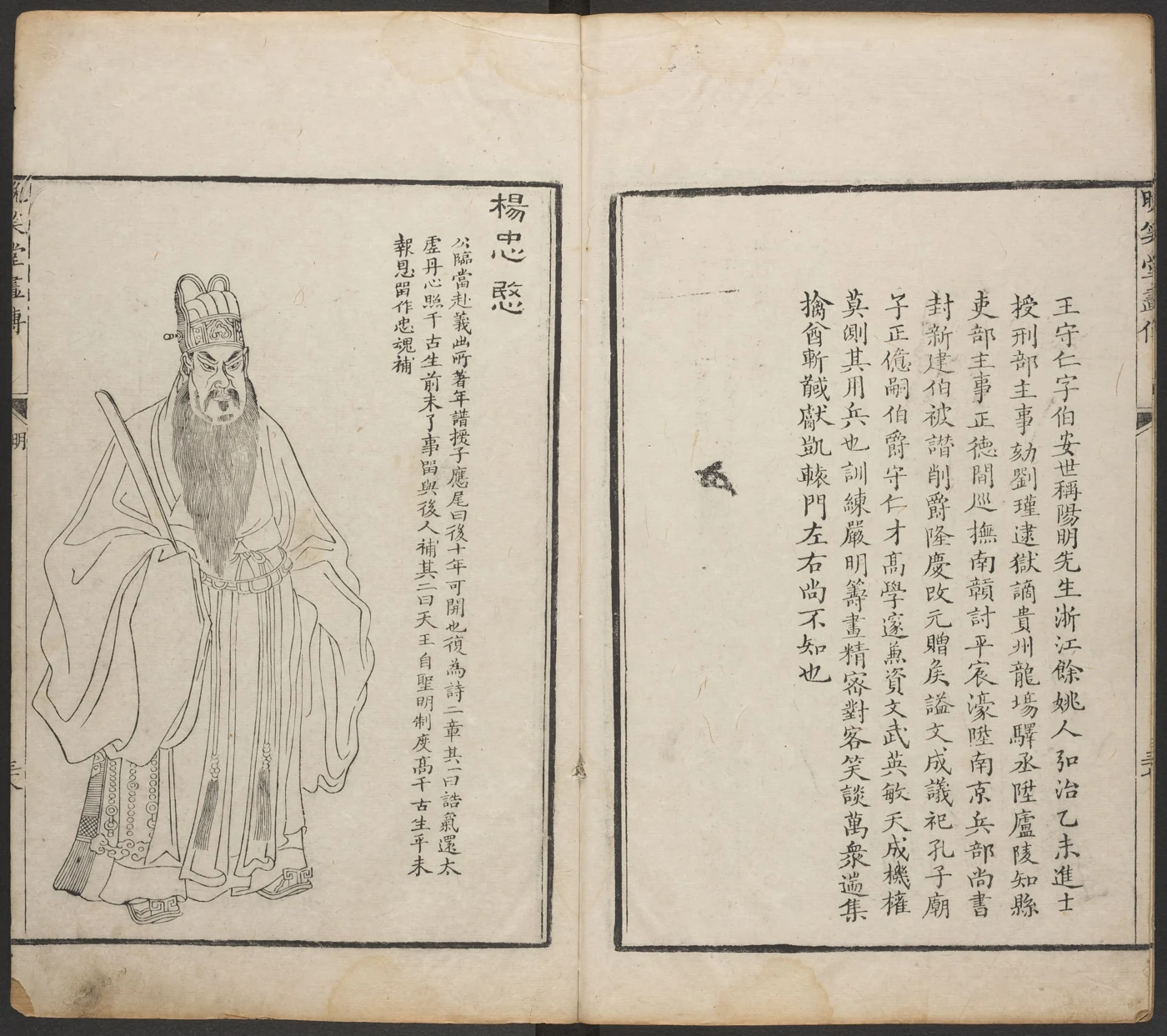
1516 CE–1555 CE
Historical figure
Yang Jisheng
杨继盛
Yang Jisheng (1516–1555), courtesy name Zhongfang, art name Jiaoshan, a native of Rongcheng in Northern Zhili, was an illustrious righteous martyr, statesman, and writer of the Ming Dynasty. Entering officialdom as a Jinshi in 1547, he served successively as Secretary in the Nanjing Ministry of Personnel and Vice Director in the Ministry of War. In 1551, he submitted his famous *Memorial Requesting the Abolition of Horse…
1516 CE–1555 CEMing Dynasty
PROFILE
Yang Jisheng (1516–1555), courtesy name Zhongfang, art name Jiaoshan, a native of Rongcheng in Northern Zhili, was an illustrious righteous martyr, statesman, and writer of the Ming Dynasty. Entering officialdom as a Jinshi in 1547, he served successively as Secretary in the Nanjing Ministry of Personnel and Vice Director in the Ministry of War. In 1551, he submitted his famous Memorial Requesting the Abolition of Horse Markets, fearlessly indicting Grand Commander Chou Luan's cowardly appeasement of Altan Khan; for this, he was flogged in court, imprisoned in the imperial dungeons, and demoted to Police Vice Magistrate of Didao in the far northwest. In Didao, he opened coal mines, built schools for Han and Tibetan youths, dredged irrigation canals, and earned universal devotion as the "Father of the People." Recalled to the capital in 1553 as Vice Director in the Ministry of War, he witnessed Grand Chancellor Yan Song's absolute tyrannical corruption. He submitted the monumental Memorial Requesting the Execution of the Treasonous Minister Yan Song, detailing Yan's "Five Treasons and Ten Grand Crimes." Enraged, Emperor Shizong cast him into the lethal Embroidered Uniform Guard dungeons. Enduring 100 bone-crushing strokes of the imperial rod that shattered his legs, Yang performed the legendary feat of using a jagged porcelain bowl shard to cut away putrid, maggot-infested flesh from his own thighs in the dark cell without flinching. In 1555, framed by Yan Song, he walked calmly to the execution ground at age forty, reciting his immortal martyrdom poem. Under Emperor Longqing, he was completely exonerated and conferred the posthumous title "Zhongmin."
- Courtesy / Art Name
- Zhongfang
- Era
- the Jiajing era of the mid-Ming (1516–1555 CE)
- Dynasty
- Ming dynasty (Statesman、Man of letters)
- Identity
- Historical figure
- Date of Birth
- June 16 1516
- Date of Death
- November 13 1555
- Ethnicity
- Han Chinese
- Ancestral Home
- Beihezhao Village, Rongcheng County, Baoding Prefecture, Northern Zhili (present-day Rongcheng County, Baoding City, Hebei Province)
- Place of Birth
- Rongcheng county, Baoding prefecture, Northern Zhili
- Place of Death
- Unknown
- Lifespan
- 40 years
- Major Offices
- Secretary of the Bureau of Noble Titles, Ministry of Personnel, Nanjing、Vice Director of the Bureau of Communications, Ministry of War、Dianzhi of Didao County, Lintao Prefecture, Shaanxi、Magistrate of Zhucheng County、Secretary of the Ministry of Revenue, Nanjing、Vice Director of the Ministry of Justice、Vice Director of the Bureau of Military Appointments, Ministry of War
- Posthumous Name
- Zhongmin
- Posthumous Honors
- Exonerated in 1567 (1st year of Longqing); posthumously conferred Vice Minister of the Court of Imperial Sacrifices (Taichang Si Shaoqing); granted the supreme posthumous name "Zhongmin" (Loyal and Compassionate)
- Major Achievements
- A jinshi of the twenty-sixth year of Jiajing, he served successively as secretary of the Ministry of Personnel at Nanjing and vice director of the Ministry of War. In the thirtieth year of Jiajing he submitted his memorial 'Requesting the Abolition of the Horse Market', sharply impeaching the powerful general Qiu Luan for craven compromise; he was imprisoned and beaten in the court, then banished as dianzhi of Didao, where he built water works and founded schools and was deeply loved by the peoples of Didao.
LIFE TIMELINE
Age 14 | Labored as an oxherd; pleaded passionately with his father to enter school, studying day and night with superhuman perseverance.
Age 25 | Passed the provincial examination as a Juren; praised by Education Vice Commissioner Xu Shi for his unbending Confucian moral character.
Age 32 | Passed the metropolitan examination as a Jinshi; appointed Secretary in the Nanjing Ministry of Personnel, living with austere incorruptibility.
Age 35 | Promoted to Vice Director in the Ministry of War; during the "Gengxu Incident," Altan Khan besieged Beijing and Commander Chou Luan urged appeasement via horse markets.
Age 36 | Submitted the Memorial Requesting the Abolition of Horse Markets; flogged 100 times, imprisoned, and banished to Didao in Shaanxi as a minor clerk.
Age 37 | Founded Chaoyuan Academy in Didao, opened coal mines, and constructed irrigation canals for Han and Tibetan locals, revered as "Father Yang."
Age 37 | Altan Khan broke the treaty; Chou Luan's treason was unmasked; Emperor Shizong recalled Yang, promoting him to Magistrate of Zhucheng and Nanjing Ministry of Revenue.
Age 38 | Transferred to Vice Director of Military Appointments in Beijing; resolved to sacrifice his life to eradicate Chancellor Yan Song's corrupt regime.
Age 38 | Fasted for three days and presented the Memorial Requesting the Execution of the Treasonous Minister Yan Song, detailing Yan's Five Treasons and Ten Crimes; imprisoned in the Northern Dungeons.
Age 38 | Flogged 100 times with lacquered rods, shattering both leg bones; performed self-surgery in prison, using a broken porcelain shard to slice away rotting flesh.
Age 39 | Endured two years in the lethal dungeons; his wife Lady Zhang petitioned to be executed in his place; Yan Song suppressed the petition.
Age 40 | Yan Song falsely attached Yang's name to the execution list of failed generals; Emperor Shizong approved it; Yang was martyred at the Western Market.
Posthumous | Emperor Longqing posthumously exonerated Yang, conferring Vice Minister of Imperial Sacrifices and the supreme posthumous name "Zhongmin."
Age 37 | Accompanied by his devoted wife, Lady Zhang, Yang journeyed thousands of miles over the Qinling mountains to reach Didao in the spring of 1552.
Age 37 | In the winter of 1552, the Emperor issued an edict exonerating Yang, promoting him rapidly from frontier clerk to Magistrate of Zhucheng, Vice Director in the Nanjing Ministry of Revenue, and finally recalling him to the central government in Beijing in the spring of 1553 as Vice Director in the Bureau of Military Appointments (Bingbu Wuxuan Si).
Age 38 | In the winter of 1552, the Emperor issued an edict exonerating Yang, promoting him rapidly from frontier clerk to Magistrate of Zhucheng, Vice Director in the Nanjing Ministry of Revenue, and finally recalling him to the central government in Beijing in the spring of 1553 as Vice Director in the Bureau of Military Appointments (Bingbu Wuxuan Si).
Age 38 | On March 5, 1553 (the twenty-third day of the first month), Yang submitted his world-shaking Memorial Requesting the Execution of the Treasonous Minister Yan Song.
Age 38 | In the winter of 1552, the Emperor issued an edict exonerating Yang, promoting him rapidly from frontier clerk to Magistrate of Zhucheng, Vice Director in the Nanjing Ministry of Revenue, and finally recalling him to the central government in Beijing in the spring of 1553 as Vice Director in the Bureau of Military Appointments (Bingbu Wuxuan Si).
Age 38 | In the winter of 1552, the Emperor issued an edict exonerating Yang, promoting him rapidly from frontier clerk to Magistrate of Zhucheng, Vice Director in the Nanjing Ministry of Revenue, and finally recalling him to the central government in Beijing in the spring of 1553 as Vice Director in the Bureau of Military Appointments (Bingbu Wuxuan Si).
Age 38 | ### The Moral Indictment of Yan Song's Dictatorship Yang Jisheng's paramount contribution to Chinese political history was his Memorial Requesting the Execution of the Treasonous Minister Yan Song (1553).
Aged thirty-nine | He spent two years in the imperial prison, where Yan Song’s agents subjected him to every kind of torment; he recited poetry and read, his resolve growing firmer, and his wife Lady Zhang petitioned at the palace gate to die in his place, but Yan Song withheld the petition.
Age 40 | Yang Jisheng (1516–1555), courtesy name Zhongfang, art name Jiaoshan, a native of Rongcheng in Northern Zhili, was an illustrious righteous martyr, statesman, and writer of the Ming Dynasty.
Age 40 | In the autumn of 1555, military crises worsened on the southeastern coast as Japanese pirates raided Zhejiang.
Twelve years after his death | On the accession of Emperor Muzong of Ming an edict fully rehabilitated Yang Jisheng, posthumously granting him the office of vice minister of the Court of Imperial Sacrifices and the posthumous name Zhongmin, and ordering the building of a shrine with sacrifices in spring and autumn.
Posthumous honours #2 | Emperor Muzong compensated the officials who had remonstrated frankly, Yang Jisheng first among them, posthumously granting him the office of vice minister of the Court of Imperial Sacrifices and the posthumous name Zhongmin.
BIOGRAPHY
Biography
Childhood Hardship and Fierce Dedication to Learning Yang Jisheng was born on June 16, 1516 (the eleventh year of Zhengde under the reign of the Wuzong Emperor) in Beihezhao Village, Rongcheng County, Baoding Prefecture, Northern Zhili (modern Rongcheng County, Baoding City, Hebei Province). The ancient region of Rongcheng, steeped in the tragic heroic traditions of the Yan and Zhao states, historically cultivated men of austere moral courage who valued righteousness above physical survival. Yang Jisheng's family was of agrarian stock, possessing neither aristocratic pedigree nor wealth, living in abject rural destitution. To compound his early misfortune, his biological mother, Lady Cao, passed away when he was merely seven years of age. His father, Yang Fu, subsequently married a stepmother who was notoriously jealous, cruel, and abusive. The young, frail boy was subjected to perpetual verbal degradation, beatings, starvation, and winter exposure. Because his stepmother fiercely objected to expending household funds on his schooling, eight-year-old Yang Jisheng was dispatched before dawn each morning to graze water buffaloes, gather firewood, and cut wild fodder across the barren fields. Whenever he herded his livestock past the village schoolhouse, the sounds of classical recitation drifted through the open windows, arresting the boy in rapt fascination. When he reached thirteen, his elder brother Yang Jichang, observing his extraordinary intelligence and burning thirst for wisdom, pleaded with their father: "My younger brother is gifted with rare mental brilliance; to abandon him to lifetime labor as a common oxherd is a tragedy. Let him enter the schoolhouse." His father finally relented. Hearing this, his stepmother erupted in mocking fury: "A little swine who cannot even earn his daily porridge aspires to study like a gentleman scholar!" Hearing her scorn, Yang Jisheng knelt before his father with tears streaming down his face, swearing: "I shall herd the oxen without neglecting a single chore; by night I shall labor over my texts, swearing never to cost the family a single copper coin!" Admitted to the village academy, the fourteen-year-old youth displayed a fierce tenacity that astonished his village. By day, he draped a straw raincoat over his shoulders and drove cattle across the muddy fields, hanging historical scrolls upon the oxen's horns to read as he walked; by night, he huddled in the family woodshed, igniting pine needles and dried grass to illuminate his texts. In bitter midwinter, as his bare toes cracked and bled from frostbite, he dipped his feet into freezing well water to dispel drowsiness; in sweltering midsummer, amidst clouds of biting marsh insects, he sat with his legs submerged in water barrels, reading continuously until dawn. Steeped in the profound Neo-Daoist moral philosophy of the Song masters and the unyielding martial ethos of northern China, Yang Jisheng forged in his soul an immutable childhood resolution: to live and die as the empire's foremost loyal and righteous minister. In 1540 (the nineteenth year of Jiajing), the twenty-five-year-old scholar passed the provincial examination as a Juren. Xu Shi, the provincial Education Vice Commissioner, inspected his policy treatises, marveling at their unvarnished moral power and deep patriotic resonance, personally inviting him to the Lotus Pond Academy in Baoding for advanced tutelage. Following years of rigorous self-discipline, Yang Jisheng triumphed in the 1547 metropolitan examinations, graduating as a Jinshi in the third rank at age thirty-two, stepping firmly onto the imperial political stage. ### The Horse Market Remonstrance and Exile in Didao Upon graduation, Yang Jisheng was appointed Secretary in the Bureau of Honors of the Nanjing Ministry of Personnel. In the secondary southern capital of Nanjing, Yang lived in ascetic simplicity. Dressed in a coarse cotton robe washed until pale, he dedicated his modest stipend to supporting his aged father and relieving impoverished scholar colleagues. In his leisure hours, he shut his doors to social vanity, immersing himself in administrative law and discussing philosophical ethics with scholars such as He Liangjun. In the autumn of 1550 (the twenty-ninth year of Jiajing), Altan Khan, the warlord of the Mongol Tümed confederacy, launched tens of thousands of nomadic shock cavalry across the Gubeikou pass, riding unchecked to besiege the imperial capital of Beijing during the infamous "Gengxu Incident." Paralyzed by panic, the garrison forces dared not engage the invaders. Supreme Commander Chou Luan, an incompetent and cowardly favorite of Emperor Shizong (Jiajing), sought to disguise his military failures and preserve his court standing by proposing a disastrous policy of appeasement: opening border "horse markets" (mashi) to provide the Mongols with imperial grain, silk, and iron in exchange for horses, purchasing a temporary, humiliating peace. Yang Jisheng had just been promoted to Vice Director in the Bureau of Communications within the Ministry of War in Beijing. Witnessing Chou Luan's treacherous capitulation, Yang was consumed with patriotic outrage. While senior court chancellors cowered in silence before Chou Luan's imperial favor, Yang Jisheng resolved to shatter the appeasement consensus with his life. In April 1551 (the thirtieth year of Jiajing), Yang submitted his historic Memorial Requesting the Abolition of Horse Markets. With extraordinary strategic clarity, he dissected the fatal flaws of Chou Luan's policy, presenting the famous analysis of the "Ten Impossibilities and Five Fallacies" (Shi Bu Ke Wu Miu). He argued that Altan Khan was predatory and deceitful; opening border markets under military duress was not genuine trade, but an imperial extortion racket that allowed the nomads to map frontier passes and acquire iron to forge weapons. He warned that appeasement would only embolden the Mongols to demand greater tribute. However, Emperor Shizong, autocratic and obstinate, was infatuated with the illusion that trade would secure northern peace. Chou Luan wept before the throne, slandering Yang for "recklessly meddling in grand strategy and sabotaging imperial peace." Infuriated, Emperor Shizong stripped Yang of office and cast him into the lethal dungeons of the Embroidered Uniform Guard. Flogged with one hundred heavy wooden blows that tore his flesh to ribbons, Yang was demoted to Police Vice Magistrate (Dianshi) of Didao County in Shaanxi (modern Lintao, Gansu)—an unranked, menial clerical post in the distant frontier wilderness. Accompanied by his devoted wife, Lady Zhang, Yang journeyed thousands of miles over the Qinling mountains to reach Didao in the spring of 1552. Didao was an impoverished, multi-ethnic border outpost inhabited by Han Chinese and Tibetan clans, plagued by chronic poverty, illiteracy, and ethnic friction. Refusing to succumb to self-pity, Yang threw his entire soul into regional reconstruction. He sold his wife's only silver hairpins to fund the construction of the celebrated "Chaoyuan Academy," personally teaching Confucian classics and ethical statecraft to over one hundred Han and Tibetan youths. Observing that the locals spent brutal winters freezing, he surveyed the mountains, discovered rich coal deposits, and taught the population coal-mining and brick-kiln techniques, relieving them of crushing wood-gathering labor; he directed the construction of canals, irrigating thousands of acres of arid wasteland. Within a single year, peace, literacy, and prosperity flourished. The grateful Tibetan chieftains and Han elders bowed before his residence, revering him as their "Living Father." ### The Fatal Indictment of Yan Song: Five Treasons and Ten Crimes History vindicated Yang Jisheng's strategic foresight with terrifying speed. In the autumn of 1552, less than a year after the horse markets were established, Altan Khan tore up all agreements, invading the frontier with devastating fury, massacring tens of thousands of border subjects. Chou Luan's treasonous collusions with the enemy were fully exposed; Chou died in terror, and Emperor Shizong ordered his corpse exhumed and decapitated. Overcome with remorse, Emperor Shizong remembered Yang Jisheng's prophetic warnings. In the winter of 1552, the Emperor issued an edict exonerating Yang, promoting him rapidly from frontier clerk to Magistrate of Zhucheng, Vice Director in the Nanjing Ministry of Revenue, and finally recalling him to the central government in Beijing in the spring of 1553 as Vice Director in the Bureau of Military Appointments (Bingbu Wuxuan Si). Upon returning to the imperial capital, Yang confronted an empire groaning under the ten-year corrupt dictatorship of Senior Grand Secretary Yan Song. Yan Song and his cunning son, Yan Shifan, monopolized imperial power, sold government appointments, embezzled frontier defense treasuries, and murdered righteous critics. The empire stood paralyzed: Japanese pirates ravished the southeastern coast while Mongol raiders burned northern towns. Senior ministers groveled before Yan Song's gates. Yang Jisheng was filled with profound sorrow and fury: "Our dynasty has nourished scholars for two centuries; yet today, not a single minister dares speak against Yan Song! If I, Yang Jisheng, value my wretched life above the altars of state, with what face can I stand before Heaven and Earth!" He resolved to offer his life as an unyielding battering ram to shatter Yan Song's tyrannical grip. Knowing that his petition would provoke mortal retribution, Yang fasted and purified himself for three days, penning his farewell testament to his family. On March 5, 1553 (the twenty-third day of the first month), Yang submitted his world-shaking Memorial Requesting the Execution of the Treasonous Minister Yan Song. In this masterwork of political indictment, Yang detailed the "Five Treasons and Ten Grand Crimes" (Wu Jian Shi Da Zui) of Yan Song:
- The Five Treasons: manipulating imperial access through palace eunuchs; subverting Censorate oversight; selling military and civil offices; using his son Yan Shifan to draft imperial responses (piaoni); and terrorizing upright ministers into silence.
- The Ten Grand Crimes: subverting dynastic constitutional statutes; severing the sovereign from ministerial reality; embezzling military payrolls, leaving frontier armies starving; framing loyal generals like Shen Lian to extinguish criticism; and enriching his private vaults while state granaries stood empty.
Yang concluded with an electrifying plea: "I beseech Your Imperial Majesty to exercise absolute sovereign judgment: execute the treasonous minister Yan Song to appease the ancestral shrines and pacify the furious hearts of all under Heaven! Though my flesh be torn to pieces, I shall never regret my words!" ### Torture in the Dungeons and Self-Surgery with a Porcelain Shard The memorial exploded like a thunderclap across the Forbidden City. Yan Song trembled in sheer terror, while Yan Shifan panicked. Knowing that the factual indictments were unassailable, Yan Song cunningly exploited Emperor Shizong's pathologically suspicious nature. Seizing upon Yang's suggestion that the Emperor "summon the Prince of Yu and Prince of Jing to verify these truths," Yan Song wept before Shizong, claiming: "Yang Jisheng conspires with regional vassal princes to undermine the imperial succession, sowing discord between imperial father and sons!" Paranoid regarding imperial succession, Shizong erupted in fury, ordering Yang arrested and cast into the dreaded dungeons of the Northern Administrative Division (Beizhenfusi) of the Embroidered Uniform Guard. In the subterranean cells, Yan Song's torturers subjected Yang to unspeakable agonies, attempting to coerce him into naming high-ranking ministerial accomplices. Clenching his teeth, Yang roared: "My heart's blood flows solely for the dynasty and the people; not a single man directed my brush!" Emperor Shizong decreed that Yang receive one hundred strokes of the imperial rod. In the Meridian Gate courtyard, executioners wielded heavy wooden staves soaked in lacquer and brine, pulverizing Yang's thighs and hips. In the Ming penal system, one hundred blows was almost universally fatal. The staves smashed flesh and splintered bone; blood saturated the paving stones. Yang lost consciousness repeatedly, revived with icy water, before being dragged back into his cell, his lower body shattered. In the sweltering midsummer heat, the unsanitary dungeon environment caused Yang's mangled flesh to putrefy rapidly. Maggots infested the decaying wounds, and septic poisoning threatened his life. Because Yan Song strictly forbade medical treatment or ointment, Yang realized that unless the gangrenous flesh was removed, death was imminent within hours. In the dead of night, immobilized and feverish on his moldy straw pallet, Yang Jisheng performed one of the most astonishing feats of physical fortitude in human history. Reaching into the darkness, he retrieved a broken coarse porcelain bowl discarded by a jailer, smashing it against the stone floor to extract a razor-sharp shard. Summoning his remaining strength, he commanded the terrified turnkey to hold up an oil lamp. Grasping his rotted flesh with his left hand and wielding the jagged porcelain shard in his right, Yang began methodically slicing away the putrid, maggot-ridden meat from his own leg bones! Blood poured across the stone floor, soaking the straw. With every stroke of the porcelain blade, unbearable agony pierced his nervous system; Yang bit through his lips, sweat cascading from his brow, yet his eyes blazed with transcendent resolve, and not a single whimper escaped his mouth. The trembling jailer shook so violently that the oil lamp nearly slipped from his hands. Turning his face, Yang smiled faintly: "Hold the lamp steady; what is there to fear?" He excised two large chunks of rotted tissue, exposing the bare white bone of his thighs, before binding the wounds with torn prison rags. Ancient history celebrated Guan Yu playing chess while Hua Tuo scraped his arm bone; yet Yang Jisheng performed self-surgery upon his own shattered limbs in a death row dungeon with serene composure, leaving jailers and inquisitors paralyzed with reverence. ### The Wife's Sacrifice and Immortal Martyrdom Yang lingered in the death cells for nearly three years. In that subterranean abyss, heavily shackled in wooden cangues, he composed his celebrated Family Letters to My Sons, exhorting his young sons: "Anchor your lives in loyalty and filial piety; never compromise your moral integrity because your father perished for speaking the truth." Outside, his wife, Lady Zhang, demonstrated equal heroism. Realizing Yan Song was determined to execute her husband, she drafted her legendary Petition Offering to Die in Place of My Husband, kneeling at the Meridian Gate to submit it: "My husband Yang Jisheng remonstrated against Yan Song out of pure loyalty to the realm. Having suffered catastrophic floggings, his body is crippled and his life hangs by a thread. I, a humble woman, beg Your Majesty to execute me in the Western Market in his stead, sparing my husband's life to preserve the lineage of our clan!" Terrified that Lady Zhang's righteousness would awaken the Emperor's conscience, Yan Song intercepted and buried the petition. In the autumn of 1555, military crises worsened on the southeastern coast as Japanese pirates raided Zhejiang. Yan Song framed anti-piracy commanders Zhang Jing and Li Tianchong for treason, securing their death warrants. Scheming to murder Yang Jisheng without imperial re-investigation, Yan Song secretly inserted Yang's name at the very end of the long execution roster presented to the aged, Daoist-obsessed Emperor Shizong. Distracted by alchemical rituals, the Emperor signed the document with the red brush without reading the names. On the morning of November 12, 1555, executioners entered the cell to read the death sentence. Yang Jisheng received the news with tranquil serenity. Combing his hair and adjusting his scholar's robes, he stepped onto the prisoner's cart with a radiant countenance. Tens of thousands of Beijing citizens lined the streets to the Western Market, weeping aloud and bowing before the cart, hailing him as the "Great Martyr of the Ming." Standing erect upon the execution scaffold, Yang gazed upon the vast autumn sky and recited his immortal martyrdom quatrain: "My vast righteous spirit returns to the great void, My loyal red heart illuminates eternity. Having failed to repay my country in this mortal life, I leave my wandering soul to serve the dynasty forever!" Finishing his verse, he calmly extended his neck to the blade, perishing at the age of forty. Heaven seemed to mourn: black dust storms swept through Beijing, and the entire populace wept in bitter grief. In 1567 (the first year of Longqing), Emperor Longqing ascended the throne, executing Yan Shifan and posthumously exonerating all victims of Yan Song's purges. The Emperor conferred upon Yang Jisheng the rank of Vice Minister of Imperial Sacrifices, granting the supreme posthumous name "Zhongmin" (Loyal and Compassionate) and ennobling Lady Zhang as a First-Rank Lady. Later, the Chongzhen Emperor personally penned the royal plaque "Supreme Solitary Loyalty of an Epoch" for his shrine. His former residence at Songyun Nunnery in Beijing became a national sanctuary where generations of scholars gathered to pay homage to the unyielding moral soul of China.
Major Activities
The Strategic Frontier Remonstrance Against Appeasement Yang Jisheng's first historic achievement was his Memorial Requesting the Abolition of Horse Markets (1551), which challenged the appeasement consensus following the Gengxu Incident. Confronting the powerful military commander Chou Luan, Yang demonstrated acute geopolitical foresight, articulating the "Ten Impossibilities and Five Fallacies" of opening border trade under military duress. He accurately predicted that Altan Khan would exploit the markets to acquire iron and intelligence before launching renewed invasions. This memorial established his reputation as a visionary military strategist whose doctrines became foundational texts for late Ming frontier defense studies. ### The Moral Indictment of Yan Song's Dictatorship Yang Jisheng's paramount contribution to Chinese political history was his Memorial Requesting the Execution of the Treasonous Minister Yan Song (1553). As a junior officer in the Ministry of War, Yang launched an uncompromising assault against the entrenched Yan Song regime. His formulation of the "Five Treasons and Ten Grand Crimes" dismantled Yan Song's facade of administrative competence, exposing systemic corruption across military, financial, and personnel administrations. Yang's martyrdom galvanized the political opposition, providing the moral catalyst that eventually brought down the Yan faction a decade later under Xu Jie. ### Exemplar of Transcendental Moral Fortitude Yang's conduct within the Embroidered Uniform Guard dungeons elevated him into a universal symbol of Confucian moral defiance. Surviving one hundred strokes of the imperial rod, he performed self-surgery using a broken porcelain shard to slice away rotting flesh down to the bare bone without crying out. His final quatrain, "My vast righteous spirit returns to the great void, my loyal red heart illuminates eternity," synthesized Mencius's concept of the "flood-like moral energy" with Wen Tianxiang's Song of Righteousness, bequeathing to Chinese civilization an immortal archetype of unbending moral integrity in the face of absolute tyranny.
Personal Relations
- | Relationship | Name | Identity / Description |
- | :--- | :--- | :--- |
- | Father | Yang Fu | Agrarian farmer of Rongcheng; initially forced Yang to herd cattle, later supported his education |
- | Elder Brother | Yang Jichang | Elder brother; persuaded their father to permit Yang's schooling; supported Yang's family after his death |
- | Primary Wife | Lady Zhang | Devoted wife; submitted the famous petition offering to be executed in his place; committed suicide after his martyrdom |
- | Secondary Wife | Lady Bao | Accompanied Yang during his frontier exile in Didao; managed domestic affairs |
- | Eldest Son | Yang Yingwei | Inherited his father's integrity; admitted to the National University under Emperor Longqing |
- | Second Son | Yang Yingkui | Granted hereditary official rank under Emperor Longqing; served with unblemished rectitude |
- | Mentor & Patron | Xu Shi | Education Vice Commissioner of Northern Zhili; discovered Yang's genius and fostered his philosophical growth |
- | Mortal Nemesis | Yan Song | Senior Grand Secretary and corrupt chancellor; dominated the court for decades; engineered Yang's execution |
- | Corrupt Adversary | Yan Shifan | Son of Yan Song; manipulated state documents; actively framed Yang Jisheng |
- | Military Opponent | Chou Luan | Grand Commander who advocated horse market appeasement; indicted by Yang; corpse exhumed and decapitated |
- | Sovereign Vindicator | Emperor Longqing (Zhu Zaiji) | Ming monarch who completely exonerated Yang in 1567, conferring the posthumous title "Zhongmin" |
- | Imperial Admirer | Chongzhen Emperor (Zhu Youjian) | Last Ming emperor; personally inscribed the imperial plaque "Supreme Solitary Loyalty of an Epoch" |
- | Philosophical Chronicler | Huang Zongxi | Eminent late Ming philosopher; celebrated Yang's moral fortitude as the absolute peak of Ming scholar integrity |
Historical Assessment
- Emperor Longqing (Zhu Zaiji): "The late Vice Director Yang Jisheng spoke unvarnished truth against tyrannical evil, suffering supreme martyrdom. His loyal bones can never decay; his upright path crowns antiquity. Let him be granted high honors to illuminate eternal fidelity!"
- Chongzhen Emperor (Zhu Youjian): "Supreme Solitary Loyalty of an Epoch,righteous spirit enduring through the ages. The name of Jiaoshan shall be worshipped alongside Heaven and Earth!"
- *Wang Shizhen (Yanzhou Shanren Sibu Gao)*: "Master Jiaoshan's indictment of Yan Song was a total sacrifice of his life for the realm. Suffering one hundred blows of the rod that shattered bone and flesh, he sliced away his own gangrenous meat with serene countenance. How could even ancient champions like Zhuan Zhu, Yao Li, or Guan Yunchang surpass him! Dying at the Western Market, his vast spirit shook the heavens; he was truly the foremost loyal minister of the Ming Dynasty!"
- Zhang Juzheng: "Master Yang Jiaoshan's loyalty and moral integrity were peerless across the world. His memorial requesting the execution of the rebel Song caused the Earth to shake and the sun and moon to change color!"
- *Huang Zongxi (Records of Ming Scholars)*: "The unbending moral spine of Ming scholar-officials reached its absolute summit in Master Jiaoshan. To shatter his legs and excise his own rotted flesh with a porcelain shard, gazing upon death as a homecoming—without profound moral learning in everyday life, who could remain so tranquil and unmoved!"
- *Tan Qian (Guoque)*: "Vice Director Yang, armed with only a minor office, challenged Yan Song's twenty years of tyrannical power. Though he perished beneath the executioner's axe, the moral spirit of all loyal scholars was electrified with new life. The eventual destruction of the Yan faction truly commenced with Master Yang!"
- *Ji Yun (Annotated Catalogue of the Siku Quanshu)*: "Jisheng died for his fearless remonstrance, and all under Heaven revere his integrity. His writings mirror his soul: austere, powerful, and unadorned, flowing purely from the primeval righteous energy of the cosmos."
FIGURES ASSOCIATED WITH THIS DYNASTY
Bibliography
- Zhang Tingyu et al. History of Ming (Ming Shi), Volume 209, Biography 97: Biography of Yang Jisheng. Beijing: Zhonghua Book Company, 1974.
- Yang Jisheng, edited by Xu Shi. Collected Works of Yang Zhongmin Gong. Beijing: Zhonghua Book Company, 1985.
- Tan Qian. National Deliberations (Guoque), Volumes 60–61: Annals of Jiajing. Beijing: Zhonghua Book Company, 1958.
- Wang Shizhen. Biographies of Senior Grand Secretaries Since the Jiajing Era, Volume 3: Biography of Yan Song. Beijing: Zhonghua Book Company, 1991.
- Huang Zongxi. Records of Ming Scholars (Mingru Xue'an), Volume 21: Scholars of the North. Beijing: Zhonghua Book Company, 1985.
- Meng Sen. Lectures on Ming History. Beijing: Zhonghua Book Company, 2002.