Birth in Jiangxi
Born into a scholar family in Fenyi, educated rigorously in classical prose and poetry from childhood.
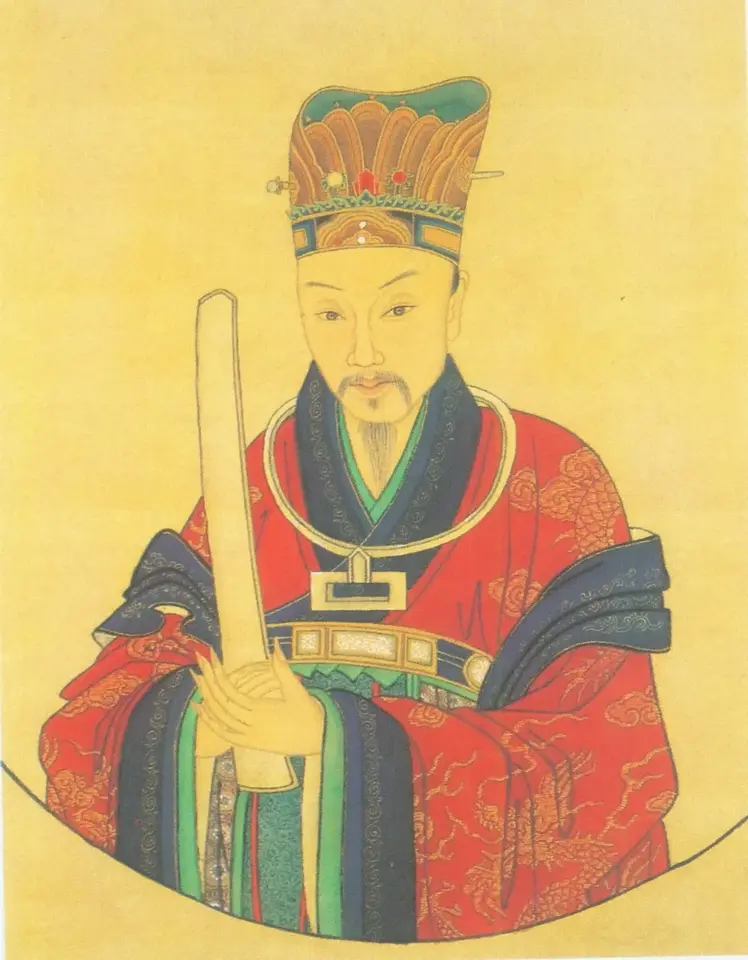
1480 CE–1567 CE
严嵩
Yan Song (严嵩; 1480–1567 AD), courtesy name Weizhong, sobriquet Jiexi, was a native of Fenyi, Yuanzhou, Jiangxi Province. He was the Senior Grand Secretary of the Ming Cabinet and supreme political courtier during the reign of the Jiajing Emperor of the Ming Dynasty, holding office as Grand Academician of the Huagai Hall, Junior Guardian, and Grand Tutor to the Crown Prince. Known historically as "Grand Secretary Yan," he was…
Yan Song (严嵩; 1480–1567 AD), courtesy name Weizhong, sobriquet Jiexi, was a native of Fenyi, Yuanzhou, Jiangxi Province. He was the Senior Grand Secretary of the Ming Cabinet and supreme political courtier during the reign of the Jiajing Emperor of the Ming Dynasty, holding office as Grand Academician of the Huagai Hall, Junior Guardian, and Grand Tutor to the Crown Prince. Known historically as "Grand Secretary Yan," he was categorized by the official History of Ming at the head of the Biographies of Treasonous Officials. Passing the imperial examination in 1505 AD, Yan retreated to his home province for a decade due to illness, successfully evading the purges of eunuch Liu Jin. During the Jiajing era, the monarch secluded himself in the Western Garden to pursue Daoist longevity rituals, neglecting normal court audiences. Yan won imperial favor through his literary mastery of Daoist liturgical prayer-poems (qingci), entering the Grand Secretariat in 1542 AD. To monopolize supreme authority, he engineered the execution of Senior Grand Secretary Xia Yan in 1548 AD over border defense debates, securing the position of Senior Grand Secretary for fifteen years. Operating in tandem with his cunning one-eyed son Yan Shifan, Yan sold offices, embezzled millions, and orchestrated the execution of upright remonstrators including Yang Jisheng and Shen Lian. His misrule left northern borders defenseless during Altan Khan's siege of Beijing in 1550 AD and allowed wokou piracy to ravage the southeast. In 1562 AD, Junior Grand Secretary Xu Jie leveraged the Daoist diviner Lan Daoxing to expose his villainy, prompting the emperor to dismiss Yan. Following the execution of Yan Shifan, Yan Song was stripped of all honors and died impoverished in a graveyard shack in Fenyi in 1567 AD at age eighty-seven.
Born into a scholar family in Fenyi, educated rigorously in classical prose and poetry from childhood.
Earned the Jinshi degree second in the second class, selected as Hanlin Bachelor and appointed Compiler.
Re-entered official service following the fall of Liu Jin, advancing to Chancellor of the National University.
Summoned to Beijing as Minister of Rites, adroitly accommodating the emperor's ritual agendas during the Great Rites Controversy.
Awarded imperial trust through his exquisite Daoist prayer-poems; appointed Grand Academician of the Wuying Hall.
Slandered Senior Grand Secretary Xia Yan over the Ordos military expedition, seizing paramount cabinet leadership.
While Altan Khan besieged Beijing and plundered its suburbs, Yan kept writing Daoist prayers and refused to receive Zhao Zhenji, who came with a plan of resistance.
Appended the name of Yang Jisheng, who had impeached him for ten crimes and five treacheries, to the death sentences of Zhang Jing and Li Tianchong, bringing about his execution.
Xu Jie introduced the medium Lan Daoxing, whose séance announced that a treacherous minister would report that day; the weary emperor dismissed Yan.
Yan Shifan was executed and family estates confiscated; Yan died in extreme penury at age eighty-seven.
Yan Song was born on March 3, 1480, the twenty-second day of the first month of the sixteenth year of Chenghua, in Jieqiao Village, Fenyi County, Yuanzhou Prefecture, Jiangxi (modern Jieqiao Village, Fenyi Town, Fenyi County). His father Yan Huai had repeatedly failed the civil examinations and placed all his hopes in his son, educating him with great care. Yan Song began his studies in the clan hall at five, entered the county school at nine, passed the county test at ten, and at nineteen placed sixteenth in the Jiangxi provincial examination. In 1505, at twenty-five, he passed the metropolitan examination, ranking second in the second class with the Book of Odes as his specialty, and was selected as a Hanlin bachelor and later appointed compiler.
Soon after entering office Yan Song fell gravely ill and returned home. The ten years he spent there coincided with the height of the eunuch Liu Jin's power. In 1512 the Yuanzhou prefect Yao Ting opened an office to compile a local gazetteer and invited Yan Song to be its chief editor; when Yao left office, his successor Xu Lian asked Yan to continue. The work was completed in 1514, a jiaxu year in the sexagenary cycle, and became known as the Jiaxu Gazetteer, later called the Zhengde Gazetteer of Yuanzhou. After Liu Jin and his faction were destroyed, Yan Song went north and formally resumed office, serving over the next decade in the Hanlin Academies of Beijing and Nanjing.
The Jiajing Emperor was absorbed in Daoism and the quest for longevity and left routine business largely to his ministers. The minister of rites Xia Yan, a favorite of the emperor and a fellow Jiangxi native, was assiduously courted by Yan Song. A few months after the emperor's accession in 1521, Yan became reader of the Nanjing Hanlin Academy and acting head of its affairs; in 1525 he became chancellor of the Imperial Academy; in 1532 minister of rites in Nanjing and two years later minister of personnel in Nanjing. In 1536, when he came to Beijing for the court evaluation, the emperor kept him as minister of rites and academician of the Hanlin Academy. Because the emperor attached great importance to ritual, the minister of rites enjoyed special prominence and the post often led to the Grand Secretariat. By Yan's own account, the emperor, busy settling rites and music with his advisers, sometimes summoned him two or three times a day and kept him until midnight; living about four li west of the palace, he often galloped in alone without waiting for his attendants. In 1538, when someone proposed giving the emperor's father a temple name and placing him in the imperial ancestral temple, Yan at first joined other ministers in opposing it. The emperor angrily wrote a treatise rebuking them, whereupon Yan completely reversed himself and drew up detailed ritual arrangements. This dispute marked the end of the Great Rites Controversy.
In 1542, when the senior grand secretary Xia Yan was dismissed, Yan Song entered the Grand Secretariat as junior guardian, junior guardian of the heir apparent, minister of rites and grand academician of the Wuying Hall, while continuing to run the Ministry of Rites. Xia Yan, proud and opposed to the emperor's Daoist devotions, gradually lost favor. When the emperor gave his ministers Daoist caps of aloeswood, Xia refused to wear his, whereas Yan wore his to every audience, covering it with light gauze as a mark of reverence, which made the emperor favor Yan and dislike Xia still more. Promoted to grand tutor of the heir apparent, Yan began to attack Xia. In 1543 the minister of personnel Xu Zan and the minister of rites Zhang Bi joined Yan in handling confidential affairs, but the emperor consulted only Yan. In the twelfth month of 1545, after Xu Zan retired through illness and Zhang Bi died, the emperor recalled Xia Yan. Xia, now aware of Yan's character, kept constantly on guard, while Yan, outwardly deferential, nursed his resentment and regained the emperor's confidence through his Daoist prayer compositions.
Around 1544 the Mongols entered the Ordos region (east of the Helan Mountains and south of the Lang and Daqing Mountains in modern Ningxia and Inner Mongolia). The supreme commander of Shaanxi, Zeng Xian, proposed recovering the Ordos, building a wall from Huangfuchuan in Fugu to Dingbian and advancing by land and water to drive the Mongols out, and Xia Yan supported him. The emperor at first resolved to recover the region and commended Zeng Xian. Yan Song, however, bribed the emperor's attendants to say that Zeng Xian was rashly provoking war, had the frontier general Qiu Luan falsely accuse Zeng of concealing defeats, embezzling army pay and bribing Xia Yan, and hinted to the emperor that the two men had ulterior motives. The emperor believed him. In the third month of 1548 Zeng Xian was executed and his wife exiled two thousand li, and Xia Yan was imprisoned; Yan then used rumors to convince the emperor that Xia had slandered him. In the tenth month Xia Yan was beheaded and his associates demoted or punished. Yan Song again became senior grand secretary and thereafter monopolized the government.
The emperor was devoted to Daoist rites and longevity, and Yan Song spared no expense to please him. Temples and secret halls were built at twenty or thirty sites employing tens of thousands of workmen, at an annual cost of two to three million taels, while the central treasury's annual income was only about two million. When funds ran short, subjects were made to contribute, and when contributions fell short offices were openly sold, wasting the people's resources even more than under the Zhengde Emperor. Daoist rites required prayer compositions addressed to the immortals, and Yan rose to favor precisely through his skill at them; it was said that no one else's prayers satisfied the emperor. He devoted enormous effort to them, sometimes forgetting food and sleep. Even in 1550, when Altan Khan besieged Beijing and plundered its suburbs, he was absorbed in writing prayers, and when the left admonisher Zhao Zhenji came to see him with a plan of resistance before going to the front, Yan refused to receive him on the grounds that he was composing a prayer. People mocked him as the prayer-writing chancellor.
After Xia Yan's death, conflict grew between Yan Song and Qiu Luan. Imprisoned after Zeng Xian impeached him, Qiu had become Yan's adopted son in prison, and Yan's son Yan Shifan had drafted his memorial accusing Zeng. Once Zeng was dead and Qiu enjoyed favor, he resented Yan's control and secretly denounced the conduct of Yan and his son, drawing the emperor's attention. In 1552 Yan was cold-shouldered: four times he was not summoned when ministers went on duty, and once he was even stopped by guards when entering the Western Park with other grand secretaries, returning home to weep with Yan Shifan. Fortunately for him, Qiu soon fell gravely ill, and the commander of the Embroidered Uniform Guard Lu Bing reported Qiu's misconduct to the emperor, who recalled Qiu's seal; Qiu died in fear, and the rift between emperor and chancellor closed.
With Xia Yan and Qiu Luan gone, no one at court could rival Yan Song. Knowing the emperor's suspicion of his ministers, he struck ruthlessly at all who impeached him, dismissing the lesser and destroying the greater; the deaths of Shen Lian and Yang Jisheng are the most notorious examples. Shen Lian listed ten crimes, chiefly bribery, selling offices, building a faction, envy of the able, muzzling remonstrators and abusing imperial favor. Yan retorted that Shen had committed faults as a county magistrate and was seeking to escape evaluation and win a reputation by memorializing; the emperor believed him and banished Shen to Bao'an beyond the frontier. When Shen continued to curse Yan and his son there, Yan left the matter to Yan Shifan, who promised the new regional inspector Lu Kai and the supreme commander Yang Shun a marquisate or a ministerial post if they removed him. When the White Lotus sectarian Yan Hao and others were arrested and named many accomplices, Yang Shun and Lu Kai added Shen Lian's name, and Shen was executed.
The vice director of the Ministry of War Yang Jisheng impeached Yan for ten crimes and five treacheries, linking him both to the northern frontier crisis that most troubled the emperor and to celestial portents believed to signal ministerial usurpation and rebellion; the substance again concerned bribery, factionalism and the persecution of opponents. These charges might have moved the emperor, but the memorial ended by suggesting that he consult the Princes of Yu and Jing or the other grand secretaries, a grave mistake, for the emperor, following Daoist advice, refused to see his sons, and princes were not supposed to meddle in government. Yan seized on this in a secret memorial, the enraged emperor sent Yang to the Guard's prison for interrogation, and Yan later appended Yang's name to the death sentences of the censor-in-chief Zhang Jing and Li Tianchong; the emperor approved, and Yang was executed.
In 1553, with no heir apparent yet named, the emperor ordered the Princes of Yu and Jing to marry in separate residences. Yan objected that with the succession unsettled, princes living outside the palace in adjoining mansions with large retinues loyal to different masters would easily fall into conflict, and proposed that they marry within the palace; a year later he urged the early appointment of an heir. Yet faced with deteriorating finances and politics he never offered remonstrance or reform, saying whatever the emperor wished to hear and carrying out even absurd wishes. Before 1536 palace expenses, though nominally reduced, still reached six or seven million taels a year, and the eight hundred thousand taels once stored in the Court of Imperial Entertainments were soon exhausted after 1542. It was in these conditions that Yan entered the Grand Secretariat and became its head, and he made matters worse.
As senior grand secretary he continued to serve the emperor carefully and received a silver seal inscribed Loyal, Diligent, Quick and Perceptive. In old age he relied on his son Yan Shifan, who became vice minister of works and bribed the eunuchs around the emperor to report every detail of his daily life. Officials privately called father and son the elder and younger chancellors, and some quipped that the emperor could not do without Yan Song, nor Yan Song without his son. Yan Shifan once laughed in his treasury that the court was not as rich as he. Under their control government business was settled by bribes and offices were bought: a seventh-rank assistant department magistrate cost three hundred taels and a sixth-rank assistant prefect five hundred; the secretary Xiang Zhiyuan paid thirteen thousand taels for a transfer to the Ministry of Personnel, and the tribute student Pan Hongye paid two thousand two hundred taels to become department magistrate of Linqing; among military posts a commander cost three hundred and a regional commander seven hundred, and the dismissed general Li Fengming paid two thousand to be reinstated as commander of Jizhou. Many officials impeached them, but the emperor protected them. Father and son held power for twenty years and were hated throughout the empire.
In 1561, when the minister of personnel Wu Peng retired, Yan arranged the nomination of his relative Ouyang Bijin. The emperor, who disliked the man, threw the list to the floor in anger, but when Yan secretly pleaded that Ouyang was his close kin and that seeing him in power would comfort his old age, the emperor reluctantly agreed, only to retire Ouyang a few months later, a serious warning to Yan. After Yan's wife died, Yan Shifan had to observe mourning and could no longer assist his father, who often failed to understand the emperor's handwritten notes. In 1562 the Shandong Daoist Lan Daoxing, famed for spirit writing, was introduced to the emperor by the second grand secretary Xu Jie; one day during a séance he declared that a treacherous minister would come to report that day, just as Yan Song passed by. Already weary of Yan and his son, the emperor dismissed Yan, and the power of the family was overturned by a few words from the medium.
In 1565 Yan Shifan was sentenced to beheading and wept bitterly before his execution. Yan Song's property was confiscated and, stripped of office, he returned home with nowhere to live. He died in poverty and illness in 1567, aged eighty-seven by traditional reckoning, lodging in a hut beside his ancestors' graves, with no coffin for his burial and no mourners to attend.
During his retirement Yan Song served as chief editor of the prefectural gazetteer at the invitation of the prefects Yao Ting and Xu Lian, completing in 1514 the Zhengde Gazetteer of Yuanzhou, known as the Jiaxu Gazetteer, an important source for the local history of Yuanzhou in the Ming.
Skilled at reading the Jiajing Emperor's wishes, Yan accommodated him in ritual disputes and excelled at writing Daoist prayer compositions, rising from minister of rites to senior grand secretary and earning the nickname of the prayer-writing chancellor. His lavish building for the emperor's Daoist devotions added heavily to the Ming fiscal burden.
Exploiting the debate over recovering the Ordos, Yan bribed palace attendants, had Qiu Luan bring false charges against Zeng Xian and used rumors to inflame the emperor, bringing about the execution of both Zeng Xian and Xia Yan and securing sole control of the Grand Secretariat.
Yan took brutal revenge on those who impeached him, having Shen Lian killed through a White Lotus case and Yang Jisheng executed by appending his name to the death sentences of Zhang Jing and Li Tianchong, silencing upright criticism at court.
Together with Yan Shifan, Yan Song held power for twenty years and sold offices at fixed prices according to rank, gravely corrupting Ming administration, until Xu Jie engineered his fall, Yan Shifan was executed and the family property confiscated.
FIGURES ASSOCIATED WITH THIS DYNASTY