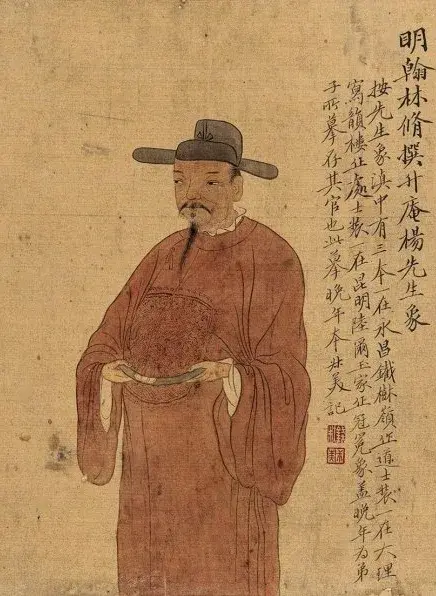
Life Story
Heritage and Early Bureaucratic Service
Yang Bo was born on June 11, 1509, in Puzhou Independent Battalion, Pingyang Prefecture, Shanxi. The Yang family of Puzhou was an esteemed regional clan with deep traditions of Confucian scholarship and civil service. His father, Yang Zhan, had served as an investigating censor known for outspoken integrity, eventually rising to the post of Minister of War. Under his father's strict intellectual tutelage, Yang Bo immersed himself in classical philosophy, historical chronicles, and ancient military treatises, developing a keen fascination with border defense and geopolitical topography.
In his youth, Yang Bo displayed exceptional analytical clarity and ambition. Beyond mastering Confucian classics, he studied the strategic passes, rivers, and mountain barriers of the empire. In 1528, at the age of twenty, he passed the Shanxi provincial examination, and in the following year, 1529, he attained the jinshi degree.
His administrative career commenced with grassroots appointments as Magistrate of Zhouzhi in Shaanxi and subsequently Changyuan in the northern metropolitan region. In these jurisdictions, Yang Bo personally adjudicated litigations, encouraged agricultural reclamation, dredged irrigation canals, and organized local defense militias. His stellar administrative record earned commendation from regional inspectors, leading to his recall to the capital in 1534 as a Director in the Bureau of Operations within the Ministry of War.
Tour of the Nine Frontiers and Central Military Staff
Upon entering the Ministry of War, Yang Bo recognized the growing crisis along the northern borders. The resurgence of Mongol federations under Altan Khan threatened the fragile defenses of Shanxi and Xuanfu. Serving in the bureau responsible for maps, garrisons, passes, and troop deployments, Yang Bo meticulously examined dynastic military registers and topographical charts.
In 1540, as northern tensions mounted, Emperor Shizong dispatched Grand Secretary Zhai Luan on an imperial inspection of the Nine Frontier garrisons. Minister of War Zhang Zan, cognizant of Yang Bo's extraordinary grasp of military geography, selected him as the principal military aide for the mission. The delegation traversed thousands of miles from Liaodong and Jizhou through Xuanfu, Datong, Pianguan, Yansui, Ningxia, Guyuan, and Gansu.
During this arduous two-year expedition, Yang Bo personally climbed observation towers, inspected frontier fortifications, and evaluated garrison discipline. He drafted detailed terrain maps and tactical reports, including the Strategic Atlas of Jizhou Garrison, outlining defensive deficiencies and riverbank fort placements. Grand Secretary Zhai Luan was deeply impressed by Yang's strategic foresight and recommended him enthusiastically to the throne upon their return, securing his promotion to Chief Director within the Ministry of War.
Command of Xuan-Da and the Gengxu Defense
In 1546, as Mongol incursions intensified along the northern border, Emperor Shizong appointed Yang Bo as Right Vice Minister of War and Supreme Commander of Xuanfu and Datong. Taking command of a demoralized frontier force, Yang Bo immediately enforced strict military discipline, executed commanders who retreated, restructured signal beacon networks, and accelerated wall construction.
Yang Bo introduced innovative tactical adaptations. He directed the construction of nine major border fortresses, including Niuxin Mountain, ninety-two beacon towers, and sixty-four defensive trenches. To neutralize the battlefield mobility of Mongol cavalry, he commissioned more than one hundred war wagons equipped with defensive mantlets and firearms, training infantry to coordinate maneuvers behind rolling ramparts. In 1547, when Altan Khan led tens of thousands of cavalry toward Huairen, Yang Bo ambushed the raiders at narrow defiles, utilizing wagon formations and firearms to inflict heavy casualties and compel a retreat.
In August 1550, Altan Khan bypassed heavily fortified Datong, pierced the frontier at Gubeikou, and swept down to the gates of Beijing, an event known as the Gengxu Incident. As the capital panicked and imperial guards faltered, Yang Bo marshaled seasoned frontier contingents and completed a forced march to the capital. Entrusted with city defenses, he maintained calm, supervised cannon placements along the outer walls, enforced night curfews, and launched counter-raids against enemy camps. Finding Beijing well prepared and encircled by arriving relief armies, Altan Khan withdrew beyond the passes. For his resolute defense, Yang Bo was elevated to Minister of War.
Supreme Command of Jiliao and the Relief of Datong
In 1554, with Mongol forces testing eastern defenses, the court appointed Yang Bo as Minister of War and Supreme Commander of Jiliao, overseeing military affairs in Jizhou, Liaodong, and Baoding. Traversing the Great Wall passes of Gubeikou and Xifengkou, Yang Bo constructed stone bastions along riverbanks and built layered warning outposts across mountain passes, neutralizing hostile cavalry infiltration.
In 1556, Yang Bo retired to observe mourning for his deceased father. However, soon after his departure, Altan Khan concentrated overwhelming cavalry forces to encircle Datong Right Guard. The fortress remained under siege for six months; food supplies were exhausted, defenders survived on roots and leather armor, and relief forces hesitated to advance. In desperation, Emperor Shizong issued an urgent decree recalling Yang Bo from mourning to resume supreme command of Xuan-Da.
Rushing to the front, Yang Bo devised a two-pronged strategy: while ordering garrison units along the perimeter to hoist numerous banners to simulate a general offensive, he directed Vice Minister Jiang Dong to lead light cavalry in a swift rear raid against Mongol supply trains. Concurrently, daring messengers infiltrated the besieged citadel to coordinate a synchronized sally. Fearing his retreat route was severed, Altan Khan lifted the siege and retreated northward overnight. In 1558, Yang Bo returned to the capital to direct the Ministry of War, purging fraudulent names from military payrolls and modernizing the Three Capital Battalions.
Heading the Ministry of Personnel and Late-Life Honors
Following the demise of Emperor Shizong in late 1566, the Longqing Emperor ascended the throne. Yang Bo was reassigned from the Ministry of War to head the Ministry of Personnel, the preeminent civilian ministry governing civil appointments and performance assessments. At a time when administrative bribery and partisan influence remained pervasive, Yang Bo instituted strict merit-based protocols, summarily rejecting private solicitations from imperial relatives and senior grand secretaries.
In evaluating officials, Yang Bo prioritized practical competence and integrity over rhetorical talent. He systematically promoted capable administrators with frontline frontier experience, most notably sponsoring Wang Chonggu and Fang Fengshi to oversee northern borders. This personnel support directly facilitated the realization of the Longqing Peace Accord of 1571, establishing formal border tribute markets and securing decades of northern peace.
Retirement and Posthumous Honors
The Longqing Emperor advanced Yang Bo to Junior Preceptor and Grand Tutor of the Heir Apparent. In handling court affairs, Yang Bo maintained an open-minded and conciliatory demeanor, serving as a stabilizing mediator between rival Grand Secretaries Gao Gong and Zhang Juzheng. In 1573, following the accession of the ten-year-old Wanli Emperor, Yang Bo repeatedly requested retirement due to severe leg ailments and declining vitality. The court granted his request with generous imperial stipends. Yang Bo returned to Puzhou and passed away peacefully on September 23, 1574, at age sixty-six. Emperor Shenzong suspended court proceedings, posthumously conferred the rank of Grand Tutor, and granted the posthumous title Xiangyi.
Major Achievements
Construction of the Frontier Shield and Nine-Garrison Strategy
Yang Bo's primary historical legacy was his comprehensive restructuring of northern border defense during the mid-sixteenth century. Facing continuous nomadic incursions and decaying imperial fortifications, Yang Bo served consecutively as Supreme Commander of Xuanfu and Datong, Supreme Commander of Jiliao, and Minister of War. He articulated the foundational doctrine that imperial security depended upon securing the Nine Frontiers, with Jizhou functioning as the primary gateway to the capital.
At the engineering level, Yang Bo supervised the reconstruction of hundreds of miles of outer border walls in Datong, establishing nine strongholds including Niuxin Mountain, ninety-two signal towers, and sixty-four deep trenches. To overcome the vulnerability of Chinese infantry against steppe cavalry, he introduced more than one hundred war wagons, pioneering mobile wagon-and-firearm combined tactics that neutralized cavalry mobility.
In institutional administration, Yang Bo secured tax exemptions for ravaged border prefectures, opened irrigation channels for abandoned arable lands, resettled frontier refugees, and recruited local frontiersmen into defensive ranks, recovering over sixteen hundred captured civilians. His synthesis of structural fortifications, tactical wagon systems, and economic revitalization stabilized the northern perimeter.
Rectification of Civil Administration and Eradication of Patronage
During his tenure as Minister of Personnel in the Longqing reign, Yang Bo transformed the imperial civil service by dismantling entangling patronage networks. He closed informal channels of factional recommendation, insisting that appointments adhere strictly to statutory evaluations and administrative examinations. Requests from imperial in-laws or powerful courtiers were consistently turned away.
Yang Bo restructured performance evaluation standards, judging regional governors, military commanders, and county magistrates on tangible governance results such as agrarian recovery, judicial fairness, and defense readiness. Negligent or corrupt officials were demoted, while diligent administrators were promoted regardless of family origins. His promotion of Wang Chonggu and support for Zhang Juzheng laid the administrative groundwork for the Longqing Peace Accord with Altan Khan and the Wanli administrative reforms.
His equitable management of civil examinations and evaluations preserved administrative cohesion during a period of intense ideological and factional friction, ensuring the smooth implementation of crucial fiscal and maritime reforms under the Longqing Emperor.
Strategic Prudence and Stabilization of the Imperial Court
Yang Bo possessed an unshakeable composure and deep strategic intellect, earning acclaim from contemporary chroniclers for his tranquil mastery during extreme emergencies. During the panic of the Gengxu Incident of 1550, his serene deployment of capital defenses prevented widespread collapse. His accurate foresight during border skirmishes, such as predicting the tactical vulnerability of Qiangziling in 1563, reflected his mastery of military geography.
Within the imperial court, Yang Bo navigated the turbulent waters of late Jiajing autocracy and the volatile transition between the Longqing and Wanli reigns. While Grand Secretary Yan Song wielded despotic power, he held Yang Bo in deep respect and could not undermine his standing. Emperor Shizong, renowned for unpredictable temper and reclusive Daoist retreats, regularly sent midnight queries on urgent border strategy, all of which Yang Bo resolved with clarity.
During factional rivalries between Gao Gong and Zhang Juzheng, Yang Bo refused to align with factional cliques, placing the preservation of the Ming state above partisan interests. His broad-minded statesmanship earned him universal respect across court factions, leading contemporaries to celebrate him as the foremost among the Three Geniuses of the Empire.