Birth | Born on the nineteenth day of the eleventh lunar month in Guo County, Northern Zhili.
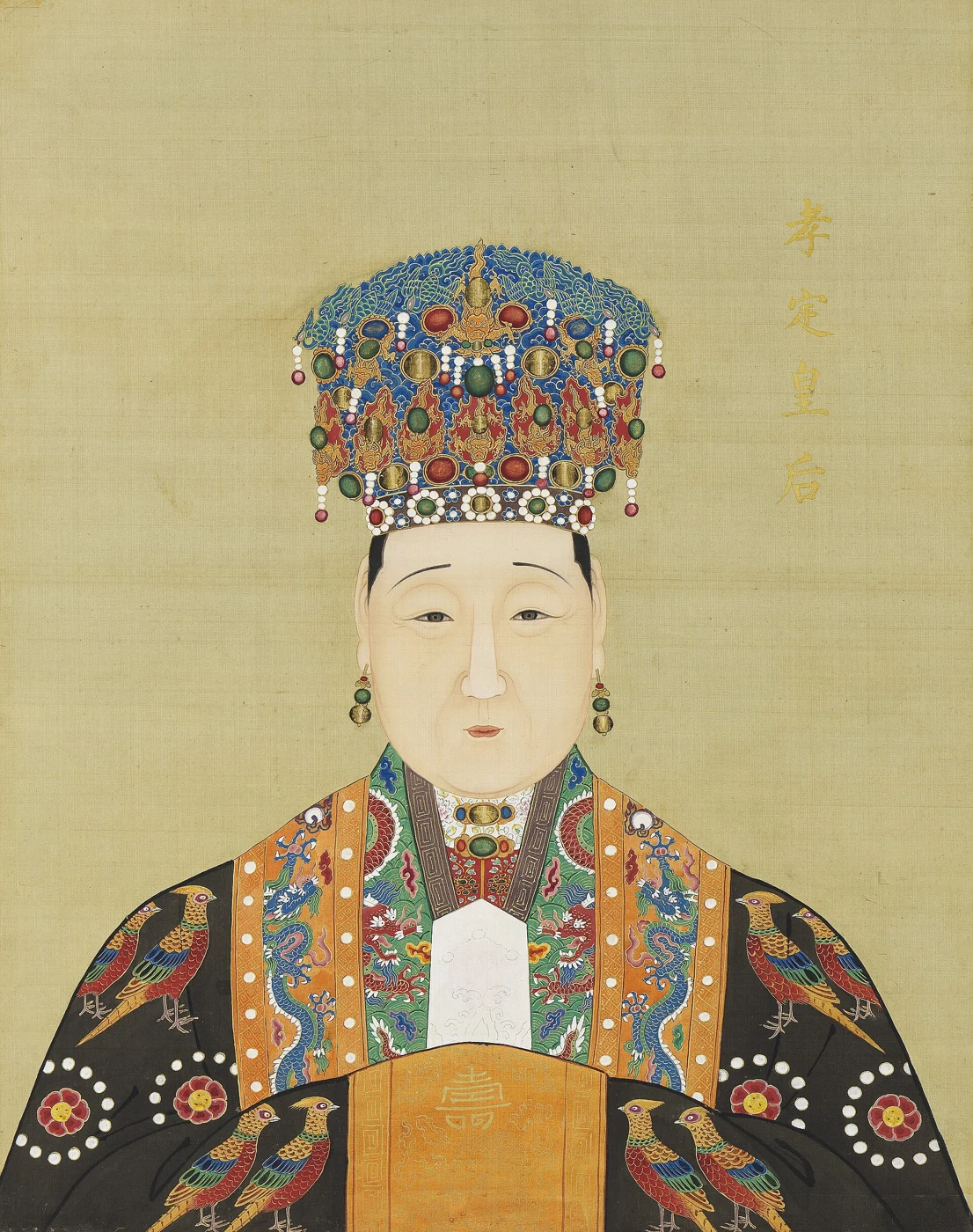
1546 CE–1614 CE
Empress Dowager
Empress Dowager Li (Mother of the Wanli Emperor)
李氏(明神宗生母)
Empress Dowager Xiaoding Li (1546–1614), Lady Li, was born on the nineteenth day of the eleventh lunar month in the twenty-fifth year of the Jiajing era and died on the ninth day of the second lunar month in the forty-second year of the Wanli era. A later tradition gives her personal name as Caifeng. She was from Guo County, Shuntian Prefecture, Northern Zhili, in present-day Tongzhou District of Beijing, with ancestral…
1546 CE–1614 CEMing Dynasty
PROFILE
Empress Dowager Xiaoding Li (1546–1614), Lady Li, was born on the nineteenth day of the eleventh lunar month in the twenty-fifth year of the Jiajing era and died on the ninth day of the second lunar month in the forty-second year of the Wanli era. A later tradition gives her personal name as Caifeng. She was from Guo County, Shuntian Prefecture, Northern Zhili, in present-day Tongzhou District of Beijing, with ancestral origins in Yicheng, Shanxi. She was a Noble Consort of Emperor Muzong of Ming, Zhu Zaiji, and the birth mother of Emperor Shenzong, Zhu Yijun. Her full posthumous title was Empress Dowager Xiaoding Zhenchun Qinren Duansu Bitian Zuosheng.
- Alternative Names
- Empress Dowager Xiaoding Li; Empress Dowager Cisheng; mother of the Wanli Emperor
- Period
- Ming
- Dynasty/Polity
- Ming
- Identity
- Empress Dowager
- Ethnicity/People
- Not reliably established in surviving sources
- Native Place
- Guo County, Shuntian Prefecture, Northern Zhili (present-day Tongzhou District, Beijing)
- Date of Birth
- 1546 (19th day of the 11th lunar month, 25th year of the Jiajing era)
- Place of Birth
- Unknown
- Date of Death
- 1614 (9th day of the 2nd lunar month, 42nd year of the Wanli era)
- Posthumous Name
- Empress Dowager Xiaoding Zhenchun Qinren Duansu Bitian Zuosheng
- Major Achievements
- Noble Consort of Emperor Muzong and mother of Emperor Shenzong; supported Zhang Juzheng in the early Wanli reign and was a devout Buddhist patron associated with the Palace of Compassion and Tranquility.
LIFE TIMELINE
Age five | During the Gengxu Crisis, she moved with her family to Beijing.
Age sixteen | Entered the household of the Prince of Yu as a palace maid.
Age eighteen | Gave birth to the Prince of Yu's third son, Zhu Yijun.
Age twenty-one | The Prince of Yu, Zhu Zaiji, succeeded to the throne as Emperor Muzong of Ming.
Age twenty-two | In the third lunar month, she was invested as Imperial Noble Consort.
Age twenty-three | Gave birth to Zhu Yiliu; her son Zhu Yijun was formally appointed heir apparent.
Age twenty-seven | Emperor Muzong died and Zhu Yijun succeeded to the throne; she was honored as Empress Dowager Cisheng and moved to the Palace of Heavenly Purity.
Age twenty-eight | Gave birth to Zhu Yaoyuan, later Princess Rui'an.
Age thirty-three | After Emperor Shenzong's marriage, she returned political authority and moved back to the Palace of Compassion and Tranquility; in the third lunar month she received the additional honorific “Xuanwen.”
Age thirty-six | Sent eunuchs to Mount Wutai to establish a Buddhist ritual site for prayers for imperial heirs.
Age thirty-seven | Received the additional honorific “Mingsu.”
Age thirty-nine | Visited the imperial tombs in the Tianshou Mountains with Empress Dowager Rensheng.
Age fifty-six | Received the additional honorific “Zhenshou Duanxian”; the emperor's eldest son Zhu Changluo was formally appointed heir apparent.
Age sixty-one | Received the additional honorific “Gongxi.”
Age sixty-nine | Died on the ninth day of the second lunar month; received the full posthumous title Empress Dowager Xiaoding Zhenchun Qinren Duansu Bitian Zuosheng and was jointly buried in the Zhaoling Mausoleum.
BIOGRAPHY
Biography
Family Background and Early Years
Empress Dowager Li was born on the nineteenth day of the eleventh lunar month in 1546. Her father was Li Wei and her mother Lady Wang. The Li family was not prominent. A biographical account of Li Wei records that before his daughter's birth he dreamed of multicolored clouds, an imperial carriage, banners, and music descending toward the family residence. The source notes that such portent stories are common in biographies of later-prominent figures and need not be accepted literally, but they show how the family's origins were later mythologized after her rise.
In 1550, during the Gengxu Crisis, Altan Khan's Mongol forces approached the capital and the metropolitan region was placed on alert. The Li family therefore moved to Beijing. Surviving sources do not give a precise date for Lady Li's entry into the Prince of Yu's household. According to an inference from her father's biographical account, she probably entered as a palace maid around 1561, at about age sixteen.
The Prince of Yu, Zhu Zaiji, was the third son of Emperor Shizong. Because his elder brothers had died young, he was effectively the eldest surviving son, but Emperor Shizong was said to have believed in a taboo that “two dragons should not meet,” and treated the prince coldly. The prince's household therefore occupied a delicate position late in the Jiajing reign. After entering the household, Lady Li gained Zhu Zaiji's favor because, according to the source, she was attractive, intelligent, and quick-minded.
From Palace Maid to Imperial Noble Consort
On the seventeenth day of the eighth lunar month in 1563, Lady Li gave birth to Zhu Yijun, the Prince of Yu's third son. The prince had previously had two sons, but both had died young, so Zhu Yijun's birth was especially important. In the second lunar month of 1566, Lady Li gave birth to a daughter, later Princess Shouyang Zhu Yao'e.
In the twelfth lunar month of 1566 Emperor Shizong died, and the Prince of Yu succeeded as Emperor Muzong, adopting the Longqing era name the following year. In the third lunar month of 1567, Muzong invested Lady Li as Imperial Noble Consort, while Lady Jiang, mother of the eldest imperial daughter, was made Worthy Consort. The investiture document praised Lady Li as gentle and upright. By this point she was described as having borne “two imperial sons and daughters.”
In 1568 Lady Li gave birth to her second son Zhu Yiliu. That same year Zhu Yijun was formally established as heir apparent, further strengthening her position in the palace. She later also gave birth to Princess Yongning Zhu Yaoying and Princess Rui'an Zhu Yaoyuan. The source states that Lady Li had two sons and three daughters, more children than any of Emperor Muzong's other consorts.
Empress Chen, Muzong's principal wife, had no son and was frequently ill and out of favor. Lady Li nevertheless did not behave arrogantly toward her and consistently showed deference. The source connects this behavior with the later inclusion of “Duansu” in her posthumous title and with the relatively harmonious relationship between the two empress dowagers during the Wanli reign.
Empress Dowager Cisheng and the Palace of Heavenly Purity
In the fifth lunar month of 1572 Emperor Muzong died and the ten-year-old Zhu Yijun succeeded as Emperor Shenzong. Under earlier Ming convention, the principal empress of the deceased ruler became empress dowager, while the new emperor's birth mother, if formerly a consort, was distinguished by an added honorific. The eunuch Feng Bao sought to please Lady Li and encouraged Grand Secretary Zhang Juzheng to have the court discuss the matter. The final decision honored Empress Chen as Empress Dowager Rensheng and Lady Li as Empress Dowager Cisheng, placing the two on an equal formal footing rather than emphasizing the distinction between principal wife and concubine.
Empress Dowager Chen lived in the Palace of Compassionate Celebration, while Empress Dowager Li resided in the Palace of Compassion and Tranquility. Zhang Juzheng petitioned that Li should oversee the young emperor's daily life, and she therefore moved into the Palace of Heavenly Purity. For the next several years she disciplined Emperor Shenzong strictly. When he did not want to study, she made him kneel as punishment; after lectures on the classics, she required him to repeat the content before her; and on court days she rose before dawn, personally woke him, ordered attendants to prepare him, and saw him off in his carriage.
In 1573, after Shenzong drank excessively at a private banquet in the western part of the palace, he ordered a eunuch to sing a new song. When the eunuch said he did not know it, the emperor drew a sword and threatened to kill him. Attendants intervened, after which the emperor cut the eunuch's hair as a prank. When Empress Dowager Li learned of the incident the next day, she sent word to Zhang Juzheng to submit a severe remonstrance and had a self-critical imperial statement drafted for the emperor. She then summoned Shenzong, made him kneel, and enumerated his faults until he cried and promised to reform.
Her discipline was not purely punitive. She placed great importance on imperial education, supported Zhang Juzheng's daily lectures for the emperor, and backed the compilation of teaching materials such as the Illustrated Mirror for the Emperor. She could also be relatively lenient toward officials. The censor Cao Xuecheng once angered Shenzong and nearly received a death sentence. Because Cao's mother was elderly, Empress Dowager Li pleaded for him and saved his life, although he remained imprisoned for ten years.
Return to the Palace of Compassion and Tranquility and Later Years
In 1578, after Shenzong's marriage, Empress Dowager Li returned political authority and moved back to the Palace of Compassion and Tranquility. Before leaving, she reminded Zhang Juzheng that she could no longer supervise the emperor morning and evening and asked Zhang, who had received the late emperor's trust, to continue instructing him daily and not betray that confidence. In the third lunar month of the same year she received the additional honorific “Xuanwen.”
She did not completely withdraw from politics after returning authority. She continued to pay attention to major affairs, especially the long succession dispute. After Zhang Juzheng's death in 1582, Shenzong's purge of Zhang's family gradually intensified, and the source states that Empress Dowager Li did not take a clear position.
In 1601, after years of controversy over the succession, Shenzong finally appointed his eldest son Zhu Changluo heir apparent. Empress Dowager Li's position strongly influenced the outcome. According to the account, Shenzong once resisted on the grounds that Zhu Changluo had been born to a palace woman. Li rebuked him by saying that a mother's status was raised by her son and asking whether he himself was not also the son of a palace maid. Since Shenzong's own mother had indeed begun as a palace maid, he could not easily continue the argument.
In the second lunar month of 1614 Empress Dowager Li became gravely ill. An imperial proclamation stated that “our compassionate mother died at noon on the ninth day of the second month.” She was sixty-nine. She received the full posthumous title Empress Dowager Xiaoding Zhenchun Qinren Duansu Bitian Zuosheng, was buried with Emperor Muzong in the Zhaoling Mausoleum, and received additional sacrifices in Chongxian Hall.
Major Activities
Stabilizing the Early Wanli Government
When Emperor Muzong died in 1572, the new ruler was only ten, creating a potentially unstable transition. Grand Secretary Gao Gong and Feng Bao, director of the Directorate of Ceremonial, were in intense conflict. Empress Dowager Li and Empress Dowager Chen acted together to remove Gao on the charge of exercising autocratic power, and Zhang Juzheng became the leading grand secretary. The source presents this decision as stabilizing the succession period and creating political conditions for Zhang's reforms.
For the following several years, Empress Dowager Li lived in the Palace of Heavenly Purity and oversaw the young emperor's daily life while coordinating with Zhang Juzheng and Feng Bao. Zhang implemented reforms including the examination-of-achievements system and the Single-Whip reforms, and Li supported him within the palace. The History of Ming: Biography of Empress Dowager Xiaoding Li states that in the early Wanli government, Zhang Juzheng was entrusted with authority, administrative performance was rigorously examined, and the state came close to wealth and strength, with the empress dowager contributing substantially.
Disciplining Emperor Shenzong
Empress Dowager Li invested great energy in her son's education. She required Shenzong to observe the classical lecture system, personally checked his learning, and rose before dawn on court days to ensure he attended court on time. She supported the rigorous curriculum arranged by Zhang Juzheng, including classics and histories, calligraphy, and practical training in government.
Her methods could be very strict. When Shenzong resisted study, she made him kneel; when he behaved improperly after drinking, she again punished him and had Zhang submit a strong remonstrance. The source argues that this highly pressurized education constrained him effectively while he was young but may also have contributed to later resistance once he reached adulthood. After his marriage in 1578 and her return to the Palace of Compassion and Tranquility, Shenzong increasingly escaped her direct control.
Position in the Succession Dispute
In 1582 Emperor Shenzong had relations with Lady Wang, a palace woman in Empress Dowager Li's household, and Lady Wang became pregnant. Shenzong initially denied responsibility, but Li ordered that the palace daily record be checked, forcing him to acknowledge the matter, and Lady Wang was made Consort Gong. In the eighth lunar month of that year, she gave birth to the emperor's eldest son Zhu Changluo.
In 1586 Shenzong's favored Noble Consort Zheng gave birth to his third son Zhu Changxun. The emperor wished to make Zhu Changxun heir apparent, producing a succession dispute that continued for years. Empress Dowager Li upheld the principle “if there is a legitimate son, establish the legitimate; if there is none, establish the eldest” and supported Zhu Changluo. The source again recounts her pointed reminder that Shenzong himself was the son of a former palace maid.
Under pressure from the empress dowager and officials, Shenzong finally appointed Zhu Changluo heir apparent in 1601. The source attributes decisive importance to Empress Dowager Li's position in this outcome.
Buddhist Patronage and the Nine-Lotus Bodhisattva
Empress Dowager Li was deeply devoted to Buddhism. Early in the Wanli reign she sponsored the casting of a large bell for Huangu Temple in the capital. She later built or supported temples and Buddhist rites at Cishou Temple, Mount Wutai, and elsewhere. In 1581 she sent eunuchs to Mount Wutai to establish a ritual site to pray for imperial descendants.
In 1586 a “auspicious lotus” reportedly appeared in the Palace of Compassion and Tranquility. Shenzong announced it to senior ministers and ordered them to submit poems. Later traditions identified Empress Dowager Li as an incarnation of the Nine-Lotus Bodhisattva, and late in Shenzong's reign texts such as the Sutra of the Great Compassionate Most Holy Nine-Lotus Bodhisattva's Transformation and Salvation of the World were promulgated.
The source states that her patronage contributed to the revival of Buddhism in the late Ming. She built and restored temples in the capital and elsewhere, donated Buddhist canons, and honored eminent monks. Yet temple construction consumed substantial labor and resources, and some religious activity was tied to sensitive issues of praying for and selecting heirs, which the source says deepened tensions between mother and son.
Compilation of the Mirror for Women
Empress Dowager Li supervised compilation of a work titled Mirror for Women, collecting examples of forty virtuous women and fourteen women who had failed in conduct. She wrote a preface and distributed the work to empresses and consorts for study. The source compares its purpose with Zhang Juzheng's Illustrated Mirror for the Emperor: both used historical examples as moral instruction, in this case to regulate conduct within the inner palace.
Personal Relations
Family
- Father: Li Wei, enfeoffed as Earl of Wuqing and later posthumously Duke of Wuqing
- Husband: Emperor Muzong of Ming, Zhu Zaiji
- Sons: Emperor Shenzong of Ming, Zhu Yijun; Zhu Yiliu, Prince of Lu
- Daughters: Princess Shouyang Zhu Yao'e; Princess Yongning Zhu Yaoying; Princess Rui'an Zhu Yaoyuan
- Grandson: Emperor Guangzong of Ming, Zhu Changluo
Allies and Associates
- Zhang Juzheng: Grand Secretary and Empress Dowager Li's most important political ally in the early Wanli government
- Feng Bao: director of the Directorate of Ceremonial; promoted equal honor for the two empress dowagers and formed a political alliance with Li and Zhang Juzheng
- Empress Chen, Empress Dowager Rensheng: Emperor Muzong's principal wife; jointly honored with Li and maintained a harmonious relationship with her
Ruler and Ministers
- Emperor Shenzong of Ming, Zhu Yijun: her son, whom she disciplined strictly
- Gao Gong: former chief grand secretary, removed through action by the two empress dowagers
- Noble Consort Zheng: Shenzong's favored consort, whose position in the succession dispute opposed Li's preference
Conflicts
- Gao Gong: removed in the sixth year of Longqing and directly in conflict with Li's political group
- Noble Consort Zheng: opposed Li for years over succession
- Emperor Shenzong: their relationship became more distant in the middle and later Wanli period because of strict discipline and the succession dispute
Historical Assessment
Ming and Contemporary Views
- The History of Ming: Biography of Empress Dowager Xiaoding Li describes her as strict and clear-sighted and credits her support of Zhang Juzheng and administrative reform with contributing substantially to the relative strength of the early Wanli state.
- The History of Ming: Biography of Imperial Relative Li Wei states that she restrained her natal family and, when Li Wei committed an offense, summoned and sharply reprimanded him rather than bending dynastic law because he was her father.
- Late Ming and early Qing scholar Zha Jizuo, in Records of the Guilty Ming, described her as strict, clear-sighted, and possessing discernment.
Early to Mid-Qing
- Qing historian Wan Sitong praised her use of capable men and argued that even the worthy empresses of antiquity did not necessarily surpass her.
- The compilers of the History of Ming criticized the costs of her Buddhist patronage but regarded her political conduct as far removed from the destructive influence of Lady Ke and Wei Zhongxian under the Tianqi emperor.
Late Qing and Republican Period
- Lin Shu wrote that Empress Dowager Li cared for the common people and described her relinquishing political authority as an action that surpassed earlier examples.
- Republican-era writer Cheng Fa argued that she exerted an enormous influence on the Wanli emperor because, in his view, no one else could provide him with the same natural maternal affection.
Modern Scholarship
- Wang Limei, in a study of Empress Dowager Xiaoding Li's influence on early Wanli politics, characterizes her as politically astute and argues that she actively participated in government through her status as empress dowager, worked to maintain imperial rule, and exerted substantial influence over the early Wanli government.
- He Xiaorong, in a study of her Buddhist patronage and the late Ming Buddhist revival, argues that her patronage strongly encouraged officials, commoners, clergy, and laypeople to build temples in the capital and elsewhere and played an important role in the Buddhist revival.
FIGURES ASSOCIATED WITH THIS DYNASTY
Bibliography
- History of Ming, juan 114, “Biography 2: Empress Dowager Xiaoding Li”
- History of Ming, juan 114, “Biography 2: Imperial Relative Li Wei”
- Veritable Records of Emperor Shenzong, juan 517