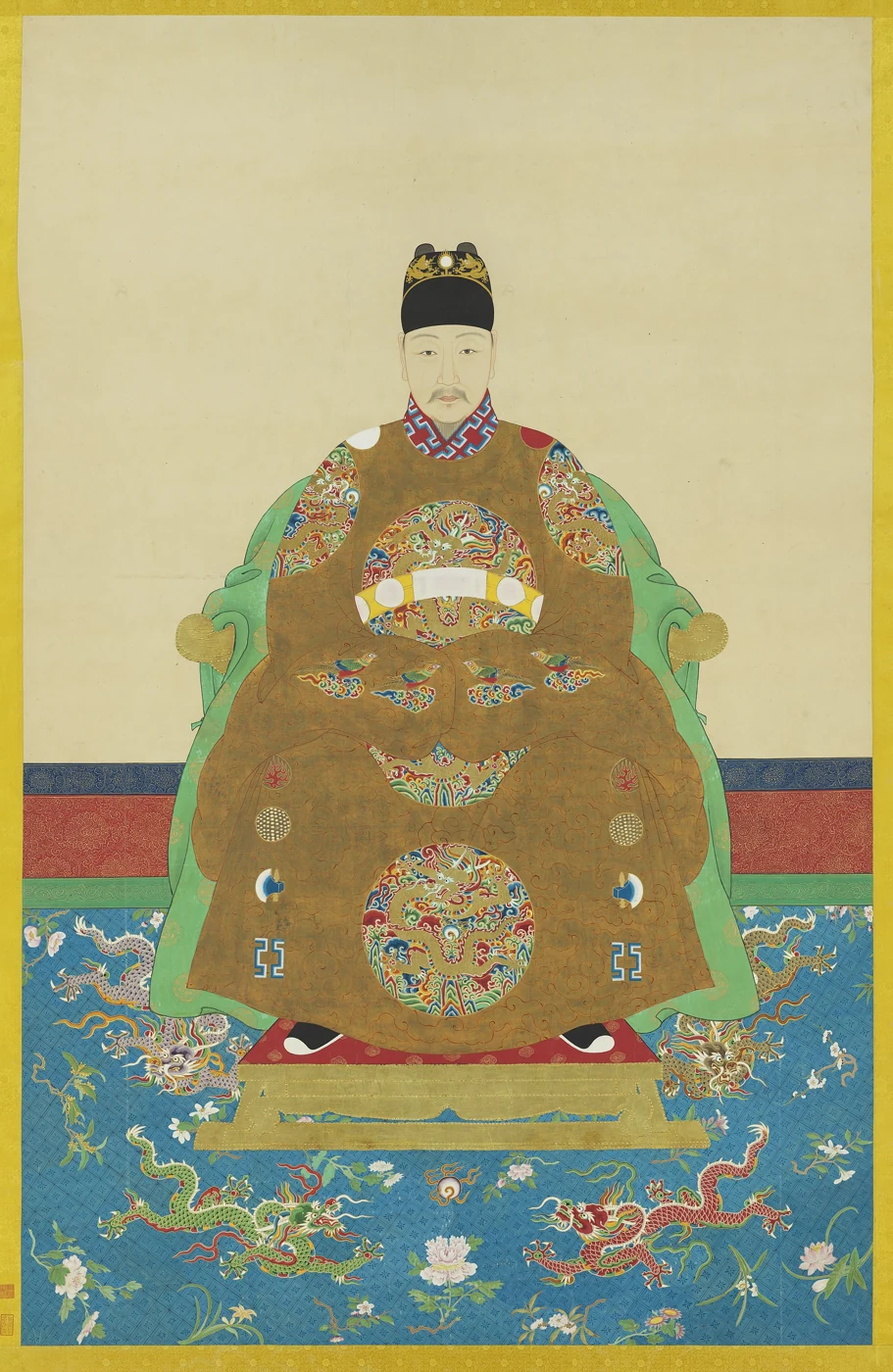
Biography
The Struggle over the Imperial Heir (Guoben Zhizheng)
Zhu Changluo's mother, Lady Wang, was of humble origin, a palace maid at Cining Palace who became pregnant after an encounter with the Wanli Emperor. The emperor's favored Consort Zheng wished to have her own son Zhu Changxun named heir. Court officials insisted on primogeniture, resulting in a struggle that lasted fifteen years. Zhu Changluo was finally named crown prince in 1601.
The Club Attack Case
In 1615, a man named Zhang Cha armed with a wooden club broke into the Crown Prince's residence Ciqing Palace, injuring gate guards before being captured. Interrogation pointed to connections with Consort Zheng's palace eunuchs. This became known as the "Club Attack Case," one of the three major cases of the late Ming.
Accession and Reforms
After the Wanli Emperor's death in the seventh month of 1620, Zhu Changluo formally ascended the throne with the era name Taichang. During his brief reign, he appointed capable ministers, abolished the long-hated mining and commercial taxes, recalled officials demoted for outspokenness, and attempted to restore good governance.
The Red Pill Case and Death
After reigning for just over a month, Zhu Changluo died after taking "red pills" offered by Court Official Li Kezhuo of the Honglu Temple, at age thirty-nine. His sudden and mysterious death left his son the Tianqi Emperor with a fractured and confrontational ruling group. The "Red Pill Case" became one of the three major late Ming political scandals.
His Obscure Birth and the Dispute over the Heir
Zhu Changluo (28 August 1582 - 26 September 1620), eldest son of the Wanli emperor, was born on the eleventh day of the eighth month of 1582, the child of a palace maid whom the emperor had casually favoured. The emperor's empresses and consorts having no sons since the enfeoffments of 1578, in 1581 he favoured the maid Wang in the chambers of his mother the empress dowager Li; she conceived, and the emperor "shunned the matter and dared not acknowledge it," but it was recorded in the palace diary and proved by the gifts he had given her, and the empress dowager, eager for a grandson, forced him to admit it. In 1582 he made Wang consort Gong, and she bore a son that eighth month, the eldest son, named Changluo. The empress having no sons and the emperor favouring Consort Zheng above the rest, she was made noble consort in 1584, bore a second son who died, and on the fifth day of the first month of 1586 bore a third son, Changxun, whereupon she was made imperial noble consort and took the occasion to beg that Changxun be made heir with herself as empress, "the two writing a pact and swearing to it in a Daoist temple." This broke both ancestral and ritual law and could only bring political crisis: the emperor, doting on Consort Zheng, long delayed naming an heir, and the ministers, fearing she meant to set up the third son and injure the foundation of the state, raised the question of the succession in memorials "numbering hundreds and thousands, all accusing the inner palace of meddling in government and pointing at Consort Zheng," while the emperor shelved them and went on favouring her. To settle the matter, in the tenth month of 1601 he at last made Zhu Changluo crown prince and the third son (Changxun) prince of Gui, ending the dispute over the foundation — the fiercest and most complicated political affair of the Wanli reign, which "forced out four grand secretaries and more than ten ministers, involved over three hundred officials central and local, of whom more than a hundred were dismissed, removed or sent into military exile." The waves did not subside: in 1603 a rumour of a change of heir led to many arrests, and in 1613 a further report that Consort Zheng and the prince of Fu meant to murder the crown prince ended only in the prince of Fu's being sent to his fief, and that was secretly blocked by Consort Zheng.
The plight of Zhu Changluo's mother shows his own position: Consort Gong Wang "still dwelt in isolation in the cold palace, unable to see the Wanli emperor, weeping all day so that in time she went blind"; she died in 1611, and when the grand secretary Ye Xianggao proposed a generous burial the emperor refused outright, consenting only on further remonstrance to grant her the posthumous title of imperial noble consort. On the fourth day of the fifth month of 1615 came the famous "club case": a man of over thirty, Zhang Chai, with a jujube-wood club forced his way into the Ciqing palace where the crown prince lived, "striking at everyone he met, wounding several gate officers and reaching the eaves of the hall," until the eunuch Han Benyong seized him and the palace quieted. Zhang Chai confessed that he had been sent by Consort Zheng's eunuchs Pang Bao and Liu Cheng; Consort Zheng wept before the emperor to save her men, and the emperor, with the ministers in an uproar over the crown prince's near murder, told her it would be best to seek the crown prince's forgiveness, whereupon she knelt to the crown prince and he bowed hastily in return. In the end the emperor and the crown prince would not press the matter, and Zhang Chai was executed as a madman, while on the first day of the sixth month the emperor secretly ordered the eunuchs to put Pang Bao and Liu Cheng to death, "so that the case could no longer be traced." This is the "club case," which with the red pill case and the removal-of-the-palace case makes up the "three cases" of the late Ming.
Accession, Illness and the Red Pill Case
In the seventh month of 1620 the Wanli emperor died, and in the eighth the crown prince took the throne, proclaimed an amnesty and announced the era name Taichang. It is recorded that on the first day of the eighth month, at his accession ceremony, he was "steady in gait and composed" and "of pure and unclouded look, with no sign of illness"; and that on the twenty-second and twenty-fourth of the seventh month of 1620 he had already "issued a million taels each time to reward the frontier troops in Liaodong, abolished the mining and commercial taxes, recalled the mining commissioners, filled up the grand secretariat and set the centre working again," so that "court and country were moved." Yet only ten days after the ceremony, on the tenth of the eighth month, he took to his bed. The (Ming History) records that Consort Zheng "presented eight waiting maids, and the emperor's illness began from exhaustion," and the Zuiwei lu likewise that "on his accession the consort presented beauties to serve him, and within ten days he fell ill." On the fourteenth, gravely ill, he was attended by the eunuch (Cui Wensheng), who had been a trusted eunuch of Consort Zheng's palace and was made a eunuch of the seal after his accession; when he fell ill "Consort Zheng directed Cui Wensheng, as eunuch in charge of the imperial pharmacy, to present him with a 'purging remedy,' that is rhubarb" — rhubarb being a purgative, so that in a day and a night he purged thirty or forty times, "his body wholly weakened and near collapse." The ministers fiercely attacked Cui Wensheng's qualifications and the violence of his remedy; the supervising secretary (Yang Lian) said: "The traitor Cui Wensheng knows no medicine... and makes reckless experiments; for if he knew medicine, then as physicians drain what is in excess and supplement what is deficient, and Your Majesty, in the midst of grief and with ten thousand affairs a day, should by the rule have been given gentle support, yet Wensheng gave him a mutually destructive draught." The families of the emperor's mother and of the former crown princess both held there must be a plot, going about to the ministers and weeping that "Cui Wensheng's medicine was deliberate, not a mistake." On the twenty-eighth of the eighth month Zhu Changluo summoned the duke of Yingguo, Zhang Weixian, Fang Congzhe and eleven others into the palace, had the eldest prince brought out to see them, "with much the air of a deathbed charge," and ordered Cui Wensheng expelled from the palace.
On the twenty-ninth Li Kezhuo, an assistant in the court of state ceremonial, said he had a wonder drug to present, and the eunuchs, not daring to decide, reported it to the grand secretary Fang Congzhe, who said that "since he calls it a wonder drug, it cannot be believed." The grand secretaries then went into the Qianqing palace to visit, and Zhu Changluo, already arranging his affairs, entrusted the eldest prince to their care and asked about the building of his tomb; his arrangements made, he asked where the official with the medicine was, and when Fang Congzhe answered that Li Kezhuo called it a wonder drug and they had not dared believe it, he, knowing his end was near, decided to try it and had Li Kezhuo bring the medicine. At noon Li Kezhuo prepared a red pill and gave it to the emperor, who felt better and sent word that "after the medicine the imperial person is warm and comfortable and inclined to eat and drink"; in the evening he had Li Kezhuo bring another pill, and though the physicians all objected he insisted, and after it he felt as well as before, with no ill effect. At the fifth watch of the first day of the ninth month of Taichang (26 September 1620) Zhu Changluo died. The ministers at once laid the blame for the emperor's sudden death on Li Kezhuo and the red pill, implicating Fang Congzhe; but the histories note that the red pill was like the red lead pills he had taken before, "compounded of women's menses, autumn mineral, human milk and the like, hot in nature and exactly contrary to the rhubarb Cui Wensheng had given," so that he, already weak, "in his last days was tormented by two violently opposed medicines and died suddenly." This is the "red pill case."