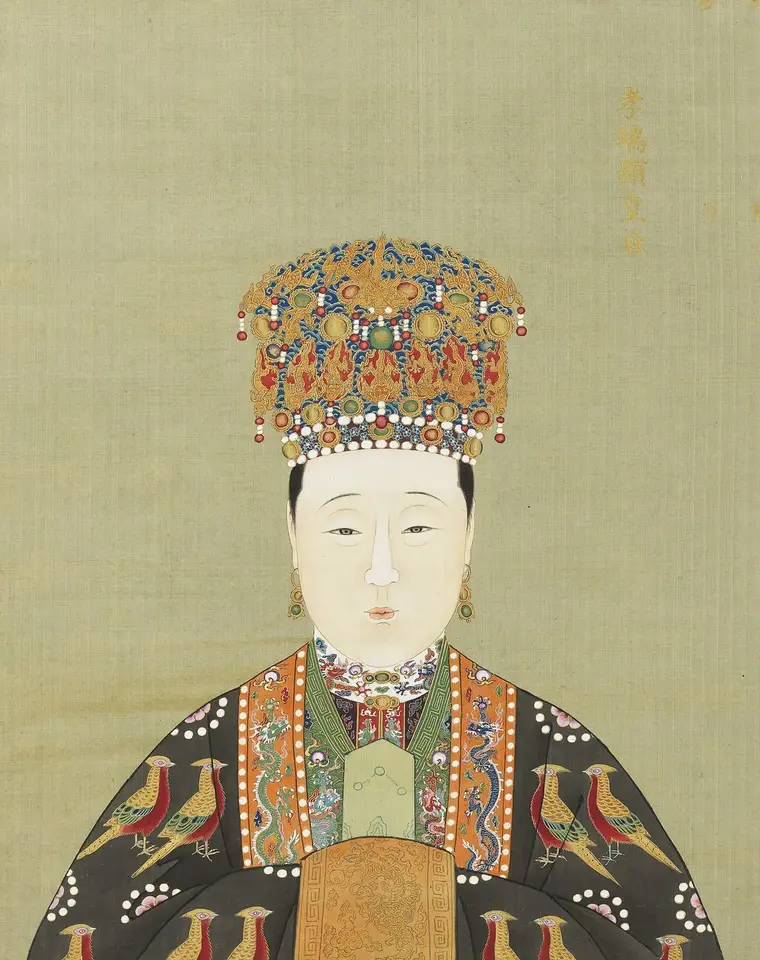
Life Story
Selection in the Capital and Royal Wedding
Wang Xijie was born on November 7, 1564, the fifth day of the tenth lunar month in the forty-third year of the Jiajing era under Emperor Shizong. Her paternal ancestors originated from Yuyao in South Zhili, moving to Daxing County in Shuntian Prefecture during the Zhengde era. Her father, Wang Wei, served in the military and was later appointed Battalion Commander in the Embroidered Uniform Guard. Raised within an upright, modest household in the capital region, Wang Xijie developed an unpretentious, gentle, and dignified demeanor, renowned among neighborhood elders for her refined filial conduct.
In January 1577, the fifth year of the Wanli reign, Empress Dowager Rensheng (Empress Chen) and Empress Dowager Cisheng (Lady Li) issued an imperial edict commanding the Ministry of Rites to conduct a selection of maidens from respectable families across the metropolitan domain for the fifteen-year-old Emperor Shenzong. Under the ancestral injunctions of Ming founder Emperor Taizu, the court deliberately avoided powerful aristocratic lineages, seeking maidens of moral rectitude and domestic virtue from common or low-ranking military families.
More than four hundred and fifty eligible maidens participated in the preliminary examinations. Following several rounds of scrutiny concerning deportment, physical appearance, horoscopes, and household reputation, fourteen-year-old Wang Xijie and another maiden named Lady Chen advanced to the final stage. Palace examiners unanimously selected Wang Xijie for her composed elegance and calm modesty, while Lady Liu (the future Consort Zhao) and Lady Yang (the future Consort Yi) were chosen as secondary consorts.
The Directorate of Astronomy originally proposed holding the wedding in December 1577. However, Senior Grand Secretary Zhang Juzheng submitted a memorial reminding the court that ancestral monarchs typically married at sixteen, noting that Emperor Shenzong was fifteen while Wang Xijie was only fourteen. Persuaded by the grand secretary, the dowager empresses postponed the ceremony to the following spring.
On March 29, 1578, the twenty-first day of the second lunar month in the sixth year of Wanli, the court celebrated the grand imperial wedding. Fourteen-year-old Wang Xijie was consecrated as Empress of the Ming empire, entering the Kunning Palace as the mother of the realm, while her father Wang Wei was enfeoffed as Count of Yongnian. In his coronation proclamation, Emperor Shenzong extolled her virtuous harmony, establishing her as the ritual exemplar of the empire.
Mother of the Realm and Filial Devotion
Upon assuming her position as empress, Wang Xijie established a model of unostentatious grace. Emperor Shenzong was willful and possessed a volatile temper, having grown up under the strict discipline of Zhang Juzheng and Empress Dowager Cisheng. Empress Wang offered patient companionship, attending to the sovereign's daily health with gentle solicitude. Deeply respecting her moral integrity and calm forbearance, Emperor Shenzong maintained a harmonious and affectionate partnership with his empress.
Empress Wang was exceptionally devoted to the two dowager empresses. Empress Dowager Rensheng resided in the Ciqing Palace, while the emperor's birth mother, Empress Dowager Cisheng, occupied the Cining Palace. Each morning, after dressing, Empress Wang proceeded immediately to both palaces to pay ritual respects, personally supervising their meals and medicines year after year without omission.
Empress Dowager Rensheng was quiet and solitary, whereas Empress Dowager Cisheng was a devout Buddhist who governed the imperial family with unyielding rigor. Empress Wang navigated the distinct personalities of both matriarchs with consummate tact and filial warmth. During imperial birthdays, both dowager empresses repeatedly praised Empress Wang as an immaculate, gentle, and faithful daughter-in-law who brought peace to the imperial altars.
In December 1581, the seventeen-year-old Empress Wang gave birth to her only child, Princess Rongchang (Zhu Xuanshu). Emperor Shenzong rejoiced, later arranging her marriage to Imperial Son-in-law Yang Chunyuan. However, due to lingering physical frailty from unremitting palace duties, Empress Wang bore no further children.
Safeguarding the Heir in the Guoben Crisis
In August 1582, a palace maid from the Cining Palace gave birth to Emperor Shenzong's eldest son, Zhu Changluo. Embarrassed by the casual encounter, Shenzong initially attempted to deny paternity until Empress Dowager Cisheng confronted him with the imperial record. That same year, the captivating Noble Consort Zheng entered the palace, quickly monopolizing the emperor's affections and giving birth in 1586 to the third imperial son, Zhu Changxun. Infatuated with Consort Zheng, Emperor Shenzong sought to bypass his eldest son to make Zhu Changxun heir apparent, sparking the twenty-year Guoben Controversy.
Confronted with overwhelming demands from the civil bureaucracy to invest the eldest son, Emperor Shenzong repeatedly delayed the decision under the pretext that the young empress might yet bear a legitimate son, asserting that succession should favor primary birth over chronological seniority. This prolonged impasse gave rise to poisonous palace rumors, with outside officials fearing the emperor might seek to depose or harm Empress Wang to elevate Consort Zheng and legitimize her son.
At the center of this dangerous political vortex, Empress Wang displayed extraordinary moral grandeur. Far from feeling resentment over her lack of a male heir, she recognized the sacred inviolability of ancestral primogeniture and stepped forward to shield Zhu Changluo.
Because his biological mother resided in cold neglect, the young prince lived in continuous dread, facing covert harassment from Consort Zheng's partisans. Empress Wang embraced Zhu Changluo as her own child. Whenever the young prince faced deprivation or hostility, she personally supplied his wardrobe and provisions, defending him before Emperor Shenzong and the dowager empresses.
In 1601, yielding to the united pressure of the dowager empress and the bureaucracy, Emperor Shenzong finally invested Zhu Changluo as Crown Prince. Throughout the following two decades, as Consort Zheng's faction staged dangerous intrigues—culminating in the Club-Striking Incident of 1615—Zhu Changluo survived to ascend the throne largely through the steadfast protection of his primary mother, Empress Wang.
When Supervising Secretary Wang Dewang submitted a memorial meddling in succession affairs and casting aspersions on inner palace dynamics, Emperor Shenzong rebuked the official, issuing a forceful defense of Empress Wang: "The Empress was personally selected for me by the Empress Dowager as my wedded primary consort. She resides with me in the same palace, attending upon me daily. Even if she had minor shortcomings, how could I not treat her with boundless indulgence and love? How dare external ministers spread rumors about the inner palace!" This imperial rescript shattered all speculation regarding her position and affirmed the sovereign's enduring trust in his consort.
In 1596, disastrous fires consumed the Qianqing and Kunning Palaces, destroying Empress Wang's golden imperial seals and ceremonial crowns. Emperor Shenzong ordered the Ministry of Revenue to allocate substantial funds to procure fresh gold and exquisite gems to recreate her complete regalia. When Minister of Revenue Zhao Shiqing requested to utilize existing gems from palace vaults to economize state expenditure, Shenzong refused, insisting on purchasing the finest new jewels for his empress, demonstrating his unswerving esteem.
Secretarial Stewardship and Administrative Mediation
During the middle and late Wanli reign, exhausted by ideological recriminations from factional officials and suffering from chronic illnesses, Emperor Shenzong retreated into the inner palace, beginning his celebrated era of administrative seclusion. For over two decades, the emperor held no morning audiences and shelved thousands of urgent memorials from throughout the empire without issuing rescripts.
Amidst this paralysis of central governance, Empress Wang stepped into the administrative breach, quietly maintaining bureaucratic continuity behind palace walls. As recorded in the Mingshu: "When Emperor Shenzong secluded himself and shelved all incoming memorials, the Empress classified, sealed, and archived them. Whenever the emperor inquired about an affair, she retrieved the exact memorial immediately without the slightest error."
Confronted with mountains of military reports, ministerial memorials, and provincial dispatches, Empress Wang led senior female scribes in systematically categorizing and cataloging every document. Whenever Emperor Shenzong recalled a frontier emergency or ministerial appointment, Empress Wang produced the relevant papers in an instant, maintaining secretarial order across decades.
Empress Wang also served as a vital moral buffer against imperial anger. During the bitter factional conflicts of the late Wanli era, outspoken censors repeatedly submitted memorials that provoked imperial fury. When Emperor Shenzong ordered harsh dismissals or prison tortures, Empress Wang intervened in private, gently counseling the sovereign to tolerate candid criticism and cherish honest ministers, saving numerous upright officials from imprisonment and execution.
Toward her domestic staff, Empress Wang exhibited deep compassion. Emperor Shenzong possessed a severe temper in his later years, frequently flogging attendants or subjecting them to harsh confinements for minor infractions. Empress Wang practiced gentle benevolence in the Kunning Palace, sheltering female attendants and eunuchs from punishment and fostering an oasis of calm within the Forbidden City.
Toward her own family, Empress Wang enforced strict rectitude. Although her brother Wang Dong inherited their father's earldom, and her nephew Wang Mingfu subsequently inherited the title—granting her family three generations of hereditary nobility—Empress Wang barred her relatives from meddling in court governance, preserving an honorable reputation for her clan.
Demise and Eternal Rest in Dingling
Decades of relentless administrative labor, emotional mediation, and chronic infirmity gradually wore away Empress Wang's vitality. Beginning in her thirties, she suffered from debilitating fatigue, enduring chronic illness for years.
In early 1620, her condition worsened rapidly. Distressed, Emperor Shenzong summoned palace physicians and ordered religious services across Beijing to pray for her recovery. Yet her vitality was spent. On May 16, 1620, the sixth day of the fourth lunar month in the forty-eighth year of the Wanli reign, Empress Wang passed away peacefully in the Kunning Palace at the age of fifty-seven, having reigned as Empress for forty-two years.
Her death delivered a devastating psychological blow to the aged and ailing Emperor Shenzong. In his imperial rescript, the emperor mourned: "The Empress served me with diligent devotion, sharing my meals, rest, and life for forty-two years. Unexpectedly, she has succumbed to chronic illness; my heart is shattered by profound grief!" Having lost his lifelong companion, Emperor Shenzong declined rapidly and passed away just three months later, on August 18, 1620.
Crown Prince Zhu Changluo ascended the throne as Emperor Guangzong, immediately honoring his late adoptive mother as Empress Xiaoduan. Following Guangzong's sudden death twenty-nine days later, Emperor Xizong ascended the throne, conferring upon his grandmother the full posthumous title of Empress Xiaoduan Zhenhui Zhuangjing Shitian Zuosheng Xian.
In October 1620, Emperor Xizong conducted a magnificent state funeral, conveying the imperial caskets of Emperor Shenzong and Empress Xiaoduan Xian to Mount Tianshou in Changping, where they were interred together in the subterranean vault of the Dingling Mausoleum of the Ming Dynasty. Setting an unheralded record of forty-two years on the throne, Empress Xiaoduan Xian Wang Xijie remains celebrated as an immortal paragon of wisdom, maternal devotion, and imperial rectitude.
Major Achievements
Reigned as Primary Empress for Forty-Two Years
From her coronation at fourteen in 1578 until her demise at fifty-seven in 1620, Wang Xijie presided over the Kunning Palace for forty-two consecutive years.
This tenure represents the longest continuous reign of any primary empress consort of a unified imperial dynasty in Chinese history, standing as an enduring record in dynastic annals.
Resolute Protection of the Imperial Heir
Amidst the treacherous twenty-year Guoben Controversy, Empress Wang placed dynastic legitimacy above personal advantage, despite having borne no male heir of her own.
She embraced the vulnerable prince Zhu Changluo as her son, shielding him from factional plots orchestrated by Noble Consort Zheng and preserving dynastic continuity until he safely ascended the throne.
Secretarial Stewardship of State Memorials
During Emperor Shenzong's protracted administrative seclusion, Empress Wang personally organized, sealed, and cataloged thousands of imperial memorials.
Her systematic archival stewardship ensured that state documents could be instantly retrieved whenever needed, maintaining the minimum operational continuity of the imperial government.
Mediating Sovereign Wrath to Save Upright Officials
During an era of bitter factional strife, Empress Wang continuously intervened to temper Emperor Shenzong's anger toward outspoken censors and ministers.
Her gentle domestic counsel persuaded the sovereign to refrain from draconian punishments, preserving the lives and careers of many loyal civil servants.
Gentle Benevolence Toward Palace Attendants
Confronted with Emperor Shenzong's late-life severity toward inner palace retainers, Empress Wang maintained a household governed by forgiveness, patience, and compassion.
She consistently shielded maids and eunuchs from imperial wrath, earning universal love and gratitude across the Forbidden City.