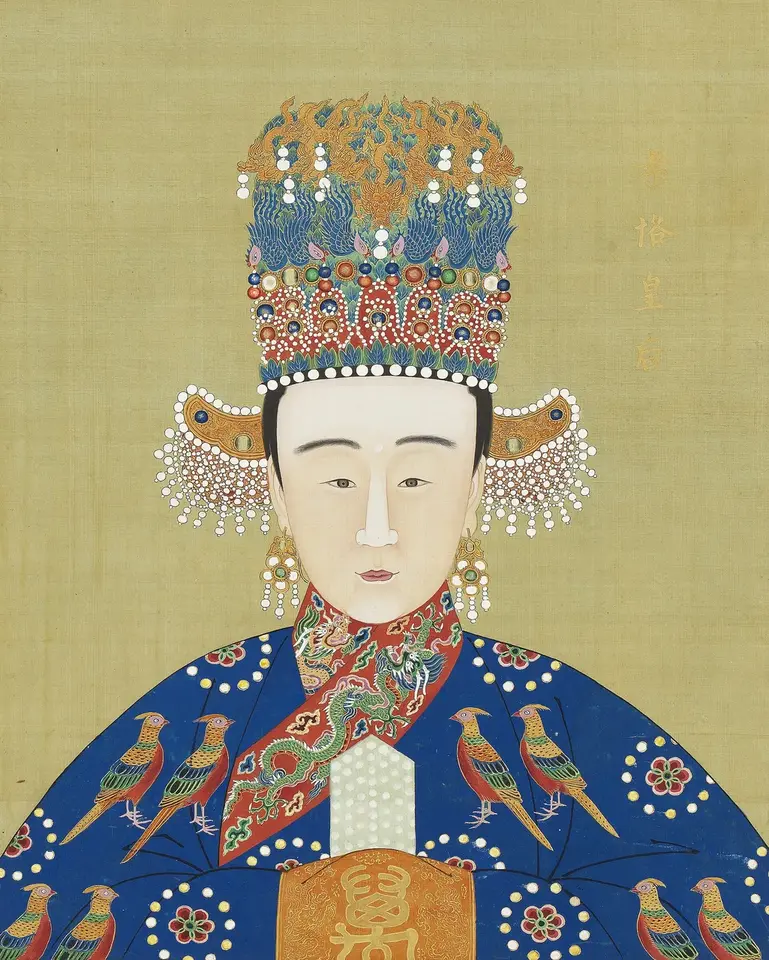
Life Story
Entrance into the Inner Palace and Nine Concubines
Lady Du was born in 1516, the eleventh year of the Zhengde reign under Emperor Wuzong. Her family resided in Daxing County, Shuntian Prefecture, where her father Du Lin served as an upright Battalion Commander in the Embroidered Uniform Guard, and her mother was Lady Bai. Raised in a respectable military family near the capital, Lady Du was instilled with traditional Confucian virtues, developing a gentle, prudent, and soft-spoken temperament.
In 1530, the ninth year of the Jiajing era under Emperor Shizong, the imperial court faced an acute succession crisis. Having occupied the throne for nine years, Emperor Shizong remained childless following the premature death of Empress Chen from a miscarriage and the continued infertility of Empress Zhang. Grand Secretary Yang Yiqing and ritual ministers repeatedly implored the emperor to select virtuous maidens from respectable families to ensure dynastic continuity. In response, Emperor Shizong dispatched imperial commissioners to search for accomplished maidens across the metropolitan domain and neighboring provinces.
At fifteen, Lady Du was chosen from thousands of candidates for her refined grace and solemn decorum, entering the palace for ritual training. In March 1531, Emperor Shizong reformed the inner palace hierarchy to align with ancient classical precedents, establishing the rank of the Nine Concubines. On March 2, during a solemn ceremony in the Hall of Fengtian, Lady Du was formally invested as Concubine Kang, becoming one of the inaugural Nine Concubines.
Residing in the inner palace, Concubine Kang conducted herself with extreme prudence and humility. During this era, rival consorts such as Noble Consort Yan, Noble Consort Wang, and the rising Empress Fang competed intensely for imperial favor. Conscious of her modest family origins and naturally detached from ambition, Concubine Kang resided quietly in the Jingyang Palace, performing daily rituals with scrupulous deference and avoiding factional alliances, which earned her widespread respect among palace attendants.
Promotion to Consort and Birth of the Imperial Heir
In 1536, having resided in the palace for six years, Concubine Kang conceived an imperial child. Delighted by the news of prospective offspring, Emperor Shizong issued an imperial edict that winter promoting her to Consort Kang, advancing her to the high rank of second-grade imperial consort with upgraded retinue and stipends.
On February 23, 1537, the twenty-third day of the first lunar month in the sixteenth year of Jiajing, Consort Kang gave birth to an imperial prince in the Jingyang Palace. He was Emperor Shizong's third son, named Zhu Zaiji. As Shizong's firstborn son Zhu Zaiji had died in infancy and his second son Zhu Zairui was invested as Crown Prince, the arrival of a third prince brought immense relief to the imperial court, prompting congratulatory memorials from civil and military officials across China.
However, bearing an imperial heir did not translate into enduring imperial favor for Consort Kang. Emperor Shizong possessed a volatile, suspicious, and mercurial temperament, growing increasingly obsessed with Daoist immortal arts and alchemical longevity rituals. In his later years, Shizong fell under the spell of the Daoist adept Tao Zhongwen, who proclaimed the ominous astrological prophecy that two dragons must never meet. Fearing that contact with his sons would drain his spiritual vitality and shorten his life, Shizong avoided Crown Prince Zhu Zairui and treated Prince Zhu Zaiji with profound coldness.
In this oppressive palace environment, Consort Kang displayed extraordinary maternal wisdom and forbearance. Realizing that unpredictable sovereign whims could imperil her child, Consort Kang retreated even deeper into quiet seclusion. In 1539, when Zhu Zaiji was three years old, he was formally enfeoffed as Prince of Yu. Consort Kang nurtured the young prince with gentle devotion, teaching him modesty, filial obedience, and discretion, imbuing the future sovereign with an unassuming and patient character.
Seclusion in the Forbidden City and Burial at Jinshan
In 1549, Crown Prince Zhu Zairui died suddenly at the age of fourteen. Under the ancestral laws of Ming succession, Prince Yu Zhu Zaiji, as Shizong's eldest surviving son, became the undisputed heir presumptive to the throne.
Yet, paralyzed by his fear of the Daoist prophecy, Emperor Shizong stubbornly refused to name Zhu Zaiji Crown Prince, banishing him from the Forbidden City to take up residence outside the Chaoyang Gate in the Prince Yu mansion. Concurrently, Shizong's fourth son, Prince Jing (Zhu Zaijun), whose mother Consort Jing enjoyed imperial favor, harbored ambitions to supplant his elder brother, sparking treacherous factional undercurrents across the capital.
Trapped within the deep palace, Consort Kang spent her days in agonizing anxiety for her son's safety. Barred from participating in outer court politics and unable to approach the reclusive emperor, she turned to Buddhist vegetarianism and prayer, beseeching Heaven to protect Prince Yu from political assassination. The unrelenting mental strain and emotional isolation took a catastrophic toll on her health, leaving her chronically ill and bedridden.
On February 12, 1554, the eleventh day of the first lunar month in the thirty-third year of Jiajing, Consort Kang passed away in the Forbidden City at the age of thirty-nine. Emperor Shizong suspended court audiences for two days, conferred the posthumous title Consort Rongshu Kang, and ordered her buried in the imperial cemetery at Jinshan in Beijing's western suburbs.
Her passing sparked an intense debate over mourning protocols. Minister of Rites Ouyang De cited the Records of Filial Piety and Compassion promulgated by Emperor Taizu, petitioning for Prince Yu to observe three years of mourning for his mother, supported by a five-day suspension of court business. Senior Grand Secretary Yan Song endorsed the petition, noting that Emperor Taizu had previously ordered Prince of Zhou Zhu Su to observe three years of mourning for Noble Consort Sun as an eternal model.
However, the rigid and unyielding Emperor Shizong rejected the ministers' counsel. The emperor decreed coldly: "For a son to observe heavy mourning for his mother is an ordinary private emotion, but Prince Yu is an imperial prince of the realm; before the exalted presence of the sovereign father, how can he prioritize maternal mourning over sovereign majesty!" Shizong commanded that the mourning ceremonies be minimized, compelling Prince Yu to endure his grief in silence and bury his mother with minimal pomp, leaving an indelible sorrow in the young prince's heart.
Posthumous Coronation and Reburial in Yongling
In January 1567, Emperor Shizong passed away after reigning for forty-five years. Having endured decades of suspicion in his princely residence, Prince Yu ascended the throne in the Hall of Fengtian as Emperor Muzong, inaugurating the Longqing era.
Upon assuming personal rule, Emperor Muzong enacted major reform decrees and sought immediately to console the spirit of his late mother buried in the desolate graves of Jinshan. In March 1567, Emperor Muzong issued an imperial proclamation posthumously elevating his mother Consort Rongshu Kang to Empress of the Ming dynasty, granting her the full posthumous title Empress Xiaoke Yuanchun Ciyi Gongshun Zantian Kaisheng (Empress Xiaoke). Her spirit tablet was enshrined alongside the dynastic sovereigns in the Hall of Shenxiao and the Imperial Ancestral Temple.
To rectify the indignity of her previous interment, Emperor Muzong dispatched imperial kin and Ministry of Works officials to Jinshan in June 1567 to exhume her coffin. In a ceremony of supreme imperial magnificence, Empress Xiaoke's imperial casket was conveyed to Mount Tianshou in Changping, where it was reinterred in the subterranean vault of the Yongling Mausoleum beside Emperor Shizong, Empress Xiaojie, and Empress Xiaolie.
Simultaneously, Emperor Muzong showered posthumous honors upon his maternal relatives. His grandfather Du Lin was posthumously enfeoffed as Earl of Qingdu, his grandmother Lady Bai as Countess of Qingdu, and his maternal uncle Du Jizong was granted the hereditary title of Earl of Qingdu with estates and stipends. Although Consort Du lived and died in quiet seclusion, her gentle virtue and maternal sacrifices received glorious vindication through her imperial son.
Major Achievements
Bearing the Imperial Heir and Preserving the Succession
In 1537, when Emperor Shizong's eldest son had died in infancy and the imperial succession hung in the balance, Consort Du gave birth to Zhu Zaiji, who survived to become Emperor Muzong.
Her son subsequently enacted the celebrated Longqing Reforms and the opening of maritime trade, preserving the dynastic lineage and ensuring the stability of the Ming empire during a critical historical transition.
Modeling Serene Prudence in Palace Turmoil
Amidst the fierce intrigues of the Jiajing inner palace, Consort Du maintained exemplary modesty from her investiture as a concubine to her promotion as an imperial consort.
She never exploited the birth of an imperial prince to demand political privileges, modeling moral discipline and avoiding factional entanglements that could have drawn sovereign wrath upon her family.
Forbearing Hardship to Protect Her Son
Confronted with Emperor Shizong's late-reign estrangement from Prince Yu driven by Daoist astrological fears, Consort Du endured deep emotional isolation with dignified composure.
She instructed Prince Yu in humility, filial deference, and discreet conduct, enabling the young prince to navigate decades of suspicion in the princely mansion and safely ascend the imperial throne.
Igniting Fundamental Debates on Filial Mourning
Her death in 1554 prompted Minister of Rites Ouyang De and Senior Grand Secretary Yan Song to advocate for three years of maternal mourning under imperial ancestral law.
This historic debate highlighted the profound ideological conflict between sovereign autocratic supremacy and Confucian filial ethics, standing as an important case study in Ming ritual and political history.
Historical Evaluation
The History of Ming records in its biography of Empress Dowager Du: "Empress Dowager Xiaoke was the biological mother of Emperor Muzong. During the Jiajing reign, residing in the Jingyang Palace as Consort Kang, she was quiet, frugal, and austere, never participating in palace disputes. In his later years, Emperor Shizong was deeply suspicious, leaving the heir apparent position unfilled for long periods; while Prince Yu resided discreetly in his mansion, the consort nurtured him with care, preserving his virtuous character. Though she enjoyed modest imperial favor during life, her inner virtue was profound. When Emperor Muzong ascended the throne, he elevated her posthumous titles, reinterred her in the Yongling Mausoleum, and bestowed earldoms upon the Qingdu lineage; that Heaven rewards the virtuous is truly proven here!"
Emperor Muzong proclaimed in his eulogy: "Maternal virtue was tranquil and unassuming, her goodness rich in gentleness and grace. Nurturing me through infancy, she endured immense toil and hardship. Beholding the grand enterprise of our dynasty, I grieve that I cannot see her beloved countenance. Consulting ancient statutes, I bestow supreme posthumous titles and reinter her in the Yongling Mausoleum to fulfill the highest filial duty of Heaven and Earth!"
Senior Grand Secretary Yan Song remarked in a memorial: "The consort was innately pure and benevolent, maintaining strict discipline in domestic management. In giving birth to the sacred heir, her merits reside in the altars of state. Her final rites should be grand and generous to instruct future generations."