Age one | Born at Jiamaying in Luoyang, in present-day eastern Chanhe Hui District, Luoyang, Henan.
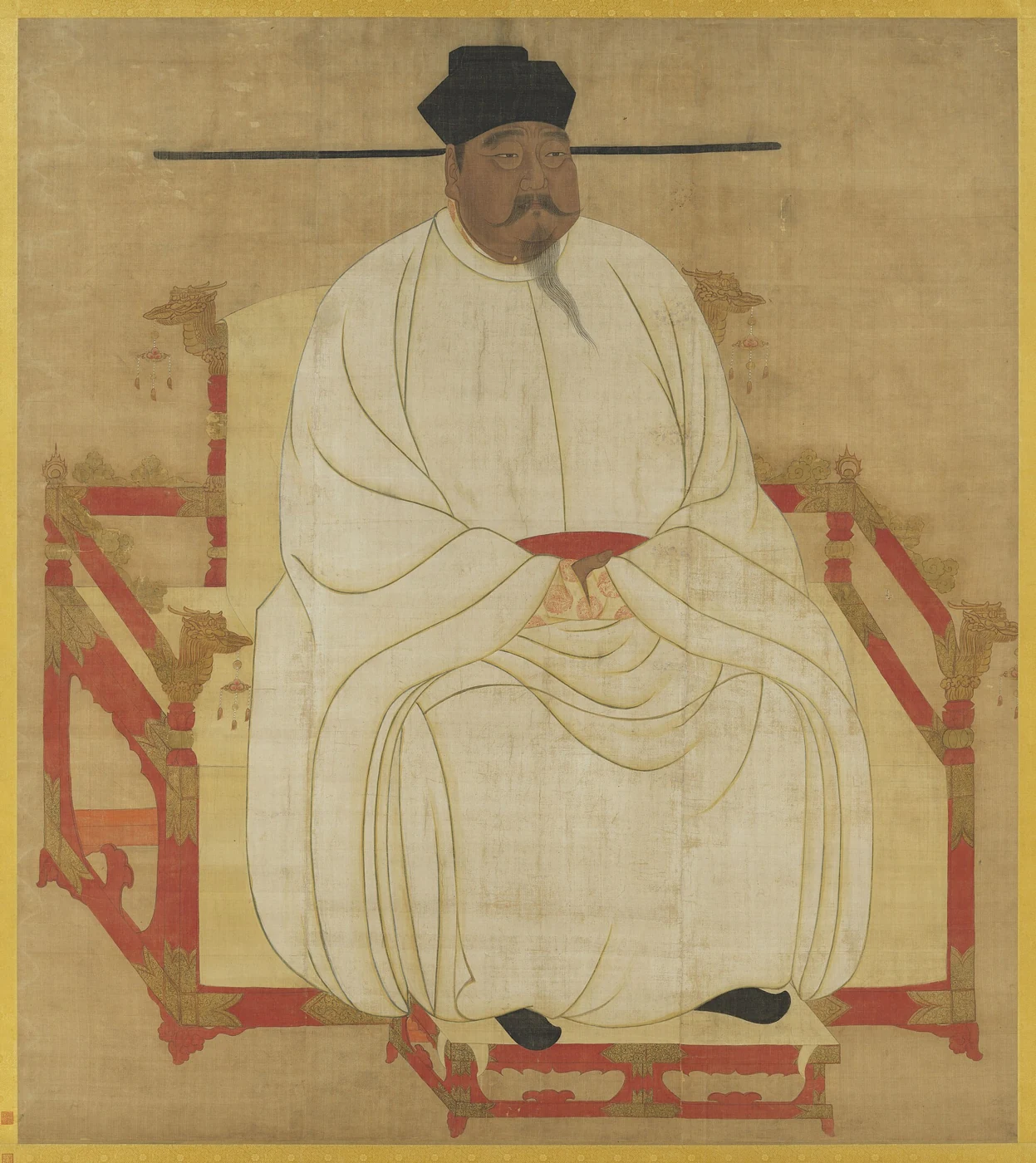
927 CE–976 CE
Emperor
Zhao Kuangyin
赵匡胤
Zhao Kuangyin (March 21, 927 – November 14, 976), courtesy name Yuanlang and posthumously known by the temple title Emperor Taizu of Song, was from Zhuo Commandery, though another tradition gives Bao Prefecture as his native place. He was born at Jiamaying in Luoyang, in present-day eastern Chanhe Hui District, Luoyang, Henan. A military commander, politician, and strategist active from the Five Dynasties into the early…
927 CE–976 CENorthern Song
PROFILE
Zhao Kuangyin (March 21, 927 – November 14, 976), courtesy name Yuanlang and posthumously known by the temple title Emperor Taizu of Song, was from Zhuo Commandery, though another tradition gives Bao Prefecture as his native place. He was born at Jiamaying in Luoyang, in present-day eastern Chanhe Hui District, Luoyang, Henan. A military commander, politician, and strategist active from the Five Dynasties into the early Northern Song, he founded the Song dynasty and reigned from February 4, 960, to November 14, 976. He was the second son of Zhao Hongyin, a Later Zhou military commander later honored as Emperor Xuanzu of Song, and Lady Du, later Empress Dowager Zhaoxian.
- Other name
- Emperor Taizu of Song
- Courtesy name
- Yuanlang
- Period
- Northern Song
- Dynasty / polity
- Northern Song
- Identity
- Emperor
- Ethnicity / people
- Not recorded in historical sources
- Native place
- Zhuo Commandery, corresponding to present-day Qingyuan District, Baoding, Hebei
- Date of birth
- March 21, 927
- Place of birth
- Jiamaying, Luoyang
- Date of death
- November 14, 976
- Reign
- February 4, 960 – November 14, 976
- Predecessor
- Emperor Gong of Later Zhou (Chai Zongxun)
- Successor
- Emperor Taizong of Song (Zhao Guangyi)
- Era name
- Jianlong
- Temple name
- Emperor Taizu of Song
- Posthumous title
- Not recorded in historical sources
- Major achievements
- Founding emperor of the Northern Song; elevated in the Chenqiao Mutiny; reduced military commanders' power through Releasing Military Command over a Cup of Wine; strengthened civil government over the military and brought the Five Dynasties era of division toward an end.
LIFE TIMELINE
Age eighteen | Married Lady He, eldest daughter of He Jingsi.
Age about twenty-one | Left home seeking opportunity; traveled south to Wang Yanchao, defense commissioner of Fu Prefecture, but was not accepted into service; then joined Dong Zongben, governor of Sui Prefecture, but left after conflict with Dong Zunhui; stayed at a temple in Xiangyang and, on the advice of an old monk, traveled north.
Age twenty-two | Entered the service of Guo Wei, then commissioner of military affairs, and joined the campaign against Li Shouzhen.
Age twenty-five | After Guo Wei founded Later Zhou, Zhao was appointed Dongxi Ban Hangshou in the palace troops.
Age twenty-seven | Recruited by Chai Rong, then prefect of Kaifeng, and transferred to Kaifengfu Mazhi Junshi.
Age twenty-eight | Distinguished himself at the Battle of Gaoping against Northern Han and was wounded in the left arm by an arrow; promoted to Dianqian Duyuhou and given the title of governor of Yan Prefecture; participated in reorganization of the imperial army.
Age twenty-nine | Sent to inspect the Qin-Feng front; recommended continuing the campaign, after which Later Zhou recovered Qin, Jie, Cheng, and Feng prefectures.
Age thirty | Campaigned with Chai Rong against Southern Tang, defeating its forces at Wokou, Qingliu Pass, and Liuhe; appointed Commander-in-Chief of the Palace Command and Military Commissioner of Dingguo Command.
Age thirty-one | Again campaigned against Southern Tang, taking Shouchun, Hao Prefecture, and Si Prefecture; transferred to Military Commissioner of Zhongwu Command.
Age thirty-three | Accompanied Chai Rong on the northern campaign against the Khitan; when Chai Rong became critically ill, Zhao was promoted to Inspector-General of the Palace Command, the highest commander of the palace army; after Chai Rong died, the seven-year-old Chai Zongxun succeeded.
Age thirty-four | On the first day of the first month ordered to resist a reported Northern Han-Khitan invasion; the Chenqiao Mutiny began on the night of the third day; on the fourth day troops placed the yellow robe on him, he returned to the capital, forced Emperor Gong of Later Zhou to abdicate, took the throne, adopted the era name Jianlong, and founded Song.
Age thirty-four | Suppressed the rebellions of Li Yun, Military Commissioner of Zhaoyi, and Li Chongjin, Military Commissioner of Huainan.
Age thirty-five | First Releasing Military Command over a Cup of Wine; removed command from Shi Shouxin, Wang Shenqi, and other palace-army generals.
Age thirty-seven | Sent Murong Yanzhao and Li Chuyun into the Two Lakes region and destroyed Jingnan and Wuping Circuit.
Age thirty-eight | Ordered prefectures to remit surplus tax revenue to the center and established Fiscal Commissioners to control local finance.
Age thirty-nine | Sent Wang Quanbin and others to conquer Later Shu.
Age forty-three | Carried out a second removal of military power from regional military commissioners; personally campaigned against Northern Han without success.
Age forty-five | Sent Pan Mei and others to conquer Southern Han.
Age forty-nine | Sent Cao Bin and others to conquer Southern Tang.
Traditional age fifty | Died in Wansui Hall on the evening of the twentieth day of the tenth month, November 14, aged forty-nine in Western reckoning; buried at Yongchang Mausoleum.
BIOGRAPHY
Biography
Family Background and Early Life
According to the History of Song, Zhao Kuangyin was from Zhuo Commandery and was born on March 21, 927, the sixteenth day of the second month of the second year of Tiancheng under Later Tang, at Jiamaying in Luoyang. He came from a military family. His great-great-grandfather Zhao Tiao had served in the Tang as magistrate of Youdu County, in present-day Beijing; his great-grandfather Zhao Ting served as Censor-in-chief; and his grandfather Zhao Jing held governorships in Ying, Ji, and Zhuo prefectures. Zhao Kuangyin was the second son of Zhao Hongyin. His elder brother Zhao Kuangji died young, and his mother was Lady Du, later Empress Dowager Zhaoxian.
Zhao Hongyin valued classical learning and actively sought books, believing that literary and martial abilities were both foundations for a man's career. Lady Du also possessed some education. Under their influence Zhao Kuangyin first studied in a school at Jiamaying under a teacher surnamed Chen. The family later hired another local tutor surnamed Zhao, an account recorded in Sun Sheng's Sun Gong Tanpu. Zhao Kuangyin also studied the Five Classics under the learned Xin Wenyue, according to the Long Draft of the Continuation of the Comprehensive Mirror in Aid of Governance and the History of Song. He nevertheless showed still greater interest in martial skills. Sources say that his riding and archery surpassed others, that he organized companions into mock battle formations, and that he often practiced with an iron staff.
As a youth Zhao Kuangyin was forceful in temperament, enjoyed gambling, defended those he considered wronged, and repeatedly got into trouble. In 944, the first year of Kaiyun under Later Jin, the eighteen-year-old Zhao married Lady He, eldest daughter of He Jingsi, who served in the imperial army alongside Zhao Hongyin.
Wandering and Entering Military Service
In the early Later Han period, Zhao Kuangyin left home in search of a chance to make his name. He traveled south to Fu Prefecture and sought support from Wang Yanchao, an old colleague of his father and defense commissioner there. Wang gave him only some money and did not take him into service, according to Zhuang Chuo's Jilei Bian. Zhao then went to Dong Zongben, governor of Sui Prefecture, who received him, but Zhao left after falling out with Dong's son Dong Zunhui.
While staying in a temple at Xiangyang, Zhao received advice from an elderly monk versed in divination to travel north. He reached the front where Guo Wei, Later Han commissioner of military affairs, was fighting Li Shouzhen, Military Commissioner of Hezhong. The source suggests that Zhao probably did not yet formally enter Guo Wei's service there, but visited his father Zhao Hongyin, who had been wounded in the left eye while campaigning with Guo. Zhao then went north to Taiyuan and was taken in as a garrison officer by Liu Chong, Military Commissioner of Hedong, who was recruiting men without fixed affiliations. Zhao did not remain at Taiyuan. He continued wandering through the Three Qin region and the northwest, and on returning to Luoyang recognized the growing power of Guo Wei, then commanding from Yedu, and decisively entered Guo's service.
The Later Zhou Period
In 951, after Guo Wei overthrew the Later Han emperor and founded Later Zhou, Zhao Kuangyin was appointed Dongxi Ban Hangshou in the palace units. In 953 he was appointed deputy commander of Xingchun at Hua Prefecture, but before taking office Chai Rong, Guo Wei's adopted son and then prefect of Kaifeng, recruited him into his own service as Kaifengfu Mazhi Junshi.
At the beginning of 954 Chai Rong took the throne as Emperor Shizong of Later Zhou. That year a joint Northern Han and Khitan force invaded. Chai Rong personally campaigned and met Northern Han south of Gaoping in Ze Prefecture. Zhao Kuangyin served as a deputy commander in Chai Rong's household cavalry and, together with Zhang Yongde, led two thousand cavalry on each flank. During the battle the right-wing units under Fan Aineng and He Hui fled without fighting, and more than a thousand infantry surrendered to Northern Han, creating a crisis. Zhao rallied the troops, calling on them to fight to the death for the ruler, and asked Zhang Yongde to seize high ground with archers. Zhao and Zhang then attacked from both flanks with elite troops. Chai Rong, following the advice of Wei Renpu, personally led a charge toward Northern Han ruler Liu Chong's camp. Later Zhou morale recovered and Northern Han was heavily defeated.
Zhao advanced toward Taiyuan as a vanguard, burned a city gate, and took an arrow wound in the left arm during the costly siege. Chai Rong stopped further assault and withdrew. In the third month Zhao was exceptionally promoted to Dianqian Duyuhou and given the nominal governorship of Yan Prefecture, then under Southern Han control. In the tenth month he also received the defense commission of Yong Prefecture, then within Wuping Circuit.
After the Battle of Gaoping, Chai Rong reorganized the old imperial guards and expanded the palace army. Zhao first helped eliminate weak and elderly soldiers and select elite troops. He then took part in enlarging the Palace Command and forming or strengthening elite guard formations. The Institutional History of the Five Dynasties and Old History of the Five Dynasties describe the resulting force as exceptionally powerful for its time. Zhao used the reorganization to build ties with officers at many levels. He formed the sworn group later called the "Ten Brothers of the Righteous Society" with men including Yang Guangyi, Shi Shouxin, Li Jixun, and Wang Shenqi, and promoted a network of trusted officers such as Yang Xin, Cui Han, Tian Chongjin, and Zhang Qiong within the Palace Command.
In the fifth month of 955, Chai Rong sent troops to recover Qin, Jie, Cheng, and Feng prefectures, which Later Shu had occupied after the fall of Later Jin. The campaign initially stalled and some court officials urged withdrawal. In the seventh month Chai Rong sent Zhao Kuangyin to inspect the front. Zhao returned recommending that the campaign continue, strengthening Chai Rong's resolve. Later Zhou eventually recovered all four prefectures.
In the eleventh month of 955 Chai Rong began operations against Southern Tang, and after an unfavorable opening phase personally led the Huainan campaign. In spring 956 Zhao Kuangyin followed him south and defeated more than ten thousand Southern Tang troops at Wokou, killing the commander He Yanxi and others. Huangfu Hui, Military Commissioner of Fenghua, and Yao Feng, military training commissioner of Changzhou, led a force claimed to number 150,000 at Qingliu Pass. Zhao defeated them and pursued them to the city. Huangfu Hui asked to form ranks for a set battle; Zhao agreed, charged directly into the formation while leaning over his horse's neck, struck Huangfu in the head, and captured both Huangfu Hui and Yao Feng.
When Han Lingkun captured Yangzhou and Southern Tang counterattacked, Han wanted to withdraw. Chai Rong ordered Zhao to bring two thousand troops to Liuhe. Zhao declared that any Yangzhou troops who retreated past Liuhe would have their feet cut off, and Han then held the city. Zhao soon defeated Li Jingda, Prince of Qi of Southern Tang, east of Liuhe and killed more than ten thousand men. After returning from the campaign, Zhao was appointed Commander-in-Chief of the Palace Command and soon also Military Commissioner of Dingguo Command.
In spring 957 Zhao followed Chai Rong against Shouchun, captured Lianzhu Stockade, and then took Shou Prefecture. Chai Rong appointed him Military Commissioner of Yicheng with the honorific rank Jianjiao Taibao while retaining his Palace Command post. That winter Zhao served as vanguard against Hao and Si prefectures. Southern Tang troops had established a camp at Shibalitan. While Chai Rong was still considering how to ferry soldiers across with camels, Zhao crossed alone on horseback, followed by his cavalry, and broke the enemy water-camp. Using captured Southern Tang ships, the army then took Si Prefecture. At Qingkou, Chai Rong and Zhao advanced in two wings down the Huai River, pursued through the night to Shanyang, captured Southern Tang reinforcement commander Chen Chengzhao, and took Chu Prefecture the following first month. As Chai Rong moved on Yangzhou, Zhao won further victories at Yingluan River mouth and Guabu. Southern Tang eventually sued for peace and ceded territory north of the Yangtze. In the fifth month Zhao was transferred to the Zhongwu military commission.
In 959 Chai Rong campaigned north against the Khitan. Zhao Kuangyin served as overall commander for land and water forces and reached Waqiao Pass ahead of the emperor, where defender Yao Neibin surrendered. Chai Rong became ill in the sixth month and ordered the imperial party to return to the capital. On the twenty-third day of the seventh month Zhao was appointed Inspector-General of the Palace Command, making him the highest commander of the palace army. Four days later Chai Rong died. The seven-year-old Chai Zongxun, Prince of Liang, succeeded as Emperor Gong of Later Zhou, while Zhao was transferred to the Guide military commission with the honorific rank Acting Grand Commandant.
The Chenqiao Mutiny and Founding of Song
On January 31, 960, the first day of the first month of the seventh year of Xiande, frontier commanders at Zhen and Ding prefectures urgently reported that Northern Han and the Khitan had joined forces to invade. Emperor Gong's government ordered Zhao Kuangyin to lead the capital guards north. On February 1 rumors spread through Kaifeng that the troops intended to make the Inspector-General emperor once the army left the capital, causing alarm among residents. On February 2 Zhao led his army out through Aijing Gate on the northeast side of the city. Discipline was strict and public anxiety eased. That night the army camped at Chenqiao Station, about twenty kilometers northeast of Kaifeng. Officers began discussing the elevation of Zhao as emperor. Li Chuyun conveyed the plan to Zhao Guangyi, and the two consulted Zhao Pu. During the discussion, armed generals repeatedly gathered and pressed the issue. Zhao Pu and Zhao Guangyi initially tried to dismiss them, but after they returned with drawn weapons Zhao Pu agreed and sent men into the capital to arrange internal support, while troops surrounded Zhao Kuangyin's tent waiting for dawn.
Early on February 3, Zhao Kuangyin was still recovering from heavy drinking when soldiers shouted around the camp. Zhao Pu and Zhao Guangyi entered his tent and informed him. Zhao rose, dressed, and came out to find armed officers standing in the courtyard. Before he could speak, the troops placed a yellow robe over him, bowed, and shouted acclamations. Zhao refused but was ignored and was forced onto a horse for the return south. Seeing that the situation could not be reversed, he took control of the reins and declared that if the men wanted riches and honor by making him emperor, they must obey his orders. The officers dismounted and pledged obedience.
Zhao ordered that the Later Zhou emperor, empress dowager, and officials were not to be harmed and that troops were not to loot households or seize government stores; violators would be executed together with their families. He entered the capital through Renhe Gate and ordered the troops to remove armor and return to barracks, while he went back to the Inspector-General's headquarters and removed the yellow robe. Senior officials Fan Zhi, Wang Pu, and Wei Renpu were then brought to the office and forced to acknowledge the new situation. With no practical alternative, they bowed and acclaimed Zhao. Zhao then performed the abdication ceremony at Chongyuan Hall, ascended the throne, founded the state of Great Song, adopted the era name Jianlong, and proclaimed a general amnesty.
Accounts in the History of Song, Long Draft of the Continuation of the Comprehensive Mirror in Aid of Governance, Sushui Jiwen, and other histories and notebooks portray Zhao as having been compelled by the troops and unaware of the plot beforehand. The Chinese source notes, however, that modern historians, pointing to contradictions and suspicious elements in these accounts, generally regard the Chenqiao Mutiny as a planned military coup organized by Zhao and his close staff.
Suppression of Rebellions
In the fifth month of 960, Li Yun, Military Commissioner of Zhaoyi at Lu Prefecture, rebelled, captured Ze Prefecture, joined forces with Northern Han, and moved south. Emperor Taizu sent Shi Shouxin and Gao Huaide from the imperial army, together with Murong Yanzhao and Wang Quanbin, against him. At the Battle of Changping they heavily defeated Li Yun, killing more than three thousand. In the sixth month Taizu decided to campaign personally. South of Ze Prefecture he and his generals defeated a combined force of about thirty thousand under Li Yun and Northern Han. More than three thousand Northern Han reinforcements surrendered and the Song army killed them all. Li Yun retreated into Ze Prefecture, which Song stormed; he died by self-immolation. In the seventh month Li Yun's eldest son Li Shoujie surrendered Lu Prefecture.
In the tenth month of the same year, Li Chongjin, Military Commissioner of Huainan, rebelled at Yangzhou. Taizu sent Shi Shouxin, Wang Shenqi, Li Chuyun, and Song Wo to suppress him. In the eleventh month Taizu again led a personal campaign. At Dayi Town, Shi Shouxin sent a message asking the emperor to come witness the fall of Yangzhou. Taizu proceeded to the city, which was quickly taken. Li Chongjin burned himself to death, and several hundred close followers were hunted down and executed.
Centralization and Wars of Unification
Fiscal Authority
In 964, the second year of Qiande, Taizu ordered prefectures and commanderies to remit all tax income beyond ordinary local administrative expenses to the central government and prohibited local retention. He established Fiscal Commissioners to control regional finances, inspect taxation, arrange transfers to the court, and authorize local expenditures. Their subordinate auditing officials checked account books and could investigate conditions among the people and illegal conduct by officials and report directly to the throne, thereby weakening local fiscal autonomy.
Taizu also ordered state monopolies over tea, alcohol, and salt, forbidding private trade by officials or commoners under severe penalties and greatly increasing government revenue according to the source. After the conquest of Later Shu, he established the Reserve Treasury in the palace to accumulate annual central-government surpluses for emergency use. He intended to save three to five hundred thousand units and then use the funds to redeem the Sixteen Prefectures of Yan and Yun, which Shi Jingtang, founder of Later Jin, had ceded to the Khitan. Taizu died before the plan could be carried out.
Administrative Authority
After pacifying Hunan, Taizu abolished subordinate prefectures there so that prefectures formerly dependent on regional military governors became directly responsible to the central government. By the reign of Emperor Taizong, such dependent units had been abolished throughout the empire. Taizu also established the office of Controller-General, whose holders were centrally appointed to supervise prefectures and commanderies rather than serve as subordinates of military governors. Official documents issued by local governors required the countersignature of these officials, thereby checking local administrative power.
Releasing Military Command over a Cup of Wine
In 961 Taizu summoned imperial-army commanders including Shi Shouxin and Wang Shenqi to a banquet. After they had been drinking, he dismissed the attendants and told the generals that he owed his position to their support and would never forget their service, but that being emperor was more difficult and less comfortable than serving as a regional military governor because he could not sleep securely at night. When the generals asked why, he said that everyone desired the imperial throne. They protested that Heaven's mandate was already fixed and none of them harbored disloyalty. Taizu answered that even if they had no such intention, ambitious subordinates might one day place a yellow robe on one of them just as troops had done to him.
The generals, frightened, asked how they could preserve themselves. Taizu advised them to relinquish military command, take wealthy provincial appointments, acquire property for their descendants, maintain entertainers, and enjoy their remaining years, while he would form marriage alliances with their families so that ruler and ministers could live without mutual suspicion. The next day the generals pleaded illness and requested release from command. Taizu accepted and compensated them generously, appointing Shi Shouxin, Gao Huaide, Wang Shenqi, and Zhang Lingduo to regional military commissions while removing them from command of the imperial army. This episode became known as Releasing Military Command over a Cup of Wine.
In 969 Taizu summoned regional military commissioners to court and used a similar approach to strip local military governors of their independent armed power, further reducing the danger of regional separatism.
Unification of the South
In 963 Taizu sent Murong Yanzhao and Li Chuyun into the Two Lakes region, using a strategy of borrowing passage through one state to attack another. They successively destroyed Jingnan, also called Nanping, and Wuping Circuit in Hunan. In 965 he sent Wang Quanbin, Cao Bin, and others against Later Shu and conquered it. In 971 Pan Mei and others conquered Southern Han. In 975 Cao Bin, Pan Mei, and others conquered Southern Tang. By then the principal independent regimes of the south had largely been eliminated.
The Reorganisation of the Guards and the Men Around Him
After the battle of Gaoping, Chai Rong, troubled that his armies were undisciplined and fell back before the enemy, resolved to reform the guards. By the Institutional History of the Five Dynasties he told his attendants in the tenth month of the first year of Xiande that "the guardsmen, through successive reigns, have been half old and half young, the strong and the weak undistinguished, because favour has ruled and no selection or training has been possible; this spring, when we met Liu Chong and his barbarian troops at Gaoping, there were those who would not advance at the word of command, and had I not faced the solid ranks myself we should nearly have been ruined; moreover a hundred farming households cannot support one armored soldier, and an army lies in its quality, not its numbers, so let every man be picked one by one, the best raised to the upper army and the timid allowed to go as they please". Because "the brave and skilful were mostly monopolised by the outer lords", he summoned the bold of the realm, "not barred by humble origin", tried them himself at the palace and made them into the various guard companies of the palace command. The Old History of the Five Dynasties says likewise that Chai Rong, "seeing that the armies were not well ordered and had fallen back, commanded the present emperor to review them all and enroll the most skilful in the palace companies, whence came the titles of unattached guardsman, unattached commander, inner palace attendant, unattached captain, iron cavalry and crane-handlers", appointing officers to select from the Longjie and Hujie down, "the old and weak dismissed, so that every rank of every army was fit, and from this the splendour of the army was without equal in modern times, with a saving in wasteful rations". Zhao Kuangyin was the chief agent of this reform, and used the review and recruiting to make wide acquaintance among the officers and to raise up such followers as Yang Xin, Cui Han, Tian Chongjin and Zhang Qiong. From his Later Zhou days he had also "always attended to the choosing of commanders": by the Song History's life of He Jiyun he placed Li Hanchao at Guanman, Ma Renyu at Yingzhou, Han Lingkun at Changshan, He Weizhong at Yizhou and He Jiyun at Dizhou against the northern enemy, Guo Jin in the western hills, Wu Shouqi at Jinzhou, Li Qianpu at Xizhou and Li Jixun at Zhaoyi against Taiyuan, and Zhao Zan at Yanzhou, Yao Neibin at Qingzhou, Dong Zunhui at Huanzhou, Wang Yansheng at Yuanzhou and Feng Jiye at Lingwu against the Xixia, so that "when they invaded, ambushes were set and blows struck, and there was no anxiety in the northwest for twenty years".
The Rest of the Southern Tang Campaign and the Pacification of Jiangnan
The Song History records that in the winter of the fourth year of Xiande he went with the campaign against Hao and Si as vanguard, and "when the Southern Tang camped at Shibalitan and the emperor was still debating how to ferry the army over with camels, the founder alone spurred his horse across the stream, his cavalry following him, and so broke the camp", taking Sizhou with the captured Tang warships; and that when the Tang camped at Qingkou he "went east down the Huai with the emperor on the two wings, pursued them by night to Shanyang, took the Tang commissioner Chen Chengzhao and sent him in, and so took Chuzhou", breaking the Tang again at Luanjiangkou and at Guabu, so that "Huainan was pacified". The Tang ruler, fearing his fame, "sowed discord with the emperor, sending envoys with a letter to the founder and three thousand taels of silver, all of which the founder sent into the inner treasury, and the discord came to nothing". In the sixth year of Xiande, when Chai Rong went north, he was commander of land and water, reaching Waqiao pass before Mo, receiving the surrender of its commander Yao Neibin and beating off several thousand horse, so that the south of the pass was pacified; on the road Chai Rong, reading the documents of the four quarters, found in a leather bag a stick of wood more than three feet long inscribed "the inspector shall be Son of Heaven", and since Zhang Yongde was then inspector and the emperor was unwell, on returning to the capital he made Zhao Kuangyin grand guardian and inspector of the palace command in his place. Of the campaign against Jiangnan from the seventh to the eighth year of Kaibao the Song History records that in the ninth month Cao Bin was made commander, Pan Mei commissioner and Cao Han vanguard with a hundred thousand men out of Jingnan, and that before they left he summoned Cao Bin and Pan Mei and warned them that "on the day the city falls be careful not to slaughter; and if they fight to the last, the household of Li Yu must not be harmed"; in the tenth month he "visited Yingchun park and climbed the Bian dike to watch the warships go down" and again to "watch the troops drill", sending them off from Jiangling by water and land, after which Chizhou was taken, the Jiangnan army beaten at Tongling, Wuhu and Dangtu taken and the army encamped at Caishi, "making a floating bridge to cross"; in the eleventh month Cao Bin's commissioner Liu Yu broke the Jiangnan army at Wankou and took its generals Zhu Lingyun and Wang Hui, and on the day Yiwei "Cao Bin took Shengzhou and captured its ruler Yu, and Jiangnan was pacified, giving nineteen prefectures, three armies, a hundred and eighty counties and six hundred and fifty-five thousand and sixty households". In the campaign against Shu the Song History records that Liu Guangyi took Kuizhou and "the Shu commissioner Gao Yanchou burned himself", that Wang Quanbin took the two fortresses of Wanren and Yanzi, reduced Xingzhou and twenty more, that Liu Guangyi took the Wu mountain fortresses and "beheaded eight thousand of the Shu general Nan Guanghai's men and took twelve hundred, including the commander Yuan Dehong", and that Wang Quanbin's vanguard Shi Jinde beat the men of Shu at the Sanquan fortress and "took the commissioners Han Baozheng and Li Jin".
The Treatment of Surrendered Rulers and His Handling of Men
Zhao Kuangyin generally sought to preserve the rulers of the states he conquered. After the fall of Shu, Meng Chang's house was moved east, an edict declaring that he had "led all his officials and surrendered at the gate of the army", so that "great faith be shown and every flaw washed away", and making him a duke of Qin with the rank of the chief minister; he died within a few days at forty-seven, and Zhao Kuangyin "suspended court for five days, put on plain clothes and mourned in the Daming hall", granting him the title of prince of Chu posthumously and the name Gongxiao, with a thousand bolts of cloth and the funeral at public expense. When Liu Chang of the Southern Han surrendered, one day at the martial pond, the officials not yet assembled and Liu Chang arriving first, he had wine given him; Liu Chang, who in the Southern Han had often poisoned his ministers with drugged wine, suspected harm and, holding the cup, wept that "I inherited my forefathers' estate, defied the court and wearied the royal army, and my guilt deserves death; Your Majesty did not kill me and I have seen the peaceful age and am a commoner of Daliang; I beg to prolong my brief life and to be spared through Your Majesty's graciousness, and I dare not drink this wine", whereupon he laughed and said that "I open my heart to men; how should such a thing be?", drank it himself and poured another for him, and Liu Chang, greatly ashamed, bowed his head in thanks. Nor did he punish old loyalty to former rulers: when a trusted minister, drunk, mourned his old master aloud and the officials asked that he be punished, he said that "Wang Zhu is only a drunkard; I knew his temper well when he was in the household of the late emperor, and what can a scholar do even if he weeps for Shizong?" His management of men also showed method: Chenqiao lies between Chenqiao and Fengqiu, and at the mutiny the keeper of the Chenqiao gate shut it and would not let his army pass, so that he had to go round by Fengqiu, whose keeper at once opened the gate; on taking the throne he promoted the keeper of the Chenqiao gate for his loyalty to duty and reproached the keeper of Fengqiu for failing in the crisis and had him executed. He also liked to shoot birds in the rear garden, and once, when a minister claiming urgent business was admitted only to present a trivial memorial, he struck him on the mouth with the handle of an axe and knocked out two teeth, and the man "slowly stooped and picked up the teeth and put them in his bosom", and when he angrily asked whether he meant to sue him, answered that "I cannot sue Your Majesty, but a historian will surely record it", at which his anger cleared and he gave him gold and silk. A Song notebook records another case: having ordered a perfuming cage and waited days for it, he reproached his attendants, who explained the sequence by which "the matter goes to the department of state, the department to its bureau, the bureau to its section, the section to its office, and after memorial and answer and decree the thing is finally made and brought in", and he angrily asked who had made such rules to bind him, to which Zhao Pu answered that "these are old rules, made not for Your Majesty but for Your Majesty's descendants, so that if a later descendant would make needless luxury and waste goods, the matter must pass through every office and the censors must take cognizance of it, and in this lies their deep meaning", at which he was delighted and said that "these rules are excellent". As to his going abroad in disguise, after taking the throne he often went out to observe men's feelings, and by the Record of Things Seen and Heard he once came on a snowy night to Zhao Pu's house, where Zhao Pu, alarmed, received him, and he said that "I have already asked the prince of Jin", and when Zhao Guangyi arrived the three "sat on thick rugs in Zhao Pu's hall, burning charcoal and roasting meat", Zhao Pu's wife pouring the wine and he calling her "elder sister-in-law"; asked why he had come out so late and cold, he answered that "I cannot sleep; beyond this one couch everything belongs to other men, and so I came to see you", and thereupon the plan for the south was made. Of the meaning of this, the Qianlong emperor observed that "Song Taizu's visit to Zhao Pu's house on a snowy night to plan the taking of Taiyuan has been made a fine tale by later ages... but he could not be without suspicion of his meritorious ministers, and his several excursions in disguise had a deep purpose".
Institutions and Matters After His Death
Besides taking back the military power, appointing overseers and establishing the transport commissioners, Zhao Kuangyin attended to law and learning. In the seventh month of the first year of Qiande Dou Yi, presiding over the court of judicial review, presented a revised penal code in thirty books with four of collected edicts, which was printed and given out to the realm, "weighed carefully in severity and lightness and thought just". In the examinations he introduced the "special listing" by which candidates who had failed in the ministry or the palace examination might, on recommendation, sit again and "without regard to whether they passed, were granted a degree and an office", a means of drawing in the unsuccessful, though their numbers grew yearly until they nearly equalled the regular graduates, bringing a multitude of superfluous officials. He told Zhao Pu that "the military governors of the Five Dynasties were cruel and the people suffered greatly; I have some hundred picked scholars appointed to govern the great circuits, and even if all were corrupt it would not equal one soldier", which shows his purpose in using civil officials. As to the sixteen prefectures lost to the Khitan, he felt the duty of recovering them, yet estimated the strength of the two sides realistically, saying that "the one strong enemy today is the Khitan, and since Kaiyun they have thought the less of China", and therefore designed "to recover them by peaceful purchase", storing gold and silk in a treasury within the palace; by the Post-Records of the Whisk, Shenzong, "following Taizu's intention, gathered gold and silk into a treasury and composed a four-character poem himself" on the founding of the state and the guarding of his legacy, "and the so-called front treasury came from this". Legend also has it that when Wang Quanbin had pacified Shu and sent up the map, and some proposed to push on beyond Yuexi, he drew a line on the Dadu river with a jade axe and said that "beyond this I do not hold it", which the later gazetteers record. At the end of Kaibao he proposed moving the capital to Luoyang, and the prince of Jin memorialised that "the capital keeps a million troops, all fed by the transport of the southeast up the Bian canal; to move to Luo would hinder the water transport and leave the army's stores short", which he kept back unanswered; later, when the prince opposed it to his face, he said that "my westward move has no other purpose than to hold the natural defences and do away with superfluous troops, following the precedent of Zhou and Han to settle the world", and to the prince's "it lies in virtue, not in the terrain" he made no answer, and after the prince left he told his attendants that "the prince's words are good and I shall follow them for the present, but within a hundred years the people's strength will be exhausted". He is said to have set up a tablet of oath: by the Collected Anecdotes of Song Men, "in the third year after the founder received the mandate he secretly engraved a tablet and set it in a side chamber of the temple, calling it the tablet of oath, covered with a curtain of gilded gauze and locked fast", commanding that on every sacrifice and on each new emperor's accession the oath be read in private, its three lines being that "the descendants of the Chai family shall not be punished with death for any crime, and even for treason shall only be given death in prison, not executed in the market, nor shall their kin be involved", that "no scholar-official or man who memorialises shall be killed", and that "descendants who break this oath shall be smitten by Heaven". As to the succession, the Song History's life of the Empress Dowager Du records that in the second year of Jianlong, when she was ill and near death, she summoned Zhao Pu for the final charge and asked Taizu whether he knew how he had won the world, and when he wept and could not answer she said that "it was because the Later Zhou made a child ruler over the world... after your hundred years you should pass the throne to your brother; the seas are wide and the business of government vast, and to set up a grown ruler is the blessing of the altars of state", whereupon he bowed and wept that he would not fail to obey, and she had Zhao Pu write the covenant before the couch, Zhao Pu adding at the foot of the paper "I, Pu, have written it", and it was hidden in a golden casket; Li Tao, examining the matter, held that "the dying charge pointed only to Taizong" and that Sima Guang's account of a wish to pass it to two brothers was mistaken. On the night of the twentieth day of the tenth month of the ninth year of Kaibao, Zhao Kuangyin died in the Wansui hall; by Wen Ying's Records of the Wilds of Xiangshan, that night he summoned the prince of Jin to the great chamber to "drink wine together", all eunuchs and palace women being dismissed, and there was "only seen in the candlelight the prince now and then leaving his mat, with a look as if he could not bear it"; when the drinking was done and the snow lay several inches deep, he "thrust the pillar-axe into the snow and said to the prince, 'Do it well, do it well'", then loosened his belt and went to bed, "breathing like thunder", and before the fifth watch "nothing was heard about the camp, and the emperor was already dead"; Sima Guang, by contrast, records that after the death the Empress Song sent the eunuch Wang Jilong to summon the prince of Qin, Zhao Defang, and that Wang, "the emperor's long-settled intention to pass the throne to the prince of Jin" being known to him, went instead to the prince of Jin's residence and entered with the physician Jia Dexuan, the prince hesitating until Wang urged that "if the matter drags it will belong to another", and so went on foot through the snow to the palace gate, where the Empress, seeing him, cried out in amazement "Sovereign!", saying that "the lives of my son and me are entrusted to the sovereign", and the prince wept that "we shall keep wealth and honour together; have no fear". His tomb, the Yongchang mausoleum, has a garden higher in the south than in the north, measuring five hundred and forty-six metres by two hundred and thirty, with a tumulus of truncated-pyramid form fifty-seven metres long, fifty-five wide and fourteen high, forty-seven stone figures remaining, the earth platforms of the gates and corners standing two or three metres high with visible layers of rammed earth, its plan laying down the pattern of Song imperial tombs; the lower palace, about a hundred and sixty-five metres by a hundred and thirty-five, was long since destroyed by fire and only a pair of gate lions remains, and it had already been robbed in the Jin dynasty. Since Song times there have been many literary works on Zhao Kuangyin, especially in the Yuan, Ming and Qing, no fewer than thirty-seven extant pieces describing his early life and campaigns, in which he is drawn as a bold and rough hero of the streets, as in the Yuan drama Beating Dong Da, in which he and his sworn brothers Zheng En and Chai Rong kill the bully Dong Da and his sons who hold a bridge by force. Of Chen Tuan it is told that when Zhao Kuangyin took the throne he was riding his donkey through the market at Huayin and, hearing the townsmen say that "Inspector Zhao has become emperor", laughed in delighted surprise and said that "the world will be settled this time"; by Wei Tai's Record of the Eastern Pavilion he had frowned for days at every change of dynasty since the Jin and Han, but now laughed, "knowing that peace began from this".
The Details of the Mutiny at Chenqiao
By the Song History, in the spring of the seventh year of Xiande, when the Northern Han joined the Khitan in invasion, Zhao Kuangyin was ordered out against them and "halted at the post station of Chenqiao, where Miao Xun, an astrologer in the army, drew the gate-clerk Chu Zhaofu to look at a second sun beneath the sun, with a black light wavering for a long while"; "at the fifth watch of the night the soldiers gathered at the gate of the station and declared that the inspector should be made Son of Heaven, and though some stopped them the crowd would not hear"; "towards dawn they pressed into the sleeping quarters, and Taizong went in to tell him, and the founder rose", the officers "baring their blades in the courtyard" and saying that "the armies have no master and wish to make the grand guardian Son of Heaven", and before he could answer "a yellow robe was put upon him, all bowed in a ring and shouted 'ten thousand years', and they lifted him onto a horse". Taking the reins he asked his officers whether they would obey his orders, and all dismounted and said "your command", whereupon he ordered that "the Empress Dowager and our sovereign I have served as a subject, and you shall not alarm or offend them; the great ministers are my equals and you shall not encroach on them; the treasuries of the court and the households of the gentry you shall not plunder; those who obey shall be richly rewarded, and those who disobey shall be killed with their families". All bowed, "and in ordered ranks they entered the city". Han Tong, the deputy commander, tried to resist and was killed in his house by Wang Yansheng; entering by the Mingde gate he sent the armored men back to their camps and withdrew to his office. Presently the officers brought the chancellors Fan Zhi and others, and he wept as he saw them that "I have offended Heaven and earth and come to this", while the officer Luo Yangui, hand on sword, cried out to Fan Zhi and the rest that "we have no master and must have a Son of Heaven today", so that Fan Zhi and his fellows, seeing no way out, "descended the steps and bowed in a rank". By late afternoon, when order was taken, the Hanlin secretary Tao Gu "brought out from his sleeve the abdication edict of the last Zhou emperor", and the herald led him "to the courtyard to receive it, bowing northward, after which he was lifted up to the Chongyuan hall, robed in the dragon robes and placed on the throne", the last emperor and his empress being moved to the western palace and their title changed to that of king of Zheng, with the empress honoured as empress dowager of Zhou.
The Two Rebellions
In the fifth month of the first year of Jianlong Li Yun, the military governor of Zhaoyi, rebelled at Luzhou. By the Continuation of the Comprehensive Mirror he had "held his command more than eight years, relied on his courage and was wilful, gathering desperate men and secretly planning defiance", and had been indulged by Chai Rong; when Taizu sent an envoy to notify him of the abdication, Li Yun "would at once have refused, and only at the arguments of his attendants bowed with reluctance", and then, "having brought the envoy up the steps and set out wine and music, suddenly called for a portrait of the Zhou founder to be hung on the wall and wept before it without cease", while his guests, alarmed, told the envoy that "the lord is drunk and out of his usual temper; be not surprised". The Northern Han, knowing his designs, "secretly tempted him with a letter in wax, and though he reported it, his resolve to rebel was fixed", nor would he hear his eldest son Li Shoujie's tearful remonstrance. In the tenth month Li Chongjin, governor of Huainan, rebelled at Yangzhou, and Taizu sent Shi Shouxin, Wang Shenqi, Li Chuyun and Song Wo against him, going himself again in the eleventh month to Dayi, where Shi Shouxin asked him to come to the city wall and watch it fall, and "the city fell in a moment and Li Chongjin burned himself", several hundred of his partisans being hunted out and killed.
His Treatment of Scholars, of Attendants, and the Tribute Envoys
After the pacification of Jinghu he continued the unification: from the ninth month of the third year of Jianlong he "disposed troops to guard the western and northern frontiers against the Khitan and the Northern Han, and chose Jinghu as the point of attack, marching south", taking Jingnan and Wuping by the stratagem of "borrowing a road to destroy Guo", since Jinghu lay at the crossroads of the middle Yangtze and its possession "would split the states of Jiangnan and prepare them to be broken one by one". Before the Southern Tang campaign he appointed Li Mu as envoy to Jiangnan and the prince of Wuyue as commissioner for Shengzhou, and when Xue Juzheng and others presented the new History of the Five Dynasties in the sixth year of Kaibao he gave them vessels and silk and "ordered the chancellors and assistant ministers to keep the diary by turns". To those who submitted he was conciliatory: two hundred men under Chen Quan of Chenzhou in Guangnan were released, the autumn taxes of Gui and Xia in Shu were remitted and the new tea regulations of Hunan reduced; and when Ding Lian of Jiaozhou sent tribute in the sixth year of Kaibao and asked to submit, the court gave him the titles of chief minister, commissioner of the pacific navy and protector of Annam with a fief of ten thousand households, and in the eighth year, when he sent tribute again, the court honoured his father Ding Bulin as prince of Jiaozhi with ten thousand households, "the court, since Lian had repeatedly performed his duty of tribute, wishing to exalt his father". When the Khitan sent the envoy Kemiao Gushensi in the seventh year of Kaibao, the herald Hao Chongxin was sent to the frontier to receive him, he was lodged at the capital post station, received with the twelve of his suite and given robes, belts, vessels and silk in due degree, feasted in the Changchun hall, "and brought to the convenience hall to see the guards shoot", his two attendants being made to shoot at balls and cut willow branches with the guards, and received again with gifts when he took his leave.
Further Anecdotes
Xu Xuan's two embassies best show his readiness. By Wang Tao's Talks from the Deep, Xu Xuan was learned and eloquent, and "before the Li submitted, bearing the king's command, he came to the court and was received at the convenience hall", where, taking his tablet, he said that "Li Yu of Jiangnan is guiltless, and Your Majesty sends out your army without a name", adding that "Li Yu is as the earth and Your Majesty as heaven, Li Yu as son and Your Majesty as father; heaven can cover the earth and a father can shelter a son", to which he answered at once that "if they are father and son, how can they eat in two places?", and Xu Xuan had no reply. In the eighth year of Kaibao, when Xu Xuan came again and argued that "Li Yu, serving the great as a son serves a father, has done no wrong; why is he attacked?", he answered that "do you call father and son two houses?", and when Xu Xuan argued more vehemently and raised his voice, he was angry and, hand on sword, said that "there is no need of many words; Jiangnan too is guiltless, but the world being one family, how can I let another snore beside my couch?", at which Xu Xuan withdrew in fear. Xu Xuan had also praised Li Yu's many talents as those of a sage, meaning to mock his want of letters, and by Hu Zi's Fisherman's Talks by the Tiao Stream, quoting the Post-Mountain Talks on Poetry, he had Xu Xuan recite Li Yu's "Autumn Moon", laughed and said "the words of a poor scholar, and I do not speak so", and when Xu Xuan challenged him to do better, said that "when I was of no account and came back from Qinzhong, I passed below Hua, lay drunk in the fields and woke as the moon rose, and made the lines: ere it leaves the sea floor a thousand hills are black; when it comes to mid-heaven ten thousand lands are bright", at which Xu Xuan was astonished and the court wished him long life. By the Record of the Yuan City he had once ordered a perfuming cage and waited days for it, and when he reproached his attendants they told him of the many offices through which such an order must pass and the memorial, edict and renewed order required, so that he asked angrily who had made such rules to bind him. He is said often to have gone out in disguise, answering those who feared for him that "if a man has Heaven's mandate, let him do as he will". A legend tells that when a stray arrow struck the board of his carriage he cried out that "even if you shoot me dead, it is not certain that the throne will come to you". By the Record of the Words and Deeds of Famous Ministers of the Three Reigns, when Shi Jie was about to present his record of the government of the three reigns he put several matters to Han Qi, one being that "the founder, being infatuated with a palace woman, rose late for court, and when his ministers spoke he understood it and had her killed while she slept", to which Han Qi said that "this can never be a law for ten thousand generations; having drowned in her, to hate the drowning and kill her — what guilt was hers? And if he should have another favourite, the killing would never end", and so the matter was struck out. It is also told that, seeing officials whispering at court, he had wings added behind the black gauze caps, framed with iron and bamboo, so that they could only speak face to face. Many schools of martial art named after the "Founder's Long Fist" are said to descend from his drill for soldiers, worked into thirty-two postures from the experience of battle, and even the Zhao school recorded in the Compendium of Sichuan Martial Arts takes his name.
The Argument for Centralising Power and the Retirement of the Governors
The Continuation of the Comprehensive Mirror records that in the second year of Jianlong, after putting down Li Yun and Li Chongjin, Taizu one day asked Zhao Pu why "since the end of the Tang, in a few decades, eight families have held the throne, fighting has never ceased and the people have been dragged in the mire; I wish to end the wars of the world and provide for the long continuance of the state — by what way?", and Zhao Pu answered that "for Your Majesty to speak so is the blessing of Heaven, earth and men; the cause is nothing else than that the military governors were too heavy and the ruler weak and the ministers strong; and the cure is no strange device — only to take back their power by degrees, to control their revenues and to draw off their best troops, and the world will be at peace", whereupon Taizu said at once that "say no more; I understand". In the tenth month of the second year of Kaibao he feasted his military governors in the rear garden, and, when the wine had gone round, said mildly that "you are all old servants of the state who have long held great commands and been burdened with the sovereign's business, which is not how I would treat the worthy". Wang Yanchao, formerly governor of Fengxiang, understood and at once came forward to say that "I have no merit and have long enjoyed undeserved honour; now that I am old and decayed I beg to lay down my bones and return to my garden, which is my wish", but Wu Xingde, Guo Congyi, Bai Chongyun and Yang Tingzhang "vied in reciting their campaigns and the hardships of their careers", to which he said that "these are matters of another dynasty and not worth discussing", and the next day made them tutors and guardsmen of the palace, stripping them of their commands and giving them nominal posts.
Major Activities
Military Achievements
Zhao Kuangyin rose through military achievement. At the Battle of Gaoping, when the right wing collapsed, he rallied the troops and, with Zhang Yongde, led elite soldiers in attacks from both flanks, reversing the battlefield situation and defeating Northern Han. This performance won Chai Rong's trust and rapid promotion. Zhao later helped reorganize the imperial army and expand the palace units, contributing to the creation of Later Zhou's most effective military force.
During campaigns against Southern Tang he repeatedly distinguished himself. At Wokou he defeated Southern Tang troops and killed He Yanxi; at Qingliu Pass he captured Huangfu Hui and Yao Feng; at Liuhe he heavily defeated Li Jingda; during the Shouchun operations he cut support routes; at Shibalitan he personally crossed first and broke a river camp; and subsequent fighting at Si and Chu prefectures brought further victories. These campaigns established his high standing in the Later Zhou army.
Founding Institutions
After founding Song, Zhao Kuangyin addressed the Five Dynasties pattern in which powerful soldiers deposed commanders and powerful commanders rebelled against rulers by implementing a series of centralizing measures:
- Removing command from imperial-army generals: through Releasing Military Command over a Cup of Wine, he exchanged the military authority of Shi Shouxin, Wang Shenqi, and others for rank, wealth, and provincial honors, avoiding the mass killing of founding generals common in some earlier dynasties.
- Removing the power of regional military governors: in 969 he carried out a second round of the same policy against regional military commissioners and gradually abolished dependent prefectures so that local units reported directly to the center.
- Reducing local fiscal autonomy: Fiscal Commissioners controlled regional finances, and surplus local revenue was remitted to the center; state monopolies were imposed on tea, alcohol, and salt.
- Strengthening administrative supervision: officials serving as Controller-General countersigned local documents and checked the authority of prefectural governors.
- Establishing the Reserve Treasury: central fiscal surpluses were accumulated with the stated intention of eventually redeeming the Sixteen Prefectures of Yan and Yun.
Wars of Unification
Following Zhao Pu's strategy of moving against the south before the north and easier targets before harder ones, Zhao Kuangyin concentrated on unifying the south while maintaining northern defenses:
- 963, first year of Qiande: Jingnan and Wuping Circuit were destroyed.
- 965, third year of Qiande: Later Shu was destroyed.
- 971, fourth year of Kaibao: Southern Han was destroyed.
- 975, eighth year of Kaibao: Southern Tang was destroyed.
By Taizu's death, the principal southern regimes had been brought under Song control, laying the foundation for completion of unification under Emperor Taizong.
Civil Governance
Although Zhao Kuangyin founded his state through military power, he also emphasized civil government and classical learning. He honored Confucian scholarship, expanded the civil examinations, and broadened routes for scholars to enter government. A later Song notebook tradition records a pledge not to execute scholar-officials or people who submitted remonstrating memorials. The Chinese source notes that the authenticity of this specific pledge is disputed, while the broader Song political tradition of treating scholar-officials with exceptional favor is well attested. Zhao himself had studied the Five Classics under Xin Wenyue when young and continued to value reading after becoming emperor, using historical and classical texts as sources for government.
His Treatment of Surrendered Rulers and of His Own Men
Zhao Kuangyin generally preferred to preserve the rulers he conquered. After the fall of Shu, an edict granted Meng Chang the rank of duke of Qin for having "led all his officials and surrendered at the gate of the army", so that "great faith might be shown and every flaw washed away"; he died within days at forty-seven, and the emperor "suspended court for five days, put on plain clothes and mourned in the Daming hall", granting him posthumously the title of prince of Chu with a thousand bolts of cloth and a funeral at public expense. When Liu Chang of the Southern Han surrendered, one day at the martial pond the emperor had wine given him, and Liu Chang, who had often poisoned his ministers, suspected harm and wept that "I inherited my forefathers' estate, defied the court and wearied the royal army, and my guilt deserves death; Your Majesty spared me and I have seen the peaceful age; I beg to prolong my brief life and dare not drink this wine", whereupon the emperor laughed, said that "I open my heart to men; how should such a thing be?", drank it himself and poured him another, and Liu Chang bowed in shame. Nor was loyalty to a former master punished: told that a drunken minister had mourned the late emperor aloud, he answered that "Wang Zhu is only a drunkard, and what can a scholar do even if he weeps for Shizong?" He also knew how to use men: at the mutiny the keeper of the Chenqiao gate shut it against him so that he had to go round by Fengqiu, whose keeper opened at once, and on taking the throne he promoted the one for his loyalty to duty and executed the other for failing in the crisis. Shooting birds in the rear garden, he once knocked out two teeth of a minister who had claimed urgent business with a trivial memorial, and the man "slowly picked up the teeth and put them in his bosom", saying when asked whether he meant to sue that "I cannot sue Your Majesty, but a historian will record it", at which the emperor's anger cleared and he gave him gold and silk. Having waited days for a perfuming cage, he was told of the long sequence of offices through which such an order must pass, and asked who had made such rules to bind him, to which Zhao Pu answered that "they are old rules, made not for Your Majesty but for your descendants, that a later descendant who would make needless luxury must pass through every office and be answerable to the censors, and therein lies their deep meaning", and he said gladly that "these rules are excellent". He often went out in disguise, and once came on a snowy night to Zhao Pu's house, where the three sat on rugs roasting meat, Zhao Pu's wife pouring, the emperor calling her "elder sister-in-law"; asked why he had come out in the cold, he answered that "I cannot sleep; beyond this one couch everything belongs to other men, and so I came to see you", and the plan for the south was made. Of this the Qianlong emperor observed that "his several excursions in disguise had a deep purpose".
The Frontier Commands and the Use of Civil and Military Men
From the founding Zhao Kuangyin gave weight to the choosing of commanders, keeping his frontier generals long in place: in the north Li Hanchao, Ma Renyu, Han Lingkun, He Weizhong and He Jiyun held Guanman, Yingzhou, Changshan, Yizhou and Dizhou; in the west Guo Jin, Wu Shouqi, Li Qianpu and Li Jixun controlled the western hills, Jinzhou, Xizhou and Zhaoyi; and in the northwest Zhao Zan, Yao Neibin, Dong Zunhui, Wang Yansheng and Feng Jiye held Yanzhou, Qingzhou, Huanzhou, Yuanzhou and Lingwu, so that "when they invaded, ambushes were set and blows struck, and there was no anxiety in the northwest for twenty years". Of the relative weight of soldiers and scholars he spoke his mind to Zhao Pu, saying that "the military governors of the Five Dynasties were cruel and the people suffered greatly; I have appointed some hundred picked scholars to govern the great circuits, and even if all were corrupt it would not equal one soldier", holding the harm done by soldiers far greater. Of his own love of books the Continuation of the Comprehensive Mirror records that he was "grave and sparing of speech, but delighted only in reading, carrying books even in the army and buying rare books at no stint of money", and that when, in the Xiande years, someone slandered him before Chai Rong for carrying several cartloads of "heavy goods" from Shouzhou, Chai Rong sent to examine them "and all the baskets were opened and held only several thousand volumes and nothing else", whereupon Chai Rong said that "you are my general, opening up frontiers, and should attend to strong armor and sharp weapons; what use are books?", and he bowed and answered that "I have no rare plans to offer Your Majesty's virtue, and, undeservedly charged with responsibility, I fear only to fall short; therefore I gather books to widen my hearing and increase my understanding", which Chai Rong approved. He employed men without regard to seniority, "commanding his ministers to select the able though junior for heavy charges, while he himself kept note of the good points and abilities of every official he saw in a notebook, and when a post fell vacant would consult it and appoint the right man", so that all his ministers strove to better themselves.
Personal Relations
- Father: Zhao Hongyin, posthumously Emperor Xuanzu of Song and a Later Zhou military commander.
- Mother: Lady Du, Empress Dowager Zhaoxian.
- Elder brother: Zhao Kuangji, died young.
- Younger brothers: Zhao Guangyi, Emperor Taizong of Song; Zhao Guangmei, later renamed Zhao Tingmei.
- Empresses: Lady He, daughter of He Jingsi; Lady Wang, daughter of Wang Rao; Lady Song, daughter of Song Wo.
- Sons: Zhao Dexiu, died young; Zhao Dezhao; Zhao Delin, died young; Zhao Defang.
- Xin Wenyue: teacher from whom Zhao studied the Five Classics.
- Zhao Pu: according to the Chinese source, an early tutor known as "Teacher Zhao," later his most important strategist and chancellor.
- Shi Shouxin, Wang Shenqi, Li Jixun, and others: sworn military allies in the group later called the Ten Brothers of the Righteous Society.
- Guo Wei, Emperor Taizu of Later Zhou: early patron under whom Zhao began his rise.
- Chai Rong, Emperor Shizong of Later Zhou: patron who trusted and promoted Zhao and ultimately made him Inspector-General of the Palace Command.
- Chai Zongxun, Emperor Gong of Later Zhou: forced to abdicate to Zhao Kuangyin.
- Li Yun: Military Commissioner of Zhaoyi who rebelled against Song in 960 and died by self-immolation after defeat.
- Li Chongjin: Military Commissioner of Huainan who rebelled at Yangzhou in 960 and died by self-immolation after defeat.
- Dong Zunhui: son of Dong Zongben, with whom Zhao had conflict in youth; after becoming emperor Zhao nevertheless employed him in important posts rather than retaliating.
Historical Assessment
Song and Contemporary Assessments
- Zhao Guangyi, Emperor Taizong of Song, praised his elder brother's accession as supported by Heaven and the people and emphasized Taizu's personal frugality, lack of luxury in the palace, diligence in government, and constant attention to affairs of state, according to the Collected Draft of the Important Documents of the Song.
- Chancellor Zhao Pu said that Emperor Taizu received Heaven's mandate, ruled the realm, corrected the abuses of the Five Dynasties, and established institutions for later generations, as recorded in the Long Draft of the Continuation of the Comprehensive Mirror in Aid of Governance.
- Sima Guang in Sushui Jiwen wrote that although Zhao's acquisition of the empire was called Heaven's mandate, human action was decisive and his natural generosity and benevolence won the hearts of the people.
- Fan Zuyu praised Taizu's military ability and his role in correcting the disorder inherited from the Five Dynasties and establishing foundations for later rule.
Song and Yuan Periods
- Southern Song historian Li Tao in the Long Draft of the Continuation of the Comprehensive Mirror in Aid of Governance praised Taizu's benevolence and relatively simple style of government and credited these qualities with political unification and a stable inheritance for later rulers.
- Zhu Xi described Emperor Taizu as intelligent, martial, broad-minded, and generous, comparing his character with Emperor Gaozu of Han.
- The Yuan compilers of the History of Song emphasized that Zhao rose from the military to the throne and that measures such as Releasing Military Command over a Cup of Wine, appointing civil officials to prefectural government, and establishing Fiscal Commissioners concentrated authority at court and showed unusually far-sighted political calculation.
Ming and Qing Periods
- Wang Fuzhi in Song Lun praised Zhao for obtaining the throne through an abdication without major bloodshed and for the intelligence of his later removal of military command.
- Li Zhi regarded Taizu's benevolence as both the means by which he gained the empire and the foundation by which he governed it, seeing Song government as comparatively close to older ideals.
- Zhao Yi in Notes on the Twenty-Two Histories praised Taizu's generous treatment of founding generals and his use of the banquet to remove military command without killing them, contrasting his breadth of mind with some Han and Tang precedents.
- Qian Daxin emphasized benevolence and frugality as foundations of Taizu's rule and credited them with ending the harsh politics of the Five Dynasties and creating a stable dynasty.
Modern Assessments
- Chen Yinke famously argued that the development of Huaxia culture reached a peak in the Song and connected that achievement to institutions begun under Emperor Taizu.
- Deng Guangming described Zhao Kuangyin as an outstanding politician and military commander who ended much of the Five Dynasties and Ten Kingdoms fragmentation, built a centralized state, and laid foundations for the high economic and cultural development of the Song.
- Ray Huang argued that Zhao's strategy of subordinating military power to civil authority and favoring civil officials weakened Song military performance but also contributed to the dynasty's cultural brilliance.
FIGURES ASSOCIATED WITH THIS DYNASTY
Bibliography
- History of Song, vol. 1, "Annals of Emperor Taizu," by Toqto'a et al.
- Wang Pu, Institutional History of the Five Dynasties
- Xue Juzheng et al., Old History of the Five Dynasties, vol. 114
- Ray Huang, Talks on Chinese History by the Hudson River