Zhang Ping died while Zhang Liang was still young | Zhang Ping died while Zhang Liang was still young
250 BCE–186 BCE
Officialstatesman
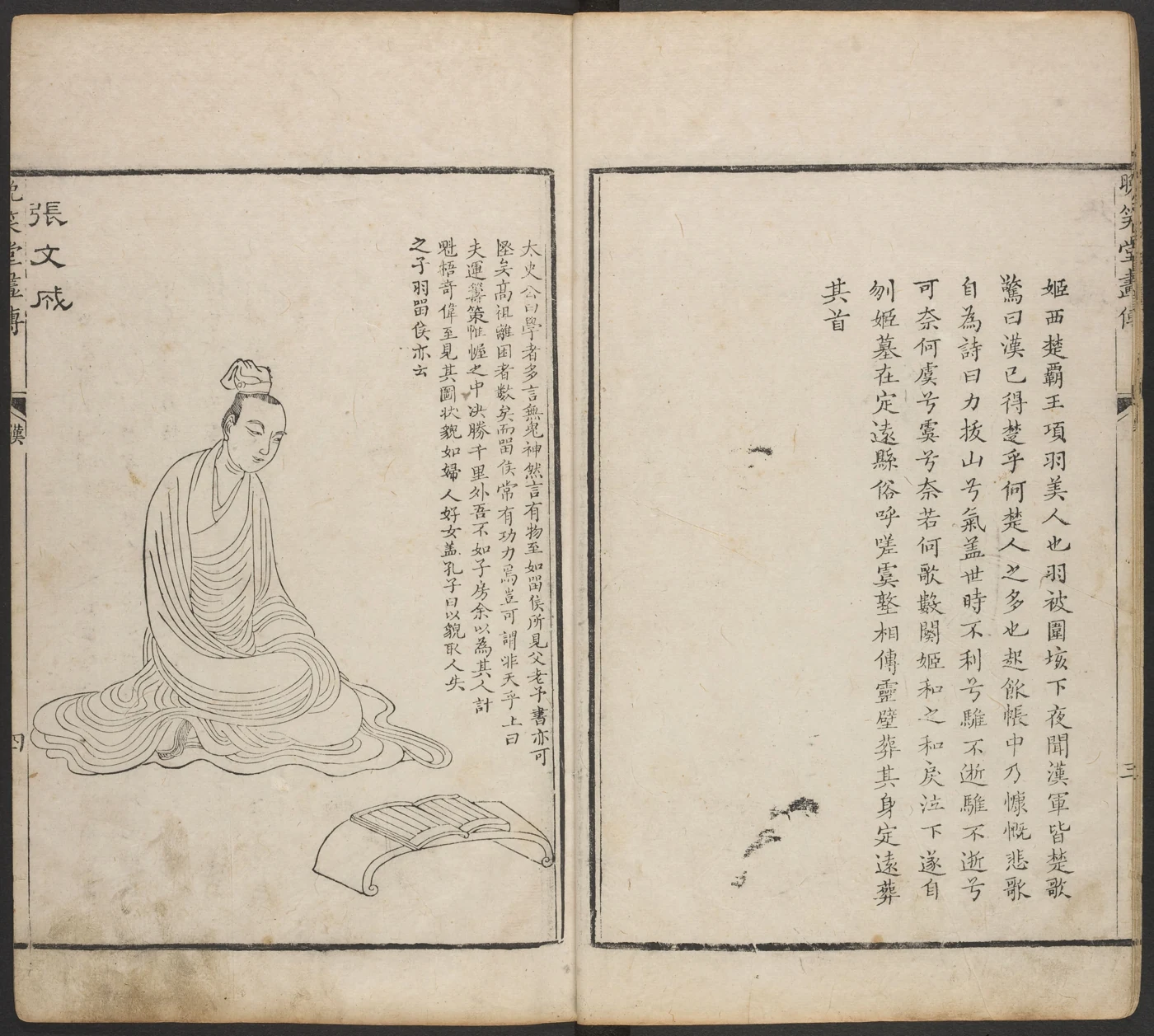
Zhang Liang
张良
Zhang Liang (d. 186 BCE), courtesy name Zifang, was a native of Chengfu in Yingchuan Commandery, in present-day Jia County, Pingdingshan, Henan. A descendant of the aristocracy of the late Warring States state of Han, he became an outstanding strategist and statesman at the end of the Qin and beginning of the Han and a founding contributor to the Western Han. Together with Han Xin and Xiao He, he was later grouped among the…
250 BCE–186 BCEWestern Han
PROFILE
Zhang Liang (d. 186 BCE), courtesy name Zifang, was a native of Chengfu in Yingchuan Commandery, in present-day Jia County, Pingdingshan, Henan. A descendant of the aristocracy of the late Warring States state of Han, he became an outstanding strategist and statesman at the end of the Qin and beginning of the Han and a founding contributor to the Western Han. Together with Han Xin and Xiao He, he was later grouped among the “Three Heroes of the Early Han.” Physically frail and often ill, he rarely commanded armies independently and generally accompanied Liu Bang as an adviser. During the Chu–Han Contention, his strategic counsel helped Liu Bang defeat Xiang Yu and establish the Han dynasty, after which he was enfeoffed as Marquis of Liu. Zhang Liang was versed in Huang-Lao thought, showed little attachment to power, and gradually withdrew from political life, later saying that he wished to roam with the immortal Master Chisong. He died in 186 BCE, the second year of Empress Gao's rule, and received the posthumous name Wencheng. Liu Bang famously said of him that in devising strategy within the command tent and determining victory a thousand li away, he himself was inferior to Zifang.
- Alternative name
- Marquis of Liu
- Courtesy name
- Zifang
- Period
- Western Han
- Date of Birth
- Not recorded in historical sources
- Date of Death
- 186 BCE
- Dynasty / regime
- Western Han
- Identity
- Official, statesman
- Ethnicity / affiliation
- Not recorded in historical sources
- Native place
- Chengfu, Yingchuan Commandery (present-day Jia County, Pingdingshan, Henan)
- Place of birth
- Not recorded in historical sources
- Major achievements
- Founding statesman of the early Han and Liu Bang's principal strategist; devised campaigns from headquarters and helped secure victories from afar; retired from active politics after being enfeoffed as Marquis of Liu.
LIFE TIMELINE
Qin destroyed Han | Qin destroyed Han; Zhang Liang resolved to avenge his fallen state
Failed in an assassination attempt at Bolangsha and fled to Xiapi | Failed in an assassination attempt at Bolangsha and fled to Xiapi
After the uprising of Chen Sheng and Wu Guang | After the uprising of Chen Sheng and Wu Guang, gathered more than one hundred followers in response
Met Liu Bang and joined him | Met Liu Bang and joined him; persuaded Xiang Liang to establish Han Cheng as king of Han and became Minister over the Masses of Han
Followed Liu Bang into Xianyang | Followed Liu Bang into Xianyang; the Qin dynasty fell
Helped save Liu Bang at the Feast at Hong Gate | Helped save Liu Bang at the Feast at Hong Gate; after Xiang Yu's enfeoffments, Liu Bang became King of Han while Zhang Liang remained with Han Cheng
Han Cheng was killed by Xiang Yu | Han Cheng was killed by Xiang Yu; Zhang Liang returned to Liu Bang
The Chu–Han Contention ended | The Chu–Han Contention ended; Liu Bang became emperor and Zhang Liang's major wartime service concluded
Enfeoffed as Marquis of Liu | Enfeoffed as Marquis of Liu
Death | Died and received the posthumous name Wencheng
BIOGRAPHY
Biography
Family Background and Early Life
Zhang Liang was born into the ruling aristocracy of the Warring States state of Han, and his family had served for generations as chief ministers of Han. His grandfather Zhang Kaidi served as chancellor under Marquis Zhao, King Xuanhui, and King Xiang'ai of Han, while his father Zhang Ping served as chancellor under King Xi and King Huanhui. This gave rise to the saying that the family had “served Han as ministers for five generations.” According to later investigations attributed to Wang Fu and Huangfu Mi, Zhang Liang's original clan name was Ji, reflecting descent from the Han ruling house, and he adopted the surname Zhang after Qin authorities placed a reward on his capture.
Zhang Ping died in 250 BCE. In 230 BCE Qin destroyed Han. Although Zhang Liang was already an adult, he had not yet held office at the Han court. After Han's fall he still possessed three hundred household retainers. Determined to avenge the destruction of his state, he did not even arrange a funeral for a younger brother who died, instead devoting his wealth to anti-Qin activity and seeking assassins to kill King Zheng of Qin.
Zhang Liang studied ritual in Huaiyang and then traveled east to meet Lord Canghai, with whom he devised an assassination plan. He recruited a strongman and had an iron hammer weighing 120 jin made for him. In 218 BCE, during the First Emperor's eastern tour, Zhang Liang and the strongman lay in ambush at Bolangsha in Yangwu County, in the eastern part of present-day Yuanyang County, Henan. Unable to identify the emperor's carriage because the vehicles were similarly drawn, they struck a secondary carriage instead. The First Emperor was enraged and ordered a nationwide search. Zhang Liang changed his name and identity and fled to Xiapi, where he went into hiding.
Receiving the Book at the Bridge and Seclusion in Xiapi
While living in exile at Xiapi, near present-day Gupi in Suining County, Jiangsu, Zhang Liang once walked near a bridge over the Yi River and encountered an old man dressed in rough clothing. The man deliberately dropped a shoe beneath the bridge and ordered Zhang Liang to retrieve it and put it on his foot. Zhang Liang suppressed his anger and obeyed. The old man told him to return to the bridge at dawn five days later. Zhang Liang arrived late on the first two occasions; on the third he came before midnight and waited until the old man arrived. Pleased, the old man said that Zhang Liang was teachable and gave him a book, telling him that by reading it he could become the teacher of a king and that thirteen years later he would encounter the man again as a yellow stone at Gucheng Mountain in Jibei. At daybreak Zhang Liang discovered that the book was The Art of War by Taigong. He thereafter studied it day and night. The old man came to be identified in later tradition as Master Huangshi, also called the Old Man at the Bridge.
During his years at Xiapi, Zhang Liang also helped Xiang Bo, an uncle of Xiang Yu who was fleeing after killing a man, evade Qin pursuit. This connection later became crucial at the Feast at Hong Gate.
Raising Troops against Qin and Joining Liu Bang
In the seventh month of 209 BCE, Chen Sheng and Wu Guang launched their uprising at Dazexiang, and anti-Qin forces rose across the empire. Zhang Liang gathered more than one hundred followers and joined the rebellion. Considering his force too weak to operate independently, he intended to join Jing Ju, who had proclaimed himself acting king of Chu. On the way, he met Liu Bang and his insurgent force near Xiapi. The two immediately found each other congenial. Zhang Liang repeatedly explained principles from The Art of War by Taigong to Liu Bang, who was usually able to understand and adopt them, whereas others could not. Zhang Liang remarked that the Duke of Pei seemed almost endowed by Heaven and decided to remain with Liu Bang, who appointed him Stable General.
In June 208 BCE, Xiang Liang and Xiang Yu established Xiong Xin, a grandson of King Huai of Chu, as ruler and summoned the leaders of the various rebel forces to Xue, southeast of present-day Tengzhou in Shandong. Still determined to restore Han, Zhang Liang proposed that Xiang Liang install Han Cheng, Lord of Hengyang and a capable member of the Han royal house, as king of Han so as to broaden their political support. Xiang Liang agreed, made Han Cheng king, and appointed Zhang Liang Minister over the Masses of Han, roughly equivalent to chancellor. Zhang Liang's long-standing goal of restoring Han was thus temporarily achieved. He devoted himself to Han Cheng, campaigned to recover Han territory, and operated around Yingchuan, although without creating a stable power base.
Assisting Liu Bang in the Conquest of Qin
In 207 BCE Liu Bang's army entered Yingchuan, where Zhang Liang and Han Cheng joined him. Liu Bang asked the king of Han to remain at Yangdi while Zhang Liang accompanied him south. In the ninth month the army reached Nanyang Commandery. The local governor withdrew into Wan and prepared for defense. Eager to enter the passes, Liu Bang initially planned to bypass Wan and continue west. Zhang Liang warned that many Qin troops remained along the route and controlled strategic terrain; leaving Wan unconquered would expose Liu Bang to attack from the rear while Qin forces blocked the front. Liu Bang accepted the advice, turned back during the night, and surrounded Wan. He then accepted Chen Hui's proposal to induce the Nanyang governor to submit, taking the city without a major battle and removing the threat to his rear.
Liu Bang next reached Yao Pass, northwest of present-day Shangzhou in Shaanxi, a strategic gateway to Xianyang. When Liu Bang proposed a direct assault, Zhang Liang urged caution and suggested deception. He recommended preparing provisions for fifty thousand men, multiplying banners on the surrounding hills to exaggerate Liu Bang's strength, and sending Li Yiji with valuable gifts to bribe the Qin commanders. The defenders agreed to surrender and even offered to advance west with Liu Bang. Zhang Liang nevertheless warned that while the commanders had defected, their soldiers might not obey them, and advised attacking while the Qin force was relaxed. Liu Bang launched a surprise assault, defeated the defenders, pursued them to Lantian, and defeated them again.
In the tenth month of 206 BCE, Liu Bang reached Bashang. Ziying, king of Qin, came out with a cord around his neck and surrendered the imperial seal and insignia. The Qin dynasty came to an end.
The Feast at Hong Gate and the Chu–Han Contention
After entering Xianyang, Liu Bang was attracted by the luxury of the Qin palaces, their women, and their treasures, and wished to remain there. Fan Kuai remonstrated forcefully but failed to persuade him. Zhang Liang then argued that Qin had fallen because its rulers had committed injustice; having entered the capital on behalf of the people, Liu Bang ought to demonstrate frugality rather than immediately indulge in the pleasures of Qin. He invoked the sayings that bitter medicine benefits illness and unwelcome advice benefits conduct. Liu Bang reconsidered and withdrew his army to Bashang.
When Xiang Yu learned that Liu Bang had entered the passes first, he became enraged and prepared to attack. Xiang Bo, remembering Zhang Liang's earlier kindness, secretly visited him by night to warn him to flee. Zhang Liang instead brought Xiang Bo to meet Liu Bang. Liu Bang explained that he had not touched Qin's wealth, had registered the officials and people, sealed the storehouses, and was waiting for Xiang Yu. He also established a marriage alliance with Xiang Bo. Xiang Bo returned to camp and spoke on Liu Bang's behalf. At the Feast at Hong Gate the next day, Xiang Yu's adviser Fan Zeng had Xiang Zhuang perform a sword dance with the intention of killing Liu Bang. Zhang Liang left the tent and summoned Fan Kuai, who entered and sharply rebuked Xiang Yu. Liu Bang then used a visit to the latrine as a pretext to escape. Zhang Liang remained behind to apologize and present gifts, enabling Liu Bang to withdraw safely.
When Xiang Yu divided the empire among eighteen lords, he planned to enfeoff Liu Bang only in Ba and Shu. Zhang Liang bribed Xiang Bo and asked him to intercede, helping secure Liu Bang's investiture as King of Hanzhong, also styled King of Han. Zhang Liang himself left Liu Bang to accompany Han Cheng. He also advised Liu Bang to burn the plank roads behind him, signaling that he had no intention of returning east and causing Xiang Yu to lower his guard.
Xiang Yu, suspecting Han Cheng of collusion with Liu Bang, prevented him from taking up his fief and later demoted him to Marquis of Rang. In 205 BCE Xiang Yu finally killed Han Cheng and installed his own subordinate Zheng Chang as king of Han. Zhang Liang escaped and returned to Liu Bang, thereafter devoting himself fully to the Han cause.
During the Chu–Han Contention, Zhang Liang repeatedly offered major strategic advice. Li Yiji once proposed restoring and enfeoffing the descendants of the Six States as a means of opposing Xiang Yu. Liu Bang was attracted to the idea, but Zhang Liang argued against it point by point, famously borrowing Liu Bang's chopsticks to demonstrate his calculations, and persuaded him to abandon the proposal. Later, when Han and Chu had negotiated the Treaty of Hong Canal, Zhang Liang and Chen Ping advocated breaking the agreement and pursuing Xiang Yu. After Liu Bang suffered a setback, Zhang Liang proposed offering territory to Han Xin and Peng Yue to secure their full cooperation, thereby creating the encirclement that ultimately destroyed Xiang Yu at Gaixia.
Establishment of the Han and Withdrawal from Politics
In 202 BCE Xiang Yu committed suicide at the Wu River, bringing the Chu–Han Contention to an end. Liu Bang proclaimed himself emperor and established the Han dynasty. At the Southern Palace in Luoyang, he praised Zhang Liang by saying that when it came to devising strategy in the command tent and deciding victory a thousand li away, he himself was inferior to Zifang.
In the first month of 201 BCE, Liu Bang distributed fiefs among his major supporters and allowed Zhang Liang to choose thirty thousand households from the rich lands of Qi. Zhang Liang declined and asked only for Liu County, memorializing the place where he had first encountered Liu Bang. He was therefore enfeoffed as Marquis of Liu.
After the empire was pacified, many officials from east of the Xiao Mountains favored Luoyang as the capital. Lou Jing of Qi instead recommended moving the capital into the Guanzhong region. When Liu Bang asked Zhang Liang's opinion, Zhang Liang strongly supported Chang'an, arguing that Guanzhong was a “golden fortress extending a thousand li,” supported by the wealth of Ba and Shu and the pastoral resources of the northern bend of the Yellow River, and protected by strategic passes from warfare in the east. Liu Bang adopted the recommendation and established the capital at Chang'an.
When rewards for the founding officials were delayed, groups of officers gathered and spoke of rebellion. Zhang Liang asked Liu Bang whom he hated most; Liu Bang named Yong Chi. Zhang Liang recommended immediately giving Yong Chi a conspicuous reward so that everyone else would be reassured. Liu Bang did so, and the other officers concluded that if even Yong Chi could be rewarded they had nothing to fear.
Late in Liu Bang's reign, he favored Consort Qi and considered replacing Crown Prince Liu Ying with Ruyi, Prince of Zhao. Empress Lü sought Zhang Liang's counsel. He recommended inviting the Four Hoaryheads of Mount Shang to support the crown prince. When Liu Bang saw that Liu Ying had acquired these eminent supporters, he abandoned the plan to change the succession.
Zhang Liang thereafter withdrew increasingly from public life. He practiced grain avoidance, remained largely at home, and declared that he wished to roam the world with the ancient immortal Master Chisong. He thus ended his life as a senior adviser rather than as an active political rival and escaped the purges that struck a number of other founding figures. He died in 186 BCE and received the posthumous name Wencheng.
Family, Name and Origins
Zhang Liang, whose courtesy name was Zifang, was by ancestry a man of Han. The Seeking the Obscure commentary on his biography cites Wei Zhao that Liu "is now under Pengcheng", and explains his wish to be enfeoffed at Liu by the fact that he first met Gaozu there; the Correct Meaning cites the Geographical Record that the old city of Liu lies fifty-five li southeast of Pei county in Xuzhou and contains a temple to Zhang Liang. On his surname the commentary notes that the History of the Han gives his courtesy name as Zifang, and, following Wang Fu and Huangfu Mi, that "Liang was of the ducal house of Han, of the Ji surname, and changed his name when Qin's search was urgent". According to the genealogical table in the New Tang History the Zhang descend from the Ji; the fifth son of Shaohao, Hui, was master of the bow and first made bow and arrow, and his descendants were granted the surname Zhang; under King Xuan of Zhou there was the minister Zhang Zhong, whose descendants served Jin, and after the partition of Jin into three the Zhangs served Han: "the Han chancellor Zhang Kaidi begot Ping, and the two of them served five rulers; Ping begot Liang, styled Zifang, Marquis Wen Cheng of Liu of the Han". Zhang Kaidi served three reigns and Zhang Ping two, whence the saying "five generations as chancellors of Han"; Zhang Ping died in the twenty-third year of King Daohui of Han (250 BC). His birthplace is not clearly given: it is argued that two Chengfu existed in the Warring States, the western one, renamed Fucheng under the Han, belonging to Han, and the eastern to Chu, so that his home should be Chengfu in Yingchuan, that is Han's Fucheng, whose city stood at Gucheng village in Lizhuang township of Baofeng; but since the district was wide the precise place is lost. The genealogical table makes the Zhangs of Qinghe, Fanyang, Henei and Wujun mostly descendants of Zhang Liang, the Qinghe line descending from his descendant the minister Zhang Xin. As to the name Zifang, commentators cite the celestial record that "of the four stars of Han, one is the heavenly team, and beside it is Wang Liang", Wang Liang being the ancient master charioteer, so that "Fang" answers "Liang", and "Zi" is an honorific for a man.
Bolangsha, Xiapi and the Book on the Bridge
When Han was destroyed Zhang Liang was still young and had not served its court; after its fall he still had three hundred retainers, yet "did not bury his younger brother, but spent his whole fortune seeking an assassin to kill the king of Qin, for the sake of his five generations of service to Han". He had studied the rites at Huaiyang, went east to see the Lord of Canghai, and with him laid plans, finding a strong man for whom he had an iron hammer of a hundred and twenty catties made. When the First Emperor toured east, Zhang Liang and his companion ambushed the train at Bolangsha and struck "by mistake the auxiliary carriage"; since the emperor, having survived several attempts, had all carriages drawn by four horses and often changed his own, the target was hard to tell, and Zhang Liang escaped into the reeds, the emperor ordering a ten-day search of the realm that found nothing. He changed his name and hid at Xiapi. There, on the bridge over the Yi river, an old man in coarse cloth dropped his shoe and ordered him to fetch and put it on; Zhang Liang, mastering his anger, "knelt long and put it on him", and the old man, laughing, went off, then returned within a li and said that "the boy can be taught; five days hence at dawn meet me here". Twice Zhang Liang came late and was rebuked; the third time he "went before midnight", and the old man came soon after and said that this was right, and gave him a bundle of books, saying that "if you read this you will be the teacher of kings; in ten years there will be a rising, and in thirteen years you will see me north of Ji, and the yellow stone at the foot of Gucheng mountain will be me", then went and was not seen again; at dawn the book proved to be the Art of War of the Grand Duke. Su Shi, in his essay on the Marquis of Liu, explained the old man rather as a recluse of Qin's day who came out to test him, "haughty and shameless, to bend him deeply", so that he "could bear small anger and accomplish great designs", adding that thirteen years later, passing north of Ji with Gaozu, he found the yellow stone and enshrined it. At Xiapi he also sheltered Xiang Bo, who had fled after killing a man, a kindness that later opened the way at the Hongmen banquet.
Raising Troops and Restoring the King of Han
In the seventh month of 209 BC, when Chen Sheng and Wu Guang rose, Zhang Liang gathered more than a hundred men, and, feeling himself too weak, meant to join Jing Ju, who had styled himself acting king of Chu; on the way he met Liu Bang's force, and the two took to one another at once. Zhang Liang expounded the Art of War to Liu Bang, who grasped and used much of it, while others to whom he explained it could not follow, so that he exclaimed that "the Duke of Pei is surely Heaven-sent", and joined him, being made his stablemaster. In the sixth month of 208, when Xiang Liang and Xiang Yu raised Xiong Xin, grandson of the king of Huai of Chu, and gathered the leaders at Xue, Zhang Liang, mindful of Han, proposed that "since you have set up a descendant of the king of Chu, the worthiest of the Han princes, Cheng, Prince of Hengyang, might be made king, to gather many adherents". Xiang Liang agreed, made Cheng king of Han and Zhang Liang his minister, sending him west with a thousand men to recover Han's land; they took several cities which Qin at once retook, and they roved as irregulars about Yingchuan without gaining much ground. In 207, when Liu Bang went south from Luoyang through Huanyuan, Zhang Liang brought his troops to him, took more than ten cities of Han and defeated Yang Xiong's army; Liu Bang left the king of Han at Yangzhai and went south with Zhang Liang, took Wan and entered the Wu pass.
The Destruction of Qin: Wan, Yao Pass and Bashang
In the ninth month the army reached Nanyang, whose governor withdrew into Wan. Liu Bang, eager to enter the pass, meant to bypass it, but Zhang Liang advised that "though you are eager to enter the pass, the Qin troops along the way are many and hold the defiles; if Wan is not taken and its troops pursue from behind, with strong Qin before and pursuers behind, it will be dangerous". Liu Bang turned back by night and ringed the city, then, on Chen Hui's advice, accepted the governor's surrender and took Wan without fighting. Reaching the Yao pass, the throat between Nanyang and the passes, where Qin held strong forces, Liu Bang wished to storm it with his twenty thousand, but Zhang Liang advised that "the Qin troops are still strong; do not take them lightly", and proposed the stratagem of preparing rations for fifty thousand, planting many banners on the surrounding hills as a feint, and sending Li Yiji with rich gifts to tempt the Qin commander. When the commander wished to defect and Liu Bang was inclined to accept, Zhang Liang warned that "this is only the commander's wish; his soldiers may not follow, and if they do not it will be dangerous — better to attack them while they are slack". Liu Bang attacked suddenly, routed them, and at Lantian defeated them again. In the tenth month of the first year of Han Liu Bang reached Bashang before the other lords, and the king of Qin, Ziying, surrendered by the Zhi road in a plain carriage with a cord about his neck and the seals and tallies boxed. Entering Xianyang, and when the palaces, women and treasures tempted him to stay and Fan Kuai's remonstrance went unheeded, Zhang Liang said that "it was because Qin was without the Way that you have come here; to rid the realm of a tyrant you should take plainness for your provision; to rest in pleasure as soon as you enter Qin is what is called helping Jie do his cruelty", and cited the sayings that "honest words are bitter to the ear but profit the conduct, and strong medicine is bitter to the mouth but cures the disease"; Liu Bang sealed the palaces and treasuries, withdrew to Bashang, and made with the elders the covenant of three articles — that the murderer should die, and that wounding or robbery should be punished — abolishing the rest of Qin's law and telling them that he had come to rid them of harm, not to injure them. The people of Qin, delighted, brought oxen, wine and food, which he declined, saying that his granaries were full and he would not put them to expense, so that they rejoiced the more and feared only that he should not be their king.
The Hongmen Banquet and the March to Hanzhong
Xiang Yu, enraged that Liu Bang had pacified the passes, was about to attack; Xiang Bo rode by night to Liu Bang's camp to see Zhang Liang and would have taken him away, but Zhang Liang said that "I was sent with the Duke of Pei by the king of Han; to flee in a moment of danger would be dishonourable", and told Liu Bang everything. Asked whether his troops could withstand Xiang Yu, Liu Bang was long silent and said they could not; Zhang Liang then had Xiang Bo brought in, and Liu Bang, learning that Xiang Bo was the elder, drank to him, pledged a marriage between their houses and asked him to say that he dared not betray Xiang Yu's kindness. At the Hongmen banquet, with Xiang Yu and Xiang Bo facing east, Fan Zeng south, Liu Bang north and Zhang Liang attending to the west, Fan Zeng three times raised his jade ring and Xiang Yu did not respond; Fan Zeng called Xiang Zhuang to dance with his sword, and Xiang Bo danced too, shielding Liu Bang with his body. Zhang Liang went to the camp gate and told Fan Kuai that "Xiang Zhuang is dancing and his intent is ever on the Duke of Pei"; Fan Kuai burst in with sword and shield, drank a great cup standing, gnawed a raw shoulder of pork, and denounced Xiang Yu for suspecting a man of such merit, saying that this was to continue the fallen Qin. Xiang Yu had no answer and bade him sit; soon after, Liu Bang went out as if to the privy and, with Fan Kuai's words that "great conduct does not heed small scruples, and great courtesy does not shrink from small concessions; now they are the chopping-block and we the fish", departed, leaving Zhang Liang to make his apologies. In the first month of the first year of Han Liu Bang was made King of Han over Ba and Shu, and gave Zhang Liang a hundred yi of gold and two pecks of pearls, which Zhang Liang gave entirely to Xiang Bo, the king also having him send rich gifts to Xiang Bo to ask for the land of Hanzhong, which Xiang Yu granted. Zhang Liang escorted the king to Baozhong, and observing the terrain advised burning the plank roads behind the army to show that he had no thought of turning east, both removing Xiang Yu's suspicion and guarding against attack; reaching Han, he told Xiang Yu that "the King of Han has burned the plank roads and has no mind to return", and sent word of Tian Rong's rebellion in Qi, so that Xiang Yu gave no thought to the west and marched north against Qi. Because the king of Han had taken Zhang Liang with him, Xiang Yu kept the king of Han Cheng from his fief and carried him east, later reducing him to Marquis of Rang and killing him, and making Zheng Chang king of Han; Zhang Liang thereupon fled back to Liu Bang and served him alone.
The Plan of Xiayi, the Borrowed Chopsticks and the Pursuit of Xiang Yu
When Liu Bang, routed at Pengcheng, fled to Xiayi in despair and, dismounting, asked who could share the task of breaking Chu if he gave away the lands east of the passes, Zhang Liang answered that "Qing Bu, the King of Jiujiang, is Chu's fierce general and at odds with Xiang Yu; Peng Yue has rebelled in Liang against Tian Rong of Qi; these two may be used at once, and of your generals only Han Xin can be entrusted with great matters and hold a front alone; if you would give away lands, give them to these three, and Chu can be broken". Liu Bang sent Sui He to win over Qing Bu, sent envoys to Peng Yue and gave Han Xin the northern campaign against Yan and Zhao, thus encircling Chu: the plan of Xiayi. In the winter of 204, when Chu besieged him at Xingyang and his supplies failed, and Li Yiji proposed restoring the descendants of the six states, Zhang Liang, coming in from outside, borrowed the chopsticks from the table to set out eight reasons against it, beginning with the point that Tang's enfeoffment of Jie's descendants rested on his power to put Jie to death, and asking whether Liu Bang could put Xiang Yu to death; he argued that land and titles were the means of rewarding merit and holding the soldiers' hearts, so that to give all to the descendants of the six states would leave nothing to reward his own men. Liu Bang spat out his food and cursed the "sour scholar" who had nearly ruined his affairs, and ordered the already-cut seals of the six states destroyed. When Han Xin, holding Qi, asked to be made a "pretended" king of Qi, Liu Bang cursed him in the envoy's presence, but Chen Ping trod on his foot and Zhang Liang agreed, so that he changed to say that a great man who has settled the princes should be a true king and not a pretended one; in the second month Zhang Liang was sent with the seals to enfeoff Han Xin in Qi and to requisition his troops against Chu, and Xun Yue, remarking on it, said that "to take what is not one's own and give it to another is to grant a hollow favour and gain a solid blessing". In 203, when the two sides agreed on the Honggou boundary and Xiang Yu marched east and Liu Bang would have gone west, Zhang Liang and Chen Ping urged that with two-thirds of the realm in his hands the moment to destroy Chu had come, and that to let it go was to let the tiger back to the mountains. Defeated at Guling because Han Xin and Peng Yue did not come, Liu Bang was told by Zhang Liang that the two held no fiefs and that if he shared the realm with them they would come at once; he gave the lands from Chen east to the sea to Han Xin and those from Suiyang north to Gucheng to Peng Yue, and two months later both came, leading to the siege at Gaixia.
The Capital, the Enfeoffment of Yong Chi and the Heir
In the second month of 202 Liu Bang took the imperial title and in the fifth month feasted his ministers at the Southern Palace in Luoyang, where he said that he had won the realm by using the three heroes and praised Zhang Liang above all for "planning in the tent and deciding victory a thousand li away". On the capital, when Lou Jing urged the passes and the ministers, mostly men of the old six states, argued for Luoyang, Zhang Liang said that "Luoyang is indeed well defended, but its heartland is small, not above a few hundred li, its fields thin, and it is exposed on all sides — no country for the exercise of arms; while the passes are flanked by the Xiao and Han on the left and Long and Shu on the right, with a fertile plain a thousand li wide, the wealth of Ba and Shu in the south and the pastures of the north, so that holding three sides one may control the princes from the east; with the princes at peace the Yellow River and Wei can float the grain of the realm to the capital, and if they rebel, the current carries it down to the armies. This is what is called a wall of metal a thousand li, a land of Heaven"; and Gaozu moved the capital west that day. Seeing from a covered walk generals sitting and talking in the sand, he said that this was rebellion, explaining that they feared a limited realm could not reward them all and dreaded punishment for past faults; he advised that Yong Chi, whom the emperor most hated and the ministers most knew he hated, be enfeoffed first, and when Yong Chi was made Marquis of Shifang, the ministers rejoiced that if Yong Chi could be a marquis they had nothing to fear. In the emperor's last years, when the Lady Qi was favoured and he wished to replace the heir Liu Ying with the Prince of Zhao, Ruyi, the Empress Lü sent Lü Ze to force Zhang Liang to advise; he said that the emperor had four men he could not summon, who, being old and thinking the emperor treated men with contempt, had fled to the hills and would not be Han subjects, and that if the heir would write humbly and send a comfortable carriage with eloquent men to press them, they would come and, appearing at court with the heir, would be asked about and would help. The four came to lodge with the Marquis of Jiancheng; in the twelfth year, when the emperor returned from defeating Qing Bu and, more ill, wished again to change the heir, Zhang Liang remonstrated without success and ceased to attend to business. At a feast the heir attended with the four, all over eighty, with white brows and imposing dress, and when the emperor asked who they were they named themselves the Duke of the Eastern Garden, Master Jiao Li, Master Qi Li and the Duke of Xia Huang, saying that he despised scholars and loved to curse, so that they would not suffer insult and had hidden, but that they had heard the heir was humane and filial and respectful to scholars, so that all the realm wished to die for him, and that therefore they had come. The emperor asked them to protect the heir, and, watching them go, showed them to the Lady Qi, saying that he had wished to change the heir but that these four supported him, so that his wings were grown and it could not be done, and sang the song of the swan that flies a thousand li at a wing, at which the Lady Qi wept. The heir was never changed, "and it was through Zhang Liang's summons of these four that it was so".
Retirement, Death and Remains
At the distribution of honours the emperor had him choose thirty thousand households in the rich land of Qi, but Zhang Liang declined, asking only for Liu, where he had first met the emperor, and was made Marquis of Liu. Thereafter he pleaded illness and shut himself in, passing from "teacher of emperors" to "guest of emperors", taking neither part nor not, and abstaining from grain, saying that he wished to leave the world's affairs and wander with the immortal Chi Songzi. After the emperor's death the Empress Lü, mindful of his service, pressed food on him, saying that a man's life was like a white horse passing a crack and that he should not torment himself, and he was obliged to eat a little. He died in 186 BC with the posthumous name Wencheng; his son Zhang Buyi inherited and lost the title in the fifth year of Emperor Wen for want of respect. His tomb is variously placed: at Mount Baiyun southwest of Lankao in Henan, where tradition has him retire after the emperor's death and be buried; near Pei in Xuzhou, on the Tang record that "the tomb of Zhang Liang of the Han lies sixty-five li east of Pei county, near Liu", his fief being at Liu; at Mount Qingyan in Hunan, whose gazetteers record a tomb "now appearing, now hidden"; and on the southern slope of Weishan island, where the mound is square below and round above, built of red and yellow clay with pebbles, fifteen metres high and a hundred metres across, with a Qing stele before it. At Liuba in Shaanxi there is a temple to him, founded by those who admired his "wise self-preservation" and his refusal to claim merit, of six courts and more than a hundred and fifty halls in some fourteen thousand two hundred square metres, one of the largest shrines in Shaanxi, with more than a hundred cliff steles, fifty wooden tablets and thirty couplets. At Huangpao mountain in Tongcheng, Hubei, he is said to have built the Liangshan Daoist temple and the Fanggui academy to teach the local children, whose stone inscription survives. In February 2006 a red stone was found at Zhangdian village in Likou township, Jiaxian, Henan, bearing fifty-seven characters in six lines, including a vow to bow to the Marquis of Liu, whose image was not awe-inspiring yet who "planned in the tent and decided victory a thousand li away, becoming the teacher of emperors", and to admire and imitate him.
Major Activities
Assassination Attempt at Bolangsha
In 218 BCE, seeking revenge for Qin's destruction of Han, Zhang Liang and a strongman ambushed the First Emperor's convoy at Bolangsha. Their iron hammer struck a secondary carriage and the assassination failed. The First Emperor ordered a ten-day empire-wide search, but Zhang Liang changed his identity and escaped to Xiapi. The source text contrasts this episode with the better-known attempts of Jing Ke and Gao Jianli, noting that Zhang Liang alone survived a failed assassination attempt and evaded pursuit, evidence of his early planning ability.
Strategic Counsel to Liu Bang
As Liu Bang's principal strategist, Zhang Liang repeatedly offered advice at decisive moments:
- Withdrawal to Bashang: persuaded Liu Bang not to indulge in the Qin palaces after entering Xianyang, reducing the danger of an immediate confrontation with Xiang Yu.
- Escape from the Feast at Hong Gate: used his connection with Xiang Bo and summoned Fan Kuai at a critical moment, helping Liu Bang leave safely.
- Burning the plank roads: advised Liu Bang to destroy the roads behind him to suggest that he had no intention of returning east, lowering Xiang Yu's vigilance.
- Opposition to restoring the Six States: rejected Li Yiji's proposal to broadly restore the old Warring States ruling houses and persuaded Liu Bang to abandon it.
- Pursuit of Xiang Yu: after the peace agreement between Han and Chu, joined Chen Ping in urging Liu Bang to pursue Xiang Yu.
- Winning over Han Xin and Peng Yue: after a Han setback, advised Liu Bang to promise territory to both commanders, enabling the final encirclement of Xiang Yu.
- Capital at Guanzhong: supported Chang'an as the imperial capital, shaping the geopolitical center of the Western Han.
- Rewarding Yong Chi: defused anxiety among the founding commanders by recommending that Liu Bang reward a man he personally disliked.
- Protecting the crown prince: advised Empress Lü to secure the support of the Four Hoaryheads of Mount Shang for Liu Ying, helping prevent a change in the succession.
Opposition to Broad Feudal Restoration and Support for Centralization
The source text presents Zhang Liang as one of the early Han advisers who opposed restoring the political order of the Warring States through large-scale enfeoffment of old ruling houses and instead favored a more centralized commandery-and-county system. Although early Han government ultimately combined commanderies with princely kingdoms, his position is described as contributing to the long-term centralizing direction of the Western Han state.
Travels and Movements
Zhang Liang's life took him across much of north and central China. He came from former Han territory in present-day Henan, studied at Huaiyang, attempted to assassinate the First Emperor at Bolangsha in present-day Yuanyang, hid at Xiapi in present-day Suining, Jiangsu, and then accompanied Liu Bang through Yingchuan, Nanyang, Wuguan, and Xianyang. During the Chu–Han Contention he moved repeatedly through the Xingyang and Chenggao region. In later life he resided at Chang'an and practiced withdrawal and grain avoidance.
The Art of Huang-Lao, Merit without Battle, and Later Fame
Zhang Liang never commanded troops alone nor won merit in battle, his plans being made in the tent, so that Sima Qian's postface says that he "planned in the tent and won victory unseen: Zifang contrived the matter, without repute for wisdom or valour in arms, finding the hard in the easy and the great in the small". Yang Xiong said that "Xiao set the rule and Cao followed it, the Marquis of Liu drew the plans and Chen Ping produced the stratagems: their merit was as Mount Tai and their echo like a collapsing slope, for though these men were abundantly wise, it was also that their time allowed it". Above all, Liu Bang at the Southern Palace put him first of the three heroes, saying that he was unequal to him in planning in the tent and deciding victory a thousand li away. Later ages made him the measure of the supreme strategist: Cao Cao called Xun Yu "my Zifang", and the Ming founder called Liu Ji "my Zifang". Sima Guang, on his abstention from grain, judged that "with Zifang's clarity he must have known the immortals to be a fiction; but that he wished to follow Chi Songzi shows his wisdom, for between merit and fame lies the difficulty of a minister's place", instancing the execution of the Marquis of Huaiyin and the imprisonment of Xiao He, and concluding that to shelter in the immortals, cast off the world and hold fame as an external thing is the way of "wise self-preservation". Wang Fuzhi held that "the wisdom of the Marquis of Liu lay not in planning for the state but in planning for himself". Li Zhi and others praised his borrowed-chopstick argument as a brilliant piece; some held that he was "a knight-errant who knew righteousness and a strategist who knew the times, but no Confucian", resembling Jing Ke in youth and Lu Zhonglian in age, and that he had the art of Laozi's "not daring to be first in the world", so that he did not take the great carpenter's axe and did not cut his hand. In his own views he was among the few early Han ministers to oppose restoring the Warring States system of fiefs and to favour centralised commanderies and counties; though his view was not fully adopted — the early Han combining commanderies with fiefs — it mattered greatly for the later centralisation of the dynasty.
His Teachers, Family and Descendants
His teacher, by the Records, was the old man on the bridge who gave him the Grand Duke's Art of War; Su Shi held that the old man was no ghost but "a recluse of Qin's day come out to test him", the purport of his cryptic words being "the mutual warning of sages". Of his family, his grandfather Zhang Kaidi and father Zhang Ping had been chancellors of Han; his son Zhang Buyi inherited the marquisate and lost it in the fifth year of Emperor Wen; and another son, Zhang Pijiang, is recorded as advising in the reign of Emperor Hui. The genealogical table of the New Tang History makes the Zhangs of Qinghe, Fanyang, Henei and Wujun descend from him, the Wujun line from the fourth son of Zhang Song, and the Qinghe line from his descendant the minister Zhang Xin. Daoist and popular tradition made him an adept who "cultivated it in his own person and could refine the breath and abstain from grain, making himself light and feathered", an associate of the Four Whiteheads and the other recluses, who at last dissolved his form and was buried at Longshou plain; the gazetteer of Chao county records a Zifang cave on its Mount Baiyun where he is said to have fasted and retired, with a shrine and incense offered by later ages, and the Tianshou temple at Chen county, where he was enfeoffed in 1111-1118 as the "True Man who Rides the Void". Such accounts are later embroidery and must be kept apart from his history.
The Three Attempts on the First Emperor Compared
The Records of the Grand Historian record three attempts on the First Emperor: Jing Ke's with the map, Gao Jianli's with the lute, and Zhang Liang's hammer at Bolangsha. Jing Ke and Gao Jianli went to certain death and died with their failure; Zhang Liang, having failed, escaped, changed his name and hid at Xiapi through the ten-day search of the realm, and lived to win the empire as a strategist. Su Shi makes this the centre of his essay, saying that Zhang Liang, "with a talent that covered the age, did not devise the plans of Yi Yin and the Grand Duke but produced only the stratagems of Jing Ke and Nie Zheng, trusting to luck for his life" — the very thing the old man on the bridge lamented, and why he "bent him with haughtiness and shamelessness" so that he might bear and then accomplish great things. The comparison shows both his early daring and the passage of his life from the valour of a common man to the wisdom of a statesman.
His Part in the Politics of the Early Han
Zhang Liang's plans concerned the survival of the Han. In the struggle with Chu he opposed restoring the descendants of the six states, arguing eight reasons with borrowed chopsticks against it and preventing a political retreat; he urged the pursuit of Xiang Yu and the wooing of Han Xin and Peng Yue with lands, bringing about the siege of Gaixia; after the founding he urged the establishment of the capital in the passes, fixing the centre of gravity of two hundred years of Han; he calmed the ministers' threatened revolt by first enfeoffing Yong Chi; and in his last years he preserved the heir Liu Ying by summoning the Four Whiteheads. His device of "settling one enemy to steady the many" was much imitated by later politicians. In political thought his opposition to restoring the fiefs of the Warring States and his insistence on centralisation were rare in the early Han, and his borrowed-chopstick argument was still praised by Li Zhi seventeen centuries later as a brilliant piece, giving it a place in the history of Chinese political thought.
Relics and Commemoration
The shrine at Liuba in Shaanxi, the tombs at Mount Qingyan in Hunan, at Weishan island in Shandong and at Mount Baiyun in Lankao, Henan, are places of remembrance; at Huangpao mountain in Tongcheng there survive the Liangshan temple and the Fanggui academy; and the stone found at Zhangdian village in Jiaxian in 2006 sums up his life as one who "planned in the tent and decided victory a thousand li away, becoming the teacher of emperors". The proverb that "you have Zhang Liang's plan, and I have a ladder over the wall" shows how deeply his image as a man of wisdom has entered popular speech, while the habit of calling a great strategist "my Zifang" has made him the standard by which supreme strategists are measured.
Personal Relations
- Grandfather: Zhang Kaidi, chancellor under three rulers of Han
- Father: Zhang Ping, chancellor under two rulers of Han
- Son: Zhang Pijiang
- Later descendants or attributed descendants: Eastern Han scholar Zhang Chao, Shu Han general Zhang Yi, and, according to tradition, the Daoist founder Zhang Daoling
- Master Huangshi: legendary teacher who gave Zhang Liang The Art of War by Taigong at the bridge
- Xiang Bo: Zhang Liang had once saved his life at Xiapi; he later became a crucial intermediary before the Feast at Hong Gate
- Four Hoaryheads of Mount Shang: Dongyuan Gong, Master Luli, Qili Ji, and Xia Huang Gong, whom Zhang Liang asked to support Crown Prince Liu Ying
- Liu Bang: Zhang Liang's principal ruler; the two maintained a close relationship, and Liu Bang praised his strategic ability
- Empress Lü: deeply respected Zhang Liang after his role in safeguarding Crown Prince Liu Ying
- Han Cheng: last restored king of Han, whom Zhang Liang assisted until Xiang Yu killed him
- Xiang Liang: accepted Zhang Liang's proposal to make Han Cheng king of Han
- Xiao He: one of the Three Heroes of the Early Han, responsible primarily for administration and logistics
- Han Xin: one of the Three Heroes of the Early Han and the leading field commander
- Chen Ping: strategist who cooperated with Zhang Liang in major late-war decisions
- Fan Kuai: general who helped protect Liu Bang at the Feast at Hong Gate and also remonstrated against remaining in the Qin palaces
- First Emperor of Qin: target of Zhang Liang's assassination attempt
- Xiang Yu: principal opponent during the Chu–Han Contention
- Fan Zeng: Xiang Yu's strategist and a major rival in political and military maneuvering
Historical Assessment
Han Dynasty and Contemporary Assessments
- Liu Bang praised Zhang Liang as the strategist whose planning in the command tent decided victory a thousand li away.
- Sima Qian emphasized that Liu Bang repeatedly escaped danger with Zhang Liang's assistance and described Zhang Liang's strength as winning through planning rather than through personal fame or battlefield valor.
- Ban Gu repeated the tradition that, despite Zhang Liang's reputation for courage and intelligence, his appearance was delicate and unexpectedly feminine, and likewise emphasized his repeated assistance to Liu Bang in moments of crisis.
- Yang Xiong grouped Zhang Liang's strategic planning with the achievements of Xiao He, Cao Shen, and Chen Ping.
- Feng Yan praised the courage shown by Zhang Liang, a descendant of five generations of Han ministers, in striking at the First Emperor at Bolangsha.
Wei, Jin, and Northern and Southern Dynasties
- Zhuge Liang remarked that Zhang Liang's appearance was not imposing, yet he devised strategy from within the command tent and determined victory at great distance, thereby becoming a teacher of emperors and kings.
- Liu Shao classified Fan Li and Zhang Liang as masters of strategic methods whose thinking penetrated the principles of rule and whose plans were subtle and extraordinary.
- Cao Cao famously compared Xun Yu to “my Zifang,” showing that Zhang Liang had already become a model against which later rulers measured elite advisers.
Tang and Song Dynasties
- Su Shi's Essay on the Marquis of Liu interpreted Master Huangshi's test at the bridge as a lesson in endurance and praised Zhang Liang's ability to tolerate small humiliations for a greater plan. He also reflected critically on Zhang Liang's late claim that he wished to follow Master Chisong.
- Sima Guang, in the Comprehensive Mirror in Aid of Governance, criticized Zhang Liang's later pursuit of grain avoidance and immortality and suggested instead that his withdrawal may have reflected a clear-eyed response to court struggles and the danger faced by powerful founding ministers.
Ming and Qing Dynasties
- The Ming founder Zhu Yuanzhang compared Liu Ji, also known as Liu Bowen, to “my Zifang,” continuing the tradition of treating Zhang Liang as the archetype of a supreme strategist.
- Wang Fuzhi, in Discussions on Reading the Comprehensive Mirror, argued that Zhang Liang's wisdom lay not only in planning for the state but also in planning for his own survival, praising his ability to retire after success.
Modern Period
- Zhang Liang is popularly honored as a “Sage of Strategy,” often grouped in later cultural tradition with figures such as Guan Yu and Zhuge Liang as archetypes of martial loyalty and wisdom.
- Modern scholarship commonly treats him as one of the outstanding strategists of the early Han, and the image of “planning within the command tent” has become synonymous with the highest level of strategic counsel in Chinese historical memory.
- The popular saying contrasting “Zhang Liang's plan” with “a ladder over the wall” continues to reflect his deep association with ingenuity in later folklore.
FIGURES ASSOCIATED WITH THIS DYNASTY
Bibliography
- Sima Qian, Records of the Grand Historian, “Hereditary House of the Marquis of Liu,” “Basic Annals of Gaozu,” and “Basic Annals of Xiang Yu”
- Ban Gu, Book of Han, “Biography of Zhang Liang, Chen Ping, Wang Ling, and Zhou Bo”