Birth | Born.
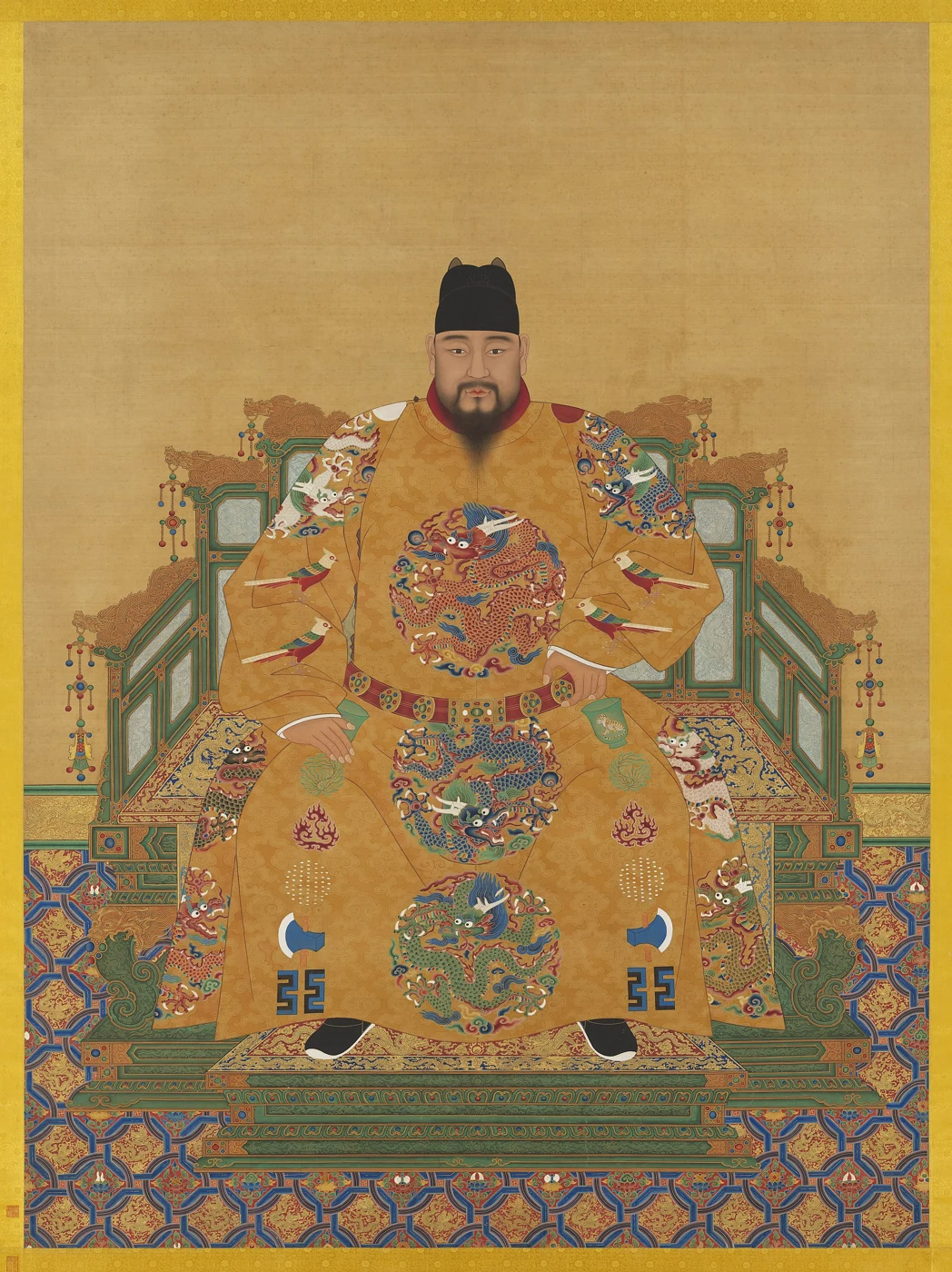
1427 CE–1464 CE
Emperor of the Ming Dynasty
Zhu Qizhen
朱祁镇
Zhu Qizhen (November 29, 1427–February 23, 1464), eldest son of the Xuanzong Emperor Zhu Zhanji and Empress Xiaogongzhang Sun, and elder half-brother of the Jingtai Emperor Zhu Qiyu, was the sixth emperor of the Ming Dynasty. He used the era names Zhengtong (1436–1450) and Tianshun (1457–1464) and reigned for a total of twenty-two years. He was the only Ming emperor to use more than one era name and, after the fall of the…
1427 CE–1464 CEMing Dynasty
PROFILE
Zhu Qizhen (November 29, 1427–February 23, 1464), eldest son of the Xuanzong Emperor Zhu Zhanji and Empress Xiaogongzhang Sun, and elder half-brother of the Jingtai Emperor Zhu Qiyu, was the sixth emperor of the Ming Dynasty. He used the era names Zhengtong (1436–1450) and Tianshun (1457–1464) and reigned for a total of twenty-two years. He was the only Ming emperor to use more than one era name and, after the fall of the Song Dynasty, the only reigning dynastic monarch captured as a result of military defeat. His life included accession in childhood, reliance on the eunuch Wang Zhen, capture in the Tumu Crisis, seven years of confinement in the Southern Palace, and restoration in the Duomen Coup. He was a central figure in a key period when the Ming began to shift from prosperity toward decline.
- Other names
- Zhengtong, Tianshun
- Period
- Ming Dynasty
- Date of Birth
- November 29 1427
- Date of Death
- February 23 1464
- Dynasty/Regime
- Ming Dynasty
- Identity
- Emperor of the Ming Dynasty
- Predecessor
- Emperor Xuanzong of Ming (Zhu Zhanji)
- Successor
- Emperor Daizong of Ming (Zhu Qiyu) after the first reign; Emperor Xianzong of Ming (Zhu Jianshen) after the second
- Ethnicity
- Not recorded in historical sources
- Native place
- Not recorded in historical sources
- Place of birth
- Not recorded in historical sources
- Place of death
- Not recorded in historical sources
- Reigns
- 1435–1449; 1457–1464
- Era names
- Zhengtong, Tianshun
- Temple name
- Yingzong
- Posthumous name
- Fatian Lidao Renming Chengjing Zhaowen Xianwu Zhide Guangxiao Rui Huangdi
- Highest office
- See Life and Major Deeds
- Major achievements
- Ascended the throne at a young age and favored Wang Zhen; was captured in the Tumu Crisis; spent seven years confined in the Southern Palace; restored to the throne in the Duomen Coup.
LIFE TIMELINE
Given the name Qizhen. | Given the name Qizhen.
Invested as crown prince. | Invested as crown prince.
The Xuanzong Emperor died | The Xuanzong Emperor died; Zhu Qizhen ascended the throne and adopted the era name Zhengtong the following year.
Began ruling personally | Began ruling personally; Beijing was formally designated the capital that same year.
Grand Empress Dowager Zhang died | Grand Empress Dowager Zhang died; Wang Zhen began to monopolize power.
Tumu Crisis | Tumu Crisis; Yingzong was captured by the Oirats.
Esen took Yingzong north | Esen took Yingzong north, beginning his captivity in the steppe.
Prince of Cheng Zhu Qiyu ascended the throne as the Jingtai Emperor and honored Yingzong a | Prince of Cheng Zhu Qiyu ascended the throne as the Jingtai Emperor and honored Yingzong as Retired Emperor.
Yang Shan was sent to the Oirats and Yingzong was escorted back to Beijing. | Yang Shan was sent to the Oirats and Yingzong was escorted back to Beijing.
Yingzong was confined in Chongzhi Palace in the Southern Palace. | Yingzong was confined in Chongzhi Palace in the Southern Palace.
The Golden Knife Case occurred | The Golden Knife Case occurred; Ruan Lang was tortured to death.
Duomen Coup | Duomen Coup; Yingzong was restored to the throne and changed the era name to Tianshun.
Yu Qian and Wang Wen were executed for alleged treason | Yu Qian and Wang Wen were executed for alleged treason; their deaths were widely regarded as unjust.
Death | Died at age thirty-six and was buried in Yuling.
BIOGRAPHY
Biography
Family Background and Early Years
On the eleventh day of the eleventh month of Xuande 2 (November 29, 1427), Zhu Qizhen was born in the imperial palace in Beijing. His father, the Xuanzong Emperor Zhu Zhanji, was twenty-nine and had previously been worried by the lack of a son. He rejoiced greatly at Zhu Qizhen's birth. On the third day of the second month of the following year (February 17, 1428), Xuanzong bestowed the name “Qizhen” and explained in a sealed edict that “Qi” signified greatness and “zhen” the way of stabilizing and pacifying, linking the name to the heavy responsibility of the ancestral temples, the vast realm, and its people, and urging sincerity, reverence, benevolence, and care for the empire. Four months later, Zhu Qizhen was established as crown prince, and his mother Lady Sun was made empress.
During Zhu Qizhen's childhood, the Ming was nearing the end of the Reign of the Ren and Xuan Emperors. His grandfather, the Renzong Emperor Zhu Gaochi, had reigned for less than a year, while his father Xuanzong ruled for ten years with active governance, relatively clear administration, and strong state power. As Xuanzong's only surviving son, Zhu Qizhen was raised with high expectations and received strict education as heir apparent. In the first month of Xuande 10 (1435), however, the thirty-six-year-old Xuanzong suddenly died, leaving the eight-year-old Zhu Qizhen to inherit the throne.
Early Zhengtong Government and Wang Zhen's Ascendancy
Zhu Qizhen ascended the throne in the first month of Xuande 10 (1435) and adopted the era name Zhengtong the following year. Because he was still a child, government was overseen by Grand Empress Dowager Zhang, consort of the Renzong Emperor, while the Grand Secretariat was led by the “Three Yangs”—Yang Shiqi, Yang Rong, and Yang Pu—allowing the policies of the preceding era to continue. In 1441 (Zhengtong 6), Zhu Qizhen formally began ruling in person and declared Beijing the capital, ending Nanjing's nominal status as capital.
Grand Empress Dowager Zhang died in 1442 (Zhengtong 7), and the Three Yangs gradually withdrew from politics because of age. Wang Zhen, a eunuch who had long served Zhu Qizhen, then began to monopolize authority. Originally an instructor who had castrated himself and entered palace service, Wang Zhen won the young emperor's confidence through skill at reading his wishes. He used the emperor's youth and inexperience to accumulate power, build a faction, and exclude opponents. Officials feared him, while many nobles and meritorious families called him “revered father.” This marked the first major episode of eunuch dominance in the Ming and helped set the stage for the Tumu Crisis.
Tumu Crisis and Captivity in the North
In 1449 (Zhengtong 14), Esen, taishi of the Oirats, launched a large-scale invasion after the Ming reduced the rewards offered in frontier exchanges. Wang Zhen urged the young Yingzong to lead the army personally in hopes of winning military glory. Against the objections of the ministers, Zhu Qizhen hastily led an army said to number five hundred thousand. The force left through Juyong Pass and marched by Datong. Extravagance, weak discipline, continuous rain, and supply problems undermined the campaign. Wang Zhen first planned to retreat through Zijing Pass, then altered the route toward Weizhou because of concern for his property, and changed it again toward Xuanfu because he feared the army would trample crops near his home. The repeated detours exhausted the troops.
On the fifteenth day of the eighth month of Zhengtong 14 (September 1, 1449), the Ming army reached Tumu, in present-day Huailai County, Hebei, and was encircled by Oirat forces. The Chinese source records that “tens of thousands died,” and more than fifty civil and military officials accompanying the expedition were killed. Zhu Qizhen was captured. The guard general Fan Guang killed Wang Zhen in the chaos, crying that he was “executing this traitor for the realm,” and then died fighting. The episode became known as the Tumu Crisis.
After capturing Zhu Qizhen, Esen initially sought to use him to demand wealth from the Ming. Once the Ming had installed a new emperor, Esen brought Yingzong south to pressure Beijing. During the Defense of Beijing, Yu Qian and other ministers insisted on holding the capital and repelled the Oirats. Esen then saw that Yingzong had lost much of his value as a hostage and became willing to release him.
During his captivity on the northern steppe, Yuan Bin and Ha Ming cared for Zhu Qizhen and eased his difficult circumstances. Esen treated the captive emperor with considerable courtesy: according to the account, he provided a sheep every two days, an ox every seven days, held banquets at intervals of five, seven, or ten days, and supplied cow's and mare's milk daily. Oirat men and women bowed to him when he sat in camp or rode past. Esen was even said to have considered marrying his younger sister to Yingzong, an offer the emperor declined.
Seven Years of Confinement in the Southern Palace
In 1450 (Jingtai 1), Honglu Court official Yang Shan sold his property and went alone on a mission to the Oirats. Although the Jingtai Emperor had not authorized him to recover Yingzong, Yang Shan used persuasion to secure his return to Beijing. Zhu Qiyu, the Jingtai Emperor and Yingzong's younger half-brother, was reluctant to see him return because he wished to retain the throne. After reaching Beijing, Yingzong was confined in Chongzhi Palace in the Southern Palace, in the area of present-day Nanchizi, and was placed under close guard by the Embroidered Uniform Guard.
During his seven years of confinement, Zhu Qizhen lost his freedom and lived under difficult conditions. Empress Qian wept daily. The source states that prolonged kneeling in prayer left one leg disabled and one eye blind. Despite these hardships, Zhu Qizhen and Empress Qian remained close; in the Southern Palace he fathered four sons and six daughters, although the third and fourth sons died young.
In 1452 (Jingtai 3), the Jingtai Emperor removed Yingzong's eldest son Zhu Jianshen from the position of crown prince and made his own son Zhu Jianji heir. Zhu Jianji died the following year, but the Jingtai Emperor still refused to restore Zhu Jianshen. Zhu Qizhen remained closely watched in the Southern Palace throughout this period.
Golden Knife Case
In the sixth month of 1452, the Left Junior Eunuch Ruan Lang served Yingzong in the Southern Palace. Yingzong gave him a gilded knife with a decorated pouch, which Ruan Lang passed to his subordinate Wang Yao. While drinking at the home of Lu Zhong, a commander of the Embroidered Uniform Guard, Wang Yao displayed the object. Lu Zhong considered its form unusual and reported it to the eunuch Gao Ping, falsely alleging that it was a token by which Yingzong was secretly contacting outside officials and plotting restoration.
Ruan Lang was arrested and imprisoned, where he was subjected to severe torture but refused to confess, dying under torture on the twelfth day of the seventh month. Wang Yao and Ruan Lang's adopted son Zhao Jin were executed by lingchi, and their property was confiscated. Lu Zhong had privately consulted a diviner and was accused of signs connected with treason, so he feigned insanity to protect himself. Scholar Shang Lu and Directorate of Ceremonial eunuch Wang Cheng later memorialized that the word of a madman was unreliable, and further investigation ended. After Yingzong's restoration in 1457, Ruan Lang received a posthumous promotion within his bureau and a stele proclaiming his innocence, while Gao Ping and Lu Zhong were executed by lingchi.
Duomen Coup and Restoration
On the seventeenth day of the first month of Jingtai 8 (February 11, 1457), the Jingtai Emperor was too ill to attend court. Marquis of Wuqing Shi Heng, Vice Censor-in-Chief Xu Youzhen, and the eunuch Cao Jixiang led armed men into the Southern Palace and restored Yingzong. Before dawn the emperor entered the audience hall through Donghua Gate; at daybreak the palace gates opened and the officials were informed. The era name was changed to Tianshun on the twenty-first day of the month. The episode is known as the Duomen Coup.
After his restoration, Yingzong did not immediately depose the Jingtai Emperor, producing a brief period in which both men formally retained imperial status. Only on the first day of the second month was Jingtai reduced again to Prince of Cheng and moved to the western residence. He died soon afterward, received the posthumous title Prince Li of Cheng, and was buried at Jinshan in the western suburbs. Yingzong compelled women of Jingtai's harem to follow him in death.
Yingzong then carried out a broad purge. Minister of War Yu Qian and Grand Secretary Wang Wen were imprisoned for alleged treason. Yingzong initially acknowledged that Yu Qian had rendered real service, but Xu Youzhen reportedly argued that “if Yu Qian is not killed, today's action has no justification.” Five days later Yu Qian and Wang Wen were executed at the western market. Yu Qian's body was left in the street, his property confiscated, and his family exiled, prompting widespread claims of injustice. The wife, children, and residence of the meritorious commander Fan Guang were even granted to a surrendered former enemy, an act later historians treated with shame.
Yingzong also ordered a sandalwood statue of Wang Zhen made, conducted sacrificial funerary rites for him, and established a memorial shrine at Zhihua Temple in Beijing. He additionally built a temple for the Oirat leader Esen. Grand Secretary Li Xian later explained what had actually happened in the Duomen Coup: the Jingtai Emperor had no surviving son, Empress Dowager Sun was still alive, and the throne would eventually have returned to Yingzong without a coup; the coup had largely been staged by ambitious men seeking promotion. Yingzong thereafter ordered that the term “Duomen” no longer be used in the palace and revoked more than four thousand promotions granted for participation in the coup.
Shi Heng and Cao Jixiang later became implicated in the Cao–Shi rebellion. Shi Heng died in prison and Cao Jixiang was executed by lingchi. During the Tianshun era Yingzong was comparatively diligent in government, employing Li Xian, Wang Ao, Peng Shi, and other ministers, and the administration was relatively orderly.
Final Years and Testament
Yingzong died in the first month of Tianshun 8 (February 1464), aged thirty-six, and was buried in Yuling among the Ming tombs.
Shortly before death, after others sowed distrust of the crown prince, Yingzong considered passing the throne to his second son Zhu Jianlin, Prince of De, but Grand Secretary Li Xian dissuaded him. Because Consort Zhou was domineering, Yingzong feared that after his death his successor, the Xianzong Emperor Zhu Jianshen, who was her son, would fail to honor Empress Qian. He therefore ordered in his testament that when Empress Qian died she should be buried with him. When Qian later died, Empress Dowager Zhou indeed opposed her burial in Yuling, but the ministers invoked Yingzong's testament and secured her joint burial. Empress Dowager Zhou was eventually buried there as well, helping establish the later Ming pattern in which one emperor could be buried with two or more empresses.
Immediately before his death, Yingzong abolished the practice, in force since the time of Ming Taizu, of compelling palace consorts to die with the emperor, and restored the title of Empress Hu. The source also records that he established the Boluohe Guard and Hulum Guard east of the Ussuri River in the region of present-day Sakhalin, reinforcing Ming rule along the northeastern frontier.
Birth, Investiture and the First Years of Zhengtong
Zhu Qizhen was born on the eleventh day of the eleventh month of the second year of Xuande, 29 November 1427, the eldest son of Emperor Xuanzong of Ming, his mother being the consort Sun, later empress; he was the first emperor of Ming born after his father had come to the throne, and within three months of birth, on the sixth day of the second month of the third year of Xuande, 1428, was made heir apparent. It is recorded that the consort Sun had no son of her own and secretly took a palace woman's child as hers, namely the Yingzong Emperor, and was therefore the more favoured. When he had learned to speak, Xuanzong took him on his knee and asked whether, when he became Son of Heaven, he could make the realm peaceful, and Zhu Qizhen answered that he could; and when Xuanzong asked whether, if any disturbed the law and order of the state and rebelled against their superior, he would dare to lead the six armies in person to attack them, Zhu Qizhen answered that he would; and it is said that in answering his voice was strong and his look firm without hesitation, so that Xuanzong was overjoyed, feeling his line secure, and put his own dragon robe and jade belt on Zhu Qizhen and set him on the throne, while all about him shouted ten thousand years. On the first day of the first month of the tenth year of Xuande, 1435, the dying Xuanzong excused the ministers from the new year's greetings and had them go to the eastern palace, and two days later died in the Qianqing palace, leaving a testament passing the throne to the heir apparent; Zhu Qizhen was nine by Chinese reckoning and could not manage business, and the testament required that all weighty matters of state be reported to the empress dowager.
In the first month of the tenth year of Xuande Zhu Qizhen came to the throne and changed the era name to Zhengtong. The government was in the hands of the three Yangs, the grand secretaries Yang Shiqi, Yang Rong and Yang Pu, while the eunuch Wang Zhen was put in charge of the directorate of ceremonial to balance them. The grand empress dowager Zhang also took care to curb Wang Zhen, and in the second year of Zhengtong, 1437, summoned the three Yangs together with Zhang Fu and Hu Ying, requiring Zhu Qizhen to heed them and providing that no business be carried out without the consent of all five; and when Wang Zhen then entered, the dowager, on the ground that eunuchs ruin families and states, would have had him put to death, and Zhu Qizhen knelt and begged for him, so that Wang Zhen escaped death. In the winter of the sixth year of Zhengtong, 1441, when the rebuilding of the three great halls was finished and Zhu Qizhen held court to receive congratulations, the ministers should have made four bows, but the herald mistakenly called five, and after the ceremony he was at once impeached by the master of ceremonies; and all thought that so grave an error on so great an occasion must bring heavy punishment, but Zhu Qizhen said that it was a good day, that he had feared rather that a bow might be lacking, and that since the mistake was a surplus it might be let pass. After the death of the grand empress dowager Zhang in the seventh year of Zhengtong, 1442, Wang Zhen, the eunuch of the directorate of ceremonial whom Zhu Qizhen favoured, grew daily more powerful; ruling his subordinates with harsh law and guarding against ministers' deceits, he led Zhu Qizhen to degrade, arrest and beat many of the great ministers of the court, so that in the latter half of the Zhengtong years Wang Zhen's monopoly of power took shape and opened the way for the eunuchs' monopolising of state government in the Ming.
The Change at Tumu and His Captivity
In the third year of Zhengtong, 1438, with the destruction of the khan A-tai, the Oirats took control of the Tatars and unified the whole Mongolian plateau; and in the time of Esen their power reached from Liaodong in the east to the western regions, and though they raided the Ming frontier they kept up the tributary relations of the Yongle years. In the fourteenth year of Zhengtong, 1449, the Oirats, on the pretext of a reduction in the price of horses and the failure of a marriage proposal, invaded in force: on the eleventh day of the seventh month the Tatar and Oirat armies came in by several roads, Esen into Datong and Esen's colleague into Liaodong. Zhu Qizhen, learning that the Oirats meant to plunder Datong, sent the imperial son-in-law, the Marquis of Xining, and others to deal with it; and as the reports came in from the several armies, Wang Zhen urged him to take the field in person. Zhu Qizhen had the ministers deliberate, and the minister of personnel and the other ministers of the court jointly memorialised against it, holding that the move would neither allow the prompt handling of urgent business from every quarter nor be good for Zhu Qizhen's own safety; but Zhu Qizhen noted on the memorial that their words were those of loyal and patriotic men, yet that the rebels, having defied Heaven and requited kindness with enmity, had already violated the frontier and slain and plundered soldiers and people, that the frontier commanders had repeatedly asked for troops, and that he could not but lead the great army himself to destroy them. So, leaving the capital in the charge of others, he set out the next day with five hundred thousand troops of the capital army, taking Wang Zhen and such grandees as Zhang Fu. On the first day of the eighth month he reached Datong, and Wang Zhen, seeing the situation to be bad, decided to turn back the next day; but on the way Wang Zhen, on the ground that more than a thousand carts of baggage were behind, decided to halt and wait, and the halting ground was high with no spring, and wells dug to two fathoms found no water, so that the soldiers, parched with thirst, lost all their fighting strength. On the fifteenth day of the eighth month Zhu Qizhen found himself ringed about by twenty thousand Oirat horsemen, and the Ming army, unable to break out, could only wait for relief; in the meantime Oirat envoys came to the camp to discuss peace, and Zhu Qizhen hurriedly had the academician Cao Nai draft an edict and sent two interpreters with the Oirat envoys to see Esen. Wang Zhen, thinking the Oirats were withdrawing, moved the camp toward water, and in the confusion of the turning the ranks broke and the Ming troops ran for it, whereupon the Oirat horse attacked and utterly defeated them, more than half being lost, with Zhang Fu and more than fifty other grandees dying in the rout and Wang Zhen also dying in it; and Zhu Qizhen, trying to break out with his guards, was taken by the Oirat troops.
By his own account, when he was surrounded at Tumu, Zhu Qizhen dismounted and sat cross-legged facing south; and when an Oirat soldier came to strip him of his armour he would not let him, and as the soldier was about to harm him the soldier's elder brother came and, learning why, said that this was no common man, whose bearing was not that of a petty fellow, and took him to Esen's younger brother, the Prince Saihan, and so he lived. Esen would only agree not to kill Zhu Qizhen, but resolved to hold him as a rare prize with which to take Peking, and sent him to be guarded in the camp of Boran Timür. The Mongol histories record that when Zhu Qizhen was taken the Oirats first meant to kill him, but that when the curved sabre came down it did him no hurt and instead broke in pieces; and that when they bound him and threw him into the water he floated and did not sink; and again that when he slept his body gave off light and that plague and calamity arose wherever he was, so that the Oirats said he was a man of great fortune. Esen treated him with much courtesy, sending a sheep every two days and an ox every seven, holding feasts on the fifth, seventh and tenth days and giving milk of cows and mares daily.
The Northern Sojourn, the Return, and the Southern Palace
Esen, after deliberating with the other Tatar and Oirat chiefs, resolved to take Zhu Qizhen with him against Peking. On the seventh day of the tenth month Esen brought his army to the east gate of Datong, declaring that he would escort Zhu Qizhen back to Peking to remount the throne, and Zhu Qizhen secretly charged the defending commander Guo Deng to hold the city and not open the gate, and Guo Deng again refused. Then the Oirat army, with Zhu Qizhen, passed by Zijing pass through Yizhou and Liangxiang and on the eleventh day of the tenth month came before the walls of Peking and drew up in order; and Esen demanded that Yu Qian and other great ministers come to see him and asked for much gold, silk and goods. Zhu Qiyu was inclined to grant it, but Yu Qian said that on that day he knew only of war and could not hear of anything else; and on the thirteenth day of the tenth month Esen launched a general attack, and Yu Qian and Shi Heng met him with the Ming army, were at first worsted, and then, with the help of Mao Fushou, Shi Heng and others, drove the Oirats back; and the Ming, aided by firearms, drove them off again at the Zhangyi gate, while the Oirats who attacked the Juyong pass also failed. Esen was forced to withdraw north with Zhu Qizhen on the fifteenth day of the tenth month. In the spring of the first year of Jingtai, 1450, Esen's repeated invasions gained him nothing, and Zhu Qizhen had lost his value for him, so that he was minded to send him back; on the twenty-sixth day of the sixth month Oirat envoys came to Peking to make peace, and Zhu Qiyu agreed only to the peace and said nothing of bringing Zhu Qizhen back. Afterwards Yang Shan and others went to give thanks, and on the second day of the eighth month saw Esen and persuaded him to release Zhu Qizhen at once; on the sixth day of the eighth month Yang Shan brought Zhu Qizhen south, and Esen with his chiefs escorted the carriage for half a day's journey, and at parting dismounted and gave Zhu Qizhen his bow and arrows and his battle kilt, while Boran Timür escorted him two days more, weeping aloud and turning back only at the Yihu ridge on the eighth day, and still sent five hundred horsemen to escort him to Peking. Before Zhu Qizhen reached Peking, the ministry of rites asked for a grand welcome, but Zhu Qiyu refused on the pretext that it might be a trick of the Oirats, and Zhu Qizhen too, on the ground that he had disgraced the state, lost its armies and defiled the ancestral temple, asked that the ceremony be as simple as possible. Thereafter Zhu Qizhen was taken into the Chongzhi hall of the Southern Palace and his house arrest began. Zhu Qiyu treated him most harshly: on Zhu Qizhen's birthdays and at the new year the ministry of rites would by custom memorialise for congratulations to the retired emperor, but Zhu Qiyu would not allow them, and his support of Zhu Qizhen was so scanty that the empress Qian had to do needlework and have it sold outside to buy food and daily necessities.
Military Institutions, the Frontier and the Peoples Beyond
In Zhu Qizhen's reign the Ming principle of ruling the military by the civil was gradually established, the lead in campaigns and frontier defence passing from military to civil officials: in the first month of the second year of Zhengtong, 1437, when the Tatars invaded Xuanfu and some held that the matter of the Gansu frontier should be handled by the commander-in-chief, Zhu Qizhen would not hear of it, and thereafter civil officials were gradually employed, and the office of grand coordinator, until then used only in the interior, was extended to the frontier and became a standing institution. He used Wang Ji to command the armies in the south-west, Wang Ji thus becoming the first civil official formally charged with a sole expedition and full authority; and in the eleventh month of the fifth year of Zhengtong, 1440, when the expedition against Luchuan was deliberated and Zhang Fu and others advised following the ancestral practice of a military commander in command with a civil official as adviser, Zhu Qizhen in the end made Wang Ji superintendent of military affairs. This campaign steadied the south-western frontier, but the sending out of a hundred and fifty thousand troops and the supply of half the realm was no small drain on the Ming strength. In the second year of Zhengtong, 1437, Zhu Qizhen ordered the ministry of war to recruit soldiers from among the civil and military officials, soldiers, people, artisans, including criminals, slaves and outlaws, which was the beginning of recruitment in the Ming; and in the Zhengtong years, as the garrison soldiers fled in great numbers, the court had to recruit from outside the military registers to keep up its strength. He also reformed the way military officers were promoted: in the fourth month of the tenth year of Zhengtong, 1445, when the capital camp lacked officers, those who passed the test and were promoted to command were not posted to the offices of the regional commands but led troops in the capital camp; and in the eighth year of Zhengtong, 1443, a further selection was held, the ministers being ordered to recommend thirty-four military officers fit for command from all the realm, and the ministry of war having them tested in the great training ground in riding and shooting and in answering questions on policy, so that the examination added discussion of policy to bow and horse, and thereafter in the fourth and fifth months of most years such examinations were held. On the ninth month of the eighth year of Zhengtong, 1443, he sent the supervising censor Li Chun as grand coordinator of Liaodong to put the military farms in order.
Toward the peoples round about, Zhu Qizhen changed policy in several ways. Finding the Jurchen tribute costly and troublesome to the people, he altered the policy of the Yongle and Xuande reigns of actively inducing the Jurchen to come with tribute, instructing the commander-in-chief of Liaodong that in future outland peoples coming to court on business should be allowed only two or three, or four or five, for each guard, and that without an official letter none should be let into the country; and by the record of Jurchen tribute missions in the Veritable Records, there were twenty-three or twenty-four in the first and second years of Zhengtong, 1436 and 1437, but only five in the third. In the Tianshun years the number of Jurchen coming with tribute rose again, often to a thousand at a time, and Zhu Qizhen ordered them to come once a year. In the second month of the seventh year of Zhengtong, 1442, the right guard of Jianzhou was established for Fanca, whereby the three guards of Jianzhou were formally complete. In the west, in the eleventh year of Zhengtong, 1446, when Nange, chief of the Shazhou guard, one of the seven guards beyond the passes, wavered and many of his people wished to flee to the Oirats, the whole guard, under pressure from Ren Li's army, was moved into Ganzhou, two hundred and five households and more than twelve hundred and thirty persons; and Zhu Qizhen, meaning to move them into the interior to prevent trouble, the next year moved them to the Ping Shan and Dongchang guards in Shandong, and the Shazhou guard was abolished. On the eighth month of the fifth year of Tianshun, 1461, Zhu Qizhen wrote to the Tatar grand preceptor Bolai, saying that if he were sincere in seeking friendship he might send tribute as before, and thereafter Bolai sent tribute repeatedly by way of Datong and Dushikou.
Livelihood, Finance and the Wandering People
In Zhu Qizhen's reign the people driven from their land became a great social affliction of Ming. His accession edict required the wandering to return to their trades, remitting arrears of tax, excusing them from labour service for two years, pardoning those who had gathered in the hills, and forbidding the concealment and occupation of persons and land. In the sixth year of Zhengtong, 1441, he granted a great amnesty, and as to the wanderers made further concessions: besides pardoning them and remitting arrears of tax and grain, he extended the remission of miscellaneous labour service to three years, provided that private debts might be repaid three years after resuming their trades without interest, and allowed those long absent whose property was established to register where they were and to share in the waste land there. In the Tianshun years he still dealt with the wanderers chiefly by soothing, and did not, as in the Chenghua years, adopt the harsh measures of driving them out, sending them home under escort and ordering their return to their registers, so that social conflict was not sharpened. At the beginning of his reign the ministry of revenue published the realm's households as nine million seven hundred and two thousand four hundred and ninety-five, and the fields as four million two hundred and seventy thousand one hundred and seventy-two qing; compared with the figures of the twenty-sixth year of Hongwu the households had fallen by three hundred and sixty thousand and the fields by nearly half. In the thirteenth year of Zhengtong, 1448, the court issued sanctions against those who obstructed the paper currency, but after Tianshun it issued no further edicts to maintain it by force, and the prohibition on the use of silver became a dead letter, so that silver came to be used in trade ever more widely in court and country, and the monetary system of Ming took a decisive turn; Zhu Qizhen himself was fond of silver, and in the fourth month of the fourth year of Tianshun, 1460, sent eunuchs separately to Zhejiang, Fujian, Yunnan and Sichuan to supervise the silver levy, to a total of more than one hundred and eighty-three thousand taels.
Major Activities
Political Activity
Beginning of eunuch dominance: After Grand Empress Dowager Zhang died in 1442, Wang Zhen came to dominate politics. His faction extended widely through the bureaucracy, and officials feared him. The episode became an early precedent for later eunuch intervention in Ming government.
Tumu Crisis: In 1449, encouraged by Wang Zhen, Yingzong personally led a huge army against the Oirats and suffered a catastrophic defeat at Tumu. The source states that tens of thousands of Ming troops died and the emperor himself was captured. It was the most serious military defeat since the founding of the Ming and, after the fall of the Song, the only case in which a reigning dynastic monarch was captured in military defeat.
Duomen Coup: In 1457, while the Jingtai Emperor was seriously ill, Shi Heng, Xu Youzhen, Cao Jixiang, and others restored Yingzong in a coup. After restoration he purged the government and unjustly executed Yu Qian, Wang Wen, and other meritorious officials, an episode remembered as one of the gravest stains on his reign.
Abolition of consort sacrifice: In 1464, immediately before his death, Yingzong issued a testament abolishing the palace practice of forcing imperial consorts to die with the emperor, a custom observed since Ming Taizu. The History of Ming praised this as a virtuous act worthy of emulation by later generations.
Travels and Movements
Campaign against the Oirats: In 1449 Yingzong led an army out through Juyong Pass, passed Datong, and, after route changes ordered by Wang Zhen, was encircled at Tumu. The circuitous campaign exposed the emperor's lack of military experience and his reliance on the eunuch.
Captivity on the northern steppe: After his capture in 1449, Yingzong lived for roughly a year in the steppe. Esen treated him with considerable courtesy and regularly supplied livestock, milk, and banquets. Oirat men and women bowed to him, and he was even said to have nearly married Esen's sister. The experience exposed Yingzong to severe hardship and was later regarded as important to his outlook.
Confinement in the Southern Palace: After returning to Beijing in 1450, Yingzong was confined in Chongzhi Palace in the Southern Palace for seven years. He lived under harsh restrictions but fathered four sons and six daughters there, while his bond with Empress Qian deepened.
Relations with Contemporaries
Wang Zhen: Wang Zhen was the eunuch Yingzong trusted most in his early reign. Having served him from childhood, Wang exerted great influence over the emperor. His dominance contributed to the Tumu Crisis, yet after restoration Yingzong not only refrained from condemning him but built a shrine and memorial in his honor.
Yu Qian: Yu Qian, Minister of War, led the insistence on defending Beijing after the Tumu Crisis and helped defeat the Oirats, making him a crucial minister in the dynasty's survival. After restoration, Yingzong had him executed following Xu Youzhen's argument that otherwise the coup would lack justification. The execution was widely condemned as unjust.
Li Xian: Li Xian was a major minister in the Tianshun era and enjoyed Yingzong's trust. He explained the real circumstances of the Duomen Coup, prompting Yingzong to revoke more than four thousand promotions connected with it. He also dissuaded Yingzong from changing the succession shortly before death.
Empress Qian: Empress Qian was Yingzong's principal wife, and the two were deeply attached. During his captivity she was said to have wept and prayed until she became physically disabled. Yingzong's final testament ordered that she be buried with him and told the crown prince to treat her well.
The Restoration through the Gate
In the fifth month of the third year of Jingtai, 1452, Zhu Qiyu, supported by ministers who urged it, degraded Zhu Jianshen to be Prince of Yi and set up his own son Zhu Jianji as heir; but Zhu Jianji died within a year of being made heir, and Zhu Qiyu had no further sons, and to get one he gave himself up to women until his health daily failed. In the summer of the sixth year of Jingtai, 1455, Gao Ping advised Zhu Qiyu that the many trees of the southern city might breed trouble and asked that they be cut down, and Zhu Qiyu agreed, so that Zhu Qizhen had not even shade to sit in, and the brothers' estrangement deepened. At the end of the seventh year of Jingtai, 1456, Zhu Qiyu fell ill, so that he had the Marquis of Wuqing, Shi Heng, sacrifice in the ancestral temple for him, and on the thirteenth day of the first month of the next year had Shi Heng sacrifice to Heaven for him. Shi Heng, knowing that Zhu Qiyu was coughing blood and had not long to live, conspired with the commander Zhang Gui, the left censor-in-chief Yang Shan and the eunuch Cao Jixiang to restore Zhu Qizhen, and while making secret contact with Zhu Qizhen in the Southern Palace they brought in the left vice censor-in-chief Xu Youzhen to the plan. On the sixteenth day of the first month of the eighth year of Jingtai, 1457, Shi Heng and Xu Youzhen resolved to act first and led troops toward the Southern Palace at the third watch; and as Shi Heng had the keys of the palace gates he entered easily, broke open the gate of the Southern Palace with a great beam, and Zhu Qizhen came out with a candle, and Shi Heng and Xu Youzhen knelt and asked him to restore himself; then the soldiers brought a sedan chair, Xu Youzhen helped Zhu Qizhen into it, and by dawn they reached the Fengtian gate and he took his seat and received congratulations. Zhu Qizhen told the ministers that since the Jingtai emperor was ill they had welcomed him back to his place, and that they should serve as before, and all the ministers shouted ten thousand years. On the twenty-first day of the first month Zhu Qizhen proclaimed it to the realm, changing the year to the first of Tianshun, and in the edict accused Zhu Qiyu of having usurped the throne and imprisoned him and of other faults; and when the proclamation had been read to the hundred officials at the Wu gate, Yu Qian and Wang Wen were seized from their ranks and thrown with Wang Cheng, the eunuch of the directorate of ceremonial whom Zhu Qiyu trusted, into the imperial prison. Zhu Qizhen held that Yu Qian had indeed done good service and hesitated, but Xu Youzhen warned that unless Yu Qian were killed the restoration would have no name, and Zhu Qizhen resolved to put Yu Qian and the others to death. On the first day of the second month, in the name of the empress dowager Sun, Zhu Qiyu was degraded to Prince of Cheng and moved to the western palace, and eighteen days later he died, and Zhu Qizhen buried him with the rites of a prince, suspending court two days and giving him the posthumous name Li.
The Government of the Tianshun Years
After his restoration Zhu Qizhen at first relied on the ministers of the gate, Xu Youzhen, Shi Heng and Cao Jixiang, but Xu Youzhen was soon pushed out, and then Shi Heng lost power. Xu Youzhen first curbed the greed and arrogance of Cao Jixiang and Shi Heng, and Cao Jixiang had a young eunuch eavesdrop on Zhu Qizhen's secret talk with Xu Youzhen and then himself repeated those words before Zhu Qizhen, saying he had heard them from Xu Youzhen, thus shaking Zhu Qizhen's trust in him. In the sixth month of the first year of Tianshun, 1457, the two were pushed out of the court; but Zhu Qizhen was not ignorant of the arrogance of Cao and Shi, and soon brought Li Xian back to curb them, degrading Shi Heng's adherents among the ministers in the first month of the second year of Tianshun, 1458, and dealing with Shi Heng at the year's end, so that in the second month of the fourth year of Tianshun, 1460, Shi Heng died in prison and Shi Biao was executed. While dealing with the two Shis, Zhu Qizhen forbade the use of the words gate-breaking, and Cao Jixiang, feeling the hare's grief for the dead fox, conspired with his adopted son Cao Qin to rebel, rising on the second day of the seventh month of the fifth year of Tianshun, 1461, and being put down by Sun Tang, so that Cao Qin's whole clan died in the disorder and Cao Jixiang was cut in pieces. Thereafter Zhu Qizhen held the reins entirely in his own hands, and again employing Li Xian and other grand secretaries he formally established the balance between the eunuch of the seal and the grand secretaries who held the drafting of rescripts, so that cabinet government grew steadily, laying down the pattern of the directorate of ceremonial and the cabinet holding the secrets in parallel, which became a fundamental feature of Ming government for the next two hundred years.
After his restoration Zhu Qizhen was not only diligent in government but also very shrewd, seeing the truth of every memorial he read; and sometimes, when a word or two in a memorial seemed doubtful, he would hold it up in the sunlight and then point out to his attendants where it had been scraped and altered, at which they would kneel in astonishment. In the Tianshun years he rose at the beginning of the fifth watch, purified himself and put on his robes to worship Heaven, then read the memorials sent up by the directorate of ceremonial, then worshipped his ancestors, and then held the morning court; after court he went at once to the Wenhua hall to discuss with the ministers concerned the business that the morning court had not settled and give his decision, and only then took his meal, and after the meal read memorials again, deciding at once those easily settled and sending those needing deliberation to the cabinet for the grand secretaries to deliberate. After the death of his mother the empress dowager Sun he restored the title of his father's wrongly degraded first wife and gave her the posthumous name Gongrang; and he released the Jian commoner, the young son of the Jianwen emperor, allowing him to live at Fengyang with a monthly allowance. In the first month of the eighth year of Tianshun, 1464, Zhu Qizhen was already gravely ill and soon died at the age of thirty-eight, with the temple name Yingzong and the posthumous name of the emperor who followed Heaven's way, established the way, was benevolent, bright, sincere and reverent, illustrious in letters and martial in arms, of the utmost virtue and broad filial piety, being buried at Yuling; the tomb was begun on the twenty-ninth day of the second month of the eighth year of Tianshun, with famous craftsmen in charge, more than eighty thousand soldiers and workmen taking part, Zhu Qizhen being laid there on the eighth day of the fifth month and the whole work finished on the twentieth day of the sixth month. In his testament, besides speaking of caring for the empress Qian and of burying her with him, he ordered the abolition of the ancestral practice of burying palace women with the dead.
Religion and Letters
Zhu Qizhen was a firm believer in Buddhism. In his reign he had monasteries built at Peking with ten thousand men at work daily and several hundred thousand taels of treasury gold spent, of a splendour first in Peking, one of them being granted the title of the foremost monastery, with monks performing great services and the emperor visiting in person, so that Buddhism flourished the more; and though in the Tianshun years he moderated somewhat, his faith did not decline. He successively made the Tibetan monks Yamengge and others Buddhas of the Western Heaven and honoured the Zen master Yang of the Guochong monastery as a high master. In letters, a volume of his own compositions survives; and he would by custom give fans to his ministers, writing on the face of the fan an old-style poem of twelve hundred characters of exhortation, and in the Ming such imperial poems on fans were written only in those two years. He attended to local gazetteers and documents, and in the eighth month of the second year of Tianshun, 1458, took measures concerning the gazetteer compiled in the Jingtai years. In the Zhengtong years he had given a gold-embroidered bag and a gold knife to the young supervisor of the imperial household who served him; and these, passing through several hands, were later used by Gao Ping, eunuch of the wardrobe, to accuse the supervisor Ruan Lang of having secretly received the retired emperor's orders and conspired with Wang Yao, an officer of the imperial city, to restore him. Zhu Qiyu was enraged and had Ruan Lang and Wang Yao thrown into the imperial prison and questioned, with Lu Zhong as witness; but Lu Zhong, afraid and unwilling to be drawn in, took a fortune-teller's advice and feigned madness, and in the end none of the three confessed, Wang Yao being cut in pieces, Ruan Lang dying in prison and Lu Zhong banished to Guangxi, while Zhu Qizhen escaped disaster.
The Testament and After
In his testament, besides speaking of caring for the empress Qian and of being buried with her, Zhu Qizhen ordered the abolition of the ancestral practice of burying palace women with the dead. After his death the ministers and the people mourned as for a parent, thinking his divine virtue and sage government beyond reckoning, and four things were held especially surpassing: that he never in his life put an innocent man to death, never sent eunuchs out to meddle in the prefectures and counties, restored the title of the empress, and would not have palace women buried with him. He was buried at Yuling on the southern slope of Shimen mountain at Xifeng near Peking, the tomb being begun on the twenty-ninth day of the second month of the eighth year of Tianshun, 1464, and finished on the twentieth day of the sixth month; in the Qianlong period of the Qing it was repaired, and in the Republican years the hall of the tomb was dismantled in the disorder and its gate burned in the sixth year of the Republic, 1917, the remaining buildings being fairly preserved.
Personal Relations
- Xuanzong Emperor Zhu Zhanji: father
- Empress Xiaogongzhang Sun: mother
- Jingtai Emperor Zhu Qiyu: younger half-brother
- Xianzong Emperor Zhu Jianshen: eldest son
- Prince of De Zhu Jianlin: second son
- Empress Qian: principal wife
- Consort Zhou: mother of Xianzong
- Wang Zhen: most trusted eunuch in the early reign
- Li Xian: major minister of the Tianshun era
- Yuan Bin: attendant during captivity
- Ha Ming: attendant during captivity
- Yu Qian: Minister of War, unjustly executed after the restoration
- Shi Heng: major organizer of the Duomen Coup, later imprisoned to death for plotting rebellion
- Xu Youzhen: major organizer of the Duomen Coup, later exiled
- Cao Jixiang: major organizer of the Duomen Coup, executed by lingchi after the Cao–Shi rebellion
- Esen: Oirat taishi who captured Yingzong in the Tumu Crisis
- Ruan Lang: palace eunuch serving in the Southern Palace, tortured to death in the Golden Knife Case
Historical Assessment
Ming / Contemporary
- Mingshi Jishi Benmo discussed Yingzong's captivity and return in detail, arguing that once Esen's desire for advantage weakened and a sense of obligation emerged, and after persuasion from Ming envoys, the emperor was able to return alive through the frontier passes.
- Deng Shilong argued that Yingzong's conduct in the Tianshun period differed greatly from that of the Zhengtong era, and that the hardships of northern captivity taught him to understand human sincerity and deception, producing a more compassionate and clearer style of government after restoration.
- Wang Shizhen, in Collected Works of Yanzhou Mountain Man, praised Yingzong's abolition of consort sacrifice as a moral act of enduring significance.
Early and Mid-Qing
- The History of Ming praised Yingzong for inheriting the prosperity of the Ren and Xuan reigns and for several later acts, including restoring honors, releasing imprisoned members of the Jianwen line, and abolishing consort sacrifice, calling these virtues worthy of later rulers.
- The History of Ming also criticized him for allowing Wang Zhen to monopolize power and create the crisis that led to the emperor's displacement, then continuing to remember Wang favorably even after restoration, calling this a sign of deep delusion.
- Gu Yingtai lamented Yingzong's execution of Yu Qian, arguing that loyal officials could only grieve at the emperor's failure to appreciate those who had preserved the dynasty during his absence.
Late Qing and Republican Period
- Republican-era historian Meng Sen, in Lectures on Ming History, regarded Yingzong's reign as a crucial point in the Ming transition from prosperity to decline, with Wang Zhen's dominance and the Tumu Crisis inflicting heavy damage and worsening frontier conditions.
- Cai Dongfan, in his historical novel on the Ming, judged that Yingzong had no exceptionally disastrous policies beyond his trust in Wang Zhen, which led to Tumu, but considered the unjust execution of Yu Qian after restoration a major moral failure.
Modern Assessments
- Mao Zedong remarked on the History of Ming that, apart from Ming Taizu and Ming Chengzu, whom he said had governed relatively well despite lack of education, the Wuzong and Yingzong emperors were somewhat better than most later Ming rulers, whom he viewed negatively.
- Zhao Yi and Luo Dongyang, in their biography of Yingzong, described the Zhengtong era as the critical point in the Ming shift from prosperity to decline, while arguing that many underlying causes had developed since the Yongle and Xuande periods. They considered the motive for the emperor's personal campaign understandable but attributed the Tumu disaster mainly to command failures by Wang Zhen and the accompanying generals.
- Modern Ming historian Fang Zhiyuan has argued that Yingzong's reign marked a shift in the political system from balancing the Grand Secretariat and Directorate of Ceremonial toward stronger eunuch dominance, and that the emperor's indecision and emotional decision-making contributed to that transformation.
FIGURES ASSOCIATED WITH THIS DYNASTY
Bibliography
- History of Ming, Annals of Yingzong
- Meng Sen, Lectures on Ming History