Birth in Changping | Born into the household of Zhou Neng, an officer of the Embroidered Uniform Guard.
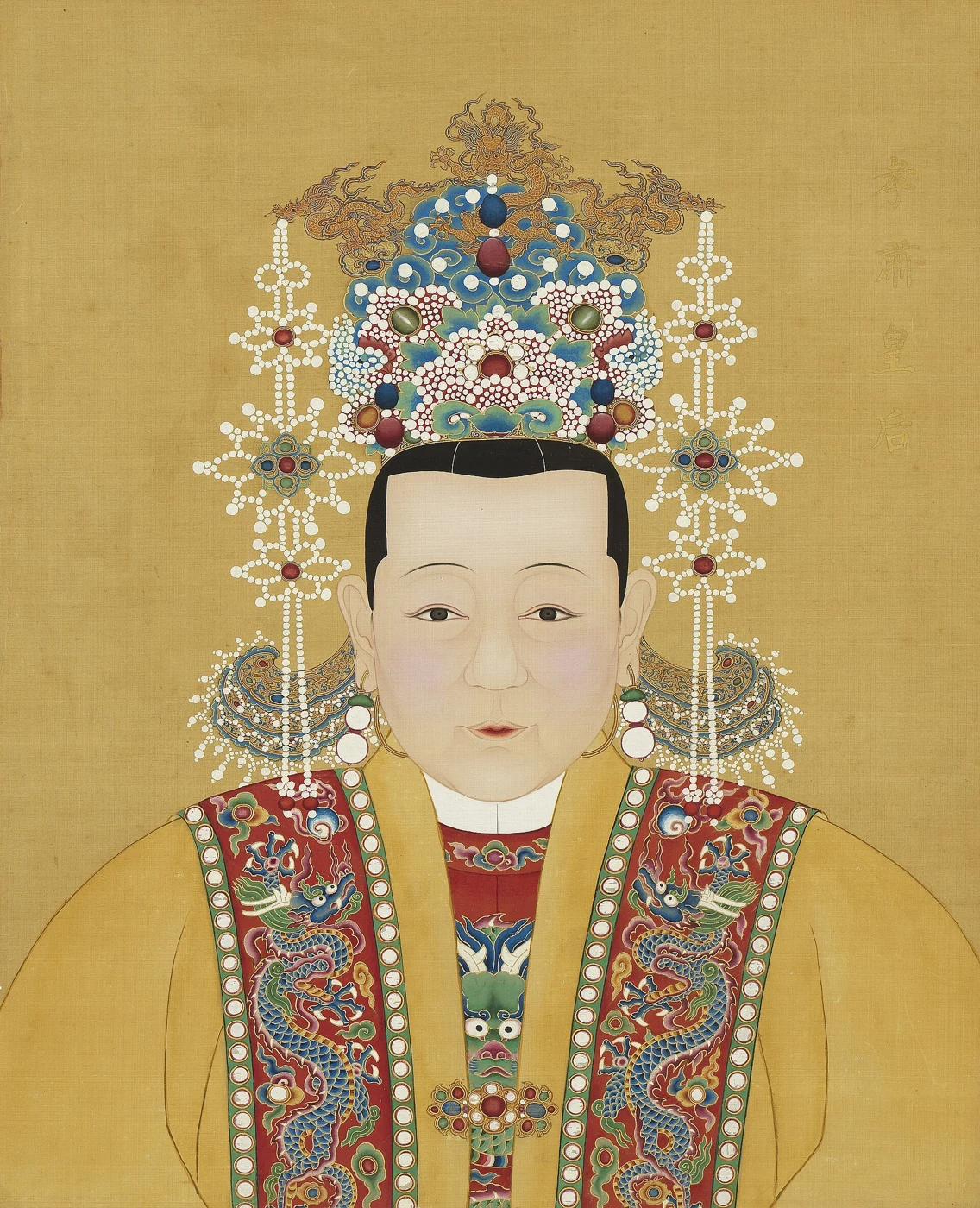
1430 CE–1504 CE
Noble Consort of Ming YingzongBiological Mother of Ming XianzongEmpress DowagerGrand Empress Dowager
Lady Zhou (Biological Mother of Ming Xianzong)
周氏(明宪宗生母)
Empress Xiaosu Zhou (1430–1504 CE), a native of Changping in Shuntian Prefecture, was the Noble Consort of Emperor Yingzong (Zhu Qizhen) and the biological mother of Emperor Xianzong (Zhu Jianshen). Entering the imperial palace during her youth, she bore Princess Chongqing in 1446, the eldest imperial son Zhu Jianshen in 1447, and Zhu Jianze in 1455. Following Yingzong's restoration in 1457, she was formally invested as Noble…
1430 CE–1504 CEMing Dynasty
PROFILE
Empress Xiaosu Zhou (1430–1504 CE), a native of Changping in Shuntian Prefecture, was the Noble Consort of Emperor Yingzong (Zhu Qizhen) and the biological mother of Emperor Xianzong (Zhu Jianshen). Entering the imperial palace during her youth, she bore Princess Chongqing in 1446, the eldest imperial son Zhu Jianshen in 1447, and Zhu Jianze in 1455. Following Yingzong's restoration in 1457, she was formally invested as Noble Consort. Upon Xianzong's accession in 1464, following ministerial advocacy by Grand Secretaries Li Xian and Peng Shi, she was concurrently elevated with Empress Qian as Empress Dowager. In 1487, she received the honorific Empress Dowager Shengci Renshou, and upon Emperor Xiaozong's enthronement that same year, was revered as Grand Empress Dowager. Passing away in April 1504, she was interred in Yuling Mausoleum and honoured at the Fengci Palace, posthumously titled Empress Xiaosu Zhenshun Kangyi Guanglie Futian Chengsheng.
- Alternative Forms
- Empress Xiaosu, Noble Consort Zhou, Empress Dowager Shengci Renshou
- Identity
- Noble Consort of Ming Yingzong, Biological Mother of Ming Xianzong, Empress Dowager, Grand Empress Dowager
- Era
- Ming Dynasty (Zhengtong to Hongzhi reigns)
- Dynasty
- Ming Dynasty
- Ancestral Home
- Changping (modern Changping, Beijing)
- Date of Birth
- 1430 CE(the 5th year of Xuande)
- Date of Death
- 1504 CE(the 3rd month of the 17th year of Hongzhi)
- Mausoleum
- Yuling Mausoleum (co-buried with Ming Yingzong)
- Spouse
- Zhu Qizhen (Emperor Yingzong of Ming)
- Children
- Princess Chongqing, Zhu Jianshen (Emperor Xianzong), Zhu Jianze (Prince of Chongjian)
- Relatives
- Zhou Neng (father, created Marquis of Qingyun), Zhou Shou (brother), Zhou Yu (brother)
LIFE TIMELINE
Birth of Heir | Bore the eldest imperial son Zhu Jianshen, who later became Emperor Xianzong.
Noble Consort Investiture | Invested as Noble Consort following Emperor Yingzong's imperial restoration.
Elevation to Empress Dowager | Concurrently elevated alongside Empress Qian upon Emperor Xianzong's accession.
Grand Empress Dowager | Honoured as Grand Empress Dowager upon Emperor Xiaozong's enthronement.
Demise and Joint Interment | Passed away in Beijing; buried in Yuling Mausoleum and enshrined in Fengci Palace.
BIOGRAPHY
Biography
Palace Service and Dynastic Maternity
Originating from Changping in Shuntian Prefecture, Lady Zhou entered the inner palace during her youth. In 1446, she gave birth to Princess Chongqing. In November 1447, she delivered Zhu Jianshen, Emperor Yingzong's eldest son. Following the Tumu Crisis of 1449 and Yingzong's capture by Esen, two-year-old Zhu Jianshen was created Crown Prince under Empress Dowager Sun's decree while Zhu Qiyu assumed the throne. When Yingzong returned from the northern steppe in 1450 and was placed under house arrest in the Southern Palace, Zhu Jianshen was demoted to Prince of Yi. Throughout these perilous years, Lady Zhou remained steadfastly by Yingzong's side, bearing his sixth son Zhu Jianze in 1455.
Consort Elevation and Court Titular Controversy
In January 1457, the Incident at the Southern Gate restored Emperor Yingzong to the throne, and Zhu Jianshen was reinstated as Crown Prince. Yingzong invested Lady Zhou as Noble Consort, bestowing noble titles upon her father Zhou Neng and brothers Zhou Shou and Zhou Yu. Following Yingzong's demise in 1464, Emperor Xianzong ascended the throne. Eunuch Xia Shi attempted to curry favor by advocating that Lady Zhou alone be declared Empress Dowager. Grand Secretaries Li Xian and Peng Shi resolutely protested, insisting that ancestral protocol required precedence for the principal consort, Empress Qian. Consequently, the court established concurrent honors: Empress Qian became Empress Dowager Ciyi, while Lady Zhou was titled Empress Dowager.
Matriarchal Devotion across Successive Eras
Throughout the Chenghua era, Emperor Xianzong displayed consummate filial reverence, attending to her personally every five days. In April 1487, Xianzong presented the honorific title Empress Dowager Shengci Renshou. Following Xianzong's passing in August 1487, Emperor Xiaozong ascended the throne. Because Xiaozong's mother, Consort Ji, had died mysteriously under Consort Wan's inner-court dominance, Lady Zhou had taken the young prince into her Renshou Palace, personally sheltering him until maturity. In deep gratitude, Emperor Xiaozong revered her as Grand Empress Dowager. In the winter of 1498, when the Qingning Palace caught fire, she temporarily relocated to Renshou Palace before returning to the rebuilt quarters.
Funerary Debates and Dual-Tomb Precedents
In April 1504, Grand Empress Dowager Zhou passed away at the age of seventy-four. When Empress Qian had passed away decades earlier, Lady Zhou had obstructed joint burial, resulting in architectural modifications that walled off Empress Qian's burial corridor. Upon Lady Zhou's demise, senior statesmen Liu Jian, Xie Qian, and Li Dongyang engaged in rigorous court debates regarding her posthumous title and enshrinement. The Grand Secretaries maintained that as she was not the primary empress consort, her tablet could not be placed in the Imperial Ancestral Temple or bear Yingzong's posthumous designation. Ultimately, Emperor Xiaozong adopted the cabinet's recommendation: her imperial title omitted the dynastic epithet Rui, naming her Empress Xiaosu; her coffin was placed in the right corridor of Yuling Mausoleum, while her spirit tablet was dedicated separately at Fengci Palace.
Major Activities
Safeguarding the Imperial Lineage across Five Reigns
Lady Zhou lived through five imperial reigns—Zhengtong, Jingtai, Tianshun, Chenghua, and Hongzhi. During the treacherous climate of the Chenghua court when Consort Wan dominated palace affairs, Lady Zhou acted decisively by shielding young Zhu Youxiao within Renshou Palace, securing the survival of the legitimate imperial successor and paving the way for the Hongzhi Renaissance.
Establishing Dual Joint-Burial Conventions for Emperor Mothers
The ritual debates following her death marked a pivotal turning point in Ming imperial mortuary institutions. Traditional protocol permitted only the principal empress consort to be interred within an imperial mausoleum. Lady Zhou's burial established a lasting convention whereby a reigning emperor's biological mother could share the imperial tumulus while maintaining separate ancestral sacrifices at the Fengci Palace without the emperor's posthumous title.
Mediating Factional Debates on Dowager Titular Primacy
The accession debates of 1464 illustrated structural tensions between inner-court favorites and scholar-officials over agnatic legitimacy. By resisting eunuch pressure to subordinate the principal empress, Grand Secretaries Li Xian and Peng Shi preserved dynastic decorum, establishing balanced titular guidelines that defined subsequent Ming accessions.
Personal Relations
- Spouse: Zhu Qizhen, Emperor Yingzong of Ming.
- Eldest Son: Zhu Jianshen, Emperor Xianzong of Ming.
- Second Son: Zhu Jianze, Prince of Chongjian.
- Daughter: Princess Chongqing.
- Grandson: Zhu Youxiao, Emperor Xiaozong of Ming, fostered in Renshou Palace.
- Principal Empress: Empress Qian (Empress Xiaozhuangrui), primary consort of Yingzong.
- Relatives: Zhou Neng, father, created Marquis of Qingyun; Zhou Shou and Zhou Yu, brothers.
Historical Assessment
- Official Dynastic Evaluation: The History of Ming chronicles her progression from palace attendant to five-reign matriarch, noting her supreme domestic prestige while recording her partisan conduct regarding Empress Qian's burial.
- Confucian Ritualists' Perspective: Historians examine Lady Zhou's career as the quintessential expression of maternal elevation in Ming court ritual. While maternal affinity often pushed against orthodox protocol, Grand Secretaries Li Xian, Peng Shi, and Liu Jian successfully preserved core agnatic hierarchies, highlighting the enduring influence of scholar-officials in maintaining dynastic balance.
FIGURES ASSOCIATED WITH THIS DYNASTY
Bibliography
- History of Ming, Volume 113: Biographies of Consorts.
- Veritable Records of the Ming: Xianzong Annals.
- Veritable Records of the Ming: Xiaozong Annals, Volume 209.
- Historical Records of the Ming (Guoque), Volume 45.