肃孝杭皇后
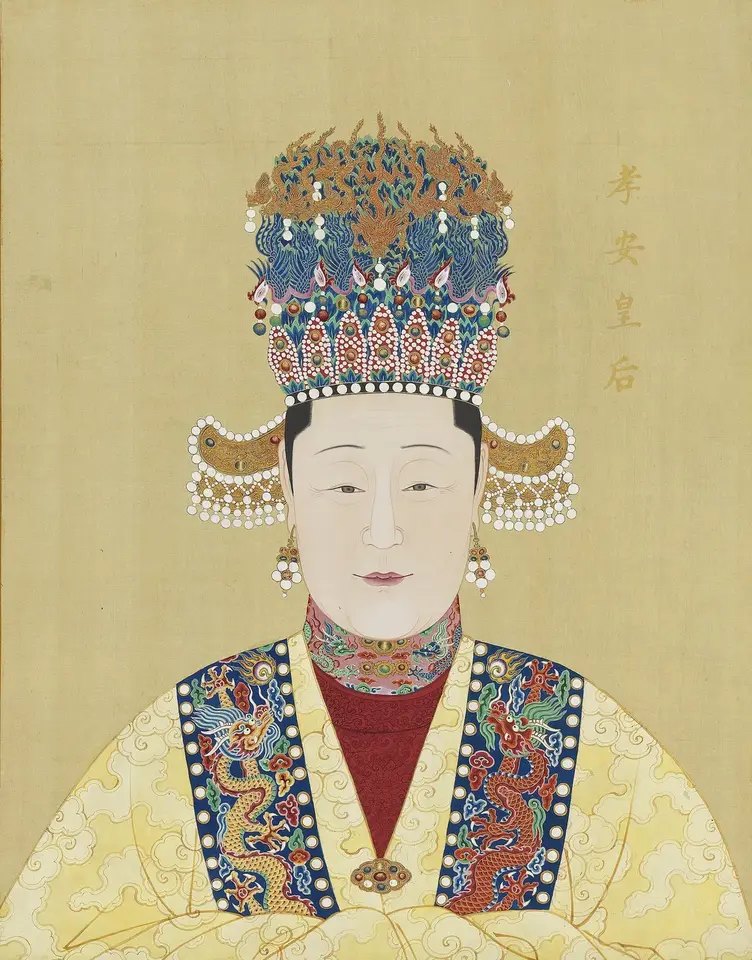
Historical portrait of Empress Hang
Image creditshttps://www.shuge.org/view/li_dai_di_hou_ban_shen_xiang_ce/ · Public domainImage source

?–1456 CE

Second Empress Consort of Emperor Daizong of MingBiological Mother of Crown Prince Zhu Jianji

Empress Xiaosu (肃孝杭皇后)

肃孝杭皇后

Empress Xiaosu (肃孝杭皇后, ?–1456), commonly known in dynastic sources as Empress Suxiao (肃孝皇后) or Empress Hang (杭皇后), was a native of Xuancheng County, Southern Metropolitan Region (modern Xuancheng, Anhui). She was the second primary empress consort of Emperor Daizong of Ming (Zhu Qiyu, the Jingtai Emperor) and the biological mother of Crown Prince Zhu Jianji (posthumously Crown Prince Huaixian). Originally recruited into the…

?–1456 CEMing Dynasty (明朝)

PROFILE

Empress Xiaosu (肃孝杭皇后, ?–1456), commonly known in dynastic sources as Empress Suxiao (肃孝皇后) or Empress Hang (杭皇后), was a native of Xuancheng County, Southern Metropolitan Region (modern Xuancheng, Anhui). She was the second primary empress consort of Emperor Daizong of Ming (Zhu Qiyu, the Jingtai Emperor) and the biological mother of Crown Prince Zhu Jianji (posthumously Crown Prince Huaixian). Originally recruited into the princely household of the Prince of Cheng as a secondary consort, she was renowned for her gentle demeanor and graceful modesty. In 1448, she gave birth to Zhu Qiyu's only son, Zhu Jianji, greatly elevating her domestic standing. Following the Tumu Crisis in 1449, Zhu Qiyu ascended the imperial throne as Emperor Daizong. His primary consort Lady Wang was invested as Empress, while Lady Hang was created Noble Consort. In 1452, Emperor Daizong resolved to depose Crown Prince Zhu Jianshen (Emperor Yingzong's eldest son) and install his own son Zhu Jianji as imperial heir. When Empress Wang adamantly opposed this alteration of dynastic succession, Daizong deposed her, elevated Noble Consort Hang to Empress, and enfeoffed her father Hang Yu as Count of Fengsheng. However, Empress Hang's elevation proved fleeting and tragic. In February 1453, Crown Prince Zhu Jianji died prematurely at the age of five. Devastated by the loss of her only child, Empress Hang fell into severe depression and protracted illness. She died in the Forbidden City in February 1456. Emperor Daizong suspended court audiences, conferred the posthumous title Empress Suxiao, constructed a grand imperial mausoleum named Shouleng at the Mount Tianshou necropolis, and enshrined her spirit tablet in the Imperial Ancestral Temple. In January 1457, Emperor Yingzong was restored to the throne following the Duomen Coup. Harboring deep bitterness over the alteration of imperial succession, Yingzong promulgated an imperial edict stripping Lady Hang of her empress title and posthumous name Empress Suxiao, reducing her son's title to Prince Heir, and ordering five thousand troops to completely raze her Shouleng mausoleum to the ground, scattering her remains. She stands as one of the most tragic imperial consorts in Ming dynastic history.

Alias
Empress Suxiao (肃孝皇后), Empress Hang (杭皇后), Empress Xiaosu (肃孝杭皇后)
Identity
Second Empress Consort of Emperor Daizong of Ming, Biological Mother of Crown Prince Zhu Jianji
Era
Ming Dynasty
Dynasty
Ming Dynasty
Highest Office & Status
Empress Consort
Posthumous Title
Empress Suxiao (肃孝皇后, stripped posthumously by Emperor Yingzong in 1457)
Native Place
Xuancheng County, Southern Metropolitan Region
Date of Death
1456

LIFE TIMELINE

Relationship graph

BIOGRAPHY

Chronological Biography

  • 1444 (9th year of Zhengtong) | Entry into Princely Mansion | Recruited into the Prince of Cheng's household as a secondary consort, winning affection for her decorum.
  • 1448 (13th year of Zhengtong) | Birth of Princely Heir | Gave birth to Zhu Qiyu's only son, Zhu Jianji, in the princely residence.
  • 1449 (14th year of Zhengtong) | Accession of Emperor Daizong | Following the Tumu Crisis, Zhu Qiyu became emperor; Lady Wang became empress and Lady Hang noble consort.
  • 1452 (3rd year of Jingtai) | Invested as Empress Consort | Empress Wang was deposed for opposing succession changes; Lady Hang was elevated to Empress and Zhu Jianji became heir.
  • 1453 (4th year of Jingtai) | Premature Demise of Heir | Crown Prince Zhu Jianji passed away suddenly; Empress Hang was overcome with grief, falling chronically ill.
  • 1456 (7th year of Jingtai) | Demise in the Palace | Died on February 21 in the Forbidden City, granted the posthumous title Empress Suxiao, and interred at Shouleng; in 1457, following the Duomen Coup, Emperor Yingzong abolished her empress title and dismantled her tomb.

Life Story

Princely Residence and the Birth of an Heir

Lady Hang was born into a hereditary military family in Xuancheng County, Southern Metropolitan Region. Her father, Hang Yu, served in the Embroidered Uniform Guard. During the Zhengtong reign of Emperor Yingzong, Lady Hang entered the princely mansion of Zhu Qiyu, the Prince of Cheng, as a secondary consort.

In 1444, Emperor Yingzong arranged the marriage of the Prince of Cheng to Lady Wang, the daughter of military commander Wang Ying. As a secondary consort, Lady Hang served beneath Princess Consort Wang with humility and diligence. In February 1448, Lady Hang gave birth to Zhu Qiyu's first and only son, Zhu Jianji. Having reached his twenties without male progeny, Zhu Qiyu was overjoyed, and Lady Hang's status rose markedly within the princely household.

Imperial Succession and Elevation to Empress

In August 1449, the Ming military suffered a catastrophic defeat at Tumu, where Emperor Yingzong was captured by the Oirat Mongols. In September, Empress Dowager Sun and senior ministers including Minister of War Yu Qian installed the Prince of Cheng as Emperor Daizong (the Jingtai Emperor) to defend the dynasty. Zhu Qiyu created his primary wife Lady Wang as Empress, while Lady Hang became Noble Consort. According to the original dynastic agreement, Yingzong's two-year-old son Zhu Jianshen remained Crown Prince.

Following the successful defense of Beijing and the stabilization of the northern frontiers, Emperor Daizong sought to establish his own biological lineage on the imperial throne. In 1452, he resolved to depose Crown Prince Zhu Jianshen and replace him with his own son Zhu Jianji. Empress Wang remonstrated vigorously, warning that disrupting ancestral succession would destabilize dynastic altars. Angered by her resistance, Daizong deposed Empress Wang in May 1452, elevated Noble Consort Hang to Empress, and formally designated Zhu Jianji as Crown Prince.

Grief and Untimely Demise

Empress Hang's elevation transformed her household. Her father Hang Yu was enfeoffed as Count of Fengsheng, and her elder brother Hang Ju was commissioned as a battalion commander. However, her triumph was short-lived.

In February 1453, five-year-old Crown Prince Zhu Jianji died of sudden illness. The tragedy shattered Emperor Daizong's dynastic aspirations and deprived Empress Hang of her sole emotional and political foundation. Weeping inconsolably day and night, Empress Hang suffered from unrelenting melancholy and severe physical deterioration. For three years, she remained secluded in the inner palaces, unable to recover from her profound grief.

On February 21, 1456, Empress Hang passed away in the Forbidden City around the age of thirty. Deeply grieved, Emperor Daizong suspended court sessions, bestowed the posthumous name Empress Suxiao, and conscripted soldiers and artisans to build an elaborate tomb named Shouleng at Mount Tianshou. In June 1456, she was interred at Shouleng, and her spirit tablet was placed in the Imperial Ancestral Temple.

Dynastic Reversal and Posthumous Ruin

Empress Hang's posthumous honors endured for less than a year. In January 1457, while Emperor Daizong lay critically ill, military commanders and courtiers staged the Duomen Coup, restoring Emperor Yingzong to the imperial throne. Yingzong immediately launched a comprehensive political reckoning against the Jingtai court.

In March 1457, Emperor Yingzong issued an imperial proclamation demoting Zhu Qiyu to Prince of Cheng, restoring the deposed Lady Wang as princely consort, and stripping Lady Hang of all imperial titles and her posthumous name Empress Suxiao. Zhu Jianji's title was reduced from Crown Prince to Prince Heir. In May, Yingzong dispatched Minister of Works Zhao Rong with five thousand soldiers to dismantle the Shouleng mausoleum completely, demolishing all structures and scattering her coffin. Her younger brother Hang Min was stripped of military rank and banished to his hometown.

When Emperor Xianzong of Ming (Zhu Jianshen) ascended the throne, he restored Daizong's imperial status out of gratitude for his defense of the empire, and Empress Wang was posthumously rehabilitated. However, because Lady Hang had been the direct beneficiary of the coup that deposed him as crown prince, she was never rehabilitated by Ming official historians, remaining a tragic symbol of palace factionalism.

Major Achievements

Matrimonial Factor in the Jingtai Succession Crisis

Lady Hang's primary historical impact derived from giving birth to Zhu Jianji, the only male offspring of Emperor Daizong. Amid the extreme uncertainty following the Tumu Crisis, her son's birth provided Daizong with a direct heir, altering the inner court balance between Yingzong's lineage and Daizong's branch.

Her existence became the central catalyst for the controversial succession change of 1452. In his determination to pass the crown to his biological son, Emperor Daizong bribed court ministers, removed Empress Wang, and created Lady Hang as empress. Lady Hang and her son were thrust into the storm center of Ming ritual and constitutional disputes.

Brief Tenure as Empress Consort

Lady Hang's installation as Empress represented an unusual precedent where a concubine from a non-elite military background supplanted a legitimate primary consort solely due to childbearing. Her father's rapid peerage as Count of Fengsheng stirred resentment among conservative Confucian officials.

Yet her tenure as empress lasted barely four years. The sudden demise of Crown Prince Zhu Jianji extinguished the political rationale for her elevation. Her swift transition from imperial exaltation to grief-stricken decline demonstrated the fragile vulnerability of female power in the imperial inner quarters.

Posthumous Desecration and Historiographical Erasure

Following the Duomen Coup of 1457, Lady Hang endured an unprecedented political purge. Emperor Yingzong's decree stripped her of imperial rank and ordered the demolition of her mausoleum, an act of physical desecration unparalleled among Ming imperial wives.

In official historiography, the History of Ming denied Lady Hang an independent biography, relegating her to a brief mention in Empress Wang's chronicle. This enduring erasure cemented her status as an innocent pawn sacrificed in the fierce struggle for imperial dynastic primacy.
Personal Relationships

  • Husband: Zhu Qiyu
  • Only Son: Zhu Jianji
  • Predecessor / Rival: Empress Wang
  • Adversary: Emperor Yingzong of Ming
  • Companion: Noble Consort Tang
  • Father: Hang Yu
  • Elder Brother: Hang Ju
  • Younger Brother: Hang Min

Historical Evaluation

  • Emperor Yingzong of Ming: 'Prince of Cheng Zhu Qiyu usurped the throne, and the deposition of Lady Wang arose from private bias, while Lady Hang and her son obtained imperial honors undeservedly. Now that legitimate lineage is restored, Lady Hang's imperial titles and posthumous name Empress Suxiao shall be abolished, and her tomb leveled to satisfy dynastic propriety.' (Veritable Records of Emperor Yingzong of Ming)
  • Emperor Xianzong of Ming: 'My uncle Emperor Daizong preserved the altars of state in crisis, and Empress Wang adhered to maternal modesty; but the alteration of the crown succession was not a blessing for the realm.' (Veritable Records of Emperor Xianzong of Ming)
  • History of Ming (Biographies of Empresses and Consorts): 'Emperor Daizong altered the succession, expelling Empress Wang to install Lady Hang; yet within years, the crown prince died young, and Empress Hang followed in death. After the restoration, her tomb was razed and her titles erased; in ancient and modern times, never has elevation through a son led to such total ruin as with Lady Hang.'
  • Zuiwei Lu (Records of Historical Transgressions): 'Lady Hang attained the empress throne through a single son, yet lost her son and perished shortly thereafter. Her tomb was destroyed and her bones left without peace; this was not Lady Hang's personal fault, but the consequence of Daizong's selfish ambition.' (Cha Jizuo)

Related Entries

  • Emperor Daizong of Ming
  • Tumu Crisis
  • Duomen Coup
  • Crown Prince Huaixian
  • Empress Wang (Emperor Daizong of Ming)
  • Emperor Yingzong of Ming

FIGURES ASSOCIATED WITH THIS DYNASTY

Bibliography

  • History of Ming, Volume 113, Biographies 1: Empresses and Consorts I
  • Veritable Records of Emperor Yingzong of Ming
  • Veritable Records of Emperor Xianzong of Ming