Birth | Born in Qiao County, Pei Commandery (present-day Bozhou, Anhui)
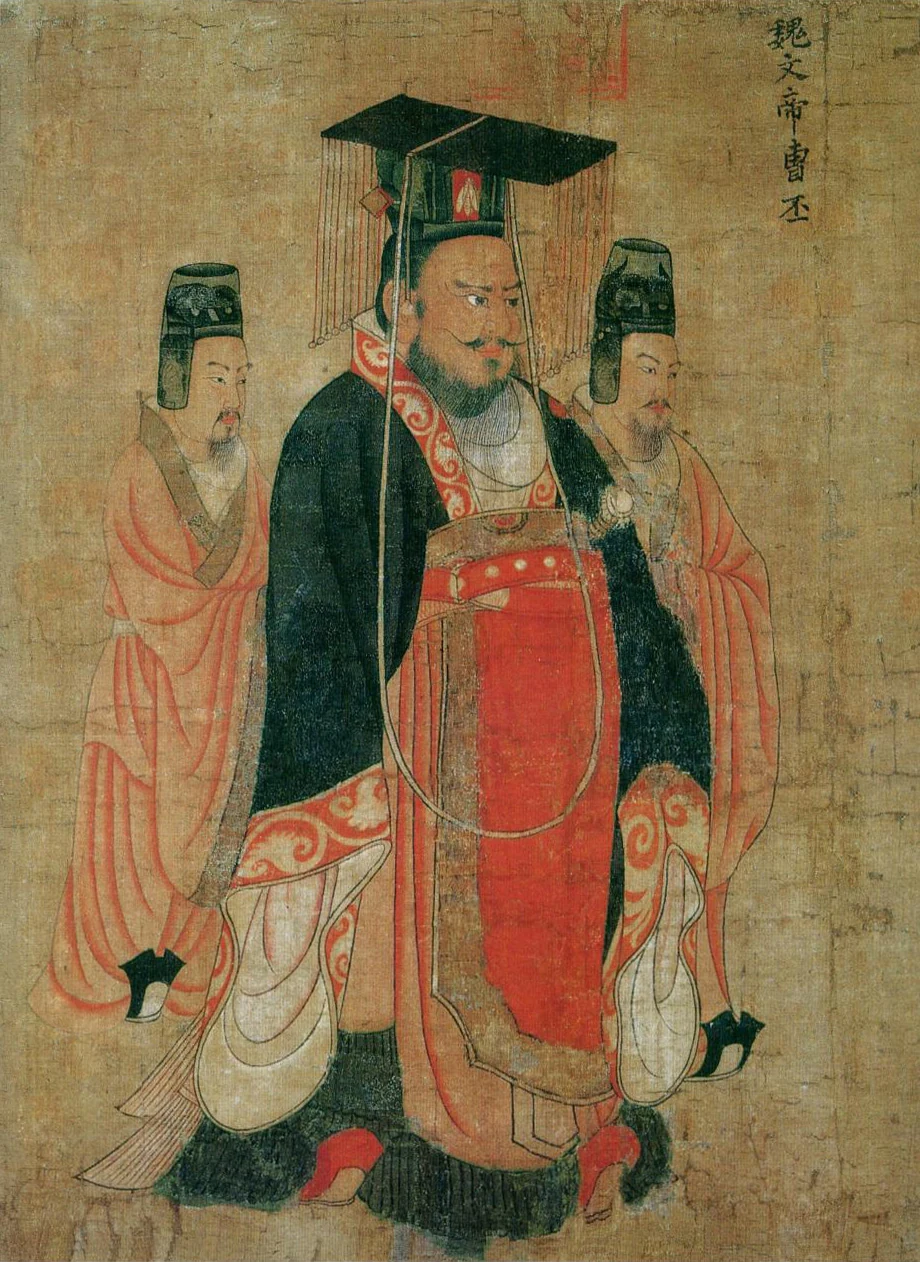
187 CE–226 CE
Emperor
Cao Pi
曹丕
Cao Pi (187–June 29, 226), courtesy name Zihuan, was a native of Qiao County, Pei Commandery (present-day Bozhou, Anhui). He was a politician and writer of the Three Kingdoms period and the founding emperor of Cao Wei, reigning from December 11, 220 to June 29, 226. He was a son of Emperor Wu of Cao Wei, Cao Cao, and Empress Wuxuan, Lady Bian. Accomplished in both civil and military arts, he read widely in the classics and…
187 CE–226 CECao Wei
PROFILE
Cao Pi (187–June 29, 226), courtesy name Zihuan, was a native of Qiao County, Pei Commandery (present-day Bozhou, Anhui). He was a politician and writer of the Three Kingdoms period and the founding emperor of Cao Wei, reigning from December 11, 220 to June 29, 226. He was a son of Emperor Wu of Cao Wei, Cao Cao, and Empress Wuxuan, Lady Bian. Accomplished in both civil and military arts, he read widely in the classics and histories and was familiar with the various philosophical traditions. In 217, the twenty-second year of Jian'an, he became heir of the Kingdom of Wei. In 220, the twenty-fifth year of Jian'an, he succeeded as Grand Councilor and King of Wei and later that year accepted the abdication of Emperor Xian of Han, proclaimed himself emperor, and established Cao Wei. During his reign he adopted Chen Qun's proposal for the Nine-rank system, which became the principal system of official selection during the Wei, Jin, and Northern and Southern Dynasties; suppressed separatist forces in the Qing and Xu Province regions and consolidated the unification of the north; repelled the Xianbei, maintained friendly relations with the Xiongnu, Di, Qiang, and other groups, and restored administrative institutions in the Western Regions. He died in Luoyang on the ding-si day of the fifth month of the seventh year of Huangchu (June 29, 226), aged forty. He received the posthumous title Emperor Wen, the temple name Gaozu, and was buried at Shouyang Mausoleum. Cao Pi was accomplished in poetry, rhapsody, and literary criticism, especially in five-character verse. Together with his father Cao Cao and younger brother Cao Zhi, he was known as one of the “Three Caos.” Two juan of the Collected Works of Emperor Wen of Wei survive. He also wrote the Dianlun, whose chapter “Discourse on Literature” is described in the Chinese source as the first systematic monograph on literary criticism in Chinese literary history.
- Aliases
- Emperor Wen of Cao Wei; courtesy name Zihuan
- Courtesy name
- Zihuan
- Period
- Cao Wei
- Dynasty/Polity
- Cao Wei
- Role
- Emperor
- Ethnicity
- Not recorded in historical sources
- Ancestral home
- Qiao County, Pei Commandery (present-day Bozhou, Anhui)
- Date of birth
- 187
- Place of birth
- Not recorded in historical sources
- Date of death
- June 29, 226
- Reign
- December 11, 220–June 29, 226
- Predecessor
- Emperor Xian of Han (Liu Xie)
- Successor
- Emperor Ming of Wei (Cao Rui)
- Era name
- Not recorded in historical sources
- Temple name
- Gaozu
- Posthumous name
- Emperor Wen
- Major achievements
- Son of Cao Cao and founding emperor of Cao Wei; accepted the abdication of the Han emperor in 220, implemented the Nine-rank system, and achieved distinction in literature.
LIFE TIMELINE
Age six | Learned archery from his father Cao Cao and became able to shoot that year
Age eleven | Accompanied Cao Cao on the southern campaign against Zhang Xiu; his elder brother Cao Ang and cousin Cao Anmin were killed, while Cao Pi escaped on horseback
Age twenty-two | Recommended by Excellency over the Masses Zhao Wen; Cao Cao dismissed Zhao Wen on the grounds that the recommendation was not based on genuine merit
Age twenty-five | Became General of the Household for All Purposes and deputy Grand Councilor
Age twenty-six | Accompanied Cao Cao on a southern campaign against Sun Quan and discussed archery techniques with Secretariat Director Xun Yu
Age twenty-seven | Returned with Cao Cao to Qiao County to worship the ancestors and composed Rhapsody on Approaching the Wo River
Age thirty-one | Defeated Cao Zhi in the succession struggle and was established as heir of the King of Wei
Age thirty-three | Guarded Ye as heir apparent and suppressed Wei Feng's plot to seize the city
Age thirty-four | Cao Cao died; Cao Pi succeeded as Grand Councilor and King of Wei and changed the twenty-fifth year of Jian'an to the first year of Yankang
Age thirty-four | Emperor Xian of Han abdicated; Cao Pi ascended the abdication terrace, proclaimed himself emperor, changed the era name to Huangchu, and founded Cao Wei
Age thirty-four | Enfeoffed Emperor Xian of Han as Duke of Shanyang
Age thirty-five | Adopted Chen Qun's proposal and implemented the Nine-rank system; sent an envoy ordering Lady Zhen to die
Age thirty-six | Launched his first campaign against Wu without decisive success; made Lady Guo empress; Cao Zhen pacified Hexi
Age thirty-seven | Transferred Cao Zhi to the title Prince of Yongqiu
Age thirty-eight | Launched a second campaign against Wu and reached Guangling, but withdrew because of Xu Sheng's false fortifications and severe wind and waves
Age thirty-nine | Launched a third campaign against Wu and reached Guangling; withdrew because the river froze and was attacked by Sun Shao during the retreat
Age forty | Died in Jiafu Hall in Luoyang and was buried at Shouyang Mausoleum
BIOGRAPHY
Biography
Family Background and Early Life
Cao Pi was born in Qiao County, Pei Commandery, in the winter of 187, the fourth year of Zhongping. The Records of the Three Kingdoms states that he “was born at Qiao in the winter of the fourth year of Zhongping.” A tradition held that when he was born, blue clouds shaped like the canopy of a carriage appeared in the sky and remained above him throughout the day; those who saw them regarded the omen as a sign that he would not remain a mere subject.
Cao Pi was regarded as intelligent from childhood. Under Cao Cao's strict supervision, he read poetry and the Analects while still young, and later studied the Five Classics, the histories of the Qin and Han, and the writings of the various schools of thought. In 192, the third year of Chuping, Cao Cao, considering the age to be one of warfare and disorder, taught him archery. Cao Pi learned to shoot at six and to ride at eight. In the autobiographical section of the Dianlun, he recalled that his father taught him archery when he was five because the world was in turmoil; by six he could shoot, and by eight he could ride and shoot from horseback.
From about age ten, Cao Pi accompanied his father on campaigns throughout the north and south. Long years of military life strengthened his physique, broadened his experience, and supplied material for his later poetry. As he grew older, the hardships and shocks of this environment contributed to the somber temperament that became characteristic of his writing.
In 197, the second year of Jian'an, Cao Pi accompanied Cao Cao on the southern campaign against Zhang Xiu. Zhang Xiu first surrendered and then rebelled. Cao Cao's eldest son Cao Ang and his nephew Cao Anmin were killed, while the ten-year-old Cao Pi escaped on horseback. Cao Pi later recalled the event in the autobiographical portion of the Dianlun. After Cao Ang's death, Cao Cao's principal wife Lady Ding, who blamed Cao Cao for the death of her adopted son Cao Ang, separated from him. Cao Pi's mother Lady Bian was subsequently elevated as principal wife, and Cao Pi, previously the eldest surviving son by a concubine, replaced Cao Ang as the senior legitimate son.
Succession Struggle and Appointment as Heir
Among Cao Cao's twenty-five sons, four successively emerged as serious candidates for the succession: Cao Ang, Cao Chong, Cao Pi, and Cao Zhi. After Cao Ang's death, Cao Cao at one point intended the succession for the younger Cao Chong. Cao Chong was remembered as a prodigy whose abilities at five or six were said to resemble those of an adult, and his gentle disposition won Cao Cao's affection. He died of illness at thirteen. After Cao Chong's death, the substantive succession contest came down to Cao Pi and Cao Zhi. Cao Zhi, Cao Pi's full younger brother, became celebrated for his literary talent and was greatly favored by Cao Cao, leading to a protracted rivalry between the brothers.
Cao Cao's prolonged indecision over the succession affected his subordinates, who gradually divided into groups supporting Cao Pi or Cao Zhi. Cao Pi's supporters included Jia Xu, Cui Yan, Sima Yi, Chen Qun, Huan Jie, Xing Yong, and Wu Zhi, while Cao Zhi was supported by Ding Yi and his brother Ding Yi, Yang Xiu, Kong Gui, Yang Jun, Jia Kui, and Handan Chun. The groups formed competing networks, devised strategies, shaped opinion, and attacked one another politically. Yang Xiu, a member of the eminent Hongnong Yang clan and Cao Cao's highly informed registrar, was particularly useful to Cao Zhi, who at several points appeared close to securing the succession. Cao Zhi, however, was impulsive and undisciplined and once entered the Sima Gate while drunk, which ultimately damaged Cao Cao's confidence in him.
In 217, the twenty-second year of Jian'an, Cao Pi, aided by Jia Xu, Cui Yan, Chen Qun, and others, prevailed over Cao Zhi and was established as heir of the King of Wei. During his period as heir, Cao Pi actively organized literary circles and encouraged composition, helping foster a distinctive culture of linked poetic and rhapsodic exchanges associated with Jian'an literature.
In 219, the twenty-fourth year of Jian'an, Cao Pi guarded Ye (present-day Linzhang, Hebei) as heir apparent. Wei Feng plotted to seize the city, but his co-conspirator Chen Yi confessed. Cao Pi suppressed the plot and executed Wei Feng.
Succession and the Replacement of Han
On the geng-zi day of the first month of the twenty-fifth year of Jian'an (March 15, 220), Cao Cao died in Luoyang. Cao Pi traveled from Ye to Luoyang and succeeded him as Grand Councilor and King of Wei, changing the twenty-fifth year of Jian'an to the first year of Yankang. The Chinese source describes Cao Pi as emotionally stirred and satisfied by this sudden transfer of supreme authority, while also regarding the restoration of national strength and the completion of unification, inherited as goals from his father, as major responsibilities.
Drawing lessons from the collapse of order in the late Eastern Han, Cao Pi quickly concentrated authority and stabilized the regime. He cultivated and promoted his own political supporters, redistributed power among court factions, and struck at rival forces. On the ren-xu day of the second month (April 6), he appointed Jia Xu Defender-in-chief, Hua Xin Grand Councilor, and Wang Lang Censor-in-chief. On the ji-mao day he appointed Xiahou Dun General-in-Chief. The Yemaek, the Fuyu chanyu, the king of Yanqi, and the king of Khotan each sent envoys with tribute. In the fifth month, he granted marquis titles to the surrendered bandits Zheng Gan and Wang Zhao and ordered Su Ze to command troops in suppressing rebellions in Wuwei, Jiuquan, and Zhangye. In the seventh month Sun Quan sent tribute. In the same month, Xiahou Shang and Xu Huang coordinated with the Shu general Meng Da and recovered the three commanderies of Shangyong. Yang Pu, a Di king of Wudu, led his people in submitting and settled in Hanyang Commandery. On the jia-wu day (September 5), Cao Pi brought his army to Qiao, presented food and wine to the Six Armies and local elders east of the city, and remitted Qiao Commandery's taxes for two years.
On the yi-mao day of the tenth month of the first year of Yankang (November 25, 220), Emperor Xian of Han formally offered to abdicate. Cao Pi submitted three refusals. On the xin-wei day (December 11), he ascended the abdication terrace, proclaimed himself emperor, adopted Huangchu as the new era name, changed the written form of Luoyang's name, and declared a general amnesty. On the gui-you day of the eleventh month of the first year of Huangchu (December 13, 220), he assigned ten thousand households in Shanyang, Henei Commandery, to the former Han emperor, enfeoffing him as Duke of Shanyang. The former emperor was permitted to observe the Han calendar, perform suburban ancestral sacrifices with imperial rites, and submit memorials without calling himself a subject; four of his sons were made marquises.
Imperial Career
After becoming emperor in 220, Cao Pi began a reign of roughly seven years. The Chinese source characterizes him as aspiring to be a benevolent ruler in the Confucian tradition while carrying forward Cao Cao's ambition to unify the realm. In domestic government he combined favor and coercion: he centralized authority, established laws, reduced the power of imperial princes, struck at opponents, and prohibited consort clans and eunuchs from interfering in government. At the same time, he promoted recovery of livelihoods, adopted measures favorable to the population, and encouraged a revival of Confucian learning in order to restore social order and support economic and cultural development.
In 221, the second year of Huangchu, Sun Quan, fearing Liu Bei's retaliation after the seizure of Jing Province and the death of Guan Yu, sent envoys to Cao Pi, offered a memorial of submission, and returned Yu Jin and others. Cao Pi therefore sent the Chamberlain for Ceremonials Xing Zhen with credentials to appoint Sun Quan General-in-Chief and King of Wu and grant him the Nine Bestowments. Sun Quan consequently acknowledged Cao Wei's overlordship. Liu Bei, enraged by Sun Quan's attack on Guan Yu and alliance with Wei, personally led an army against Wu despite Sun Quan's attempt to negotiate peace.
In the first month of 222, the third year of Huangchu, Sun Quan wrote to Cao Pi concerning his preparations for battle. Cao Pi replied in Letter in Reply to the King of Wu, Sun Quan, encouraging him to defeat the enemy. In the intercalary month Sun Quan defeated Liu Bei at Yiling (present-day Yidu, Hubei). When Cao Pi first heard that Liu Bei had advanced east and built connected camps stretching more than seven hundred li, he judged that Liu Bei had committed a serious military error and would soon be defeated. Seven days later the report of Sun Quan's victory arrived. Once the threat from Shu Han had been removed, Sun Quan repeatedly delayed sending his eldest son Sun Deng to Wei as a hostage, and the Wei-Wu alliance increasingly became one of outward cooperation but inner estrangement. In the tenth month Sun Quan again broke with Wei. Angered by what he regarded as Sun Quan's deception and betrayal, Cao Pi issued an Edict on Attacking Wu to encourage his officers and soldiers and declared his determination to campaign south.
Cao Pi marched south from Xuchang as several armies advanced simultaneously. Forces under Cao Zhen, Cao Xiu, and others won a series of victories, defeating Sun Sheng, inflicting a major defeat on Lü Fan, burning Zhuge Jin's forces, and nearly taking Jiangling. Sun Quan held the line of the Yangtze. Several fronts collapsed or were defeated; only Zhu Huan's force at Ruxu defeated Cao Ren. Cao Pi appeared close to victory, but disease broke out and Zhu Ran held Jiangling. Sun Quan took the opportunity to send tribute again, and the two sides made peace, after which Cao Pi withdrew. On the xin-wei day of the eleventh month, Cao Pi ordered General Who Pacifies the West Cao Zhen to lead generals and provincial and commandery troops against rebellious Hu groups under Zhi Yuanduo, Feng Shang, and others. Hexi was pacified. Ten days later the victory report reached Luoyang, and Cao Pi expressed great satisfaction at the coordination between his planning at court and the generals' operations thousands of li away.
In the eighth month of 224, the fifth year of Huangchu, Cao Pi led one hundred thousand troops against Wu at Guangling. According to the Chinese source, Xu Sheng's false fortifications intimidated the Wei army, and heavy waves later drove Cao Pi's dragon boat toward the Wu position while overturning other vessels, leading him to withdraw. In the eighth month of 225, the sixth year of Huangchu, he again led one hundred thousand troops toward Guangling. The river froze and obstructed operations and withdrawal; during the retreat a five-hundred-man force sent by Sun Shao attacked the Wei army and seized Cao Pi's dragon boat and military supplies.
On the bing-chen day of the fifth month of 226 (June 28), the seventh year of Huangchu, Cao Pi became critically ill. He established the Prince of Pingyuan, Cao Rui, as crown prince and summoned Cao Zhen, Cao Xiu, Chen Qun, and Sima Yi to receive his final instructions as guardians of the successor. On the following ding-si day (June 29), he died in Jiafu Hall, aged forty. Cao Rui succeeded him as Emperor Ming of Cao Wei. On the wu-yin day of the sixth month (July 20), Cao Pi was buried at Shouyang Mausoleum.
His Family, His Birth and Early Years
Cao Pi, courtesy name Zihuan, was a man of Qiao county in the Pei state, son of the martial emperor Cao Cao, his mother the empress Wuxuan, lady Bian. It is said that at his birth a blue cloud in the shape of a carriage canopy appeared in the sky and hung about the place all day, and those who saw it thought he was destined for more than a subject's lot. He was clever from childhood, and the good education and surroundings of his later years gave him a deep literary culture. By his own account in the Discourse on Literature, "I was then five years old, and my father, the age being troubled, taught me to shoot, and at six I understood shooting, and he taught me to ride, and at eight I could shoot from horseback." In his youth he read widely, and under strict discipline read the Odes and the Discourses as a boy and, a little older, the Five Classics and the Four Divisions, the Histories and the Han, and the words of the hundred schools. From ten he followed his father on campaigns north and south, and long years in the army gave him a strong body and enriched his experience, storing up much material for his poems, while the spiritual shock of a hard life as he grew in years and knowledge gradually formed his own deep and brooding temper. By the same account, "the times being full of trouble, I was always with him on every campaign. Early in Jian'an, when he went south against Jingzhou and reached Wan, Zhang Xiu surrendered and within ten days turned again, and my late elder brother the filial and incorrupt Zixiu and my cousin Anmin were killed; I was then ten and escaped on horseback." Later, the army going south to Quli, the president of the secretariat Xun Yu was sent to encourage the troops and, seeing Cao Pi, said at the end of their talk that he heard he was good at shooting to left and right, which was indeed hard to do; and Cao Pi answered that he had not seen him shoot from the nape of the neck and the mouth, at the galloping horse's hoof and the moon-support, at which Xun Yu laughed and said, "So!" and Cao Pi added that there was a constant path for the general and a constant place for the mark, and that though a man hit every time it was not the height of the art; but to gallop over the plain and into the tall grass, to intercept a cunning beast and cut down a light bird, so that the bow is never bent in vain and whatever is hit is pierced through, that was the height. Zhang Jing, then master of sacrifice of the army, sitting by, turned to Xun Yu and clapped his hands and said, "Well said."
The Contest for the Succession
Of Cao Cao's twenty-five sons, four appeared in his view as possible heirs. After Cao Ang's death Cao Cao had even meant to pass the succession to his younger half-brother Cao Chong, a prodigy whose understanding was like a grown man's at five or six and who was by nature kind, often contriving to save those who had carelessly offended so that "those saved by him, before and after, were several tens"; but he died of illness at thirteen. After his death Cao Cao once told Cao Pi that Cao Chong's death was his own misfortune but Cao Pi's great good fortune; and Cao Pi afterwards often said that had Cao Chong lived he would never have had the place of heir. After Cao Chong's death the only serious candidates were Cao Pi and Cao Zhi, and Cao Zhi, shining by his brilliant talent, was much loved by Cao Cao, so that the quarrel over the succession arose between the brothers. Cao Cao wavering long, his subordinates gradually formed two parties, one for Cao Pi and one for Cao Zhi; and Cao Zhi, with his advisers' counsels, gained the advantage in the contest and several times had the chance of being made heir, but being wilful and careless of restraint and once entering the palace drunk, Cao Pi with the help of the great ministers won the succession and was made heir to the prince of Wei. In the twenty-fourth year of Jian'an, 219, Cao Pi holding Ye as heir, Wei Feng of Pei, a man with the talent to move the crowd and shake the capital of Ye, was taken by the chancellor Zhong You as his clerk of the west; and Rencan of Xingyang being his friend, Zheng Mao of the same commandery would tell Rencan that Wei Feng was a wicked hero who must in the end make trouble. In the ninth month Wei Feng secretly gathered partisans and plotted with the commandant of the ChangLe guard, Chen Yi, to attack Ye; but before the day Chen Yi in fear informed against him, and the heir Cao Pi put Wei Feng to death. As heir Cao Pi actively organised literary groups and encouraged writing, so that poems and rhapsodies on the same themes flourished as a phenomenon peculiar to the literature of Jian'an.
His Accession as Prince of Wei and His Taking of the Throne from Han
On the day gengzi of the first month of the twenty-fifth year of Jian'an, 220, Cao Cao died at Luoyang at sixty-six. Cao Pi succeeded as chancellor and prince of Wei and changed the twenty-fifth year of Jian'an to the first year of Yankang. Coming suddenly to high place and power, he could not but be stirred and pleased with himself. Learning from the disorder of the late Han, he quickly gathered power into his hands and steadied the government: on the day renxu of the second month he made the grand master of the palace Jia Xu grand commandant, the censor-in-chief Hua Xin chancellor and the commandant of justice Wang Lang censor-in-chief; in the fifth month he enfeoffed the surrendered bandit chiefs Zheng Gan and Wang Zhao as marquises. On the day jiawu of the seventh month the army halted at Qiao and he feasted the six armies and the elders and people of Qiao east of the town, with musicians and hundred plays, decreeing that the former kings all took pleasure in the place of their birth and that ritual does not forget its root, that Qiao was the land of the hegemon and the birthplace of the true man, and that its taxes should be remitted for two years; the elders and officials offered long life and the feast ended at nightfall, and on the day bingshen he sacrificed in person at the Qiao tombs. On the day guimao of the tenth month of winter he decreed that where officers and men had died on campaign and not been gathered in he grieved for them, and that the commanderies should provide coffins and burial and send them home, the government making the offerings. On the day yimao of the tenth month Emperor Xian of Han formally abdicated, and Cao Pi thrice memorialised declining; and on the day xinwei he ascended the altar, received the seals and took the throne, sacrificing with fire to heaven and earth and the mountains and rivers, changing the era and proclaiming a general amnesty. On the day guiyou of the eleventh month of the first year of Huangchu he gave the emperor of Han the ten thousand households of Shanyang in Henei as duke of Shanyang, with the Han calendar and the right to sacrifice to heaven and earth with imperial rites, not to be called a subject in his memorials, and to receive the sacrificial flesh when the capital sacrificed in the ancestral temple, and enfeoffed four of the duke's sons.
His Government
In the first year of Huangchu, 220, Cao Pi came to the stage as an emperor and began seven years of rule. He wished to accomplish the work of a benevolent Confucian sovereign, inheriting his father's ambition to unite the realm, and in his ideas of government sought to follow the ancient benevolent rulers and worthy ministers; inwardly he used both kindness and severity, gathering power while steadying his rule, framing laws and cutting down the princely fiefs, striking at those not of his party, forbidding consort kin and eunuchs to meddle in government, and letting the people rest while he favoured them and revived Confucian learning. At the outset of his princedom he issued two new measures: the first was to abolish the regular attendants of the palace and the lesser yellow gates, fixing four of each, and to proclaim that eunuchs made officials might rise no higher than the directors of the several offices, thus rooting out eunuch interference in government; and to make this lasting he had the decree carved on metal tablets, after the ancient rule that great affairs of state are engraved on plates of gold, and kept in a stone chamber. He further adopted Chen Qun's advice and instituted the nine-grade system of selecting officials, which eased the relation between the Cao house and the great clans and won their support, laying the ground for his accession; but though the power of appointment passed from the localities to the centre, it also led to the real power of Wei gradually passing to the great clans. He transferred the drafting of edicts and documents to the officials of the secretariat, so that the power of the secret gradually moved thither; and he decreed that women should not meddle in government, that ministers should not memorialise the empress dowager, and that the families of empresses should not hold the office of regent nor be enfeoffed with lands. On the day jiawu of the ninth month he decreed that it was the root of disorder for women and eunuchs to take part in government, that henceforth ministers should not memorialise the empress dowager, that the families of empresses should not hold the regency nor receive fiefs, and that this decree should pass to later ages with all the realm to punish any who broke it. He also cut down the rights of the princes: their fiefs were often changed, they had no civil or military power, their movements were closely watched, so that they were as in prison; and this policy, though learning from the disorders of the Han princedoms, left a hidden danger in that the imperial kin were left weak and could not afterwards stop a minister from seizing power. Having founded Wei he set about ordering the court, issuing in the second year of Huangchu an edict that no grand commandant should be impeached for an eclipse, to end the abuse of blaming the great ministers for what was innocent, and the next year edicts forbidding slander and forbidding the hundred officials to interfere in the commanderies and counties, to change the temper of mutual accusation and of ministers' arbitrary direction. In economy he had grain and silk exchanged in the markets to steady order, so that by the end of Huangchu the treasury was full and heaped to the ten-thousands, the losses of the wars being in the main made good; and he took up strategic defence, restored production, removed prohibitions, lightened the customs, forbade private vengeance, had punishments widely discussed and lightened, and let the people rest, so that the north again became settled and prosperous. In learning he decreed in the first year of Huangchu the restoration of the imperial college and the establishment of Confucian teaching and the spread of the classics, and afterwards collected and arranged the texts of the classics and encouraged scholars to study and annotate them; in the second year he decreed that commanderies and states of more than a hundred thousand souls should yearly choose one filial and incorrupt, without limit of population for men of outstanding talent; in the third year he issued an edict that no age limit be set in taking officials, holding that old or young, any man who "understands the classics as a scholar or the statutes as an official" might be tried; in the fourth year he made rites and music on the basis of the Han, so that in the hall of government and the ancestral temple were performed the music of rectifying the age, of welcoming the spirits, of the martial praise and of shining achievement, with the dances of the phoenix, of the spirit's answer, of the martial praise, of the great brightness and of the great martial; in the fourth month of the fifth year he set up the imperial college, fixed the method of examining the Five Classics, and appointed a master of the Guliang commentary to the Spring and Autumn; and in the second month of the sixth year he sent envoys from Xuchang to Pei to inquire into the people's hardships and relieve the poor, while in the same year the inspector of Bingzhou, Liang Xi, heavily defeated the Xianbei.
His Campaigns Abroad and the Pacification of Qing and Xu
Cao Pi was ever for war abroad, wishing early to unite the realm, and twice sent armies against Wu. In the second month of the third year of Huangchu, 222, the kings of Shanshan, Kucha and Khotan each sent envoys with tribute, and thereafter the Western Regions were again open and the wuji and wuyi colonels were appointed. Sun Quan, having taken Jing and Xiang and fearing Liu Bei's revenge with enemies on both sides, feigned friendship with Wei, sending a memorial, and so called himself Wei's vassal. In the first month of the third year of Huangchu Sun Quan memorialised Cao Pi that he would send troops against the enemy, and Cao Pi wrote him a letter encouraging him to kill the enemy; in the intercalary month Sun Quan defeated Liu Bei at Yiling. Cao Pi, hearing that Liu Bei was coming east to fight Sun Quan with stockades and camps linked for seven hundred li, held that Liu Bei had committed the great military fault and must soon be destroyed, and seven days later the report of Sun Quan's victory arrived. Afterwards Sun Quan, freed of the threat from Shu, delayed again and again in sending his eldest son Sun Deng to Wei as hostage, so that the alliance of Wei and Wu grew to be one in name only. In the tenth month Cao Pi wrote encouraging his officers that in the southern campaign they had besieged Jiangling, taken many ships, beheaded and captured and had deserters crowding the roads with cattle and wine arriving daily, showing his resolve to go south against Sun Quan. Cao Pi marched south from Xuchang with all the armies advancing, and Cao Zhen and Cao Xiu on several fronts won great victories, defeating Sun Sheng and others. In the fifth and sixth years of Huangchu he twice led armies in person against Wu, both times halting at Guangling without engaging the Wu armies, yet putting down the mutiny at Licheng and settling the danger in Qing and Xu for good; in the tenth month of the sixth year he went to the old city of Guangling and reviewed his troops by the river, more than a hundred thousand men with banners for several hundred li, and the cold being great that year the waterways froze and the boats could not enter the river, so that he withdrew; and passing Yongqiu he came to Cao Zhi's place and saw him, adding five hundred households to his fief; and in the twelfth month, passing from Qiao by Liang, he sent envoys to sacrifice with the great sacrifice to the late Han grand commandant Qiao Xuan. On the question of unification Cao Pi had both the sincerity to hope that a civilising influence might achieve his wish and the resolve to strengthen the state and destroy the rebels; and though his two campaigns against Wu came to nothing for want of the right moment, the ambition drove him in his later years to seek wealth and military strength, which had a certain positive meaning for the society of the time. In the frontier he sent generals who heavily defeated the allied Qiang and Hu and pacified the west of the river, sent envoys to reopen the Western Regions, restoring the central dynasty's rule there and appointing the wuji and wuyi colonels; and he used Tian Yu as commissioner of the Wuhuan with the tally and Qian Zhao and others to guard the Xianbei, Tian Yu holding that it was not to China's advantage that the barbarians should be one, and so first dividing them to make them enemies and fight one another, and once leading picked troops alone deep into the barbarian court, camping ten li from them and burning great heaps of cattle and horse dung, then withdrawing by another road, so that the Hu seeing the smoke unbroken thought he was still there, and pursuing him to Macheng they surrounded him ten deep, and Tian Yu, having his master of horse raise banners and beat drums and lead the foot and horse out of the south gate while he led the picked troops out of the north with drums and shouts, both heads striking together unawares, scattered the barbarians, who threw away bow and horse and fled on foot, and were pursued twenty li with corpses covering the ground. As to Qing and Xu: since the end of the Han there had been in those parts the separatist forces of Zang Ba and others, who though they submitted to Cao Cao held their own territory and troops, so that he had to use a loose rein; and when Cao Cao died the Qing and Xu troops at Luoyang rioted, and Cao Pi soothed them without attacking and steadied the situation. In the third year of Huangchu, on the ground that Sun Quan had not sent a hostage, he attacked Wu in three columns, taking the occasion to strip Zang Ba of his troops; and in the fifth and sixth years, leading armies in person against Wu, he halted at Guangling without engaging, yet put down the Licheng mutiny and settled Qing and Xu for good. Later ages have therefore conjectured that his real purpose in going in person was not to attack Wu but to use it as a screen for quietly pacifying the separatists of Qing and Xu, showing him as a statesman cautious yet resolute.
His Death and Tomb
In the first month of the seventh year of Huangchu, 226, Cao Pi returned to his palace at Luoyang, and in the third month built the Jinhua terrace. On the day bingchen of the fifth month of summer he fell gravely ill and charged the general of the garrison Chen Qun, the general of the centre Cao Zhen, the general of the conquest of the east Cao Xiu and the general of the army of the left Sima Yi to receive his testament and assist the heir Cao Rui, and sent the palace women below the ranks of the agreeable and the elegant home to their families. On the seventeenth day of that month he died at forty, with the posthumous name of the cultured emperor and the temple name Gaozu, and was buried at the Shouyang tomb; and from his coffining to his burial everything was done by the austerity he had laid down. The Shouyang tomb lies on the Shouyang mountain and is of the simplest construction, cut into the hill, without mound or trees and with no tomb park or spirit road, leaving no trace on the surface; the building within is quite unadorned and the grave goods are mostly of tile, to prevent later desecration.
Major Activities
Political Reform
One of Cao Pi's most important political measures was the adoption of Chen Qun's proposal for the Nine-rank system. Under this system, commanderies selected local evaluators who assessed men of talent and divided them into nine grades for use in official recruitment. The Chinese source states that the system established and consolidated the political privileges of great clans and secured their support for the Cao Wei regime, and that it became the principal recruitment system of the Wei, Jin, and Northern and Southern Dynasties.
Cao Pi also restricted the political power of eunuchs and imperial consort clans. He ordered that eunuchs who held office could not rise above certain bureau-director posts, that ministers were not to submit affairs of state to the empress dowager, and that members of the empress's family were not to serve as chief regents or receive territorial titles without proper basis. According to the Chinese source, these restrictions prevented Cao Wei from suffering a political crisis caused by eunuch or consort-clan domination.
Cao Pi reduced the authority of imperial princes. Their fiefs were frequently changed, and they possessed neither independent administrative authority nor military command; their conduct was closely monitored. The Chinese source notes that while this policy drew lessons from the disturbances caused by Han princely states, it also created a longer-term weakness by leaving the Cao and Xiahou clans too politically weak to prevent later seizure of power by outside ministers.
Education and Livelihoods
Cao Pi valued cultural and educational policy and appointed Confucian literati to office. In 221, the second year of Huangchu, he ordered each commandery or kingdom with more than one hundred thousand people to recommend one candidate for filial and incorrupt service each year, while exceptionally talented men were not to be limited by population quotas. In the fifth year of Huangchu he enfeoffed Kong Xian, a descendant of Confucius, as Marquis Who Honors the Sage, repaired the Temple of Confucius, promoted Confucian schooling across the realm, established the National University, instituted examinations on the Five Classics, and created a professorship for the Guliang Commentary to the Spring and Autumn Annals. The source describes these measures as rapidly reviving orthodox classical culture.
He also promoted recovery of production, removed certain prohibitions, reduced customs levies, prohibited private feuds, encouraged discussion of lighter punishments, and adopted measures intended to let the population recover. In monetary policy, he issued coinage after taking the throne, but the attempt was unsuccessful. With grain prices rising, he later abolished use of the Han five-zhu coin. The Chinese source states that barter consequently became the main form of exchange in the north for the remainder of Cao Wei.
Military Campaigns
Cao Pi favored military expansion and sought to complete the unification of the realm. He personally launched three major campaigns against Wu. In 222 he marched south from Xuchang while several armies advanced, with Cao Zhen, Cao Xiu, and others achieving major successes and nearly taking Jiangling; disease and Zhu Ran's defense, however, prevented a decisive result. In 224 and 225 he again launched large campaigns against Wu, but both ended in withdrawal for the reasons described above and produced no lasting territorial gain.
During Cao Pi's reign, Cao Zhen was also employed to repel the Xianbei, while the regime maintained relations with the Xiongnu, Di, Qiang, and other groups and pacified frontier troubles. In the second month of 222, the kings of Shanshan, Kucha, and Khotan each sent envoys with tribute. Communication with the Western Regions was restored, and the Wuji Commandant was reestablished.
Literary Achievements
Cao Pi wrote in varied poetic forms, with particular strength in five- and seven-character verse. His language is described as accessible and close to the spirit of folk song, while his technique was indirect, detailed, and cyclic in expression. He was especially skilled at themes of love, travelers, and women separated from absent husbands. The Chinese source treats Yan Ge Xing as the highest achievement of his poetry. It is said to have been written during Cao Cao's northern campaign against the Wuhuan of the three commanderies in the twelfth year of Jian'an. Written in the Music Bureau tradition, it innovatively used a seven-character line with rhyme in every line and is described as the earliest complete surviving seven-character poem. From the perspective of a “woman thinking of her absent husband,” it reflects wartime separation in the late Eastern Han and conveys the resentment and melancholy of men and women forced apart. The Ming thinker Wang Fuzhi praised its emotional, formal, visual, and sonic qualities in superlative terms.
Many works for which Cao Pi was later admired were composed during his service as General of the Household for All Purposes and his period as heir of Wei. His verse is described as delicate and lucid, restrained and lingering, rather than possessing the heroic force associated with Cao Cao or Cao Zhi. Of the twenty-eight rhapsodies attributed to him in the Chinese source, sixteen have prefaces. Their themes are chiefly lyrical or descriptive. In form they moved away from the long, elaborate fu of the Han toward shorter lyrical compositions and brought individual emotions more directly into the genre.
Cao Pi wrote the Dianlun. Its chapter “Discourse on Literature” is described in the source as the first systematic monograph on literary criticism in Chinese literary history. Cao Pi achieved distinction in poetry, rhapsody, and literary thought. Together with his father Cao Cao and brother Cao Zhi, he was known as one of the “Three Caos”; together with his son Cao Rui, he was also counted among the “Three Ancestors of the Wei House.”
His Literary Achievement
Cao Pi had achievement in poetry, rhapsody and letters, excelling in the five-character poem, and with his father Cao Cao and his brother Cao Zhi he is called one of the three Caos of Jian'an, his collected works in two volumes surviving. His verse is varied in form, strongest in the five- and seven-character lines, in plain language with the spirit of folk song, and in manner delicate and lingering, so that he was a master of the themes of love between man and woman and of the wanderer and the wife at home. The Song of Yan, the highest of his poems, was written in the seven-character form with rhyme in every line, the earliest and most complete seven-character poem surviving; it speaks from the wife's side of the separation and wandering of the end of the Han and of the resentment and melancholy of parted lovers, its words unpolished and its movement melodious. His Discourse on Literature, written while he was heir, is the earliest work of literary theory and criticism in China: it holds that "literature is governed by the vital breath, and the breath is clear or turbid by constitution and cannot be forced," so that the writer's temper determines his style, and it affirms the lasting value of letters as "a great work of ordering the state, a flourishing undertaking that does not decay," opening the way to literary criticism. By later editors his prose comes to seventy-five edicts, thirty-seven letters, twenty-six commands, six discourses, four decrees, four prefaces and so on, a hundred and seventy-six pieces in all, wide in range and full of true feeling; and of his twenty-eight rhapsodies, sixteen have prefaces, small and polished after the fashion of the age rather than the vast Han rhapsody, touching the realities of society with a true pen.
Anecdotes
Cao Pi loved skills and talk. By the Shishuo xinyu, the game of flicking counters began in the Wei palace and he was especially good at it, never failing when he brushed with the corner of his scarf; and a guest who claimed the same skill, bowing his head in a hempen cap, surpassed the emperor. He boasted too of his shooting to left and right; and once drinking with the general Deng Zhan, when the wine was warm and they were eating sugarcane, they fought with the cane as swords, and after several bouts Cao Pi struck Deng Zhan's arm three times in succession, at which all laughed. Deng Zhan, unwilling to yield, asked for another bout; and Cao Pi, guessing he would charge suddenly at the centre, feigned carelessness and advanced, and Deng Zhan charging as he had foreseen, Cao Pi stepped swiftly aside and struck from above, hitting him on the forehead, so that the drinkers could not help crying out. When Wang Can died, Cao Pi, then heir, who had been very close to him, came in person to mourn; and at the funeral he proposed that since Wang Can had loved the braying of donkeys they should each bray once to speed him on his way, and the mourners all brayed, which was long told as a good story. When Yu Jin, who had surrendered to Guan Yu in the twenty-fourth year of Jian'an, was sent back by Sun Quan, Cao Pi received him, his hair and beard white and his looks worn, weeping and knocking his head on the ground; and Cao Pi comforted him with the stories of Xun Linfu and Meng Mingshi, restored him to the rank of general of distant peace, and had him first go north to bow at the Gaoling; but he had had painted beforehand in the tomb house the scenes of Guan Yu's victory, of Pang De's angry death and of Yu Jin's surrender, and Yu Jin seeing them died of shame and rage. He loved grapes too, writing in a letter that they are sweet without cloying, sour without harshness, cold without chill, long in savour and rich in juice, easing fever and quenching thirst. And it is said that he once ordered the prince of Dong'e, Cao Zhi, to make a poem within seven paces on pain of death, and that Cao Zhi at once made the verses on beans boiled for soup and bean-stalks burning beneath the pot, of the same root, asking why they burned each other so, at which Cao Pi was much ashamed; the tale is not in the histories and its truth has been long disputed.
Personal Relations
- Cao Cao (father), Lady Bian (mother), Cao Ang (paternal half-brother), Cao Shuo (paternal half-brother), Cao Zhi (full younger brother), Cao Zhang (full younger brother), Cao Chong (paternal half-brother), Cao Rui (son), Cao Hong (clan uncle), Lady Zhen (wife), Lady Guo (wife)
- Xun Yu (mentor and associate; discussed archery with Cao Pi), Chen Qun (political ally and proposer of the Nine-rank system), Sima Yi (political ally and one of the guardians entrusted with the successor), Wu Zhi (literary associate and supporter during the succession struggle), Wang Can (one of the Seven Masters of Jian'an; literary associate), Liu Zhen (one of the Seven Masters of Jian'an; literary associate), Ying Yang (one of the Seven Masters of Jian'an; literary associate)
- Jia Xu (senior minister and Defender-in-chief), Hua Xin (senior minister and Grand Councilor), Wang Lang (senior minister and Censor-in-chief), Xiahou Dun (senior minister and General-in-Chief), Cao Zhen (clan minister and General Who Pacifies the West), Cao Xiu (clan minister), Huan Jie (Secretariat Director and supporter during the succession struggle), Cui Yan (supporter)
- Cao Zhi (rival in the succession struggle), Ding Yi (Ding Yi; supporter of Cao Zhi, later executed), Ding Yi (Ding Yu; supporter of Cao Zhi, later executed), Yang Xiu (supporter of Cao Zhi), Sun Quan (enemy; target of three campaigns against Wu), Liu Bei (enemy), Cao Hong (earlier financial dispute; later imprisoned by Cao Pi), Bao Xun (executed after remonstrating against hunting), Xiahou Shang (his favored concubine was put to death by Cao Pi)
Historical Assessment
Wei, Jin, and Northern and Southern Dynasties
- Chen Shou in the Records of the Three Kingdoms praised Cao Pi's natural literary ability, breadth of memory and learning, and range of talents, while arguing that with greater magnanimity, fairness, commitment to the Way, and cultivation of virtue he might have approached the worthy rulers of antiquity.
- Liu Xie in the “Talent and Strategy” chapter of The Literary Mind and the Carving of Dragons described Cao Pi's talent as expansive, lucid, and ornate and argued that conventional judgments had unfairly diminished him in comparison with Cao Zhi. Liu Xie attributed the difference partly to their contrasting styles and circumstances rather than to a simple difference in worth.
- Zhong Rong placed Cao Pi in the middle grade of the Grades of the Poets, regarding his poetry as inferior to Cao Zhi's and criticizing much of it as plain and conversational.
Tang and Song Periods
- Wang Tong's Zhongshuo said that Cao Pi had the bearing of a ruler but faulted him for failing to govern through ritual deference.
- Su Shi criticized Cao Pi's usurpation of Han and his political conduct as falling short of the government of the ancient sage dynasties.
- Ouyang Xiu, in his discussion of political legitimacy, addressed Cao Wei's claim to orthodoxy, treating Cao Pi's replacement of Han as usurpation while also acknowledging the political reality of a settled realm.
Ming and Qing Periods
- Wang Fuzhi, in Jiangzhai Shihua, argued forcefully for Cao Pi's literary talent and rejected the notion that Cao Zhi simply overwhelmed him as a poet.
- Li Zhi's Cangshu judged that although Cao Pi usurped Han, he was capable of accommodating others and possessed the bearing of a ruler.
- Mao Zonggang's commentary on the Romance of the Three Kingdoms frequently criticized Cao Pi for replacing Han, while also acknowledging his learning and talent.
Modern Assessments
- Lu Xun, in “The Style and Literature of the Wei-Jin Period and Their Relation to Drugs and Wine,” called Cao Pi a pioneer of literary criticism and treated the “Discourse on Literature” chapter of the Dianlun as the earliest specialized work in the history of Chinese literary criticism.
- Ye Jiaying, in her lectures on Han, Wei, and Six Dynasties poetry, described Cao Pi as a “rational poet,” marked by restraint and reflection and strong in feeling and musicality.
- Yi Zhongtian, in Pin San Guo, argued that the Nine-rank system established and consolidated elite-family political privilege and secured their support for Cao Wei, while also laying groundwork for later aristocratic politics.
FIGURES ASSOCIATED WITH THIS DYNASTY
Bibliography
- Chen Shou, Records of the Three Kingdoms, Wei section, "Annals of Emperor Wen."
- Fan Ye, Book of the Later Han, "Annals of Emperor Xian."
- Wei Hongcan, Annotated Collected Works of Cao Pi, Anhui University Press, 2009.