Age 1 | Born at the Sanqiao residence in Tongxia Ward, Moling County.
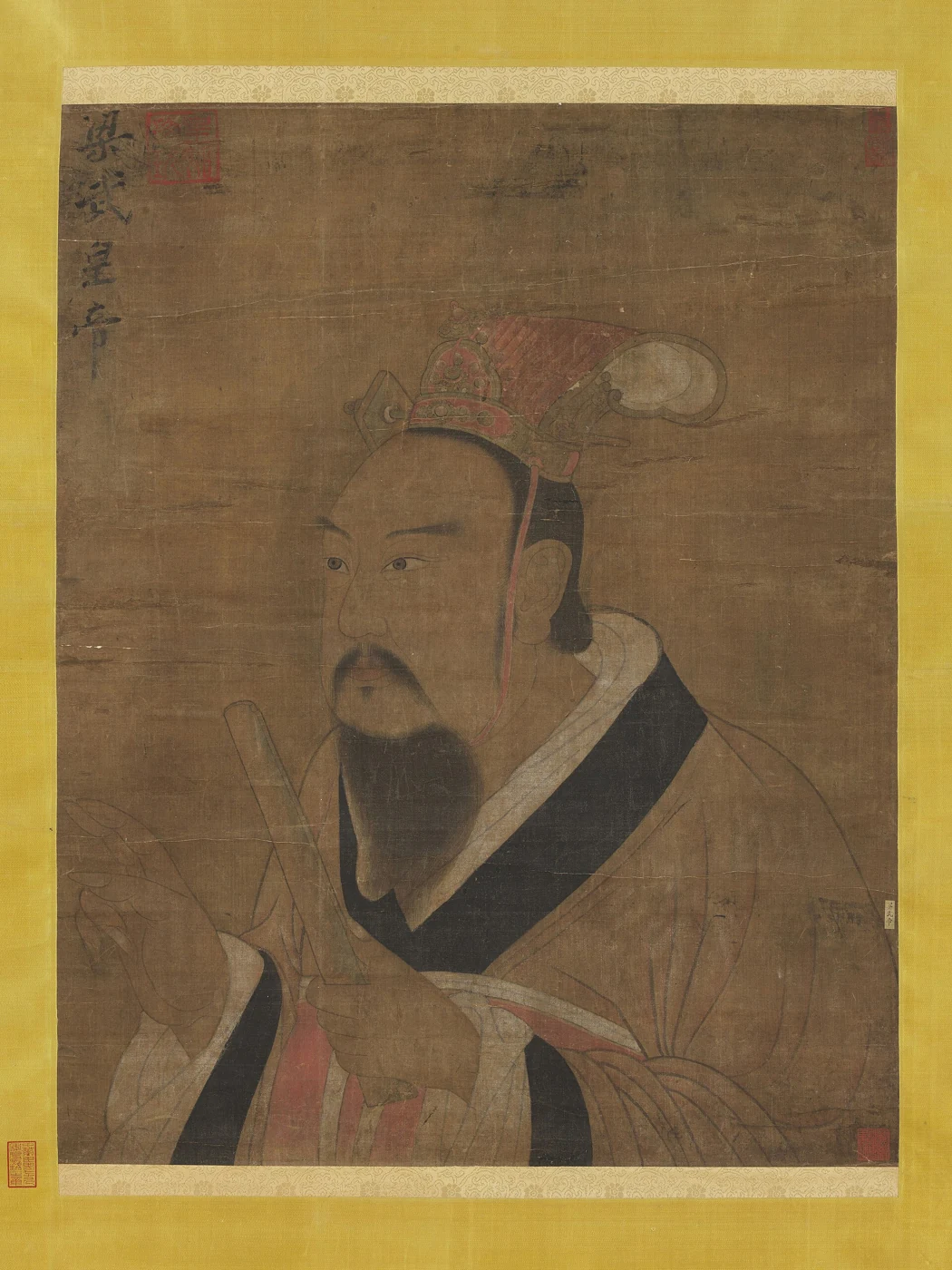
464 CE–549 CE
Emperor
Xiao Yan
萧衍
Xiao Yan (464–June 12, 549), courtesy name Shuda and childhood name Lian'er, was from Zhongdu Ward in Southern Lanling Commandery (present-day Changzhou, Jiangsu; another view places it in Danyang, Jiangsu). He was the founding emperor of Southern Liang, reigning from 502 to 549, with the temple name Gaozu. A member of the Lanling Xiao clan, he was said to descend from the Western Han chancellor Xiao He and belonged to the…
464 CE–549 CELiang dynasty
PROFILE
Xiao Yan (464–June 12, 549), courtesy name Shuda and childhood name Lian'er, was from Zhongdu Ward in Southern Lanling Commandery (present-day Changzhou, Jiangsu; another view places it in Danyang, Jiangsu). He was the founding emperor of Southern Liang, reigning from 502 to 549, with the temple name Gaozu. A member of the Lanling Xiao clan, he was said to descend from the Western Han chancellor Xiao He and belonged to the same broader clan as the Southern Qi imperial house. Learned and versatile, he was one of the “Eight Friends of Jingling” and was accomplished in literature, the Confucian classics, historiography, and Buddhism. Early in his reign he attended closely to government and carried out several reforms, and Southern Dynasties culture reached what the source describes as its greatest prosperity since the Eastern Jin. In the middle and later parts of his reign he became deeply devoted to Buddhism and offered himself to Tongtai Temple four times. In his final years, his acceptance of the Eastern Wei defector Hou Jing led to the Hou Jing Rebellion, and he ultimately died amid hunger and thirst at the age of eighty-six. Xiao Yan reigned for nearly forty-eight years, the longest reign among rulers of the Northern and Southern Dynasties, and was also one of the longest-lived emperors in Chinese history.
- Other name
- Emperor Wu of Liang
- Courtesy name
- Shuda
- Period
- Liang dynasty
- Dynasty / polity
- Liang dynasty
- Identity
- Emperor
- Ethnicity / group
- Not recorded in historical sources
- Ancestral home
- Zhongdu Ward, Southern Lanling Commandery (roughly in present-day Changzhou, Jiangsu; the precise identification is disputed)
- Born
- 464
- Birthplace
- Sanqiao residence, Tongxia Ward, Moling County
- Died
- June 12, 549
- Reign
- 502–549
- Predecessor
- Emperor He of Southern Qi (Xiao Baorong)
- Successor
- Emperor Jianwen of Liang (Xiao Gang)
- Era name(s)
- Not recorded in historical sources
- Temple name
- Gaozu
- Posthumous title
- Emperor Wu of Liang
- Principal achievements
- Founder of Southern Liang and a man of letters; noted for broad learning and literary ability, deep devotion to Buddhism, four acts of “self-offering” at Tongtai Temple, and the Hou Jing Rebellion in his later years.
LIFE TIMELINE
Age 21 | Became a guest at the Western Residence of Xiao Ziliang, Prince of Jingling, and was grouped with Shen Yue, Xie Tiao, and others as one of the “Eight Friends of Jingling.”
Age 27 | Appointed advisory officer to Xiao Zilong, Prince of Sui; his father Xiao Shunzhi died the same year, and Xiao Yan left office for three years of mourning.
Age 30 | During the final illness of Emperor Wu of Southern Qi, Xiao Yan predicted that Wang Rong's coup would fail; after Xiao Luan took charge as regent, Xiao Yan participated in the political settlement.
Age 31 | Appointed Gentleman of the Secretariat and then Yellow Gate Gentleman; assisted Xiao Luan in the deposition and enthronement process and was enfeoffed as Baron of Jianyang County.
Age 32 | Defeated a larger Northern Wei force in the Battle of Yiyang.
Age 37 | After his elder brother Xiao Yi was ordered to die by the Marquess of Donghun, Xiao Yan raised troops at Xiangyang.
Age 38 | Captured Jiankang; the Marquess of Donghun was killed.
Age 39 | Accepted the abdication of Emperor He of Southern Qi and founded Southern Liang, becoming Emperor Wu of Liang.
Age 41 | Issued the Edict on Abandoning Service to Daoism, declaring his abandonment of Daoism in favor of Buddhism.
Age 49 | Completed regulations for the Five Rites in more than one thousand juan.
Age 64 | Made his first self-offering at Tongtai Temple; returned to lay life three days later and changed the era name to Datong.
Age 66 | Made his second self-offering at Tongtai Temple; officials contributed one hundred million cash to redeem him.
Age 83 | Made his third self-offering; officials paid two hundred million cash to redeem him.
Age 84 | Made his fourth self-offering, remaining at Tongtai Temple for thirty-seven days; in the same year he accepted Hou Jing's submission.
Age 85 | Hou Jing rebelled and besieged Jiankang.
Age 86 | Jiankang fell; Xiao Yan was confined by Hou Jing and died amid hunger and thirst.
BIOGRAPHY
Biography
Family Background and Early Life
Xiao Yan was born in 464, the eighth year of the Daming era under Emperor Xiaowu of Liu Song, at the Sanqiao residence in Tongxia Ward, Moling County. His father, Xiao Shunzhi, was said to be a descendant of the Western Han chancellor Xiao He and a clansman of Emperor Gao of Southern Qi, Xiao Daocheng. Xiao Shunzhi held offices including Attendant, Commandant of the Guards, Chamberlain for the Heir Apparent, General of the Guards, and governor of Danyang, and was enfeoffed as Marquis of Linxiang County. Xiao Yan's mother, Zhang Shangrou, was said to be a sixth-generation descendant of the Western Jin minister Zhang Hua and came from Fangcheng in Fanyang. According to the genealogy presented in the source, Xiao Yan's family traced its settlement in Lanling County, Donghai Commandery, to Xiao Biao, a grandson of Xiao He. In 291, the first year of the Yuankang era of Western Jin, Lanling Commandery was separated from Donghai Commandery. Xiao Yan's great-great-grandfather Xiao Zheng served as magistrate of Huaiyin County; in the early Eastern Jin the family migrated south and settled at Dongcheng Ward in Wujin County, Jinling Commandery, where Southern Lanling Commandery was established as an émigré commandery. The Xiao clan was thereafter regarded as a Southern Lanling family.
Xiao Yan was intelligent and eager to learn from childhood and was especially gifted in literature. Benefiting from his family background, he first entered office as a legal aide in the household of Xiao Zilun, Prince of Baling, and later served as an Eastern Pavilion libationer under Wang Jian, General of the Guards. Wang Jian valued him highly on first meeting and recommended him for a post in the Revenue Section. He reportedly told the notable He Xian: “This young Xiao will become an Attendant before he is thirty; beyond that, his rank will be beyond measure.”
The Eight Friends of Jingling and Service under Southern Qi
In the first lunar month of 484, the second year of the Yongming era, Xiao Ziliang, Prince of Jingling, opened his Western Residence and gathered literary men. Xiao Yan associated there with Fan Yun, Xiao Chen, Ren Fang, Wang Rong, Xie Tiao, Shen Yue, and Lu Chui; the eight were known as the “Eight Friends of Jingling.” Wang Rong, famed for judging talent, often told friends and relatives: “The man who will govern the realm must be this one.” During this period Xiao Yan became known not only for literature but also for strategic ability and competence in both civil and military affairs.
In 490, the eighth year of Yongming, Xiao Yan became an advisory officer to Xiao Zilong, Prince of Sui. Soon afterward his father Xiao Shunzhi died, and Xiao Yan left office and returned to Jiankang to observe mourning for three years. In 493, the eleventh year of Yongming, Emperor Wu of Southern Qi, Xiao Ze, became gravely ill. Xiao Ziliang appointed Xiao Yan, Xiao Yi, Wang Rong, Fan Yun, and others as military commanders within his retinue. Wang Rong planned to forge an imperial order and install Xiao Ziliang as emperor. Xiao Yan judged that the plan would fail and told Fan Yun, “Wang Yuanzhang is not a man capable of saving the age; watch him fail.” As he predicted, Xiao Luan, Marquis of Xichang, thwarted Wang Rong's plot and supported the accession of the imperial grandson Xiao Zhaoye.
After Xiao Zhaoye came to the throne, he devoted himself to pleasure. Xiao Luan, Xiao Yan, and others plotted to depose him. Xiao Yan advised Xiao Luan on how to neutralize Xiao Zilong, Prince of Sui, arguing that Xiao Zilong was mediocre and that his subordinates Yuan Lisheng and Bian Bailong could be won over with high office and generous rewards. He also suggested reassuring Wang Jingze by means of beautiful women. Xiao Luan followed these plans and removed the threats. In 494, the first year of Longchang, Xiao Yan was appointed Gentleman of the Secretariat and then Yellow Gate Gentleman. For his role in supporting Xiao Luan's accession, he was made Baron of Jianyang County with a fief of three hundred households. His position thereafter rose steadily, although he later avoided discussion of this episode and did not wish to be reminded that he had been one of the “founding supporters” of Xiao Luan's enthronement.
The Battle of Yiyang and Command at Yongzhou
In 495, the second year of the Jianwu era, Northern Wei emperor Xiaowen, Tuoba Hong, led an army said to number three hundred thousand against Southern Qi and advanced east along the Huai River toward Zhongli. Xiao Luan first sent Cui Huijing and Pei Shuye to resist and then dispatched Xiao Yan together with the General Who Pacifies the North, Wang Guangzhi, to relieve Yiyang. When Wang Guangzhi reached a point one hundred li from Yiyang, he became hesitant after hearing of the size of the Wei force. Xiao Yan asked to act as vanguard. Marching by a small road through the night, he reached Xianshou Mountain, only a few li from the Wei camp, and ordered banners planted across the hills. At daybreak the Qi defenders inside Yiyang saw the banners, believed that a large relief army had arrived, and their morale rose. They sallied out and attacked the Wei army, setting fires with the wind. Xiao Yan personally led a simultaneous attack from the other side. Pressed from front and rear, the Wei army broke out and withdrew, and the Qi forces won a major victory.
Xiao Yan later held posts including Central Attendant to the Crown Prince and concurrently Director of the Feathered Forest Guard. In 497, the fourth year of Jianwu, Emperor Xiaowen of Northern Wei again campaigned south. Xiao Yan led reinforcements, but at the Battle of Dengcheng he was forced to withdraw after commander Cui Huijing fled the battlefield. Xiao Yan regrouped the troops and retreated while fighting, eventually withdrawing safely. After Emperor Ming of Southern Qi, Xiao Luan, died, Xiao Yan was appointed governor of Yongzhou and stationed at Xiangyang. There he strengthened the army and quietly accumulated military power, laying the groundwork for his later uprising.
Rebellion against the Marquess of Donghun and the Founding of Southern Liang
In 500, the second year of the Yongyuan era, the Marquess of Donghun, Xiao Baojuan, ruled violently. Xiao Yan's elder brother Xiao Yi, governor of Yuzhou, was falsely accused of treason and ordered to die. On learning of this, Xiao Yan raised troops at Xiangyang against the Marquess of Donghun. He secretly had large quantities of bamboo cut around Xiangyang and submerged in a lake for later use in shipbuilding, giving rise to the later story of “cutting bamboo and sinking timber.” Xiao Yan wrote to Xiao Yingzhou, acting administrator of Jingzhou, urging him to join the uprising. Persuaded by his subordinates Xi Chanwen and Liu Chen, Xiao Yingzhou killed Liu Shanyang, a general sent by the Marquess of Donghun, joined Xiao Yan's revolt, and supported Xiao Baorong, Prince of Nankang and governor of Jingzhou, as their nominal leader.
In 501, the first year of Zhongxing, Xiao Yan besieged Yingcheng for more than two hundred days before taking it, then marched east toward Jiankang. In the twelfth lunar month the Marquess of Donghun was killed in a coup led by the general Wang Zhenguo, and Xiao Yan occupied Jiankang. In 502, the second year of Zhongxing, Xiao Yan accepted the “abdication” of Emperor He of Southern Qi, Xiao Baorong, founded Southern Liang, and became Emperor Wu of Liang. He reduced the former emperor to Prince of Baling and had him ordered to die the following day.
Reforms and Achievements in the Early Reign
In the early years of his reign, Xiao Yan paid close attention to government and attempted to correct abuses inherited from the Liu Song and Southern Qi periods. To bring the provinces and commanderies under his control, he replaced opponents, appointed trusted men, and used military force when necessary. He revised the “Hundred Families Genealogy,” treated members of the imperial clan with relative leniency, and sought to mediate tensions between great aristocratic lineages and families of humbler status. Militarily, he resisted Northern Wei incursions. In 506, the fifth year of Tianjian, Liang forces dealt Northern Wei a major defeat at the Battle of Zhongli, helping preserve the balance between north and south. Xiao Yan later launched several northern campaigns, but with limited results.
In culture and scholarship, Xiao Yan strongly promoted learning and sponsored the organization of classical, historical, and literary texts. In 512, the eleventh year of Tianjian, regulations for the Five Rites—auspicious, funerary, military, guest, and festive rites—were completed in more than one thousand juan and 8,019 provisions and promulgated for use. Dissatisfied with the dynastic-history format represented by the Book of Han, he also sponsored the compilation of a six-hundred-juan Comprehensive History and personally wrote its encomia and prefaces. Under his patronage, Southern Dynasties culture reached what the source describes as its greatest prosperity since the Eastern Jin. Li Yanshou, author of the History of the Southern Dynasties, wrote: “In the more than two hundred years since the dynasty crossed the Yangzi, material and cultural refinement was never more flourishing than at this time.”
Buddhism in His Later Years and the Four Self-Offerings
On the eighth day of the third lunar month of 527, the eighth year of Putong, Xiao Yan made his first self-offering at Tongtai Temple, becoming a monk. Three days later he returned to lay life and the palace, granted a general amnesty, and changed the era name to Datong. On the fifteenth day of the ninth lunar month of 529, the third year of Datong, he went to Tongtai Temple for a second time, held an unrestricted assembly of the fourfold Buddhist community, removed his imperial robes and put on a monastic robe, offered himself to the monastery, and lectured on the Nirvana Sutra. Court officials contributed one hundred million cash to redeem him. On the tenth day of the fourth lunar month of 546, the twelfth year of Datong, he entered monastic life a third time, and officials paid two hundred million cash for his return. On the third day of the third lunar month of 547, the first year of Taiqing, he entered Tongtai Temple for the fourth time, remained there for thirty-seven days, and was redeemed by the court for one hundred million cash.
Xiao Yan was deeply devoted to Buddhism. Beyond his four self-offerings, he sponsored temple construction on a large scale. Guo Zushen described the capital as having “more than five hundred Buddhist monasteries, magnificent to the utmost; more than one hundred thousand monks and nuns, with rich estates.” The source attributes to Xiao Yan hundreds of juan of exegetical writings on the Mahaparinirvana Sutra, the Large Perfection of Wisdom Sutra, the Vimalakirti Sutra, the Three Wisdoms Sutra, and other scriptures, as well as the creation of the Liang Emperor's Jeweled Repentance. It also credits him with promoting vegetarianism in Chinese Buddhism. He further combined Confucian ritual norms, the Daoist idea of “nonbeing,” and the Buddhist doctrine of karmic retribution into a theory that the Three Teachings shared a common source, which the source presents as significant in the history of Chinese thought.
The Hou Jing Rebellion and Death
In 547, the first year of Taiqing, Eastern Wei general Hou Jing rebelled in the thirteen provinces of Henan after falling into conflict with the chief minister Gao Cheng and initially submitted to Western Wei. Because Yuwen Tai of Western Wei distrusted him, Hou Jing then wrote to Xiao Yan, offering the thirteen provinces of Henan in return for acceptance by Southern Liang. Xiao Yan accepted Hou Jing, appointed him General-in-Chief, and made him Prince of Henan. Eastern Wei soon attacked Hou Jing. Xiao Yan sent his nephew Xiao Yuanming to support him, but Xiao Yuanming was defeated and captured. Gao Cheng then feigned an offer of peace in order to drive a wedge between Hou Jing and Liang. Ignoring the warnings of his ministers, Xiao Yan exchanged envoys with Eastern Wei. Hou Jing forged a letter in the name of Eastern Wei proposing that Xiao Yuanming be exchanged for Hou Jing; Xiao Yan unexpectedly agreed. Hou Jing then rebelled.
In 548, the second year of Taiqing, Hou Jing crossed the Yangzi with Xiao Zhengde acting as his internal collaborator and besieged Jiankang. After a long siege, the city ran out of food, hunger and disease spread, and fewer than four thousand men remained capable of defending the walls. The princes of Southern Liang commanded substantial armies but distrusted one another and failed to act. On the twelfth day of the third lunar month of 549, the third year of Taiqing, Hou Jing entered Jiankang and allowed his troops to plunder the city. Members of the Xiao imperial clan, the Wang clan of Langya, and the Xie clan of Chen Commandery were all subjected to slaughter. After the fall of the city, Hou Jing's soldiers moved freely through the palace, and Xiao Yan's food was reduced. Elderly and suffering from a bitter, dry mouth, he asked for honey water but was refused. After shouting several times, he died amid hunger and thirst at the age of eighty-six. He was buried at Xiuling (in present-day Lingkou, Danyang, Jiangsu), with the posthumous title Emperor Wu and temple name Gaozu.
Xiao Yan, styled Shuda and known in childhood as Lian'er, was a native of Zhongdu li in Southern Lanling, of the line of the Han chancellor Xiao He. The genealogy in the Book of Liang traces him through the marquis of Zhan, an attendant gentleman, a succession of governors and academicians down to Xiao Zheng, magistrate of Huaiyin, and so to Xiao Daoci, whose son Xiao Shunzhi was his father. Xiao Shunzhi was a collateral cousin of the Qi founder, Xiao Daocheng, had a share in founding the dynasty, was enfeoffed marquis of Linxiang and held a series of high posts, being posthumously made general of the north. Xiao Yan was born in 464, his mother the empress Zhang Shangrou. Xiao Zheng had two sons, one the great-grandfather of Xiao Daocheng and the other the great-grandfather of Xiao Yan, both branches of the Lanling Xiao; this family background did much for his later career.
Clever and fond of learning from boyhood, broadly accomplished and especially gifted in letters, he began his official life as a staff officer in the household of the prince of Baling and afterward became master of the eastern pavilion to the general Wang Jian, who saw at once that he was extraordinary, asked for him as an aide and told He Xian of Lujiang that this young Xiao would be an attendant gentleman before thirty and beyond that too exalted to name. When the prince of Jingling, Xiao Ziliang, opened his western residence to men of letters, Xiao Yan moved there with Shen Yue, Xie Tiao, Wang Rong, Xiao Chen, Fan Yun, Ren Fang and Lu Chui, and they were called the Eight Friends; among them Wang Rong, brilliant and perceptive, held Xiao Yan in particular esteem and often said that the man who would rule the empire must be this one. He rose to be a staff adviser to the prince of Sui and soon left office for his father's mourning. His resourcefulness and his combination of civil and military talent showed themselves again and again in the political storms that followed.
When the Qi emperor Wu fell ill, Wang Rong meant to take the occasion to put the prince of Jingling on the throne, and Xiao Yan saw what was coming: he told Fan Yun that the streets were full of talk of some extraordinary move, and that Wang Rong was no man to save the world and would be seen to fail; when Fan Yun said that Wang was the only man who cared for the state, Xiao Yan asked whether he meant to be a Duke of Zhou and Shao or a Shudiao of old, and Fan Yun did not answer. The heir Xiao Zhaoye entered the palace, Wang Rong in crimson robes blocked the eastern palace guard at the gate of the secretariat, and when the emperor revived he called in the eastern palace arms and gave the government to the marquis of Xichang, Xiao Luan; on his death Wang Rong barred the gates with the prince of Jingling's troops, but Xiao Luan rode to the Yunlong gate, was refused entry, declared that he was summoned by edict, forced his way in, brought the heir to the hall, had the prince of Jingling led away, and disposed everything with a voice like a bell, so that none in the hall disobeyed. Xiao Zhaoye, once emperor, thought only of pleasure; Xiao Luan consulted Xiao Yan on deposing him, and needing to recall the prince of Sui from Jingzhou and fearing Wang Jingze in Kuaiji, asked his advice. Xiao Yan answered that the prince of Sui, for all his fair name, was a mediocre man whose only props were two officials who would go anywhere for profit, and that a letter would bring him; and that Wang Jingze wanted only to sit at ease in Jiangdong in the utmost wealth, and should be given beautiful women to amuse him. Xiao Luan approved, called the two officials to court and summoned the prince of Sui, who was given to take his own life. When the governor of Yuzhou, Cui Huijing, an old servant of Emperor Wu, grew uneasy, Xiao Luan sent Xiao Yan to Shouyang ostensibly against the Northern Wei but really to watch him; at Changlai Cui Huijing came out in plain clothes to meet him in fear of punishment, and Xiao Yan, though his officers asked leave to kill him, said he was like a child in the palm of one's hand and it would be no feat, and soothed him, and Cui Huijing was quieted. In 494 Xiao Yan was made a secretariat attendant and promoted to the yellow gate.
In the process by which Xiao Luan took the government and then the throne, Xiao Yan's part in the coup raised him steadily: made a general and posted to Shouchun when Xiao Luan took over the government, he became an attendant of the heir and yellow gate attendant after mourning, with the run of the palace, and was enfeoffed a baron of Jianyin county with three hundred households for his share in the coup. Yet he was afterward close-mouthed about it and disliked being called a kingmaker of the Ming emperor: when Wu Jun, wanting to make a name by writing history, asked for the Qi court diaries and the conduct records of the ministers and was refused, he privately wrote his Spring and Autumn of Qi and presented it, and it called Xiao Yan the kingmaker; the emperor, disliking so plain a record, had the secretariat attendant Liu Zhilin question him on dozens of points, and when his answers fell apart had the book burned in the department and dismissed him.
In 495, when the Northern Wei sent Liu Chang and Wang Su against Sizhou, Xiao Yan served as a general in the relief force under the governor of Jiangzhou, Wang Guang. When the force halted a hundred li from Yiyang and the officers hung back before the Wei numbers, Xiao Yan asked to lead the way, and Wang Guang gave him picked troops; that night he advanced, halted a few li from the Wei camp and went straight up Xianshou hill, planting banners over the whole slope. The Wei, unable to judge his numbers, dared not attack; at dawn the garrison saw the relief come and attacked the Wei stockades, while Xiao Yan charged from without, so that the Wei were caught between and abandoned the siege. He was made a staff officer, then an attendant of the heir with command of the guards, and posted to Shitou. In the autumn of 497 the Wei came south again and took Xinye and Nanyang, and Xiao Yan was sent to relieve Yongzhou, reaching Xiangyang in the tenth month and afterward serving under the minister Cui Huijing. In the third month of the next year the two met the enemy at Dengcheng, where the Wei commander arrived suddenly with more than a hundred thousand cavalry. Cui Huijing lost color and wanted to retire; Xiao Yan urgently tried to stop him and was ignored, and Cui Huijing fled with his own following, the Wei falling on them and routing the army. Xiao Yan alone held the enemy off, killing some hundreds, and so got his men into order and brought them off to the boats at nightfall, Cui Huijing's army being all but destroyed while his own came back whole. Instead of blaming him for the defeat, Xiao Luan put him in charge of the defense of Yongzhou as its governor in Cao Hu's place — and from then on Xiao Yan had a fixed base of his own, the foundation of his later power.
In the seventh month of 498 Xiao Luan died after only five years on the throne and his son Xiao Baojuan succeeded. Xiao Baojuan was savage, killing his great ministers on taking the throne and taking back their powers, and employing mean men, so that revolts broke out repeatedly and the provincial commands each had their own plans. In the winter of 500, hearing that his full brother Xiao Yi had been killed by Xiao Baojuan, Xiao Yan secretly summoned his chief of staff Wang Mao, his officer Lü Senzhen and two others to consult, and finding them in agreement began to raise troops, on the yisi day of the eleventh month gathering his staff and announcing the rising, setting up his standard the same day, and cutting timber from the Tan stream to fit out ships, so that within ten days the work was done and those who wished to follow him furnished five thousand armored horses and thirty thousand soldiers. He had Liu Shanyang, whom Xiao Baojuan sent against him, killed by a stratagem, and set up Xiao Baorong, prince of Nankang, as his figurehead; refusing his officers' proposal that he take the throne himself, he joined with Xiao Yingzhou and established the commandery of Xinye south of the Mian to gather new adherents. In the second month of 501, when the prince of Nankang took the style of chancellor and set up a western administration, Xiao Yan was made its general and the campaign downriver against Jiankang began.
In the second month of 501 the prince of Nankang took the style of chancellor with a western administration and made Xiao Yan general of the eastern expedition; he left Xiangyang and published his proclamation at Jianye. At Jingling he put Wang Mao and the governor Cao Jingzong in the van and left Zhang Fa'an to hold the town; the two crossed the river and halted nine li on, where the governor of Yingzhou, Zhang Chong, came out and was badly beaten. Xiao Yan then built a fort at the Han mouth to hold Lushan and sent his naval commanders Zhang Huishao and Zhu Siyuan to patrol the middle of the river and cut the communications of Ying and Lu. In the third month the prince of Nankang took the throne at Jiangling, changed the era name to Zhongxing and degraded the marquis of Donghun to prince of Fuling, making Xiao Yan president of the secretariat, general of the eastern expedition, commander of all campaigns and giver of the yellow axe; in the fourth month Xiao Yan moved out on the Mian and pressed on Ying. In the seventh month he sent Wang Mao with three commanders to surprise Jiahuy, where the thirteen relieving columns of Wu Ziyang and Guang Zijin lay; the river being low, ships could not pass and Guang Zijin was pleased — but that night a meteor fell on his city and in the fourth watch, without rain, the water rose suddenly, so that the fleet came on with the current, beat the drums and attacked, and the enemy collapsed in a moment, Wu Ziyang fleeing and the rest drowning in the river, Wang Mao taking the survivors back; and Ying and Lu lost heart.
Blockaded and without relief, Ying and Lu surrendered one after another. Plague had swept Ying, where of more than a hundred thousand soldiers, officials, men and women seven or eight in ten had died; when the gates opened Xiao Yan comforted the survivors and provided coffins for the dead. Chen Bozhi, wavering, was pressed by Xiao Yan, who sent Deng Yuanqi downriver that same day; as Deng approached Xunyang Chen Bozhi took fright, drew back to Hukou and left his son in Pensheng, and when Xiao Yan arrived he laid down his arms and confessed. In the ninth month an edict authorized Xiao Yan to pacify the east at his own discretion; his vanguard reached Wuhu, the governor of Southern Yuzhou abandoned Gusbu and the army occupied it, and the people welcomed them along the road as though clothed in new silk. He sent Cao Jingzong and Xiao Yingda with horse and foot to Jiangning and drove off the general Li Jushi; Wang Mao, Deng Yuanqi and Lü Senzhen occupied Chibiluo and Cao Jingzong and Chen Bozhi ranged as flying columns; when the lord of Xinting fort, Jiang Daolin, came out to fight he was taken in the field. As the army reached Xinlin the whole population of Jiankang turned out, some sending in their allegiance written in blood; Xiao Yan posted his commanders at Yuecheng, at Zaojia bridge, at the Daoshi mound and at the hedge gate. In the tenth month Xiao Baojuan sent the general Wang Zhenguo to draw up on the great road south of the dam with his best men and weapons, more than a hundred thousand still, with a eunuch holding the white tiger banner to urge on the troops; Wang Mao and Cao Jingzong fell on them in a pincer and Wang Zhenguo's host collapsed at once. Li Jushi surrendered the Xinting fort and Xu Yuanyu the eastern prefecture; the forces at Shitou and Baixia dispersed by night. On the renwu day Xiao Yan took post at Shitou and set his armies about the six gates of the palace city, building a long wall about them, and by proclamation brought over the garrisons left at Jingkou, Guangling and Guabu; he posted his brothers at Jingkou and Podun and his cousin at Guangling. On the night of the bingyin day of the twelfth month the guard commander Zhang Ji and the governor Wang Zhenguo killed Xiao Baojuan, sent his head wrapped in yellow oil to the camp, and Xiao Yan had the treasuries and registers sealed before entering, put the favorite Pan to death, and handed the forty-eight of the wicked party to the judges. The empress of Xuande degraded the prince of Fuling to marquis of Donghun and gave Xiao Yan the offices of secretary, grand marshal, director of the secretariat, general of the agile cavalry, commander and governor of Yangzhou, enfeoffing him duke of Jian'an with ten thousand households and forty sword-bearers, all in the form used in the case of the Jin prince of Wuling. He then took up his seat in the parade hall, proclaimed a general amnesty, ordered the search for and abolition of all the marquis of Donghun's perverse taxes and cruel punishments, and sent a governor with five thousand men to reassure the twelve commanderies of the east.
In the first month of 502 the Qi emperor's envoy reached Jiankang to congratulate him and to grant posthumous titles to his father and grandfather, and on the wuxu day he was formally made grand marshal; soon after he was given command of all military affairs with leave to enter the palace in shoes and with his sword, to walk unbowed and to be announced without name, with bands and escorts before and behind, and with the right to open his own headquarters and appoint his own staff. On the jiayin day he was made chancellor with the direction of all government, enfeoffed duke of Liang in ten commanderies with the nine bestowals, the distant-travel cap and the green ribbon, above all the princes; declining at first, he accepted the chancellorship and dukedom in the second month at his staff's repeated urging. Portents followed one another — jade-carved unicorns found in a well at Xuanwu city, phoenixes seen at Tongxia li in Jiankang county — and his fief was enlarged to twenty commanderies, which he accepted as prince of Liang on the guisi day of the third month after a show of refusal. He had the emperor's attendants press him to abdicate, and his brother Xiao Dan, governor of Jingzhou, had a ballad circulated that the "water in the middle" was to be son of heaven, playing on popular superstition to make opinion for him. On the bingwu day the emperor granted him the twelve-tasseled crown, imperial banners, the clearing of the way and closing of the gates, the golden-rooted carriage with six horses and the five seasonal attendants, the eight-rowed dance, and the titles of consort and princes in the old fashion; on the bingchen he issued the decree of abdication and in the fourth month the formal document, sending two ministers with the imperial seals to conduct the ceremony of receiving the end of the dynasty exactly as in the case of Tang and Yu.
When the decree came Xiao Yan again made a show of declining, and so Fan Yun led a hundred and seventeen ministers to memorialize as subjects asking him to ascend, while eight hundred and nineteen princes and officials of Qi and the hundred and seventeen of his own chancellery petitioned him, and the astronomer presented sixty-four portents, whereupon he let himself be "persuaded". On the bingyin day of the fourth month of 502 he sacrificed to heaven and earth in the southern suburb and took the throne, founding the Liang dynasty with the era name Tianjian. He enfeoffed the Qi emperor Xiao Baorong as prince of Baling and then sent him raw gold to take his own life; Shen Yue citing Cao Cao's saying that one should not court an empty name and suffer the reality, Xiao Yan sent his man Zheng Boqin to Gusbu with the gold, and Xiao Baorong said that to die he had no need of gold and mellow wine would do, drank himself insensible and was strangled, his death being announced as illness and his funeral and tomb conducted in imperial style.
For the next dozen years Liang and the Northern Wei struggled back and forth along the Huai. In 504 Cai Ling'en at Yiyang, his strength spent, surrendered to Wei, the relief force was beaten and the commanders of the three passes abandoned their posts. In 506 Xiao Yan sent his brother Xiao Hong, prince of Linchuan, with the whole army north; the equipment was new and the display such as the northerners had not seen in a century, and the Liang took the Wei towns of Xiaoxian and Hefei, advanced to the Luo mouth and took Liangcheng with the van. But Xiao Hong, timid and inept, would not press the advantage; the Wei, knowing him no soldier, sent him women's clothes and sang that they feared not Lady Xiao and Mother Lü but only the Wei tiger of Hefei — that is, Wei Rui. On the night of the jiichou day of the ninth month a storm broke over the Luo mouth, the camp panicked, Xiao Hong fled with a few riders, and the troops, unable to find him, scattered for home, throwing away armor and weapons until the roads and river were choked, abandoning the sick and the old, some fifty thousand dying. From the tenth month of 506 the Wei general Yuan Ying with a host said to be a million besieged Zhongli, held stubbornly by Chang Yizhi; Xiao Yan sent Cao Jingzong and then Wei Rui with more than two hundred thousand to relieve it. In the third month of 507 Wei Rui seized the moment when the Huai rose in flood, attacked with the fleet and broke the Wei utterly, pursuing them to the Wei river, so that for a hundred li along the Huai the bodies lay on one another and the river could not flow; more than a hundred thousand were killed and as many drowned, with fifty thousand taken prisoner — the greatest victory won by the south since the campaigns of the early Yuanjia years of the Liu Song. In the tenth month of 508 the Wei commander at Xuanhu killed his governor and surrendered the province to Liang, and Xiao Yan sent Ma Xianpin to relieve him, recovering Yiyang and the three passes for a time; but Yuan Ying then defeated the Liang columns in turn and all the recovered land was lost, Xiao Yan having to post Wei Rui at Anlu to hold the Wei advance. In 511 the people of Qushan killed the two governors of Dongguan and Langya and gave the town to Wei, and Xiao Yan had Ma Xianpin attack it with full support; the two sides faced each other outside the walls until the twelfth month, when the garrison, starving, surrendered first and the Wei army broke with heavy losses.
After the Datong years Xiao Yan continued to receive defecting Wei commanders and cities: in 532 the governor of Southern Yanzhou came over and the province was renamed Qiao; the next year the lord of Jianyi killed the Wei governor of Eastern Xuzhou and surrendered Pijiang, which was renamed Wuzhou; in 535 Lan Qin took Hanzhong and the Wei governor of Liangzhou surrendered. The Wei general Hou Jing also raided south from time to time: in 536 he invaded Chuzhou with seventy thousand men, took its governor prisoner and advanced to the Huai, writing to Chen Qingzhi to urge his surrender, and when Xiao Yan's relief force reached Lijing Chen Qingzhi had already beaten him, so that in bitter snow he abandoned his baggage and fled. In the tenth month of that year Xiao Yan again decreed a great northern campaign and at once recalled the armies, and in the twelfth month agreed to Wei's request for peace, after which no large-scale fighting occurred between the two states until Hou Jing came over.
Xiao Yan reigned nearly half a century, longer than any other sovereign of the Southern Dynasties. He had some experience of government before taking the throne and had seen the rottenness of the Qi at first hand, and he set about governing diligently, adjusting policy in several ways: he attended to the tension between the great pedigree families and the lesser houses and used men from both; he abandoned the excessive severity of the Song and Qi emperors' handling of subordinates, which had bred revolt, and was generous instead; within his own house he wished to replace kin-killing with kin-affection; and he had the Code of Liang drawn up, an important code of the Southern Dynasties after those of Song and Qi. His policy had two sides: in practice he was harsh with the common people and lenient with the powerful, which bred resentment below and license above, though in his earlier years the contradictions had not ripened and politics kept a rough order, while in his last years he delegated affairs to favorites and government grew dim.
In the succession he erred by setting aside the legitimate line for a junior. He had made his eldest son Xiao Tong heir in the year he took the throne; Xiao Tong was of generous bearing and known in the eastern palace for his virtue, loved by court and people alike, but he fell out with his father over the burial place of his mother, the consort Ding: a seller of land offered it through the eunuch Yu Sanfu, who secretly reported that the ground the heir had chosen was less auspicious for the emperor than another, and Xiao Yan, suspicious in his later years, ordered it bought; after the burial a geomancer said the site was unlucky for the eldest son, and wax figures and other objects were buried by the grave; the palace overseer Bao Miaozhi secretly reported that Wei Ya had performed a spell for the heir, and the emperor had the place dug up and found the objects, and though Xu Mian's remonstrance stopped the matter at the death of the Daoist priest, Xiao Tong was ashamed to the end of his life and his line was not made heir. He died in 531 at thirty-one, and though by rule his eldest son Xiao Huan should have succeeded, Xiao Yan, thinking the empire newly settled and a young ruler unfit for a great charge, and bearing his old grudge, hesitated from the beginning of the fourth month to the twenty-first day of the fifth, when he made Xiao Huan prince of Yuzhang and sent him back to his post — the people having a rhyme about the deer opening the city gate which the Southern History reads as the emperor weeping — and on the twenty-seventh made Xiao Gang heir. To compensate Xiao Tong's line and to quiet the talk of setting aside the legitimate, he enfeoffed all his sons as princes of great commanderies with three thousand households each, treated their sisters as full princesses, and kept the heir's widow in her own palace.
The disaster of his last years came from Hou Jing. A commander under Gao Huan of the Eastern Wei, often victorious and much relied on, but unstable by temper and at odds with Gao Huan's son Gao Cheng, he surrendered to Liang in the first month of 547 when Gao Cheng tried to take his troops. Xiao Yan, wary of him, did not receive him warmly, and Hou Jing then offered thirteen provinces; Xiao Yan, pleased, made him prince of Henan and general-in-chief and sent troops to meet him; but when he afterward made peace with Gao Cheng on condition of returning Hou Jing to the Eastern Wei, Hou Jing rose in rebellion on the pretext of destroying the favorites who misgoverned the court. His army drove straight on Jiankang and besieged the palace city; Xiao Yan called out the provincial forces, but the relieving armies each had their own aims and after a few reverses stood still and watched, so that the rebels went on with the siege.
Once in power Hou Jing found Xiao Yan outwardly subject to him but inwardly most unwilling. Hou Jing wished to make his follower Song Zixian minister of works, and Xiao Yan asked what use such a man was for harmonizing yin and yang; he refused another request to make two of Hou Jing's partisans commanders of the side halls. Hou Jing could not force him and was much in awe of him; and when the heir Xiao Gang came weeping to remonstrate, Xiao Yan asked who had sent him, saying that if the state had any spirit it would yet be restored, and if not, what was the use of tears. Hou Jing set his soldiers to keep watch within the palace, some driving donkeys and horses and carrying bows and swords in and out as they pleased; when Xiao Yan asked the reason, the guard commander Zhou Shizhen answered that they were the chancellor Hou's armored men, and Xiao Yan in fury asked why he called Hou Jing chancellor. After that his requests mostly went unanswered, his food and drink were cut down, and the old man, bitter and angry, fell ill and did not rise. On the bingchen day of the fifth month of 549, lying in the Jingju hall of the palace city with a bitter taste in his mouth and asking for honey in vain, he gave two cries of astonishment and died of hunger and thirst at eighty-six. Hou Jing kept the death secret, laid the body in the Zhaoyang hall and only after twenty-six days moved it to the Taiji hall; in the eleventh month he was given the posthumous name Wu and the temple name Gaozu, and buried at Xiuling.
Looking at his government as a whole, its early years had real merits. He had learned from the fall of Qi, was diligent in business, rising at the fifth watch in every season to read and answer memorials until his hands cracked with cold in winter; he loved men of letters but valued administrative capacity, telling Liu Xiaochuo in an autograph reply that fine brocade could not be cut at once and that one should also learn the registers. In appointments he sought good officials: he attended to the great offices at the center, employing able men, men of judgment and men who would speak plainly, and required local governors to be honest, receiving and instructing them in person and decreeing that a magistrate of a small county who did well might be promoted to a larger, and from a larger to a commandery, so that the administration of Liang markedly improved; and officials who were grasping or brutal were punished severely as soon as discovered. Against the abuses of appointment he memorialized for the careful review of the registers so that name and substance should agree, abolishing the old rule by which great families entered office at twenty while lesser men were tested only in middle life; he set up a college of the five classics for sons of humble houses, improved the national academy and increased its students, who paid no fees and were housed and fed by the state and, on mastering one classic and passing the examination, entered the service — the decree declaring that even a shepherd or a cowherd, if he passed and had ability, was to be employed and none to stand in his way — so that students gathered from every quarter and appointment by examination began to be a standing institution, opening the road to the examinations of Sui and Tang. He also opened the channels of speech, decreeing again and again that officials, governors and common people alike might memorialize on law and government for the good of the realm, and setting two boxes by the memorial drums and the stone of appeal: one for men of merit or talent unpromoted and able men blocked, and one for the criticism and proposals of ordinary people.
Major Activities
Literary Contributions
Xiao Yan was one of the “Eight Friends of Jingling” and was prominent in literary circles during the Yongming era of Southern Qi. More than eighty of his surviving poems, including old-style and Music Bureau verse, are said to remain. He made notable contributions to the composition and editing of Music Bureau poetry. After becoming emperor, he ordered the collection of local folk songs, reviving a practice that the source says had lapsed since the Jin. Under his advocacy and influence, Southern Dynasties culture reached what the source describes as its most flourishing point since the Eastern Jin.
Political Activities
In the early part of his reign, Xiao Yan attended closely to affairs of state and attempted to correct abuses inherited from the Liu Song and Southern Qi. He revised the “Hundred Families Genealogy,” sought to mediate tensions between aristocratic lineages and families of humbler status, treated the imperial clan leniently, and strengthened control over provinces and commanderies by replacing opponents and appointing trusted men. He implemented the Five Rites system and refined state ritual norms. In his later years, his deep devotion to Buddhism and repeated self-offerings involved very large expenditures; according to the source, this drained the treasury and contributed to the decline of government.
Military Activities
Xiao Yan had already demonstrated military ability under Southern Qi. At the Battle of Yiyang in 495, he defeated a larger Northern Wei force. In 506, Liang forces won a major victory over Northern Wei at the Battle of Zhongli, helping preserve the north-south balance. Xiao Yan later launched several northern campaigns with limited results. In his final years he accepted Hou Jing's submission and then mishandled the resulting crisis, which culminated in the Hou Jing Rebellion and the collapse of his own position.
Buddhist Activities
Xiao Yan is remembered in the source as a famous “monk-emperor.” He offered himself to Tongtai Temple four times, sponsored the construction of monasteries, supported Buddhist institutions, was credited with creating the Liang Emperor's Jeweled Repentance and with writing commentaries on Buddhist scriptures, advanced a theory of a common source for the Three Teachings, and promoted vegetarianism in Chinese Buddhism. Because of his support for the circulation of Buddhism, some later temples worshipped him together with his eldest son, Crown Prince Zhaoming, as protective deities.
Scholarly Achievements
In classical studies, the source attributes to Xiao Yan more than two hundred juan of works including Lectures and Commentaries on the Zhou Changes, Questions and Answers on the Spring and Autumn Annals, and Correct Sayings of Confucius. In historiography, he sponsored the six-hundred-juan Comprehensive History and ordered Yin Yun to collect anecdotes and miscellaneous tales unsuitable for formal history into works of fiction. In religious philosophy, the source credits him with creating a theory of the common source of Confucianism, Daoism, and Buddhism, which it describes as significant in the history of Chinese thought.
In the wars with the Northern Wei, Xiao Yan several times sought the advantage by damming and flooding, of which the Fushan dam is the classic case. In 514, contesting Shouyang with the Wei, he overrode his ministers and adopted the plan of a Wei defector to dam the Huai and drown the city, putting the prince's guard commander Kang Xuan in charge; the water engineers reported that the sandy bed of the river would not bear the work, and he refused to listen, conscripting the people of Xu and Yang at five men from every twenty households and giving Kang Xuan authority over all military affairs on the Huai with two hundred thousand laborers and soldiers. When the dam was made, a great reservoir formed upstream and Shouyang, two hundred kilometres away, was besieged by water; Kang Xuan in turn spread the false report that the Liang feared only the opening of the outlet and not battle in the field, and the Wei, believing him, cut a channel five fathoms deep to the north, so that the water flowed away day and night without lowering the pool, and that month the Wei army broke and withdrew, the flood covering several hundred li along the Huai. But the bed was sand, and after Kang Xuan was recalled in the autumn of 516 his successor would not repair the dam; in the ninth month the Huai rose suddenly and the dam burst with a sound like thunder heard three hundred li away, and more than a hundred thousand people in the garrisons and villages along the river were swept into the sea. The measure won a temporary advantage by drowning Shouyang, at the price of terrible losses downstream, and later writers have taken it as an instance of his fondness for risky expedients with little regard for the lives of the people.
There were further northern campaigns. In 521, when the governor of Yizhou defected to Wei, Xiao Yan sent Pei Sui, who went deep into Wei territory by a frontier road, surprised and beat the Wei governor Feng Shou and besieged his city until he surrendered with his hands bound. In 524 Xiao Yan gave Pei Sui command of the northern expedition: in the ninth month Pei Sui reached Shouyang by night, broke into the outer city and fought nine engagements in a day, withdrawing only when his rear column lost its way and no relief came; he then re-formed his troops, distinguishing the commanders by the color of their robes and riding himself in yellow, took several towns, broke the commandery of Xincai and raided as far as Zhengcheng, with the region between the Ru and Ying answering him, and when the Wei commanders came out of Shouyang with fifty thousand men he laid four ambushes, sent a general to feign flight and draw them on, and destroyed their army with more than ten thousand killed. He died in camp in the fifth month of 525, and Xiao Yan sent Xia Houxuan to take his place, the armies withdrawing for the moment until the Huai dam should be finished. In the seventh month of 526, with the dam's waters high and Shouyang about to be submerged, Xiao Yan ordered a new campaign and invested the city; in the eleventh month the Wei governor surrendered it, and the Liang recovered Shouyang, lost since the end of the Southern Qi, Xiao Yan making it the seat of Yuzhou and Hefei of Southern Yuzhou. His generals afterward took the three passes, and in the Datong years the Wei governors of Woyang and Yiyang came over, Woyang becoming Western Xuzhou and Yiyang Northern Sizhou; with the north in chaos, princes of Wei fled to him one after another, and he sent the prince of Beihai, Yuan Hao, back north as Wei sovereign under the escort of Chen Qingzhi, who took Liangcheng, Kaocheng, Daliang and Hulao and drove the Wei emperor from Luoyang, until Erzhu Rong killed Yuan Hao, retook the city and Chen Qingzhi withdrew.
The making of a code was an important part of his early civil government. On taking the throne he ordered a new code: since the old annotated statutes of a Qi official, fifteen hundred and thirty articles, had never been put in force and were fading, he made Cai Fadu the revising officer to recast them, and with the president of the secretariat Shen Yue, the minister of personnel Fan Yun and others settled the Code of Liang in twenty sections in 502, completed in 503 with the Ordinances and Regulations in thirty rolls each. Song and Qi had merely used the Jin code without creating one of their own, and only with the Liang code was there a fairly complete criminal law. In practice, however, he was harsh with the common people and lenient with the powerful: the crimes of the great were excused by every means, while the commoner's offenses were judged by the letter, with collective responsibility reaching the old and the young and one man's flight bringing punishment on his household; an old man of Moling told him to his face that to be strict with the people and lax with the great was no long-term policy, and he accepted the reproof and issued some edicts mitigating punishment. But being devoted to letters and careless of criminal law, he let the ministers neglect judicial business; and in his last years, slack in government and absorbed in Buddhist precepts, he was excessively lenient with princes and nobles who broke the law, so that they grew arrogant and some killed men in the streets of Jiankang by daylight, the prohibitions loosening after 546 until the great houses ignored the law altogether — a state of things set out in the proclamation Hou Jing addressed to the people of the city.
The fortunes of Confucian learning and Buddhism in his reign show the drift of his own sympathies. The fashion for letters had grown since the Liu Song, and the effort to revive Confucianism had never ceased, the long peace of Liang being decisive for it: at the beginning of Tianjian he decreed that rites and music be made and Confucian learning promoted, and his own mastery of it was considerable, writing answers to questions on the Spring and Autumn Annals for his ministers; by the record of his reign and the Sui catalogue his writings came to a thousand rolls, most on Confucian subjects, a smaller part Buddhist, and almost none Daoist, nearly all relating to the six classics — so that even while patronizing Buddhism he kept reading the Confucian books, and his devotion to the Buddhist scriptures was an addition rather than a replacement. In 510 he lectured in person at the national academy and had the ministers compile more than a thousand rolls on the five categories of rites, which he ruled upon and promulgated, after which court and country were orderly and courteous and the culture of Liang was called the finest seen in Jiangdong for two hundred years. Disliking the way dynastic histories cut the past into segments, he had a General History compiled in six hundred rolls with his own eulogies, a forerunner of the histories of north and south, of which he was proud enough to say that if it were finished the other histories could be discarded; it was lost in the Song. In Buddhism he held that Laozi, the Duke of Zhou and Confucius, though disciples of the Tathagata, had left a distorted trace and could only achieve worldly good, not transform the common into sages; the death of Tao Hongjing early in the Datong years and the rebellion of a Daoist in 539 may have inclined him further to Buddhism in his last years. In the third month of 527 he went for the first time to the Tongtai temple to give himself up as a monk, returning after three days and proclaiming an amnesty with the era name Datong; in 529 he did so a second time at a great assembly, taking off the imperial robes for a monk's habit, and was redeemed by his ministers; in 546 a third time, redeemed with two hundred million cash; and in 547 a fourth, staying thirty-seven days and redeemed with a hundred million. Citing the scriptures that say the flesh-eater cuts off the seed of great compassion, he advocated a wholly vegetarian diet, whence the vegetarian tradition of Chinese Buddhism; he himself abstained from women and meat and required the whole realm to follow, even ordering that the ancestral sacrifices use vegetables instead of pigs, sheep and cattle, until after much argument he allowed images of the animals made of dough. Under his patronage Liang Buddhism reached its height in the Southern Dynasties. In 514 he had Kang Xuan take twenty thousand laborers and soldiers to dam the Huai at Fushan, the dam running from Fushan to Chanshi mountain, its main body of earth, built from both banks with iron and great stones and timbers sunk in the middle, twenty fathoms high, forty-five wide at the top and a hundred and forty at the base and nine li long, planted with willows and furnished with forts, with two spillways beside it — the earliest spillways recorded in Chinese reservoir building.
In foreign relations Liang continued the north-south standoff, at war on and off with the Northern Wei and after its division with the Eastern and Western Wei, until the large-scale fighting ended in 536 and envoys passed for peace; with the Rouran of the north there were gifts and embassies, the Southern History counting six missions, in 515, 516, 528 and 532 among others. The Tuyuhun of the west sent six embassies between 516 and 538; states such as Dangchang, Dengzhi and Gaochang were regularly invested by Liang: in 502 the acting king of Dangchang was made a general and governor of He and Liang and confirmed as king of Dangchang, the governor of Northern Qinzhou was made prince of Wudu and another chief made prince of Dengzhi; in 504 the heir of the king of Henan was made a general and governor and king of Henan; and in 504 the acting king of Dangchang was again invested, while in 540 the king of Henan sent horses and local products and asked for an image of Shakyamuni and fourteen rolls of treatises, receiving the image and a hundred and three rolls of lectures on the Nirvana, Prajna and Golden Light scriptures. In 541 Dangchang, Rouran, Goguryeo, Baekje and the Hua state all sent tribute.
Relations by sea and with the south were especially frequent. Funan, Kucha, central and northern India, Khotan, Champa, Bali, Padya, Sri Lanka, Dandan, Panpan, Persia and the Hua state came repeatedly and their kings were invested in the customary way: in 503 Funan, Kucha and central India sent tribute and the king of Funan was made a general; in 510, 514 and 519 Khotan, Champa and Funan came in turn; in 520 the Hua state and Henan, in 522 Bali and Padya, in 526 Henan, Goguryeo, Champa and the Hua state, in 535 Goguryeo, Dandan, the Hua state, Persia and Funan, and in 533 Henan, Persia and Panpan. In the east, in the fourth month of 502 the king of Goguryeo was advanced to general-in-chief with the chariots and cavalry, the king of Baekje to general of the eastern expedition and the king of Wa likewise; in 508 the king of Goguryeo was made a general and a minister with the three excellencies' honors, in 520 his heir was made king, and between 512 and 541 Goguryeo sent eight embassies. The clearest sign of Liang's cultural attraction is that Baekje asked for lectures on the Nirvana scripture, for physicians, painters and a scholar of the Mao recension of the Book of Songs, and was granted them all.
In relations with Southeast Asia and the southern seas, Champa sent tribute repeatedly after the founding of Liang, seven times between 502 and 534; apart from 543, when its king took advantage of the rebellion of Li Ben in Jiaozhou to break into Dezhou and was beaten off by Li Ben's officer Fan Xiu, the two sides kept up their exchanges. In 505 the king of Funan was made a general; Kandali sent embassies in 502 and 518; Panpan three times, in 529, 532 and 540; Dandan and Langkasuka came in turn. In the east the investitures continued: in the second month of 520 the heir of Goguryeo was made a general and king, and in 548 on the death of its king his son was made king with the title of lord of Lelang; in the twelfth month of 521 the king of Baekje was advanced to general-in-chief. These exchanges show that, though the south was divided from the north and Liang lay in Jiangdong, its system of investiture and its cultural influence in East and Southeast Asia still had considerable reach.
In scholarship his strength lay in the classics and history. He wrote lectures on the Book of Changes among other works, and in 512 he and the leading scholars completed the five categories of ritual in more than a thousand rolls and eight thousand and nineteen articles, promulgated for use. His greatest work was the General History in six hundred rolls, with thirty rolls of the Sea of Gold, two hundred rolls of lectures and annotations on the five classics, a hundred and twenty rolls of eulogies, prefaces, edicts, admonitions and memorials, and several hundred rolls on Buddhism; he studied Daoist doctrine as well, and on that basis sought to reconcile the Confucian "rites", the Daoist "nothingness" and the Buddhist nirvana, giving him a place of great importance in the history of Chinese Buddhist thought. In literature he had taken part in the literary gatherings of the prince of Jingling, Xiao Ziliang, as one of the Eight Friends, and many of his poems belong to that period; after founding Liang he kept up the habit, gathering men of letters to compose verse, and gave a strong impulse to the literary fashion of the age. Some eighty of his poems survive, falling into love poems, poems on Chan and the Way, poems of banquets and exchanges, and imitations of yuefu, the last amounting to nearly half of the whole. Fond of the local songs while governing Xiangyang, he wrote many imitations there, and after taking the throne his taste for yuefu did not diminish, so that in 512 he revised the music himself. His imitations are mostly love songs addressed to women, dwelling on longing and the pain of parting, tender in feeling, ornate in style and plain in language, with a strong flavor of the popular songs of Jiangnan — as in the Winter Song of the Four Seasons of the Midnight, where a year's watch is nearly out and the man ten thousand li away has not returned, and in the Ballad of the Flying Shrike; more than ten of his yuefu are written in the seven-character song form.
In music and the arts his accomplishment was likewise notable. According to the musical treatise of the History of the Sui, he understood the pitch pipes and was thoroughly versed in the old practice, and made rites and music himself: where the procession music of Song and Qi had used Han tunes with sixteen pieces, he removed four and kept twelve to match the seasons, writing new songs to tell of his achievements; he composed ten Buddhist pieces under such titles as the Excellent, the Great Joy, the Great Way, the Way of the Immortals and the Cutting Off of Suffering, calling them orthodox music and setting forth the Buddhist law; and he devised four pitch standards called the "tubes", each with three strings, to mark the months, and twelve flutes to match the twelve pitches, each with its bell and chime, enriching the expressive range of traditional instrumental music. In calligraphy he was deeply versed and held original views of the art of Wang Xizhi and Wang Xianzhi, writing four treatises on it, of which the Twelve Meanings of Zhong You's Calligraphy is the most important: he drew out the general principles of the art under the twelve heads of level, straight, even, dense, point, force, light, decisive, supplying, reducing, artful and proportionate, covering brushwork, structure and arrangement more fully than earlier writers; and he opposed the excessive veneration of Wang Xianzhi since the late Eastern Jin, declaring that Xianzhi did not come up to Xizhi as Xizhi did not come up to Zhong You and Zhang Zhi, thus reversing the accepted ranking of the two Wangs above all others. In his reply to Tao Hongjing on calligraphy he held that pure bone without flesh has no strength and pure flesh without bone has no power, and that flesh and bone should be balanced — the same insistence on the unity of opposites he showed in music. In painting he favored Zhang Sengyou, who was skilled at likenesses: because his sons were posted in distant provinces and he missed them, he had Zhang Sengyou go and paint each of them so that he could hang the portraits in his rooms and see his sons in them; and when he built temples and pagodas for his faith, Zhang Sengyou was set to paint them. He loved chess too, and the Southern History records that he had Liu Yun grade the players, two hundred and seventy-eight of them, in three rolls of chess rankings, Yun himself being second.
To the flourishing of Liang culture his own patronage and rules gave a direct impulse. The restrictions he set on literary activity and his attention to the fashion for allusion and parallel learning deeply marked the taste and values of the age, and under his encouragement the culture of Liang reached its most flourishing stage since the Eastern Jin, so that the Southern History says that in more than two hundred years since the move to Jiangdong no age could match it. In his own poetry the themes, contents and style all show the character of Qi-Liang verse, mocked by the Tang as sporting with wind and moon and trifling with flowers, with little of the storm and much of the love of boys and girls — a natural result of the long and comfortable aristocratic life he had led before taking the throne: for though he founded a dynasty, he had already held high office and lived in ease, had suffered few reverses, and had taken the empire from the Qi in little more than a year and with great smoothness. Yet his part in the development of seven-character verse must not be overlooked: such verse began with the Wei emperor Wen and appeared sporadically, with little effect, under Song and Qi, and only with Xiao Yan did it advance, his lines alternating the level and oblique tones in a strikingly original way, so that imitators arose on every side, his sons carried the form further in structure and rhyme, and the Tang poets at last used it to write their grandest poems.
Later judgments of Xiao Yan divide, as his life did. The encomium in his reign in the Book of Liang praises him as heroic and wise, rising in righteousness at Fan and Deng, destroying the violent and settling the empire to general acclaim; and after his accession promoting letters, restoring the suburban sacrifices, ordering the five rites and settling the six pitches, so that within thirty or forty years the state reached a prosperity unmatched since Wei and Jin, with the lands reached by his taxes extending ten thousand li to the south and five thousand to the west. The same passage notes that in his dotage he gave affairs to favorites, that Zhu Yi and his like lorded it, built factions and sold office, so that the government fell into confusion and reward and punishment lost their rule, bringing on the barbarian invasion that trampled the people and laid waste the palaces — and concludes that if his mandate ended, it was the work of men and not of heaven. The northern view adds another facet: that in Jiangdong there was again a certain old man of Wu, Xiao Yan, who devoted himself to caps and robes, rite and music, so that the scholars of the Central Plains looked to him as the seat of legitimacy — evidence that north and south alike credited him with preserving the culture. He himself said that men compared him to Tang and Wu, that he could not be compared to them nor they to him: they were sages and he a common man, and so no comparison was possible; but Tang and Wu had not wholly broken with their sovereigns and yet had the affair of Nanchao and the white banner, whereas he had broken with his sovereign altogether and then swept away the tyrant for the realm's relief — on which two counts no comparison lay. Set beside the judgments quoted above, this self-assessment marks out his place in Southern Dynasties history: at once the representative of the height of Jiangdong's two hundred years of civil culture, and the ruler whose misjudgment of men and indulgence of the great in his last years brought on the rebellion of Hou Jing.
Personal Relations
- Father: Xiao Shunzhi (a clansman of Emperor Gao of Southern Qi; served as governor of Danyang).
- Mother: Zhang Shangrou (said to be a sixth-generation descendant of the Western Jin minister Zhang Hua).
- Elder brother: Xiao Yi (governor of Yuzhou under Southern Qi; ordered to die by the Marquess of Donghun).
- Eldest son: Xiao Tong (Crown Prince Zhaoming; presided over the compilation of the Wen Xuan).
- Nephew: Xiao Yuanming (captured by Eastern Wei while supporting Hou Jing).
- Imperial clansman: Xiao Zhengde (acted as an internal collaborator for Hou Jing during the Hou Jing Rebellion).
- Wang Jian: prominent Southern Qi official who valued Xiao Yan highly.
- Shen Yue: one of the Eight Friends of Jingling; later served as a chancellor under Liang.
- Fan Yun: one of the Eight Friends of Jingling; later served as a chancellor under Liang.
- Xie Tiao: one of the Eight Friends of Jingling.
- Wang Rong: one of the Eight Friends of Jingling; killed after a failed political plot.
- Tao Hongjing: Daoist scholar known as the “chancellor in the mountains”; Xiao Yan frequently consulted him on state affairs.
- Xiao Luan, Emperor Ming of Southern Qi: Xiao Yan assisted his seizure of power and later became one of the supporters credited with his accession.
- Xiao Baojuan, Marquess of Donghun: target of Xiao Yan's uprising.
- Xiao Baorong, Emperor He of Southern Qi: forced by Xiao Yan to abdicate and ordered to die the following day.
- Hou Jing: Eastern Wei defector accepted by Xiao Yan; later launched the Hou Jing Rebellion.
- Wang Rong: differed from Xiao Yan over the effort to enthrone Xiao Ziliang.
- Hou Jing: defector accepted by Xiao Yan in his later years who subsequently rebelled.
Historical Assessment
Southern Dynasties / Contemporary Assessments
- The Book of Liang described Xiao Yan as accomplished in the Six Arts, highly skilled at chess, well versed in calendrical and divinatory arts, and proficient in calligraphy, riding, and archery.
- Wang Jian said: “This young Xiao will become an Attendant before he is thirty; beyond that, his rank will be beyond measure.”
- Wang Rong said: “The man who will govern the realm must be this one.”
- Guo Zushen criticized the excesses of Xiao Yan's Buddhist patronage, describing more than five hundred lavish monasteries in the capital and more than one hundred thousand monks and nuns with rich property.
Tang Period
- Yao Silian, in the Book of Liang, praised Xiao Yan's diligence in government early in his reign but criticized his later absorption in Buddhism and relaxation of penal and administrative affairs.
- Wei Zheng, in the Discourse on Liang, criticized Xiao Yan for failing in what he called the three great virtues of rectifying the mind, cultivating the self, and ordering the family.
Song and Yuan Periods
- Sima Guang, in the Comprehensive Mirror for Aid in Government, described Xiao Yan as learned, literary, and diligent in government but argued that excessive devotion to Buddhism in his later years led to administrative neglect and ultimately the Hou Jing Rebellion.
- Hong Mai, in Random Notes from the Rongzhai Studio, discussed Xiao Yan's four self-offerings and criticized him for acting as a common man despite possessing imperial status.
Ming and Qing Periods
- Wang Fuzhi, in Reflections on Reading the Comprehensive Mirror, argued that Xiao Yan took pride in literary accomplishment but did not understand the principles of government and that his dynasty's collapse was ultimately self-inflicted rather than caused by Hou Jing alone.
- Zhao Yi, in Critical Notes on the Twenty-Two Histories, described Xiao Yan as learned, literary, and diligent in government but regarded his excessive devotion to Buddhism and eventual death amid dynastic disaster as a warning to later generations.
Modern Assessments
- Lü Simian, in History of the Jin and the Northern and Southern Dynasties, characterized Xiao Yan's forty-eight-year reign as politically sound in its earlier phase but increasingly neglected in its later phase because of his absorption in Buddhism, judging his record mixed.
- Chen Yinke regarded Xiao Yan's theory of a common source for the Three Teachings as significant in Chinese intellectual history and argued that his cultural contributions should not be erased because of his political failure.
- Tian Yuqing, in Aristocratic Politics of the Eastern Jin, discussed Xiao Yan's attempts to mediate between aristocratic and non-aristocratic groups and regarded them as influential on the political structure of the Southern Dynasties.
FIGURES ASSOCIATED WITH THIS DYNASTY
Bibliography
- Book of Liang, vol. 1, “Annals of Emperor Wu, Part One,” and vol. 7, “Biographies of Empresses,” by Yao Silian.
- History of the Southern Dynasties, vol. 6, “Annals of Liang, Part One,” and vol. 72, “Biography of Wu Jun,” by Li Yanshou.
- Book of Southern Qi, vol. 40, “Biography of Xiao Zilong, Prince of Sui,” and vol. 47, “Biography of Wang Rong,” by Xiao Zixian.
- History of the Jin and the Northern and Southern Dynasties, by Lü Simian.