Born | Xiao Baojuan, second son of Xiao Luan, was born
483 CE–501 CE
Emperor
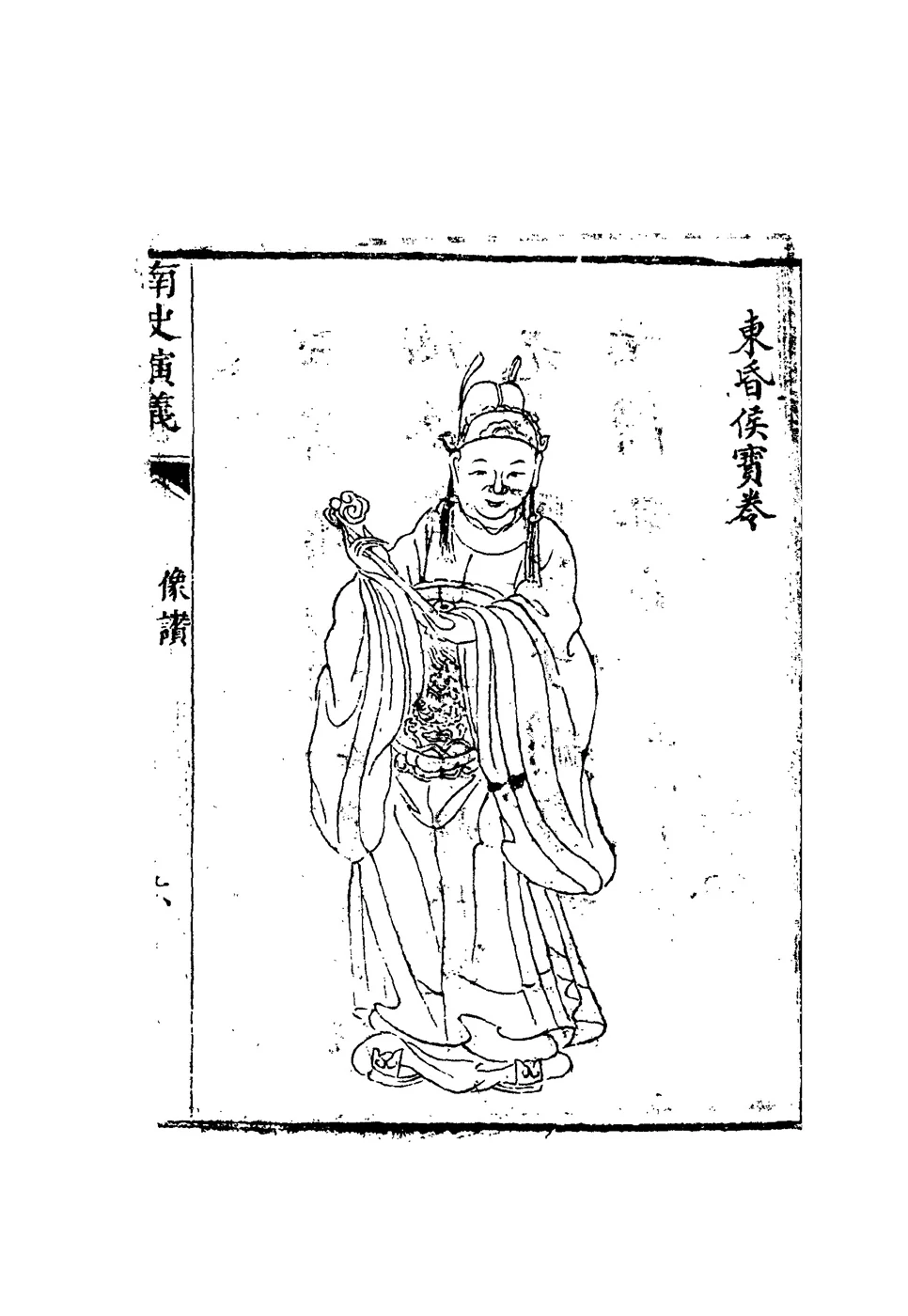
Xiao Baojuan
萧宝卷
Xiao Baojuan (483–December 31, 501), courtesy name Zhicang and originally named Minglan (one account gives Mingxian), was a native of Lanling County, South Lanling Commandery, in present-day Changzhou, Jiangsu. He was the sixth emperor of Southern Qi during the Northern and Southern Dynasties. He was the second son of Emperor Ming of Qi, Xiao Luan, and his mother was Liu Huiduan, posthumously honored as Empress Jing. In 494,…
483 CE–501 CESouthern Qi
PROFILE
Xiao Baojuan (483–December 31, 501), courtesy name Zhicang and originally named Minglan (one account gives Mingxian), was a native of Lanling County, South Lanling Commandery, in present-day Changzhou, Jiangsu. He was the sixth emperor of Southern Qi during the Northern and Southern Dynasties. He was the second son of Emperor Ming of Qi, Xiao Luan, and his mother was Liu Huiduan, posthumously honored as Empress Jing. In 494, the first year of the Jianwu era, he was made crown prince. He ascended the throne in 498, the first year of the Yongtai era, and adopted the era name Yongyuan. During his reign he killed ministers entrusted with the succession, suppressed the rebellions of Xiao Yaoguang, Chen Xianda, and Cui Huijing, and later poisoned the Vice Director of the Department of State Affairs, Xiao Yi, provoking Xiao Yan to rise in arms. In 501, the third year of Yongyuan, a mutiny led by the defending generals Wang Zhenguo and Zhang Ji killed him at the age of nineteen. After his death he was first reduced to Prince of Fuling and later, following the precedent of the Marquis of Haihun under Han, was further demoted to Marquis of Donghun.
- Other name
- Marquis of Donghun
- Courtesy name
- Zhicang
- Period
- Southern Qi
- Dynasty/Regime
- Southern Qi
- Identity
- Emperor
- Ethnicity
- Not recorded in historical sources
- Native place
- Lanling County, South Lanling Commandery (present-day Changzhou, Jiangsu)
- Date of birth
- 483
- Place of birth
- Not recorded in historical sources
- Date of death
- December 31, 501
- Reign
- 498–501
- Predecessor
- Emperor Ming of Southern Qi (Xiao Luan)
- Successor
- Emperor He of Southern Qi (Xiao Baorong)
- Posthumous name
- Not recorded in historical sources
- Main significance
- Son of Emperor Ming of Qi, remembered for violent and extravagant rule; killed after Xiao Yan's forces entered Jiankang.
LIFE TIMELINE
Age eleven | Made crown prince
Age sixteen | Emperor Ming of Qi, Xiao Luan, died; Xiao Baojuan succeeded and changed the era name to Yongyuan
Age seventeen | Made Lady Pan a Noble Consort; killed the regency ministers Jiang Shi, Jiang Si, Xiao Tanzhi, Liu Xuan, and Xu Xiaosi; Xiao Yaoguang rebelled and was killed after defeat; Grand Commandant Chen Xianda rose at Xunyang
Age eighteen | Cui Huijing rebelled and besieged Jiankang but was defeated and killed; Xiao Baojuan poisoned Vice Director Xiao Yi; Xiao Yan rose at Xiangyang
Age nineteen | Xiao Yan's army reached Jiankang; Xiao Baojuan was killed by Wang Zhenguo and Zhang Ji and was posthumously reduced to Marquis of Donghun
BIOGRAPHY
Biography
Family Background and Early Life
Xiao Baojuan was the second son of Emperor Ming of Qi, Xiao Luan. His mother was Liu Huiduan, originally a concubine of Xiao Luan and titled Princess Consort of Shi'an; after Xiao Luan became emperor, she was posthumously honored as Empress Jing. Xiao Baojuan had a stammer from childhood, disliked study, and spent his days at play. He often dug holes with palace guards in the Eastern Palace to catch mice through the night, while Xiao Luan did not restrain him. The Comprehensive Mirror in Aid of Governance describes him as “disliking study and indulging only in excessive play.”
Xiao Luan's eldest son Xiao Baoyi was born of a concubine and had a physical disability, making him an unsuitable successor. Thus in 494, the first year of Jianwu, Xiao Baojuan was established as crown prince. Xiao Luan had seized the throne through intrigue and, after becoming emperor, killed many descendants of Emperor Gao and Emperor Wu of Qi in order to secure his own position. Before his death, Xiao Luan warned Xiao Baojuan that “one must not act after others have already acted,” urging him to kill decisively rather than repeat the fate of the deposed Yulin Prince Xiao Zhaoye, who had hesitated and was overthrown and killed. Xiao Baojuan remembered this advice.
Accession and Killing of the Regency Ministers
On the jiyou day of the seventh lunar month of the first year of Yongtai, September 1, 498, Emperor Ming of Qi, Xiao Luan, died. Xiao Baojuan succeeded and changed the era name to Yongyuan. At the beginning of his reign, he issued orders reducing taxes and seeking out the poor and wronged, but his governing style soon became clear. Introverted and taciturn, he disliked contact with ministers and frequently left the palace to wander. Whenever he traveled, houses were demolished and residents driven away. After a palace fire, he built three luxurious halls—Xianhua, Shenxian, and Yushou—and gave lavish rewards to retainers and officials, contributing to severe fiscal strain.
Following his father's admonition, Xiao Baojuan killed senior ministers whenever they displeased him. Soon after accession he executed Jiang Shi, Right Vice Director of the Department of State Affairs, and Jiang Si, Palace Attendant, both ministers entrusted with the succession. The two had planned to depose the ruler they considered unworthy and enthrone Xiao Baojuan's cousin Xiao Yaoguang, Prince of Shi'an; the plot was exposed and they were killed. Fearing for his own life, Xiao Yaoguang then rebelled and was killed after defeat. Xiao Baojuan subsequently killed Right General Xiao Tanzhi, his maternal uncle and Guard General Liu Xuan, Minister over the Masses Xu Xiaosi, and senior officials Cao Hu and Shen Wenji. With these deaths, all the senior ministers left by Emperor Ming had been eliminated.
Xiao Baojuan also believed strongly in spirits and omens and observed many taboos. Before leaving the palace he always had the auspiciousness of the journey divined. In the later part of his reign he became increasingly harsh and readily executed officials, creating widespread fear both at court and throughout the realm.
Rebellions and Xiao Yan's Uprising
Xiao Baojuan's rule provoked a series of rebellions. In 499, General Pei Shuye surrendered the strategic stronghold of Shouyang to Northern Wei. In the eleventh lunar month of the same year, Grand Commandant Chen Xianda rose at Xunyang, present-day Jiujiang in Jiangxi, and advanced toward Caishi on the eastern bank of the Yangtze near present-day Ma'anshan, Anhui; he was defeated and killed. In the third lunar month of 500, General Who Pacifies the West Cui Huijing rebelled and joined Xiao Baojuan's younger brother Xiao Baoxuan, Prince of Jiangxia, in besieging Jiankang. Cui proclaimed that Xiao Baojuan was to be reduced to Prince of Wu and sought to enthrone Xiao Baoxuan. Xiao Baojuan sent Vice Director of the Department of State Affairs Xiao Yi to suppress the rebellion. Cui was defeated and killed, and Xiao Baoxuan was also executed.
After crushing these rebellions, Xiao Baojuan became even more violent rather than moderating his conduct. He poisoned Xiao Yi, the official who had played the leading role in suppressing Cui Huijing. This directly caused Xiao Yi's younger brother Xiao Yan, governor of Yongzhou, to rise in arms against Jiankang. Xiao Yan cooperated with Xiao Yingzhou, acting head of the Jingzhou administration, and in the third lunar month of 501 supported Xiao Baorong, Prince of Nankang, as emperor at Jiangling—later Emperor He of Qi—while declaring Xiao Baojuan reduced to commoner status. Xiao Yan's army then moved east along the Yangtze toward Jiankang.
Fall of Jiankang and Death
Even as Xiao Yan's army approached the capital, Xiao Baojuan remained absorbed in amusement. He spent his days staging mock military formations with attendants and palace personnel in front of Huaguang Hall and paid little attention to the fighting outside the walls. When he heard battle drums beyond the city, he put on a bright red robe and climbed onto the roof of Jingyang Tower to watch; a stray arrow nearly struck him in the legs. His favorite courtier Ru Fazhen knelt and begged him to reward the soldiers, but Xiao refused, saying: “Are the rebels coming only to seize me? Why do you insist on asking me for rewards?”
On December 31, 501, in the twelfth lunar month of the third year of Yongyuan, acting Commandant of the Guards Zhang Ji and governor of Northern Xuzhou Wang Zhenguo, who were responsible for defending Jiankang, launched a mutiny. That night Xiao Baojuan did not retire until after enjoying music and dancing at Hande Hall. Wang Zhenguo led soldiers into the palace under cover of darkness. Hearing the disturbance, Xiao fled through the northern gate. The eunuch Huang Taiping slashed his knee with a blade, causing him to fall; Xiao shouted, “Are you slaves rebelling?” Another eunuch, Zhang Qi, then cut off his head with a single stroke. The mutineers sent Secretariat Drafter Pei Changmu to deliver Xiao Baojuan's head to Xiao Yan.
After taking power, Xiao Yan executed forty-one of Xiao Baojuan's favored retainers and induced Empress Dowager Xuande, Wang Baoming, to strip Xiao of the imperial title. He was first reduced to Prince of Fuling and later, following the Han precedent of the Marquis of Haihun, further demoted to Marquis of Donghun, though his tomb was constructed at imperial scale.
Xiao Baojuan was the second son of Emperor Ming of Qi, his mother dying early and leaving him to be raised by the Consort Pan. Stammering from childhood and no lover of books, he spent his days in play, digging holes for rats in the Eastern Palace with the guards until dawn, and his father did not much restrain him. On Emperor Ming's death he took the throne as the Marquis of Donghun.
In his reign he killed ministers and gave himself to pleasure, even joining in killings in the streets, until court and people alike fell away from him. In 499 he killed the director of the Secretariat, Xiao Yi, whereupon Xiao Yi's brother, the governor of Yongzhou Xiao Yan, rose at Xiangyang. In 501 Jiankang was taken and Xiao Baojuan was killed at nineteen; the state passed to Xiao Yan, who founded the Liang.
Later judgments of him center on cruelty and license, his conduct recorded in some detail in the Book of Southern Qi and the Comprehensive Mirror and important material for the court politics and palace life of the late Southern Dynasties.
The edicts and conduct of his three-year reign are recorded in Southern Dynasties sources chiefly in negative terms.
The palace life and amusements of his reign are recorded fairly concretely in the Book of Southern Qi, providing material for the study of late Southern Dynasties court culture and forming the chief later impression of him.
The manner of his killing is directly linked to the end of the Southern Qi.
His killing and the fall of the Southern Qi followed one upon the other.
In 500 the governor of Yongzhou, Xiao Yan, rose in rebellion at Xiangyang, and the next year set up Xiao Baorong as emperor at Jiangling and marched downriver on Jiankang. When Xiao Yan's troops were already at the walls, Xiao Baojuan still amused himself drilling guards and attendants in military formation before the Huaguang hall, careless of the army outside; hearing the drums, he put on a great red robe and climbed to the roof of the Jingyang tower to watch, and a stray arrow nearly wounded his leg. His favorite Rong Fanzhen knelt and begged him to reward the soldiers, and he refused, asking whether the rebels meant to seize him alone. On the night Xiao Yan's men entered Jiankang with defecting Qi generals, Xiao Baojuan was still singing in the Hande hall; before he slept, the garrison commander Wang Zhenguo and his fellows entered the palace by night, and as he fled by the north gate an eunuch struck his knee, bringing him down, and he was killed. The plot was directed by Zhang Ji and Wang Zhenguo, who held the defense of Jiankang, and they sent his head to Xiao Yan. Xiao Yan then had the empress dowager of Xuande strip him of his imperial title, first reducing him to prince of Fuling and then, following the precedent of the Han prince of Changyi, to marquis of Donghun; his tomb was nonetheless built to imperial scale.
Xiao Baojuan reigned barely three years, and his conduct was notably vicious even among the sovereigns of the Southern Dynasties: he neglected government, suspected his ministers, and put to death a series of regents and imperial kinsmen until civil officials withdrew and generals revolted. Addicted to palace games and to the market life of the streets, he brought butchery and wine-selling into the palace grounds, and when he rode out he drove the people off and pulled down their houses, so that trade stopped and the roads emptied. His fall was the work of his own character and rule, and equally of the clan feuds and unstable imperial authority of the later Qi.
Major Activities
A Palace Market and “Lotuses at Every Step”
Xiao Baojuan was notorious for bizarre entertainments. He once established a marketplace inside the palace grounds, where eunuchs slaughtered pigs and sheep and palace women sold wine and meat. Noble Consort Pan acted as market magistrate while Xiao served as her deputy, with disputes submitted to her for judgment. A popular rhyme circulated: “At the Hall for Reviewing the Troops, willows are planted; the Sovereign butchers meat, while Consort Pan sells wine.”
Xiao was deeply infatuated with Noble Consort Pan. Her personal name was Yu Nizi, also known as Pan Yunu, and her father was a petty market trader. To please her, Xiao ordered craftsmen to cut gold into lotus shapes and set them into the floor so that she could walk barefoot across them, producing the celebrated image of “lotuses springing up at every step.” After a daughter born to Pan died in infancy, Xiao wore full mourning garb with staff, refrained from music for many days, dressed entirely in coarse cloth, and built the Shenxian, Yongshou, and Yushou palaces for her with extreme extravagance.
Killing Imperial Clansmen and Ministers
After accession, Xiao Baojuan was deeply suspicious of his uncles, cousins, and other members of the imperial clan. He killed Xiao Qiang, Prince of Poyang, and other descendants of Emperors Gao and Wu of Qi. He was equally ready to kill senior ministers. The regency officials Jiang Shi, Jiang Si, Xiao Tanzhi, Liu Xuan, and Xu Xiaosi were all executed. Cao Hu, an army official whose household possessed considerable wealth, was also killed and his property confiscated.
Harassment of the Population During Excursions
Xiao Baojuan left the palace more than twenty days in some months, sometimes by day and sometimes at night. Wherever he went, he would enter wealthy households and seize their possessions until “nothing was left.” He did not wish to be seen, and anyone who encountered him could be killed on the spot. Local officials therefore remained constantly alert; whenever he went out, they ran ahead shouting and drove the population away so that the roads were empty and shops and houses deserted. For a time, “merchants and artisans all abandoned their occupations.”
Rare Moments of Personal Feeling
Although remembered chiefly for violence, Xiao Baojuan was also recorded as displaying genuine emotion on a few occasions. After his cousin Xiao Yaoguang was defeated and killed, Xiao climbed the old palace earthwork and looked toward the Eastern Residence, crying sorrowfully, “Brother An!” before breaking into sobs, while those around him could not bear to watch. When Xiao received a list of people who had joined Xiao Baoxuan and Cui Huijing, he said, “If even the Prince of Jiangxia acted like this, how can anyone else be blamed?” and ordered the list burned. His younger brother Xiao Baoyin had been seized by rebels and forced to serve as their figurehead; after the rebellion failed, Xiao Baoyin surrendered himself, but Xiao Baojuan did not punish him.
Personal Relations
- Father: Emperor Ming of Qi, Xiao Luan
- Mother: Empress Jing Liu Huiduan, posthumously honored
- Elder brother: Xiao Baoyi, Prince Yin of Baling, born of a concubine
- Younger brothers: Xiao Baoxuan, Prince of Jiangxia; Xiao Baoyuan, Prince of Luling; Xiao Baoyin, Prince of Poyang; Xiao Baorong, Emperor He of Qi; Xiao Baoyou, Prince of Shaoling; Xiao Baosong, Prince of Jinxi; Xiao Baozhen, Prince of Guiyang
- Empress: Chu Lingqu
- Noble Consort: Pan Yunu, also called Pan Yu'er
- Shuyi: Lady Huang, mother of Crown Prince Xiao Song
- Consort Yu: later remarried Wang Mao
- Wu Jinghui: later remarried Xiao Yan and gave birth to Xiao Zong
- Children: Crown Prince Xiao Song; Xiao Zong, Xiao Yan's second son, who believed himself to be Xiao Baojuan's posthumous son; and a princess born to Noble Consort Pan who died young
- Xiao Yaoguang: Xiao Baojuan lived with this cousin in childhood and was close to him, calling him “Brother An”
- Regency ministers: Jiang Shi, Jiang Si, Xiao Tanzhi, Liu Xuan, and Xu Xiaosi, all killed
- Favorite courtiers: Ru Fazhen, Mei Chong'er, Xu Shibiao
- Generals who suppressed rebellions: Xiao Yi, later poisoned; Wang Zhenguo and Zhang Ji, who mutinied and killed Xiao Baojuan
- Xiao Yan: Xiao Baojuan poisoned Xiao Yan's elder brother Xiao Yi; Xiao Yan rose in rebellion and ultimately entered Jiankang
- Chen Xianda: rebelled in 499 and was defeated and killed
- Cui Huijing: rebelled and besieged Jiankang in 500, then was defeated and killed
Historical Assessment
Southern Dynasties / Contemporary Views
Xiao Zixian wrote in the Book of Southern Qi: “The Marquis of Donghun let vice overflow unchecked. The Way returned through the suppression of disorder; he himself met the blade, and thus opened the way to peace. Even the names of his eunuchs seemed to carry Heaven's intent.” He also wrote: “Donghun scorned the Way, matching Jie and Xin. He destroyed the norms and abandoned human relations, delighted in soldiers and fire, and in the end burned himself by them.”
Empress Dowager Xuande, Wang Baoming, condemned Xiao Baojuan in an edict: “He dissipated the state's reserves and devoted himself solely to empty ornament; he forcibly seized the people's wealth, from those nearby to those far away. The common people were terrified and fled along the roads... Even exhausting all the bamboo of Chu and Yue would not suffice to record his crimes; compared with the rulers Jie and Zhou, how could he be their inferior?”
Tang Period
Li Yanshou wrote in the History of the Southern Dynasties: “Donghun bore the name 'Juan' and ended with 'Cang'; the omen had already appeared in advance, perhaps as Heaven had ordained.”
Song and Yuan Periods
Zhou Tan wrote in “Marquis Donghun of Qi,” from Gates of the Six Dynasties: “Who framed the plan to support the mouse-catching child? He feared not Xiao Yan but feared Consort Pan. When the long siege closed and the blade reached his neck, he still begrudged his gold beneath the setting sun.”
Su Shi wrote of Pan Yunu: “Yunu ultimately did not betray Donghun.”
Modern Period
Cai Dongfan wrote: “Xiao Baojuan was without the Way, and his evils are too numerous to record. Yet to place the blame solely on Noble Consort Pan is wrong; no single woman can by herself destroy a state. Still, once a ruler's intelligence is bewitched and confused, disorder inevitably follows.”
FIGURES ASSOCIATED WITH THIS DYNASTY
Bibliography
- Book of Southern Qi, vol. 7, “Basic Annals 7: Marquis of Donghun”
- History of the Southern Dynasties, vol. 5, “Qi Basic Annals, Part Two”
- Comprehensive Mirror in Aid of Governance, “Qi Annals”